





























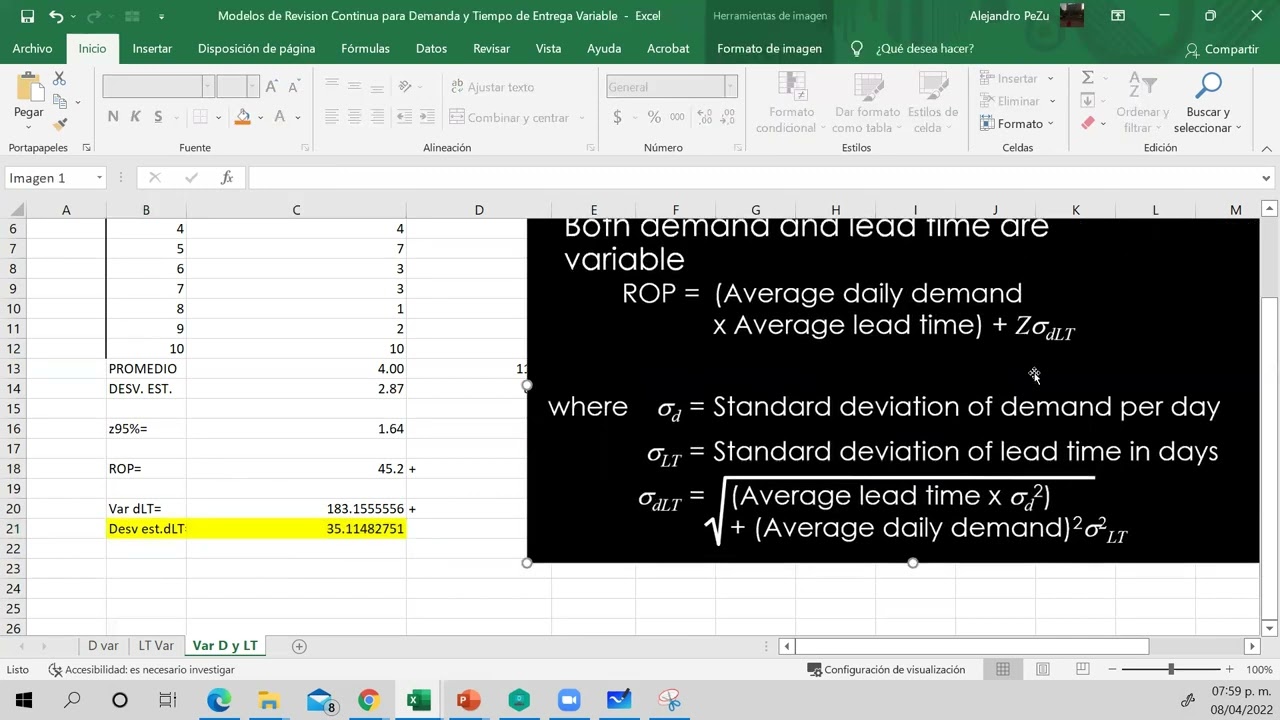
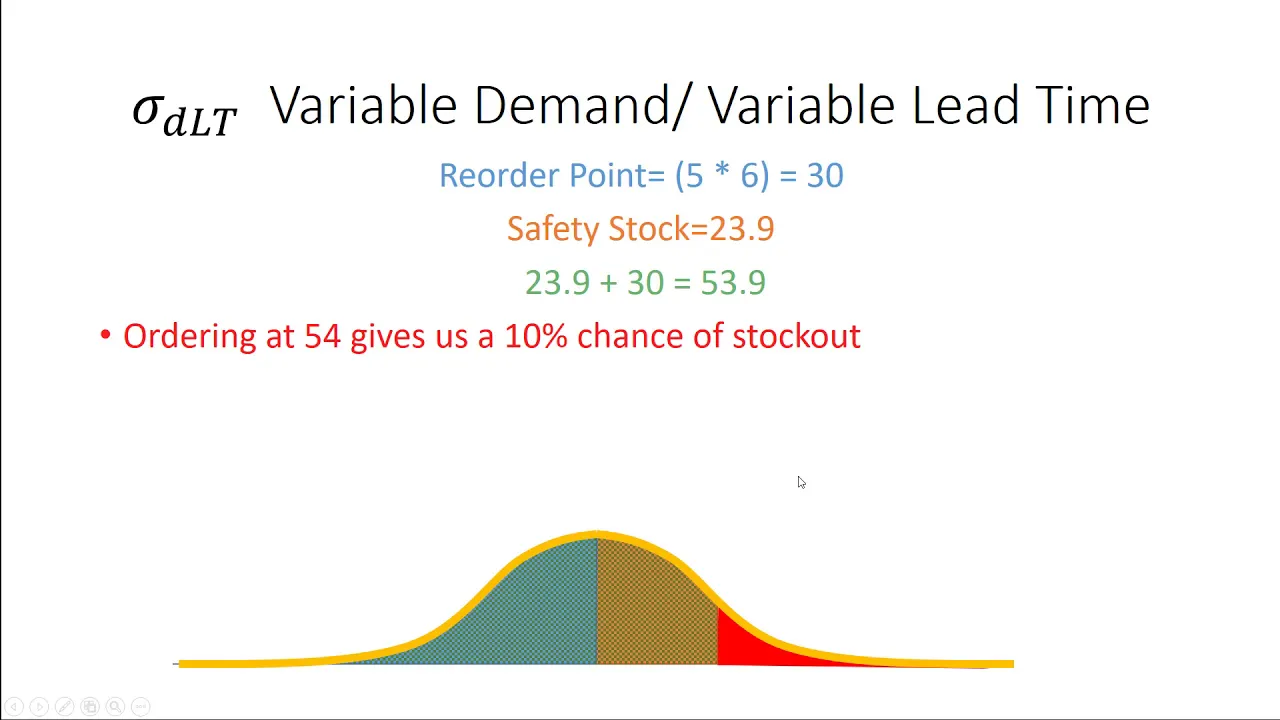




Safety stock is a buffer inventory held to protect against supply chain delays, calculated using the formula: Safety Stock = (Maximum Daily Use × Maximum Lead Time) - (Average Daily Use × Average Lead Time); Reorder Points are calculated as: Reorder Point = (Average Daily Use × Average Lead Time) + Safety Stock, ensuring businesses can place orders before stockouts occur even during extended lead times.
Safety Stock and Reorder Point Calculation in Inventory Management
Added:Basic inventory concepts, including holding costs, ordering costs, and the primary purpose of maintaining stock.
Understanding of 'lead time'—the duration of time between initiating a replenishment order and receiving the goods.
Foundational statistics, specifically how to calculate averages (mean) and a basic understanding of demand variability.
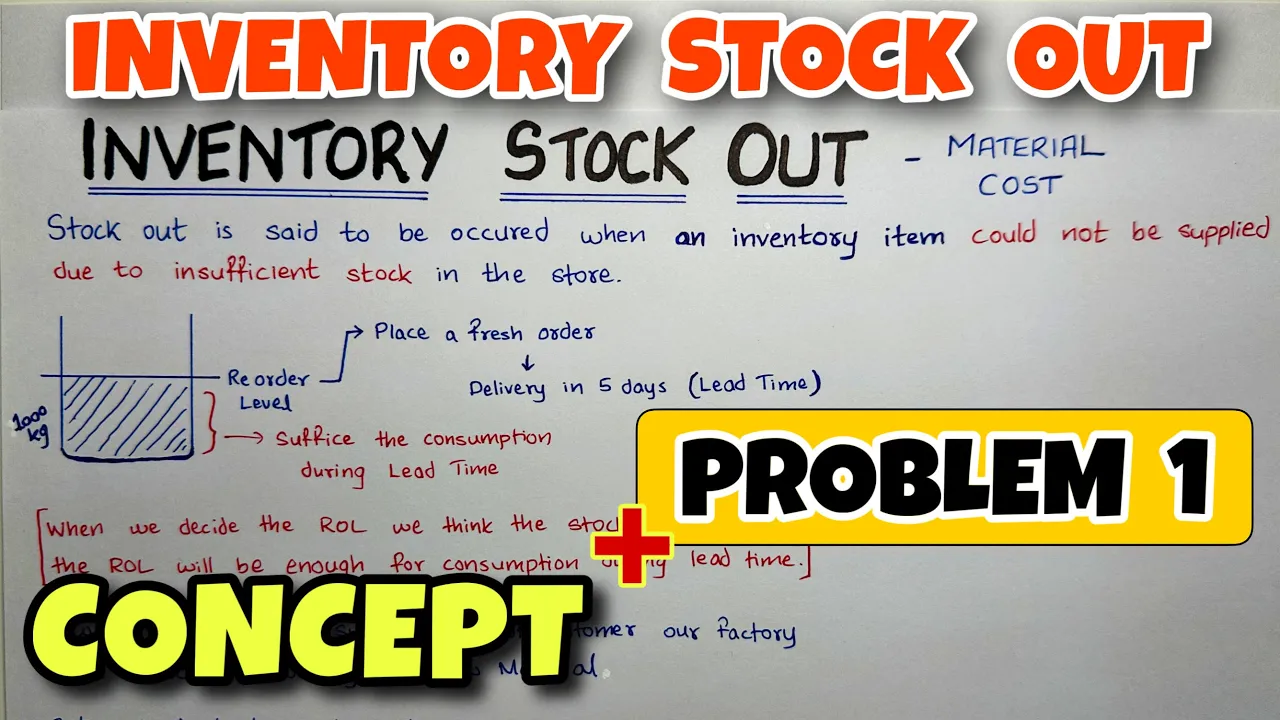
The concept and business consequences of a 'stockout' (running out of inventory during periods of active demand).
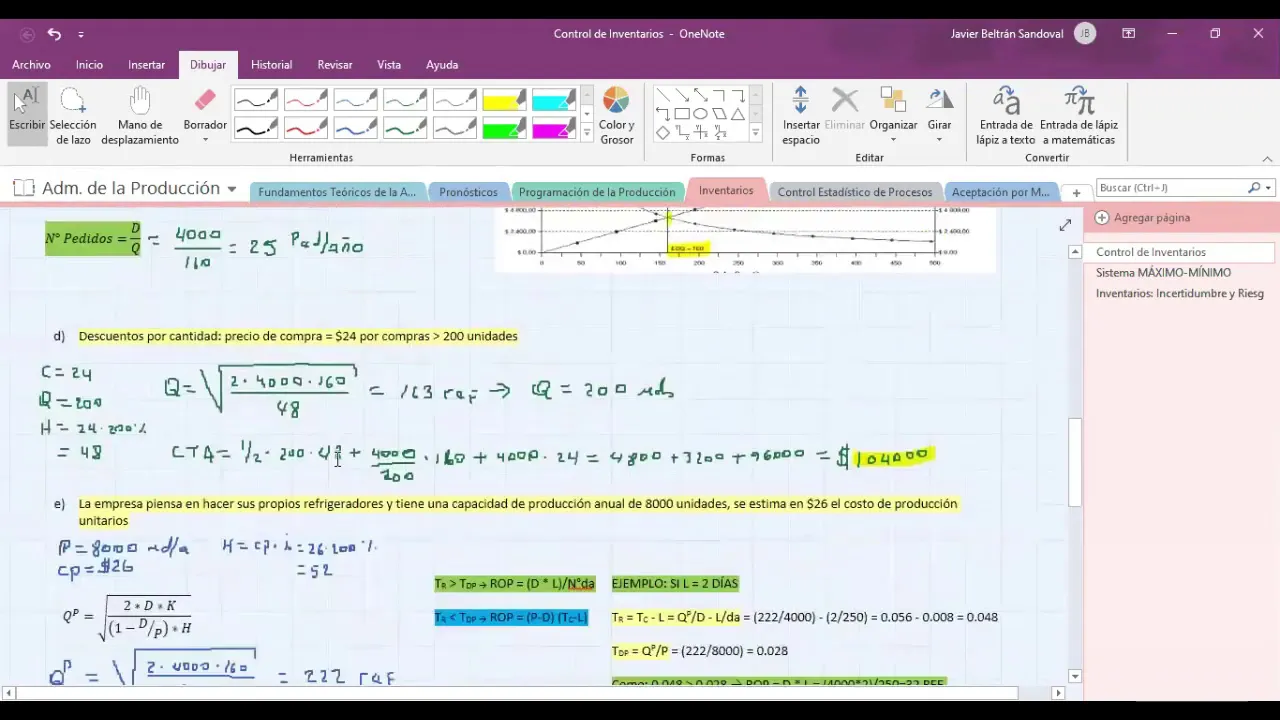
Economic Order Quantity (EOQ) to calculate the most cost-effective volume of inventory to order.
Advanced safety stock calculations incorporating service levels (Z-scores) to manage demand uncertainty statistically.
Comparing Continuous Review Systems (Q-systems) and Periodic Review Systems (P-systems) for inventory monitoring.
How to model replenishment formulas when both demand and lead time are highly variable.
Applying inventory control models within Material Requirements Planning (MRP) and Enterprise Resource Planning (ERP) software.
14.5K views0likes9:08Original Release: 2022-06-09
Calculating safety stock is relatively straightforward, and I’m going to show you how to do it in this video.
All you need is some basic data on how much of a given product you sell, or use up, in a day – plus how long that stock takes to get to you once you order more.
If you have that information you can plug it into a basic formula and that will spit out a recommended safety stock number for any product in your business.
And the same goes for reorder points.
But before we do that I want explain why we set safety stock -- when it’s a good idea, when it can be a bad idea. And clear up some definitions so you can feel really confident using these basic inventory management principles in your business.
Safety Stock is stock that you hold as a buffer. The purpose of safety stock is simply to protect your business from delays in your supply chain. In a perfect world, you would never eat into it – it's there to cover you when the unexpected happens, and the stock you’ve ordered doesn’t turn up on time.
By the way, when we talk about not using your safety stock – we don’t mean you should have the same items sitting on your shelves forever.
They'd get dusty, go past their use by date, and go to waste.
In reality, you’ll want to sell your oldest items first so that you do actually cycle through your safety stock and use it up. It’s just that ‘on paper’ there’ll be slightly more stock in your inventory than what you need in a given period – and that's your safety stock.
If you have an eCommerce sales channel, safety stock is what protects you from unexpected stock outs on popular items. That’s particularly important in eCommerce, because in the digital world customers are after instant gratification. If you don’t have what they want right now, they’ll go to a competitor – or if they order from you and it turns up super late, that will kill your brand loyalty For different reasons safety stock is also important for manufacturers.
You simply can’t run a factory – or even work with a contract manufacturer - if you’re constantly stopping production because you ran out that one type of screw halfway through.
So you need safety stock and that’s true for what we might call “Min-Max” production – think of a coca cola plant, where you’ve got bottles whizzing by, and your job is just to reorder ingredients when you hit those minimum levels so that that line keeps running.
And it’s also true for what you call Just In Time manufacturing. That’s when you only order the parts you need when you, yourself, make a sale. That’s a great to keep your inventory costs down – and a smart approach to Just in Time production is to hold just enough stock that you can commence production right away, and have enough parts to see you through until the rest arrives.
So that’s your safety stock – the amount of each product that you don’t actually want to use, but you have on hand just in case. And then you have reorder points, which tell you when to order more.
They’re closely related – and together they help your business run smoothly.
Let’s look at an example. Say you have a particular kind of screw that you use to assemble furniture.
Your safety stock number for that screw might be 200, your reorder point might be 800 and let’s say you have 1000 left in your warehouse.
As you use up screws making tables and chairs the number remaining drops until it hits your reorder point – which is when you send a purchase order to your supplier for some more.
As they’re picking, packing and shipping your order – maybe even making it – you’re still using up screws. But luckily the new stock arrives before you run out because Instead of relying on guesswork, you’ve used the proper reorder point formula to work out when to make that purchase – and because you’ve factored in some safety stock, to cover for any delays Of course just because safety stock is important, that doesn’t mean you should hold vast quantities for each of your stock items. That would be hugely wasteful – it would take up much more warehouse space, choke off your cashflow, and see you buying items that you might not be able to sell.
On the other hand of course we’ve seen how important it is to keep your supply chain running smoothly, and customers happy So really the key word here is tension. In a product business you’re always navigating that tension between the costs of holding too much stock, against the risks of running out.
And that’s why we go to the trouble of calculating things like safety stock, and reorder points – rather than just guessing them - so we can find that sweet spot in between.
So we’re almost ready to run through the formulas – but before we do that, let’s quickly get some context. Why is everyone about talking about safety stock suddenly?
Well, at the time of filming this – roughly half past 2022 – the world has pretty much experienced two full years of supply chain madness.
Before 2020 product businesses had become pretty darned efficient. Supply chains more or less hummed along, which meant businesses were able to keep their costs super low by holding smaller quantities of stock – or none at all in the case of drop-shippers.
And they were able to do this by putting their trust in the smooth running of the world’s supply chains. Things like ships sailing on time, factories making products when they said they would, and raw materials being available.
But then we had a global pandemic. Ports and factories went quiet – while consumers doubled down on internet shopping from home. A ship blocked the Suez canal, Britain kicked out half of its lorry drivers during Brexit, and much of the world swore off Russian oil.
All of this has made it harder to do business, with goods not only costing more but turning up later than expected.
And that’s where Safety Stock helps.
As you’ll see, the safety stock formula does account for variability in lead times.
But – and it’s a big but – it's only as good as your data.
If your lead times – the amount of time it takes orders to arrive from your suppliers – if they’re blowing out, getting much more volatile – then you’ll need to build some resilience into your supply chain by recalculating and updating those safety stock figures – and by extension your reorder points too.
So here we are, ready to calculate our safety stock and reorder point figures.
All we need is some fresh data on each stock item.
We’ll use the example of screws used in a furniture factory – but you use the same process if you're dealing with completed products that you sell in a store.
So, we need to know our Maximum daily use as well as our Average daily use of that item Plus our Maximum lead time in days, as well as our Average lead time for that item And then we just plug those numbers into the formula. I like to use a calculator – this is a free one that we made at Unleashed So with those screws we want to order – let’s say the most we’ve ever used in the factory is 100 in one day. And on average we go through 90 And let’s say once we order them, on average they take 5 days to arrive – but lately they’ve taken as long as 15 to turn up.
We just put those numbers into the formula – which is maximum daily use, times maximum lead time – minus average daily use times average lead time And that gives us our safety stock figure - which in this case is 1,050 screws.
Now we take that Safety Stock number to our Reorder point formula. Again, there’s a calculator on that same page we were using, and we take the same data and calculate it slightly differently.
This time we take our average daily use of 90 screws per day Multiply it by that average lead time of 5 days – remember, that’s how long it takes for those screws to arrive and be ready to use, from when we first place the order And then we add our safety stock figure of 1,050 screws, Which gets us a reorder point of 1,500 So there we have it – we now know that, even if our order takes the longest it’s ever taken to arrive – we shouldn't run out if we place our order when there’s only 1,500 left in the warehouse.
Now, obviously, keeping on top of your reordering becomes very time intensive the more product lines you sell – or make.
At a certain scale, using something like Excel or Google Sheets simply doesn’t cut.
So if you’re at the point where you’re managing multiple SKUs, multiple suppliers, and spending hours stressing over your reordering, then I encourage you to check out something like Unleashed. It’s a super smart cloud software package that keeps track of all your product items, all their min and max levels and sends off digital purchase orders in seconds – so if you’d like to learn more, there are a whole host of webinars you can watch here.
Otherwise, I hope you found all of that useful and informative, and we’ll see you in the next video.
Up Next

8:56
Amazon FBA vs Shopify: Which Ecommerce Model Yields Better Returns?
@MoneyTalksMediaCo
102 views•2025-10-28

46:36
Retention Habits of Top DTC Ecommerce Brands Revealed
@SendItPodcast
44K views•2026-03-03

15:23
Decoy Effect: How Pricing Psychology Influences Consumer Spending
@bobinvestsUS
90K views•2026-01-05

17:30
The Planned Obsolescence of Light Bulbs and Tech
@veritasium
25.3M views•2021-03-26
Related Study Plans & Knowledge Roadmaps
Structured learning paths in Business
business
Pop-Up Retail: Strategy, Design & Execution
01Introduction to Pop-Up Retail & Strategic Goal Setting
02Budgeting, Site Selection, and Legal Essentials
03Experiential Retail Design & Visual Merchandising
+ 2 more learning modules
15h5 modules
Explore Roadmap
business
Reg CF: Startup Funding, Marketing & Launch
01Introduction to Equity Crowdfunding & Reg CF
02Platform Selection & Legal Preparation
03Crafting High-Converting Campaign Assets
+ 2 more learning modules
14h5 modules
Explore Roadmap
business
Productized Services: Scaling Solo Freelance
01Foundations of Productized Services
02Packaging and Scope Definition
03Pricing and Subscription Models
+ 2 more learning modules
15h5 modules
Explore Roadmap
business
Gov Procurement: Find, Bid & Win Contracts
01Introduction to Government Procurement & Business Setup
02Small Business Certifications & Set-Asides
03Finding and Analyzing Contract Opportunities
+ 2 more learning modules
14h5 modules
Explore Roadmap