




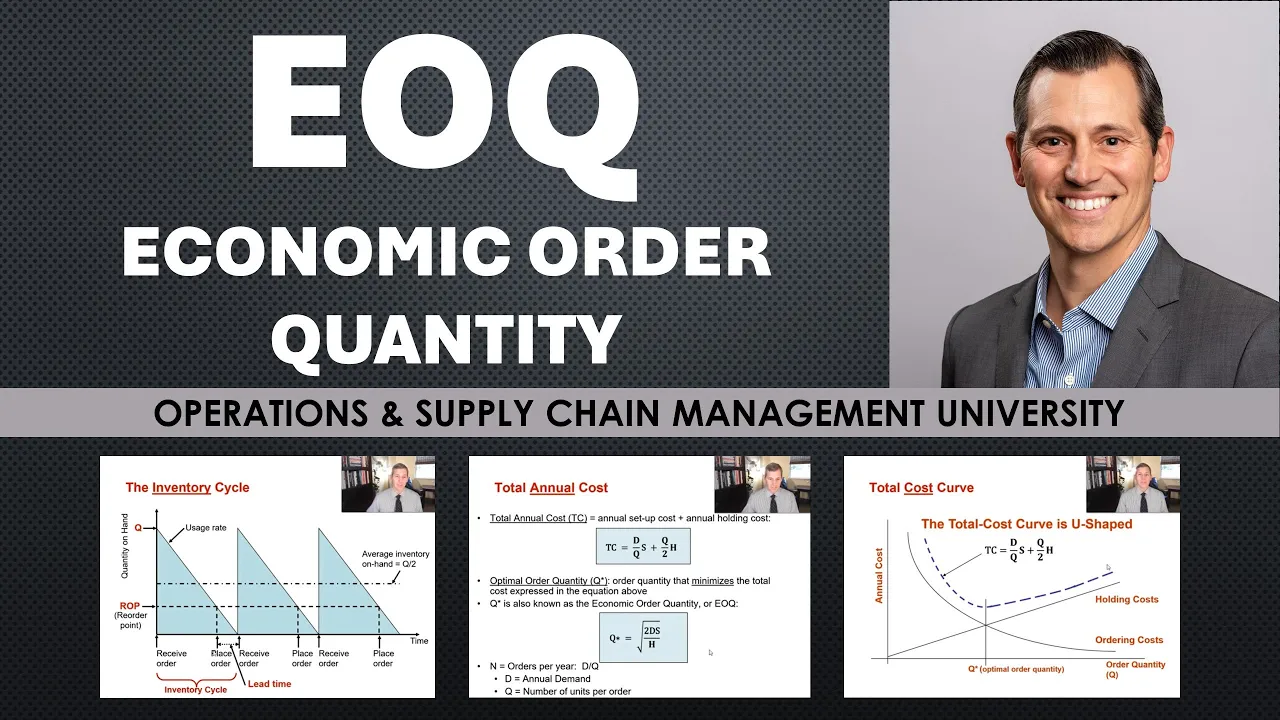








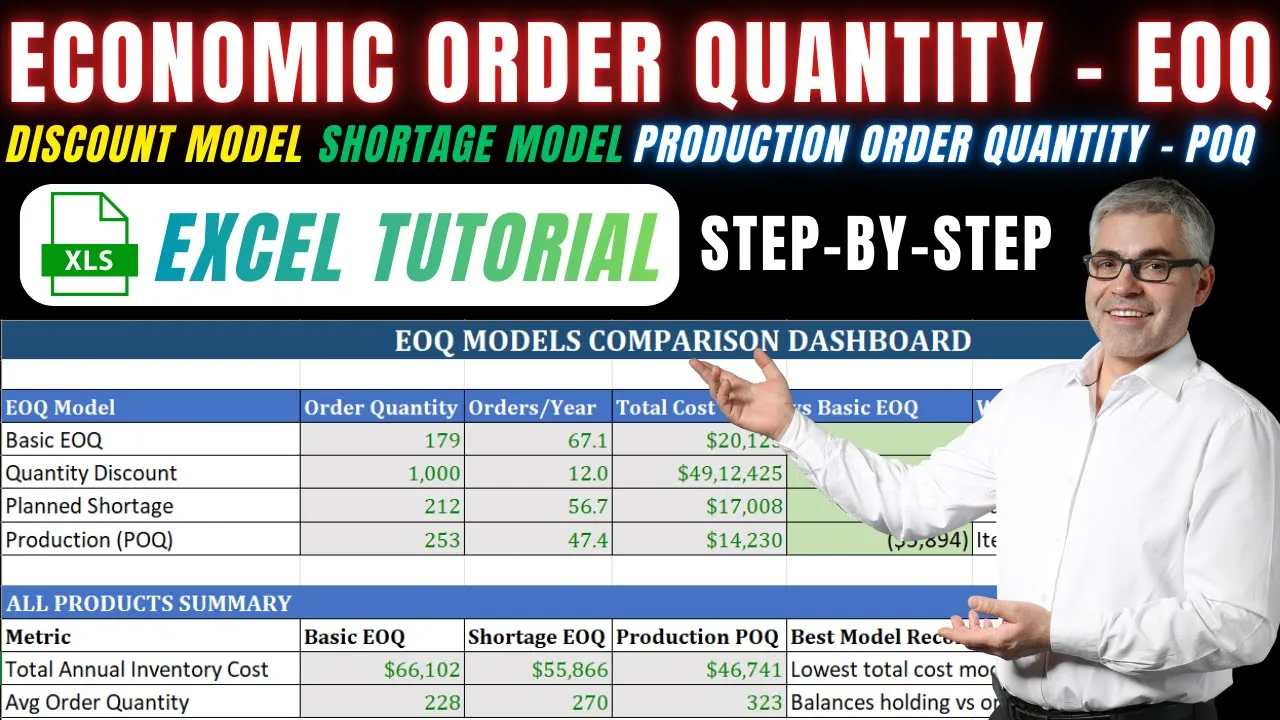


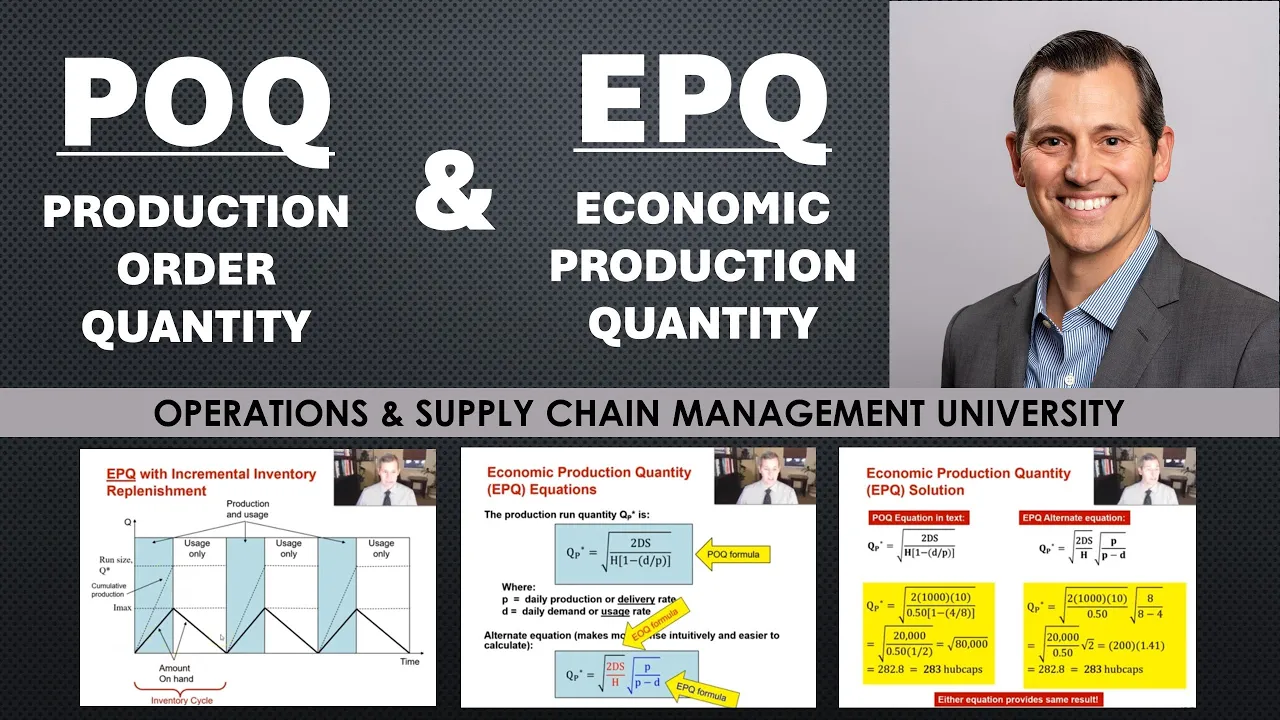



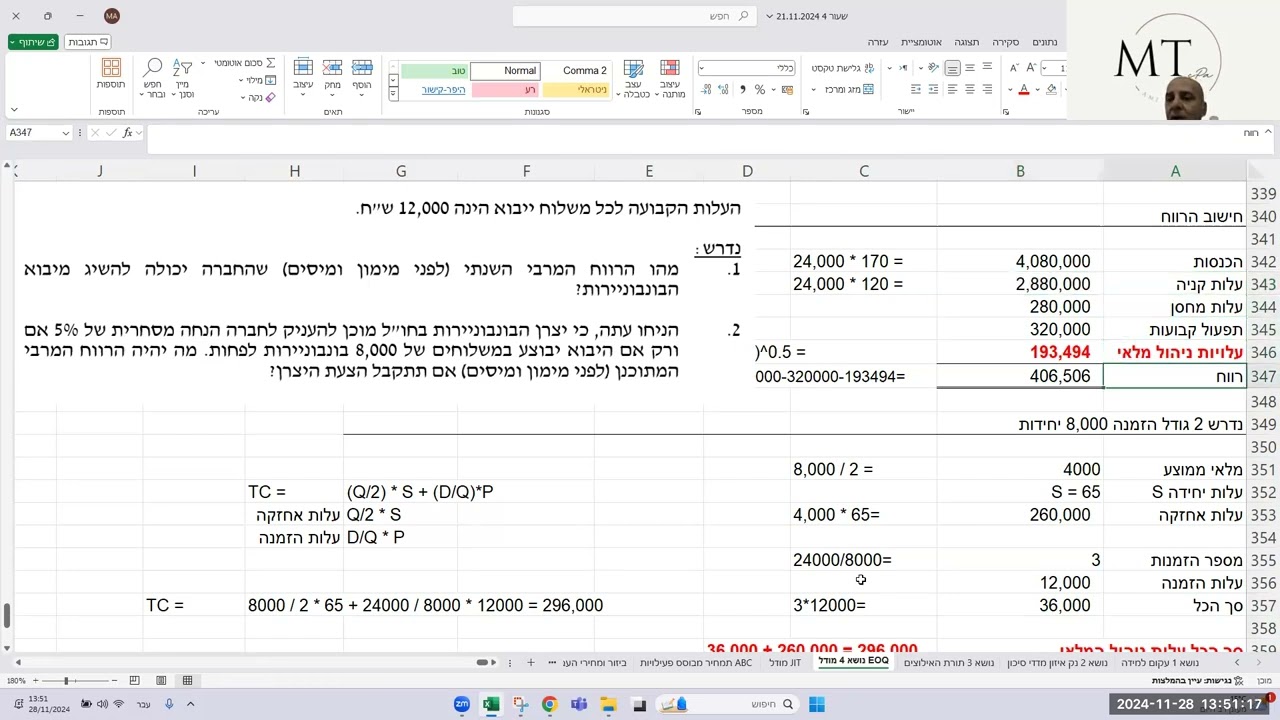



The Economic Order Quantity (EOQ) formula calculates the optimal order size that minimizes total inventory costs by balancing ordering costs (cost to place each order) against carrying costs (cost to store inventory). The formula is Q* = √(2RD/H), where R is the order cost, D is the annual demand, and H is the carrying cost per unit per year. For example, with an order cost of $50, annual demand of 200 units, and carrying cost of $2 per unit per year, the optimal order quantity is 100 units.
EOQ Formula Explained: How to Calculate Economic Order Quantity
Added:Basic inventory management terminology, such as stock levels, lead time, and annual demand.
The fundamental trade-off in supply chain finance between holding (carrying) costs and ordering (setup) costs.
Basic algebraic proficiency, specifically understanding how to manipulate formulas and calculate square roots.
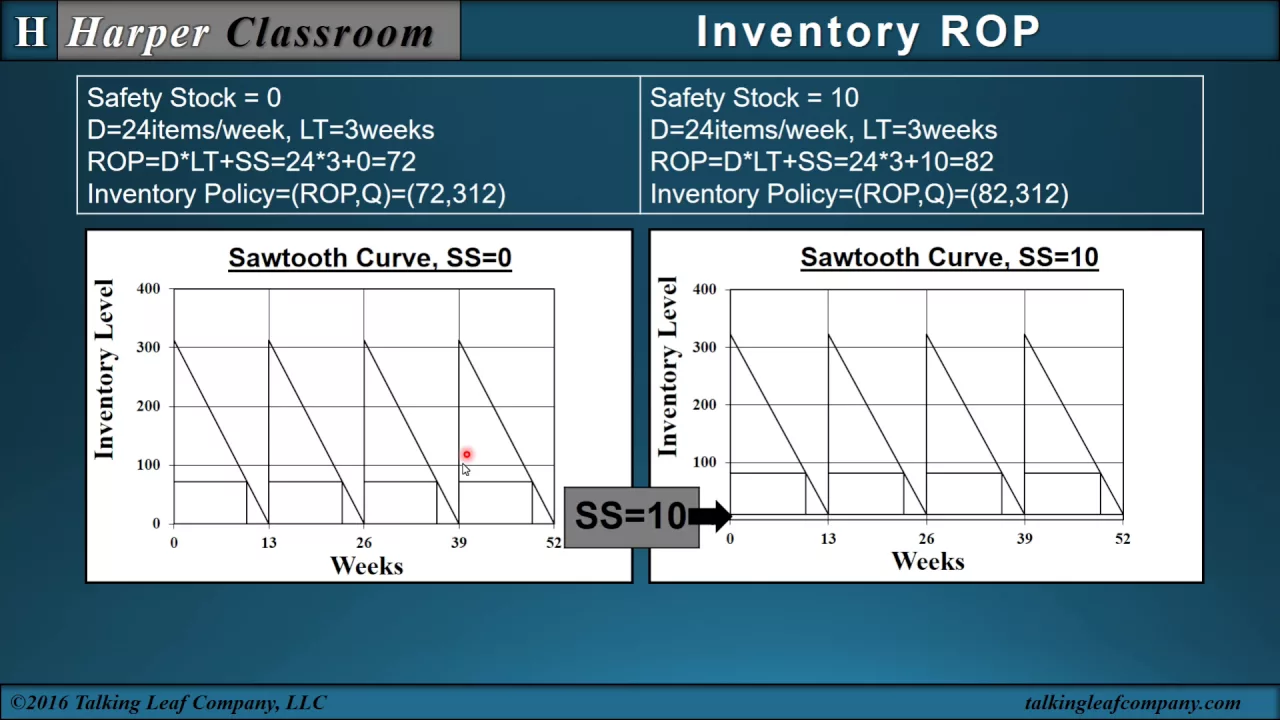
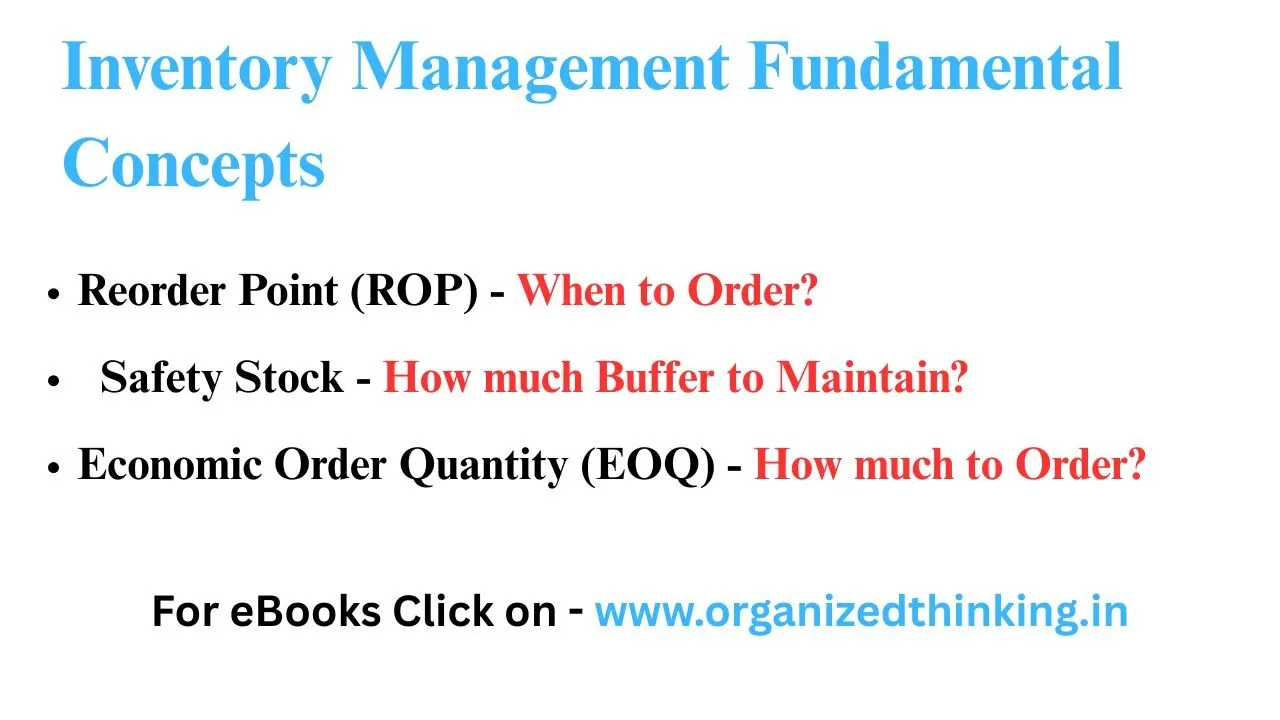
Calculating the Reorder Point (ROP) and Safety Stock to determine exactly when to place a new inventory order.
The Quantity Discount Model, which adjusts the basic EOQ formula to account for bulk-purchase price breaks.
The Economic Production Quantity (EPQ) model, designed for scenarios where inventory is manufactured continuously rather than received in a single batch.
Analyzing the real-world limitations of EOQ assumptions (e.g., constant demand and instant replenishment) and exploring Just-In-Time (JIT) inventory systems.
302.3K views2.5Klikes10:15Original Release: 2013-07-11
In this video, I'm going to talk about EOQ, otherwise known as economic order quantity. So, this sounds a little complex, but what we're really talking about here is when you order inventory, so let's say you you start your own business and and you you need to buy some inventory, you need to know precisely how much inventory you want to buy because you don't want to buy too much or too little.
So, if you buy too little, then you could have a thing called a stockout. A stockout is where the customer shows up, they're ready to buy your product, and it's not on the shelf. You they want it, but it's not there. So, they're going to leave and they're going to be angry. But you also don't want to buy too much. And why is that? Well, you could have something like spoilage. So you if you're talking about something like food, food spoils over time or if you're talking about electronics, it might become obsolete. Uh and you also have to, for example, you have to store these things. So you have storage costs. If you buy a ton of of of inventory, you're going to have to pay possibly to expand your storage capacity. So So there's reasons that that you don't want too little inventory. You you don't want too much. when you make that order, when you pick up the phone and call your supplier and say, "Okay, I need to order some inventory." We we need to figure out a way to figure, well, how how much do we want? So, when we're thinking about this, it's best to remember that the total cost of of inventory and what we're doing here is not just a function of the purchase cost of the inventory.
So, let's say we're talking about hot dogs. The cost of of the inventory, the hot dogs that we have for our hot dog restaurant, is not just how much it costs for a hot dog, but there's also an ordering cost, which is the cost to actually place an order, have someone come out and deliver it on a truck, but then this carrying cost, right? So, the carrying cost, we're talking about the cost to to like store these hot dogs.
Let's say that you buy so many hot dogs that you can't put them all in your freezer. Well, then you have to buy another freezer. Well, so there's a carrying cost associated with with having that inventory.
And so when we think about this cost function and realize that it's not just the purchase cost, but also these other things, this becomes a factor when we're thinking about not buying too little or not buying too much inventory. Because what we want to do is we want to balance these things, right? So if we say, okay, well, there's a cost involved with picking up the phone and ordering hot dogs because the the the the supplier has to drive the truck out here and incur gas and pay a driver. So, they're going to charge us for for shipping or or whatever. So, you might say, "Well, let me just buy a ton of hot dogs."
Well, but but now you have that carrying cost is going to be high. your ordering cost is low because you just have one big order but now you have a higher carrying cost. So what you want to do is you want to balance balance these costs and you need to find the optimal order. So you want to say okay I'm I've looked at both these things and now you want to find optimal order size the perfect order size given these things.
So, the nice thing about all this is is that there's a there's a there's a formula that we can use that will help you balance these things out. So, let's let's go with an example, though.
Let's illustrate this through an example. So, let's say we we you decide you want to start a restaurant, but this time we're not going to do hot dogs. Let's do let's do uh chocolate milk. So, your restaurant, this is going to be a family restaurant.
Okay? So, the kids want chocolate milk.
When the parents come in, their kids, they they don't want to h the kids aren't big wine drinkers. They they decide they want chocolate milk. So, the chocolate milk comes in little cartons.
But what do we have to be careful of?
Well, chocolate milk has an expiration date. You can't set the chocolate milk in there for a year and give it to some kid. Well, I guess you could, but that'd be cruel. So the chocolate milk can spoil. Remember we talked about we've got we've got this spoilage problem.
Plus you have to store this chocolate milk, right? You might need a second refrigerator if you buy so much. And but at the same time, we don't want people getting upset if if we don't have any chocolate milk. So, so let let's go ahead and let's figure out well what what is this formula that I've been talking about here in order to figure out what's the optimal order size of how much chocolate milk should we buy? So, we're trying to figure out optimal order size, right? Optimal order. And how much is that? Okay. Well, let's look at our formula. So, our formula, the optimal order, we're going to call it Qstar.
So Qstar, I'll just erase that there. Qstar is going to be our optimal order.
But we need to know a few other things because Qstar is what we're going to be trying to solve for. But we also need to know and we're going to take the square root of this whole thing. We're going to need to know something called the cost of placing an order. The order cost.
And that's just from our cost function above. I'm just going to call that R.
But if we go back to our cost function, see, we've got order cost right here. So that's if you think of, for example, so a chocolate milk, you have to have the chocolate milk delivered to you. Now, let's say that it was some kind of a bookstore where you had a campus bookstore. Well, when you order the books, there's an ordering cost, right?
Shipping. You have to pay for shipping.
Every time you make an order, there's a shipping cost. Well, there's a shipping cost here with the chocolate milk. We have to have a driver come out and deliver it to us. We're going to call that order cost R.
And then we have to know the carrying cost. Now, some of these things are a little bit difficult to estimate and and and so, you know, we're not going to have an exact uh number maybe, but we'll just come up with our best estimate. And we're going to call that carrying cost, we're going to call that H. But then up in the numerator there's one other thing we need to know called D demand annual units demanded. How much chocolate milk is demanded? How much do people want in a year or whatever period we're talking about. So, so this when we've got the carrying cost, we're actually talking about here this H is the carrying cost of one unit for one year. So, hypothetically, if we were going to keep one thing of chocolate milk for an entire year, that's the carrying cost is H. R is the cost of the order and then D is the annual units demanded. That doesn't look like a D. That looks more like an O. I apologize for my pendulum chip. We've got the square t of 2 * r, our order cost, * d over h.
So when we have this formula, now we can go ahead and start computing this. Oh, that r looks terrible. My apologies.
We're gonna get that all cleaned up.
All right. Oh, that looks even worse.
Okay. Well, I'm just going to leave that be. So let's take our example here. So in our example, we're going to have to put some numbers to these items right here.
Well, not QST star. Qstar is what we're actually solving for. But we have to have an R, an H, and a D in order to to plug in here and find out our optimal order size. How many chocolate milks we want to order. So let's say that we think about it and we say you know what based on our past uh we we think that you know past data tell us that this is going to be 200 uh things of chocolate milk are going to be demanded this year.
So we say okay well what's the order cost? How much does it cost to have that chocolate milk brought out here? Well $50 the driver will charge. Okay well what's the carrying cost of one unit of chocolate milk for a year? Well, let's say that's $2. So now we need to solve and say what is this Qstar? So that's what we're going to do next. So now we just plug in. So we say Qstar is equal to let's see if my penmanship's a little bit better this time around. So two and then we're going to have the R which is 50 and then the D which is 200 and then we're going to put that all over H which is two.
Put that in here and multiply this out. Take this all and then just take the square root and we end up with Qstar is going to be 100.
So what does that mean? That means that our optimal order size we talk about up here optimal order size that will balance the ordering cost and the cost of carrying our inventory that will balance these things. The perfect fit is to make an order of 100 chocolate milks. So that's how we solve. We use EOQ to solve for the optimal ordering size.
Up Next
4:28
The Bullwhip Effect: Why Retailers Slash Prices
@wsj
601K views•2022-10-05
5:07
Impact of Yuan in Indo-Russian Trade Amid Sanctions
@WION
261.9K views•2022-07-01
8:52
Price Supports Explained: Effects on Surplus & Deadweight Loss
@Edspira
18.9K views•2017-02-26

113:18
The Age of Easy Money: Fed & Inflation | Full Documentary
@frontline
21.2M views•2023-03-15
Related Study Plans & Knowledge Roadmaps
Structured learning paths in Economics
economics
Sovereign Debt: Defaults, IMF & Restructuring
01Introduction to Sovereign Debt & Government Bonds
02Debt Sustainability & Credit Ratings
03Anatomy and History of Debt Crises
+ 2 more learning modules
12h5 modules
Explore Roadmap
economics
Market Design: Matching Theory & Gale-Shapley
01Introduction to Market Design and Price-Free Markets
02Two-Sided Matching & The Gale-Shapley Algorithm
03School Choice Systems and Mechanism Design
+ 2 more learning modules
10h5 modules
Explore Roadmap
economics
Impossible Trinity: Forex, Capital & Policy
01Introduction to Monetary Policy and Central Banking
02Exchange Rates and International Capital Flows
03The Mundell-Fleming Model
+ 2 more learning modules
8h5 modules
Explore Roadmap
economics
Healthcare Economics: Market Failures & Systems
01Introduction to Healthcare Markets and Market Failure
02Asymmetric Information and Adverse Selection
03Moral Hazard and Insurance Design
+ 2 more learning modules
12h5 modules
Explore Roadmap