















![[ENG] F5C13 GENETIC TECHNOLOGY REVISION (SPM BIOLOGY)](https://i.ytimg.com/vi/hD87fjOc2cg/maxresdefault.jpg)







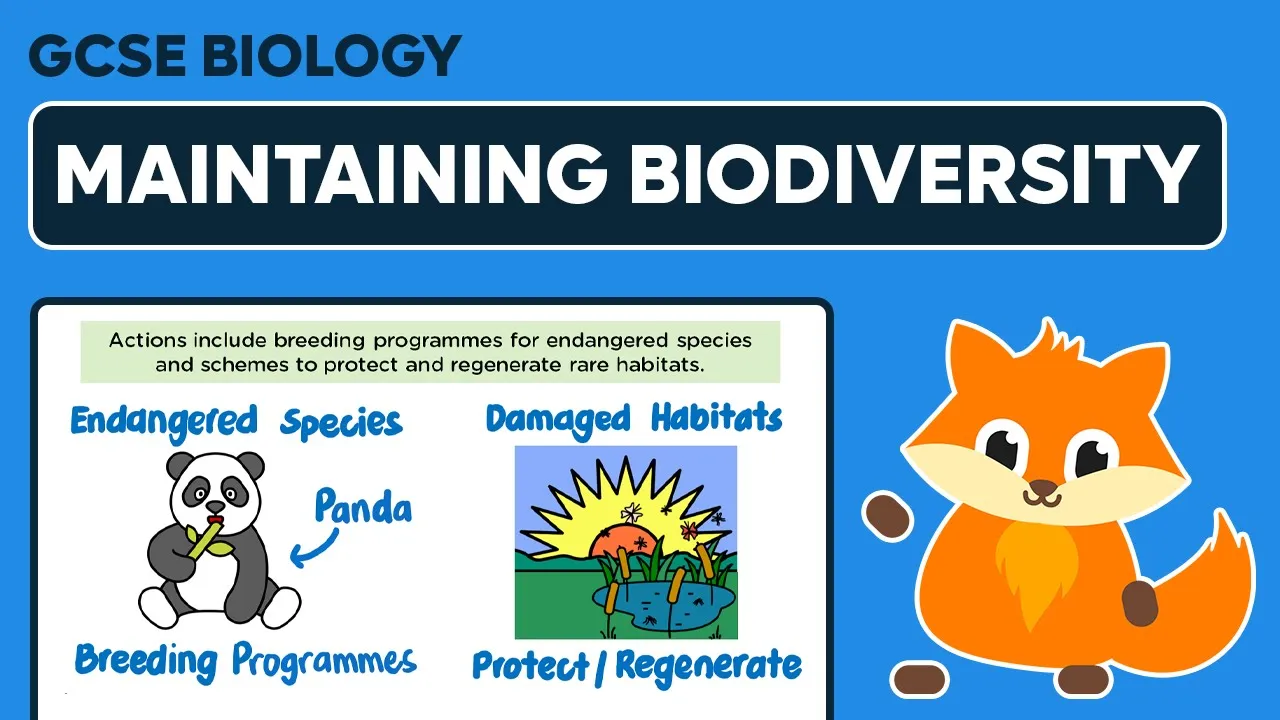

Conservation involves human efforts to protect environments and species, with examples including Kielder Forest reforestation, red squirrel protection from invasive grey squirrels, and South China Tiger captive breeding. Food security means having access to enough safe and healthy food, but faces challenges from population growth (3 billion to 7.5 billion), changing dietary patterns, poverty, conflict, and fertilizer sustainability. Decomposition breaks down organic matter through bacterial and fungal respiration, requiring oxygen, water, and warmth, with the rate calculated as mass lost divided by days. Food preservation methods include cold storage, drying/salting, oil/vinegar, irradiation, and modified atmosphere packaging to prevent decomposition.
GCSE Biology: Conservation, Food Security & Decomposition
Added:hi biologists okay what we're going to do today is we're going to look at conservation and there's a couple of examples that you need to know about we're going to look at food security decomposers and how food can be preserved so first of all what is conservation well conservation is when humans actually make an effort to protect the environment or particular species within the environment and why is that important well we have a right a human right to protect species and make sure that they don't become extinct we also have a selfish reasons for do it for doing it because obviously as I've said before we use plants and animals to provide us with food and to provide us with medicines maintaining the environment also helps the environment to cope if there are natural disasters for instance if a region that used to have woodland is then the woodland is removed if there is flooding in that area then it's just going to wash that soil away whereas actually if we have trees and tree roots there is going to hold the soil together and the area will be much more likely to be able to recover the first example that you need to know about is the kill DeForest so the kill DeForest is found in the north of England right up next to Scotland and in 1800 the forest had actually been destroyed and had been replaced with moorland and so now there's a large conservation effort to reforest the area and if you were to visit now you would find that there lots of conifer trees deciduous trees they're the ones that lose their leaves and lots of open areas and by bringing in lots of trees and lots of open areas what that means is that we've increased the range of habitats available and that has increased the number of species living in each of those areas a couple of other examples of conservation projects they've done is that they have built nesting platforms in the tops of tall trees to encourage Ospreys to nest and they've also kill any grey squirrels that enter the region and the reason for that is that the red squirrel is the native population of the UK but the gray squirrels were introduced from North America and they compete with the red squirrels and they able to out-compete them and so the population of red squirrels in this country is now is quite small and so we are conserving the numbers in that region the final example that you need to know is about the South China Tiger and their numbers are decreasing for several reasons one because their habitat is being destroyed but also because those Tigers are being hunted and they are being killed because they are moving on to farmland and attacking farm animals so what people are doing is that we are now breeding those tigers in captivity such as in zoos to start to increase their numbers again because their population is actually now so the next part you need to know about is food security and food security means having access to enough safe and healthy foods at all times and of course there are reasons why this isn't the case with populations around the world so let's look at those reasons there are five that you need to know about the first one is the human population is massively increasing in 1960 human population was three billion now it's seven and a half billion and it's not evenly spread around the world if you look at the graph on the right here that you can see there's been a massive increase in the population and China and in India and actually what we're talking about here is there enough food in those regions clean and healthy food to feed that population and to feed the increasing population number two is that food types that are being consumed are changing as countries become more wealthy they tend to eat more fish and meat but at the moment there is an enough fish and meat to go around so how are we dealing with that how are we going to change people's eating habits or how are we going to make sure there's enough food available fish and meat available for those people to eat last lesson we talked about fish farming that is one way that we can increase the amount of fish available for consumption some people feel that we ought to move to plant protein for instance as an alternative number three and four here reasons why there is food poverty in some parts of the world is that we have regions where this conflict and we have regions where countries are poorer than others that means that the people in those countries simply do not have enough money to be able to purchase food or they're in a conflicted region which means that they've had to move away from their farmland or the area that they lived and now they are living in camp situations where you know they are dependent on being provided food perhaps by charity other organizations number five is the use of crops what's actually use of fertilizers on crops the problem with this is that we use fertilizers to increase the growth of the crops and that has worked up to now and actually the there's been a 700 percent increase in the amount fertilizers use globally each year but the difficulty with this is that it might not be sustainable that means can we still keep adding fertilizers to the soil and increasing the amount fertilizer to the soil without it causing harm to the environment we will reach a peak where we can keep adding fertilizer but actually it's not going to increase the the crop yield any more than it does already so we produce all this food to feed the population of the world but we do know that if food is not eaten and plant materials will start to decompose and they're broken down by decomposes and examples of those could be bacteria and fungi and as they break the materials down drop them down that process that they're doing that by is respiration so that requires oxygen it requires water and it requires warmth so that these enzymes can work at the correct temperature plants when they're well decayed form compost compost I'm sure you've heard is used to put it's put back into the soil it's it's high in nutrients it's put back into the soil too and is used by other plants for minerals to help them to grow so you need to be able to calculate the rates of decomposition using an equation it's nice and simple so the rate of decomposition is the mass lost divided by the number of days so we've got an example here so the mass of five strawberries was 153 kilograms after being in a compost bin for ten days their mass was 37 grams calculate the rate of the decomposition of the strawberries see if you can have a go pause the video okay hopefully if I'll try so let's look first of all at the mass lost so that is 153 grams - 37 grams so the mass that has been lost in total is 116 grams and then we divide that by the number of days which was 10 and so we can say that 11.6 grams per day has been lost so that is our decomposition rate so remember the unit's there is grams per day so the final thing you need to know about is about food preservation so we've created all this food we've grown all this food so now we're looking at ways that we can stop the food from decaying or decomposing and so we've got five different methods here that are used the first one cold storage we can freeze things we can make them cold and what that does is it slows down the diffusion of reactants onto enzymes and the products of enzymes and so that slows down decomposition and the rates of reaction it stops those fungi in those bacteria from growing and from reproducing we've got dried or salted foods salted food is it's doing the same thing as drying food basically it removes water from the food and because we need water for chemical reactions to occur it means again that those dqo decomposers can undertake those chemical reactions of decomposition respiration we can put organisms in oil or in vinegar oil actually stops oxygen being able to get to the decomposers so they can't then decompose the food vinegar creates really acidic conditions which stops those enzymes from working if the ph becomes really low the enzymes are denatured and so these fungi and those bacteria can't decompose that food we can irradiated food that means that we can pass the food through radioactive kind of waves and when we do that that actually kills off any bacteria or fungi which were present the the foods are then packaged to prevent organisms from getting back in against them the other thing and this you probably don't know that this happens but when you look in a supermarket and you get lettuce or fresh produce in packages actually what's happened is there is no oxygen in those bags that lettuce in that picture there has been has been stored with either nitrogen or carbon dioxide because there's therefore no oxygen around the decomposers can no longer sit down you
Up Next

Anaerobic Digestion & Fermentation Processes in Detail
@npteliitguwahati8283
1.3K views•2021-02-18
Bacterial Communication: Quorum Sensing and Biofilm Formation Explained
@JHUAAP
12.6K views•2011-06-28

Enteric Nervous System Explained: The Gut's Brain | Neurobiology Lecture
@alumniu6029
438 views•2018-09-12
Bacteriophages: Earth's Deadliest Killers and Future Antibiotics
@kurzgesagt
34.6M views•2018-05-13
Related Study Plans & Knowledge Roadmaps
Structured learning paths in Biology