













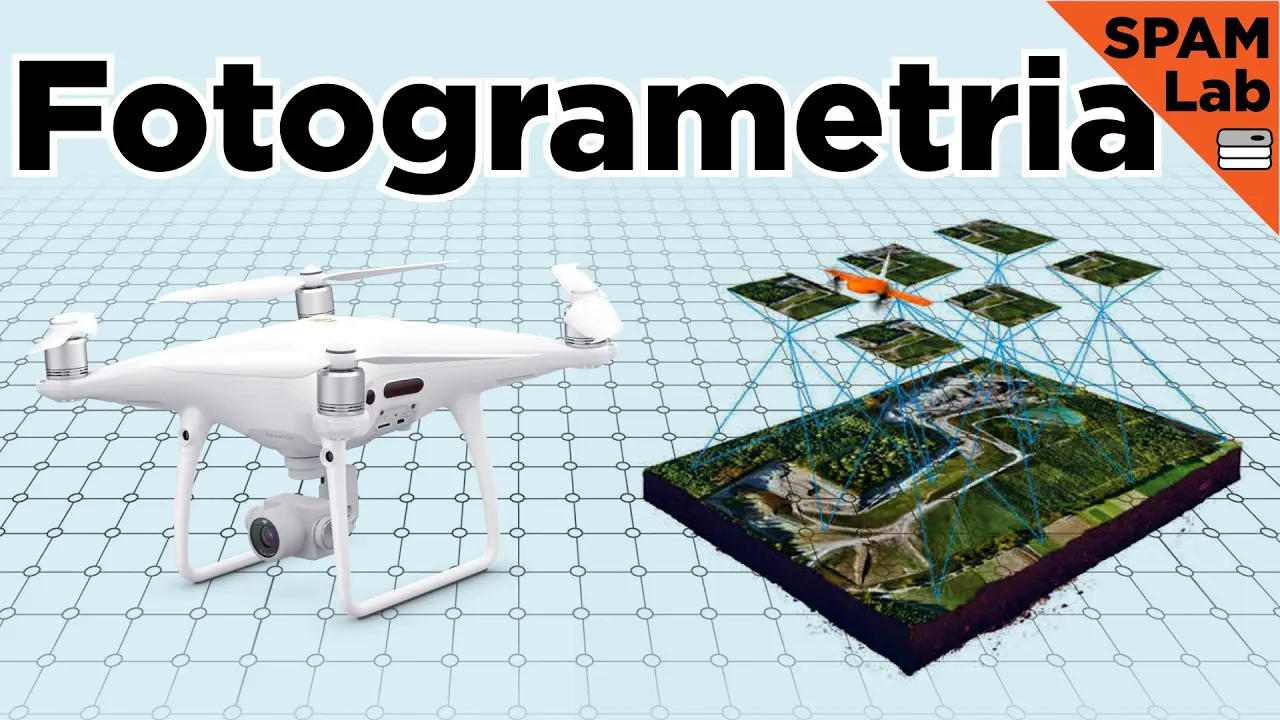


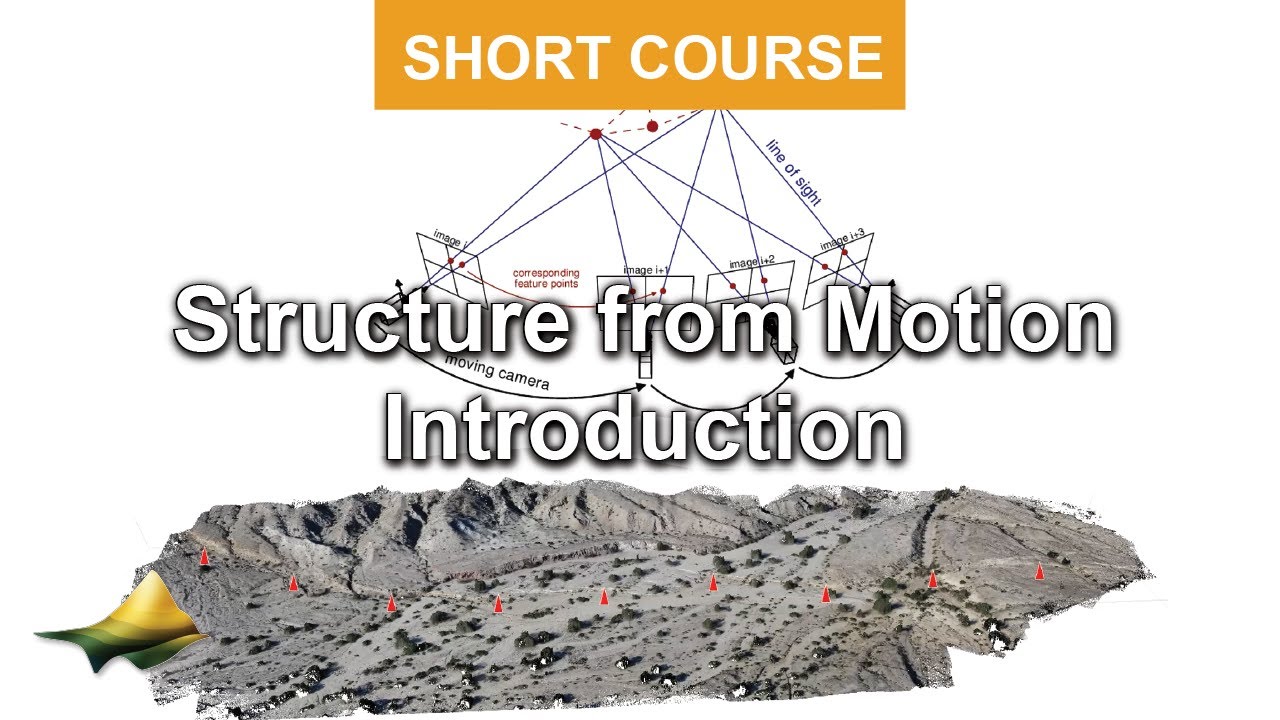


Homogeneous coordinates provide a mathematical framework for representing geometric objects in projective geometry, where points and lines are defined up to a scalar factor, enabling elegant representation of points at infinity (where the last coordinate equals zero) and allowing all transformations (translation, rotation, scaling, affine, and projective) to be expressed through matrix-vector multiplication, making complex geometric operations like line-point intersection and line fitting computationally efficient.
Homogeneous Coordinates: A Lecture by Cyrill Stachniss (2020)
Added:Basic linear algebra, including vector operations, matrix-vector multiplication, and matrix inversion.
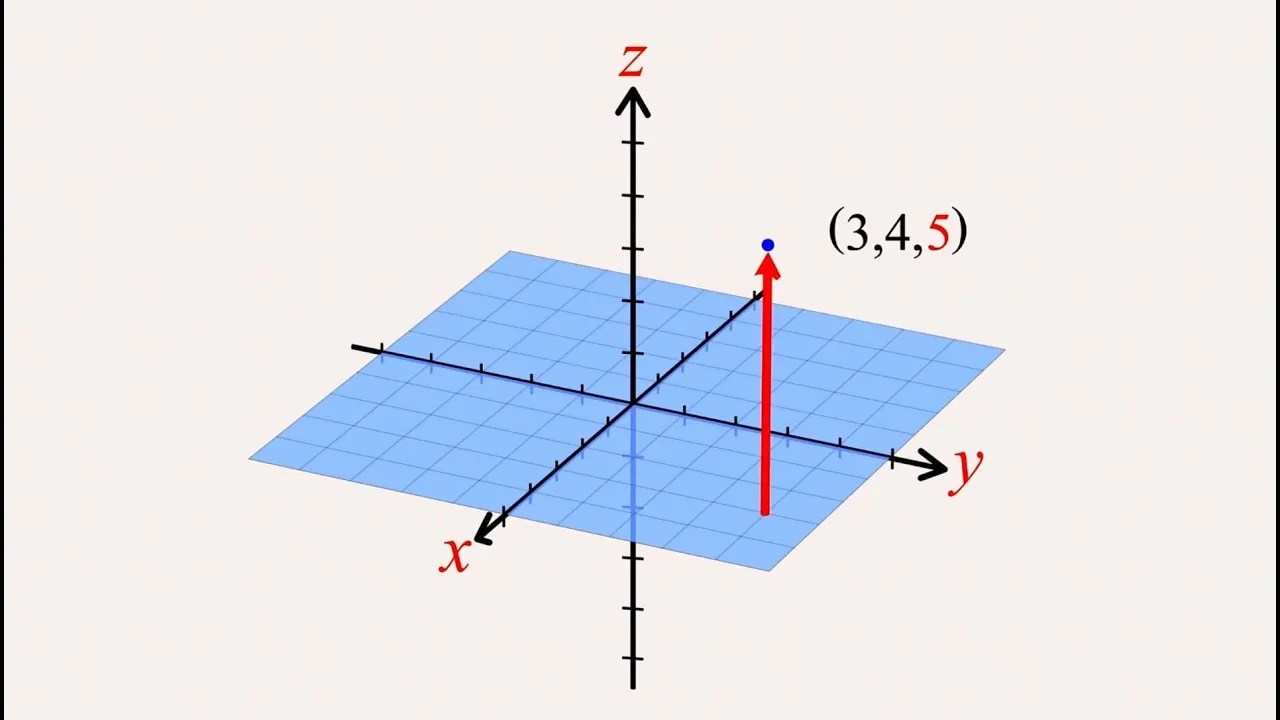
Cartesian coordinate systems in 2D and 3D space.
Standard geometric transformations such as rotation, translation, and scaling in Euclidean space.
The mathematical distinction between linear transformations and affine transformations.
The pinhole camera model and the use of projection matrices in computer vision.
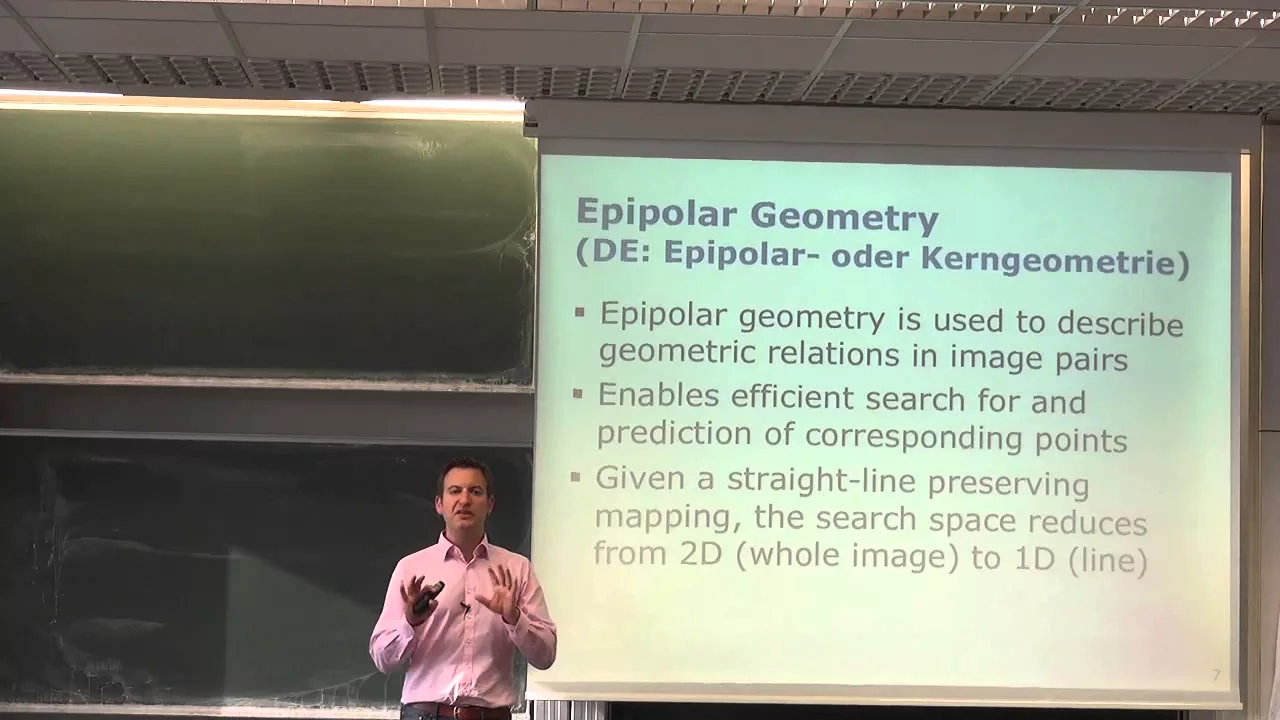
Epipolar geometry, including the estimation of Essential and Fundamental matrices for stereo vision.
Homography estimation and its application in image stitching and planar perspective rectification.
3D reconstruction techniques, such as Structure from Motion (SfM) and photogrammetry workflows.
Robot kinematics and coordinate frame transformations for robotic manipulation and SLAM.
32.2K views824likes1:10:19Original Release: 2020-08-20
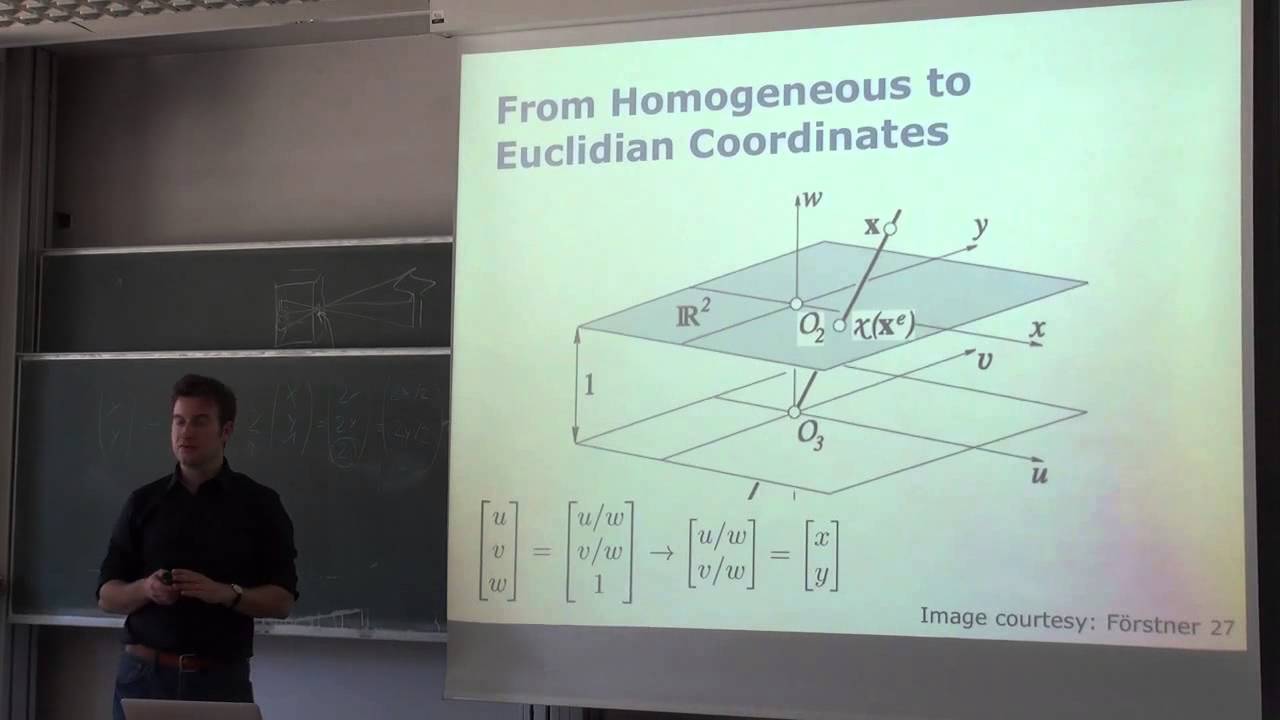
in this part of the lecture i want to dive a little bit into homogeneous coordinates homogeneous coordinates are tool that we're using in photogrammetry computer vision and robotics very frequently because it allows us to do certain tasks much more elegantly compared to the euclidean space and therefore it's an important mathematical toolbox that you can use in order to write down equations in a very compact fashion and for example perform transformation elegantly and also have possibilities to represent for example points or geometric objects which are infinitely far away with finite numbers and that's something which is also an important thing um and becomes very handy when we are performing performing state estimation problems or want to represent certain equations that involves points that are potentially far away so why a projective space what homogeneous coordinates are the reason for that is that we often use cameras in our discipline and cameras basically take the 3d world and project them onto a 2d image and so there's a popular pinhole camera model and that you all know so you have an object in the 3d world so this is our object over here and so you for example light source like the sun this is reflecting light towards the camera and the ray passes through that pinhole and generates an image on the image plane over here often um although this kind of the real image plane we're using a virtual um image over here which sits again in front of the camera although this doesn't exist in reality it's sometimes easier to visualize things it's basically this image plane rotated around the pinhole in front of the camera so the object actually stands upside down and the what happens in this pinhole camera model you have this small hole which is infinitely small and all the rays all the light that reaches my image plane passes through this point so it's basically a bundle of rays of rays of light that reaches my image plane and [Music] the the what happens over here is this light generates an image and this image is a projection from the 3d world onto the 2d image plane and it's a projection as we say that so it will as you will see is a projective space is um more can more elegantly describe this model and therefore we are frequently using it because whenever projections are involved certain things can be formulated simply in a more compact fashion especially transformations which makes this very very attractive so if we have an image for example such an image that we have generated here the question is what can we say about the geometry of the image so for example if we have certain lines do parallel lines from the real world stay parallel in that image or are do angles between lines change so if we have in the 3d world two lines which have a certain angle with respect to each other is this angle preserved in an image and it turns out for example that this is not the case so it's not an angle preserving mapping but typically straight lines stay straight lines at least in the pinhole camera model and there are certain properties of the geometric objects how they are changed when i'm projecting them from the 3d world into an image just to mention a few things so straight line preserving mapping means that straight lines are mapped into straight lines and this is something that at least if you don't have lens distortions if you just have kind of the basic pinhole model that's actually the case so if you have a straight line in the real world it stays a straight line in your image it is not length preserving that means the um you can have two objects in the real world which have the same size but maybe maybe map to a different size in our image plane for example if one is further away uh from the pinhole camera then the then the other object this leads to a different size in the object in the image space and it's not an angle preserving mapping that means the angle between two lines for example doesn't stay the same if you project them from the three world onto the 2d image plane there's an example for as we can see here so these are two lines which are parallel in the real world there's also two lines which are parallel in the real world and we can see um and they have kind of a 90 degree corner over here we can see that this is definitely not the case in the image so just as an example that um straight lines stay straight but power lines may not remain parallel because the angle between lines can actually change another interesting thing is kind of the vanishing point if we have parallel lines in our image then we have a vanishing point and those lines move towards this vanishing point so that means again parallel lines in the real world which those tracks are at least approximately do not stay parallel in my image right so those lines are are not parallel in my image plane and um the uh the fact that those lines do not uh stay parallel is something that we want to actually encode in this projective mapping that we want to express and these parallel lines we can describe as kind of meeting at infinity so if you have parallel lines and we approach this towards infinity then we have then these are two lines which are actually intersecting but the intersection point is infinitely far away so you can see that if you have two lines which intersect in the euclidean world like my hands over here and i'm increasing the angle decreasing the angle between those two lines the intersection point moves further and further and further away and when they become parallel these points moves infinitively far away and so this is something that as we will see something that we can represent really elegantly with homogeneous coordinates for example and um if you have parallel lines in our image then every direction leads to one vanishing point exactly one vanishing point so if you have parallel lines and we kind of move the train tracks so to say or remove our camera point of view so that they're at a different location with respect to my camera they will generate actually a different vanishing point in the image but every set of parallel lines has the same vanishing points and so one of the questions that we have here how can we describe these points which are infinitively far away in an elegant fashion and it turns out that homogeneous coordinates are a very good tool for actually realizing this so the it's important to say that the projective geometry that we are looking into is just a different way for representing our space and it's motivated by the fact that certain things cannot be expressed that elegantly in the euclidean space in the cleaning geometry and it's sub-optimal for example for this central projection so what happens in the pinhole camera model and that doesn't mean we can't express it in general in the euclidean space um the thing is that it becomes more complicated to write down the equations and the equations don't become very handy and the method of mathematical expression become complex and therefore we can go to an alternative representation these are these homogeneous coordinates which are better suited for describing this so homogeneous coordinates are a system of coordinates that are often used in projective geometry and they make things simpler compared to the euclidean space and there are two important properties that we will express especially exploit in here the first thing is that they can elegantly represent points which are infinitely far away without using infinity as a number so we can use finite numbers and still represent points which are infinitely far away and that's something which becomes very attractive as we will see and the second thing is it's also a very good tool and therefore it's also used outside problems where projections play a role so even if you have a state estimation problem for example where projections are not involved homogeneous coordinates can be very elegantly and one of the reasons is that they can describe different transformations in a unified fashion with matrices so a rotation can be described for example through a magnetic factor multiplication that's the same for the euclidean space but it also holds for trans uh translations and that's something that euclidean space for example cannot do so the last two bullet points here are the things why we are using it here as an attractive tool for our state estimation problems so um before we start a few words about the notation so if we have geometric objects such as points lines or planes they're typically described with this capital calligraphic fonts so for example x y or p typically represents a point and describes the geometric object point and we can express this in different coordinates either in homogeneous coordinates or in euclidean coordinates and for that we'll be using different fonts so if you see this type of fonts we are talking here about homogeneous coordinates if we use this type of font we are talking about something represented in the euclidean world l or m typically refers to lines and a to planes and another thing which should make your life easier everything which is lowercase means we are referring here to the 2d world so for example to the obligating world if we move on a plane or live in a plane or if it's a capitalized character then it means we are in the 3d world so just by looking to the variable on the slide you can actually see if we're talking about 3d or 2d or sometimes if you're talking general i may also use lower case but otherwise it means that we are living in the 2d world okay so let's start and look into homogeneous coordinates what is this and what's a homogeneous object so the representation of a geometric object is something that we call homogeneous and what needs to be done for this is if x and lambda times x the lambda is a scalar unequal to 0 represent the same object that means x equals 2 times x for example or x equals 3 times x or x equals 0.5 times x so this refers to the same geometric object then it's something which is homogeneous so we can write this down so this equation holds we have a vector this vector x is the identical vector and this is lambda and this lambda must be unequal to zero so for zero it doesn't hold but for every number unequal to zero this equation holds and this is clearly something that doesn't hold for the equation space so in the equilibrium space that is not the case this would only hold if lambda would equal to one um but so we are more general here so those two things represent the same object okay so that's the definition what's an homogeneous object is so something that is defined only up to a scale vector so now let's become a little bit more concrete how does this look like for example for a point in 2d and so if you have a 2d point in our 2d euclidean world point x with an x and a y coordinate over here so both phase is a vector and these are the individual coordinates in regular characters so then to go to euclidean coordinates we turn from an n-dimensional space to an n-plus one-dimensional space that means we add one additional dimension and this is the last dimension that we add here to our vector so a 2d vector turns into a 3d vector a 3d vector turns into a 4d vector a 4d vector turns into a 5d vector and the last dimension in this vector is set to one so if we move from our euclidean world to our homogeneous world to our projective space we add a one as a last dimension and that's basically it there's nothing else that we do for representing a point or transforming a point from our euclidean world into our homogeneous part and this is then from r2 into the projective space p2 so it's our two-dimensional projective space okay so um that means if we say that a point is homogeneous is only defined up to a scale vector that means if we take our euclidean point x y turn it into a homogeneous vector x y one that means we can multiply this point x with an arbitrary weight for example w w unequal to zero that means all three coordinates need to be multiplied with w so w times x w times y w times 1 is w so it turns into a point u y w where u equals y m w times x and v equals w times y okay so and this is the same thing so what we have written over here x y one is the same as u v the w this is comes from the homogeneous property and then the constraint that we have a point x in the 2d plane is represented by a three-dimensional vector this is my u v w and the o the constraint that i have is that the um the square norm of this point so u squared plus v square plus w square must be unequal to zero so that means not all three coordinates can be zero okay so if i have a point in the homogeneous coordinates it's not allowed that we have the point zero zero zero all right and as we said that the point is only defined up to a scale vector and if you want to turn this point back to the euclidean world where we need to get rid of the scale vector again that means we normalize by the last coordinate that means we if we have this three-dimensional vector we take the first two coordinates copy it over and divide both of them by w so if i want to go back to my euclidean coordinates the first coordinate gets u divided by w and the second one v divided by w where again w must be unequal to zero so this then turns into u divided by w which if you remember u was x times w so if x times w divided by w is equal to x so i get back my original point in my euclidean world and even if i'm in the homogeneous world scaled it with an arbitrary factor through this division by the last coordinate i'm taking this scale factor out again returning back to our euclidean world so just as a thought experiment what would actually happen if my term w my weight my last dimension would be zero just assume it's zero if it is zero that would mean if you turn it back into a euclidean point so something that we can actually better visualize in our brains because we're used to that that would mean we would take a value u and v and would divide it by zero and that would mean those points would take arbitrarily large values for x and y or let's say y would be zero then only the x coordinate for example would be infinitively large so it leads to values which are infinitely large as the coordinates of the points and that means this is a point which is infinitely far away okay so if the last coordinates is zero that means we have a point which is infinitely far away and this can in the euclidean world only be expressed through an infinitively large number so infinity basically is the x y or x and y coordinate and this is equivalent to a point that is has a weight of zero so um just an example the projective plane these are kind of all the points um in p2 they contain all points that we can that we know from our euclidean world um so if the point isn't as an arbitrary point x y um we add the point x y one so there's an element of this um projective plane so all the points in the from the euclidean world sit in this plane what we don't have in that plane however and what additionally sorry what we additionally have in that plane are all points which take a zero in the end so a point that i cannot generate directly out of an euclidean coordinate because if i come from the euclidean coordinate i have this weight vector of one over here and these are the points which are infinitively far away so if the last coordinate is zero then it's a point which is infinitely far away in the first two coordinates here just basically specify the direction where that point is in the world and the only point which is not part of that projective plane is the point zero zero zero this is explicitly taken out so the zero vector where all dimensions are zero is not part of p2 so if you want to go from homogeneous coordinates back to the euclidean coordinates we can write this as u v w so my arbitrary vector only w arbitrary vector so this is equivalent to u divided by w v divided by w so i'm taking these two coordinates divided by the last coordinates so that this is turns into one and then i'm basically dropping the last coordinate because if this is one i can go from homogeneous coordinates to euclidean coordinates by dropping the last dimension and then this is equal to my point x and y so let's try to visualize this fact again so what you see here is a three-dimensional space and this is the three coordinates that we have in our euclidean world um what you can see in here is there's a plane with where the z coordinate equals to one this is this gray plane over here and if the z coordinate or the that's called the third coordinate not the z coordinate but the third coordinate equals to one that means um the other two coordinates represent the point in the euclidean space and so this grey plane here represents the euclidean space the euclidean to the euclidean space we however have a vector with three values the first two values sitting here and the third value is one then we're in this gray plane but we can also be outside this grey plane right so we can be anywhere in this three value three-dimensional space and um so any point that has where i for example multiply the the x y coordinate was let's say 2 i get 2 times x 2 times y and the third coordinate would be 2 would be a point which is sitting higher up here so on third coordinate equals to 2. and every point which lies on that line towards zero zero zero represents the same point in the euclidean world so we can see that all points which lie on that line on that black line in this euclidean coordinate euclidean space represent this single same point in my euclidean world okay and only this plane down here these are the points which are infinitively far away and which then cannot be represented with with the euclidean coordinate or in the euclidean space because this is this plane which sits up here okay what we can do in 2d we can also do in the same way in 3d so the analogous thing to 3d from 2d to 3d is we have a three-dimensional vector and we turn into a four-dimensional vector right we add this one dimension and add one to it exactly the same thing and also the way back is very similar that we take all the coordinates that we have in this case three and not two and divide it by the last in this case fourth coordinate so if you have u v w t and t is now a last dimension that means if you want to go back from homogeneous coordinates into euclidean coordinates we first divide the vector by t so it's we're still in euclidean space where you can u divided by t v divided by t w divided by t and this turns into one and as soon as i have a one sitting over here i can drop this dimension and then it brings me back to the euclidean space okay so we what we can do in 2d we can do exactly the same way in our 3d world representing a point in the in p3 from r3 to p3 in this example and then the origin of the euclidean coordinate system this may be said because this mainly to some confusion is the point zero zero and the last coordinate is one or zero zero zero one so this is the origin in the euclidean world remember the point 0 0 is the origin in r2 and this is the plane r2 so it's exactly this point over here so that means the origin of the euclidean coordinate system in homogeneous coordinates is the zero vector where the last dimension is still one it's not zero zero zero this would not be part of that space so it's kind of the important thing that you need to keep in mind the origin is 0 0 1 or 0 0 0 1 in the um in the expression homogeneous coordinates so the next thing i want to look into are transformations this is one thing which can which is the reason why homogeneous coordinates are so frequently used because because you can write down change of transformations in a very very easy way and so the transformation can be expressed through a matrix vector multiplication so again x is my an arbitrary homogeneous object and those examples here will be done in 2d or in 3d now and i can perform a projective transformation by multiplying a matrix h in this example to and then the vector from the right hand side to this matrix h and we're talking here about an invertible mapping so projective transformation is invertible mapping of that form that takes a point x you multiply h times x and it gives me a new point x prime and let's have a look how this matrix h actually looks like and try to make the connections between the euclidean space so what is a translation in the euclidean space in the three euclidean space for example and would be a translation by x y and that so i'm going to shift in x shift and y and shift in that coordinate can be expressed by a matrix h again the matrix h is a homogeneous object so it can be multiplied with any arbitrary scalar scalar factor this was our homogeneous property and then i have this matrix h is a four by four matrix because we're representing the 3d euclidean world and this identity over here is a three by three identity matrix so this matrix over here a three by three matrix with one on the main diagonal and zero everywhere else this is a three-dimensional vector zero so zero zero zero this is a scalar one and this is a vector t a three dimensional translation vector and this vector t represents the shift in the x y and that coordinate in our euclidean world so if i use this matrix over here so it's a matrix which has basically is basically a four by four identity matrix so it's one of the main diagonals except that these the last three values over here contain the translation vector t x t y t z and if i then multiply a point from the left hand side to this matrix h it's equivalent to shifting the point translating the point in our three dimensional world this is an elegant thing because that's something that i cannot express in euclidian coordinates through a vector a matrix vector multiplication i only can do this by adding a vector to it and if we can express all the transformations as matrix vector multiplications this becomes very elegantly because they can simply chain those by multiplying those matrices together for example okay so but this was only a translation let's see how that looks like for more complex transformations what about a rigid body transformation rigid body transformation is a transformation which has three more parameters um so rotation and a translation so let's look to the translation maybe first how can we express rotation in this euclidean space it turns out i take the same h matrix and this identity matrix over here i put in a regular rotation matrix as you know them from our euclidean world and of course if i only want to rotate something there's no translation involved so this this three-dimensional vector must be the zero vector because there's no translation involved so basically have a matrix which has um the last column and last row are zero except the last element last last element down here which is one and over here i have a three by three space which is left which is filled with a regular rotation matrix just as a reminder rotation matrix is something we discussed in the previous lecture this is how the standard rotational matrix looks like in a two-dimensional space and how different rotation matrix around the x y and that coordinate look in the in the three-dimensional space and we can just multiply for example three rotational matrices together or even more than that and obtain an arbitrary rotation in the 3d world and this is the rotation matrix which sits there in in this rotation here so this r is exactly this rotation matrix and this allows us to express a rotation of rotating a point in homogeneous coordinates through this transformation into a new point and if we turn that back into the leading coordinates we get exactly what we would get if it would execute rotation in the euclidean space as well so other important transformations are rigid body transformations so rigid body transformation consists of a rotation and a translation and it's then six parameters three for the translation part and three for the rotation part and this is now expressed in that way so it contains of basically the rotation transformation and the translation transformation i have my r sitting over here my rotation matrix my translation over here a zero vector and a one and everything is only defined again up to this magic scalar factor and this is if i multiply now a point with this transformation h it basically executes a rigid body transformation consisting of a rotation and a shift and a translation and this is exactly what it has so if you multiply a point here from the left hand side the point will be rotated by the rotation matrix r and translated by the vector t okay now let's look into other transformations they're more than just translation rotation and rigid body transformation so there's for example the similarity transform which is a very frequently used transformation in computer vision or in photogrammetry this basically adds an additional parameter is scale factor and this is a scale factor which scales the points down so and here we cannot just add in the euclidean space multiply multiply the whole transformation with a scalar because this is the homogeneous property that wouldn't change the object itself so we only need to multiply the this rotation matrix here with a scalar so we are basically not scaling this um the the one down here and as a result of this it will just make our objects larger or smaller so this small m is the scaling factor that we um know how we would scale in our euclidean space so this is again still an angle preserving mapping because we are just rotating something we are shifting something and we're making things larger or smaller in the same way in all dimensions so all angles stay the same under this similarity transformation if you now go to an affine transformation which has additionally three shear parameters involved and maybe even scale parameters in x y and that differently then we end up having 12 parameters so three translations three rotations three scale parameters and three shear parameters and then we still have this zeros down here our translation vector here our one sitting down here but this matrix which was a scaled rotation matrix before turns into an arbitrary matrix because we have three degrees of freedom sitting in here so we have nine degrees of freedom sitting in here so three from rotation three from scale and three from shear so this non-arbitrary matrix a which is nine elements and nine degrees of freedom and this we can use to express an affine transformation so um in fine transformation means that parallel lines still remain parallel but it's not an angle preserving mapping so angles between lines for example in this world will change and then we can go even further to a projective mapping and the only three parameters we still have actually sits down here so what happens if we have this add the three degrees of freedom in here if we add the additional three parameters here into a vector this turns then into a projective transformation and this projective transformation has 15 degrees of freedom again this is a 4x4 matrix so it means 16 values but this one is one so we have 50 degrees of freedom and these are the reasons why parallel lines may not stay parallel so if you have a projective transformation which is goes beyond or extends the defined transformation we get three additional values over here and as a result of this parallel lines may not stay parallel okay so what we have seen now is that we can express projective transformations of fine transformations similarity transformations rigid body transformations rotations and translations and scaling very elegantly through the same object through a four by four matrix for the three-dimensional space and this allows us to chain those matrix simply by matrix multiplications next to each other um just for illustration purposes what this slide shows shows a different transformation for 2d that we can do from transformation mirroring axis rotation motion similarity transform scale differences and so on and so forth until the projectivity and you see the degrees of freedom and how these matrices actually looks like so which parameters are fixed which type of value and what i've discussed here are basically those the representation of this matrix h this is what we have done for 3d now and here's a nice overflow overview for 2d so in sum we have this hierarchy of transformation the most general one is this projective transformation where parallel lines may not stay parallel anymore due to the projection the fine transformations which is not angle preserving so angles may change but parallel lines stay parallel the similarity transform which is an angle preserving mapping so angles stay the same just the size of the object may change the rigid body transformation doesn't scale the object it keeps its size and this can be then split up into a translation and rotation and you also see the number of free parameters for 2d and 3d in this plot by expressing those transformations as matrices as i said before we can very easily chain those transformations something we see down here so if we have two transformations h1 and h2 and we want to execute h2 and then h1 we can express this by h1 times h2 times x and so x is first transformed through h2 and then transformed through h1 and then gives me my point h prime i could also multiply those two matrices together because they're just four by four matrices so i can multiply them with each other we'll get a new four by four matrix which expresses the combinations uh the chaining of these two transformations but as a note this is not a cumulative operation so executing h1 and then h2 is different from executing h2 and then h1 you may remember this from the rotations um through this because in general matrix multiplication is not commutative so that's something that you also have to take into account here but the other thing which is also elegant that i can easily invert a transformation and inverting a transformation can be obtained by just inverting my matrix h so if i have a point x which is transformed through h into x prime what i can do is i can take this matrix h compute its inverse multiply h prime from its um from its right hand side and then we'll actually obtain the original point x so i can use these transformations as matrices as i'm used to be i can chain them multiply them i can invert them to invert the transformation and that is something that i can also do in this um homogeneous coordinates and which allows me to very elegantly combine and invert different transformations with which points are executed in the real world and this is important if you for example like you have a camera which is moving through the environment you want to describe the motion of the camera with translations with rotations or a mobile robot for example or you have a scene and you want to shift and rotate the scene and scale the scene then it's a similarity transform or you have points in the 3d board which are projected onto a camera image then all these things these transformations are very very useful and therefore they're such a frequently used tool in photogrammetry so to go a step further what else can we do or what is also important in here and what i want to dive a little bit further is into other geometric objects especially looking into lines we can also see how we can represent those lines in homogeneous coordinates and that we can do attractive manipulations with those homogeneous representations of the lines that allows us to do certain operations like checking if a point lies on a line or if the computing intersection between two lines in a very easy and elegant way let's have a look how we can actually represent lines in homogeneous coordinates so we can have different ways for representing lines how we do this in the euclidean world depending where you went to school you have seen different ways for doing this the first prominent example is so-called has a normal form there we have an angle which represents the direction of the line and a distance d from the origin and we can express this line with the equation x times cosine of the orientation of the line plus y times the sine of the orientation of the line minus the distance d to the origin should be equal to zero or you can go for this intercept form which is shown here or most prominently the standard form ax plus b y plus c equals to zero and this is all called the implicit form in german or the standard form which is a common way for describing a line through this form of equation okay so what we can see in here is that we typically have three parameters to represent a line this can be the three coefficient of the standard form or two quantities that depends on the angle of the line and one that depends on the distance of the line to the origin and now we can take those three values and arrange them in form of a vector and before we do this we want to kind of rewrite those equations a little bit so that all kind of have the same form so we are rearranging these three forms such that we always have an equation where the first parameter is a coefficient times x the second term is another coefficient times y and then we have a constant and equals to zero so it's a very easy way if we can trivially rewrite has a form intercept form and standard form so that they fulfill this equation as you can see it here on the right hand side of that slide so if we have that we can always see that we have coefficients that sit in front of x coefficient that sits in front of y and a constant part and then equals to 0. so we now want to do is we can take these coefficients and arrange the coefficients in form of lines so these are always equations that are equal to zero and we take out the coefficients of these equations and put them in a vector form and this is then our representation of a line in homogeneous coordinates so again we can do it in three different ways if we take the standard form it would be a vector with the coefficients a b and c if you prefer the hassel form this would be the cosine of the orientation of the line the sine of the orientation of the line and the negative distance to the to the origin or the corresponding elements in the intercept form and if we then have a point and want to see if a point lies on a line so if a point fulfills the equation we basically need to check if a times x plus b times y plus c equals to zero right because this is the equation but a point that lies on line must fulfill so we can do is we can take one of those three forms over here it doesn't matter which one and multiply it with a point x y one and if this equals to zero then we know this point lies on the line so that is actually very conveniently written as x multiplied with the line equation must equal to zero so through the dot product we can express the fact if or the test if a point lies on a line so if we multiply a line given with all three parameters with a point x y one and the result is zero it means the point lies on that line because that means that it fulfills the line equation so just by using dot product we can very elegantly check if a point lies on a line so more formally we can define a line um in homogeneous coordinates in 2d as a vector containing of three elements l1 l2 and l3 and the important thing is that not all quantities can be zero so at least one of those quantities must be unequal to zero and then this three-dimensional vector represents a line that corresponds to a line in the euclidean world that fulfills this equation which is shown down here so it's basically the standard form where the three dimensions of the line vector are the coefficients of the standard equation used for a line okay so it's a the only thing we do we basically take the three parameters that the line has and arrange it in vector form and not all quantities are allowed to be zero and then if you want to test if a point x lies on line l the only thing we need to do we need to compute the dot product x times l and must check if it's zero yes or no if it's zero the point lies on the line if it is unequal to zero the point does not lie on the line so it's a very easy to execute test that we can do okay we can go further and see what happens if you actually want to compute the intersection of two lines so given that we don't have a point in the line but two lines and we want to compute the intersection of those two lines can we do this in an efficient manner and we it will turn out we can actually do this in homogeneous coordinates in an efficient way so what needs to be done so that we can compute the intersection of two lines so again that means we want to find a point x which lies on both lines because then this is the intersection of the two lines that means we can if we have a line l and line m we can set up two equations saying first x times l must be zero and x times m must be zero these are two equations that need to be fulfilled and so that's something we can very easily arrange in a system of two linear equations with two unknowns so l times x must be zero and m times x must be zero and we can arrange it in this form and we can if we kind of expect if we expand this expression we can also express it in the following way but moving the constant part here to the right hand side of this equation then we have a two by two matrix multiplied with a two dimensional vector and um our equals another vector and this is kind of the standard way for representing a system of linear equation here with two unknowns and two equations so how do we solve this we take and take an arbitrary technique that we have in order to solve this one of the easiest way to do this here for this by two system is to use um kramer's rule so as a short reminder if you wanna solve a linear system ax equals to b you can compute this by the different solution dimensions of x are so x1 is the determinant of the matrix a where we replace the first column of a with the vector b divided by the determinant of a and if you want to compute the second dimension of x this would be then taking the matrix a and replacing the second column of this matrix a by the vector b and the only thing i need to do i need to compute these two determinants and divide them through each other and this gives me the result for x and this is especially something which can be very easily done in 2d because in 2d the determinant can be very easily directly computed without needing to do a lot of complex instructions so let's go through that step by step i want to compute the solution of that system that is shown here which is the system i need to solve in order to find the point at which two lines l and m intersect so by just the um straightforward application of chromos rule i know that the x coordinate of the intersection point is d1 divided divided by d3 and for the y coordinate d2 divided by d3 where d1 d2 and d3 are the three determinants one for this the first one the matrix a where the first column is replaced d2 the matrix a with the second column is replaced and d3 is the original determinant of the matr or the determinant of the original matrix a okay and these are the ways we can compute the determinant again if you want to compute the determinant of this matrix for example it's l1 times m2 minus m1 times l2 and if you expand this you get exactly those expressions down here okay so this is my result and now what i'm doing i'm just taking this fact of this result over here and i'm just slightly rearranging this so this is a copy paste the solution of chroma's rule and then i can rewrite this in homogeneous coordinates by saying my solution x is a vector x y one which is the intersection in euclidean coordinates and this is nothing else just from the result of grammar's rule as d1 divided by d3 d2 divided by d3 and now i can say i can write this in homogeneous coordinates as d1 d2 d3 as a vector with three components and if i would take this vector and go back to the euclidean world you know i have to divide by the last component so i exactly get this result and then i have my point in my euclidean world so this means i can obtain the solution by writing it in homogeneous coordinates as a vector d1 d2 d3 where these are the three different determinants computed based on chromosomal okay if you now carefully look to this vector d1 d2 d3 with those elements in here this is actually the result that you obtain if you compute the cross product of two vectors in 3d so the result that we have for this system can be expressed by this vector x exactly in the way we did it we did it before and i can actually take out this d3 um just to see the correspondences to the um euclidean world and then this is nothing else than l cross product m so by computing the cross product of two lines i actually obtain the point the intersection point of those two lines that's an interesting thing it's just kind of lets you write down the intersection of two lines in a very elegant way just by l cross x and um so you can if you have a mathematical equation where you need to compute the intersection of two lines and then continue working with these two lines you can write it down in this very elegant way so it makes the mathematical opera notation much much more compact and is very elegant if you write things down in homogeneous coordinates so just to summarize this we said we the test if a point lies on the line with the dot product of the point in the line it must be zero and if we compute want to compute the detection of two lines um we obtain the point x as the intersecting points of l and m just by computing l cross m so it's a very simple and elegant way for computing the intersection of two lines using homogeneous coordinates so then we have one operation more which we commonly use we have two points and we actually want to fit a line through those two points or compute the line parameter that that generates a line that goes exactly to those two points and this is again something we can do in a very an elegant way so also homogeneous coordinates also provide us with a simple way for computing the line that goes to two points so now consider we have two points a point x and a point y so x i are the three parameters homogeneous coordinates of the point x and y the corresponding one and our line l has the parameters l1 l2 on l3 another question is how can we find the line that connects those two points so how to determine l so that l passes through the points x and y and we can formulate this again in a very in a very similar way by saying the point x must lie on l and the point y must lie on l so i can again write l dot x must be zero and l dot y must be zero so two things um i exploit that the both points must lie on the resulting line that i want to compute so it's basically it turns out into a system which is more or less the same to what we had before when we computed the intersection of two of two lines except that now we want to obtain the point we obtain the line given two points and before we want to obtain the point given that we had two lines but in the end both are three dimensional vectors nothing else than that so it turns out that i can do more or less the same steps than i did before and compute solve this linear system using grammar's rule and then come up with my result the only difference was before these were here just kind of one parameters and no two parameters involved so this requires a very minor modification but the result in the end will be the same so we can use again use grammar's rule to to solve this linear system over here and again the as it was done before the first and second solution of the line parameter is given by d1 divided by d3 and d2 divided by d3 and then written down exactly the same way so it's directly the application of um of chroma's rule as we used it five minutes ago for computing the um point that intersects two lines okay so then i can i forget again my vector d1 d2 d3 i have my parameters l1 and l2 and now i can use the define a third line parameter which is my l3 and then i can say this is l3 equals l3 times d3 divided by d3 and then i can i use this for a small trick because then i can write my line equation in this form d1 divided by d3 d2 divided by d3 d3 divided by d3 times l3 so i can move l3 divided by d2 out of that equation and i do this in order to simplify these terms d1 and d2 here so that they turn into the result that corresponds to the first two dimensions of the of the cross product so this is just kind of moving an expression out of the um out of the of the vector so that this turns into a cross product and as we have a homogeneous object as long as this expression is unequal to zero and this is the case because otherwise the determinant of our system would be zero and this is not the case this expression is unequal to zero and so this is just the constant scaling factor that we know from homogeneous coordinates so we can simply drop this vector over here because we are having homogeneous object it's still identically the same and as a result of this this expression equals this expression because i can drop this scaling factor so my line parameters l turns into nothing else than x cross y so in order to compute the line that go through two points i just need to compute the cross product of the two points so x cross y gives me the line so to summarize the three properties that we have derived now to check if a point lies on a line we just have to compute the dot product of the point in the line or the line the point because of course this commutative the first operation and for computing the intersection of two lines the intersecting point is the cross product by the two lines or the fitting computing a line that passes through the two points x and y is again computed by the cross product so very simple operations that we can use later on if we have lines in our image and we want to do operations with those lines um having a line putting through the points intersection with something else there these mathematical expressions become very handy because they simply allow us to write things in a very compact way and therefore that's something that we will also use later on in your studies or you will have to use in your studies when we operate with images and lines and images the last point i want to look into are points and lines in infinity so i said before in the lecture that one of the elegant things of homogeneous coordinates is that we can express geometric objects which are infinitely far away like a point at infinity and we can actually do something similar as lines and what i want to do now in the next minutes elaborate that a bit further and dive into the details of what means to have a point or lines at infinity so we have seen before that the last component of this homogeneous vector is important and if it is zero the last dimension so like in this case over here this is an element which cannot be represented in euclidean coordinates at least with finite values for the other dimensions so this was kind of the kind of the the the the z equals to zero plane in this visualization that i had before the third component it's not actually the z component but the third component and this was kind of a plane which was parallel to the euclidean r2 plane in this illustration and these were the points which lie infinitively far away so what we have if we have a point which is infinitely far away we sometimes want to make it explicit we write this infinity down here which means nothing else that the last component is zero and my the other two components are still here and these are finite coordinates so remember the important thing is we have a vector which only contains of finite numbers but it represents a point which is infinitely far away and the interesting thing or the important thing that we have in here is that we maintain the direction where that point is and those first two parameters indicate that the direction of that point you can see this if you think about the form because the first two parameters from the hesse form was the cosine and sine of the of the orientation of the line so it tells me in which direction i'm actually looking to and the last point was just um the related to the distance to the origin so this is a great tool when you work for example with cameras you know if you have a camera and you make a picture of an object you do not know how far that object is away you just know the direction of the object so you know which pixel in which pixel coordinate the object lies to but you have no idea how far that is away the point lies somewhere on the line or the object lies somewhere on the ray of light but can be infinitively far away and that's a homogeneous coordinates are especially a great tool if you work with cameras to represent those facts at points can be infinite infinitely far away but we still know the direction we can express a direction with finite coordinates so if you consider you have a point which is this is infinitely far away so wherever you are you observe this point in the same direction that's a very great tool in order to determine your orientation so where you're looking to because if you know that in a certain direction you always see the same object like the north star the north star is always in the same direction there's north no matter where you exactly are there's a great tool for fixing the orientation of a camera or robot moving through the environment and the nice thing is you can explicitly express this with homogeneous coordinates so let's have a look to all the lines which actually go to a point which is infinitely far away the next thing that i want to look into kind of check which lines actually intersect at that point which is infinitely far away in order to do this we can use the tools that we just derived by having checking if a point lies on a line so we say we are interested in all lines l that intersect with this point x infinity again x infinity was u v zero okay so uv zero and i'm interested in the line or in the in all the lines which intersect with this points so the point which is infinitely far away the questions know which lines intersect actually at that point which is infinitely far away okay so if you now interpret the lines in hesoform we have seen that the first two parameters of those lines tell me the orientation to the line so what's the heading in line what's the direction where is this line going to um and what this equation actually tells me given that i know that the last coordinate of this vector of this point x infinity is zero the third parameter of this line doesn't really matter because we all enemy with that to zero so the only parameters in l which i need to fix in order to make them the lines intersect with that point are the first two coordinates and these are exactly the cosine and the sine so that means that u times cosine of the orientation of the line plus v times the sine of the rotation of the line must be zero and this is a constraint that i have the third component of the line doesn't matter okay so that means that for all the lines which have the form the first two dimensions are fixed through the orientation of the line and the third one is communicated with the stars kind of the free parameter i don't care how far the point the line is away from the origin all those points will pass through x infinity and this equation over here fixing the first two coordinates but leaving the last coordinate open or basically all the lines which look into the same direction so these are parallel lines so that means all lines which are parallel will intersect at the same point in infinity so all parallel lines meet at one single point at infinity and that's kind of an important thing um that we that we can exploit and take into account that if we have parallel lines those parallel lines will intersect in one single point which is infinitely far away from us we can also see this in a different way if we look in to exploit the fact that we want to compute the intersection of two lines so let's let's design two lines and compute the intersection of the two lines there's something that we can do with a cross product as we have seen just a couple of minutes ago so what we can do is we can say okay we have a line a b c and we have a second line a b d so again these the first two dimensions are identical but the last two dimensions are can be different so these are two lines which are parallel i don't specify the direction in which they go to because i don't tell you how a and b looks like but i can tell you that they are the same so the lines must be parallel so it's an arbitrary two arbitrary but parallel lines if i compute the cross product between the two elements over here um then the important thing is that we can see is that the third dimension here is a b minus a b because it results from having these two operations combining these two dimensions so this means whatever i do the last component is zero that means the point is infinitely far away and the first two dimensions of this of this point only depend on the or depend on the line parameters okay so if i have two parallel lines which i expressed over here they meet at a point at infinity and the line parameters which i have in here tell me uh which point that actually is so all parallel lines meet at one point at infinity and kind of a nice illustration here the two lines and they meet at infinity just kind of as an illustration or a reminder for yourself for that effect so those images always help you to remind those things in a nice way so we can then look into infinitively distant objects so we set um an infinite point is a point u v 0 that is kind of the point which is infinitely far away we can also look into an infinitely distant line which is called the ideal line and the ideal line has the parameters 0 0 1 over here and as we'll see in a second this line l infinity can be represented as kind of as a horizon line because it is a line where all which con which contains all points which are infinitely far away so a line at infinity is a line that passes through all the points which are infinitely far away you can have a line that passes through one point which is infinitely far away and maybe your camera or the projection center of your camera i'm not talking about this line over here i'm talking about the line that path through all points which are infinitely far away and this is this line how can we test that we take all points which are infinitively far away which are represented in this way and compute the dot product with this line which connects all the points which are infinitely far away because all those points must lie on the line so the product of x infinity and l infinity must be zero so if i compute the product of x infinity and l infinity it turns out that the first two component as x infinity can take arbitrary values over here must be zero for that line and as this value is zero for x infinity this must be a non-zero value for the line okay and we can just write a one in here because it's only defined up to a scaling vector so this must be zero that means nothing else that this is a line the ideal line which connects all points which are infinitely far away and kind of you can visualize this kind of the horizon line it's basically the whole horizon which spans infinitely far away and that connects all points that are infinitely far away from you so we can explicitly represent the line containing all the points which are infinitively far away from us so this is something that we have done in 2d so far we can do things in a similar way in 3d so if we have a point in 3d again we have just a four-dimensional vector to express the three-dimensional point in homogeneous coordinates and we can do a very similar thing for a plane and say a plane has simply is it can be expressed as an equation that equals to zero um with four coefficients rather than three coefficients because now i have not only the x and y coordinate of x y z and my constant so i have one parameter more for representing my line so and i can do very similar thing to check if a point lies on a plane in 3d now again using the dot product so a dot x where a is a plane equation and x is the point must be 0 which can be expressed as a transposed x or x transposed a must be 0. and though this is done in a very similar way that i can use the standard equation of the line saying a b c d other line equations are the coefficients of my sorry not line plane equation so a b c and d are the coefficients of the plane not line equation or i can express this also with the a product of the normal vector um and then the the constant factor that kind of two different ways how can i can actually represent this and then i can also have in a very similar vein points which are infinitively far away in 3d which are points where the first three parameters are take arbitrary values and the last parameter is zero and again these are points in infinity but now in 3d not in 2d but again the first three dimensions are finite and they determine the direction of that point just in 3d we have one dimension more in a very similar way i can define this plane which goes through all points which are infinitively far away and you can basically envision this at the sky so it's kind of all points which are infinitely far away lie on this special plane and this is the plane with the parameters 0 0 0 and then a constant value which is only defined up to a scaling factor so we can do very similar things but i've showed in 2d also in 3d and can exploit similar effects in here so this brings me towards the end of the lecture today which was a kind of introduction to the key things or key aspects of homogeneous coordinates that we will use here in the lecture so there are a lot more things that you can do in homogeneous coordinates it can also get substantially more complicated especially also if you take into uncertainties into account and things like this it's not always trivial but homogeneous coordinates are a very very useful tool and the important thing to note it's just an alternative representation for geometric objects and an alternative to the euclidean representation that you are used to why are we using this because it allows us to do certain things in a more elegant way so certain mathematical operations can be expressed easier if we operate in homogeneous coordinates so we have seen this with for example chaining transformations or inverting transformations which can be done very elegantly and dramatically simplifies the mathematical operations that you have so especially if you think about a point from the 3d volt which is snapped into a camera an image you have several coordinate systems involved where's the camera in the world what how are the internal mappings in our camera um how the projection is done maybe lens distortions come in later on and for a lot of those operations that we do we can actually write them down in this transformations in homogeneous coordinates and then these are just simple matrix multiplications so the math gets much easier if you use homogeneous coordinates in a lot of cases the other interesting thing is that the homogeneous coordinates can represent points at infinity explicitly so we can recover or maintain the direction in which that point lies even though the point is is infinitely far away and there's also something that becomes very useful for bearing only sensors so cameras which or sensors which only measures directions such as regular cameras and homogeneous coordinates do that or realize this by adding one extra dimension and the transition between the euclidean world and the homogeneous world the other way around is just adding or removing this last dimension if you add it you add a one in there if you remove it you need to normalize it so that it the the homogeneous vector so it becomes one and the last dimension and then you can actually drop the last dimension and the key thing is as a result of this all the homogeneous elements are only defined up to scale this holds for vectors representing points lines but also for homogeneous matrices they're only defined up to a scaling factor homogeneous coordinates can also be disadvantages in a few situations so if you for example need to solve certain complex linear systems um as we will see it also later on the course for example in bundle adjustment and then you have the effect that the scaling parameter adds a lot of potential unknowns to your equations because you're increasing the number of unknowns because everything is only defined up to scale factor and in this situations it can be suboptimal and you may want to go back to euclidean coordinates in those situations there are very few but sometimes it's worse going back to homogeneous coordinates because you have a smaller number of unknowns that you have especially for large systems this can be advantageous but the key thing you need to take into account in here is that homogeneous coordinates are a common tool that we are using in the remaining part of this course or actually your whole study program so make sure you're familiar with homogeneous coordinates whenever you work in robotics division photogrammetry you will need to know what homogeneous coordinates are and how to deal with them what others are if you want to read through a few things that i said i recommend the book by wolfgang foster and verbal on for photogrammetric computer division we have a couple of books here also in the library and there are these chapters 5.1 and 6.1 on homogeneous coordinates points and lines basically what i've presented here and also transformations where you which you can study you can rehearse this and even go deeper because there actually is more information in there that what i have presented here so with this i think thank you very much for your attention and i hope i could stimulate your interest in homogeneous coordinates and that you will study them at home and be able to use them on a daily basis because they're really a very very useful tool when you have to do a lot of transformations so that's it thank you very much for your attention and see you soon in the new courses thank you
Up Next

51:38
Algebraic Curves 1: Introduction to Projective Spaces | Oxford Mathematics
@OxfordMathematics
8.5K views•2025-07-29

8:17
JEE Maths | Circles: Pole & Polar Explained with Equations
@TargetPublications
14.4K views•2019-02-23
80:02
Homogeneous Coordinates in Photogrammetry | Lecture Explanation
@CyrillStachniss
32K views•2015-07-09

6:00
The Mathematical Impossibility of Accurate World Maps
@Vox
23.3M views•2016-12-02
Related Study Plans & Knowledge Roadmaps
Structured learning paths in Mathematics
mathematics
Projective Geometry: Coordinates & Conics
01From Euclidean to Projective Space
02Homogeneous Coordinates
03Duality and Projective Transformations
+ 2 more learning modules
14h5 modules
Explore Roadmap
mathematics
Tensor Calculus: Vectors to Riemann Curvature
01Mathematical Foundations: Linear Algebra & Calculus
02Covectors, Dual Spaces, and Tensor Basics
03The Metric Tensor and Index Gymnastics
+ 2 more learning modules
40h5 modules
Explore Roadmap
mathematics
Gödel's Incompleteness: Logic, Proofs & Limits
01Introduction to Formal Systems & Hilbert's Dream
02Set Theory, Cardinality, and Cantor's Diagonal Argument
03Arithmetization and Gödel Numbering
+ 2 more learning modules
14h5 modules
Explore Roadmap
mathematics
Galois Theory: Fields, Groups & Solvability
01Foundations of Abstract Algebra: Groups & Fields
02Polynomials & Field Extensions
03Splitting Fields & Symmetries
+ 2 more learning modules
24h5 modules
Explore Roadmap