


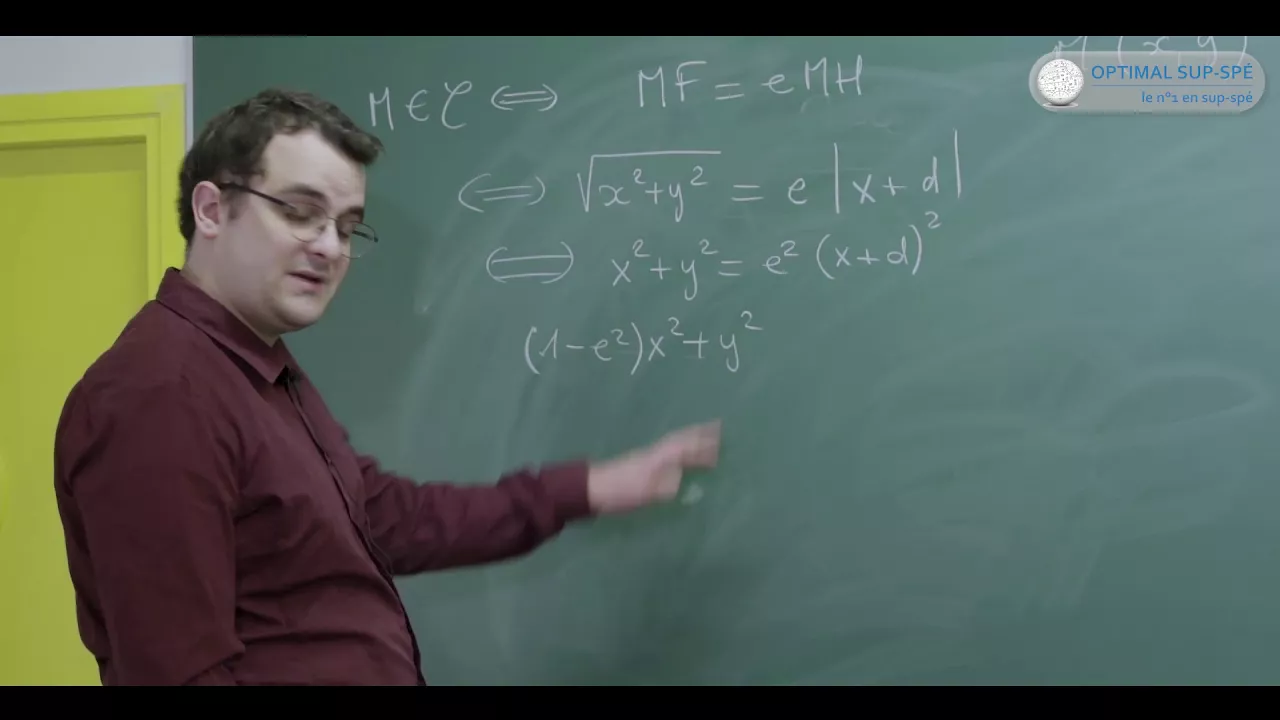


The polar of a point P with respect to a circle is the locus of the intersection points of tangents drawn at the endpoints of chords passing through P; for a circle x² + y² = a², the equation of the polar of point (x₁, y₁) is xx₁ + yy₁ = a², while for a general circle x² + y² + 2gx + 2fy + c = 0, the polar equation is xx₁ + yy₁ + g(x + x₁) + f(y + y₁) + c = 0; conversely, if the polar line is known, the corresponding pole can be found by comparing equations.
JEE Maths | Circles: Pole & Polar Explained with Equations
Added:Standard and general equations of a circle, including identifying the center and radius.
Equation of a tangent to a circle at a given point using the T = 0 notation.
Concept and equation of the Chord of Contact from an external point to a circle.
Fundamental coordinate geometry of straight lines, including slope-intercept form and condition of concurrency.
Properties and equations of conjugate points and conjugate lines with respect to a circle.
Extension of the Pole and Polar concept to other conic sections (Parabolas, Ellipses, and Hyperbolas).
Radical Axis, Radical Centre, and Coaxial Systems of Circles.
Application of Pole and Polar in solving advanced locus and geometry problems in JEE Advanced and Olympiad mathematics.
14.4K views380likes8:17Original Release: 2019-02-23
hello everyone in this session we will be doing a totally new concept of circle and that is polar and pole polar of a point is extremely important part of circles so let us first define what i mean by polar and for that i need a point p inside or outside circle and a line is drawn through that point p which meets the circle at q and r so picture is something like this i take a point p i draw a circle and then through p i draw a line which meets the circle at q and r this is what i have described right now what we do further is that at ends q and r i try to draw tangents and they meet at point p the question is that q r the way i have shown in the picture it is not the only position position q and r are varying positions i could have drawn line through p something like this also where i'm naming now n points where that line meets the circle as q dash and r dash and at q dash and r dash also i could have drawn tangents like previous way and then point of intersection of those two tangents what i've shown here as s is different from position t so as q and r move or as q and r change their positions obviously position t also changes this is what i want to tell you that point of intersection of tangents drawn at q and r is a varying position and hence locus of point t can be observed or can be understood so again i repeat if through point p inside or outside if line is drawn which meets the circle at q and r and if further i draw the tangents at the positions q and r and those tangents meet at point say as in picture t then t is a moving position and locus of point t can be understood what i've drawn here is that locus i have tried to show you by joining snt and which happens to be a line that line s t is important to us let me complete my sentence again statement again that if through point p a line is drawn which meets the circle at q and r then the locus of the point of intersection of tangents drawn at q and r is called the polar of p that means what i have shown there in the picture s t that line is polar of point p shown in the figure point p is inside here and s t is outside here picture could have been other way also that you try on your own point p you keep outside and then try to do similar exercise and through p there also you will be drawing a line which will meet circle at q and r draw two three lines and see q one has various positions draw tangents at the q and r various positions and see point of intersection of tangents when you join those points of intersection of tangents you will be getting polar correct so polar here is st and pole is point p so understand one thing in picture st is the polar and point p is the pole don't forget that okay now of course you all must be realizing this that we should be in position to write now equation of the polar so let us start with equation of the now if a pole is given as x 1 y 1 and circle is x square plus y square equal to a square straight away i am giving you equation of the polar and which is x x 1 plus y y 1 equal to a square had you taken point p outside then you would have understood the meaning that we are talking about chord of contact only and chord of contacts equation was same x x 1 plus y y 1 equal to a square but actually polar is further i should say more general expression rather than chord of contact for chord of contact point has to be outside here i am saying point can be inside or outside but equation is same as x x 1 plus y y 1 equal to y square ok again equation of the circle not necessarily b all the time x square plus y square equal to a square we will have to make provision for equation of the circle if it is x square plus y square plus 2 g x plus 2 f i plus c equal to 0 then what would be the equation of polar equation of the polar like again as equation of chord of contact would be x x 1 plus y y 1 plus g times x plus x 1 plus f times y plus y 1 equal to plus c equal to 0 so that is equation of the polar in two different situations let me take my illustration for clarifying things further now my illustration is that find the equation of the polar of point four comma 4 with respect to the circle x minus 1 whole square plus y minus 2 whole square equal to 1 i have taken your equation in the form x minus h whole square plus y minus k 1 square equal to r square of circle i am saying and this is not of the form x square plus y square plus 2 g x plus 2 f y plus c equal to 0 so you will have to rewrite that equation okay so i start x minus 1 whole square plus y minus 2 whole square equal to 1 i simplify that and i get x square plus y square minus 2 x minus 4 y plus 4 equal to 0 and then i know how to write equation of the polar it is x x 1 plus y 1 plus g times x plus x 1 plus f times y plus y 1 plus c equal to 0 what is x 1 here 4 what is y 1 here 4 substitute that and get finally your answer as 3x plus 2y minus 8 equal to 0 that is your equation of the polar of point 4 comma 4 with respect to the circle x minus 1 whole square plus 5 minus 2 whole square equal to 1 right let us proceed further and the next one is that i take one more illustration so that there will be finding pole okay so my next illustration is that find the pole of the line x upon a plus y upon b equal to 1 with respect to the circle x square plus y square equal to c square now here pole is to be obtained polar is given in previous question poll was given polar was to be obtained okay now how do we proceed from here now since paul you are interested in finding i will have to name it so i say let paul be h comma k right with this h comma k i know how to write polar's equation and that polar's equation using formula i'm saying it x x 1 plus y y 1 equal to y square that formula i'm saying using that you know how to write equation of the polar that i write as x h plus y k minus c square equal to 0 you can always compare this equation with the given polar because polar is given as x upon a plus y upon p equal to 1 and both stand for same thing so can't we compare them by comparing what we get that h upon 1 upon a equal to k upon 1 upon v equal to minus c square upon minus 1 which on simplification will give you h and k h turns out to be c square upon a and k turns out to be c square upon b and what was our job to get paul this h comma k we were interested in knowing so final answer for pole should be c square upon a comma c square upon b right so you can get pole also if polar is given or otherwise now here i end my session again something new will be coming your way in the next sessions till then stay tuned thank you hope you have liked this video to subscribe please click on this side or if you want to place an order for the book please click on this side thank you
Up Next
13:08
Conic Sections Through Five Points via Pappus' Theorem | Math Proof
@206p
14.3K views•2023-08-10
15:43
Pole and Polar in Projective Geometry: Harmonic Construction
@danielhafner1649
398 views•2021-01-28
10:44
Fourier Series Introduction: The Big Idea Explained
@DrTrefor
387K views•2021-05-03

6:00
The Mathematical Impossibility of Accurate World Maps
@Vox
23.3M views•2016-12-02
Related Study Plans & Knowledge Roadmaps
Structured learning paths in Mathematics
mathematics
Projective Geometry: Coordinates & Conics
01From Euclidean to Projective Space
02Homogeneous Coordinates
03Duality and Projective Transformations
+ 2 more learning modules
14h5 modules
Explore Roadmap
mathematics
Tensor Calculus: Vectors to Riemann Curvature
01Mathematical Foundations: Linear Algebra & Calculus
02Covectors, Dual Spaces, and Tensor Basics
03The Metric Tensor and Index Gymnastics
+ 2 more learning modules
40h5 modules
Explore Roadmap
mathematics
Gödel's Incompleteness: Logic, Proofs & Limits
01Introduction to Formal Systems & Hilbert's Dream
02Set Theory, Cardinality, and Cantor's Diagonal Argument
03Arithmetization and Gödel Numbering
+ 2 more learning modules
14h5 modules
Explore Roadmap
mathematics
Galois Theory: Fields, Groups & Solvability
01Foundations of Abstract Algebra: Groups & Fields
02Polynomials & Field Extensions
03Splitting Fields & Symmetries
+ 2 more learning modules
24h5 modules
Explore Roadmap