





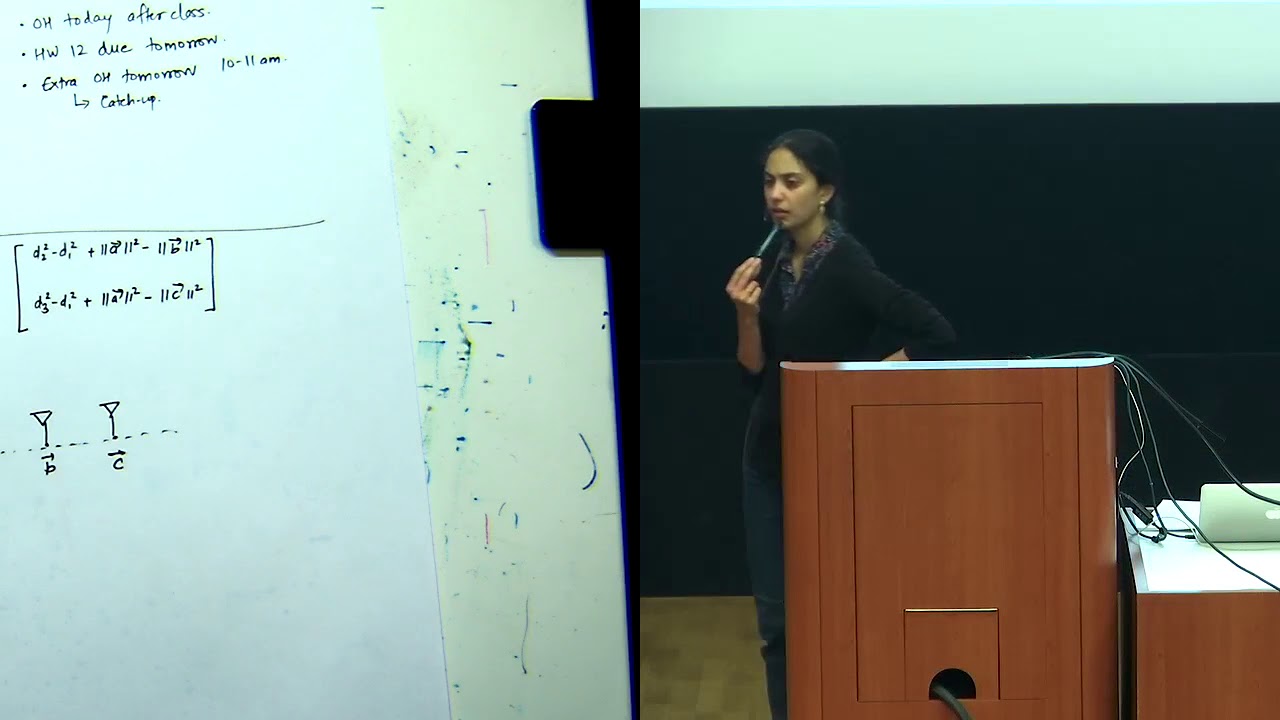





A conic section can be uniquely determined by five arbitrary points using Pappus' theorem from projective geometry, which states that if eight collinearity conditions are satisfied among nine points arranged in a specific configuration, the ninth collinearity condition is automatically implied; this allows deriving a conic section equation as a determinant expression that passes through all five points without solving a system of equations.
Conic Sections Through Five Points via Pappus' Theorem | Math Proof
Added:Fundamentals of projective geometry, including homogeneous coordinates and the projective plane.
The algebraic definition of general conic sections and their representation as quadratic equations.
Linear algebra concepts, particularly determinants, matrix representation of conics, and solving systems of linear equations.
Pappus's Hexagon Theorem, which describes the collinearity of intersection points of lines connecting six points on two lines.
Pascal's Mystic Hexagram Theorem, which generalizes Pappus's Theorem from line pairs to general conics.
Practical applications in Computer Vision and Image Processing, such as camera calibration and ellipse fitting from sparse image data.
Bézout's Theorem regarding the number of intersection points of algebraic curves.
Advanced topics in Algebraic Geometry, specifically the study of linear systems of curves and rational transformations.
14.3K views612likes13:08Original Release: 2023-08-10
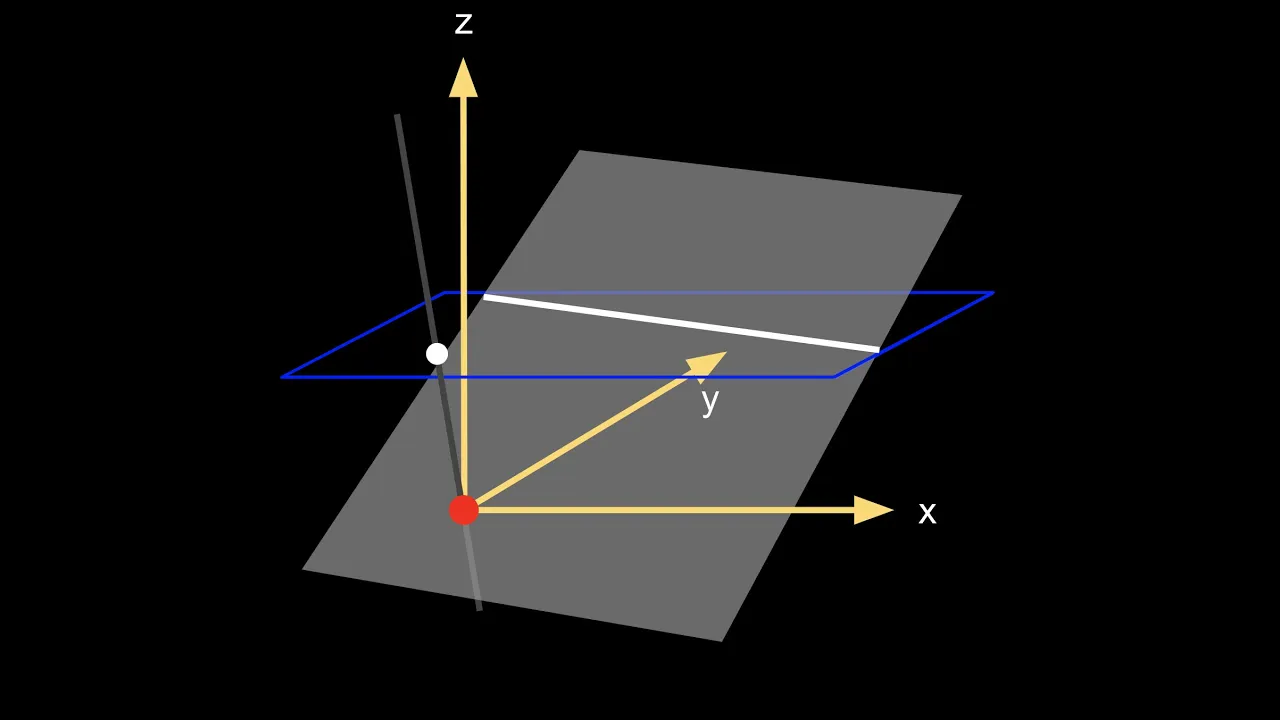
a conic section is formed by graphing a quadratic polynomial of X and Y equaling zero it includes hyperbolas parabolas up to two lines circles single points and ellipses let's say that I want to describe iconic section not by these coefficients but by some of the points that lie on the curve simply because it's cooler the number of required points is the same as the number of free parameters of the equation the equation seems to have six free parameters but I can always divide out a non-zero coefficient let's say the coefficient a and treat each new coefficient as a free parameter so there are actually five free parameters since there are five parameters I need five arbitrary points to solve for these parameters in terms of the coordinates of the points using these five equations however solving this system of equations looks way too complicated and even if I did the result will look too messy and be difficult to arrange to look nicer then how can I derive a conic section equation in terms of five solution points and have the equation look nice and what does nice even look like to answer that I'll look at another collection of points in something called the Papas configuration foreign consists of a set of nine points anywhere on the plane however they must follow 9 rules that restrict their positions relative to each other each rule demands that three certain points are cloneier when three points are linear there exists a line that can be on all three points for example these three points are clinier but now they're not cloneier since no long can be on all three points [Music] with this I can start constructing the Papas configuration given these nine arbitrary Place points I applied the first rule this rule restricts points one two and three typical linear there are many ways for these points to be linear so I'll just choose to move Point 2 to be aligned with points one and three the line marks that these points are linear the next rule is for points four five and six I'll choose to move point six next is points one five and seven I'm with 0.7 next is points three four and eight I'm with point four I've applied four rules so far note that these rules can be applied in any order but the order that I'm doing now is best for under setting the Pappas configuration I'll let the animations quickly do the next four the final rule is for point seven eight and nine I'm with Point wait these points are already linear well maybe it's just a coincidence I'll scatter the points and try again [Music] 0.78 and 9 are still clinier it's as if I don't even need the finality rule since the first aid already implied no matter where all the points are as long as the first eight rows are already there the ninth rule is always implied this is what is special about the Papas configuration and it's called papas's theorem I'll write it like this where the set with the nine rules equals the type with eight rules if I were to consider a different configuration with different linearity rules and a different number of points applying all but one of the rules doesn't always imply that excluded rule in this case all the rules but the rule for points 8 9 and 10 have been applied but points 8 9 and 10 are not linear I'd have to first move around many of the points in order to apply that rule [Music] now that I've shown the visualization of Topsy's theorem how do I formally prove it first I had to formally Define what it means for three points to be linear since collinearity involves the positions of three points maybe linearity can be Quantified as a function of the coordinates based on how align the points are when the points look more aligned the function value gets smaller and when the points look less aligned the function value gets larger when the points are fully aligned they are collinear and they function equals zero then what could this function be one possible function could be the area of the triangle formed by the points since the area decreases to zero when the points become linear I won't show you algebraic details but the area in turn to the coordinates is this since I only care about whether or not the function equals zero I can use a nicer function that would be two times the area to get rid of that one half Factor also the fact that this function could technically be negative doesn't matter since it still equals zero when the points are linear then this could be arranged further [Music] get this a third by three determinant this form of the area function reveals the truth behind where these points actually live in the Z equals one plane I'll now think of these points as 3D vectors on this plane where each Vector is a column of this determinant therefore if I create a parallel pipette formed by these three vectors its volume is the determinant when the points become linear the volume goes to zero I'll not say the determinants of three arbitrary vectors A B and C like this now I can algebraically and concisely write the clinology rules of the purpose configuration like this [Music] I have to show that the ninth equation is true using only the first eight equations in other words I had to manipulate the first eight equations to obtain the determinants of vectors 7 8 and 9 and show that it equals zero I'll do this by solving for those vectors in terms of vectors one through six taking the determinants of them and showing that it equals zero [Music] this is the Papas configuration on the Z equals one plane I'll start with solving for Vector 7 first there are two equations that contain Vector 7 that I can use to solve for it visually these two equations represent two lines intersecting at Vector seven with the other four vectors on their respective lines there is a visual way to obtain Vector 7 in terms of the other four vectors but the cross products make it hard to work with instead I want to express Vector 7 as a linear combination of these four vectors as you'll see how that will be helpful later since Factor 7 is collinear with vectors 1 and 5 and vets four and two Vector 7 actually doesn't need to be a linear combination of all four vectors but only of either vectors one and five or vectors four and two for convenience I'll choose vectors 4 and 2.
then I'll solve this into the two equations and simplify using the properties that determinants can distribute over vector addition and can have scalars factored out there are determinants that contain two of the same vectors visually when two of three vectors equal each other their volume and thus determinant equals zero so the second equation can be used to solve for C and D however from Vector 7 its Z component must equal one so I can get another equation with these two equations I can solve for c and d and simplify vector 7.
[Music] now I can get the same kind of result for vectors 8 and 9 since they come from the same kind of equations next I'll take the determinants of these vectors I can factor out the three scalars and then expand the determinants since Vector 7 8 and 9 are expressed as linear combinations but before I do that I'll temporarily multiply the scalars to the other side to leave more room for the expanded determinants [Music] okay foreign overall there are eight terms I'll do some rearranging using the property that's swapping vectors in the determinants negate them so swapping twice doesn't change the sign [Music] I find that three pairs of terms cancel [Music] next I'll use the remaining two clinology rules the determinants of vectors one two and three could be substant to the first term and the determinants of vectors four five and six can be subbed into the second term making the whole thing equal zero this means that these eight equations imply that the determinants of vectors 7 8 and 9 equals zero proving pappas's theorem in order to make a connection to conic sections I'll examine these simplified determinants of vectors seven eight and nine before I subbed in the last two determinants the key difference is that I'll decide to have the expression still equal zero I have no mathematical justification for this decision I just want to see what happens then what would happen if I just replaced any Vector with a plotting Vector with the coordinates x y and one and graph the equation I'll arbitrarily choose to replace vector 6.
[Music] first I can multiply out the denominator but before I actually graph anything I'll try to determine a general idea of what the graph would look like just from the equation I'll expand the determinants that contain the plotting vector the other determinants are constants relative to X and Y so each term is in the form of the product of a constant and two linear polynomials of X and Y this means that the equation is in the form of a quadratic polynomial of X and Y equaling zero which is a conic section next I'll check what happens if the plotting Vector equals Vector one after some rearranging the left side of the equation simplifies to zero so Vector 1 is a solution to the equation then I'll track the same thing for the remaining four vectors foreign cases also satisfy the equation this means that I know that the graph of the equation will intersect vectors one through five and for the sake of symmetry I can replace any of the other vectors with a plotting vector and still get the same kind of result [Music] technically the denominator that I multiplied out can also equal zero but I don't want the conic section to have holes at where the denominator would equal zero so I'll still ignore it this is the equation graphed but now it is more convenient to show this on the 2D plane I'll rearrange the equation once more to make it look nicer as you can see the Five Points can move anywhere and the conic section will always intersect all of them [Music] I could also create part of the Papas configuration on the five points and the conic section since the equation technically comes from the clinarity of 0.78 and 9. 6 can just be any position on the conic section so it turns out that the interpolation form of the conic section equation is in the form of a difference of two products of four third by three determinants equaling zero this definitely looks nicer than the result of solving for polynomial coefficients from a system of five equations in terms of 10 variables the fact that iconic section can be interpolated from Five Points is called the Breaking Ridge McLaurin theorem however the conic section equation used for this theorem is this it has the same properties as the equation that I found where if I sub in any of the five points they satisfy the equation since determinants with two of the same rows always equal zero this equation also looks neat but I feel like it feels less natural because it's written using the coordinates of the five points and not the points or vectors themselves unlike the other equation I have a Desmos link of the interpolated iconic section equation in the description or you can move around the Five Points yourself and see how the conic section changes
Up Next

8:17
JEE Maths | Circles: Pole & Polar Explained with Equations
@TargetPublications
14.4K views•2019-02-23
15:43
Pole and Polar in Projective Geometry: Harmonic Construction
@danielhafner1649
398 views•2021-01-28
10:44
Fourier Series Introduction: The Big Idea Explained
@DrTrefor
387K views•2021-05-03
6:00
The Mathematical Impossibility of Accurate World Maps
@Vox
23.3M views•2016-12-02
Related Study Plans & Knowledge Roadmaps
Structured learning paths in Mathematics
mathematics
Projective Geometry: Coordinates & Conics
01From Euclidean to Projective Space
02Homogeneous Coordinates
03Duality and Projective Transformations
+ 2 more learning modules
14h5 modules
Explore Roadmap
mathematics
Tensor Calculus: Vectors to Riemann Curvature
01Mathematical Foundations: Linear Algebra & Calculus
02Covectors, Dual Spaces, and Tensor Basics
03The Metric Tensor and Index Gymnastics
+ 2 more learning modules
40h5 modules
Explore Roadmap
mathematics
Gödel's Incompleteness: Logic, Proofs & Limits
01Introduction to Formal Systems & Hilbert's Dream
02Set Theory, Cardinality, and Cantor's Diagonal Argument
03Arithmetization and Gödel Numbering
+ 2 more learning modules
14h5 modules
Explore Roadmap
mathematics
Galois Theory: Fields, Groups & Solvability
01Foundations of Abstract Algebra: Groups & Fields
02Polynomials & Field Extensions
03Splitting Fields & Symmetries
+ 2 more learning modules
24h5 modules
Explore Roadmap