












Projective geometry provides a unified mathematical framework that extends Euclidean geometry by introducing points at infinity, allowing parallel lines to intersect and proving that all 2D quadratic curves are conic sections; it formulates Euclidean, spherical, and hyperbolic geometries using linear algebra where projective points are represented as column spaces of matrices and projective lines as null spaces, with the key insight that all projective quadratic curves form double cones through the origin, thereby showing that all typical 2D quadratic curves are conic sections.
Projective Geometry via Linear Algebra Explained Intuitively
Added:Fundamental Linear Algebra: Solid understanding of vector spaces, basis, dimension, linear transformations, and matrix operations.
Euclidean Coordinate Geometry: Familiarity with Cartesian coordinates and the standard algebraic equations for conic sections (ellipses, parabolas, and hyperbolas).
Equivalence Relations and Quotient Spaces: Conceptual understanding of equivalence classes, which is essential for grasping how homogeneous coordinates represent projective points.
Basic Geometric Transformations: Experience with translation, rotation, and scaling matrices in standard 2D and 3D Euclidean space.
Felix Klein's Erlangen Program: Studying how projective geometry serves as a universal framework that unifies Euclidean, affine, and non-Euclidean geometries through group theory.
Computer Vision and 3D Reconstruction: Applying homogeneous coordinates to camera calibration, epipolar geometry, stereo vision, and image homography.
Projective Duality and Classic Theorems: Exploring the elegant duality between points and lines, alongside advanced geometric results such as Desargues's and Pascal's theorems.
Introduction to Algebraic Geometry: Transitioning from linear systems to the study of projective varieties, which are defined by systems of homogeneous polynomials.
46.2K views1.5Klikes28:31Original Release: 2022-07-23
today i want to talk about projective geometry which is simpler but more powerful and in my opinion more beautiful than conventional euclidean geometry it makes parallel lines intersect it proves that all 2d quadratic curves are conic sections and it can also formulate euclidean spherical and hyperbolic geometries in almost identical ways i also want to talk about a formulation of projective geometry in terms of linear algebra here is one way projective geometry could have been discovered and it begins with parallel lines they don't intersect but in a way it seems like they should suppose we stand on top of a plane containing two parallel lines on opposite sides of us if we look at everything with one eye it seems like these parallel lines intersect at the horizon at some imaginary point infinitely far away from us so maybe parallel lines intersect at a point at infinity how can we formalize this let's consider two lines that obviously intersect in the plane which we will call our ground let's draw a ray coming out of our eye and pointing towards that intersection point now let's turn the lines so that they gradually become more and more parallel to each other the intersection point will move further and further away from us and our ray coming out of our eye will adjust accordingly in the limit when the two lines are parallel the intersection point is gone but our array coming out of our eye has a well-defined limit it has become parallel to the ground and pointing in the same direction as both of our lines so maybe this ray can represent the point at infinity in fact given any point on the ground we can replace it with a ray coming out of our eye pointing towards that point on the ground so maybe we can replace all points on the ground with rays coming out of our eyes but this leads to a problem if we change the way we make the lines more parallel to each other it's possible to end up with a limiting ray that points in the opposite direction of the ray we had before this wouldn't make sense because two lines are supposed to intersect in at most one point the solution is to use a line through our eye to define a projective point rather than array through our eye now how do we define a projective line let's consider a regular line on the ground this line is made up of points we can use our previous definition of a projective point to replace each point on the ground with its corresponding line through our eye if we do this for all points in the line we end up with a plane through our eye however you might notice that there is one line through our eye that is missing and that is the line that points in the same direction as the line in the ground but which is also parallel to the ground this represents a point at infinity and for reasons that will become clear very soon it is extremely important that we include this in our plane doing so has an interesting geometric consequence it means that every projective line contains exactly one point at infinity using these definitions of projective points in lines we have that two projective points form a projective line two projective lines intersect at a projective point two parallel projective lines intersect at a projective point at infinity which we saw earlier for this to work we had to have included a projective point at infinity inside each projective line otherwise two parallel projective lines would not intersect at all because their corresponding planes through the eye would not include the necessary line through the eye that was parallel to the ground what about two projective points at infinity here we get a plane through our eye that is parallel to the ground we can interpret this as a projective line at infinity let's put everything we have into 3d coordinates we'll put the i at the origin in the ground at the plane z equals 1. let's also represent every 2d point x y in our ground with the 3d point x y 1.
how do we represent a line to the origin let's say it intersects at some point x y z we'll call this the projective point x colon y colon z x y and z cannot all be zero otherwise it would not be possible to make a line then if z is not equal to zero this line will intersect the ground at the point x over z y over z one so it represents the 2d coordinate x over z y over z in our ground if z equals zero then we get a line parallel to the ground through the origin aka a point at infinity notice that if we scale x y and z by some number lambda not equal to zero we get the same projective point this system of representing projective points is known as homogeneous coordinates now how do we represent a projective line let's look at a normal line in 2d coordinates the general equation is ax plus b y plus c equals 0.
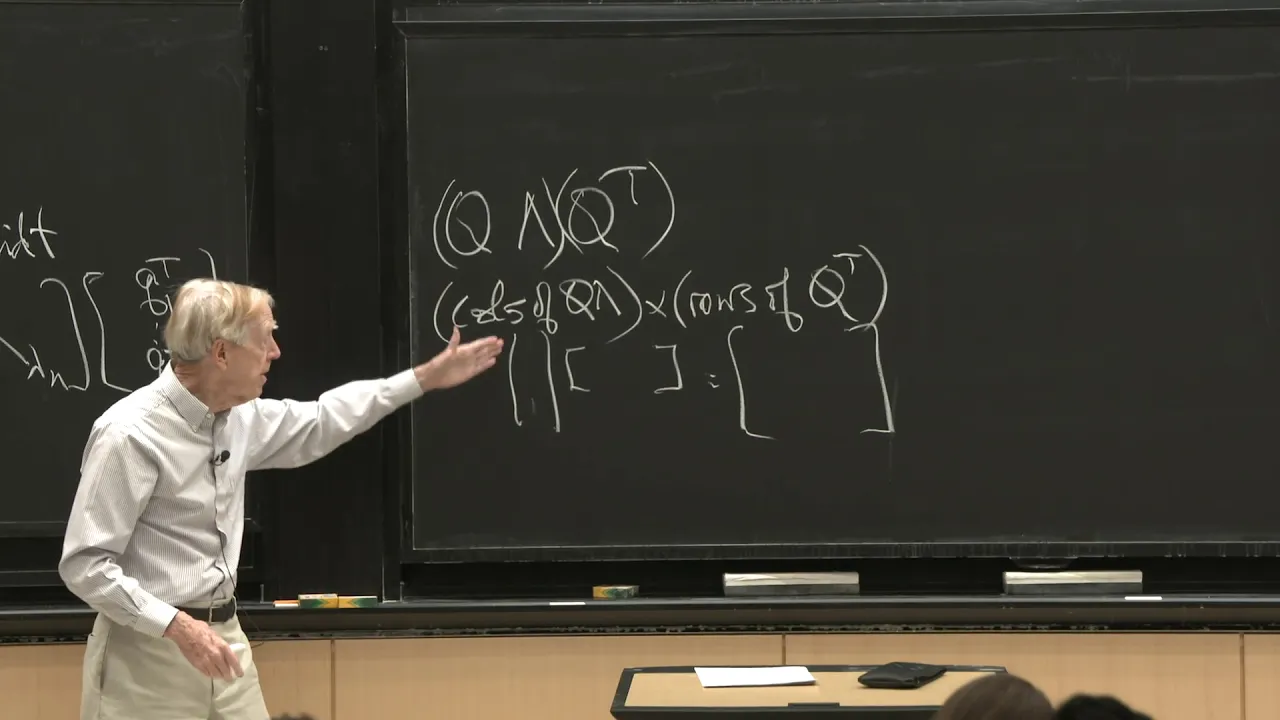
now we saw before that a 3d coordinate xyz could represent the projective point x colon y colon z which represents the coordinates x over z comma y over z in 2d projective geometry aka our ground assuming z is not equal to zero we want this 2d coordinate to be inside our original line so we take our original equation and replace x and y with x over z and y over z respectively now we'll do something that seems a little unusual we will get rid of the denominator z by multiplying both sides of the equation by z the right side of the equation is zero so if we multiply by z it stays zero the left side however changes into ax plus by plus cz and this is our final equation for the projective line a really important reason why we multiply both sides of our original equation by z is that our new equation allows z to equal zero so our projective line actually includes a point at infinity here is what a normal line and its corresponding projective line would look like now what are the formulas for turning two points into a line or the intersection point of two lines we will find that out later let's look at how to turn quadratic curves into projective quadratic curves here's a circle parabola and a hyperbola using similar reasoning as before we replace x and y with x over z and y over z respectively then we get rid of the denominators here we have to multiply both sides of each equation by z squared instead of z here is what a general quadratic curve will become once we apply this procedure this process of turning curves into projective curves is also known as homogenization because we take a polynomial and add a new variable such that each term in the new polynomial ends up having the same degree here is what the circle parabola and hyperbola look like in regular 2d coordinates and here is what their projective counterparts look like in 3d they're shown in red and the ground z equals one is shown in light blue notice that the intersection of the red region with the blue plane in each case corresponds exactly to the 2d versions of the circle parabola and hyperbola now you might notice that the red regions in all three pictures which are projective quadratic curves all form double cones is this always true for every projective quadratic curve we will also find that out later let's also look at non-euclidean geometries if we replace the ground z equals one with the unit sphere centered at the origin we get spherical geometry a line to the origin forms a pair of antipodal points on the sphere which we can call a spherical point and a plane to the origin intersects the sphere at a great circle which we can call a spherical line then two spherical lines always make a spherical point there are no spherical points at infinity so that means parallel lines do not exist in spherical geometry if we replace the ground with a two sheeted hyperboloid x squared plus y squared minus z squared equals negative one we get hyperbolic geometry specifically the minkowski model aligned to the origin if it intersects the hyperboloid will form a pair of antipodal points we can call this a hyperbolic point a plane to the origin if it intersects a hyperboloid will form a hyperbola that goes across the two sheets we can call this a hyperbolic line now although two planes to the origin always intersect at a line through the origin as long as the planes are distinct because that line to the origin does not always have to intersect the hyperboloid the corresponding two hyperbolic lines do not always have to intersect the first case is where that line to the origin is asymptotic to the hyperboloid this means that it can get arbitrarily close to the hyperboloid but it never intersects it in this case the hyperbolic lines are said to be limiting parallel so in some sense they metaphorically meet at infinity because the hyperbolic lines become arbitrarily close to each other if that line to the origin does not intersect the hyperboloid and is not asymptotic to it either then our hyperbolic lines are said to be ultra parallel which means that they never meet even at infinity one last thing i should add before we move on to the main topic is distance projective geometry by itself does not have a concept of distance so when formulating euclidean spherical and hyperbolic geometries we must create a definition of distance for euclidean geometry we can take two projective points find their intersections with the ground and then simply calculate the standard euclidean distance between those point intersections this only works if both projective points intersect the ground i.e neither point is a point at infinity in spherical geometry we can use the smallest arc length between two antipodal pairs of points on the sphere those familiar with vectors may realize that this can be done using the vector dot product and the inverse cosine function for hyperbolic geometry distance is a bit more complicated we need to use the smallest minkowski arc length between antipodal pairs of points on the hyperboloid here infinitesimal length ds is defined as the square root of dx squared plus dy squared minus dz squared instead of the square root of dx squared plus dy squared plus dz squared at this point the rest of the video will be about these two questions posed earlier first what are the formulas for forming a line from two points or finding the intersection point of two lines and second do all projective quadratic curves form double cones we will answer both of these questions with linear algebra let's first redefine a projective point aka aligned to the origin in a slightly different way say that a line to the origin intersects the 3d point rst this line to the origin contains all points lambda r lambda s lambda t for all real numbers lambda we can represent each 3d coordinate xyz as the column vector xyz this means that we can represent our line to the origin as the column space of the three by one matrix r s t what about a projective line ax plus b y plus c z equals zero we can represent this equation as row vector abc times column vector x y z equals the one by one matrix zero this means that our projective line is the null space of the one by three matrix abc however there is an alternative and arguably more natural way of defining a plane to the origin we can define it as the span of two vectors or rather as the column space of a three by two matrix so are these two representations of planes of the origin equivalent more generally if we have the column space of some matrix a can we represent it as the null space of another matrix b where a has n rows and b has n columns by representing we mean that the column space of a has to equal the null space of b and given either a or b we need to find the other now one direction of conversion between column space and null space is somewhat easy if we have the matrix b we can make the columns of a form a basis of null space b we can find this basis via row reduction on b more on that later the other direction is a bit trickier given a how do we find a valid b first all vectors in the column space of a are in the null space of b so for any appropriately dimensioned vector u b times a u equals all zeros vector so the matrix b a equals all zeros we can transpose this equation to get a transpose times b transpose equals all zeros this means that for any appropriately dimensioned vector v a transpose times b transpose v equals the all zeros vector so the column space of b transpose is in the null space of a transpose from the equation column space a equals null space b we also have that the dimension of both of these spaces are equal so rank of a equals nullity of b using the row rank equals column writing theorem we have that rank of a equals rank of a transpose using the rank nullity theorem we have that the rank of a transpose equals n minus the nullity of a transpose and the nullity of b is equal to n minus the rank of b thus the rank of b equals the nullity of a transpose using the row rank equals column rank theorem again we have that the rank of b transpose equals the null d of a transpose therefore we have that the column space of b transpose equals the null space of a transpose we can construct a valid matrix b by having the columns of b transpose form a basis of the null space of a transpose and such a basis can also be found by row reduction so column space and null space representations can always be converted into each other making these two representations equally powerful let's try converting column space representation to null space representation of a plane through the origin in 3d space here a is the three by two matrix a d b e c f in row major order a transpose equals the two by three matrix a abcdef now let's do row reduction but there are a few twists we want to avoid edge cases specifically we want to avoid possible division by zero we can do that by avoiding division altogether now in order for row reduction to be possible we need to relax one of its rules namely we need to allow each row to have a leading coefficient not equal to one as a result we want to turn a transpose into this form shown here using row operations where each asterisk represents some arbitrary value let's eliminate this cell where the d term currently is we can do that by first multiplying the top row by d in the bottom row by a which will make the leading terms of both rows become a d then subtracting the first row from the second row this means the second row ends up becoming zero then ae minus bd then af minus cd to eliminate the other term where the b currently is we can use a similar process as shown we can represent all these row operations by multiplying some matrix on the left of a transpose in this case that matrix is two by two e negative b negative d a we end up with the matrix on the right hand side as shown here from this we can use a bit of algebra to show that all vectors that are in the null space of this matrix must be parallel to the vector b f minus c e c d minus a f a e minus b d so this single vector forms a basis for the null space of that matrix therefore we can set b to this row vector as shown one might notice that this expression for b is almost identical to the cross product of abc with def so essentially we have derived the cross product by using row reduction this expression for b means that two projective points a colon b column c and d colon e colon f form this projective line as shown so this is a formula for making a line from two points we can prove correctness as follows first we can show that b times a equals all zeros which can be shown directly second rank of b equals one assuming rank of a equals two this is a necessary assumption because otherwise the projective points a colon b colon c and d colon e colon f would in fact be identical projective points notice that b can be written as shown with determinants also using the row rank equals column rank theorem we have that the rank of a transpose equals two this means that at least two of the column vectors a d b e and c f are linearly independent using facts about determinants this means that at least one component of b is not equal to zero therefore the rank of b is equal to one thus the null d of b is two and combined with the previous fact that b a equals all zeros this means that the column space of a equals a null space of b so our formula for b is indeed correct surprisingly the formula for b is correct even if a e minus b d equals zero this would not be obvious if we look directly at the intermediate matrix that we used to calculate the null space of why should we bother switching between column space and null space representations the column space representation makes it easy to calculate the span of two objects and null space representation makes it easy to calculate the intersection of two objects so by switching between these two representations we can calculate the span and intersection between two objects with relative ease from here it can be shown that in 3d space the intersection of two planes to the origin is in fact aligned through the origin note that this is not necessarily true in higher dimensions i will leave the exact formula as an exercise to the viewer since the projective point is aligned to the origin and a projective line is a plane to the origin linear algebra confirms our geometric intuition from earlier in which two projective points form a projective line and two projective lines intersect at a projective point in 2d projective geometry let's extend to one higher dimension here we are dealing with 3d projective geometry so we need to use 4d linear algebra here is what a point a line in a plane look like in column space representation notice that each of these objects are actually a line a plane and a three space that goes to the origin in 4d space let's convert from column space to null space representation for a three space to the origin we need to find some matrix m such that m times a transpose becomes this form if we write out each of the elements of m and a transpose and then focus on the zeros on the right hand side we get these three equations these equations look really familiar in fact they're exactly the kind of equation we dealt with when converting from column space to null space representation of a plane to the origin in 3d space so we can use the same formula and we have just found a matrix m if we multiply this with a transpose we get this matrix here which can be represented using three by three determinants after a bit of simplifying we can extract a null space basis for this matrix and we can set b to this matrix here for some exercises convert from column space to null space representation for a four by two matrix a instead of a four by three matrix a and convert from column space to null space representation for higher dimensional projective geometry and vice versa now we address our second and final big question do all projective quadratic curves make double cones first we will define the standard double cone to be x squared plus y squared minus z squared equals zero shown in this picture here notice that this is the projective version of the unit circle centered at the origin we can write that expression into this form shown here we can then insert arbitrary coefficients as follows which corresponds to placing arbitrary coefficients along the main diagonal of the middle matrix as shown to get access stretched versions and access aligned rotated versions of the standard double cone we can also represent a general projective quadratic curve as shown here notice that the middle 3x3 matrix is symmetric this will be very important because we can write these expressions in this specific matrix equation they are also known as quadratic forms now our goal is to take any projective quadratic curve and apply some stretching and or rotating about the origin to get an axis stretched standard double cone this means that we want to turn the equation v transpose times a times v equals all zeros for some symmetric a into u transpose times d times u equals all zeros for some diagonal matrix d stretching and rotating about the origin means linearly transforming so that means we want some matrix b such that v transpose av equals all zeros implies b v all transpose times d times b v equals all zeros for diagonal d what's going on here is that we want to find some diagonal d and some matrix b such that given any vector v inside the quadratic curve defined by matrix a transforming it by b will make it become inside the quadratic curve defined by matrix d doing some algebra the equation b v all transpose times d times b v equals all zeros is equivalent to the equation v transpose times b transpose db times v equals all zeros if we have a equals b transpose times d times b our goal will be achieved and it turns out because a is symmetric this is always possible by the spectral theorem for symmetric matrices so do all projective quadratic curves make double cones the answer is yes although some curves might make degenerate double cones what's the main takeaway from this remember what a regular and a projective quadratic curve are a regular 2d quadratic curve is its projective version intersected with the plane z equals one which remember is the ground that we're using in standard projective geometry geometrically this means that a regular quadratic curve is a double cone intersected with a plane therefore all 2d quadratic curves are conic sections possibly degenerate conic sections in summary we started with a question about whether or not parallel lines intersect and got an entire form of geometry projective geometry is essentially euclidean geometry with points at infinity and without a notion of distance projective points lines planes three spaces etc can all be defined as column spaces of certain matrices in summary we started with a question about parallel lines and from that we created an entire field of geometry projective geometry is essentially euclidean geometry with points at infinity and without a notion of distance projective points lines planes three spaces etc can be defined as column spaces of certain matrices which can then be converted to and from null spaces of other matrices when using the appropriate representation of these objects calculating their spans and intersections with each other becomes as simple as concatenating matrices and most of the work in converting between column space and null space representation comes down to row reduction also for a 3d linear algebra when converting from column space to null space representation of a plane to the origin we accidentally discovered the cross product additionally all 2d projective quadratic curves are double cones through the origin this means that all typical 2d quadratic curves are conic sections finally projective geometry can be used to formulate euclidean spherical and hyperbolic geometries even though it does not have a concept of distance i still think these properties of projective geometry make it worth further investigating and seeing if it can be applied to more areas of mathematics what do you think
Up Next

70:19
Homogeneous Coordinates: A Lecture by Cyrill Stachniss (2020)
@CyrillStachniss
32.2K views•2020-08-20

8:17
JEE Maths | Circles: Pole & Polar Explained with Equations
@TargetPublications
14.4K views•2019-02-23
10:44
Fourier Series Introduction: The Big Idea Explained
@DrTrefor
387K views•2021-05-03

6:00
The Mathematical Impossibility of Accurate World Maps
@Vox
23.3M views•2016-12-02
Related Study Plans & Knowledge Roadmaps
Structured learning paths in Mathematics
mathematics
Projective Geometry: Coordinates & Conics
01From Euclidean to Projective Space
02Homogeneous Coordinates
03Duality and Projective Transformations
+ 2 more learning modules
14h5 modules
Explore Roadmap
mathematics
Tensor Calculus: Vectors to Riemann Curvature
01Mathematical Foundations: Linear Algebra & Calculus
02Covectors, Dual Spaces, and Tensor Basics
03The Metric Tensor and Index Gymnastics
+ 2 more learning modules
40h5 modules
Explore Roadmap
mathematics
Gödel's Incompleteness: Logic, Proofs & Limits
01Introduction to Formal Systems & Hilbert's Dream
02Set Theory, Cardinality, and Cantor's Diagonal Argument
03Arithmetization and Gödel Numbering
+ 2 more learning modules
14h5 modules
Explore Roadmap
mathematics
Galois Theory: Fields, Groups & Solvability
01Foundations of Abstract Algebra: Groups & Fields
02Polynomials & Field Extensions
03Splitting Fields & Symmetries
+ 2 more learning modules
24h5 modules
Explore Roadmap