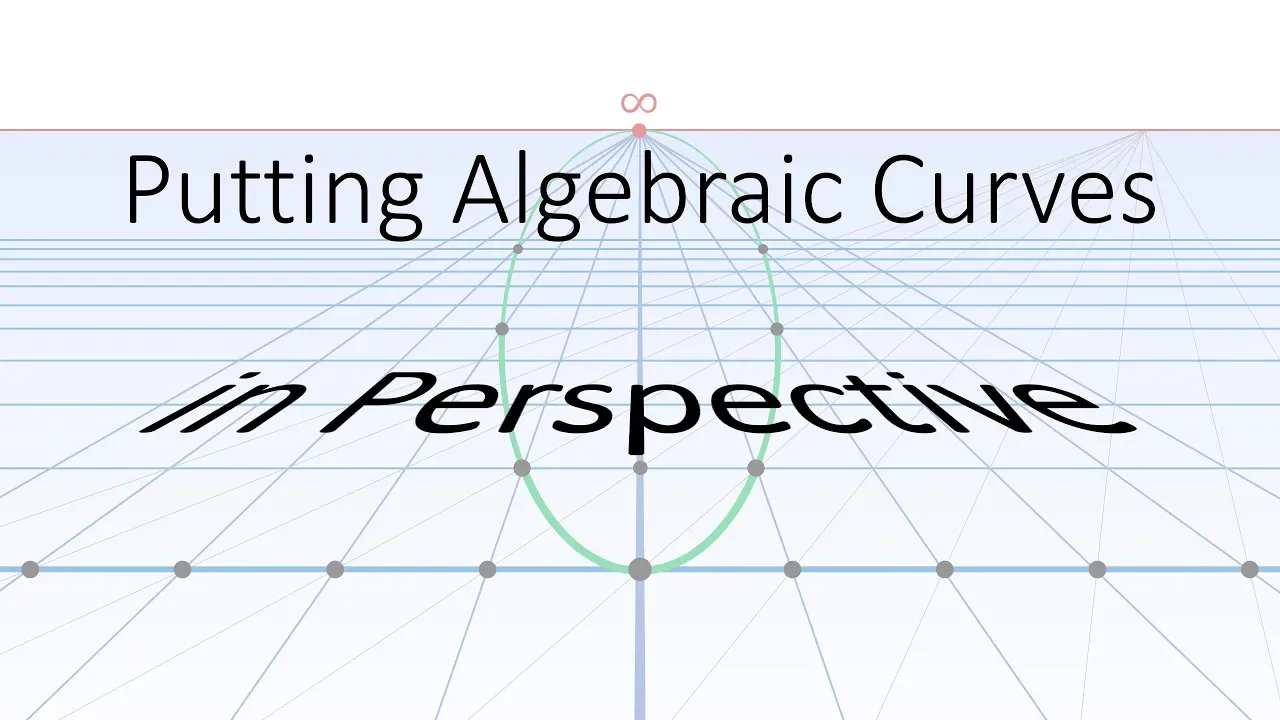
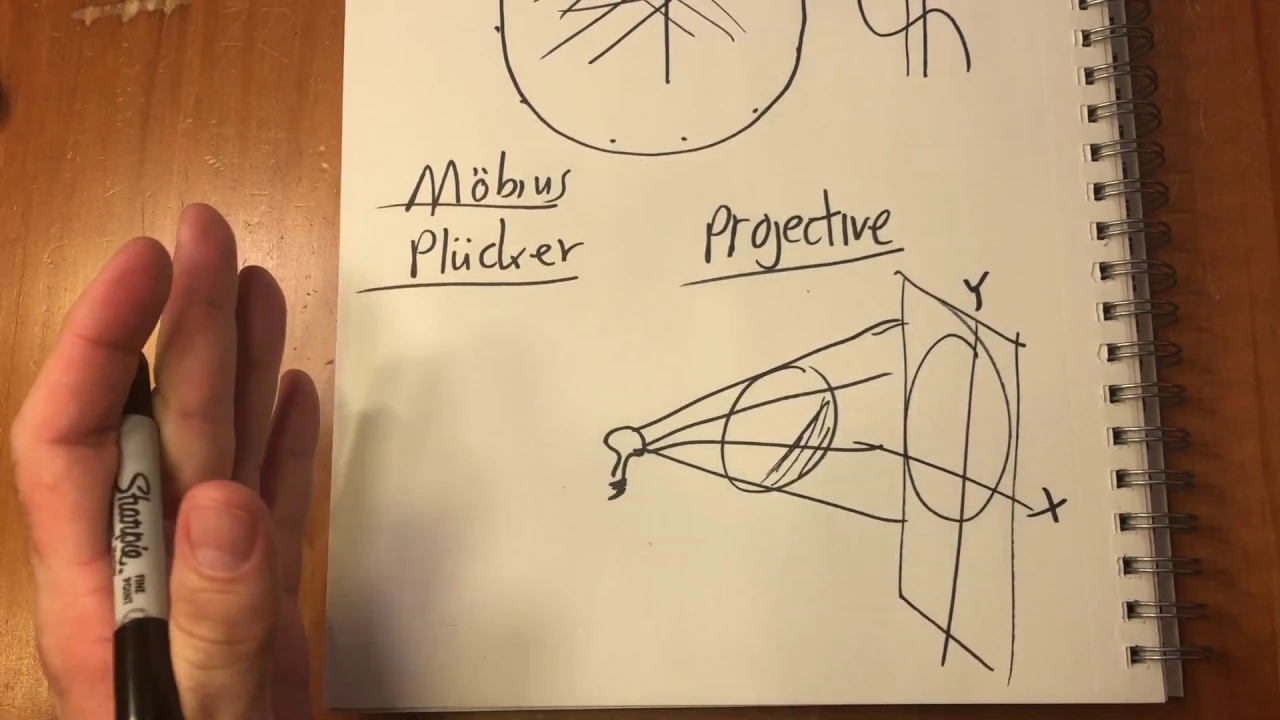








In projective geometry, the pole of a point with respect to a conic is a line such that any line through the pole intersects the conic in a harmonic range, and conversely, the polar of a line is a point such that any point on the line creates a harmonic pencil with the conic; this reciprocal relationship allows constructing tangents to conics using only a straightedge by finding harmonic conjugates, and the whole construction works for circles seen in perspective (conic sections) because the pole-polar relationship relies solely on incidence rather than metric properties.
Pole and Polar in Projective Geometry: Harmonic Construction
Added:Fundamental concepts of Projectivity, including the projective plane, points and lines at infinity, and homogeneous coordinates.
Basic algebraic and geometric properties of conic sections (ellipses, parabolas, and hyperbolas).
The concept of cross-ratio and the mathematical definition of a harmonic bundle of collinear points.
The distinction between metric geometry (Euclidean constructions) and synthetic projective geometry (straight-edge only constructions).
The Principle of Projective Duality, exploring how theorems about points map to dual theorems about lines.
Pascal's Theorem and Brianchon's Theorem, analyzing their dual relationship and applications to hexagons inscribed in conics.
Analytical representation of poles and polars using symmetric conic matrices and bilinear forms in homogeneous coordinates.
Practical applications in Computer Vision, such as camera calibration, 3D reconstruction, and epipolar geometry using projective relations.
398 views10likes15:43Original Release: 2021-01-28
a diameter of a circle is an axis of symmetry it is a metrical entity but it can still be understood morphologically namely it is the axis of a harmonic mirroring whose center is the infinitely distant point perpendicular to the axis that is any point a on the circle determines a line in the center p which in turn determines a point q in the axis p now our usual method of completing a quadrangle gives us the harmonic conjugate b of a with respect to p and q and b will always lie on the circle pause if you want to polarize this procedure on your own any line a on the circle determines a point in the axis p which in turn determines a line q in the center p now our usual method of completing a quadrilateral gives us the harmonic conjugate b of a with respect to p and q and b will always lie on the circle can a circle be mirrored harmonically unto itself from a center that is not infinitely distant choose a center elsewhere in the plane and construct from it a complete quadrangle on the circle the diagonal associates the four points on the circle pairwise harmonically test construct a different complete quadrangle from the same center on the same circle and you get the same diagonal conclusion any line from the center of harmonic symmetry through the circle and the diagonal gives a harmonic range when the line rotates into either tangent the two intersections with the circle coincide so the tangent points are the double points of a hyperbolic involution in case you know what that means ask your friends from the previous cultural epoch whether they know how to construct tangents without a compass we call the point p the pole of the line p with respect to the circle and the line p the polar of the point p let the pole travel out to the infinite distance and you again have symmetrical mirroring at the diameter try the same construction from a pole inside the circle and the polar lies outside here again two harmonic ranges are marked apply the same test by choosing two other lines in the pole and the diagonal again remains unchanged this time there are no visible tangents in the pole the involution is elliptical and has no visible double points involution will be introduced properly soon the whole construction relying solely on incidents it works on circles seen in perspective as well also known as conic sections move the pole closer to the circle and the polar approaches move the pole onto the circle and the polar becomes the tangent at that point if the pole lies in the interior of the conic the polar does not and vice versa move the pole to the metrical center and the polar becomes the infinitely distant line now start from a polar and find the pole choose any line in the plane and construct from it a complete quadrilateral on the conic the diagonal point associates the four lines on the circle pairwise harmonically test construct a different quadrilateral from the same axis on the same circle and you get the same diagonal point conclusion any point in the polar gives a harmonic pencil by connecting with the conic and the pole preview this holds good even if the point in the polar does not generate any visible tangents likewise even if the line in the pole does not generate any visible tangent points it does generate a harmonic range by connecting with the conic and the polar more about that when we get around to the so-called imaginary elements in a later presentation note that this way of constructing a pole and its polar actually gives you three now think the construction in movement it always associates the same pole and polar but the polar triangle shown here in yellow shifts and with it so do the tangents it follows the tangents whose tangent points align with the pole intersect in the polar and tangent points whose tangents intersect in the polar align with the pole and that leads to the fundamental theorem of pole and polar the pole of any line in a pole lies in the polar and the polar of any point in a polar lies in the pole this is easy to understand if you see the conic as the perspective image of a circle the pole as its center and the polar as the horizon the tangent points align with the pole meaning they lie pairwise opposite one another on the circle which is to say that the tangents there lie parallel so of course they are going to meet in the horizon or if the pole lies outside the circle you can see it as the vanishing point and the polar as a diameter remember the steiner constructions for conics the points joining corresponding lines of two projective pencils plot iconic the lines joining corresponding points of two projective ranges envelop a conic last time we saw that cross points or cross lines give the center or the axis of a projectivity with respect to the steiner curve these turn out to be the pole of the line connecting the two projective pencils and the polar of the intersection of the two projective ranges respectively given a point and a line not in it construct a conic such that they are pole and polar choose one point of the conic and find its harmonic conjugate with respect to p and p repeat and once more once you have six points there is no more choosing complete the conic with one of the methods shown in the earlier presentations namely steiner or descartes pause if you want to polarize on your own choose one line of the conic and find its harmonic conjugate with respect to p and p repeat and once more once you have six lines there is no more choosing complete the conic with one of the methods shown in earlier presentations namely steiner or bryon given two poles and their respective polars construct a conic first of all the point joining the two polars has to be the pole of the line joining the two poles so you already have three note that this is not a polar triangle though assuming you started with general position choose a point of the conic and construct its three harmonic conjugates with respect to the three pairs of pole and polar now keep repeating this procedure with the new points in this case the further points are not going to be farther points they are all going to approach line r to reach other areas use steiner or descartes pause if you want to polarize on your own choose a line of the conic and construct its three harmonic conjugates with respect to the three pairs of pole and polar now keep repeating this procedure with the new lines to reach inaccessible areas use steiner or brionshon as we saw at the beginning of this series polarity in the plane is between point and line in space it is between point and plane so if you want homework try constructing the pole of some odd slicing plane perhaps with respect to a hyperboloid synthetically of course no centers and normals allowed
Up Next
13:08
Conic Sections Through Five Points via Pappus' Theorem | Math Proof
@206p
14.3K views•2023-08-10

8:17
JEE Maths | Circles: Pole & Polar Explained with Equations
@TargetPublications
14.4K views•2019-02-23
10:44
Fourier Series Introduction: The Big Idea Explained
@DrTrefor
387K views•2021-05-03

6:00
The Mathematical Impossibility of Accurate World Maps
@Vox
23.3M views•2016-12-02
Related Study Plans & Knowledge Roadmaps
Structured learning paths in Mathematics
mathematics
Projective Geometry: Coordinates & Conics
01From Euclidean to Projective Space
02Homogeneous Coordinates
03Duality and Projective Transformations
+ 2 more learning modules
14h5 modules
Explore Roadmap
mathematics
Tensor Calculus: Vectors to Riemann Curvature
01Mathematical Foundations: Linear Algebra & Calculus
02Covectors, Dual Spaces, and Tensor Basics
03The Metric Tensor and Index Gymnastics
+ 2 more learning modules
40h5 modules
Explore Roadmap
mathematics
Gödel's Incompleteness: Logic, Proofs & Limits
01Introduction to Formal Systems & Hilbert's Dream
02Set Theory, Cardinality, and Cantor's Diagonal Argument
03Arithmetization and Gödel Numbering
+ 2 more learning modules
14h5 modules
Explore Roadmap
mathematics
Galois Theory: Fields, Groups & Solvability
01Foundations of Abstract Algebra: Groups & Fields
02Polynomials & Field Extensions
03Splitting Fields & Symmetries
+ 2 more learning modules
24h5 modules
Explore Roadmap