
































Research demonstrates that heat negatively impacts human productivity across multiple domains: students learn approximately 10% less on hot exam days, factory workers produce less on hot days, and economic output peaks at around 13°C average temperature before declining with higher temperatures. Air conditioning can restore about 80% of lost productivity in classrooms and factories, but the technology is expensive and requires reliable electricity infrastructure. While air conditioning was part of Singapore's development strategy, economists argue it was more of a result of economic growth than a primary cause, as other factors like port access, institutions, and policies were more fundamental to national success. The global challenge is that approximately 3 billion people currently lack access to cooling, and as air conditioning adoption increases worldwide, it will create significant grid strain and urban heat island effects.
Air Conditioning and Economic Growth: A Data-Driven Analysis
Added:Okay, look at this. Elon Musk called Lee Kuan Yew a genius—for saying this: Air conditioning made development possible in the tropics. And the post came with this chart, claiming that more heat means less work—and less learning. And he actually acted on it. He said one of his first moves as prime minister was to air-condition the buildings where Singapore's civil service worked. He called it the key to public efficiency.
That sounds ridiculous, right? A box on the wall helped make a country rich?
So I wanted to know two things. Was Lee Kuan Yew right?
And if he was, could air conditioning give poor, hot countries a real economic boost?
That decision makes more sense when you see Singapore before it was rich.
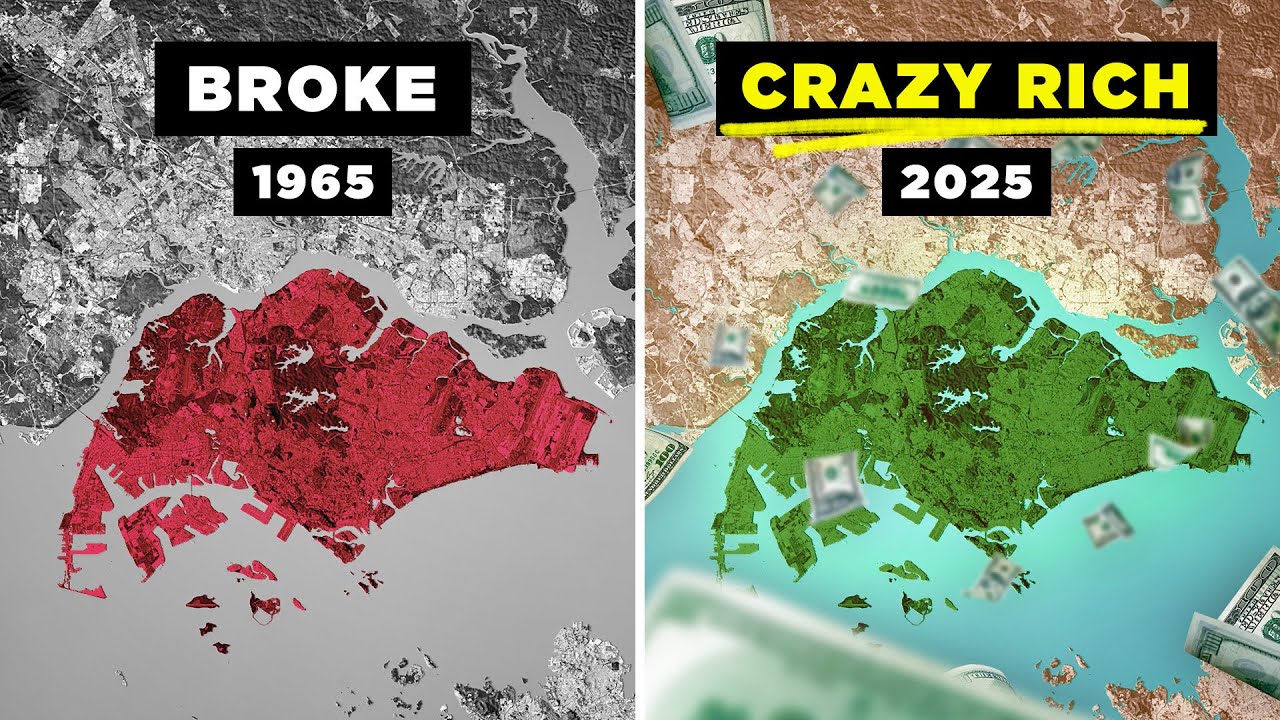
In 1959, Singapore was a crowded island with no oil, little land, and nowhere near enough water of its own. It sits one degree north of the equator. The heat is constant. And the humidity makes sure you feel all of it.
But Singapore already knew what cold air felt like.
Cooling systems had been arriving since the nineteen-twenties and thirties.
They went into cinemas, hotels, trains, hospitals—even the stables of racehorses.
One cinema advertised itself as "Malaya's Coolest Cinema."
And a home system cost a skilled worker around four hundred days of wages—and that was before paying for electricity. Here is the important part.
Advertisements for cooling already promised less fatigue, better health, and more productive workers. But Lee turned it into policy.
He took something sold as a luxury and treated it as part of running a country.
The claim in that tweet was no longer just an opinion.
It was a bet: Cool the offices where the country is run, and the country should run better. Lee believed it enough to keep his own office at eighteen degrees – sometimes even wearing a windbreaker indoors.
Which is strange, because to most people I know who live in the tropics, eighteen degrees is quite freezing. And, the temperature detail actually came from someone I contacted. Professor Linda Lim of the University of Michigan, an economist who's studied Singapore for decades. Now, obviously — weather alone doesn't make a country poor. Nobody serious is saying that. But "heat makes everything harder"? That, you can actually test. And if it's true, heat should leave fingerprints.
We should see students learning less in hot rooms. Workers should produce less on hot factory floors.
Controlled air should change what buildings can be—and what a tropical country can manufacture.
So let's stop taking Lee Kuan Yew's word for it. Over the past few weeks, I tracked down the people who study this. Economists. A historian. A heat-health scientist. Even an engineer who measures the heat inside public-school classrooms. Ten of them answered.
The first fingerprints show up in a New York exam room.
But before the exam room — one quick question. Where does this machine even come from?
Well, weirdly enough — from a Brooklyn printing plant, in 1902, that was fighting the air itself. Literally, the air. When the weather turned humid, the paper would swell up between print runs, and the colors would stop lining up. So a young engineer named Willis Carrier built them a machine that held the factory's air at one constant humidity.
Which means one of the very first air conditioners wasn't built for people at all. It was actually built because wet air ruined paper. It took about twenty years before cooling was really aimed at people — and the American public met it the same way Singapore did: at the movies first, then the stores and offices. This leads us to the first fingerprint. It lies a subway ride away — and a hundred and twenty years later.
Every June in New York City, students take the Regents, the exams that help decide who graduates.
An economist named Jisung Park pulled thirteen years of them — four and a half million exams, from nearly a million students — and matched every score to the temperature on test day.
And this is the data from his study. Each step to the right is a hotter exam day — and look at what the scores do. On a ninety-degree exam day — which is about thirty-two Celsius — the same student, compared to their own scores on cooler days, was about ten percent less likely to pass. And because the Regents are high-stakes, a hot day didn't just mean lower scores. For some students, it meant not graduating on time.
Park and his colleagues then went bigger — ten million American students, and whole school years.
They saw the same pattern: hotter school years, less learning. And it's not just on test days, it's across the whole school year. And here's the part that convinced me it's really the classroom. The researchers checked the days when kids weren't in school.
That meant hot weekends, and they found that the scores didn't move. They checked entire hot summers and still nothing. The drop only shows up when the heat lands on an actual school day, when kids are sitting in that room. So I emailed Joshua Goodman, one of the study's co-authors, and his explanation boiled down to this: heat gets between students, teachers, and the lesson. Class still happens. Students just learn less from it.
And here's where it gets interesting. The same data also shows what fixes it. This is where we get back to the machine. Fully air-conditioned schools showed about one-fifth of the loss.
In other words — by their estimates, cooling actually gave back roughly eighty percent of what the heat was taking. And that's the first fingerprint: brains. Heat taxes them. And in case you think "tax" is just me being dramatic — I ran that exact word past one of the study's authors. Here's what he wrote back. Now, flip that finding around, and it's actually good news. Cool the room, and most of that learning comes back.
The next fingerprint of air conditioning isn't at school at all. It's in India's factories.
Researchers there tracked the same thing, but instead of schools, it's work: daily output, matched against daily temperature. And on hot days, the same workers, at the same machines, simply produce less. But in the factories they studied with climate control? The heat mostly stopped mattering. The output held.
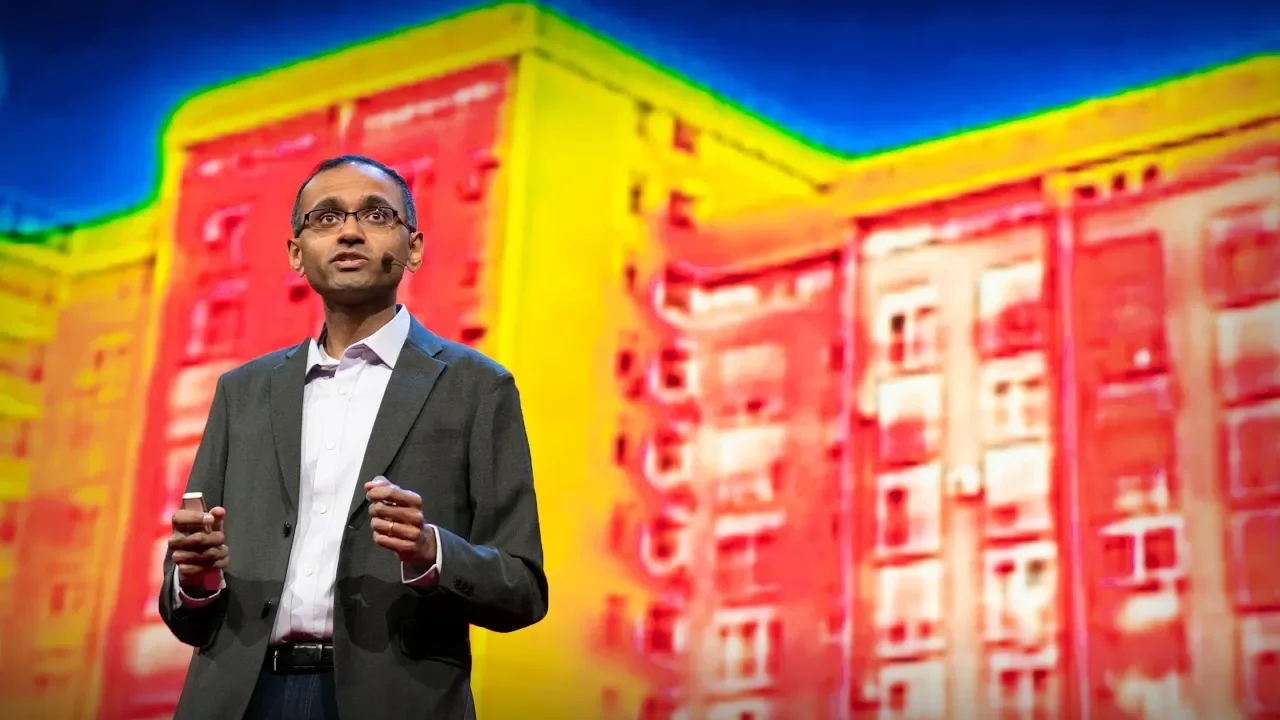
Mostly. Because one of the study's economists, Anant Sudarshan, told me the heat still finds another way in: when the hot days pile up, more workers just don't show up. He told me he can't prove why yet. But his best guess is simple: you can cool the factory. You can't cool the workers' homes. One study got even closer to a real experiment.
A garment company around Bangalore gradually replaced about half its hot fluorescent bulbs with cooler LEDs. And those old bulbs were basically little heaters around the workstations — so when the LEDs went in, the floors were likely cooler. And the lines produced more. On hot days, heat had been doing real damage to how fast they worked — and the LEDs erased about eighty-five percent of it. And the company didn't switch everything at once — it went factory by factory, over three years. Which means you can compare the factories that had switched against the ones that hadn't yet. And that's the second fingerprint: work. If we cool the room, the output comes back — same as the classrooms.
Except there's a catch: the refund isn't free. And who gets it comes down to simple math.
Sudarshan gave me the perfect example, from his own research. In the Indian city of Surat, there are diamond-processing plants — and there are weaving plants. The diamond plants run air conditioning. The weaving plants don't. And it's not like the weavers couldn't buy the machine — the equipment is for sale to both of them.
The difference is what an hour is worth. An hour of diamond-cutting earns enough to pay for the cold air around it. An hour of weaving doesn't. So if your job is cutting diamonds, you get cold air. If your job is weaving the shirt I'm wearing right now — well good luck.
I even asked him if "heat is a tax" was fair wording, he said it's actually worse than a tax. A tax at least pays for something. Heat just destroys.
So the prints are piling up: brains, and work. The last one is about buildings — and everything made inside them. Because air conditioning changed buildings too.
In 1928, Texas got the first high-rise office with air conditioning built in. Before that, every desk needed a window that opened — the windows were the ventilation. Air conditioning ended that. Buildings could finally grow thick and sealed — the skyline you see today.
Meanwhile, one degree off the equator, an island is still all verandas and ceiling fans.
In December 1968, Texas Instruments set up in Singapore. The factory went up in about seven weeks — the newspapers called it the fifty-day wonder — and that Fourth of July, the Kallang Basin plant officially opened, built to turn out semiconductors by the tens of millions a year.
And chipmaking runs on controlled air — filtered, dried, held steady. The hotter and wetter the world outside, the more the inside matters. Singapore's bet on electronics was also a bet that it could manufacture its own climate. And that's the last fingerprint: buildings — and what gets made inside them. Cold rooms decide what a country can make.
So that's three fingerprints — brains, work, and buildings with chips inside.
And Singapore? Singapore has all three. So… was Lee Kuan Yew actually right? Even partly?
And honestly? Part of me wanted to stop right there and call it proven.
But something kept bugging me. Manila had air conditioning too. So did Jakarta.
So did Lagos. The machine was for sale everywhere — and only one of those cities got rich.
And economists have a long list of what actually built Singapore. The port, sitting on the world's busiest strait. Institutions. Schools. Export policy. Public housing. None of that comes out of a wall unit. So let's zoom all the way out, to the most famous chart in this field. In 2015, three economists took five decades of data, from a hundred and sixty-six countries, and asked one question: what does temperature actually do to a country's economic output? And this is the curve they got. Output peaks where the yearly average sits around thirteen degrees Celsius — and past that peak, the hotter it gets, the harder output falls. Now, one thing to know: this is one team's estimate. Other economists have done the same math differently and gotten different curves. But almost every version agrees on one thing: the hotter and poorer the country, the harder it gets hit. And when economists track growth year by year, hot years slow poor countries down in a way rich countries barely feel. Which brings up the question that decides how much any of this matters — so I asked E. Somanathan, the factory study's senior author, directly. Does heat just take this year's income?
Or does it slow the growth itself, so the losses compound, year after year, forever?
His answer: the evidence is slight. We do not know.
What the economists could tell me is this: whatever the real damage is, their numbers probably run low. A bad hot year scares off next year's investment. One slowed factory slows every business waiting on it. So think of these measurements as the minimum.
So at this point, I went hunting for the study that would settle it — some paper proving air conditioning makes countries rich. And here's what I found: nothing that settles it. Because the clean test can't exist — you can't split a country in two, air-condition half of it, and wait thirty years to see which half got rich. There's no second Singapore to compare against.
So here's the honest answer to this video's own title: nobody can give you one clean number for how much of poverty is heat. Heat hits sleep, health, work, crops, classrooms, power grids — all at once, all tangled together. What you can do is measure the pieces.
So — how much of poverty is just heat? Well, at the scales we can measure cleanly — a classroom, a factory floor — the answer is a real yes. Heat takes, and cooling gives part of it back.
But at the scale of a whole country? Some. Enough to measure, and enough to matter. But not all of it — not even close. What actually built Singapore was the port, the schools, the institutions, the policies. Here's the thing, though. All of that had to happen in the heat — and heat, as we've now seen, makes the people inside all of it work worse: the students, the workers, the officials. So yes — the port, the schools, the policies are what built Singapore. Cooling just made it easier for the people running them to do their jobs.
So air conditioning didn't make Singapore rich. But it was part of what let everything else work.
And I liked that conclusion — which is exactly why I didn't trust it. So I sent it to someone whose job is to break it. Linda Lim has studied Singapore's economy for decades. Her verdict on my verdict? Still too generous. The civil service, the schools, the hospitals — none of them, she says, actually needed air conditioning. Even the chip plants don't make Singapore special, because chipmaking demands controlled air everywhere on Earth — so cooling gave the island no edge a competitor lacked. "I don't think cooling would even be included as an independent variable," she told me. Which is economist-speak for: it wouldn't even make the list. And then she turned the whole story around. Air conditioning, she argues, was less a cause of Singapore's growth than a result of it.
Growth raised incomes — and growth raised temperatures, as concrete, traffic, and towers heated the city until air conditioning stopped being optional. The boom built the heat, and then the boom bought the machine. The man who ran the country called air conditioning the key. The economist who studies the country calls it mostly a result of that growth — not a cause of it. And honestly? You don't have to pick. Because there's one thing none of the researchers I spoke to disputed: the heat tax is real.
Heat takes, and cooling gives part of it back — measurably, in classrooms and on factory floors.
So that's the Singapore debate — and honestly, we can leave it there. Because the bigger question isn't about Singapore anymore. Roughly three billion people live in the heat right now without air conditioning. And this decade, huge numbers of them are going to get it.
Let's graph it — how many households actually own an air conditioner, across the hot countries. And the gap is stark. In Singapore, roughly eight in ten — and that's from their own statistics office. In the Philippines? Depending on the survey, somewhere between one in ten and one in four — city households much higher, rural far lower. India, even fewer.
And owning an air conditioner isn't the same as being protected by one. A family might own a single small unit, cool a single room, run it only on the worst nights — or leave it off completely, because of one thing: the bill. And then there are the people who don't appear on this chart at all. By the latest global count, just over a billion people are at high risk from extreme heat, because they lack adequate access to essential cooling.
And the Philippines sits deep inside that gap. In April 2024, the heat index there was forecast to hit forty-five degrees — and the schools began to shut. But there was no complete public dataset of what happened. So I gathered every national count the Department of Education released during the crisis, and did the arithmetic myself. On April twelfth alone, seven thousand and eighty public schools — about fifteen percent of all the public schools in the country — stopped face-to-face classes because of the heat. Quick note, though — that forty-five wasn't the actual temperature. It's the heat index: what the heat feels like once you add the humidity.
Manuel Garcia wrote the actual paper on these closures — so I contacted him for this video.
And he explained it to me like a receipt. The temperature is the price. The humidity is the extra charge on top. The heat index is the total at the bottom of the receipt.
So on one Manila day in his paper: the thermometer said thirty-eight point eight. But the total? Forty-five. And why does humidity charge you extra? Because your body's cooling system is sweat — and sweat only cools you when it evaporates. But humid air is already full of water, so your sweat barely evaporates at all.
You're soaked — and you're still not cooling down. Anyway — those seven thousand schools on April twelfth? That was one day. And the only days we can even count are the ones where a national total actually got published. The real number is bigger. And a year later, the heat came back — and so did the closures. To be clear — learning didn't stop when schools closed; it moved to modules and phones. What kept getting lost was the classroom itself.
So what's it actually like inside one of those rooms? Because here's the problem: the heat index is measured outside. Nobody's thermometer is in the classroom. So I asked John Lowell Adalid — a DepEd mechanical engineer who spent months putting his thermometer exactly there, inside public-school classrooms — what the outside number misses.
Two things, he said. First, the roof. All morning it absorbs the sun, and all afternoon it radiates that heat back down onto the students. The building becomes its own heater. And second — the students themselves. A room built for thirty often holds fifty. And fifty bodies are fifty small heaters. By his estimate, the crowding alone adds another degree or two.
So the classroom doesn't just sit in the heat. It actually manufactures more of it.
But here's the thing about "shifting to remote learning" — it works completely differently depending on whose house you go home to. One student goes home to a laptop, fast internet, and a cool room. Another goes home to one shared phone, prepaid data — and a house that's even hotter than the classroom they just left. Garcia put it to me plainly: the same closure hits different families completely differently, because some families can buy their way through it — and others can't. So where do the others go? To the one place where cold air is free. The mall.
Ask anyone in the Philippines — the shopping mall is where you go to study, to work, to think, or just to survive the afternoon. Not really to shop. But to be cold.
Which means for millions of people, air conditioning isn't something you have. It's somewhere you go. And that's not only true in the Philippines.
It's daily life across much of the hot world. And even for the families who can buy the machine — there's another problem waiting. The machine needs electricity. And electricity is exactly what many hot countries run short of, at exactly the wrong moment.
Because when the heat spikes, demand spikes with it — millions of air conditioners and electric fans switching on at once — straight into a grid where some power plants are already down for their own reasons. That's when the red alerts start, and the rotating outages.
The heat doesn't have to break a single plant. It just has to show up while they're already down.
So the order matters. A country gets the grid first — and only then can it get the machine.
And even with the grid in place, there's still the question every family actually faces: affording the thing. So I wrote to Alan Barreca, an economist at UCLA, and he reminded me why America's climb looked so easy: in the sixties and seventies, air conditioning arrived already built into brand-new houses — its price folded right into the mortgage. Air conditioning came with the home. In the tropics, it's bought one window unit at a time, out of pocket.
And it costs money every single hour it runs. So is the machine even worth all that money?
Take the classrooms. Remember that one-fifth, from the New York schools? The Heat and Learning researchers ran the cost math on it themselves — a rough calculation, and they say so openly — in hot American cities, the learning recovered was worth far more than the machines cost.
And remember, that's a country where the heat is gentle compared to the tropics.
But cooling has passed a much harder test than exam scores. Over the twentieth century, America's hottest days gradually stopped killing people — and when researchers traced why, most of the answer was one technology: residential air conditioning.
Barreca was actually part of that team. And when I asked him how the machine saves lives, half of his answer was about the night. Everyone thinks about the brutal afternoons. But the machine's quiet job is giving people cool hours to sleep — so the body can recover from the day.
So cooling saves lives — and the classrooms and factories say it protects learning and work too. But most of that evidence comes from America. I wanted to know what the heat is doing to people's health in a city like Manila. So I got on a call with Xerxes Seposo, a heat-health scientist who studies exactly this, and asked him: what happens to a city's ambulance calls when the temperature spikes? The first half of his answer, you can probably guess. Heat spikes, heat-stroke cases spike, and the ambulance calls climb right along with the thermometer. But it's the second half you can't guess.
...there's a ceiling, a capping of those cases... an underestimation of what should have been actually greater. A ceiling. On the hottest days, the number can stop rising when the ambulances run out — not when the emergencies do.
And Goodman — the Heat and Learning co-author — was careful with me on exactly this point: In other words: they only measured the learning. The rest of what heat hits — health, farms, incomes — comes on top of that. And in poor, hot countries, those losses are probably even bigger.
And here's the strange part: hardly anyone follows the students afterward. In the Philippines, Garcia couldn't find a single study tracking what repeated closures do to the same kids over time.
Neither could I. So we can count the days schools close. We can't yet count what those days cost a kid. Garcia put it best. "We are very good at measuring degrees Celsius," he wrote me.
"I'm not yet convinced we are equally good at measuring the degrees students may never get."
So let's add it up. The heat tax is real. Cooling refunds part of it — and in the hot-school estimates we have, it can pay for itself. But most of the hot world still can't afford the machine, the grid, or the bill. So what happens next was always coming: the hot world is about to switch the machine on. Everywhere. All at once.
So — how much of poverty is just heat? The hot world is about to run the experiment at full scale. In 2018, the International Energy Agency counted the world's air conditioners and projected forward: roughly ten new machines sold every second, for thirty years. Most of them in Asia. And a newer IEA outlook zooms in on this region: Southeast Asia's home air-conditioner stock is set to roughly triple — by 2035.
At that scale, this stops being an appliance market. It becomes a grid problem — one of the biggest infrastructure buildouts on Earth that nobody calls infrastructure.
But there's a catch. And it's an engineering problem, not a moral one.
The air conditioner that cools your room heats your street. In Phoenix, researchers modeled the exhaust coming off the city's air conditioners during extreme heat — nighttime temperatures, more than a degree hotter in parts of the city. Now, Phoenix is a desert — so you might think humid cities like Manila get a pass. They don't. In humid air, the machine has to do two jobs: pull out the heat, and pull out the moisture. And the harder the machine works, the more waste heat it dumps outside. And remember what Barreca said about the night? That's when the body recovers. So this exhaust taxes the exact hours people need to reset — and cooling demand tends to peak right when the grid is under the most strain.
Heat drives cooling. Cooling warms nights and strains grids. And that drives more cooling.
Then Garcia sent me the sentence I'd been circling this entire video. Air conditioning alone, he told me, is not a national climate policy. It's an appliance.
So what does it look like when a country stops thinking in boxes?
Singapore's been trying an answer for twenty years. Instead of every building running its own machines, much of the Marina Bay district shares one cooling system — chilled water, piped underground into the towers — and its operator says the buildings on it use up to a fifth less energy on cooling. Their newest town, Tengah, takes it further: cooling piped straight into homes, as a service, no outdoor unit of your own.
It's not perfect — early residents reported leaks — but that's the idea being tested.
Now, the pipes aren't even the most interesting thing about Tengah.
I wrote to Fiona Williamson, the historian who literally wrote the book on Singapore's climate — and she gave me a warning: don't give the machine too much credit. People managed before. Lower buildings, sea breezes, shade trees, a rest through the worst of the afternoon — and the city itself was cooler then — by her estimate, a degree or two. Her real warning was sharper: we've built concrete cities that can no longer live without the machine.
And the way people managed before? That's the twist hiding inside the fix.
Because the tropics already knew how to cool buildings — with design. Shophouses with shaded walkways, required by law. Houses on stilts under steep roofs, built to catch the breeze. The veranda was never decoration — it was climate technology. Then air conditioning arrived, and the hot world started building against its own climate — sealed glass towers, imported from cold countries, designed around cooling that never stops. Air conditioning didn't just refund the heat tax. It let us build buildings that made the tax bigger.
Which brings us back to Tengah — because look at its layout. Oriented for wind. Built around shade.
Green corridors between the blocks. The future of cooling looks suspiciously like the past… with a chilled-water network underneath. And the cheapest fixes cost very little.
Seposo told me the machine's real partner is green space and blue space — trees and water, cooling the streets around them. And that part's measured: in city studies, tree canopy cuts local daytime temperatures by a degree or two. And Adalid, the DepEd engineer, gave me his fixes for a school with no budget: a spinning roof vent to pull the hot air out, and reflective paint to bounce the sun away. The cheap fixes carry real weight. They just don't carry the crisis days.
So there's a right order to this: shrink the heat first — shade, surfaces, trees — then machine whatever's left. That's what solving cooling means. Not five billion separate boxes. Machines, networks, and buildings that remember what the shophouse knew.
So — back to that tweet. Was Lee Kuan Yew right? Partly. Air conditioning didn't make Singapore rich. But it was part of what let everything else work. What he was really saying is that temperature is infrastructure. And could cooling give poor, hot countries a real boost? We used to only be able to feel what a hot classroom costs. Now it's been counted. And someone's still counting — Adalid is measuring the learning lost in those classrooms right now. His numbers go in the description when they publish.
Because the next Singapore won't be whoever gets air conditioning. It'll be whoever solves cooling.
And that race has already started.
Up Next
Mechanism Design Explained: How Blockchains Program Human Incentives
@a16zcrypto
2.5K views•2023-03-01

Impact of Yuan in Indo-Russian Trade Amid Sanctions
@WION
261.9K views•2022-07-01

Behavioral Economics Explained: Rationality, Nudges, and Risk
@crashcourse
1.1M views•2016-03-12

The Age of Easy Money: Fed & Inflation | Full Documentary
@frontline
21.2M views•2023-03-15
Related Study Plans & Knowledge Roadmaps
Structured learning paths in Economics