



















The United States national debt has grown from approximately $18 trillion to over $36 trillion in just 10 years, reaching a debt-to-GDP ratio of just over 100%, which is second World War level debt; economists warn that when debt reaches approximately 175% of GDP, interest payments become so high relative to government spending that the country can no longer raise taxes fast enough or cut spending deeply enough to stay afloat, as demonstrated by Greece's debt crisis in the early 2010s, and projections suggest Trump's proposed policies could push US debt toward 143-250% of GDP by 2047, creating significant risks for everyday Americans through higher borrowing costs, reduced government investment capacity, and potential economic instability.
The U.S. Debt Crisis: How Much Is Too Much? | Analysis
Added:The distinction between annual federal deficits (yearly budget shortfalls) and the cumulative national debt.
Understanding Gross Domestic Product (GDP) and why the Debt-to-GDP ratio is used to measure a nation's leverage.
How sovereign debt instruments function, specifically U.S. Treasury bonds, and the role of domestic versus foreign creditors.
The basic relationship between central bank interest rates, inflation, and the cost of government debt servicing.
An exploration of Modern Monetary Theory (MMT) and its controversial views on sovereign spending and currency issuance.
The geopolitical and economic consequences of the U.S. dollar losing its status as the world's primary reserve currency.
Comparative analysis of historical sovereign debt crises (such as Greece in 2010 or Japan's long-term high debt) to evaluate potential U.S. trajectories.
The political and structural challenges of implementing fiscal consolidation strategies, such as austerity versus tax reforms.
1.5M views13.8Klikes14:55Original Release: 2025-06-25
It's hard to turn on a US news channel these days without hearing someone refer to the national debt. The national debt.
The national debt. It's big. Massive actually. But it's not new, right? The US has been deep in debt for a while now. So why all of a sudden does it feel like everyone's getting a little panicky? Journalists, investors, politicians, economists. Well, for starters, there's this President Trump's one big beautiful bill passing in the House by the slimmest of margins. The bill is passed.
We call it the one big beautiful bill.
Supporters say that bill making its way through Congress right now. It reimagines border security, immigration, introduces sweeping tax cuts, but one big downside is that these things are expensive. Overall, the Congressional Budget Office projects it could add an extra $2.8 trillion to the federal debt over the next decade. It's an astronomically large sum. Okay. Now, to be fair, there is a long presidential tradition of adding to the country's debt, and you certainly can't blame the size of the debt on Trump alone. But he did spend an awful lot of time swearing up and down that he wouldn't make the problem worse. We'll hand him a little Bitcoin and wipe out our $35 trillion.
Use trillions and trillions of dollars to reduce our taxes and pay down our national debt. I I want to really make a lot of money, pay off debt. And if the government's own number crunchers say Trump's plan will add trillions to the debt load, what a lot of people don't realize is that even under current law, we're on this exploding path of debt relative to the size of the economy.
There's no question the United States is on a trajectory that's unsustainable.
So, here's the trillion dollar question.
When does all of this go from just some mathy abstract worry years off in the future to becoming everyone's problem?
Here's a look at the running national debt clock in the US. As of this recording, it's just over $36 trillion.
Some of that is debt that gets swapped between governmental agencies, but the vast majority of that is real public facing debt, easily paid off if every single American would just pony up 100 grand. But for context, the debt is about double what it was just 10 years ago. You can blame both Republicans and Democrats for that. And yes, some more than others, even setting the pandemic aside, but consistently all American presidents in the last 20 or so years have spent deep into the red. Add that all together, that's how you get to 30 or so trillion. But this alone isn't proof that there's a problem because, and this will sound crazy, we haven't yet established whether $30 trillion is a particularly big number. But we can figure that out by examining the US debt to GDP ratio. Yay. Because to put it really simply, if I owe my friend a h 100red bucks, what makes that debt fine or catastrophic really depends on how much money I make in a year, right? Like if I'm between jobs, that $100 is an expense I might not be able to afford.
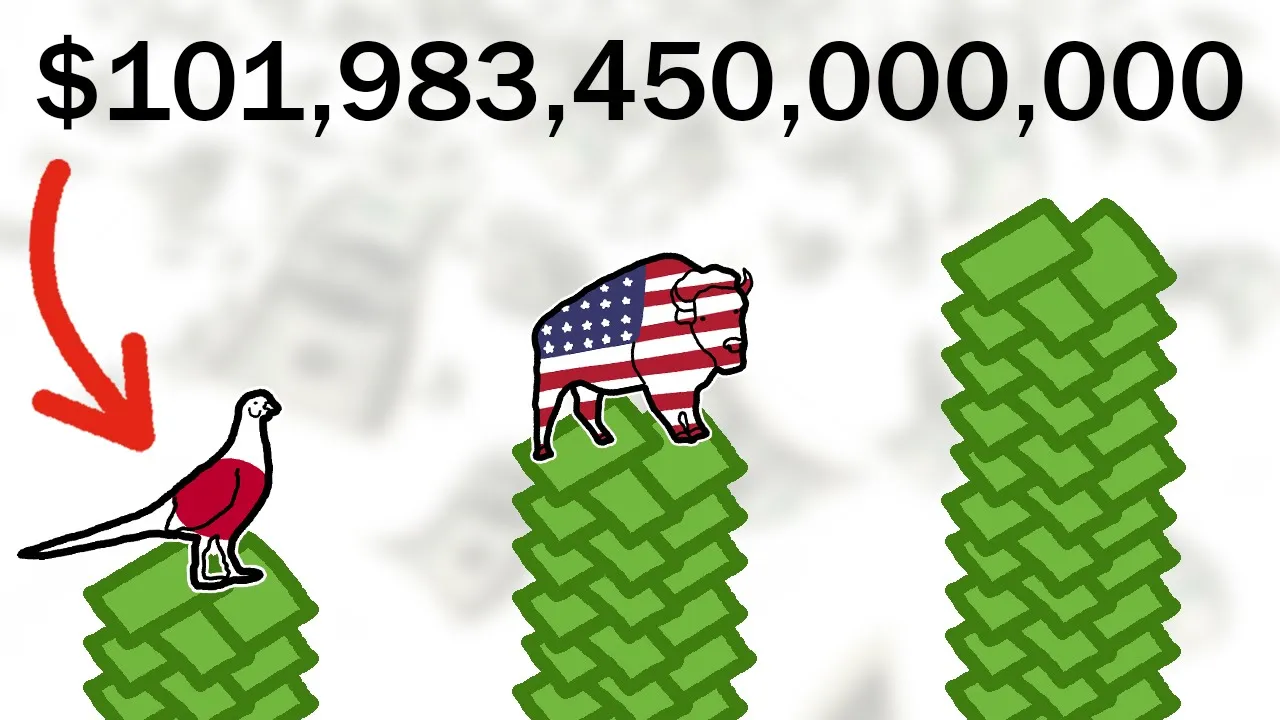
But if I'm a billionaire, then who cares? And the US is actually a trillionaire. The US economy, by virtue of its size, can tolerate a surprising amount of debt, but not unlimited. Right now, the debt it has to eventually pay back to the public is just over what the US makes in a year, just over 100% of its GDP, meaning its debt pile is the same size as the country's entire annual output. That is second world war level debt. Except in 2025 there's no world war and the US isn't spending a whole bunch of money to rebuild Europe. The difference between the 21st century in the US in the 20th century is when we had an emergency in the 20th century we cleaned up afterwards. We brought the debt back down. So we have World War II came back down. In 21st century you know great recession it goes from 30 to 70.
Pandemic goes from 70 to 100 and no one fixes anything. So when does this big issue start actually becoming a big problem? Like if the US is at 100% debt to GDP ratio, is there a higher number, a tipping point where you can't just keep borrowing and carrying on? Well, like all things finance, there's no light switch moment where suddenly US finances collapse into a black hole. But 175%.
175. That is, according to the economist we spoke to, when things might start to unravel in a serious way. The thinking being at that level, the interest payments on your debt are likely so high relative to what you have to spend each year as a government that you simply can't raise taxes fast enough or cut spending deep enough to stay afloat.
That's what happened to Greece in the early 2010s. Greek debt ballooned past 175% of GDP. And in order to avoid defaults, the government was forced to cut essential services and raise taxes.
The economy collapsed into a deep recession and regular people paid the price with pension cuts, mass unemployment, all blanketed in anger.
Greeks were defiant and angry over such demands. Now some of them are sounding just plain scared.
I'm afraid that worst days will come, says this man. Much more difficult days.
And it took years, not a year, not two years, years and years for them to get back to the point where the economy was growing again. Now to be clear, the US is nowhere near that point right now, but the trajectory is accelerating.
According to one estimate by the Committee for a Responsible Federal Budget, that's a nonpartisan policy group, if Trump were to deliver on all of the measures he promised during his presidential campaign, the debt to GDP ratio could rise to 143% in just 10 years. And that's their conservative estimate. Worst case, they figure it could rise as high as 161%.
And their estimates are not unique. the Congressional Budget Office. So that's the US government itself. They modeled even further ahead, projecting if all Trump's tax cuts were to be made permanent, US debt could reach 200% of GDP by 2047 and 250% by 204. So it would literally double it over the course of the next 30 years just from this legislation alone. So, this is a very significant increase in our aggregate debt burden. And here's the thing, the balance sheet doesn't even need to get that bad for real problems to show up. All it really takes is for investors to lose faith that the government has things under control.
Once capital markets stop believing that Congress will ever get its act together, I mean, literally things could unravel tomorrow.
[Music] Buying US government debt is seen as one of the safest investments in the world because the US has always paid its debts on time in full. In fact, when the US pays its debt by issuing bonds and then by paying investors an interest rate for buying those bonds, you'll hear investors referring to that bond rate as the risk-free rate. Meaning, it's not the biggest return on investment in the world, but it's just about guaranteed.
So, what happens if investors start to worry that maybe the US government doesn't have its fiscal house in order?
What if investing in US debt isn't completely risk-free? The crucial day is the day they lose confidence in the ability of the United States to repay in a timely fashion. And if they lose faith in that, they start jacking up the interest rates that they charge the US as compensation for the risk we don't pay back or they cut you off entirely.
And that's important because that's where a bad situation can turn worse.
The riskier the investment, the more expensive it can become to pay back. And all kinds of factors from tariffs to inflation to how highly changeable US policy on anything can be from day to day. They all get baked in. Bonds, they've had huge move the last few days.
Debt deficits and tariffs, curves steepening. We're over 50 basis points in twos to tens. There are a lot of indicators out there that makes the bond market a little nervous. The risks aren't that treasuries aren't going to be paid out. The risks are more that as you look at interest rates, they're going to have to be higher because people are going to demand higher interest rates to be willing to hold so much US debt. And those higher interest rates can snowball real fast. According to JP Morgan, if bond rates rise by just 1%, the US would have to pay $300 billion more in interest to its debt holders every year. That's on top of the $1.1 trillion it's already paying in interest every year. And then once you throw in the extra hundred billion in interest that Trump's bill is projected to add annually, you can start to see why some people are getting nervous. The thing that we always worry about with um uh irresponsible youth is you give them a credit card, they run up uh a bill, and now they have to get a new credit card to pay off the old credit card.
Well, the US borrowed $1.8 trillion last year, and over a trillion of it was to pay interest on previous borrowing. So, we are perilously close to the moment when you you might want to worry a lot.
These things can spiral out of control, and that's kind of the big risk. And that risk now has credit agencies on alert, too. Just a few weeks ago, Moody's stripped from the US the very last of its highest tier credit ratings.
Their decision, they wrote, was because of the increase over more than a decade in government debt and interest payment ratios to levels that are significantly higher than similarly rated sovereigns.
They said, "You have too much debt and you have to pay too much interest. You have a problem." That to me is more alarming. But all of this is still pretty abstract, right? Maybe you're wondering, "Okay, but how does this affect regular people?"
Totally understandable that the financial health of the US government may not be the first thing everyday Americans wake up each morning and dwell upon. But what happens in Washington doesn't stay in Washington. The bond rate, for example, doesn't just affect investors or even how expensive it is for the US government to pay those investors. It's also considered the baseline for mortgage rates, auto loans, business loans, credit card rates. If bond rates go up, often so too do all of those. And so, um, that's going to be the the real problem is that you can imagine mortgage rates, you know, persists at higher high returns, uh, higher yields, and therefore higher cost to customers. It means that you're going to pay thousands of dollars more when you try to take out a car loan or it means you're going to pay thousands of dollars more when you try to take out a small business loan to start your small business. So all of this like reverberates in the real economy in ways that households can feel in like super meaningful ways. And then there's the simple fact that every dollar the US pays in interest on debt is a dollar not spent on something else. Right now, interest payments make up about 14% of the federal budget. That's more than what the US spends on national defense.
And the way this is all going, it's not out of the question for interest on debt to eventually become a more expensive line item than social security or healthcare, too. You are crowding out important investments that need to happen by taking up a lot of fiscal space. And if everything gets squeezed, what happens when something goes wrong?
When the world is suddenly face to face with another pandemic or war or global recession, we're not going to have the capacity to respond with as much um energy and as much vigor from a fiscal perspective because a bunch of that space has kind of been taken up. Once you have a debt crisis, you can't issue new debt to get out of that. There's no easy solution. Now, there are Republicans who claim Trump's great big beautiful bill actually helps solve the debt problem because the way they see it, things like boosting energy production, deregulation, cutting entire government departments, that'll kickstart growth and expand the tax base. Then throw revenue from tariffs into the mix. And they argue that should be enough to offset all the new spending in Trump's bill. and put the US on a trajectory of 3% growth for the next few years, but not everyone's buying it. The calculations that are released by the White House uh suggesting that this tax cut could pay for itself um they're essentially a work of fiction. They don't um have any model behind them. I went back and looked and uh forecasting 10 straight years of 3 percentage point growth. There were only six quarters uh in the history of the US when that was a good forecast. They all occurred in the 20th century. None of them happened in the 21st century. So it's it's not something I think anyone should count on. It's hard to move the growth rate of an economy. Moving it by 3/10en of a percent on average over 10 years, huge success. A full percentage point, unimaginable. In fact, a range of nonpartisan analysts, including the US government's Congressional Budget Office, have argued that under almost any realistic model, the US debt is on a sharp upwards trajectory. So, what's the bottom line? Well, pretty much everyone agrees. Right now, America still has time to change course. But, as one economist told us, debt crisis happen slowly and then all at once. And when that happens, every solution is painful.
[Music]
Up Next

35:37
US National Debt Sustainability | Mohamed El-Erian Analysis
@stanfordgsb
41.2K views•2024-09-19

5:07
Impact of Yuan in Indo-Russian Trade Amid Sanctions
@WION
261.9K views•2022-07-01
10:33
Behavioral Economics Explained: Rationality, Nudges, and Risk
@crashcourse
1.1M views•2016-03-12

113:18
The Age of Easy Money: Fed & Inflation | Full Documentary
@frontline
21.2M views•2023-03-15
Related Study Plans & Knowledge Roadmaps
Structured learning paths in Economics
economics
Sovereign Debt: Defaults, IMF & Restructuring
01Introduction to Sovereign Debt & Government Bonds
02Debt Sustainability & Credit Ratings
03Anatomy and History of Debt Crises
+ 2 more learning modules
12h5 modules
Explore Roadmap
economics
Market Design: Matching Theory & Gale-Shapley
01Introduction to Market Design and Price-Free Markets
02Two-Sided Matching & The Gale-Shapley Algorithm
03School Choice Systems and Mechanism Design
+ 2 more learning modules
10h5 modules
Explore Roadmap
economics
Impossible Trinity: Forex, Capital & Policy
01Introduction to Monetary Policy and Central Banking
02Exchange Rates and International Capital Flows
03The Mundell-Fleming Model
+ 2 more learning modules
8h5 modules
Explore Roadmap
economics
Healthcare Economics: Market Failures & Systems
01Introduction to Healthcare Markets and Market Failure
02Asymmetric Information and Adverse Selection
03Moral Hazard and Insurance Design
+ 2 more learning modules
12h5 modules
Explore Roadmap