




















Climate justice requires wealthy nations that have historically emitted the most greenhouse gases to provide reparations to developing countries like Pakistan, which contribute minimally to climate change but suffer disproportionately from its effects; this reparations framework should include emergency relief funding, technical assistance, adaptation planning, and access to green technologies to enable developing nations to leapfrog high-emission development stages toward sustainable futures.
Global Climate Justice: A New Social Contract for a Just Transition
Added:The concept of 'Common but Differentiated Responsibilities' (CBDR) under international environmental law.
The historical contribution of industrialized nations (Global North) to cumulative global greenhouse gas emissions.
Basic economic principles of negative externalities and the 'polluter pays' principle.
The socioeconomic disparities between the Global North and Global South that exacerbate climate vulnerability.
The operational mechanisms and funding challenges of the UNFCCC 'Loss and Damage' Fund.
Intellectual property rights (IPR) barriers and international trade laws governing green technology transfer.
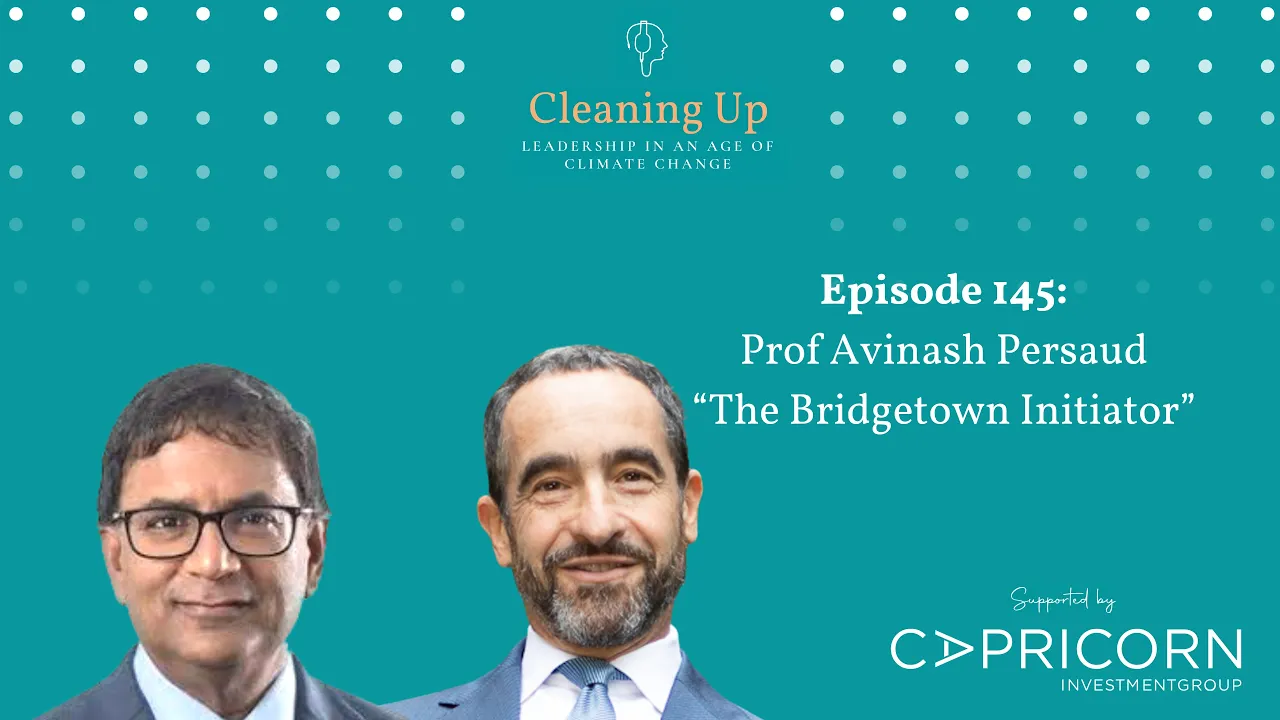
The Bridgetown Initiative and proposals for reforming global financial institutions (IMF and World Bank) for climate finance.
Case studies of domestic 'Just Transition' frameworks, focusing on labor rights and retraining for fossil-fuel workers.
58K views1.2Klikes10:40Original Release: 2022-10-28
One third of my country, Pakistan, is under water.
An exceptional monsoon coupled with flash flooding due to the accelerated melting of the Himalayan glaciers has led to devastating flooding.
Floods so destructive, so all-consuming, that the adjective most frequently used to describe them is “biblical.” The area of land that is underwater is larger than Britain.
Over 33 million people are affected, stripped of homes and livelihoods.
Hundreds have been killed, and those that survived are now dying of malaria, dengue fever, diarrhea.
The crops that we planted have been washed away, and our fields will be waterlogged for many months to come, imperiling the critical wheat-planting season.
Pakistan is in shock, and all it can look ahead to is food insecurity, famine, climate migration and conflict.
Pakistan needs tens of billions in emergency relief funds, and it needs them right now.
But I'm not here to talk about today's crisis.
I'm here to talk about the way forward.
As the scale of devastation becomes apparent, the sense of climate injustice is mounting.
Pakistan emits less than one percent of global greenhouse gases, and yet it is consistently among the countries most vulnerable to disasters caused by climate change.
That vulnerability has been horrifyingly laid bare over the last few months.
Calls are growing for the global North to compensate the global South for the fact that high-emitting activities in developed economies are leading to catastrophic climate change-linked events in less developed countries.
Since the Industrial Revolution, today's wealthy nations have benefited economically from high-emitting activities.
The G20 are still responsible for 80 percent of global greenhouse gas emissions.
The logic is simple: industrialized nations that have profited from fossil-fuel-driven development should be the ones to pay the bill when climate disasters strike poor countries such as mine.
This idea is not new, nor is it particularly controversial.
In 2009, developed countries promised to mobilize billions in climate finance to support emerging economies.
That funding has not materialized.
And so the demands for reparations have.
But let's be clear.
Developing countries are not asking for charity.
Having polluted only marginally, they are climate creditors, and that credit is now due.
As I said, the logic is simple.
But the politics are complicated.
Developing countries have not consistently demanded reparations for climate change-linked loss and damage.
Many countries in the Global South, led by India and China, subscribe to the “catch up” argument: the notion that developing countries should now be allowed their share of pollutants and greenhouse gases in order to build infrastructure and spur economic growth.
This reasoning envisions the West curtailing emissions and bearing the financial cost of the economic slowdown, while developing countries continue to emit, build and grow.
It's a way of saying, "Hey, it's our turn."
This "catch up" argument is compelling, but it does not speak the language of reparations.
Climate justice is based on the notion of not being punished for someone else's bad behavior.
It does not sanction more bad behavior.
You cannot both demand reparations and the right to emit.
But many developing countries have yet to engage in climate diplomacy, a process of reconciling the demand for reparations with existing security and foreign policies.
And so you'll see cases where some government departments are demanding climate justice, while others are seeking foreign funding for coal and gas projects or pursuing defense deals with high-emitting nations.
It is difficult to have it both ways.
And that's why demanding reparations also means bringing forward a clean, green vision -- one which includes leapfrogging the high emitting stage of economic development into a more sustainable future.
For countries like mine, that means no more poorly planned expressways or elite real estate developments dotted with swimming pools or golf courses in drought-hit areas.
Because sadly, it is true that the scale of devastation in Pakistan, and in climate calamities elsewhere, is not just the result of climate change but also a consequence of poor governance, of inadequate planning, the lack of infrastructure, corruption and the lack of accountability.
This is something the Global South must acknowledge.
But this is absolutely not to place the onus back on climate vulnerable developing countries.
No.
Instead, it is to say that the time has come for the global North and South to agree [on] the terms of a just transition.
Are we ready for a new social contract within countries and between countries?
One way forward is to adopt a more expansive definition of reparations.
This should take the form of funding for emergency relief, loss and damage, but it should also include technical assistance, adaptation planning and the skills development needed to tackle the climate challenge.
Developed countries should provide funding, but they should also provide access to the green technologies that can help countries such as Pakistan catch up, but without the high emissions.
Pakistan is drowning, and its people are desperate.
Their present is your future.
We need a new era of climate diplomacy, and we need a new recognition that we are in this together.
We can adapt, mitigate, build resilience, but only if we do it together.
The logic of climate justice is simple.
Let's make the politics simpler to.
Thank you.
(Applause and cheers) Bruno Giussani: Huma, thank you.
So when introduced you, I said that the floods have not received enough attention in the global media.
But how are the Pakistani media talking and reporting about them?
Huma Yusuf: Thank you for that question.
You know, we’re just a month into the declaration of a national emergency, and the floods are already slipping out of the news headlines in Pakistan.
I think we're really suffering from the fact that the 24-hour news cycle does not know how to tell this story, a story so big, a story that requires you to connect the dots to every other story you will ever tell, whether we're talking about food, the economy, insecurity, domestic militancy.
There is no story that can be told without also telling this story.
But unfortunately, I don’t think we have that media literacy, and the floods are already receding out of our own headlines.
So what can we expect from the international press?
BG: Well, is aid already coming, at least?
HY: Aid is coming, but not enough and not fast enough.
And, you know, Pakistan has said that they need about 30 billion dollars to help with the rehabilitation and reconstruction phase.
And we're at a stage where, for example, I think the UN tomorrow launches a new appeal that's for 600 million dollars.
So I don’t think that there will ever be enough aid.
We do need some of these reparations.
We need a better plan for how we're going to fund these kinds of climate disasters.
But unfortunately, even before the money has started flowing, those questions have started.
You know, where's the money that's already come through gone?
Who is tracking it? What is it being spent on?
And I fear that those kinds of questions deter more funding, when actually it's the absolute need of the hour.
BG: Now, I want just to put an image in the mind of people here.
One of our conversations, you told me a story about people in flooded areas going around in small boats and hitting structures under water.
Tell us about that.
HY: Yes, you saw the pictures that I started with.
And I’ve been seeing those, and I haven’t visited myself the most badly affected areas.
And it was only when I received a video from a friend of mine who was out there reporting in the field, which showed her on a boat going through what I thought was a lake, and then they start bumping up against things -- and you realize that it’s the top of electricity pylons, and it's the top of school buildings and it's the top of petrol stations with the little, you know, advertising symbol -- that I really understood that my country is submerged.
It is truly underwater.
And I don't know how you come back from that.
BG: Thank you for sharing this story and thank you for your talk.
HY: Thank you for having me.
(Applause)
Up Next
16:33
Climate Justice and the Global Loss and Damage Fund: COP28 Insights
@dwnews
3.3K views•2023-11-29

12:54
Triumph of Orthodoxy Icon: Byzantine Art & History Explained
@BenCallan
2.1K views•2024-08-06

17:40
Visual Storytelling & Future Media: Scott McCloud’s Comic Theory
@TED
332.3K views•2009-01-15

1:42
Game of Thrones Opening Credits: A Cinematic Analysis
@gameofthrones
46.3M views•2011-04-18
Related Study Plans & Knowledge Roadmaps
Structured learning paths in General & Interdisciplinary Studies
general-studies
Elevator Engineering: History, Physics & Cities
01From Hoists to Safety Brakes: The Dawn of Vertical Lift
02Hydraulic vs. Traction: The Engineering Physics of Elevators
03Modern Speed, Safety, and Algorithms
+ 2 more learning modules
12h5 modules
Explore Roadmap
general-studies
Rubber: Material Science, History & Geopolitics
01Origins of Natural Rubber & Mesoamerican History
02The Chemistry of Natural Rubber & Vulcanization
03The Geopolitics of the Rubber Boom & Colonization
+ 2 more learning modules
12h5 modules
Explore Roadmap
general-studies
Containerization: Evolution, Logistics & Trade
01Ancient Trade & Bulk Cargo: Amphorae to Barrels
02The Industrial Revolution & Cardboard Packaging
03The Containerization Revolution: Malcom McLean
+ 2 more learning modules
12h5 modules
Explore Roadmap
general-studies
Textile Tech: Evolution, Labor & Global Impact
01Pre-Industrial Textiles: Handloom & Cottage Industry
02Mechanization: The Spinning Jenny to the Power Loom
03The Factory System & Global Labor Transformation
+ 2 more learning modules
10h5 modules
Explore Roadmap