
















![[Đại số tuyến tính-BKHCM] Giải đề thi giữa kì K22](https://i.ytimg.com/vi/YY0osNnZR7Y/maxresdefault.jpg)
![Eigenvalues, Eigenvectors & Matrix Powers [IB Math AI HL]](https://i.ytimg.com/vi_webp/jGvJNHbwseg/maxresdefault.webp)
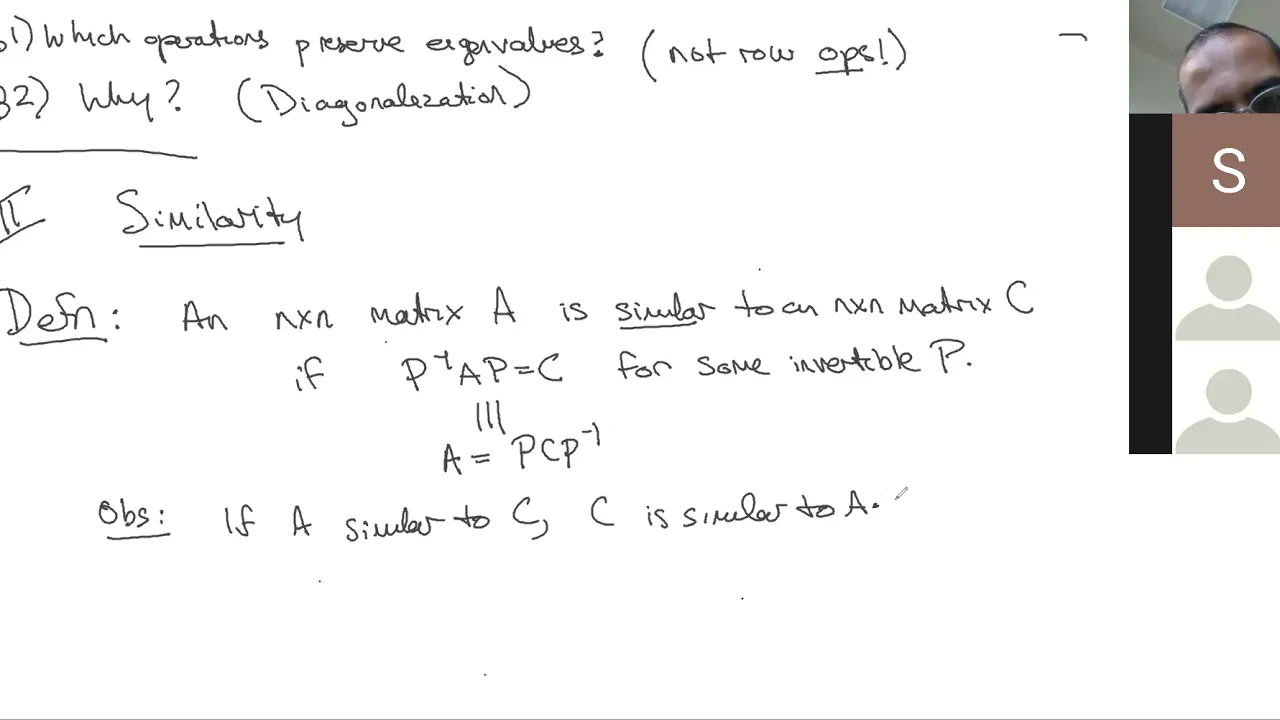
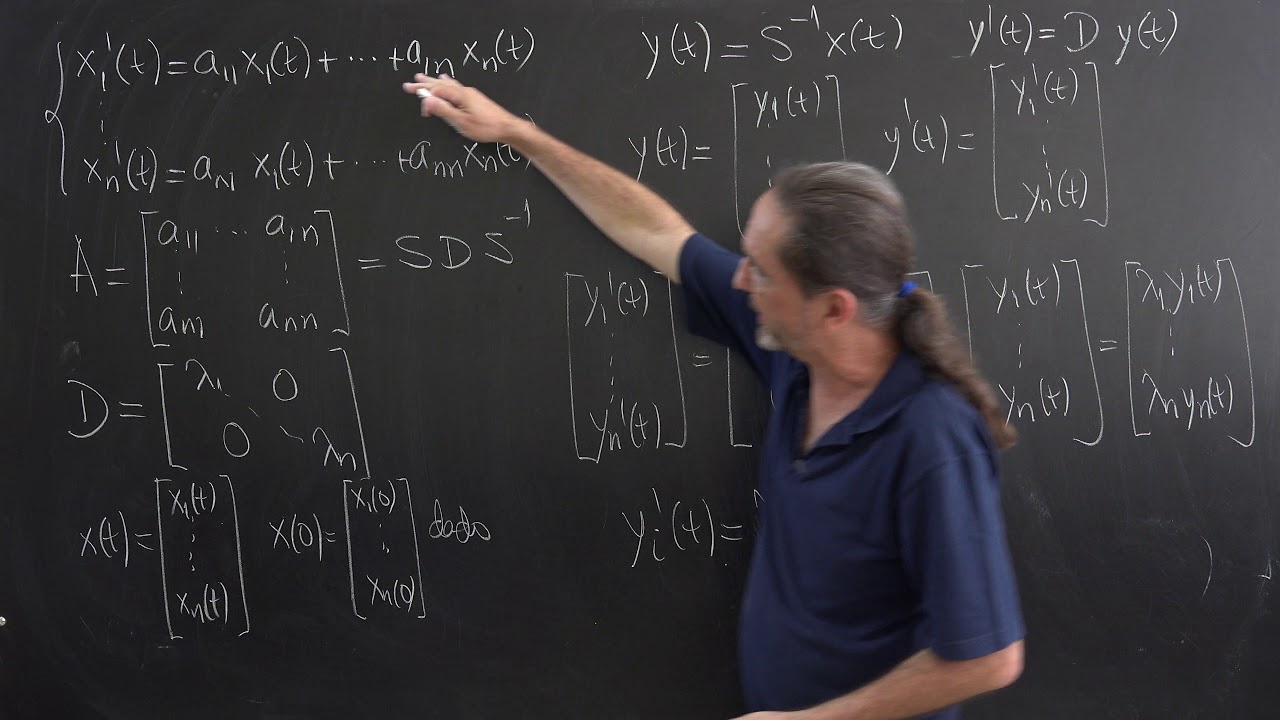
A matrix A can be diagonalized as A = VΛV⁻¹, where V is the eigenvector matrix and Λ is the diagonal eigenvalue matrix; this diagonalization simplifies computing powers of matrices since Aⁿ = VΛⁿV⁻¹, meaning the eigenvectors remain unchanged while each eigenvalue is raised to the nth power, making it easy to analyze long-term behavior such as stability and growth rates.
Diagonalizing a Matrix: Eigenvalues and Eigenvectors Explained
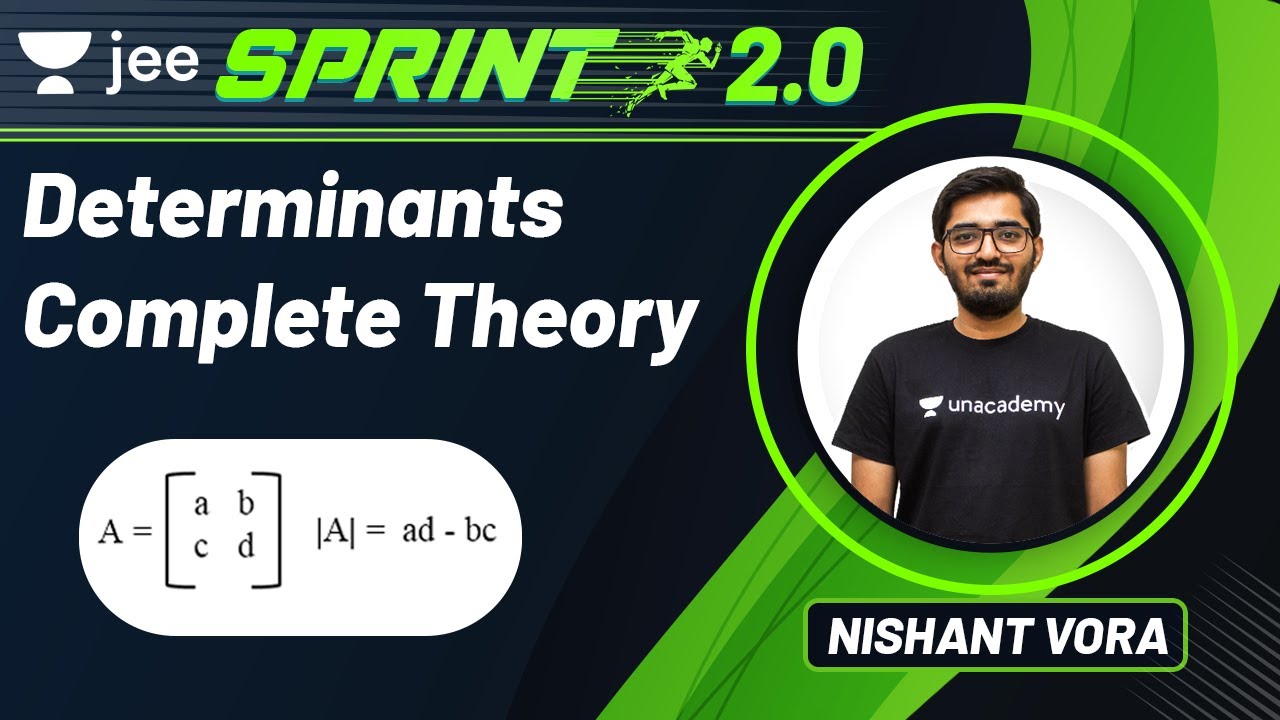
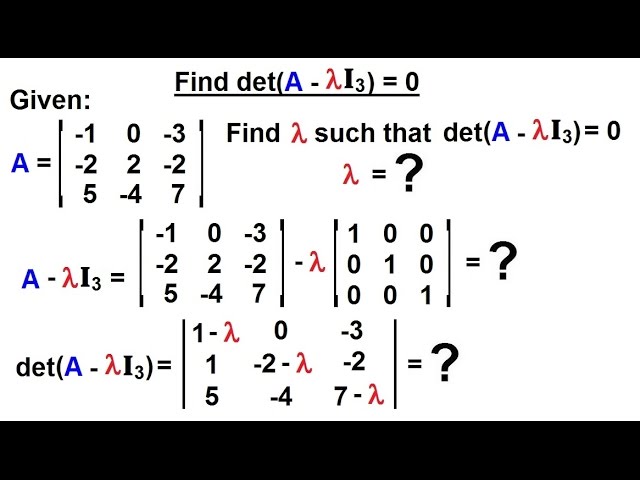
Added:Understanding how to calculate determinants and solve the characteristic equation to find eigenvalues.
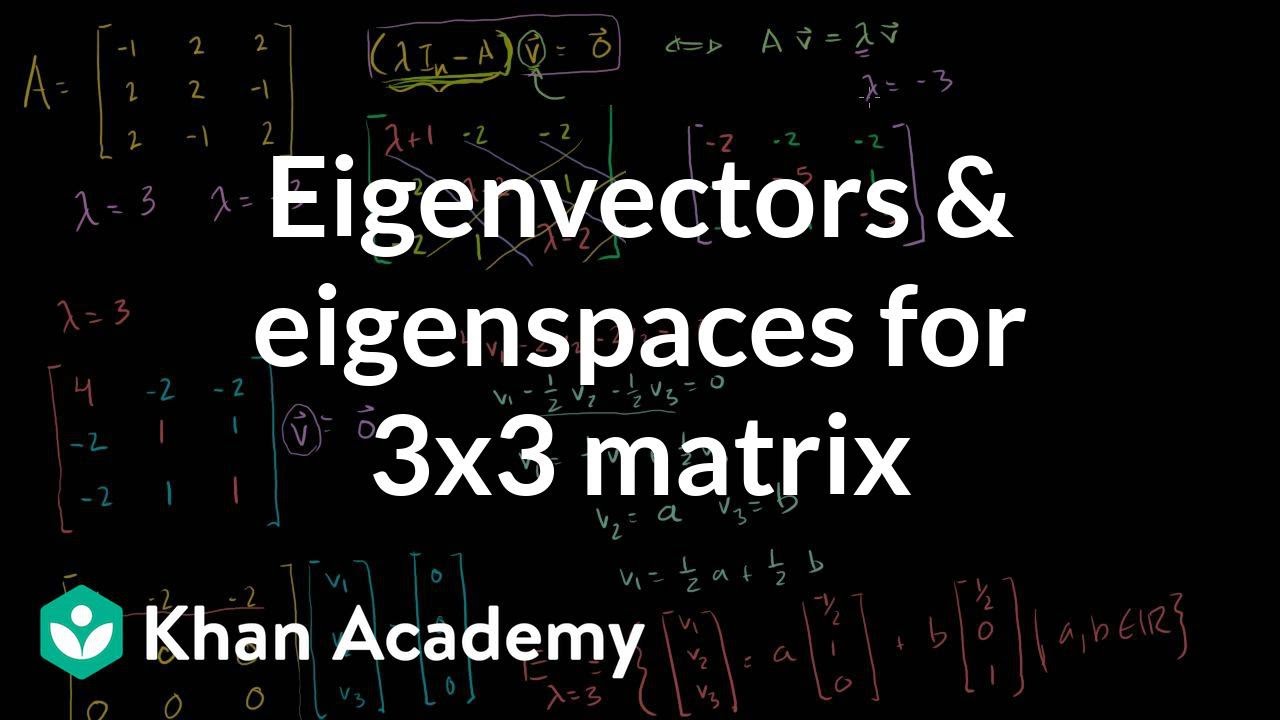
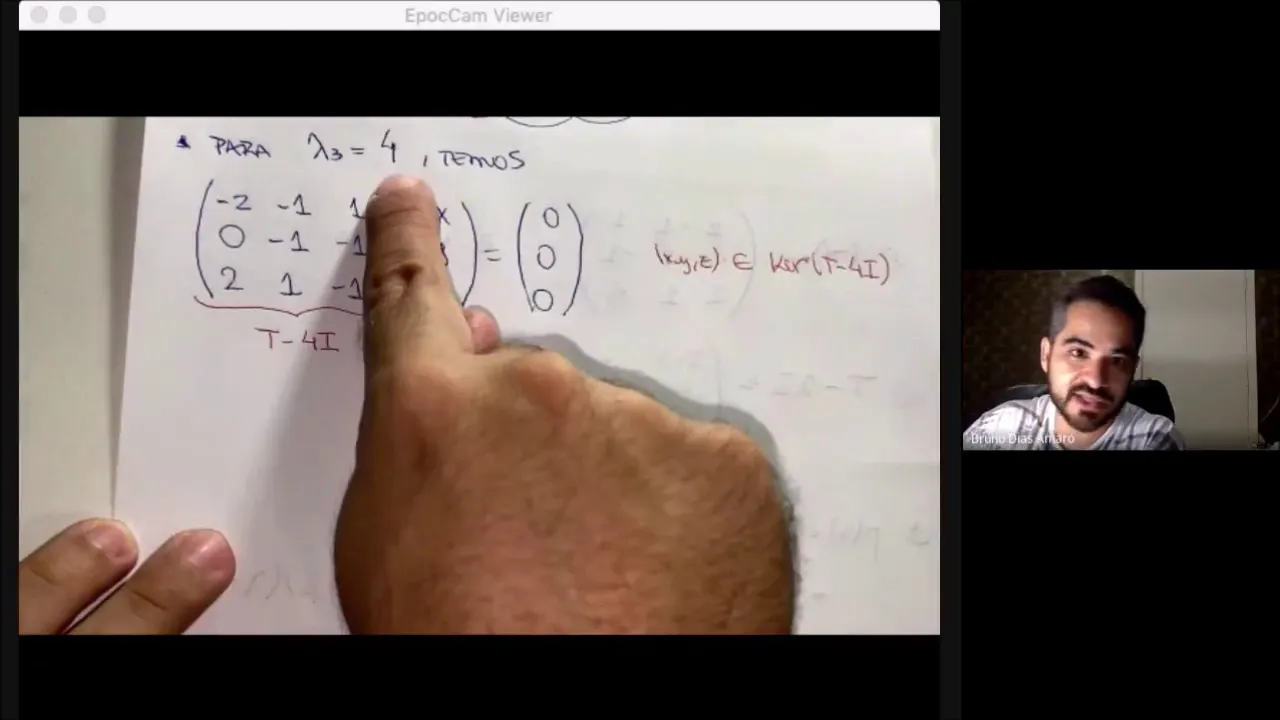
The concept of eigenvectors and how to solve the homogeneous system (A - λI)v = 0 to find the eigenspace.
Basic matrix algebra, specifically matrix multiplication and the procedure for finding the inverse of a square matrix.
The definition of linear independence and how to determine if a set of vectors forms a basis for a vector space.
Orthogonal diagonalization and the Spectral Theorem for symmetric matrices.
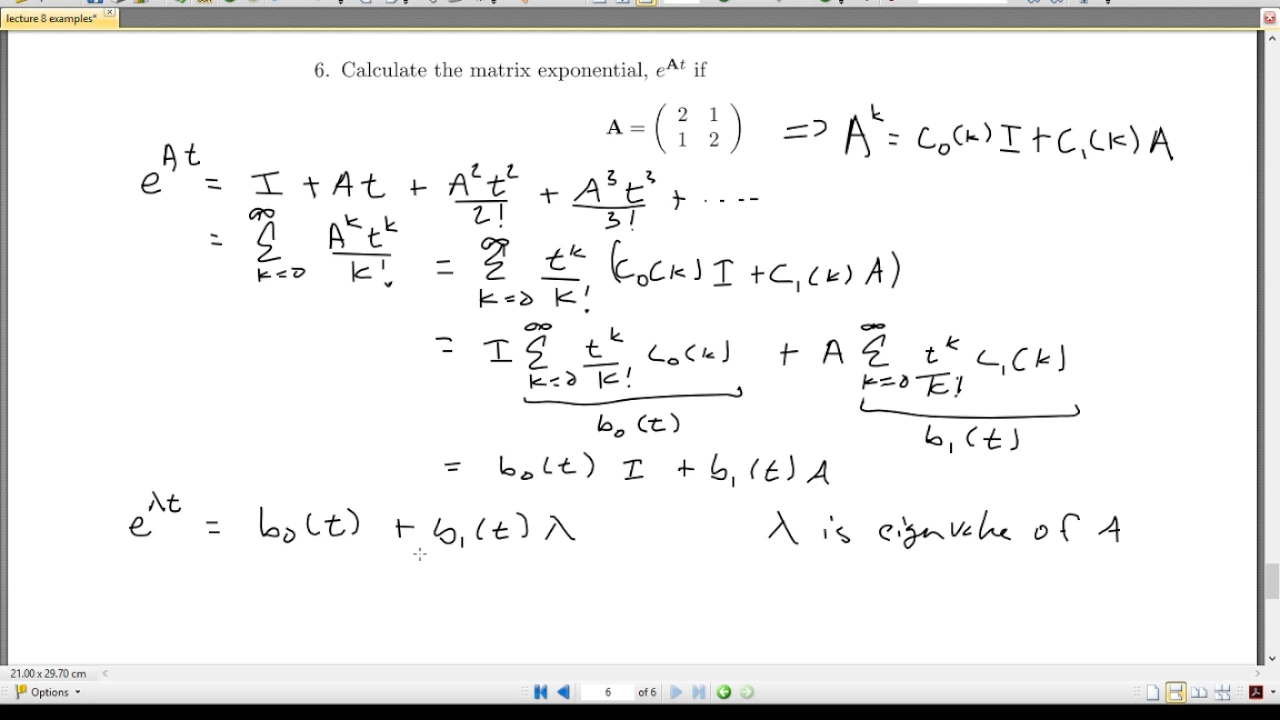
Computing matrix exponentials (e^At) to solve systems of coupled linear differential equations.
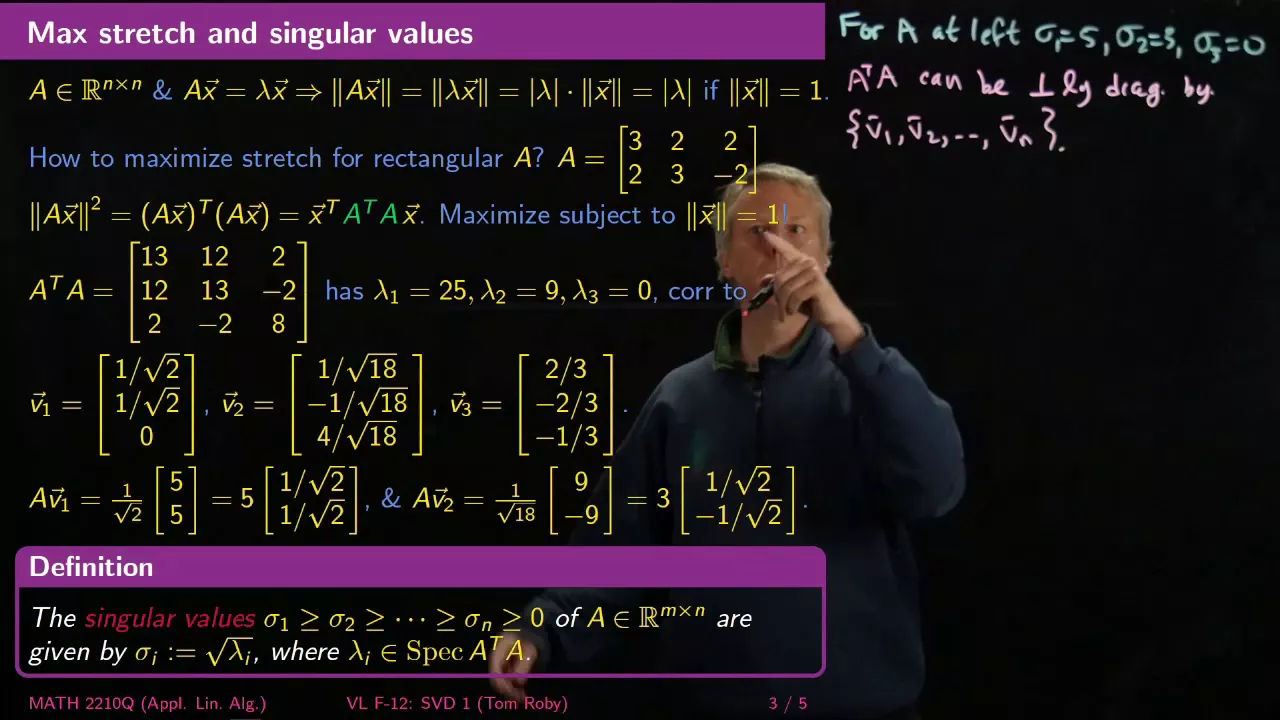
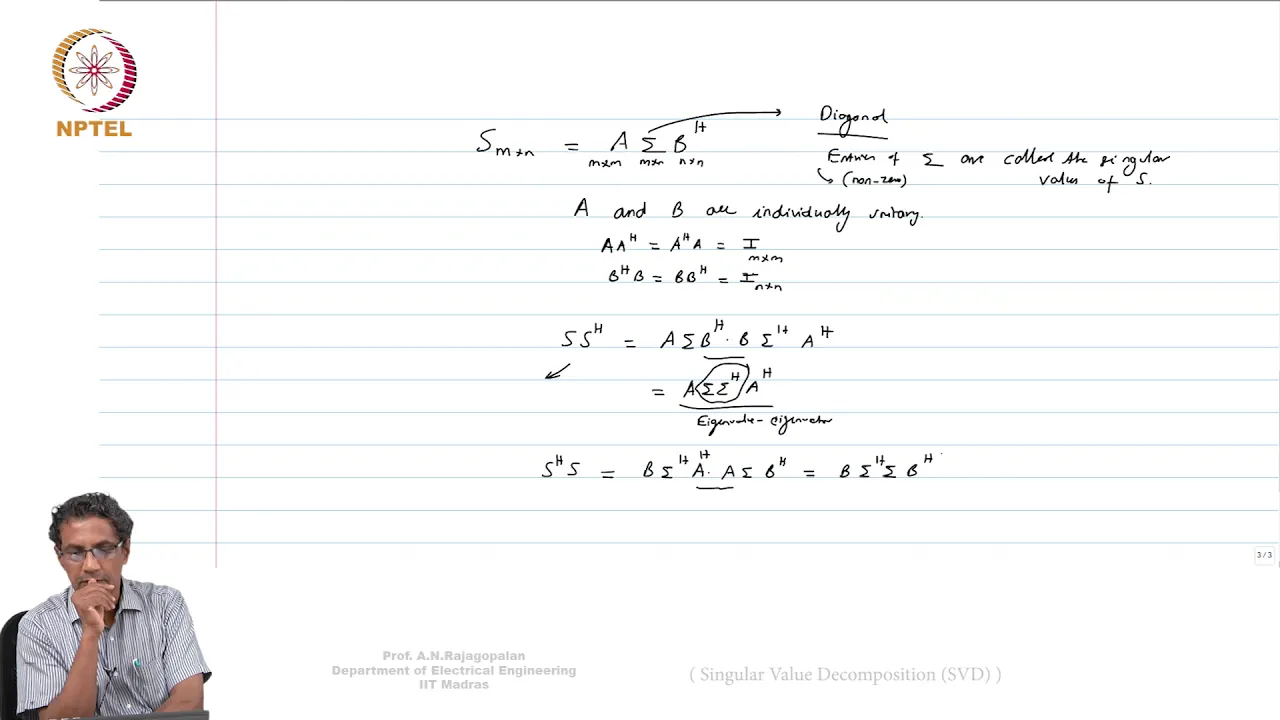
The Singular Value Decomposition (SVD) as a generalization of diagonalization to non-square matrices.
Applying matrix powers to model discrete dynamical systems, such as Markov chains and population growth models.
199.1K views4.2Klikes11:36Original Release: 2016-05-06
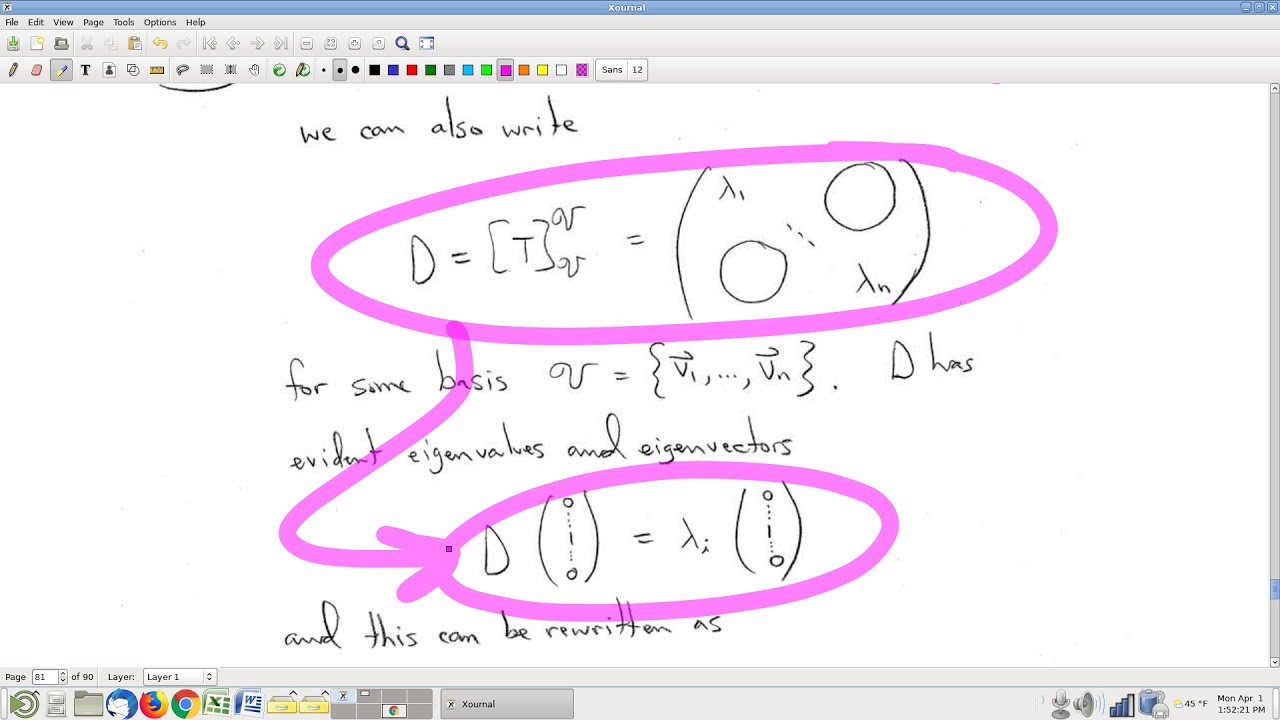
okay more about igen values and igen vectors well actually it's going to be the same thing about igen values and igen vectors but I'm going to use Matrix notation so you remember I have a matrix a 2X two for example it's got two igen vectors each igen Vector has its igen value so I could write the the IG Value World that that way I want to write it in Matrix form I want to create an igen Vector matrix by taking the two I vectors and putting them in The Columns of my Matrix so that's uh that if I have n of them that allows me to give one name the I Vector Matrix maybe I'll call it V for vectors so that's a * V and now just bear with me while I do that multiplication of a * the I Vector Matrix so what do I get I get a matrix that's 2x two that's 2x two I'm getting a 2X two Matrix what's the First Column the First Column of the output is a * the First Column of the input and what is a * X1 well a * X X1 is Lambda 1 * X1 so that First Column is Lambda 1 X1 and a times the second column is ax2 which is Lambda 2x2 so I'm seeing Lambda 2 x2 in that column okay Matrix notation those were the I vectors this is the result of a * V but but I can look at this a little differently I can say wait a minute that is my ion Vector Matrix X1 and X2 those two columns times a matrix ah yes I want to I'm I'm just taking this First Column Lambda 1x1 is Lambda 1 * X1 + 0 * X2 right there I did a matrix multiplication I did it without preparing you for it I'll I'll go back and do that preparation in a moment but when I multiply a matrix by a vector I take Lambda 1 time that one 0 * that one I get Lambda 1x1 which is what I want can you see what I want in the second column here I the result I want is Lambda 2x2 so I want no x1's and Lambda 2 of that column so that's 0 * that column plus Lambda 2 * that column are we okay so what do I have now I have the whole thing in a beautiful form as is a * the igon vector Matrix equals there's the igon vector Matrix again V and here is a new Matrix that I'm going to that's the igon value Matrix and everybody calls that because those are Lambda 1 and Lambda 2 so the natural letter is a capital Lambda that's a capital Greek Lambda there the best I could do so you see that the two equations SE written separately or the four equations or the N equations combine into one Matrix equation this is the same as those two together good good but now now that I have it in Matrix form I can mess around with it I can multiply both sides by V inverse If I multiply both sides by V inverse I I discover well shall I multiply on the left by V inverse yes I'll do that if I multiply on the left by V inverse that's V inverse a v so this the matrix multiplication and my next video is going to recap Matrix uh multiplication so I multiply both sides by V inverse V inverse time V is the identity that's what the inverse Matrix is V inverse V is the identity so there you go let me push that up that's really nice that's really nice that's called diagonalizing a i diagonalize a by taking the I Vector Matrix on the right its inverse on the left multiply those three matrices and I get this diagonal matrix this is the diagonal matrix Lambda or other times I might want to multiply by both sides here by V inverse on the coming on the right so that would give me a v v inverse is the identity so I'm I'm moving V I can move V over there as V inverse that's what it amounts to I multiply both sides by V inverse so this is just a and this is the V and the Lambda and now the V inverse that's great so that is that's a way to see what a how a is built up or broken down into the IG Vector Matrix times the igon value Matrix times the inverse of the I Vector Matrix okay let me just use that for a moment uh just so you see how it connects with what we already know about igen values and I vectors okay so I'll copy that great fact that a is V Lambda V inverse oh what do I want to do I want to look at a squ so if I look at a squ that's V V inverse times another one right there's an a there's an A so that's a s well you may say I've made a mess out of a squ but not true V inverse V is the identity so that's just the identity sitting in the middle so the V at the far left then I have the Lambda and then I have the other Lambda Lambda s squ and then the V inverse at the far right that's a 2 and if I did it n times I would have a to the N would be V Lambda to the N power V inverse what is this what is this saying about this is a s what what how do I understand that equation I to me that says that the I values of a s are Lambda squar I'm just squaring each igen value and the igen vectors what are the I vectors of a s they're the same V the same vectors X1 X2 that went into V they they're also the ion vectors of a squ of a cubed of a to the N of a inverse and so that's the point of diagonalizing a matrix diagonalizing a matrix is another way to see that when I Square The Matrix which is usually a big mess look looking at the igen values and igen vectors it's the opposite of a big mess it's very clear the ion vectors are the same as for a and the igen values are squares of the I values of a in other words we can take the N power and we have a nice notation for it we we learned already that the N power has the igen values to the n power and the igen vector is the same but now I just see it here and there it is for the ins power so if I took the same Matrix step a thousand times what would be important what controls the thousandth power of a matrix the ion vectors stay they're just set it would be the thousandth power of the igen value so if this is a matrix with an igen value larger than one then the thousandth power is going to be much larger than one if this is a matrix with igen values smaller than one they're going to be very small for lamb when I take the thousandth power if if there's an IG value that's exactly one that will be a steady state and one to the thousandth power will still be one and nothing will change so the stability what happens as I multiply take powers of a matrix is a basic question parallel to the question what happens with a differential equation when I take the the solve forward in time I I think of those two problems as quite parallel this is taking steps single steps discrete steps the differential equation is moving forward continuously this the difference between hop hop hop in the discrete case and run forward continuously in the differential case in both cases the I vectors and the igen values are the guide to what happens as time goes forward okay I have to do more about matric working with matrices uh let me come to that next thanks
Up Next
49:09
Orthogonal Matrices & Gram-Schmidt | Linear Algebra
@mitocw
280.2K views•2019-09-24

4:43
Elliptic Curve Cryptography Explained: ECC, ECDSA, ECDH
@PracticalNetworking
28.5K views•2024-10-21

20:22
Cantor's Theorem: Proof & Diagonal Argument | MIT 6.042J
@mitocw
33.1K views•2016-09-12

6:00
The Mathematical Impossibility of Accurate World Maps
@Vox
23.3M views•2016-12-02
Related Study Plans & Knowledge Roadmaps
Structured learning paths in Mathematics
mathematics
Tensor Calculus: Vectors to Riemann Curvature
01Mathematical Foundations: Linear Algebra & Calculus
02Covectors, Dual Spaces, and Tensor Basics
03The Metric Tensor and Index Gymnastics
+ 2 more learning modules
40h5 modules
Explore Roadmap
mathematics
Gödel's Incompleteness: Logic, Proofs & Limits
01Introduction to Formal Systems & Hilbert's Dream
02Set Theory, Cardinality, and Cantor's Diagonal Argument
03Arithmetization and Gödel Numbering
+ 2 more learning modules
14h5 modules
Explore Roadmap
mathematics
Galois Theory: Fields, Groups & Solvability
01Foundations of Abstract Algebra: Groups & Fields
02Polynomials & Field Extensions
03Splitting Fields & Symmetries
+ 2 more learning modules
24h5 modules
Explore Roadmap
mathematics
Non-Euclidean Geometry: Models & Geodesics
01Euclid's Fifth Postulate and the Birth of New Geometries
02Hyperbolic Space and the Poincaré Disk Model
03Geodesics: Defining Straight Lines in Curved Spaces
+ 2 more learning modules
15h5 modules
Explore Roadmap