

























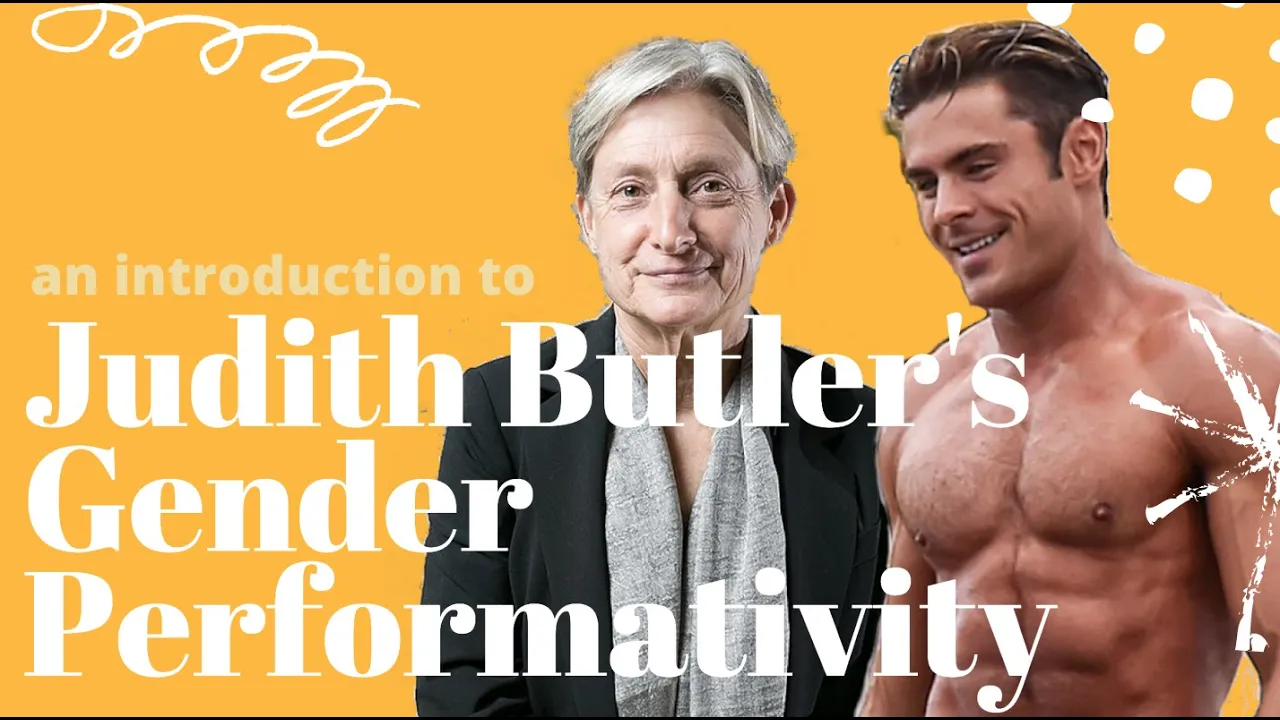





Gender is not a natural or fixed category determined by biology, but rather a performative construct shaped through cultural norms, historical contexts, and individual expression; this means that gender is continuously enacted and reshaped through our behaviors, interactions, and choices, allowing for greater inclusivity and freedom in how people define and express their identities.
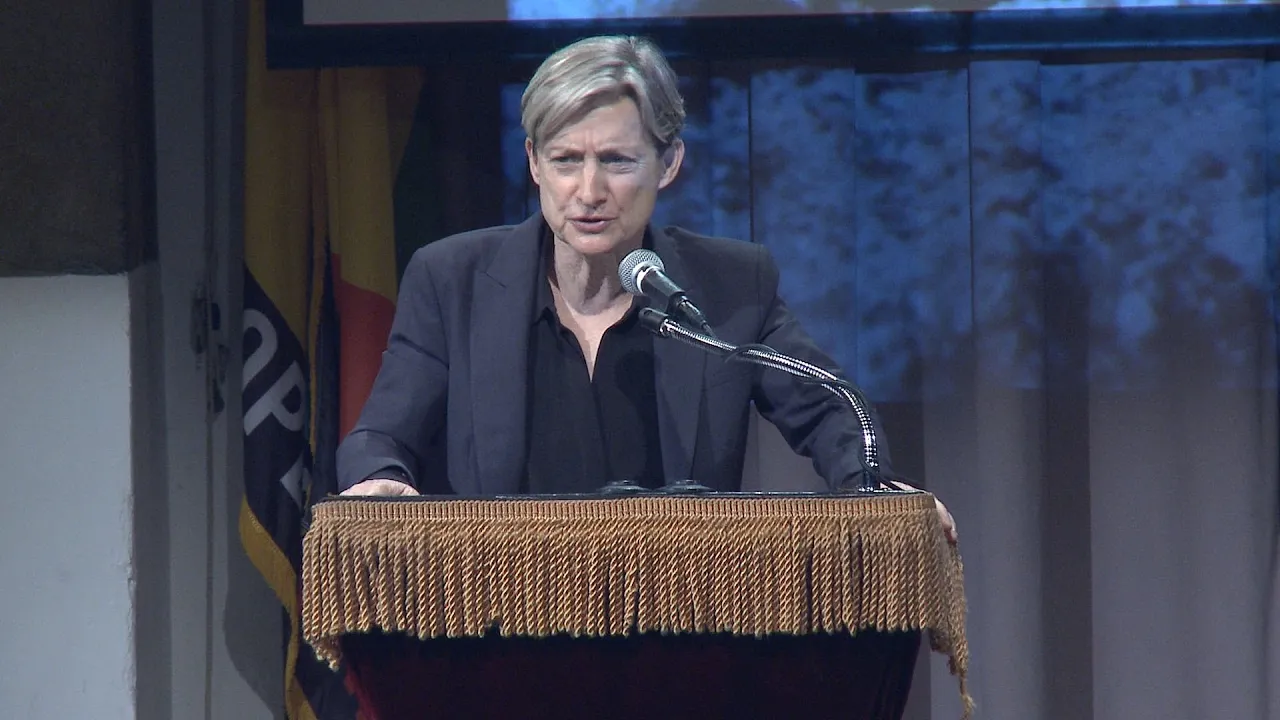
Judith Butler on Gender Theory and Performativity
Added:The distinction between sex (biological differences) and gender (socially constructed roles) as established in early sociological and feminist theory.
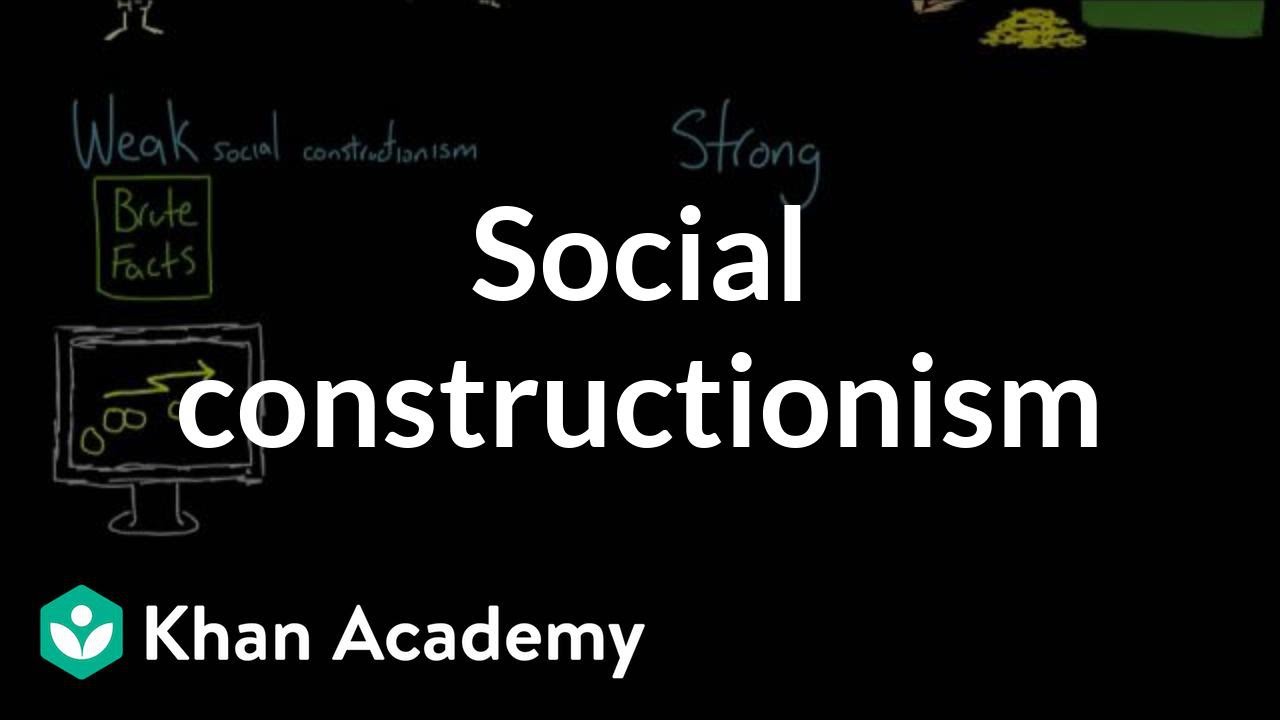
The fundamental concept of social constructionism, which posits that social phenomena and meanings are created and sustained by human agreement and interaction rather than nature.
Simone de Beauvoir's existentialist feminist philosophy, particularly the premise that 'one is not born, but rather becomes, a woman.'
Basic concepts of post-structuralism and Michel Foucault's theories on power, discourse, and the social regulation of bodies.
The development of Queer Theory and its challenge to heteronormativity and stable, binary gender identities.
Butler's later philosophical works on precarity, vulnerability, collective assembly, and the politics of nonviolence.
Intersectional feminism, exploring how performative gender dynamics intersect with race, socioeconomic class, and ability.
Critical analysis of the debates surrounding performativity within transgender studies and materialist feminist theories.
Application of performativity theory to modern digital spaces, examining how identity and gender are constructed and negotiated on social media platforms.
2M views78.4Klikes13:23Original Release: 2023-06-08
- So there are many different theories of gender, and mine is just one.
Sometimes, people who really hate gender name me as the one who made this up, but that's actually not true.
You know, in my view, everybody has a theory of gender, and what I mean by that is that everybody has certain assumptions going about what gender is or should be.
And at a certain point in life, we ask ourselves, "Wow, where'd that assumption come from?"
(Judith laughs) At this point, I'm less concerned about whose theory is right and whose theory is wrong because the assault on gender is also an assault on democracy.
We have the power and the freedom to make more livable lives for ourselves, where bodies can be more free to breathe, to move, to love without discrimination and without fear of violence.
I am Judith Butler, distinguished professor in the graduate school at the University of California at Berkeley.
I teach literature, philosophy, and critical theory, and I'm most well-known for my two books on gender, "Gender Trouble" and "Bodies That Matter" from the early 1990s.
My work has been translated into more than 27 languages.
(pensive music) I insist that what it is to be a woman, or indeed what it is to be a man or any other gender, is an open-ended question.
(pensive music) We have a whole range of differences, biological in nature, so I don't deny them, but I don't think they determine who we are in some sort of final way.
At the heart of these controversies is the distinction between sex and gender.
But what is that distinction?
How do we think about it?
Sex is generally a category that is assigned to infants that has importance within medical and legal worlds.
Gender is a mix of cultural norms, historical formations, family influence, psychic realities, desires, and wishes.
And we have a say in that.
My early life was affected by the 1960s and the social movements that took shape during that time.
I grew up on the East side of Cleveland, part of a Jewish community, and by the time I was in high school, I was politically active.
But I was also taking university courses in philosophy.
In my 20s, I came to see that it was not just the Jews who were apprehended and extinguished by the Nazi regime.
It was queer people, it was gay/lesbian people, it was people with disabilities, people with illnesses, Polish workers, communists.
And my sense was that one needed to widen the lens and see that many people have been subject to genocidal politics and to understand that there are different forms of oppression.
I remained convinced that one does need to know history in order to make sure it does not repeat and that one wants justice not just for the group to which one belongs, but for any group that suffers in a similar way.
In the '70s and '80s, I was part of a movement of people who were rethinking gender during that time.
Queer theory was emerging.
It was in a complicated conversation with feminism.
Trans issues had not yet surfaced as part of our contemporary reality, so it was a moment in which we asked questions like, "What has society made of us, and what can we make of ourselves?"
There were a number of versions of feminism that I tended to oppose.
One of them held that, well, women are fundamentally mothers and that maternity is the essence of the feminine.
And then a second one thought that feminism was about sexual difference, but the way they defined sexual difference was always presumptively heterosexual.
And both of them struck me as wrong.
I was pretty committed to the idea that people ought not to be discriminated against on the basis of what they do with their body, who they love, or how they move, or how they look.
All I was saying is that the sex you're assigned at birth and the gender that you are taught to be should not determine how you live your life.
(film camera rolling) Sometimes, people point to "Gender Trouble" as the inception of gender theory, but people were working on gender before me, Gayle Rubin, and Juliet Mitchell, and Simone de Beauvoir herself.
Simone de Beauvoir was an existential philosopher and a feminist philosopher who wrote "The Second Sex" in the 1940s.
The basic point is that one is not born a woman, but rather becomes one, that the body is not a fact.
She opened up the possibility of a difference between the sex you're assigned and the sex you become.
(pensive music) Gayle Rubin was an anthropologist, and remains an anthropologist, who wrote an extremely influential article called "The Traffic in Women."
And what she tried to say was that the family was a structure whose task it was to reproduce gender, and one of the aims it had was to kind of keep heterosexuality looking really normal.
And although it was part of feminist anthropology at the time, it allowed us to start thinking about gender as something that could be reproduced, crafted, cultivated, and that there were systems, frameworks, to which gender belongs.
There was one other dimension of Rubin's work which was, interestingly, psychoanalysis.
She basically said, "Well, maybe there's a whole lot of repression going into becoming a man and a whole lot of repression going into becoming a woman," and that one of the things we have to do to conform with existing gender norms is to rule out all those possibilities of being, feeling, doing, loving that don't line up with the gender norms that are governing our lives.
So anthropology, psychoanalysis, they all had their place in that moment way before "Gender Trouble" emerged on the scene.
I think at the time that I wrote "Gender Trouble," people treated gender as if it was a natural fact or a sociological reality, but they didn't treat it as something that you could make and remake.
Performance is important to this extent that we do enact who we are, and anybody in performance studies actually knows that there are performances that we do in our lives that are not mere performance, they're not fake.
When performative was first coined as a word, the philosopher J.L. Austin was trying to understand legal utterances.
So when a judge says, "I declare you man and wife," you become man and wife once that declaration has happened.
That's not fake, that happened.
Now, what if we were to say that in enacting our lives as a particular gender, we are actually realizing that gender anew, we are making something real happen.
When gay and lesbian people started coming out or when trans people started living openly, something changed in the world.
By appearing, speaking, acting in certain ways, reality changed.
And it has changed.
We are seeing the changing of terms.
We no longer speak about family, woman, man, desire, sex in the same way.
Even the Cambridge Dictionary (Judith laughs) acknowledges that something has changed.
Okay, so when we talk about performative, we're talking about an act that makes something come into being or an act that has real consequences.
We're talking about the changing of reality.
Even among progressive and liberal people I know, there can sometimes be a real resistance to thinking about trans rights, or lesbian and gay rights, or even women's rights.
They sometimes say that these are secondary issues or it simply makes them uncomfortable.
"Why should I have to refer to someone as a he, or a she, or a they?"
And yet, at least in the US, we've learned how to talk about Black people differently or we talk about women differently.
And sure, it was probably hard to learn how to use new language.
Maybe we had to adjust our habits.
But stumbling is part of learning and making an error is part of learning, especially when we're learning something new.
Sometimes, we can all be vitriolic, right?
Some certain statements will set me off and I will scream, but if I only were to do that, then I would never be having a conversation with anyone.
I think we all want to be the moral center of our universe, like, "That's right, that's wrong."
"You're canceled, you're not."
"You're with me, you're against me."
But we have to allow ourselves to be challenged and accept the invitation to revise our ways of thinking because that's the only way of being open to people who are trying to make their claim sometimes for the very first time, to be heard, to be known, to be acknowledged.
(uplifting music) Now, I'm less interested in defending a theory of gender.
I'm much more concerned with finding creative and effective ways of countering the attack on gender.
One problem is that many people who refuse to allow trans people to define themselves is that they feel that their own self-definition is destabilized.
The idea that we can change reality, transform reality to be more open, inclusive, just less violent - there's an instability in that that's very frightening to people who want to understand their genders as fixed.
But is anybody's gender necessary and universal, or is it a complicated emergence that happens with each of us?
Our deepest sense of self is also formed in time, and we can't always know, in advance, what that will be.
(uplifting music) Freedom is a struggle because there's so much in our world that's telling us not to be free with our bodies.
And if we are seeking to love in a free way, to live, and move in a free way, we actually have to struggle to claim that freedom.
When we live in a democracy, we assume that we're living according to certain principles - equality, freedom, justice - and yet we're constantly learning what freedom is, and what equality is, and what justice can be.
And those challenges, right, the anti-slavery movement, the suffrage movement, the movement for LGBTQIA+ rights, I mean, each of those struggles involve challenging people's existing ideas of: Who's equal?
Who has the right to be free?
And how do we define justice?
We are, all the time, struggling to achieve that goal.
We need to reoccupy these notions and show that concerns with racial justice, and gender equality, and gender freedom are an integral part of any democratic struggle, especially if we want to rethink who the people are and what it means for them to live in freedom without fear.
(uplifting music) - [Crew] Let's just wrap up the gender stuff.
Unless you want to take a break from gender, we can go back to that.
Do you want to get... Let me give you the prompt for the last- - My whole life, I've wanted to take a break from gender.
I can never take a break from gender.
- [Announcer] Get smarter faster with videos from the world's biggest thinkers.
To learn even more from the world's biggest thinkers, get Big Think+ for your business.
Up Next

120:07
Tech Censorship and Free Speech Debate Panel Analysis
@LastNightDestiny
110.1K views•2023-04-26

12:54
Triumph of Orthodoxy Icon: Byzantine Art & History Explained
@BenCallan
2.1K views•2024-08-06

9:49
FastAPI vs Flask vs Django: Choosing the Right Python Web Framework
@TechWithTim
302.5K views•2024-05-26

1:42
Game of Thrones Opening Credits: A Cinematic Analysis
@gameofthrones
46.3M views•2011-04-18
Related Study Plans & Knowledge Roadmaps
Structured learning paths in General & Interdisciplinary Studies
general-studies
Elevator Engineering: History, Physics & Cities
01From Hoists to Safety Brakes: The Dawn of Vertical Lift
02Hydraulic vs. Traction: The Engineering Physics of Elevators
03Modern Speed, Safety, and Algorithms
+ 2 more learning modules
12h5 modules
Explore Roadmap
general-studies
Rubber: Material Science, History & Geopolitics
01Origins of Natural Rubber & Mesoamerican History
02The Chemistry of Natural Rubber & Vulcanization
03The Geopolitics of the Rubber Boom & Colonization
+ 2 more learning modules
12h5 modules
Explore Roadmap
general-studies
Containerization: Evolution, Logistics & Trade
01Ancient Trade & Bulk Cargo: Amphorae to Barrels
02The Industrial Revolution & Cardboard Packaging
03The Containerization Revolution: Malcom McLean
+ 2 more learning modules
12h5 modules
Explore Roadmap
general-studies
Textile Tech: Evolution, Labor & Global Impact
01Pre-Industrial Textiles: Handloom & Cottage Industry
02Mechanization: The Spinning Jenny to the Power Loom
03The Factory System & Global Labor Transformation
+ 2 more learning modules
10h5 modules
Explore Roadmap