
























The Twins Paradox is not a true paradox but a result of misunderstanding relativity's rules; the key to resolving it lies in understanding that different observers traveling different paths through spacetime naturally measure different amounts of time, and the acceleration experienced by one twin simply provides the second shared event needed for proper time comparison, without violating the principle that no point of view has preference over any other.
Twins Paradox Explained: Special Relativity Solution
Added:The fundamental postulates of Einstein's Special Relativity, specifically the constancy of the speed of light in all inertial frames.
Basic mathematical understanding of the Lorentz Transformations and how coordinates change between moving reference frames.
The qualitative concepts of time dilation and length contraction.
An introductory familiarity with Minkowski spacetime and the concept of the spacetime interval.
Calculating 'proper time' along arbitrary, curved worldlines in spacetime using integration.
Exploring General Relativity to understand how acceleration and gravity affect clocks (gravitational time dilation).
Analysing other relativistic paradoxes, such as the Ladder Paradox (or Pole-Barn Paradox), to deepen understanding of simultaneity.
Investigating real-world applications of relativistic time correction, such as the synchronization of GPS satellite clocks.
191.8K views8Klikes10:44Original Release: 2018-04-27
This episode was supported by Brilliant.org Hey Crazies.
It’s time to tackle my favorite paradox of all time.
The Twins Paradox!
Unfortunately, I don’t have any twins, even though everyone keeps asking.
But I do have clones.
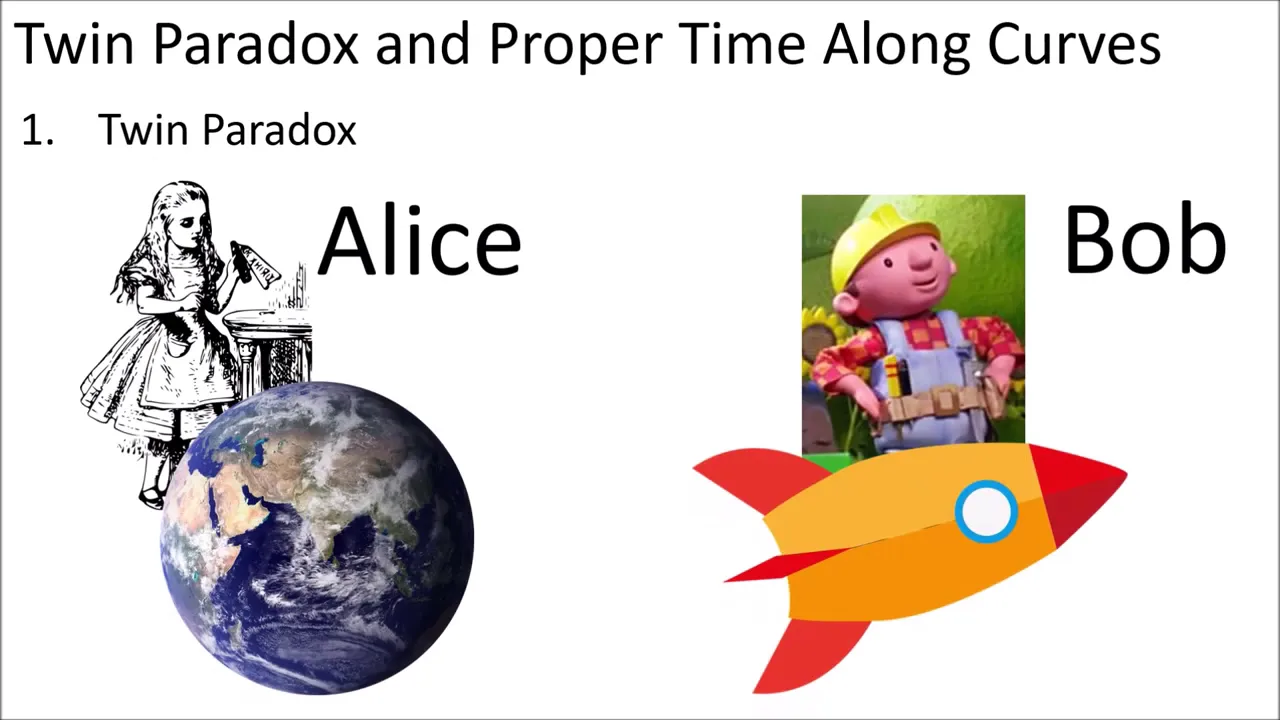
I’d like to introduce you to Rocket Clone.
Hi!!
He’s super useful for this sort of thing.
To infinity and beyond!
Yeah yeah, whatever. Just get in the rocket.
Ok, let’s do this!
Rocket Clone zips off at 55 percent the speed of light to, oh, I don’t know.
Let’s say Wolf 359, which is a modest 8 light years away.
By the way, for those of you who don’t know, a light year is not a time.
It’s a speed multiplied by a time.
A light year is a distance.
Anyway, Rocket Clone gets to Wolf 359 and immediately turns around.
When he finally gets back to the station, 29 years have gone by for me, but only 24 years have gone by for him.
If you’re familiar with relativity, this isn’t that surprising.
Rule #2 for Relativity says: Every observer carries their own set of coordinates and their own clock.
I get a clock.
You get a clock.
Everybody gets a clock!!!
Different observers traveling different paths through space-time are going to measure different amounts of time.
There’s no paradox there.
A quick way to calculate the difference is by using something called the gamma factor.
It’s a number that shows up all over relativity, so get used to seeing it.
Using that factor, I expected Rocket Clone to be only 24 years older, even though I’m 29 years older.
There’s no surprise on my end.
Rocket Clone is the one that’s surprised.
Rule #4 says: It will always look to an observer as though they are stationary in space.
As far as Rocket Clone is concerned, he stayed in one place and I’m the one that moved.
We also have Rule #1: No point of view has preference over any other point of view.
Rocket Clone is the one with the paradox.
He aged 24 years and if he does the same calculation I did, he expects to find me only 20 years older, not 29 years older.
He expects to be the older one.
Paradox!!
Ahhhhh!!!!!!!!
Huh... Not sure why that happened.
I’ve said it before and I’ll say it again.
Paradoxes are not a problem of the universe.
They’re a problem of the human mind.
The universe doesn’t have a problem.
We do.
When it comes to paradoxes, there are only two ways we could have made a mistake: Option One!
We’ve made an assumption we shouldn’t have made.
Meaning one of the rules we used isn’t actually a rule.
It’s difficult to argue with Rule #4 since perception is pretty self-centered and Rule #2 can’t be the problem since that’s what relativity is all about.
That leaves only Rule #1, so let’s take a closer look at that.
Throwing out rule #1 is a very common way people try to solve this paradox, but that unravels the entirety of relativity.
I mean, do you think I would have spent an entire video giving you a list of rules for relativity that could break in relativity?
Don’t be ridiculous!
It’s rule #1 for crying out loud!
Anyway, here’s how the typical explanation goes: Since Rocket Clone accelerates, he feels a force toward the back of his rocket.
A force of uniform gravity to be specific.
This breaks the symmetry between his clock and mine somehow making mine the correct clock.
But here’s the problem with that solution.
There never was any symmetry between him and me to begin with.
Like we said earlier: Different observers traveling different paths through space-time are going to measure different amounts of time.
And that’s not just true of time.
It’s also true of distance, length, and a whole list of other measurements.
Having one of the observers accelerate just adds another measurement to the list of things they disagree on.
Forces are now on the list.
That’s not that significant of a change.
It certainly doesn’t make one person right and another person wrong.
It just makes them more relative.
But don’t accelerated points of view require general relativity?
Yes, but general relativity fixed that by strengthening rule #1, not by throwing it away.
Rule #1 holds true in general relativity just as much as it does in special relativity.
The fact that Rocket Clone accelerates isn’t the problem.
Then what other mistake could we have made?
I’m so glad you asked!
Option Two!
We didn’t consider something we should have considered.
I feel like there’s something missing here.
1 2 4 Oh! It’s Rule #3. We forgot Rule #3.
We have to use the correct coordinate transformation.
Remember this quick calculation Rocket Clone did?
It’s wrong.
And this quick calculation I did?
Also wrong!
But didn’t you get the right answer?
Yeah, but that’s, well, OK, maybe “wrong” was a bit harsh.
Let’s go with “sloppy”?
When we do this, we get no perspective on what we’re calculating.
The number Rocket Clone calculated is valid.
It’s just not the answer to the question he was asking.
You’re not always calculating what you think you’re calculating.
It’s safer to use the full transformations or, better yet, written in matrix form because you transform both space and time together.
It gives you a better idea of what you’re looking at.
But you know what works even better?
A space-time diagram!
If you’re not familiar with those, you should go watch this video first.
It’ll also help with all these rules I’ve been giving you.
So, in the Twins Paradox, the two paths look like this.
Rocket Clone accelerates away from the space station reaches 55 percent the speed of light and stops accelerating.
He eventually gets to Wolf 359, turns around, and the whole thing happens in reverse.
The straight paths are constant velocity.
The curved paths are the accelerations.
So, yes, there are three sections where Rocket Clone accelerates.
But like I said before: The fact that Rocket Clone accelerates isn’t the problem.
This paradox does not require accelerations.
It persists even if Rocket Clone goes the same velocity the whole time.
These are the lengths of the two space-time paths: 29 years and 24 years If we’re going to remove all the accelerations though, then we can’t even let Rocket Clone turn around.
That means these are the numbers we expect to see: 14.5 years and 12 years because we’re only looking at half the trip.
OK, now let’s look at the simplified diagram.
Say Rocket Clone is already going at 55% the speed of light when he flies past my space station.
Sometime later, he passes Wolf 359.
He just keeps going because no accelerations.
I say Rocket Clone’s path is about 14 and half years tall, but he says it’s about 12 years tall.
Exactly half the time differences from earlier because this is half the trip.
So this is totally consistent with everything we got before.
The paradox arose when tried to look the other way.
Starting from Rocket Clone’s coordinates, we can look back at me and Wait a minute!!
We’re not looking at Rocket Clone’s path anymore.
We’re looking at mine.
That’s a completely different space-time path.
Hmm.
Rocket Clone’s path measured in Rocket Clone’s coordinates is 12 years tall, but that only includes a portion of my path.
A portion that’s about 10 years tall in my coordinates.
Exactly half the time difference from earlier because this is half the trip.
But that doesn’t actually say anything about my path through space-time.
It’s only saying things about his path, which isn’t the question he was asking.
The event of Rocket Clone passing Wolf 359 isn’t on my path.
It’s on his.
To line that up with the event at the end of my path, Rocket Clone has to wait over 5 more years because my entire path is almost 17 and half years tall in his coordinates.
These "horizontal" gridlines are lines of equal time.
That 17 and half years is the number Rocket Clone should have used to calculate my time using that sloppy calculation from earlier.
Except, he wouldn’t have known to do that.
That extra 5 years doesn’t even exist in the full Twins Paradox because, by then Rocket Clone would have turned around.
He wouldn’t even be on that path anymore.
So, here’s the real problem.
Both of us are trying to calculate the location and time of an event on someone else’s path in someone else’s coordinates.
There are four different measurements here.
Two different paths measured in two different coordinates.
Everyone agrees if those measurements are at the same place and the same time because we just take the measurement together.
But, if they’re at different places, we have a problem.
At distant locations, those calculations are just predictions, not measurements.
Each of us has to take a measurement of ourselves, maybe one selfie every day, and then send it to the other person.
And that’s a whole other can of worms that I’d rather not open.
My point is this: The acceleration doesn’t make one of time measurements incorrect.
It’s just that, without the acceleration, we only get one shared event.
The acceleration gives us a second shared event.
If we don’t want to deal with sending selfies to each other we need two shared events to measure the passage of time.
One at the beginning and one at the end.
We can’t agree on any other events we might want to include, so we can’t compare measurements between them.
The acceleration doesn’t give anyone priority.
It just fixes a measurement problem.
You don’t have to throw out rule #1 if you do rule #3 correctly.
The Twins Paradox disappears entirely if you remember all the rules of relativity.
So, are you satisfied with this solution?
Please discuss in the comments.
Thanks for liking and sharing this video.
Don’t forget to subscribe if you’d like to keep up with us.
Hit that notification bell if you really like what we do here.
And until next time, remember, it’s OK to be a little crazy.
Still feeling like you need some practice?
Then check out Brilliant.org.
Brilliant is a problem solving website designed to train you to think like a scientist on a wide variety of topics.
If you liked this video, then you’ll probably like their course on relativity.
Anyone who is new to relativity might want to check out “Reference Frames and Observers.” It gives you that traditional introduction using Lorentz Transformations.
You know, these equations here.
Once you feel comfortable, you can check out “Space-time and Paradoxes,” where you hone your skills using space-time diagrams.
That’s where the true power of relativity lies.
They even have a quiz on the Twins Paradox.
They do talk about acceleration in there, but we’ll forgive them.
Brilliant was nice enough to sponsor this video and crazy enough to offer you a discount.
The first 72 people to visit brilliant.org/ScienceAsylum will get 20 percent off an annual premium subscription.
It’s a really good offer if you’re interested in getting some extra practice.
Several of you were disappointed I didn’t do a space-time diagram for the two ships moving away from each other.
There’s a reason for that.
You can calculate relative speeds using angles in a space-time diagram, but they’re hyperbolic angles, which means you need hyperbolic trig.
That’s a kind of math I wasn’t interested in explaining that video.
Anyway, thanks for watching!
Up Next

9:06
Length Contraction & the Pole-Barn Paradox in Special Relativity
@kilroi22
14.4K views•2013-06-06

4:32
How Tuned Mass Dampers Stop Structures from Shaking
@MinutePhysics
573K views•2018-08-28

5:36
Gravity and Falling Objects Explained by General Relativity
@ScienceAsylum
167.6K views•2018-03-06

33:44
The Blue LED: A Decade-Long Scientific Challenge Explained
@veritasium
46.5M views•2024-02-08
Related Study Plans & Knowledge Roadmaps
Structured learning paths in Physics
physics
Medical Physics: Imaging, MRI & Radiotherapy
01Foundations of Radiation and Matter Interaction
02X-Ray Imaging and Computed Tomography (CT)
03Magnetic Resonance Imaging (MRI) Physics
+ 3 more learning modules
15h6 modules
Explore Roadmap
physics
Nuclear Physics (Decay, Fission & Reactors)
01Atomic Structure and the Binding Force
02Radioactive Decay and Half-Life
03Nuclear Fission Mechanics and Chain Reactions
+ 2 more learning modules
12h5 modules
Explore Roadmap
physics
Soft Matter (Polymers, Colloids & Rheology)
01Foundations of Soft Matter & Thermal Forces
02Polymer Physics and Macromolecules
03Colloids, Surfactants, and Self-Assembly
+ 2 more learning modules
38h5 modules
Explore Roadmap
physics
Analytical Mechanics: Lagrangian & Hamiltonian
01Mathematical Foundations: Calculus of Variations
02From Newtonian Mechanics to Constraint Dynamics
03The Principle of Least Action & Lagrangian Mechanics
+ 3 more learning modules
28h6 modules
Explore Roadmap