


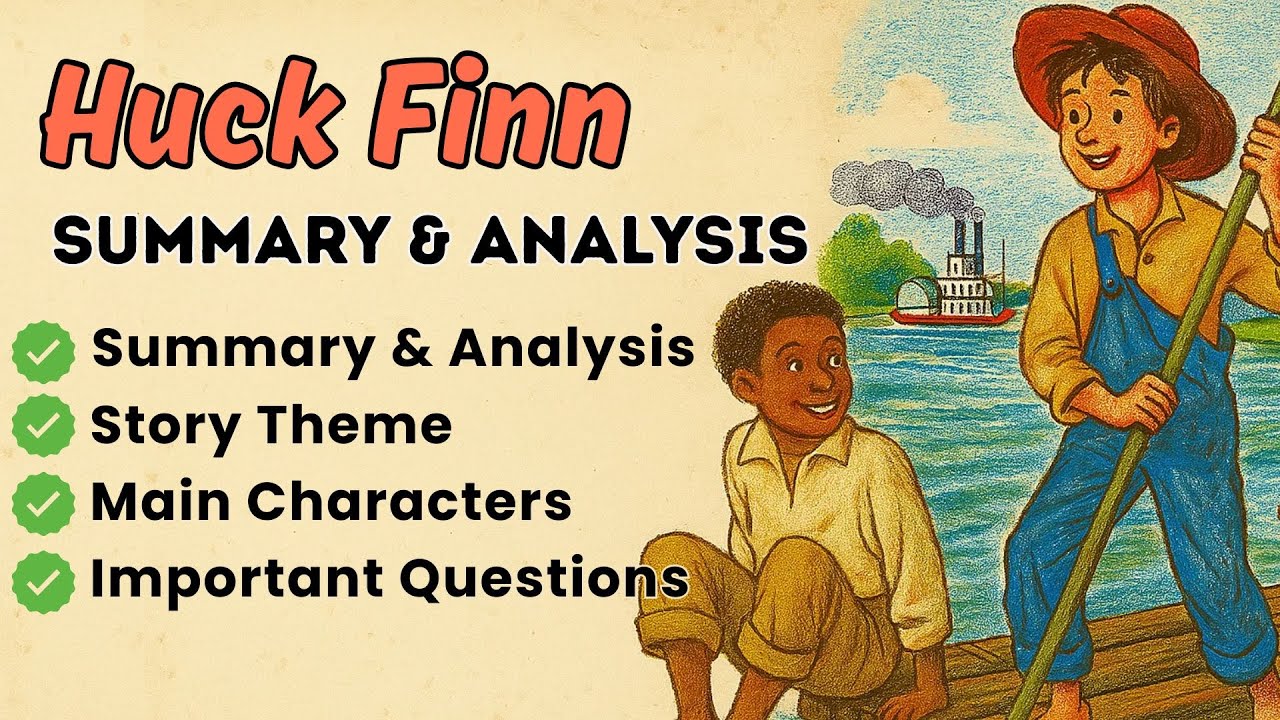

















Mark Twain's 'The Adventures of Huckleberry Finn' (1884) represents a landmark in American literature through its innovative use of vernacular language and its profound exploration of moral growth, as young Huck Finn navigates complex questions of race, freedom, and humanity while forming a transformative friendship with the enslaved Jim, ultimately choosing to help Jim escape slavery despite believing it will send him to hell, thereby rejecting both the racist social order and his father's destructive example to forge his own moral path.
Huckleberry Finn Analysis: Race, Freedom & Morality in Twain's Novel
Added:Familiarity with the basic plot and key characters of Mark Twain's 'Adventures of Huckleberry Finn'.
Historical context of the American Antebellum South, the institution of slavery, and the Fugitive Slave Act.
An understanding of literary realism, satire, and the use of regional dialect in American literature.
Basic ethical concepts, specifically the conflict between societal laws (conventional morality) and individual conscience.
Analyzing the historical and ongoing controversies, censorship, and banning of 'Huckleberry Finn' in schools and libraries.
Comparing Twain's portrayal of Jim and slavery with nineteenth-century slave narratives, such as those by Frederick Douglass.
Applying advanced critical theories (like Critical Race Theory or Post-Colonial criticism) to explore the novel's racial dynamics.
Investigating Mark Twain's broader body of satirical work and social critiques, such as 'Pudd'nhead Wilson' or 'A Connecticut Yankee in King Arthur's Court'.
756.6K views12.1Klikes12:24Original Release: 2016-07-14
Hi, I’m John Green, this is Crash Course Literature, and today we’re on a raft, floating down the great American river, reading the great american novel.
That’s right, today we’re going to be discussing Mark Twain’s the “Adventures of Huckleberry Finn.” Ernest Hemingway once said, “It’s the best book we’ve had.” “All American writing comes from that,” he added, and then threatened to punch anyone who disagreed.
He was such an American Ernest Hemingway!
Mr. Green, Mr. Green! No, no, no, Hemingway lived like half his life in France!?
Well played, Me from the past, and he spent much of the rest of his life in Key West, which I also don’t think is really America.
But anyway, Me From the Past, it doesn’t matter where you hung out with F Scott Fitzgerald, it matters where you died, and Hemingway died in Idaho, which is proper America!
I’m sorry, what are we talking about today? Huck Finn?
[Theme Music] So, today we’ll look briefly at the creator of Huck Finn, Samuel Langhorne Clemens. A.K.A. Mark Twain.
We’ll talk through the plot and what makes the book so important in American literature, and why it’s still quite controversial.
In our next video, we’ll explore some of the metaphors — the river, the raft — and talk about why when people call Huck Finn the Great American Novel, they generally mean, “well, but not the last 50 pages.” So, Sam Clemens was born to a not especially prosperous family in Missouri in 1835, the sixth of seven children.
His father died when he was 11.
He quit school in the fifth grade. He then became a printer’s apprentice.
He would later go on to squander the fortune he made writing by trying to reinvent printing.
But by the age of 15, Clemens was writing funny articles and essays for the paper his brother owned, and he was hanging out in public libraries, reading whatever he could, still trying to give himself an education.
And then, in 1859 he got a license to pilot steamboats, which is basically his boyhood dream, and that’s how he came to know the Mississippi River, which he wrote about in “Life on the Mississippi”, and again with passion and precision in “The Adventures of Huckleberry Finn.” Apparently, a steamboat needs a certain depth of water to run safely and so a sailor called a leadsman would throw a weighted rope over the side to measure the depth.
That’s how he got his pen name. So right, Clemens got his license to pilot steam boats in 1859.
Careful students of American history will know that, you know, something big was about to happen.
In 1861 the American Civil War broke out, and Clemens volunteered for the Confederate side.
That’s right, the man who wrote one of the great anti-slavery, anti-racist novels in American history was a Confederate soldier.
For two weeks.
He then decided war wasn’t for him, and followed his brother West to the Nevada territory.
You can read about all of this — the boats, the weird ragtag confederate militia he was in, Nevada.
Twain never had an experience as a boy or a young man that he didn’t mine for literature.
Twain had his first great success in 1865 when he was 30 years old, with "The Celebrated Jumping Frog of Calaveras County" and his writing career just hopped on steadily after that I’m sorry.
“Huckleberry Finn” though, was published in 1884.
It was a sequel to the “Adventures of Tom Sawyer.” I have to say that although I am a huge fan of Mark Twain, “The Adventures of Tom Sawyer” is not a great novel.
In fact, I think it’s read today, mostly only for two reasons: One. Because it’s the prequel to Huck Finn, and two, because it’s considered somehow less controversial than Huck Finn.
Which it is, but it is also much less interesting.
Right, so Huck Finn is one of those rare examples — like Aliens or The Empire Strikes Back — where the sequel outclasses the original.
At first, Twain had a hard time writing the book.
He began work in 1876 and wrote to a friend, “I like it only tolerably well…and may possibly pigeonhole or burn the manuscript when it is done.” And he did pigeonhole it for about six years, but then he returned to it in a frenzy of all-day, every day writing.
Huckleberry Finn, the son of the town drunk, is the sidekick character in “The Adventures of Tom Sawyer.” He lives rough and never has to go to school and is pretty much the envy of all the other boys.
But at the end of that first book he agrees to go and live with the Widow Douglas and become “sivilized” so that he can join Tom Sawyer’s gang.
The question of what constitutes “getting sivilized” is at the very center of “The Adventures of Huckleberry Finn.” And so it begins right there, some time in the 1830s, a few decades before the Civil War.
With Huck going to live with the widow.
Huck, who narrates the book himself and is maybe 14 years old, doesn’t take well to what he’s told constitutes civilization.
Nice clothes are itchy, table manners are confusing, he doesn’t understand why the Widow is always trying to tell him Bible stories about dead people.
He’s lonely in the house and his only fun is sneaking off with Tom Sawyer.
But all of that changes when his father, Pap, kidnaps him and locks him in a shack.
After an evening in which his drunken father nearly kills him, Huck fakes his own death, escapes in a found canoe, and paddles to a nearby island.
Quick pause here to note that in the beginning of the novel, there are just these two ways of being and adult.
The civilized way embodied by the widow.
Which involves, like, clean clothes, and religion, and institutional racism.
And then the uncivilized way of being, embodied by Huck’s father -- which involves, like, terrible alcoholism, trying to kill your children, and institutional racism.
But on the river island, away from both of these models of adulthood, Huck encounters Jim, a slave who ran away when he learned that his mistress, the Widow’s sister, planned to sell him down the river, away from his family.
Now it’s critical to the novel to understand that Huck believes that the right thing to do in this situation is not to assist an escaped slave.
He believes that the ethically correct thing to do, the civilized thing to do, and also, by the way, the legal thing to do, is to turn that escaped slave in.
But in Jim, Huck finds a companion and, in a lot of ways, a surrogate father.
And so there’s an immediate tension between what Huck calls his conscience, which is the social order, telling him that he ought to turn this escaped slave in, and his actual conscience, which is saying, “hmmm maybe not.” But when Huck learns that Jim is suspected of Huck’s murder and that men are hunting him for a reward, he says to Jim: “Git up and hump yourself, Jim! There ain’t a minute to lose.
They’re after us!” And that "us" is really important.
It’s only Jim they are after, but this makes it clear Huck has decided to team up with Jim.
From that moment they set out on the raft, and their adventures really begin.
They face all kinds of dangers and meet all kinds of people — some nice, some sinister — and get into all sorts of trouble before they team up with Tom Sawyer again and Tom devises an elaborate and cruel plan to win Jim his freedom.
What Tom knows, but Huck don't, is that Jim is already free, his mistress freed him on her deathbed.
So, in the end, Tom forces Jim to undergo an ordeal that’s just Tom’s nasty idea of a good time.
The adventures of Huckleberry Finn was not immediately recognized as a great novel.
A lot of the early reviews weren’t terrific and there were several attempts to ban it on the grounds that it would corrupt any young person who read it.
The Concord Public Library called it “trashy and vicious.” But pretty soon there was widespread recognition of the novel's importance.
Some of this has to do with plotting, and some of it has to do with style and language.
Like, Lionel Trilling, in one of the most famous essays on Huckleberry Finn, argued that it was the language that really sets the book apart.
Before Huckleberry Finn pretty much all the American writers thought that if you were writing an important book it had to be formal and high-flown, like James Fennimore Cooper.
Twain, by the way, hated James Fenimore Cooper’s books.
If you ever want a good read, you should look up “Fenimore Cooper’s Literary Offenses.” It’s a Twain essay that includes lines like: “Cooper’s art has some defects.
In one place in ‘Deerslayer,’ in the restricted space of two thirds of a page, Cooper has scored 114 offenses against literary art out of a possible 115. It breaks the record.” But, unlike ‘The Deerslayer,’ the language of Huckleberry Finn is deliberately down to earth.
It's casual, it's ungrammatical, it's frequently and deliberately misspelled.
The genius of the book, Trilling wrote, “has something to do with the ease and freedom of the language.
Most of all it has to do with the structure of the sentence, which is simple, direct and fluent, maintaining the rhythm of the word groups of speech, and the intonations of the speaking voice.” Right. At its best, Mark Twain’s writing sounds like talking.
Which is, of course, much harder than it seems, and it signaled a real watershed moment in American literature.
Let’s Go to the Thought Bubble.
What makes the book truly significant is its treatment of the relationship between Huck, a poor white boy, and Jim, an enslaved African-American man.
Twain may have written this book after the Civil War and the abolition of slavery, but America was and of course, is a nation deeply shaped by racism, so the friendship between the two characters and the emergent moral intelligence that it foists upon Huck are what really makes the book unusual.
As we saw, Huck first throws in his lot with Jim when they’re still on the island, but throughout their journey Huck struggles with the idea of what it means to help a runaway slave, and what it means to treat Jim as a comrade and a friend.
This is partly due to Huck’s conscience, which is telling him over and over that he’s going to go to actual Hell for helping Jim.
But in the beginning of the book, Huck can be quite cruel to Jim.
Early in the book, he and Tom Sawyer play a trick on Jim, hanging his hat in a tree so that Jim, who is very superstitious, thinks that witches have taken it, which Jim is very proud of.
But later in the book, Huck tries to pull another prank, making Jim think that his fear that Huck was lost in the fog was only a dream.
But Jim knows it's a trick he tells Huck that people who try to make others feel ashamed are trash.
Now, of course, Huck is an expert at tricks and telling lies.
Through the book he never uses the same name or the same origin story with any two people he meets and the people almost always believe him.
Well, except for when he dresses up as a girl. He’s really bad at being a girl.
But on the raft Huck learns that you can’t trick the people you care about.
So Huck feels ashamed for trying to trick Jim, and eventually works himself up to apologize.
He says, and I’m quoting selectively here, "I done it, and I weren’t ever sorry for it afterwards neither."
Thanks, Thought Bubble. And on the topic of me selectively quoting, we now need to take a short break to talk about the language that Twain uses to describe Jim.
You know what? Let’s just do this as an open letter.
Let’s see what’s in the secret compartment today.
Oh! It’s Mark Twain.
I like your suit, buddy. Hi Mark Twain, it’s me, John Green. First off, big fan.
Secondly, in your novel, ‘The Adventures of Huckleberry Finn,’ Huck and other characters use the n-word, to describe Jim many, many times.
This is the reason most often cited for the banning of your book here in the 21st century, so it’s important to talk about.
And it’s important to understand that when you were writing the book, it was already an offensive term.
Like, abolitionists had been arguing that we should use the term person of color as early as 1825.
And since your work is no longer protected by copyright, editions have been published of Huckleberry Finn in which that word is changed.
But whether or not you, personally were racist, Mark Twain, your book, I would argue, isn’t.
According to the scholar David L. Smith, the word, quote, “establishes a context against which Jim’s specific virtues may emerge as explicit refutations of racist presuppositions.” It’s really important to understand that although Huck seems like a pretty good kid, the social order has taught him to dehumanize Jim.
To treat him as property, rather than as a person, but Jim’s humanity forces Huck to contend with him as a person.
And that’s what makes your book so, so good.
Best Wishes. John Green.
It’s this recognition of Jim’s humanity that leads Huck, in the climactic scene in Chapter 16, to break with all the morality and religion he knows.
When he learns that Jim’s plan is to gain his freedom and gain the freedom of his wife and children, Huck writes a letter informing his mistress, but then he tears it up.
Huck has been taught to confuse social law with divine law.
And he sincerely believes that helping a slave is a terrible sin that will lead to damnation.
And he has been with the Widow long enough that Hell is a real place for him, but he ultimately decides that it doesn’t matter.
He will risk damnation if it means he can help Jim.
He tears up the letter, saying, “All right, then, I’ll GO to hell… It was awful thoughts and awful words, but they was said.
And I let them stay said; and never thought no more about reforming.” Huck rejects what he has been told is civilization, while also rejecting his father’s version of uncivilization, and for me at least, that’s why he’s a hero.
As Twain said in his lectures, Huckleberry Finn is a book “where a sound heart and a deformed conscience come into collision and conscience suffers defeat.” And that’s where we’ll leave Huck and his sound heart for today — unreformed, unrepentant, realizing that he has to follow his own moral path, whatever the risks.
And maybe that’s where Twain should have left it, too.
But instead, we get a jumbled mess of an ending that is often criticized, but which I will do my best to defend next week.
Crash Course is produced with the help of all of these nice people and it's made possible via your support at Patreon.
Patreon is a voluntary subscription service that allows you to support Crash Course directly, so we can keep it free, for everyone, forever.
So if you enjoy Crash Course, and you value it, please head over to patreon.com/crashcourse to check out our Patreon campaign. You can get lots of great perks.
Thank you again for watching. And as we say in my hometown: Don't Forget To Be Awesome.
Up Next
10:48
Decoding the River, Raft, and Ending of Huckleberry Finn
@crashcourse
477K views•2016-07-20

13:43
Formalism in Literary Criticism: An Academic Lecture Overview
@mattalberhasky9952
39.1K views•2015-08-05
12:38
Frankenstein, Part 2: Romanticism and Critical Readings
@crashcourse
1.1M views•2014-04-03

15:25
1984: Orwell's Dystopian World and the Mechanisms of Totalitarianism
@AlternateHistoryHub
7M views•2017-03-04
Related Study Plans & Knowledge Roadmaps
Structured learning paths in Literature
literature
Graphic Memoirs: Visual Art, Trauma & History
01Foundations of Sequential Art and Visual Language
02Autographics and Processing Historical Trauma
03Visualizing Personal Trauma, Grief, and Graphic Medicine
+ 2 more learning modules
14h5 modules
Explore Roadmap
literature
Campus Novels: Evolution, Themes & Critique
01Introduction to the Campus Novel Genre
02Mid-Century Satire and the Post-War Academy
03Dark Academia and the Critique of Privilege
+ 2 more learning modules
14h5 modules
Explore Roadmap
literature
Theater of the Absurd: Philosophy & Plays
01Postwar Existentialism & Historical Roots
02Dismantling Narrative: Esslin & Absurdist Conventions
03Samuel Beckett and Tragicomic Existentialism
+ 2 more learning modules
12h5 modules
Explore Roadmap
literature
Revenge Tragedy: Justice, Madness & State
01Foundations of Early Modern English Theatre
02Anatomy of Revenge: Structural Conventions
03Psychological Complexity: Madness and Melancholy
+ 2 more learning modules
15h5 modules
Explore Roadmap