























This lecture explores how language encodes and represents gender through three theoretical approaches: the deficit approach (which views women's language as deficient and restricted), the dominance approach (which explains language patterns through male supremacy and patriarchal social structures), and the difference approach (which treats men and women as two distinct social categories raised in different subcultures, resulting in different communicative styles without implying hierarchy). The lecture emphasizes that while sex is biological, gender is socially constructed, and language reflects and reinforces societal attitudes toward gender, with ongoing shifts toward more inclusive language practices.
Language and Gender: Deficit, Dominance, and Difference Approaches
Added:Introduction to Sociolinguistics: Understanding how language varies across different social groups, contexts, and geographic regions.
The Distinction Between Sex and Gender: Comprehending gender as a socially constructed identity versus biological sex.
Basic Linguistic Terminology: Familiarity with core linguistic concepts such as syntax, semantics, pragmatics, and lexicon.
Introduction to Social Power Dynamics: A foundational grasp of how social hierarchies, privilege, and institutional authority operate in society.
The Dynamic and Performative Approach: Studying Judith Butler's theory of gender performativity and Deborah Cameron's work on how gender is actively constructed through talk.
Intersectionality in Sociolinguistics: Examining how gender intersects with other identity markers such as race, ethnicity, socioeconomic class, and sexual orientation.
Gender-Inclusive and Non-Binary Language: Analyzing the evolution of gender-neutral pronouns, linguistic reform, and the representation of non-binary identities in speech and writing.
Algorithmic Bias and Computational Linguistics: Investigating how gendered language patterns and biases are encoded in, and propagated by, artificial intelligence and natural language processing (NLP) models.
3.4K views47likes34:20Original Release: 2021-07-30
Welcome to class.
Today we are going to talk about language and gender.
Gender has become a point of discussion and a venue for research after the 1960s.
In the early 60s and 70s, the issue of gender emerged in social sciences and various other disciplines with a multidisciplinary approach.
Scholars were engaged in understanding the social concept called, social category called gender.
And in the field of linguistics, specifically the emergence of sociolinguistics post 1960s has witnessed a huge interest and a very wider spectrum of study, research and publications since the 1970s.
We got a specific mention and a very categorical discussion of women's language in Otto Jespersen’s work in 1922.
A chapter in this book was dedicated to women.
Since then there was almost no challenge to that idea Jespersen put forward.
However, in 1975 a monumental work by Robin Lakoff appeared.
So today, we will take a very brief note on this relationship between language and gender.
As we know, we are all born with a particular sex, as a girl or a boy.
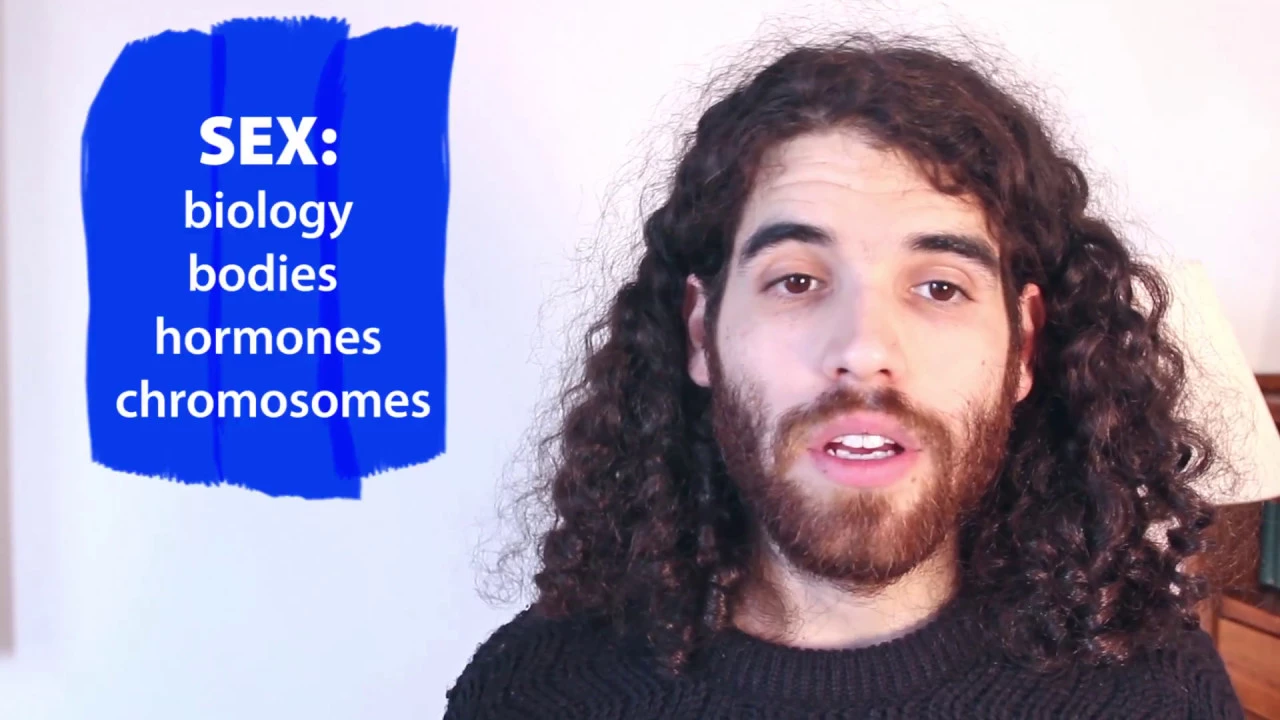
So sex is biological.
It is an outcome of the reproductive system.
So we are born either as a boy or a girl, but the term gender is socially constructed.
So sex is biological and gender is social.
It is socially constructed.
So a set of roles expected by a particular sex to perform refers to gender.
So gender is the social role that we perform as a particular sex, whether a man or a woman.
So this is a very interesting and significant development that took place in the late 60s and early 70s where gender became the object of study.
It became a focus of study in applied linguistics and sociolinguistics.
Now the gender differences in language can be understood at two different levels.
Number one, how language encodes gender, or the form and the structures available in a language that represents gender or that attends to gender.
So the presence of gender-centric expressions, words, and structures.
At the formal level, we can understand gender in language.
Like in Hindi, we have all the nouns with a particular gender.
So cars are feminine, trucks are masculine.
So that is the assigned gender to it or grammatical gender.
Hindi has grammatical gender.
For example, ‘Ram aam khata hai’, ‘Sita roti khati hai’.
‘Khata hai’ has masculine marker and ‘khati hai’ has feminine marker.
The verb agrees with the gender of the subject, so the verb ‘khana’ agrees with the gender of the subject ‘Ram aam khata hai’.
And again, ‘Sita roti khati hai’, so ‘khati hai’ has an ending verb marker that denotes feminine gender of the subject.
Hindi has grammatical gender.
Even the non-animates in Hindi have genders.
Pens are feminine.
So but there is something called biological sex and this is grammatically assigned in such cases.
‘Meri car’ means my car.
Here the long ‘e’ ending denotes feminine gender in Hindi.
There are certain exceptions, but broadly this is the feminine marker.
So you can understand the relationship between gender and language in terms of the forms and structures.
This is reflected in vocabulary very prominently.
However Hindi has grammatical gender as well.
The verb has to agree with the gender of the subject.
Then the other perspective with which we can look at gender is the gender roles performed and how language and how utterances are used.
So how language is used by different gender roles.
The difference between genders while using language in terms of style, choice, and in discourse.
So how a woman speaks and how a man speaks.
So one is the form and the other one perspective is looking at the form and the structure represented in language and how language represents the bias towards gender.
The second one is how language is used by different genders.
So user centric and use centric.
So the idea that women's speech is deficient and limited was first brought into discussion by Otto Jespersen in his work The Woman, a chapter in his 1922 book called Language its Nature and Development and Origin.
And this idea that women's language is deficient and restricted reflects the social structure of the time.
We all know that post 60s and 70s, we see a rise in demands and struggle for women empowerment.
And it has changed lots of expressions in language as well.
It has been reflected and represented in the language as well.
So the chairman is no longer the chairman.
Now we call it chairperson.
A sportsman is no longer a sportsman.
We call it a sportsperson.
And there is an accusation, and to a great extent it is absolutely right that languages are male biased.
Biased towards men.
Biased towards male.
So there is an argument that we see the world through the lenses of men.
You do not have to go too far, look at a word like mister.
Mister is an honorific marker which we prefix with any name to honor a person to show respect to a person.
The feminine equivalent of mister is mistress, but can we use mistress in any public place to represent a woman?
What goes on, why master is honorific and respectful and why not mistress.
So mistress means something else.
It represents an extramarital affair, and a woman is seen as such.
She is looked down upon, so we do not use mistress.
If you look at the abusive terms in any language which is directed towards men, the number of such expressions will be counted very small, but when you look at the curse words and abuses directed towards women, all languages have plenty of them.
Language bias, this is the bias we are talking about.
Somehow if you look at the expressions, like my lord.
Honorific markers like my lord is a respectful mode of addressing the justice, the judge or any noble person, but can we say my lady?
So the feminine equivalent of lord is lady.
So I can say my lord but can I say my lady?
So there exists these biases, because when we see these expressions in the language they are not at an equal level, these expressions are somehow biased towards men.
Look at examples like when we refer to something, whose gender is not known, so by default we represent it as he.
By default we mention he and not she.
But of late, it is a recent development, where we have been using terms like ‘his’ and ‘her’, ‘he’ and ‘she’.
So we are juxtaposing ‘she’ with ‘he’, ‘her’ with ‘him’, but it is a recent development.
So because of ideological shifts and the struggle for women empowerment, things are changing in language as well.
Expressions are changing, but it is true that Jespersen mentioned the woman's language as deficient and this idea was not challenged until 1975 when a monumental work by Robin Lakoff emerged and changed the discourse on gender and language.
So there are three main approaches to understand the relationship between language and gender that we practiced in sociolinguistics and applied linguistics which emerged from 1970 onwards.
And these are deficit approaches.
Number two, dominance approach, and number three, difference approach.
So we have three approaches to understand language and gender.
Deficit approach as the name suggests, views women's language as deficient.
Dominance approach represents and reflects male dominance and the consequent deficient speech by women.
The third is a very democratic and flexible approach where women and men are seen as two categories which socialize in two different subcultures, so it is the difference approach.
So if you want to go deeper into this idea, you can look at two important publications which are considered central texts in understanding the relationship between language and gender.
And these two are, number one, an edited book by Kira Hall and Mary Bucholtz published in 1995 titled Gender Articulated: Language and the Socially Constructed Self by Routledge, New York.
Another text which is central in understanding the relationship between language and gender is an edited volume by Janet Holmes and Miriam Meyerhoff published in 2003, The handbook of language and gender, Blackwell publication Massachusetts.
Apart from these two texts, we have many other wonderful books and publications.
And you can have a deeper look into this theme.
And the major works and the prominent researchers who have worked in this field of language and gender include Deborah Tannen, Penelope Eckert, Janet Holmes, Mary Bucholtz, Kira Hall, Deborah Cameron, Janet Sunderland and many others.
And of course this discourse was triggered by Robin Lakoff.
So we will go to each of these approaches to understand the relationship between language and gender one after the other.
So let us begin with the deficit approach.
And as I told you, women's language is deficient, restricted and subordinate to the language of men.
This idea was propagated and discussed by Otto Jespersen in his 1922 book and this idea was not challenged until the publication of Robin Lakoff’s work in 1975.
Robin Lakoff’s work in 1975 in a way endorses this idea, in a way comes closer to this idea, but she was the one who eloquently and very elaborately discussed this idea, deficit approach.
So it describes male language as stronger, more prestigious and more desirable.
And she argues that women are socialized into behaving like ladies.
You might have heard expressions in your own mother tongue ‘like ladies’, ‘like girls’.
So any act, even a boy crying in public for small reasons, you might have heard people using the terms like ‘you know do not cry like a girl’.
So the act of crying is attributed to a girl.
It is ladies-like, it is woman-like.
So the gender biases in social structure are represented and reflected in our expressions and language biases as well.
Lakoff says that men's language is stronger, more prestigious and desirable.
This approach describes the way women's speech style includes features like tag questions.
And we know what is the function of tag questions, confirmation or seeking confirmation.
So she mentions these features like tag questions, rising intonation and hedges.
So when we are not very clear, we try to cover it up and with the help of hedges.
So hedging in language is not a specific element, a specificity is missing.
So hedging is another feature she comes up with which are expressive of uncertainty, lack of confidence and excessive difference or politeness.
This approach looks at women's speech as generally inferior to that of men's and reflects their sense of personal and social inferiority.
So what you see the gap, the discrimination of gender in our social practices, the gap of gender in society is reflected in language as well.
This approach looks at language from that perspective where men's language is seen as stronger in Lakoff’s terms as stronger, prestigious and desirable.
It becomes a benchmark.
Whereas the woman's language is seen as deficient.
It lacks a specificity, strength and has features like tag questions and hedging.
So tag questions or hedging that means they are not certain about it, and that is the reason why another perspective comes in here -the power.
So does the power ascribed to a particular gender also plays a role in deficiency in women's speech.
Because women by and large are not empowered, there is a lack of equality.
So does that unequality or you know the gap or discrimination described to women play a role in determining expressions, tone, tenor and style?
So this is what the deficit approach is all about.
It looks at women's language as deficient.
Then we have the dominance approach.
So the idea of dominance approach is rooted in the social discrimination and gap which is practiced in a particular culture between genders.
So societies are male dominated.
Men control resources and share the bigger pie of power.
Women are not empowered.
So this gap or this dominance of men in the social and cultural space is reflected in the language.
So man has acquired superordinate status and women as subordinate status.
So male as a gender is superior and female as a gender is subordinate.
This is an unfortunate situation.
And this dominance approach underlines the same thing.
So this approach looks at women as a subordinate group whose difference in style of speech results from male supremacy and from an effect of patriarchy.
This explains how language is primarily male centered.
If you look at, let us say referential expressions like gender, when we refer to gender in sentences and when the gender is not clear it is by default a ‘he’.
Man is a social animal.
What about a woman?
Are they anti-social or are they not social?
But the word man includes women too.
The term man includes women in this same quote.
So a god-fearing man includes women as well, but by default it is male.
Because societies and cultures are male dominated.
Men enjoy power, dominance and they have control on resources.
Talbot criticizes this approach as a manifestation of patriarchal social order.
This approach can be cited along with the difference approach.
And both of them provide an early model for analysis of language and gender in social sciences.
So the gender gap in society is also reflected in language, in expressions, in the style, in the register, so this is the dominance approach.
Then the third approach is the difference approach.
Difference approach is an approach of equality.
So in this approach we look at these two genders as equal.
So this is an approach to equality.
Differentiating men and women as belonging to different subcultures as they have been socialized to do since childhood.
So this approach treats these two genders equal and attributes the differences in socialization as a consequent result.
How socialization takes place when we are born.
You can see around your households, in your own family.
Let me give you a perspective.
Suppose you are going to get a gift for a small baby on his or her birthday.
So you go to the shop and ask for a gift.
And this is typical of all Indian shops wherever you go irrespective of the states and provinces and societies.
You go and say I want a gift for a baby.
The first question the shopkeeper asks is whether it is a boy or a girl.
For whom do you want a gift, that is so significant at such an early age to mention the kind of gift you are going to get for the baby.
So when you say boy, he will show you, he will offer you trucks, transformers, those male characters, strong characters from the cartoons, guns.
When you say it is a baby girl, they will show you soft toys, kitchen sets, and dolls.
So somehow we are conditioned this way.
The way we are raised in a family.
If you have your siblings, sisters and brothers, the way we are raised in the family, we are raised with two different parameters.
So this distinction in parameters, this discrimination in parameters becomes so natural to us.
We are conditioned that way.
So this is how we look at women.
As an adult you are conditioned to look at women in a particular perspective.
With a particular gender perspective.
Difference approach underlines this socialization process and treats these two as two different subcultures and language is culturally rooted.
So if you find a difference, it is not because women are inferior, it is because both of them have been raised in a particular subculture.
So it treats men and women as two different social categories and who are socialized in two different cultures.
This then results in varying communicative styles of men and women.
Deborah Tannen is a major advocate of this position.
Tannen undertook this concept further and popularized the difference approach with her work You Just Don't Understand Women and Men in Conversation, published in 1990.
And this approach develops a two-culture model for men and women, where children are socialized within two separate groups and you can observe it all around you.
She claims six points for male and female language.
And those six points are, the first part of the phrase is for men.
The second part is for women and what binary expressions he gives, status versus support, so the men are conscious of their status and position and they are conscious in the conversation about their status and position, whereas women's language is more supportive, accommodative and inclusive.
So status versus support, the second phrase is independence versus intimacy.
So men are very particular about their rights, their position, their independence whereas a woman is inclusive, supportive, and wants to connect.
Then the third is, advice versus understanding.
So the speech of men is more of instructive and didactic, whereas the woman expresses understanding and accommodating.
Next is information versus feelings.
So men's speech is for disseminating information, facts and very straightforward.
That does not mean women are not straightforward, but women express emotions.
So feelings are attached, and experienced feelings are attached.
So men's speech is informative or they prefer information, they extract only information, dry facts, whereas women associate feeling in their speech acts.
Then orders versus proposals.
Orders are exclusive, proposals are inclusive.
So in men's speech we can see orders, exclusion and in women's speech we find proposals, kind of inclusion.
And then conflicts versus compromise.
Women show a higher degree of flexibility and accommodation, supporting behavior and inclusion as compared to men.
So this is the difference approach.
So this approach looks at men and women as two different categories, social categories who are raised and conditioned in two different subcultures.
But it does not treat men and women in an asymmetrical way, in a hierarchical way.
It looks at them at an equal level.
The difference lies in the two subcultures and backgrounds in which they are conditioned and raised.
And the study in language and gender continued and we witnessed the emergence of an independent field of study called gender studies.
And gender studies draws heavily from multi-disciplinary resources.
It is not restricted to a particular discipline.
So in social sciences we see the emergence of a new field which is very fertile, and has attracted lots of attention from researchers in the field.
And it draws heavily from anthropology, sociology, political science, literature, language, linguistics and other allied disciplines.
We will continue our discussion on language and gender in our series of language and variation when we talk about language and variation.
We will continue with this discussion and you can look into some major publications that I have mentioned here if you want to understand this concept and go deeper into it.
I hope that this gives you a broad understanding of the relationship between language and gender where we can look at gender from two different perspectives.
One, the language bias and availability of structure, forms and expressions in a particular language directed towards women or other gender.
And the way both the genders use language in their speech acts with these two perspectives we can understand language and gender.
There are three approaches available right now with us; the deficit approach which looks at women's language as deficient, the dominance approach which underlines the social roles, dominating social roles of men and which is reflected in the language as well, and the third is the difference approach which treats men and women as two different social categories and it looks at the way they are raised into subcultures, it assigns equality, level of equality between these two genders.
So this is it for now.
We will continue our discussion.
Thank you.
Up Next

13:25
Language and Gender: Deborah Tannen's Six Differences
@eternityclass1361
186 views•2022-04-19
36:52
Constraint Interaction in Optimality Theory: Epenthesis & Deletion
@Vidyamitra
180 views•2018-08-20

30:05
Creolization Process and Birth of a New Language | Linguistics
@nptel-nociitm9240
598 views•2022-10-11

21:32
Accent Expert Explains U.S. Regional Dialects | Part 1
@WIRED
9.3M views•2021-01-21
Related Study Plans & Knowledge Roadmaps
Structured learning paths in Linguistics
linguistics
Optimality Theory: Tableaux & Constraints
01Phonological Basics: Sounds, Syllables & Rules
02Foundations of Optimality Theory: GEN, CON, and EVAL
03The Constraint Inventory: Markedness vs. Faithfulness
+ 2 more learning modules
15h5 modules
Explore Roadmap
linguistics
Morphosyntactic Alignment: S, A & P Systems
01Foundations of Syntax: Transitivity and Arguments
02The Linguistic Variables: Mapping S, A, and P
03Nominative-Accusative Alignment
+ 3 more learning modules
12h6 modules
Explore Roadmap
linguistics
Analyzing Sign Language: Phonology & Syntax
01Foundations of Sign Language Linguistics
02Phonology: The Five Parameters of a Sign
03Morphology: Word Formation and Classifiers
+ 2 more learning modules
14h5 modules
Explore Roadmap
linguistics
Pragmatics: Speech Acts, Grice & Politeness
01Introduction to Pragmatics: Meaning in Context
02Grice’s Cooperative Principle & Implicature
03Speech Act Theory
+ 2 more learning modules
14h5 modules
Explore Roadmap