

























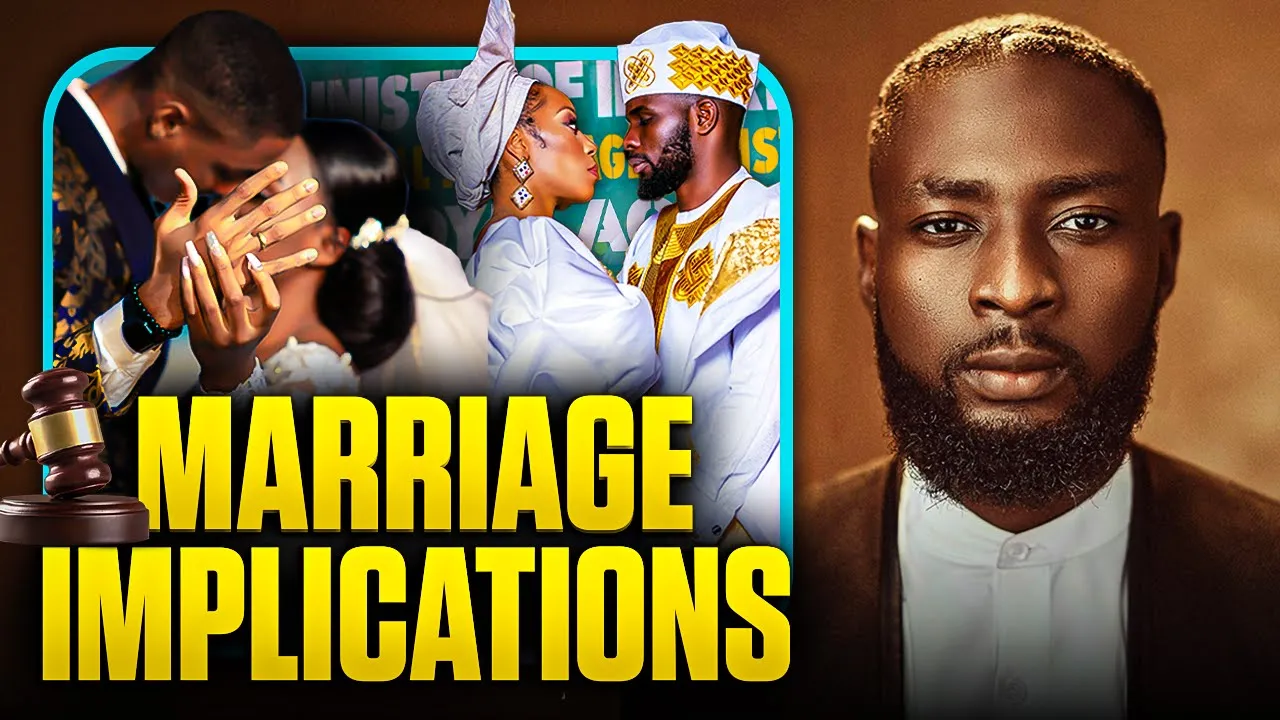


A void marriage is a marriage that the law deems never existed, even if the parties believe they are married and have performed all traditional wedding rituals. Such marriages are void under several circumstances: prohibited degrees of consanguinity (blood relationships) and affinity (marriage relationships), invalidity of lex loci celebration (marriage must occur at a licensed place of worship or registrar's office), bigamy (marrying during an existing statutory marriage), lack of consent (due to duress, fear, force, or fraud), and marriage below the legal age of consent (18 years). In Nigeria, statutory marriages (court or church weddings) are more restrictive than traditional marriages, as they invalidate any subsequent marriages and carry criminal penalties for bigamy, while traditional marriages allow for multiple subsequent marriages.
What Is a Void Marriage? Legal Grounds Explained
Added:so hello guys what's up and welcome back to my YouTube channel it's me your girl barrist NE and this is nille at what age did you discover that some of us some of you and I watching me dated proposed War wedding dress and Suits weathered had four children and lived together for 15 years under the impression that you husband and wife but you are not married eh eh he shock you if you didn't hear me right the first time let me give you 5 minutes to get some cotton board clean your left ear clean your right ear sidon let me say it again do you know that some of us are under the impression that we are happily married but we are not even married at all Chacha in the eyes of the LA we are at the best cohab beting tenants or should I say as good as two men walking in a factory together and then when something happens you will then know the true state it's the true position of things today's video will be fire I hope you're subscribed if you're new here you're seeing this pretty face for the first time or if you've been watching without subscribing do hit the Subscribe button now now give this video a big thumbs up because you can trust that it will be value added drop all your comments down in the comment section and stay glued because there is so much more coming your way so yes today's video will be highly educative impacting and enlightening so grab your chair grab your bench grab your stool if you like to sit down for ground sit down for ground and do not miss a single word from this video let us [Music] begin in today's video we will be discussing void marriages a void marriage is a marriage that the Lord deems never existed at all even if the parties to the marriage think that they are married have done everything that a supposedly married person is supposed to do to solidify the union and have it recognized by law but in the eyes of the law it is void it never happened it never existed so inexistent that you do not even need a divorce to dissolve it because for a divorce divorce means dissolving an existing marriage but a void marriage you do not need a divorce because it does not exist in the case of a void marriage just see yourself as two clowns two big clowns playing lead role in a second game your marriage will be deemed to be void and inexistent under these circumstances one prohibited degrees of consanguinity and Affinity but trust me you know that I will break it down for you molecule by molecule consanguinity is a relationship by Blood while Affinity is a relationship by marriage when you get married to somebody with close and unaccepted levels of consanguinity or Affinity meaning you guys are too related to be in a marriage even if you wore the best wedding gown and went to the best regist office and did the best cut wedding and then went to church and did the best church wedding held a big reception and had six children together in the eyes of the law both of you are jokers in a circus that marriage does not exist it lacks legitimacy in many Western countries I do not know about other African countries if you're from other African countries so let us know in the comments section but in many Western countries the prohibited degrees are usually brought I even hear that in some countries cousins can marry cousins distant cousins can marry distant cousins but in Nigeria under our law we have a very wide range of prohibited degrees of consanguinity and Affinity let me read some to you I'll read from my laptop down below so pardon my eyes being lowered prohibited degrees of consanguinity and affinity for a man includes man open your ears this is for you it includes his ancestress descendant sister maternal and paternal Auntie niece mother-in-law I hear that some men their eyes they choke for where their mother-in-law day your wife's daughter hello molesters perverts that would marry a woman and still have eyes for her own daughter prohibited your wife's daughter your wife's son's daughter grandfather's wife your son's wife sugar daddies you have a son your eyes is still looking at his wife prohibited degrees you cannot marry such a person there are a number of others but let me skip to the woman for a woman it includes your own prohibited degrees your ancestor and your descendants your brother I have read stories of where a lady falls in love with her brother maybe the man played away match and has a son or a child outside and you meet this person you begin a sexual relationship with the person without even knowing that that person is your brother until you start talking about marriage and you bring the person to your parents some people still stubbornly go ahead and say Love is All That Matters love is not all that matters when it comes to marriage you are wasting your time that marriage cannot exist your matal and paternal Uncle your nephew your father-in-law runs girls hook up Babes that date father and son please you can't marry your father-in-law your grandfather your husband's son maybe you marry a divorce he has a young son AB your own husband has big tummy and big breast your eye is on the sun prohibited so in other words if you're related to somebody by blood or by marriage any marriage to that person will be deemed not to have happened at all also note that there is an exception if you want to proceed with a marriage with somebody that you have these prohibited degrees of relationship with you can apply to a court and seek the judge's leave seek the Court's consent to endorse that marriage and the judge has to be satisfied that certain exceptional circumstances exist to warant the grant of that permission although in reality I doubt that any judge will grant such permission but this is what the law says also note that the marriage we're talking about pertains to statutory marriages not traditional marriages I'm sure that for traditional marriages the situations might differ from place to place so you can let us know in the comment section whether there are any prohibitions as to relationships in your place can a father marry his son's wife is it as strict and stringent as the statutes or what is it like in your place let us know down in the comment section two a marriage will be deemed to be void and never have happened in the first place due to invalidity of Lex looki celebration oh we ly and T be but I'll explain bear in mind that a lot of legal terminologies stem from the Latin language so you would find so many legal terminologies and maxims in Latin but let me explain simply put Lex Loi means the law of the place of Celebration the place where that marriage celebration held or took place for a marriage to be valid it must have taken place at the office of registra or at a licensed place of worship so please Pastor inan in of the fire mission House of the most high assembly Ministries located under OA Bridge before you where your wedding gown and go to any person that calls himself a pastor to bless your wedding ask yourself if that place where you are holding that wedding is a licensed place of worship it's not any man that is hungry that go and borrow coats and open Bater and call it church that you stroll in there and go and consumate a marriage if you know that that place is not a licensed place of worship and you go ahead to consumate your marriage there that marriage is null and void and in the eyes of the Lord you are still boyfriend and girlfriend the law on Lex Loki is very very serious three an existing lawful marriage where are my wondering peneses oh my God where are you I see you the you mentees Jud the Austin's Clan where are you step forward this point is for you step to the front my Wonder penises very wonder wonder wonder wonder wonder wonder till you turn to wonder wonder wonder wonder wonder wonder wonder wonder wonder wonder wonder [Music] wonder my wondering penes where are you step forward I have a word for you this point is for you you know the truth is bitter the truth is as bitter as God but you see me I will keep telling you the truth if you don't like it where sh a wall because I will let you know the facts and sometimes when you speak the facts it offends a convenient acceptable easier and irresponsible way of life when you speak the facts that seem against the norm against normaly you may think that you are overreaching some will put a tag on you some will say that you are being biased no me talk talk so as I said an exist statutory marriage invalidates and renders void any other marriage that comes after it as long as that first statutary marriage is still subsisting at the time when the second one was consumated this point is so serious that it is the only ground that comes with a punishment it is the only ground that the law criminalizes so not only is that second marriage void a person who goes our heads to Wed another person during the subsistence of an existing statutary marriage commits a criminal offense and is liable to up to 5 years imprisonment you know a few days ago I asked in my community post I said if you were to choose one which marriage would you choose to have is it a CT wedding is it a traditional wedding or is it a church wedding these three kinds of marriages are legal and accepted in Nigeria but three of them have their different consequences and weights if you have a first traditional marriage you can proceed to have another and another and another after that order you can choose to have 10 after that first traditional marriage it is acceptable by law if you have a statut Tre marriage first a cut wedding you can neither have have another cut wedding or a traditional wedding or any kind of wedding or marriage at all during the subsistence of that statutory marriage that statutory marriage invalidates any other show of seus that you call a marriage after that first one and you are also liable for punishment for even attempting to do that and if you have a traditional wedding first you cannot have a statutory marriage marage after to say okay I had a traditional marriage we didn't wedding the court that first wedding was traditional wedding this time I'm going to do cut wedding no that traditional wedding is recognized as marriage and if you must if you must St that part the only marriage that can be open to you after a traditional wedding is another traditional marriage I hope you understand you know my men my men I love you guys so much I love you my meant so much I want to give you all the Expo so if you know that your problem your headache in this 2024 is marrying multiple women and having a family established in every continent of the world you have one in Africa you keep one in Europe you establish another one in Asia if that is your life goal this is the format so do it the right way nobody is saying that you cannot do what you want to do the question is are you doing it the right way and that is why we having all these conversations surrounding UL DOI but some people are so obstinate that they have blocked their heads to understand the point look at Ned wo the senator Ned wo he's a major Mentor for the polygamists they always brag about him oh look at Ned Ned has many wives nobody's attacking him why is jeel look at Ned wo have you ever seen Ned wo with a woman in a white wedding dress have you seen lla with a white wedding dress in church or in CT have you seen Regina despite how social media Savvy and young of course she would have wanted that beautiful wedding and all of that have you seen Regina in a white dress going to court or going to church do you think he's stupid he is Rich he is powerful he is influential he might as well break the law and nobody would arrest him but he has sense and he knows what is right and wrong and he knows what is illegal and what is legal and since he has chosen the of polygamy he wants to have 10 wives he is getting married to each and every one of them only traditionally if he goes into a court to get married nobody nobody would fight him nobody would sue him in this Nigeria that we are but he has sense but Su man badamosi in Benway state with 0% knowledge of the law and 0% Zeal to even know it will be in the comment section from blog to blog fighting everybody that men are polygamous in you did not do anything wrong men are polygamous in nature and if you try to advise him to do the right thing ah they might call you a prostitute or a feminist one of those two names if you very opinionated you should be ready to have one of those names oh because that is the only weapon that might be fashioned against you so man badamosi will not want to hear so my de loving o with the wondering peees I am giving you all the EXP now I'm giving you all the tips if you know that your Bost is out of control plan yourself well and do it the right way also note the option of a divorce if you feel like the first woman you got married to is a bad wife of course everybody doesn't get it right the first time if you feel that she's not good for you she's bad for you there is an option of a divorce few days ago Mery johnsen Co was in the news and before we knew it a lot of people started coming up with her past stories oh she married someone's husband and the discussion came up again whether or not she was wrong to have married somebody's husband now if that somebody's husband has already divorced his wife for all intents and purposes that first marriage that has been dissolved does not exist again he can go ahead to marry mercy and you cannot accuse her of marrying somebody's husband because the divorce has happened so that is another exit routs my dear oo with the wondering PE pees so you have the option of divorcing the first woman and marrying the one you love or making it clear to these women that you are open for multiple families by insisting on only a traditional marriage Thank Me Later let's go to our next point four lack of consent when a marriage takes place and consent was lacking in either party either the man or the woman such marriage will be deemed by law not to have existed in the first place it can be if that consent was obtained but obtained under under duress of fear or force or may be obtained under fraud the law will deem that consent not to have been obtained at all and that marriage to be void entirely so yes we have seen cases of duress I saw you through school you must marry me if you don't marry me I will deal with you I will pour acid on you I will use the police to arrest you that is the rest oh you must marry me I have dated you for 10 years i s my youth for you I did 10 abortions for you I gave you money to start your business if you don't marry me I will get people that will kill you I would use THS to put you down and to finish you that is duress if it can be proven and any such Union arising from those circumstances didn't happen fraud also is a very big issue where some very important facts were misrepresented example identity OBO Japan me sa that your father is a king in your village but Shish you know get you're an illegal immigrant pretending to be who you're not that is fraud and such marriages do not exist even celebrating a marriage under false names some people it was during this bvn issue when I was working at the bank that I knew that some people have more than five different identities un card is another name driver's license another name bvn another name and the bank takes issues of name change very seriously you canot just come to the bank and say I want to change my name why do you want to change your name don't you know that you can just pick a check on the floor and walk into the bank if it's that easy and if the bank makes it that easy you pick a check on the floor with someone's name and come to the bank and change your name to that check of 2 million and cash the check but during my experience I saw so many people with different names if you contract a marriage under that name that is not your legal name in your birth certificate Uncle Auntie you just wasted your time that is not a marriage in the eyes of the law it did not happen so please please come out clean whoever loves you whoever wants you whoever wants to marry you will still marry you there is no need for lies the seit and fraud and the last but certainly not the least marriageable age a marriage is void when either party to the marriage has not attained the age of consent the matrimonial CES act didn't prescribe the age of consent but the child Rights Act prescribe the age of 18 as adulthood as to age of consent so my dear people I we picking some people would useless their life and roam around at the end of the day they're looking for V boots their eyes are on children you want to eat your cake and have it I am telling you now under the law any marriage you have with a child that is below 18 is at breast is seus because it never happened but please note once again if you didn't get me the first time these exceptions what we are discussing pertains to the matrimonial causes act the law that governs the southern region of Nigeria you know Nigerian legal system is very I can call it chaotic the marriage between the North and the South brought some kind of some might to call it confusion because the north practice a different system the Sharia system where people younger than 18 can be married to but in the South it is not acceptable so guys yes we have come to the end of today's very entertaining and enlightening video do share your thoughts down in the comment section which of these points do you not agree with do you think the law should amend and which of them do you think should be added to it in our next video we will discuss another interesting aspect of getting married and I believe that by these videos we all are getting more enlightened as to what the law is and how it works so thank you so much guys again for watching if you're new here you're seeing my face for the first time or if you've been watching without subscribing don't forget to hit the Subscribe button give this video a big thumbs up drop all your comments down in the comment section and stay glued because we have so much more coming your way don't forget to follow me also on Instagram to get bitter snipet of these nuggets it's me your girl viston Nea and this is Nez Veil I'll see you guys in my next one for now bye [Music]
Up Next

The Duty to Rebel: A Philosophical and Political Analysis
@delefarotimii
9.2K views•2026-04-05

US Secondary Sanctions Impact on EU Businesses and Blocking Legislation
@Bureauvandijk
1.6K views•2019-03-20

Forensic Phonetics: Speaker Identification in Legal Cases
@nptel-nociitm9240
539 views•2025-03-19

Police Interrogation Tactics: False Confessions & Legal Reform
@LastWeekTonight
7M views•2022-04-18
Related Study Plans & Knowledge Roadmaps
Structured learning paths in Law