







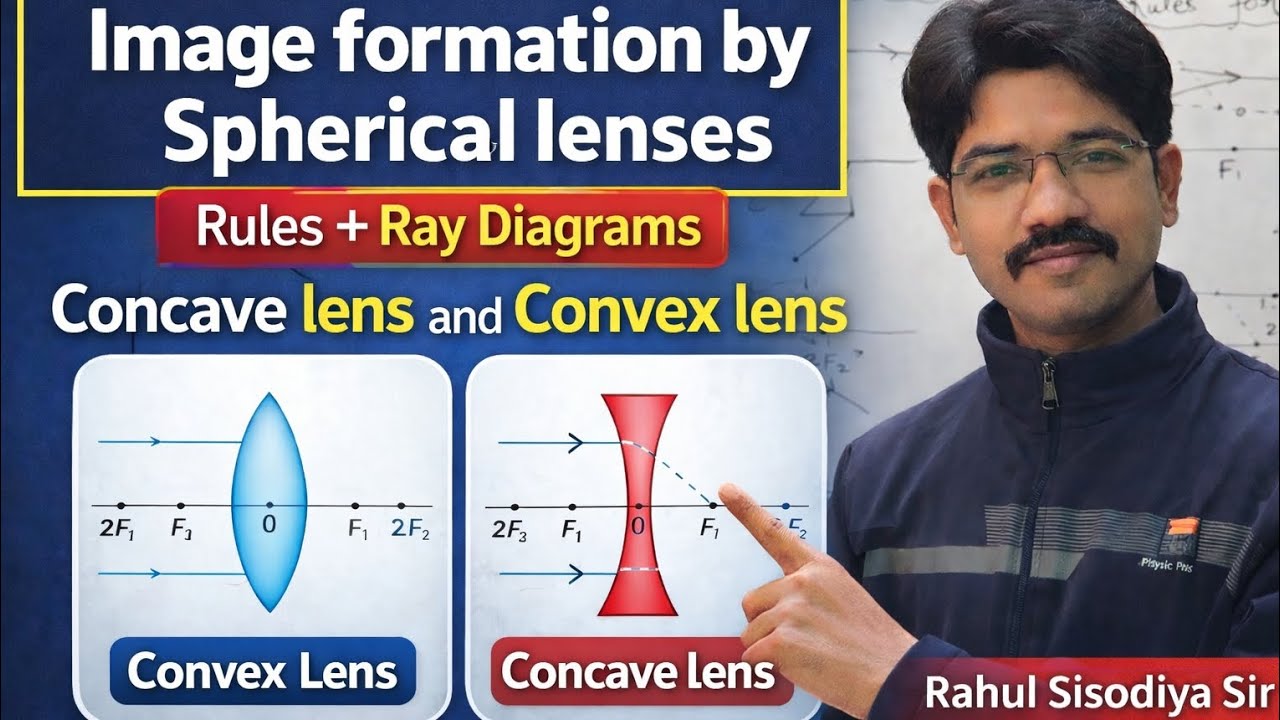

















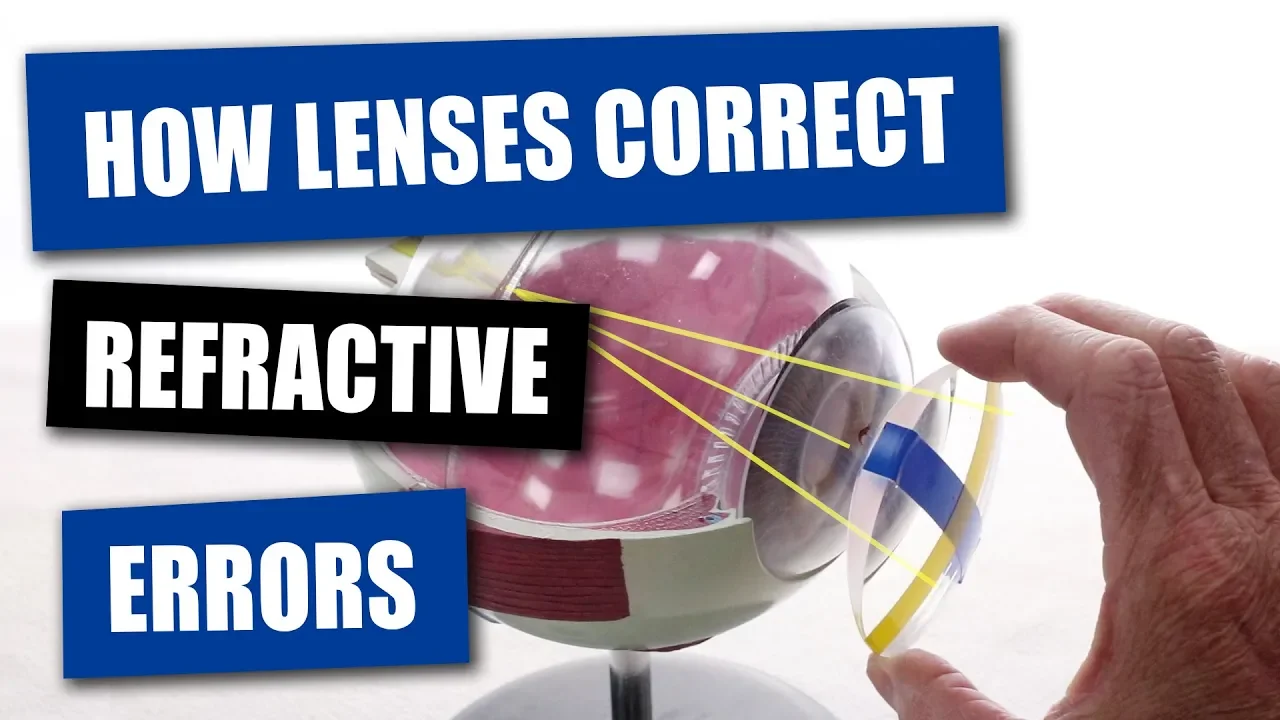


The human eye functions as an optical system where the cornea and eye lens (a double convex lens) focus light onto the retina, with ciliary muscles adjusting the lens focal length for near (2.27 cm) and far (2.5 cm) vision, while the iris controls pupil size to regulate light entry. Vision defects include myopia (short-sightedness, corrected with concave lenses) and hypermetropia (long-sightedness, corrected with convex lenses), caused by the eye's inability to properly adjust focal length for different object distances.
Human Eye & Its Defects Class 10 Physics | POLYCET
Added:Understanding the basic properties of light, including its propagation in straight lines and the concept of light rays.
The phenomenon of refraction, Snell's Law, and how light bends when passing through different media.
The characteristics of spherical lenses, specifically how convex (converging) and concave (diverging) lenses form images.
The lens formula (1/f = 1/v - 1/u) and the definition of the power of a lens measured in diopters.
Exploring more complex vision conditions such as astigmatism, presbyopia, and cataracts, and how they are clinically managed.
The study of optical instruments like microscopes and telescopes that utilize combinations of lenses to magnify objects.
In-depth analysis of atmospheric refraction phenomena, including the twinkling of stars and mirages.
The phenomenon of light scattering (Rayleigh scattering) to explain the blue color of the sky and red sunsets.
Practical applications in optometry, specifically how eye prescriptions are calculated and how contact lenses or LASIK surgery correct refractive errors.
100 views4likes1:00:14Original Release: 2026-04-06
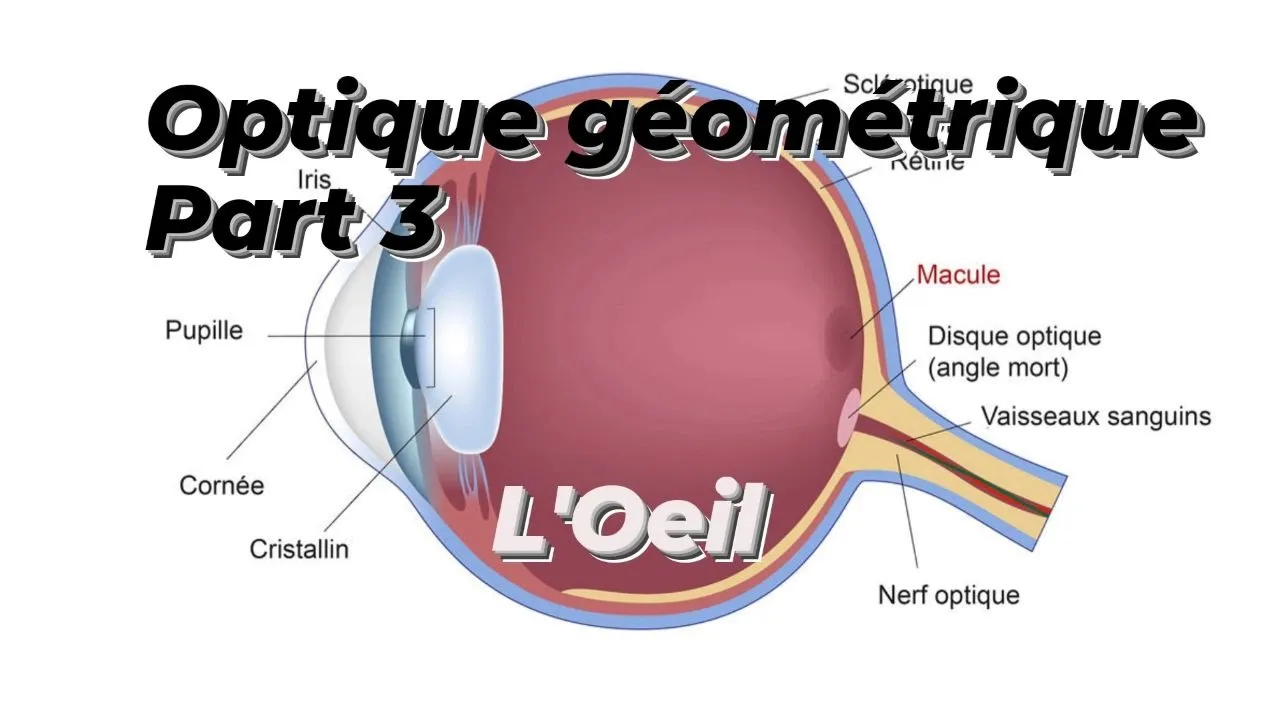
Now we will see based on the ray diagrams we discussed earlier. Now we are discussing about how the human eye works. At first before going to directly about the explanation of that human eye how it is working. First see the important parts of our human eye. Okay.
Now the first one we have to discuss is about our eyelids. Our island lens is a very sensitive and like this very elastic that is okay very sensible and elastic lens that is and it is like a double convex lens. So our eye lens is a double convex lens.
Okay, that is a double convex lens as it is very sensitive here. Actually it is folded with the two clips clip- like structure. Okay. Like this.
Okay. These clips we call that as celiary muscles.
Celary muscles.
Okay. So what is the use of these celery muscles? Later we'll discuss one by one.
Okay. After this celery musles here we are having before that one part we have that is called as iris. We call that as iris.
Okay. Which is acting like shutter for our cameras. Okay. Now next one we are having before that iriser we are having one curvewood surface is there like this. This you call that as cornea.
Cornea. Okay. And another important part is here we are having where our images are captured of which here we call that as retina that is okay like this. So these are the main important parts. We have our eye lens, cornea, iris, celery muscles and retina.
We have okay total mainly this convex lens, cornea, iris, celery muscles and retina that is. So now one by one we will see the importance and how they are working here. Now one first come to the case of this convex lens. You already know that convex lens refraction there of which it forms a real image depending on the focal length here. Actually our islands can see near distances as well as far distances also. Okay. Now if it comes to the case of celery musles, how the celerary muscles are helping here is whenever if you are seeing the near distant objects there or far distant objects there depending on the object distance we have to adjust our focal length here. That work is done by our celerary muscles. Okay. So the role of celery muscles is it is adjusting the focal length of the islands here. Okay.
adjusting the focal length of the eye lens and next one iris. Iris work is actually here we are having very sensitive eye lens is present our convex lens that's why whenever it is exposed to high intensity light that I get damaged that's why here our pupil sorry our iris it is acting like a shutter here whenever a high intensity beam of light is entering it does not allow all the light rays to come onto the directly to the islands okay so that's why whenever if a high intensity beam is coming there then What this iris do is it is closing the shutters there and allows only a small passes for the light rays to enter like this. Whenever if you are exposed to very dim light less intensity of light then iris what it do is it is extending back here. So that here the passes is more and more number of light rays they may enter inside like this that is the work of the iris. Okay.
And another important one the passes where the light rays are entering here the path or the passes where the light rays are entering that part here this is a small hole this part we call that as a pupil that is called as pupil. So pupil is nothing but it is a passes or like a hole. It is a passes for the light rays to enter onto the eyelids that only our pupil. Okay. Now iris actually it is adjusting the size of the pupil.
Whenever it is exposed to high intensity beam the size of the pupil is decreasing. Whenever if you are exposed to the dim light low intensity light the size of the pupil increases. That increasing and decreasing it is done by our iris. Okay. And the next one we are having cornea is there. Cornea helps to focus all the light rays to come onto our retina here to come onto our islands here. That is the work done by our cornea here. Okay. And after the light rays incident on the convex lens, now the light rays are going to incident on retina. Then that retina is collecting the image. Okay. And sending the signals to the brain here. Okay. And it is sending the signals to the brain. That is the work done by our retina here.
Okay. So these are the five important parts we have that is oscuilary muscles, iris, pupil, cornea. Okay. Now we will see how these islands works. Okay.
Whenever if you are seeing the near distant objects and far distant objects as I said our celery muzzles are adjusting the focal length of islands.
Then how we can decide that is a far distant object or a near distant object is our islands can see any of the nearistant objects very clearly without straining the eyes. That distance only we call that as near point. What is it that near point that is? So near point distance actually that is equal to 25 cm for a average person. Okay. So the near point is about 25 whereas near point means that is nothing but the minimum distance the minimum distance that your islands can see clearly the object.
Okay. Without any strain. Okay. Without straining we are able to see the objects here. Okay. That distance we call that as near point distance or dear distance of distinct vision that is okay. So that distance is 25 cm. That if you observe that if you are bringing the object much closer less than this 25 cm our celery muscles cannot adjust the focal length less. Here we are having a limit for that celery muscles to adjust the focal length. Okay. For example, if you are taking how much is the focal length adjusted by the celary muscles is as the far point as the near point. It is of 25 cm is there of which the near distance.
Okay, we know that our average diameter of our eyeball which is the distance from the eyelids to the retina that is around we are having 2.5 cm that is that is around 2.5 cm which means nothing but our image distance screen that is that is because retina is acting like a screen that's why that distance is nothing but the image distance here which is V is equal to 2.5 cm and now we are taking the near point distance as our object distance here. So object distance u is equal to 25 cm that is and what we need is a focal length here. How much is the focal length? Then we know that as 1x f is equal to 1x v minus 1x u for our lens formula 1x f is equal to 1x v - 1x u then 1x f is equal to v it is of 2.5 minus u it is of 25 cm.
Okay. And if you apply the sign conventions which is a very important one. So object distance is of taken negative here whereas image distance is plus then it becomes 1x f is equal to 1x 2.5 which is 25 by 10 minus 1x 25 and minus of minus becomes plus that is then it becomes 1x f is equal to 10x 25 + 1x 25 which is 1x f is equal to 11 by 25 or you can also write that as 25 by 11.
Okay, which is equal to 27 cm that is. So this is the focal length required whenever if you are seeing the near distant objects. Okay. So focal length required minimum is equal to how much we got 2.27 cm that is. So whenever if you are seeing the object if it is placed to 25 cm the focal length adjusted by our celery musles is 2.27 cm. For suppose if you are bringing the object less than this 25 cm we can see the object but the celery muscles are not able to adjust the focal length less than this 2.27 cm.
So that what happens there is we can see that image like a blur image. Okay. So that is the problem if you are taking the object less than 25 cm and at the same time we can see the far distant objects also very clearly for a normal vision there. So which means we can see the far distant objects by adjusting the focal length again by the celery muzzles that is nothing but our maximum focal length. So if you want to find that maximum focal length then the object we are placing that at infinite distance.
So means now I'm taking far distance here of which the far point that far point we are taking that as infinite.
Near point means near distance where we can see very clearly the object without straining the eyes. Far point means now this object we can see where the object we are taking is at very far distance.
Let us imagine that is infinite. So means now the object is at far distance infinite. Okay. And image where it is forming is again on our retina which is 2.5 cm. That is an average value. And we are taking now the focal length. How much is the focal length? Adjusted by our celerary muscles. Okay. Then again the formula 1x f is equal to 1x v minus 1x u. If you substitute that value then 1x f is equal to 1x v which is 2.5 - 1x u which is infinite that is okay. Then if you apply the sign convention again that is of object distance is minus and image distance is plus then 1x f is equal to 1x 2.5 - 1x infinite that is of minus and this is again plus then 1x f is equal to 1x 2.5 + 1x infinite value is zero that is then finally we got 1x f is equal to 1x 2.5 then f is equal to 2.5 5 cm. Which means whenever the object is placed at infinite distance then the focal length here it is required is 2.5 cm if you want to see the object clearly. So for a normal vision for a clear vision okay always the celary musles is adjusting the focal length when you are seeing a near distance 2.27 cm. If the object is at very far distance, it is adjusting our eye lens by 2.5 cm. That is that is the maximum focal length our celery muscles can adjust. Okay, this is for the case of normal vision we are observing. Okay, minimum focal length 2.27, maximum focal length 2.5 cm. Okay. So this one actually this arrangement or this adjustment of this focal length by our celerary musles this we call that as accommodation of eye lens. Okay the adjustment of focal length by the celery muzzles to extend from 2.27 cm to 2.5 cm that arrangement only we call that as accommodation of islands that is okay.
Now if you see the how the ray diagram for the case of formation of image by the clear vision is okay. So clear vision means we don't have any problem to see the object whether it is placed at near distance or object distance at far distance that is okay. So for example if you assume this is our islands and let us suppose this is the position of the retina we are taking at here. Now first case I'm taking as about the minimum case means I'm taking the object which is placed at here n where n is equal to 25 cm I'm taking whenever if n is equal to 25 cm the focal length required here it is of 2.27 cm 2.27 27 cm means that is the less focal length that is. So that's why here that celery muscles start contracting here. That's why here the size of the lens gradually increases means the thickness increases.
Then our convex lens becomes a bit bulge like this. So that the radius of curvature decreases that's why the focal length also decreases in this case for a normal vision I'm telling. Okay. Now if object is at 25 cm here now the light is incident on our convex lens after refraction. Now the lighters are going to meet exactly on the retina here like this.
Okay exactly on the retina here.
This is the case if you are seeing any of the nearistant object. This is for nearistant object.
Okay. Now if you are taking a far distant object, far distant object means object is at infinite we are taking.
Okay. If object is at infinite we already know that we have to take the light appears to be coming like a parall beam of light. Then in this case as the focal length required is maximum means the celary muscles are extending backside here they are going to the relaxed position here. So that's why our islands becomes very thin. So that what happens there is there is a increase in the focal length comes. When there is a increase in the focal length comes immediately we can see the far distant objects very clearly. So let us suppose this is our islands and here if you are taking the object of which the light rays are coming parall here because object is at very far distance that is then after refraction now the light rays are going to meet again exactly on the retina here like this is our retina.
Okay that is our retina here. So this is the case we are taking for the case of minimum focal length case and this is for the case of maximum focal length case. Okay. So minimum focal length we have to place the object at 25 cm we are taking whereas for the case of far distance we are taking object is at infinite that is okay. So we have to remember that the far point of a normal vision of a normal eye it is about infinite whereas the near point N for the case of normal vision it is about 25 cm and the adjustment focal length required there is in case of celery musles that is of 2.27 27 is what required and to see the far distant objects the maximum focal length required there is 2.5 cm that is okay now we have seen how the normal eye works how the celary muscles are adjusting the focal length of the islands so we have to remind those values which are that minimum focal length required to see the near is 2.27 27 cm whereas far distant if you want to see maximum distance it is of 2.5 cm that is we have to remember these two values okay now we'll see the defects of the I mainly we are having total three defects are there okay so the defects of I that is defects of I okay so when you're taking the defects of I the first one we are taking myopia okay myopia myopia another name that is called shortsightedness okay shortsightedness means short sight means vision we can see the near distant objects very clearly but not the far distant objects okay so now only I said if you want to see the near distant objects the minimum focal length required there is 2.27 to 27 cm. That is now here the problem is we can see the near distance very clearly. Short state means near distant objects we can see very clearly. Then problem here we are getting is with far distant points means here if the object is at infinite means at more distances the problem here we are getting is the maximum focal length which is actually required there is 2.5 cm is there but here our eyeens the celery muscles are not adjusting the focal length of 2.5 cm that is the problem okay so have understood the reason here reason for this myopia Reason is focal length is not adjusted up to 2.5 cm. So that's why we are getting the problem with the far distant objects but near we can see very clearly. So no problem for the short set. Only problem is with the longd distance objects. So this is the problem. up to 2.5 cmters it is not able to adjust. Okay. So if you see the diagram here how the light rays are there suppose like this if this is our islands and let us suppose this is our retina and here if you are taking the near distant one which is at the point N there is no problem for our light rays to converge exactly onto the retina here like this.
Okay. So this is myopia defected I at near distant points.
Okay at near distance we are taking. Now here we are taking if the object is at far distance then now I'm taking the object is at far distance. No.
Then if the object is at far distance now the light rays are coming parall to each other so that here as it is not adjusting up to 2.5 always it is less than 2.5 only we have so that's why the convergent point changes here it is not converging at the retina before the retina only it is converging there okay like this before the retina only it is converging then problem here is because we are having less less focal length there. So that's why they are converging before and the lighters are not converging on the retina. Whenever the light reaching the retina, they are going like a diverging beam here. So that's why we cannot see a very clear image. Always remember defect of eye short side or long side doesn't mean that that is of blind long side or short side means that is about we are getting a different size of objects like a diminished or a blurry im. See that is because of due to as I said here the light rays are not meeting exactly on the retina before only they are meeting but when they are reaching up to the retina here actually they are going like a diverging beam that is the problem. So this is the defected vision. This is the defected vision.
Okay. So this is the reason for this defect myopia. Okay. Now if you come to the case of this correction part if you want to correct this myopia which lens to use and why to use that lens there.
Okay. Now here the problem is what our problem is we can see the near distance clearly but not the far distance means for near distance we don't have any problem. So which means minimum distance we can see very clearly that one. So means to that near distance we should have a limit for that. Okay. Which means here the maximum distance that myopia defected eye can see very clearly that is our near point now. Okay. So which means that myopia defected I okay can see far distance very clearly instead of infinite we are having some finite value we are having that is the problem with this myopia okay for example let us suppose like this if this is the islands and here you are having the retina and the light rays we are taking now here this is the near point so that no problem to this near point distance. And now let us suppose as we can see near distance very clearly we should have a limit for that we are problem having problem with far distant objects far distant objects means actually for infinite that is the far point is not infinite for this myopia defected people actually you should have a fixed distance for that let us suppose that point is it here f like this so means up to f they don't have any problem means that maximum distance they can see without any defect is up to f but once the object is placed after f only we are getting the problem means we are taking the object at here like this now what happens there is now the light rays are coming onto the retina here like this after refraction now the light rays are not converging on the retina before only they are converging like this because we are not having the focal length 2.5 cm that is less than 2.5 we are having that that's why we have to change this focal length but if you see the correction here correction is very simple as the object can see okay if it is in between F and N there only problem is once the object is going away after the F there we are getting the C problem here okay so that's why what we are doing for correction is we are making the object which is placed outside F we are bringing the object to be in between F and N okay see that correction symbol of which if it is between N and F we can see very clearly the object that is our short side. Now the problem is if the object is after F we are getting the problem. So that's why the object which is placed which is placed after the four point we are making the object to be in between F and N so that we don't have any problem to see that object. If you want to get this correction, if I want to make the object which is after F, if you want to make that in between F and N, which lens I have to use is by using a concave lens because concave lens is having a nature of formation of virtual images here. So that's why here what happens there is if you are using a concave lens for example like this if this is the convex lens we are using of which our eye lens and here we are taking the object which is after f like this and before that now we are taking a concave lens there like this okay Now the light rays which are coming from the object first it is passing through concave lens here. Okay.
As the concave lens the forms the image of that object which is a virtual and erect image that it is formed before the lens because that is a virtual. So that's why here the image is formed before that only here and that if you are able to make adjust that lens here.
So that here if the object which is the virtual image formed by the concave mirror if you make that in between F and N then we can see the object very clearly so that the light rays are now meeting exactly on retina here like this. This is the correction part required there. Okay. So this is the corrected vision.
Okay. So see that very simple of which the object which is placed after F we are making the object to be in between F and N that is how that is possible is by using a concave lens. Okay by using a concave lens. Then what is the use of that concave lens means concave lens actually forms a virtual and erect image. as it is forming a virtual and erect image. Then what happens there is the object the image formed by this concave lens is formed in between F and N. Then what happens there is we can see that image acting like object for our islands and we can see that very clearly on the retina here. Okay. So this is the corrected vision for myopia. Okay. Then what is the required focal length for that concave that we have to find here.
Okay. So we already know that we don't have any problem once the object is up to F here. Let it be that distance is D.
Okay D is the distance where we can we can see very clearly that myopia defected I can see very clearly. Let it be that distance is D. Then here if it is D if you're taking means I want to make that image. Okay. where the object is at infinite far distance. I want to bring that image which is at object which is at infinite. I want to bring that image up to d where I can see very clearly.
Okay. Then what is the suggested focal length here? Okay. Then we know that 1x f is equal to again 1x v minus 1x u of which focal length 1x f is equal to v it is of d there and image distance minus we are taking that object distance as infinite that is if you see here the object as well as the image both are forming on the same side only. So that's why here both you'll get minus then 1x f is equal to - 1x t + 1 by infinity is zero that is then f is equal to minus d c cm this is the focal okay so the suggested focal length for the corrected I or for the defect of myopia is f is equal to minus d cm that is okay so Remember here the sign convention is important here I'm taking the object to the left side of the lens means the light rays are coming here opposite to the object distance here so that's why I'm taking minus and not only that the image which is formed that is also on the same side that's why here I'm taking even that distance also as minus here so that's why here the focal length we are getting is negative once the focal length we are getting is negative which means that that required con focal length is nothing but about a concave lens because I got focal length is minus. So this is the suggested focal length about myopia. Now we seen about the myopia defected eye and how to correct the eyelids there. Okay. So now we are coming to the next one which is the second defect which is called hyperetropia which is also called longsightedness.
Hyperetropia which is also called longsightedness that is when you are taking this longsightedness which means long sight means we can see the far distances very clearly but not the near distant objects that is the defect with this is okay. Now if you are taking the ray diagram for this islands which is defected with the long side like this as we don't have any problem with the near distance near distant objects we can see very clear sorry long side means a far distant objects we can see very clearly problem is with near distant objects. So the light rays which are coming from far distance we don't have any problem but the object which is of taken near here we are getting the problem actually if you want to see the near distance the minimum focal length required is 2.27 cm minimum required is 2.27 cm of which we already derived that valve but here as the islands is not able to adjust to contract up to that 2.2 27 cm which is always more than this 2.27 cm. Then what happens there is because of due to having more focal length then converging point is also at a long distance we have which means the image is not forming on the retina after the retina the image is forming here like this because the focal length is actually required is lesser 2.27 but it is not making up to 2.27 it is always more than 2.27 27 that's why the converging point is after the retina we have so that's why when the light ray is just before reaching the retina that is no more like a converging point so that's why you are getting a blur image here this is the defect of a hyper metropm okay which means actually we have to see the near distant objects up to that 25 cm very clearly the object but problem here is we are not able to see that 25 cm here which means there There is a change in the near point for the case of this myop hyper metropia of age that near point shifts to let it be that is here n ddash okay actually at here at 25 cm but it is not able to see the near distance means that is of the near point is shifted to more distance here okay that point only we call that as near point of hyper metropia Near point definition is here. That is the minimum distance that hypertropia defected eye can see. That only we call that as near point. Here the minimum distance that hypertropia defected eye can see very clearly that only we call that as near point of which in our case here nd ddash is the near point. So observe that clearly here if the object is after nd ddash we don't have any problem is coming if the object is after n ddash okay means we cannot see the near distant objects clearly only problem is with the far distant objects so that's why what we are doing is we are making the object which is placed in between n and nd ddash we are making the object to be after n dash that is that is possible only by using a convex lens. Now let us see how to correct that. If you are taking a convex lens before our island lens here like this. Now this is the original near point but this is the near point actually for the case of our islands.
Now we are taking the object which is in between n and n ddash. Now what happens there is here we are having one extra convex lens is there and convex lens actually its nature is converging nature. So that's why here what happens there is that light ray is converging two times here like this. Then finally the image is formed exactly on retina here like this.
Which means these light rays are appears to be coming from more distance here like this.
This is going to be the object position.
Original position is here. But finally the object position appears to be at O dash at here. That is okay. So this is the correction for hyperetropia. That is okay. This is the corrected vision of hyperetropia.
Okay. So very simple only one thing we can see the object if it is after n dash problem is coming only if the object is in between n and n dash. So that's why we are making an object which is in between n and n ddash. We are making the object to be after and dash by using a convex lens. Okay, that is the correction for hyper metropia. But what is the focal length required for that convex lens that we are seeing now? So means suggested focal length for hyper metropia.
Okay. So let us suppose this ndash which is the near point let it be that is of d is the near point distance that is then we already have the object object here we are taking okay so where we want to place that exactly after that d here okay so the image here object is at 25 cm actually and we want that image to be at D position there. Okay, at D means our near point that is okay. Then we need the focal length F. Then again as 1x F is equal to 1x V - 1 by U. Then 1x F is V it is of D and U it is of 25 that is then again if you apply the sign convention. So in this case object and image both are on the same side here. So that's why we have to take both cases minus that is okay. Then 1x f is equal to - 1x d minus of minus becomes + 1x 25 that is if you take the LCM then 1x f is equal to 25 d okay and of - 25 + d that is then 1x f is d - 25 by 25 d that is then finally f becomes 25 d by d minus 25 this is is the correction required.
Actually if you observe D is more 25 is less D is up to N sorry N is up to 25 means up to N D means more than 25 that is so D minus 25 value is positive so that's why here F is positive if F is positive means the required focal length is a convex lens in that way we can decide that the suggested focal length for this hyper metropia is f is equal to 25d by d minus 35 and another one is hypertropia which is of long set. For myopia suggested focal length suggested focal length for myopia we got minus d that is whereas in case of hyperetropia we got suggested focal length is 25d by d minus 25 that is okay. Now another defect we have that is called as presbopia that is presopia actually it comes because of due to for a long time if the celerary muscles are working then we are getting this problem of presbopia that is of which most of the cases we'll see that in old people that is because that is coming because of due to aging that is for a long time as the celerary muscles are working here they are going to be to a relaxed position here So that's why they are not able to convert these light rays onto the retina. Okay. So the correction for the preser required is we have to use a by convex lens just like we use in case of hyperetropia here.
Okay. Just like the case of hyperetropia because those are in the relaxed position means focal length is more for them. They cannot contract much as they are not able to contract much here.
That's why here the focal length required is less. So that's why we have to use a convex lens here for the case of press bop that is for the case of numerical we already know that power formula for power of lens is 1x f the reciprocal of the focal length. Okay power of the lens is equal to 1x f that is reciprocal of the focal length. Then for the case of myopia the required power is P is equal to this is for myopia okay required focal length is 1x F where suggested focal length it is of 1 by D is minus D that is okay so minus 1 by D that is and whereas hyperetropia if you take for hyperetropia again that is of 1x f that is 1x It is given as 25D by D minus 25 that is so finally we got D minus 25 by 25D that is the power required the power of the lens required to correct myopia and to correct hyperropia okay then how to use this while solving the numericals that we'll see that for example a person is defected with myopia having myopia short side there and we know that his fourpoint distance that is of D value is given as 25 cm that is okay uh let us suppose 30 cm okay then this is about myopia defected vision then the focal length suggested suggested focal length is minus d cm that is then it is equal to -30 cm that is as it is Go to myopia here. The power required power of the lens power power of the lens is equal to 1x d that is of - 1 by 30 that is but this is in cm okay so we have to convert that into meters m means 100 we have to take then it becomes three get cancel minus 3.33 d we'll get where d means diopter that is okay so Power units is diopter.
This f we are taking in mters.
Okay. Then power of the lens its units are diopters that is or reciprocal of mters that is okay 1 by m. So that's why here we got minus 3.33d that is okay because here we have to use a concave lens. So that's why we got minus 3.33D that is okay for suppose if they are having the doctor's prescription if you are having the focal length required there or the power required there if it is given as P is equal to -4 D what do you mean by that is the power which is equal to 1x F is equal to -4 is there then f is equal to - 1 by 4 - 1x4 means - 0.25 into actually it is of m that is 0.25 m or you can also write that as -25 cm that is okay. So that minus represents we are using a concave lens that is and here the faroint distance which is the suggested focal length that d value that is because f is equal to d as f is equal to d then f value we got 25 cm that is okay. So in that way if a power of the lens given we can find the for distance point also for the defected I where f is equal to minus 25 means that a distance is equal to 25 cm like this. This is for the case of myopia.
Okay. Now if you are taking for the case of a hyper metropia how to solve a numerical is we know that for hyper metropia that required focal length is 25d by d minus 25 that is so that's why let us suppose that myopia defected vision problem we are taking okay for example if the near point we are taking near point for the defected I is equal to 40 cm that is okay. So which means our near point distance D is equal to 40 cm.
This is for long set we are taking.
Okay. So D is equal to 40 cm. That is then we know that formula f is equal to suggested focal length 25 d by d minus 25 that is then 25 into 40 by 40 - 25 that is then 25 into 40 by 40 - 25 which is 15. Okay. So 53 is here and 55 which is of 200 by 3 that is okay. So 200 by3 which is of here f is equal to 200 by3 we got then this is f value then we have to find and that this is of cm that is then we need power power is equal to 1 by f that is which means 1 by 200 by 3 and this is in cm means we have to convert that into meters which is into 100 we have to take that 100 get cancel and three come to the numerator it becomes 3x2 2 which is 1.5 that is and if you observe here that the power we are getting is + 1.5. If it is + 1.5 as the power is + 1.5 which means this represents we are using a convex lens.
Okay. And the power given there is 1.5D that is okay the power suggested for that is 1.5D that is okay like that we can solve this numericals there in case of myopia and hyperetropia now as we already seen about how to do the numerical for the case of this myopia and hyperetropia there okay now another important one about the power is when you are using two lens at the same time then the power formula is given by let Let us suppose if you are having a convex lens with focal length f_sub_1.
Let us suppose you are taking another convex lens which is of focal length f_sub_2. Okay. This one having the power p1. This one having the power p2. In this case the formula required the final focal length f is equal to of which 1x f is equal to 1x f_sub_1 plus 1x f_sub_2 that is that is the resultant focal length we are getting and at the same time we know that 1x f_sub_1 is nothing but p1 the power and 1x f_sub_2 is nothing but p2 that is then this is the final power. If the distance if the distance between the two lens is zero, then we are using this formula. If there is a distance is present between both the lens, this is one convex lens, this is another convex lens with focal length f_sub_1 and f_sub_2. And let it be this is p1 and p2. And let us suppose the distance between them is d. Then the formula is given by 1x f is equal to 1x f_sub_1 + 1x f_sub_2 minus d by f_sub_1 f_sub_2 that is then 1x f_sub which is p is equal to 1x f_sub_1 is p1 1x f_sub_2 is p2 minus of d 1x f_sub_1 p1 1x f_sub_2 is p2 that is and finally we got p is equal to p1 + p2 minus d p1 P1 P2.
This is the case we are using if there is a distance is present between the two convex lens. We are using the same formula we have to apply even for the case of concave lens also. But we have to use for any of the focal lengths here we have to apply the sign convention here. Okay. Now we will see about the refraction of light through a glass prism. Okay. Prism means you already know that prism we are having total two triangular surfaces and three rectangular surfaces that is okay. Now we are seeing a monochromatic light.
Mono means single. Chromatic means color or wavelength that is a monochromatic light.
Okay. Mono means single.
Chromatic means color or wavelength.
Okay. So a single colored wavelength we are taking here. Okay. Now this monochromatic light for suppose if it incident on the glass prism from the front side if you see only the triangle surface we can see here like this. Let us suppose this is a BC is a prism. A is one rectangular surface. BC is the base another rectangular surface and AC is also another rectangular surface. That is now let us suppose a light ray incident on the AB surface here like this. Okay. To this surface now we are having a normal here like this. This is the normal N1 that is okay. Remember we are taking the light ray incident light ray is from air. This is our incident ray. Incident ray.
Okay. Now whenever the incident ray you're taking that is in the air air medium that is now here glass this is our glass prism is a glass which is a denser medium that is this is glass which is a denser medium that is so as this is a denser medium and the lighter is coming from rarer to denser then the lighter bends towards the normal the actual path of the light ray is actually it is going straight there like this but here the lighter bends towards the normal here. So it is bending towards the normal like this. Okay. Now the refracted ray which is making an angle let it be that is of angle of incidence is I angle of refraction is R 1. Now the light ray is instanting on the second surface here which is of AC surface. Now we are having another normal we are getting. So for this surface of AC let it be this is the normal. Okay, which is normal and to that is now the light ray here as it is coming from glass back to the air.
Okay, now the light ray bends away from the normal because this is from denser to rarer medium. So that's why here the light ray bends away from the normal here like this the light ray bends here the light ray which is coming outside finally that you call that as emergent ray. This is called as emergent ray that is okay. So normal N1 we got normal N2 we got and angle of incidence is there angle of refraction let it be this is R2 which is the second case angle of incidence and finally the emergent ray making an angle with the normal let it be that is angle of emergence E that is okay and the angle between the two refracting surfaces which is between AB and A that only we call that as angle of the prism A that is angle of the prism okay then how How much is the light ray deviating from its original path? That only we call that as angle of deviation that is. So here this is the angle of deviation D. Okay. So total we got four angles are there. Angle of incidence, angle of emergence, angle of the prism and angle of deviation which is inside.
Okay. Then if you take a relation between these four angles, we'll get angle of incidence plus angle of emergence is equal to angle of the prism plus angle of deviation. That is this is the relation between the four angles. I + E is equal to A + D. But remember whenever if you are taking the angle of incidence.
Okay. Then if you are increasing the angle of incidence gradually the angle of emergence decreases here angle of emergence decreases at one particular stage the angle of incidence and angle of emergence both are equal and the deviation made by that actually here it is minimum deviation here. Okay. So the deviation angle is minimum.
Okay. So when you are increasing the angle of incidence, angle of deviation gradually decreases at one particular stage. Angle of incidence is equal to angle of emergence. That point only we call that as a minimum deviation point.
That is called that as minimum deviation point. Remember whenever angle of incidence equal to angle of emergence minimum deviation point the light ray which is coming from this point to this point the inside refracted ray and BC both the base these two are parall to each other. Okay, those two are parall to each other. Then we can say the light ray is deviating minimum that is okay.
Then if you want to find the refractive index of this glass prism, then that formula is given by mu is equal to sin of a + dm by 2 by sin ax2 that is okay. Mu is equal to sin of A + D M by 2 by sin A by 2 that is whereas A is angle of the prism. Mu means refractive index of glass prism and a means angle of the prism and here dm means minimum deviation that is we're taking that as minimum deviation.
ation.
This comes when angle of incidence equal to angle of emergence there. Okay, this is the formula to find the refractive index of the glass prism. Okay, so by using this angle of minimum deviation.
Now we will see the poly chromatic light refraction through glass prism. This one is monochromatic light when passed through the glass prism. Now we are seeing poly chromatic light.
Poly chromatic light whereas poly means more than one which is more than one. Okay. And again chromatic means wavelength that is or the color. So now we are taking here the light ray which is having more than one wavelength here. Okay. Best example for that is white light. You can take okay white light.
So poly chromatic light is a white light is a polychromatic light having more than one because it is having seven different colors. Now we are seeing the refraction through this poly chromatic light through a glass prism. Okay. Now let us suppose this is the glass prism.
Now you're taking a white light which incident on this glass prism.
Then after refraction what happens there is as these are having white light is having a seven different colors and each color having its own wavelength is present. But once the refraction takes place, if the light ray is going from one medium to another medium, as we already know that during refraction, there is a change of velocity is there as all are having seven different colors with the different velocities. Okay, there is a change in velocity is present for the seven colors here. That change in velocity is a different for different velocities. Okay. So there is a change in velocity is there for different colors in a different way. So that's why here the light rays are not going no more in the same line. All are taking their own path. This only we call that as splitting. Okay. The splitting of white light into seven different colors.
That only we call that as dispersion phenomenon. This only we call that as dispersion of light or dispersion of white light.
Dispersion of white light. This is what we observe even in case of our rainbow also. Whenever the sunlighters are coming on a rainy season here during rain what happens there is that water bubbles there acting like here our glass prism. After refracting through that we are having total internal reflection takes place. Again that is also a special case of refraction. Here there is a splitting of white light into seven different colors that only appears to be like a rainbow here. Okay. So remember in this case of refraction through glass prism okay the more deviated part more deviated light ray is violet and minimum it is of red color that is okay so least deviated ray is violet sorry least deviated ray is red color and maximum deviated light ray is violet okay because here the red color light is having maximum wavelength is present whereas in case of violet it is having Minimum wavelength that is okay. See here as the refractive index we already know that that is related to the velocity here of which mu is equal to c by v.
mu is equal to refractive index mu is equal to c by v where c is the speed of light in the vacuum and v is velocity of the light in the given medium we are taking. Okay. So the refractive index mu is inversely proportional to the velocity here. Okay. See velocity is more velocity of light is more for red color. That's why it is used as the danger symbol also red in color. Okay. Like we see in the traffic signals that is of red in color that is and the minimum wavelength it is meant for velocity of light is minimum or less for violet.
Okay. In case of violet it is minimum.
As the red color is light is having more wave more velocity is there. It is having more wavelength also because we know that v is equal to n lambda. Then V is directly proportional to lambda.
Which means velocity of red color is more than violet is more than violet then its wavelength wavelength is also more for the case of red color here. As velocity is more then wavelength is also more but velocity and refractive index both are inversely proportional to each other. That's why the refractive index of the red color actually it is less when compared to the refractive index of violet. This refractive index and deviation okay both are related directly proportional to each other. When you are having more refractive index the deviation it is of less. If the refractive index is more then the deviation is also more we have.
So that's why here the deviation angle for red color is less when compared to the deviation angle for violet color.
These are the relations very very important one. Okay. So red color velocity is more. So that's why here we are having more wavelength is present.
As there is a more wavelength is present we are having more refractive index is present. As we are having more refractive index is there then here in the case of that deviation is more for violet. Whereas in case of red as the refractive index is less that's why the deviation for the red color is also less. That's why while coming out from the glass prism here the red color light is having less deviation which comes first. This is the screen.
Okay. Which comes first and last we are getting is violet. This is the order.
Okay. So, violet to red that is
Up Next
12:56
Lens Power, Diopters & Eye Aberrations | Optics | Khan Academy
@khanacademymedicine
218.3K views•2014-07-06

12:53
21cm Hyperfine Transition in Neutral Hydrogen: Radio Astronomy Basics
@AaronRobertParsons
12.4K views•2011-10-13

32:32
NMR Spin Physics I: Zeeman Effect, Resonance Condition & Larmor Frequency
@nptel-indianinstituteofsci8064
2.3K views•2024-01-17

27:14
Entropy and the Second Law of Thermodynamics Explained
@veritasium
27.5M views•2023-07-01
Related Study Plans & Knowledge Roadmaps
Structured learning paths in Physics
physics
Nuclear Physics (Decay, Fission & Reactors)
01Atomic Structure and the Binding Force
02Radioactive Decay and Half-Life
03Nuclear Fission Mechanics and Chain Reactions
+ 2 more learning modules
12h5 modules
Explore Roadmap
physics
Soft Matter (Polymers, Colloids & Rheology)
01Foundations of Soft Matter & Thermal Forces
02Polymer Physics and Macromolecules
03Colloids, Surfactants, and Self-Assembly
+ 2 more learning modules
38h5 modules
Explore Roadmap
physics
Analytical Mechanics: Lagrangian & Hamiltonian
01Mathematical Foundations: Calculus of Variations
02From Newtonian Mechanics to Constraint Dynamics
03The Principle of Least Action & Lagrangian Mechanics
+ 3 more learning modules
28h6 modules
Explore Roadmap
physics
General Relativity (Spacetime & Cosmology)
01Foundations of Relativity: Special Relativity
02The Geometry of Spacetime: Equivalence Principle & Curvature
03Einstein's Field Equations: The Mathematics of Gravity
+ 2 more learning modules
55h5 modules
Explore Roadmap