






![[GLOW 44 debate] McFadden/Sundaresan/Zeijlstra: On certain crosslinguistic variations](https://i.ytimg.com/vi/7OMKAlfADDw/maxresdefault.jpg)





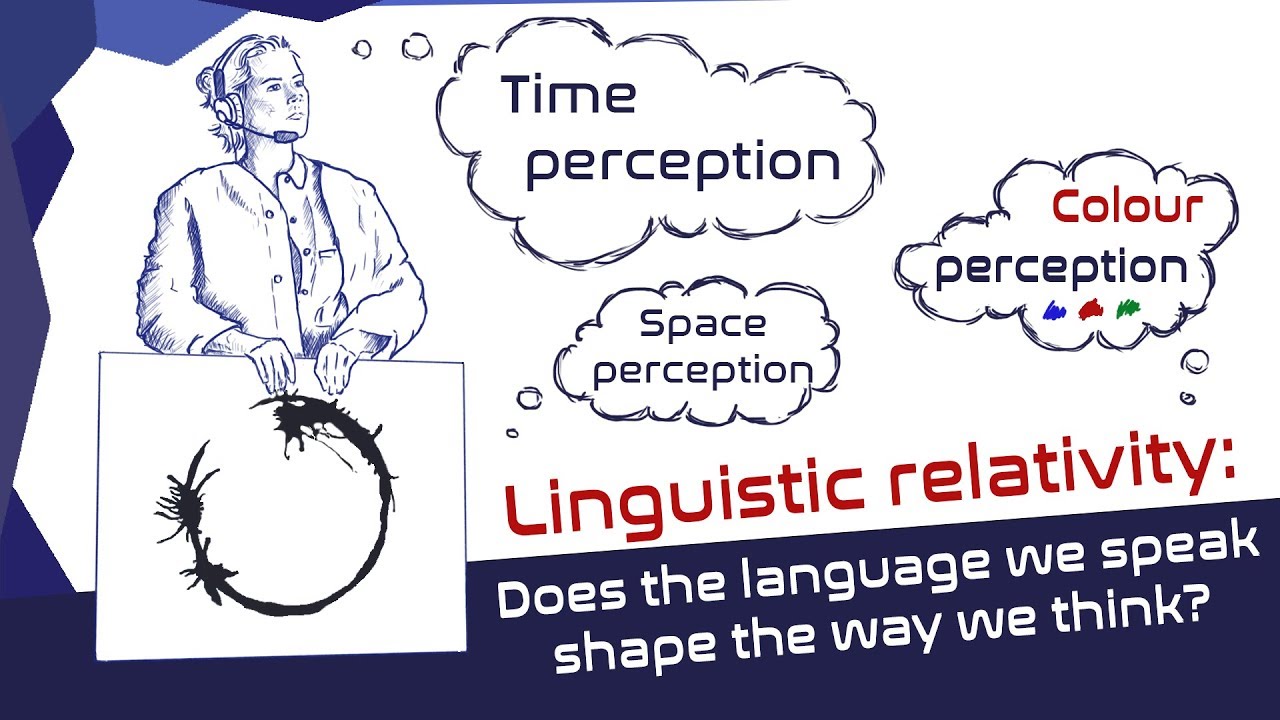







The Sapir-Whorf hypothesis proposes that the language we speak influences how we think and perceive the world, as evidenced by how different languages categorize concepts like color (e.g., some languages combine green and blue into one term), assign gender to objects, and structure reality, thereby shaping speakers' cognitive frameworks and emotional responses.
How Language Shapes Thought: The Whorfian Hypothesis
Added:Basic terminology of cognitive psychology, specifically how human perception, memory, and categorization function.
The fundamental distinction between language (as a structural system of communication) and thought (as internal mental representation).
The core debates in linguistics regarding universalism (e.g., Chomsky's Universal Grammar) versus cultural and linguistic variation.
An introductory understanding of how sensory perception, such as color processing or spatial orientation, is measured in scientific research.
The distinction between the 'strong' version (linguistic determinism) and the 'weak' version (linguistic relativity) of the Sapir-Whorf hypothesis.
Empirical case studies in linguistic relativity, such as studies on grammatical gender, spatial reckoning (e.g., cardinal vs. relative directions), and color categorization.
The cognitive and neurological impacts of bilingualism and multilingualism on executive function and perception.
The application of linguistic framing and metaphors in sociolinguistics, behavioral economics, and political discourse to influence public opinion.
274.5K views6.5Klikes4:21Original Release: 2020-03-20
so do we think differently okay-dokey use a car Magruder sorry it's like a tongue twister that's that's a boring question the Whooper hypothesis as it's known which is the idea that our language affects our thinking has been debated for decades even centuries there's a growing amount of experimental evidence that differences across languages have an influence on the way speakers of those languages conceive of the world you can see that different languages structure the world in different ways they carve up the various continued and different types of relations in the world the weather different languages chop up the world almost can vary and that is actually influenced how you see that world I think language changes everything about the way you think I go into a certain mindset sound deeper than the way I perceived situations differently I react differently I think I'm more grounded and more in touch with my emotions in German yeah it makes me feel more assertive when I'm speaking Dutch because you kind of just get straight to the point it's not just for talking language is for organizing an otherwise messy world into identifiable categories it gives us ready labeled it's like Lego you add another word to the word and that makes it more precise language and French is super gendered so everything has a masculine or feminine and it just makes everything feel a bit more one or the other if you have a word like bridge if it's in a language where it is carrying a masculine gender then bridges will be described by people slightly differently so it might be its usefulness or its power might be more associated with the feminine gender whereas its strength and its size might be more sort of associated with the masculine gender the structure of a language forces us to attend to certain aspects of a language that are certain aspects of reality that are relevant for a language at the moment of using that lang it's known as the thinking for speaking hypothesis there's evidence that language involves some kind of image simulation and that has a consequence for how we perceive of certain events color is quite a complex property of our visual world your brains decoding color in quite a complicated way so you have many languages that have a term to denote both green and blue and typically we'll call this a GRU term you find this in languages like the Himba for example in the Namibian Plains in this experiment we ask participants to look at the color tile and then after 30 seconds to show them the full array of colors we say not pick the one that we just saw and it's a very difficult task if you're an English speaker but a human speaker can do it like child's play because the font color is central to them you simply cannot recognize colors that are not easily encoded in your native language I think by virtue of being born into a particular culture and the language that goes with that culture we are almost certainly given to think in a particular way the human brain doesn't work out of the box you grow up and you're growing up learning languages in particular environments so you've got you know by the time you're dealing with an adult you're dealing with a brain that has been trained up to be an expert along a number of quite specific dimensions there's actually another very very good reason to learning language and that's simply to gain another perspective on the world there you can actually say a lot more a lot quicker in aspects you can in English which is quite interesting it used to be nomadic which means the language has to be a lot quicker because you're speaking to people while moving around and all this kind of stuff but in a sense language is culture and culture is language speaking a different language is always kind of gateway into a completely different culture understand we got her on or think Agartala kayo droogies musica we do memorable when summer she French in order as linguist cognitive diversity I think is at the core of human nature it is probably if you're looking for universals I bet it is probably the one true Universal of humanity thanks for watching don't forget to subscribe and click the bail to receive notifications for new videos see you again soon
Up Next

62:11
How Language Shapes Thought: Lera Boroditsky on Cognition
@TheShalemCenter
44.9K views•2012-07-26
36:52
Constraint Interaction in Optimality Theory: Epenthesis & Deletion
@Vidyamitra
180 views•2018-08-20

8:59
Forensic Linguistics: How Language Solves Crimes | PBS
@pbsstoried
1M views•2024-01-25

21:32
Accent Expert Explains U.S. Regional Dialects | Part 1
@WIRED
9.3M views•2021-01-21
Related Study Plans & Knowledge Roadmaps
Structured learning paths in Linguistics
linguistics
Optimality Theory: Tableaux & Constraints
01Phonological Basics: Sounds, Syllables & Rules
02Foundations of Optimality Theory: GEN, CON, and EVAL
03The Constraint Inventory: Markedness vs. Faithfulness
+ 2 more learning modules
15h5 modules
Explore Roadmap
linguistics
Morphosyntactic Alignment: S, A & P Systems
01Foundations of Syntax: Transitivity and Arguments
02The Linguistic Variables: Mapping S, A, and P
03Nominative-Accusative Alignment
+ 3 more learning modules
12h6 modules
Explore Roadmap
linguistics
Analyzing Sign Language: Phonology & Syntax
01Foundations of Sign Language Linguistics
02Phonology: The Five Parameters of a Sign
03Morphology: Word Formation and Classifiers
+ 2 more learning modules
14h5 modules
Explore Roadmap
linguistics
Pragmatics: Speech Acts, Grice & Politeness
01Introduction to Pragmatics: Meaning in Context
02Grice’s Cooperative Principle & Implicature
03Speech Act Theory
+ 2 more learning modules
14h5 modules
Explore Roadmap