













![Multi Messenger Astronomy - A New Era of Discovery – Part-1 – [Hindi] – Infinity Stream](https://i.ytimg.com/vi/Ivp_G8uE_P4/maxresdefault.jpg)






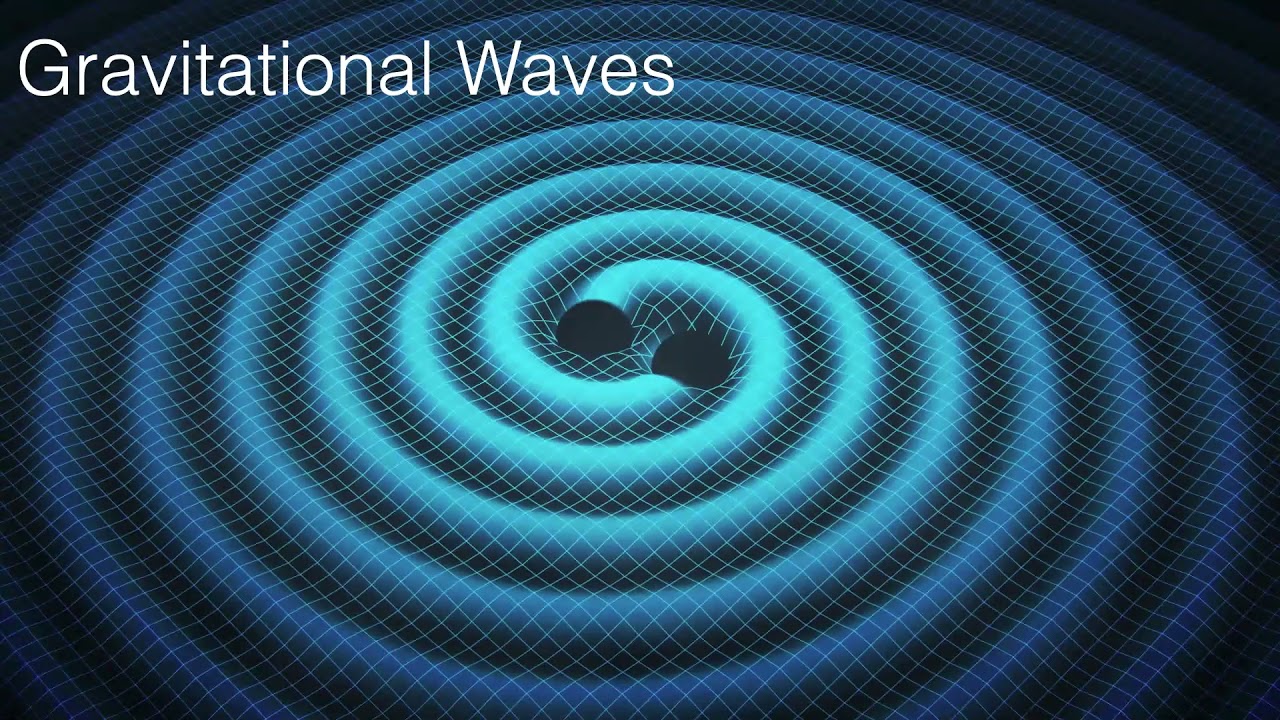


Gravitational waves are ripples in spacetime caused by accelerating massive objects, similar to how moving objects create waves in water or sound waves in air; unlike electromagnetic waves where charges oscillate, gravitational waves cause the gravitational field itself to oscillate, stretching and compressing space as they travel, making them incredibly weak but detectable only during violent cosmic events like black hole mergers.
Gravitational Waves Explained via Analogies and LIGO Detection
Added:Einstein's Theory of General Relativity: Understanding spacetime as a dynamic four-dimensional fabric warped by mass and energy.
Basic Wave Mechanics: Conceptual familiarity with wave properties such as wavelength, frequency, amplitude, and constructive/destructive interference.
The Nature of Black Holes: Understanding what stellar-mass black holes are and the extreme gravitational environments they create.
Fundamental Optics: A basic grasp of how light behaves, specifically the concept of coherent light sources like lasers.
Multi-Messenger Astronomy: How combining gravitational wave detections with electromagnetic observations (e.g., gamma rays, visible light) provides a richer picture of cosmic events.
LIGO Engineering Challenges: Delving into the extreme precision technologies used to mitigate environmental noise, such as seismic isolation and quantum squeezing of light.
Next-Generation Gravitational Wave Observatories: Investigating future projects like the space-based LISA (Laser Interferometer Space Antenna) and the underground Einstein Telescope.
Testing General Relativity in Strong Field Regimes: Analyzing how gravitational wave waveforms are used to test the limits of Einstein's theory of gravity near black hole event horizons.
931.8K views27.1Klikes3:20Original Release: 2016-07-08
When things move, they create waves.
For example, if you shake a stick back and forth in water: water waves.
Vibrate a piece of metal back and forth really fast: air pressure waves.
Shake some electrons back and forth really fast: radio waves.
And yes, shake a planet or star back and forth really fast: gravitational waves.
Gravitational waves happen because the effects of gravity don't travel outwards at infinite speed – so if the sun were to suddenly jump a few hundred thousand kilometers to the side, the changed gravitational field would take time to pulse outwards.
And if the sun shook back and forth and back and forth, instead of a single pulse, you'd get continuous gravitational waves.
So what's doing the "waving"?
In the case of water, the height of the water increases and decreases at any particular location as the waves travel past.
In the case of sound, the pressure of the air increases and decreases at any particular location as the waves travel past.
In the case of radio or cell phone signals or any other electromagnetic waves, the electric and magnetic fields get stronger and weaker at any particular location as the waves travel past.
And in the case of gravitational waves, the gravitational field gets slightly stronger or weaker as the waves travel past.
You can tell a wave has passed by looking at how nearby particles behave – a bobber on the water rises up and down, the electrons in a radio antenna move back and forth because of the changing electric field, and free-floating people or planets or cats move back and forth because of the changing gravitational field – though in this last case, the peculiarities of gravity mean that the free-floating things actually experiencing the gravitational wave don't feel like they're moving.
But if you measure the space between them by sending a pulse of laser light and measuring the time it takes for it to come back, you'll find that the distance between them increases and decreases.
In practice, physicists don't actually measure gravitational waves with free-floating cats – they use very very fancy expensive mirrors which are effectively free-floating because they're hung on pendulums suspended on isolation tables suspended on isolation tables, or which are _actually_ free-floating because they're attached to satellites floating in space – though this hasn't been done yet.
The reason physicists need fancy floating mirrors to detect gravitational waves is that the waves are very, very weak.
For example, the electrons that vibrate back and forth in a radio antenna to make electromagnetic waves ALSO make gravitational waves; electrons _are_ matter moving back and forth after all.
But the waves they make are super weak: a 200 watt radio transmitter gives off something like a quadrillionth of a quintillionth of a quintillionth of a quintillionth of that power as gravitational radiation.
And that's why here on earth we can only detect the biggest baddest astronomical events – like superfast spinning neutron stars or merging black holes or the big bang.
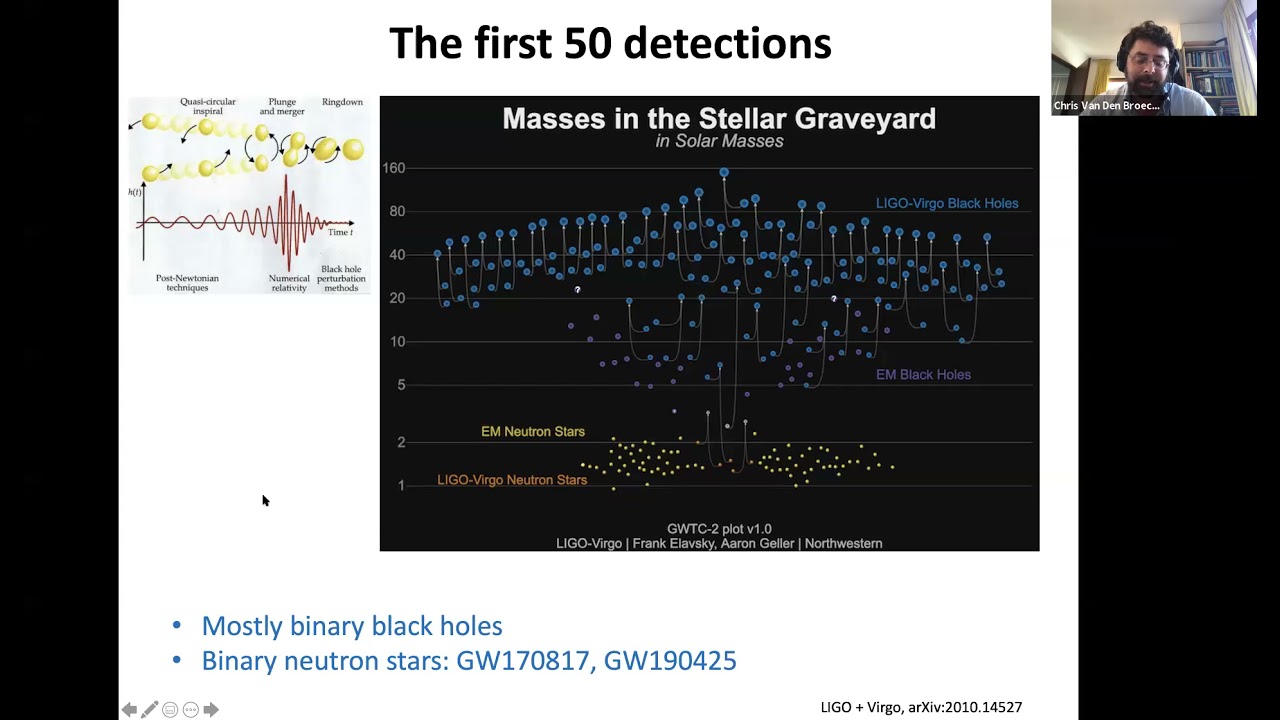
Though so far, we've only detected black hole collisions.
Up Next

61:40
Gravitational Waves Explained: Einstein's Legacy | Prof Rob Jeffries
@popastro
322 views•2016-11-05

12:53
21cm Hyperfine Transition in Neutral Hydrogen: Radio Astronomy Basics
@AaronRobertParsons
12.4K views•2011-10-13
21:43
Feynman's Lost Lecture: Why Planets Orbit in Ellipses | Physics Explained
@MinutePhysics
3.7M views•2018-07-20

27:14
Entropy and the Second Law of Thermodynamics Explained
@veritasium
27.5M views•2023-07-01
Related Study Plans & Knowledge Roadmaps
Structured learning paths in Physics
physics
Nuclear Physics (Decay, Fission & Reactors)
01Atomic Structure and the Binding Force
02Radioactive Decay and Half-Life
03Nuclear Fission Mechanics and Chain Reactions
+ 2 more learning modules
12h5 modules
Explore Roadmap
physics
Soft Matter (Polymers, Colloids & Rheology)
01Foundations of Soft Matter & Thermal Forces
02Polymer Physics and Macromolecules
03Colloids, Surfactants, and Self-Assembly
+ 2 more learning modules
38h5 modules
Explore Roadmap
physics
Analytical Mechanics: Lagrangian & Hamiltonian
01Mathematical Foundations: Calculus of Variations
02From Newtonian Mechanics to Constraint Dynamics
03The Principle of Least Action & Lagrangian Mechanics
+ 3 more learning modules
28h6 modules
Explore Roadmap
physics
General Relativity (Spacetime & Cosmology)
01Foundations of Relativity: Special Relativity
02The Geometry of Spacetime: Equivalence Principle & Curvature
03Einstein's Field Equations: The Mathematics of Gravity
+ 2 more learning modules
55h5 modules
Explore Roadmap