







![이준석을 오직 팩트로 조지는 이광수! [코너별 다시보기]](https://i.ytimg.com/vi/v4g65F-sx8E/hqdefault.jpg)
![[경제학기본37] 경제학 짱박사의 경제학원론 기본강의_제30장 경제안정화정책을 둘어싼 논쟁](https://i.ytimg.com/vi/CfYqK9ARWWs/maxresdefault.jpg)

























Monetarism, developed by Nobel Laureate Milton Friedman, is a business cycle theory emphasizing that the money supply and central bank policies are crucial for economic stability; it argues that maintaining a steady, moderate rate of money supply growth (typically 2-3%) prevents both excessive inflation (which distorts resource allocation) and deflation (which reduces aggregate demand), though critics note its limitations in addressing non-monetary shocks like credit market problems or asset bubbles.
Monetarism Explained: The Money Supply and Business Cycles
Added:Basic macroeconomic concepts of inflation, deflation, and the phases of the business cycle.
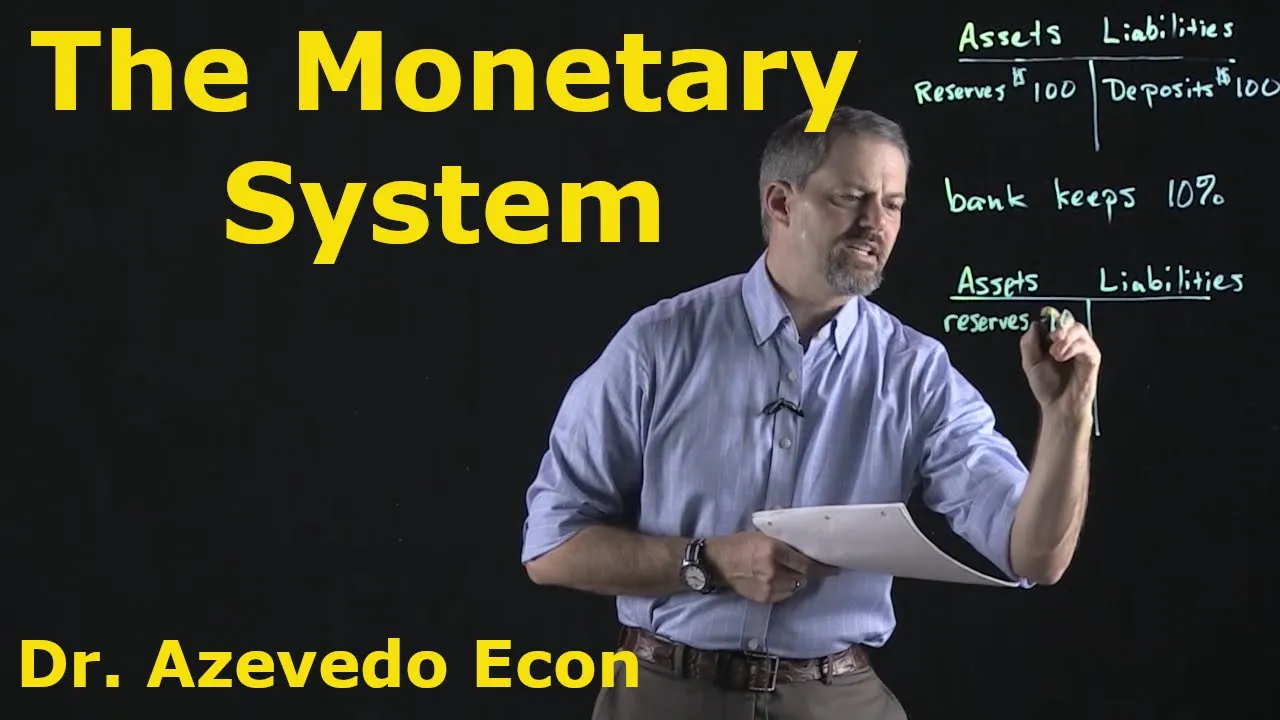
The functions of money and how the money supply (M1, M2) is defined and measured.
The role of central banks and their primary tools of monetary policy, such as reserve requirements and open market operations.
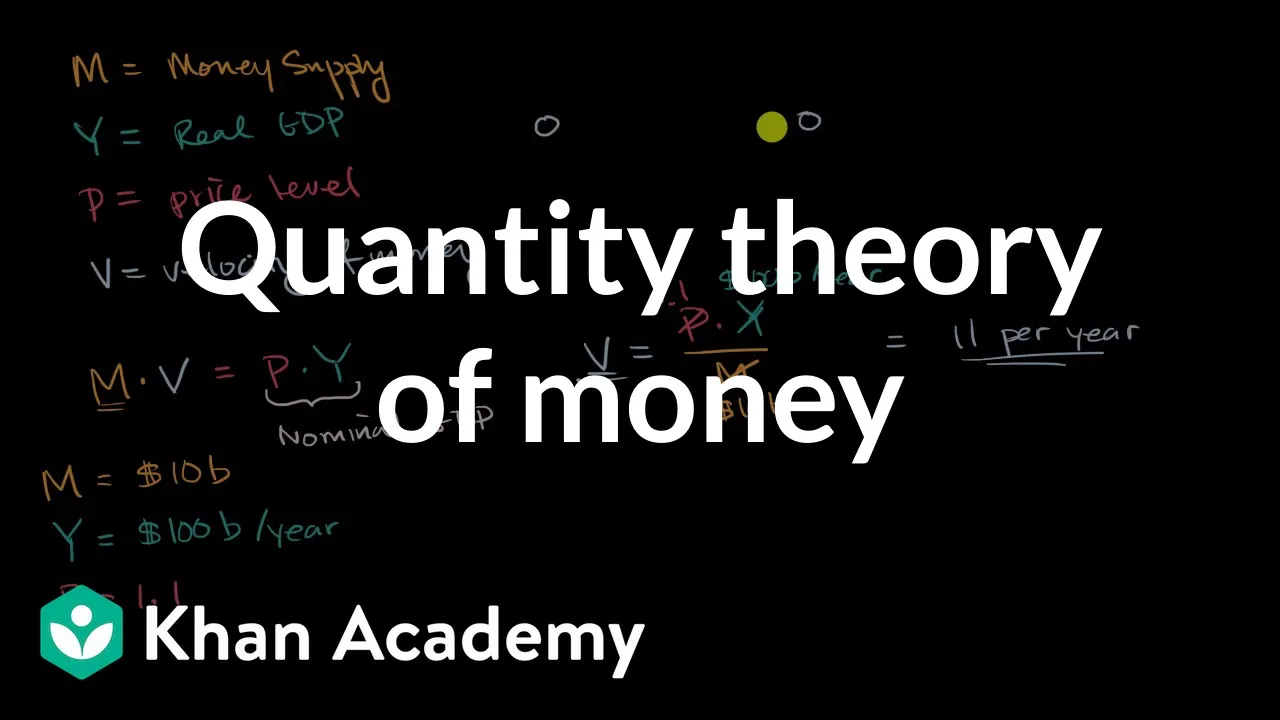
The Quantity Theory of Money (MV = PY) as the foundational mathematical framework for monetarist thought.
The policy implementation of monetarism in the late 1970s and early 1980s, particularly Paul Volcker's fight against inflation.
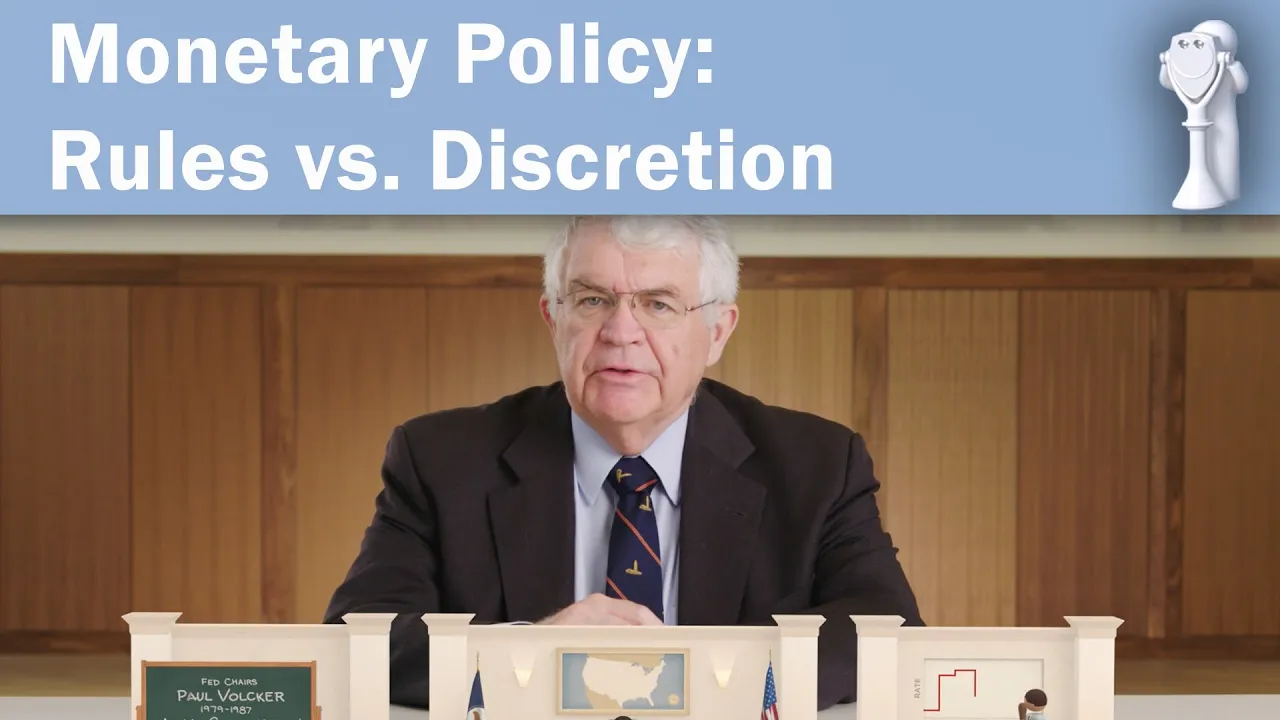
The debate between rules-based monetary policy (e.g., Friedman's k-percent rule) versus discretionary monetary policy.
The limitations of monetarism, including the breakdown of the velocity of money in the 1980s and 1990s.
Modern alternative macroeconomic schools of thought, such as New Classical Economics and Modern Monetary Theory (MMT).
The mechanics of modern unconventional monetary policies, like Quantitative Easing (QE), and how they differ from traditional monetarist recommendations.
203.2K views3Klikes6:27Original Release: 2017-11-14
♪ [music] ♪ - [Tyler] Monetarism is another framework for thinking about business cycles.
Nobel laureate Milton Friedman of the University of Chicago -- he was the most famous proponent of monetarism.
And, as the name suggests, monetarism emphasizes the importance of the money supply, and it emphasizes the decisions central banks make about what to do with the money supply.
Now monetarism is based on something called the quantity theory of money.
That means, in the long run, the absolute amount of money in an economy doesn't matter, doesn't influence real output or real employment.
But in the short run, changes in the rate of inflation can matter.
So there are two potential dangers in monetarism: too much inflation, and too little inflation.
Let's think first about too much inflation, because this is a big part of how monetarism became more popular.
In the 1970s, in America, rates of inflation were considered to be too high, and monetarism had a way to explain this.
It said the Federal Reserve was creating too much new money for the economy, and that means prices will be rising and inflation tends to distort the allocation of economic resources.
Individuals cannot tell which prices are going up because of the inflation, and which prices are going up because something is more or less valuable, and that what we should do is lower the rate of inflation and bring about more economic stability.
So at the time, a lot of Keynesian economists were accepting this higher rate of inflation.
But monetarism was saying that, yes, at first more inflation is going to get you higher economic output, but pretty quickly people figure out that there's inflation going on, and that inflation ceases to be effective in stimulating the economy.
On the other side of the ledger, there's the danger that monetary growth will be too low, and that means the rate of price inflation will be too low or there may be deflation altogether.
And in that setting, according to monetarism, aggregate demand will be too low.
In this case, monetarist and Keynesian doctrine -- they're actually pretty similar.
Monetarists, like Keynesians, believe that a lot of nominal wages are sticky -- that is they can't be readjusted or renegotiated all the time.
This may be a matter of contract, or a matter of law, minimum wages, or maybe just a matter of workplace morale.
But when you have sticky wages, and that flow of nominal purchasing power, that flow of money through an economy, when it declines, well, wages cannot just fall in tandem, and employers will lay off some workers, and you will get a business cycle downturn.
So for monetarists, there's a kind of Goldilocks rule.
It's desired that there be a constant rate of money supply growth.
Sometimes that's been given as about 2 to 3% -- not too high, not too low.
In general, monetarists believe in constraining the central bank through rules.
They don't trust the central bank to have a lot of discretion, and to turn on a dime and make a lot of very complicated, precise decisions.
Monetarists emphasize that lags are long and variable.
The information of policy makers can be unreliable, so they simply want the stable rule, which rules out the two cases of inflation too high and inflation too low.
So, so far, so good.
Monetarism has had a huge impact, and because of Milton Friedman and other monetarists, economists now look much, much more at money supplies and central bank policies.
But, that said, monetarism still has some important problems.
First, monetarism is quite an incomplete account of business cycles.
A lot of business cycles can be caused by, say, the bursting of bubbles, or problems in credit markets, or negative real shocks, or other factors.
And monetarism just doesn't have a lot to say about these cases.
Second, monetarism assumes that there's this notion of "the money supply" as a single, well-defined thing.
But, in fact, empirically there are many different money supply measures.
There are narrow measures, such as currency plus bank reserves held at the Fed.
Or you could add in demand deposits, savings deposits, different kind of credit relationships.
Which of those is the true real money supply?
Which of those should we stabilize?
It turns out those different measures of the money supply -- they don't always move together so closely.
And if we stabilize one of them, well, other measures of the money supply may not be that stable at all.
Finally, there's another problem with monetarism.
If the central bank really does fix a rate of growth for the money supply, this can make it harder to respond to other kinds of shocks.
What if there's a negative real shock, such as an oil price hike?
Some economists think the central bank should then be more expansionary.
What if interest rates turn volatile?
Maybe then, again, the central bank should expand credit a bit more.
There may be a shock to velocity.
The rate at which that money turns over in the economy may change.
And, at least under simple forms of monetarism, again, the central bank cannot easily adjust for that.
It's the case, in fact -- there's now an offshoot doctrine of monetarism, sometimes called market monetarism or nominal GDP targeting, that says, yes, we start with monetarism, but we actually want to allow the central bank the ability to respond to those changes in velocity.
Now monetarists, who generally do not trust in discretion, are willing to put up with these shocks, but in the real world there's a big debate -- many people believe the central bank actually should go beyond the confines of this very limited rule and try to offset some of these other kinds of shocks hitting an economy.
So, in sum, monetarism is really important, but still it is considered a somewhat incomplete doctrine of business cycles.
- [Narrator] You're on your way to mastering economics.
Make sure this video sticks by taking a few practice questions.
Or, if you're ready for more macroeconomics, click for the next video.
Still here?
Check out Marginal Revolution University's other popular videos.
♪ [music] ♪
Up Next

9:53
The Phillips Curve Explained: Inflation vs Unemployment in Economics
@economicsunderstood
97.2K views•2021-05-16

5:07
Impact of Yuan in Indo-Russian Trade Amid Sanctions
@WION
261.9K views•2022-07-01
12:31
Subsidies Explained: Incidence, Elasticity & Deadweight Loss
@MarginalRevolutionUniversity
325.4K views•2015-01-28

113:18
The Age of Easy Money: Fed & Inflation | Full Documentary
@frontline
21.2M views•2023-03-15
Related Study Plans & Knowledge Roadmaps
Structured learning paths in Economics
economics
Sovereign Debt: Defaults, IMF & Restructuring
01Introduction to Sovereign Debt & Government Bonds
02Debt Sustainability & Credit Ratings
03Anatomy and History of Debt Crises
+ 2 more learning modules
12h5 modules
Explore Roadmap
economics
Market Design: Matching Theory & Gale-Shapley
01Introduction to Market Design and Price-Free Markets
02Two-Sided Matching & The Gale-Shapley Algorithm
03School Choice Systems and Mechanism Design
+ 2 more learning modules
10h5 modules
Explore Roadmap
economics
Impossible Trinity: Forex, Capital & Policy
01Introduction to Monetary Policy and Central Banking
02Exchange Rates and International Capital Flows
03The Mundell-Fleming Model
+ 2 more learning modules
8h5 modules
Explore Roadmap
economics
Healthcare Economics: Market Failures & Systems
01Introduction to Healthcare Markets and Market Failure
02Asymmetric Information and Adverse Selection
03Moral Hazard and Insurance Design
+ 2 more learning modules
12h5 modules
Explore Roadmap