
![BIOLOGÍA - Célula procariota [ZOOM]](https://i.ytimg.com/vi/QyGKHDInYJg/maxresdefault.jpg)















![L- 8 FSO || FOOD MICROBIOLOGY [ A FACTOR WHICH AFFECT MICRO ORGANISM GROWTH ] #FSO #RPSC](https://i.ytimg.com/vi/qj3Y3skiZG4/maxresdefault.jpg)



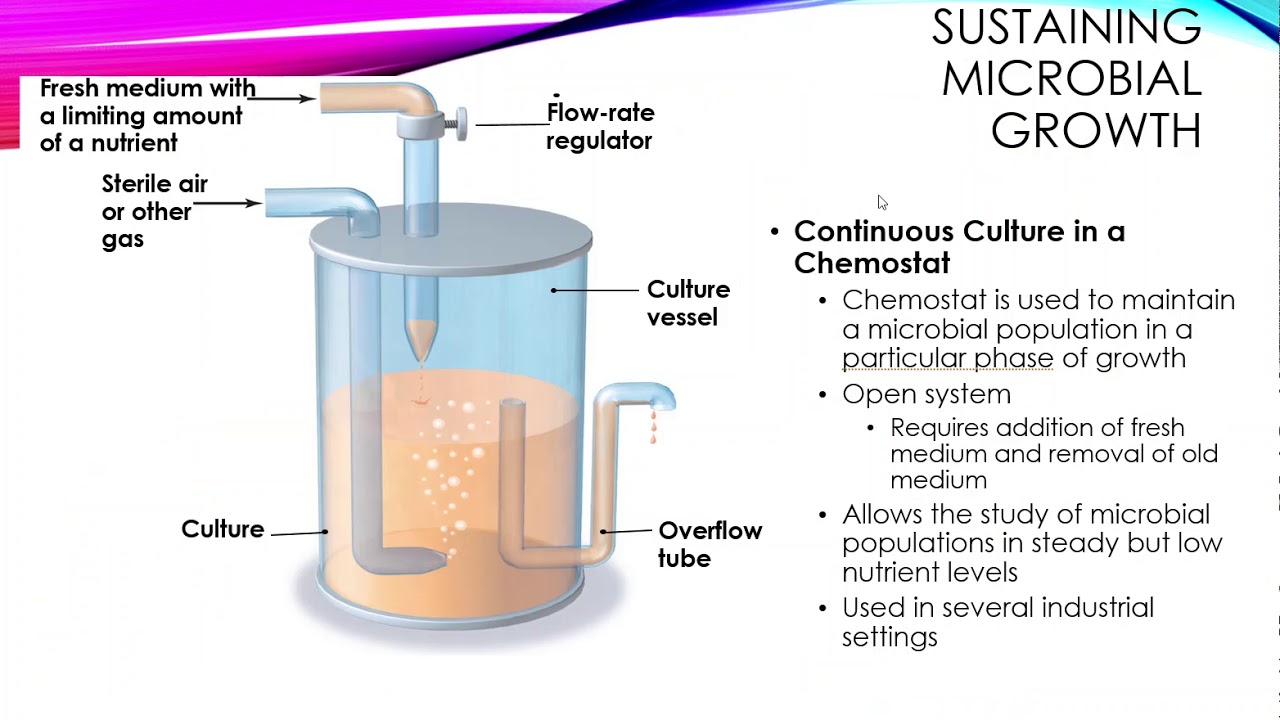



Bacterial growth follows a characteristic four-phase growth curve: (1) Lag phase - adaptation period where bacteria synthesize necessary enzymes and ribosomes without cell division; (2) Log/exponential phase - rapid geometric growth where cells double at regular intervals (generation time varies from 20 minutes for E. coli to 24 days for Mycobacterium leprae); (3) Stationary phase - equilibrium between cell division and death due to nutrient depletion and toxic waste accumulation, where secondary metabolites like antibiotics are produced; (4) Death/decline phase - population decline as cell death exceeds division. Understanding these phases is essential for optimizing industrial applications such as biodegradation, antibiotic production, and waste treatment.
Microbial Growth Explained: Bacterial Growth Curve, Phases & Kinetics
Added:hi everyone now we are going to discuss a topic called microbial growth the study about the microbial growth is most important for understanding the microbial physiology in this part we majorly discuss about bacterial growth firstly what is it rose and how do we define a growth growth can be defined as an orderly increase of all chemical compounds in a cell or population yes growth can be defined as an orderly increase of all clinical compounds in a cell or population in multicellular organisms and increase in the size of an individual is the indication of growth isn't it so if any plant or animal is growing in size we will tell that they are having the growth whereas for unicellular organisms like bacteria it leads to an increase in the number of individuals that is increase in the number of the cells is going to break forth as a growth so that's how the bacterial growth can be defined as an orderly increase in the cell size as well as increase in the number of cells as we increase in the cell size we can't see with our naked eyes but obviously we are going to pay more attention on the increase in the number of cells that is bacteria or micro organisms growth is an essential component of microbial functions because any microbial cell has only a finite lifespan that is a limited lifespan bacteria mainly divide by binary fission when it is going to have a binary fission when a bacterial cell reaches such an size it obviously divides to form the total cells so here is a1 bacterial cell when it attains a maximum size it is getting into divided into two and this is going to be called as binary fission one cell giving rise to two and these individual cells again giving rise to two that means all together forces and these four cells again giving rise to two to two so we're it it's becoming them how many four plus four eight cents so that's how one self first two and two becomes a four who becomes H so this is going to be called as a binary fission where one cell is equally getting divided into two cells now coming to generation time what is a generation term the time required for the cell to divide the time required for the cell to divide or the time required for the population to divide is called as a generation time so that means this cell is going to give rise to the two and this time is going to be called as generation time what is it the time required for the cell to divide or the time required for the population to divide is called as generation child okay now this generation time is going to be deferred from in different type of microorganism for example chicky collides it takes only 20 minutes of the time of forgetting one cell into two but Michael backs in tuberculosis is take off about 20 hours of time to get into the next generation and the Mycobacterium leprae is going to take about 24 days to have this generation time so that's how it is different from microorganisms which are not having the same generation time and this generation time is also going to depend upon the factors such as the nutritional requirements physical conditions like temperature etcetera okay under optimal conditions this generation time determines the rate of growth of microbial cultures so that so there is a link between this generation time and that's bacterial growth so now we will discuss about this bacterial growth in detail in the form of it growth cup so this the phases of a battery in growth curve or the growth curve simply so because of the bacterial small size it is not convenient to study the growth and reproduction of the bacteria by taking an individual cell is interested so if you take an individual cell is very difficult to study about its growth reproduction all the things so what we should do for those Chinese bacteria usually cultivated in a liquid medium where its growth leads to an increase in the number of bacterial cells that's why the definition of the bacterial growth is going to be define as the increase in the number of the cells which follows a definite course or pattern when that bacterial count of such culture is determined periodically and plotted in graph or a curve on the graph paper you are going to get a curve and that curve is going to be defined as growth curve and this growth curve is going to possess mainly four phases what are those four phases like phase lock this stationary phase depth or decline phase so here just remember there will be a little bit confusion for many of the students as I came to notice that lag and LOC they'll always get confused and write the log as a first and lag is a second so don't get confused in the alphabets a is the first letter when compared to O so obviously in your this phase is also lag phase is the first phase and log phase is the second phase which is also called as exponential or logarithmic phase so we will come in gjl are discussing about all these phases one by one now so the first phase is obviously the lag phase so here when I bacteria are introduced or incubated into a fresh medium increase in cell number with not occur immediately that means no number increase will occur in the first phase so what happens in this phase so here what is happening is the battery is trying to adjust to the new environment and also tries to synthesize a new component such as cofactors enzymes ribosomes which are required for its cell growth and cell division in the coming phases though no cell division is occurring during this phase the cell reminds physiologically active that means it won't be in a dormant phase like without doing anything is it next the length of the lag phase depends upon the type of the battery of species that means how much time it how to try to adjust miss depends upon the battery spacious size inoculum then quality of culture medium and we're on mental factors such as temperature carbon tax and all these things okay now the average time taken by the slag phase will be one to four hours or sometimes two hours approximately but even it may take off from one hour to several hours so this is how the lag phase is completely just trying to add up to the head of the bacterial cells to the growth conditions that they are having okay then coming to the second phase that is a log phase up till now we have discussed about the lag phase which is a smooth linear line parallel to the time that means an x axis is going to have the time and the y axis is going to have the number of bacteria so if there is no increase in this line means it is going to be a parallel so as a time is going on there is no increase in the number so that's where it's a smooth linear length and then come into the second phase that is log phase so here you can see so this log phase is also called as logarithmic or exponential phase here the number of cells increase in geometric progression that means the 2 becomes 4 4 becomes a a tail becomes 16 so like this there will be rate at which they are going to increase after every generation the cell number multiplies and becomes double so this doubling of cells occurs at regular intervals they are not going to do as they wish they are going to occur at regular intervals with a constant growth rate so that's why we are having it's nice slope of the line in the figure ok so during this phase the growth occurs its maximum possible all right by utilizing all the nutrients that are present in the available environment cells always more obviously because they are undergoing the constant dividing so obviously they will be small in size and the time taken for this lag phase will be of 8 of us okay and the actual rate of the growth or the slope of the line in the figure depends upon the growth conditions the nutrients are present if the environment conditions are not making them to divide so obviously there will be lessen exponential that is this log phase the phase cannot continue indefinitely that means going on like this it will not occur why because the medium is soon depleted of nutrients and enriched with waste that means they're there when strongly or accumulation of toxic products so because of all these things that log phase cannot continue indefinitely so obviously they are going to again affair smoothly in your line which is going to be called as a stationary phase but here in the stationary phase what is happening let's see after some time the bacterial growth ceases almost completely due to the depleting of nutrients or accumulation of toxic products there is a balance between the cell division and the center so here only cell division except one but in the stationary phase with having the balance between the new cell arises and all cells death so that's how there is a balance and we are having a smooth horizontal linear line or a curve so there is no net increase or decrease in the cell number obvious how many are arising the same number is going to that the duration may be from few hours to a few days and many back to species produce secondary metabolites in this place so that means the toxins antibiotics so all these things are going to be produced in this change not a face not only that mutations can also occur in the stationary phase only and some spore-forming bacteria produces the and the spores also okay and here if this type of the cultures are going to be stained at the stationary phase they won't strain properly that means the bacterial strain irregularly where you cannot justify the straining result and during the stationary phase as a child you are going to have a very smooth horizontal linear part of the curve and this stage of growth is also being called as cryptic growth what we call it as cryptic growth so is all about the third phase called a stationary phase so we have seen the lag phase the initial adaptation stage then the slab phase dividing phase and the third one stationary phase yes here also cell division occurs by the same time cell death also occurs because of accumulation of the secondary metabolites that is the toxins are the wastage all the things okay and then I tend us into the next phase that is going to be called as death phase which is also called as decline growth so this is a phase of growth curve in which the number of viable cells decreases or decline if the incubation is continued after stationary so this is our stationary still you are going to leave what is happening to study about them the cells will enter into the next phase call as death or decline the population reaches death phase due to the death of the cells and this phase occurs due to depletion of nutrients or exhaustion of nutrients and also accumulation of toxins during this phase a constant proportion of cell dies at regular intervals so that's why you're going to have a graph like this okay but it is going to be in the opposite direction so the various stages of the growth curve are associated with both a morphological and physiological changes of cells so this is how you're going to have your growth curve and let's have a quick review all the four phases once again so on the x axis we are going to have the chyme chicken in others and the number of the bacteria will be on the y axis so the first phase is the lag phase where it is trying to adapt themselves to the growth conditions that is the lag phase and here in the second phase is the exponential or log phase or log Adamic phase where you are going to have a continuous growth of the number of the cells and sometimes theoretically it is going to be indefinite but practically it is not going to be and then coming the stationary phase where the cell death and the cell division both are going to have the equal number so we are having a smooth linear horizontal line and then coming to the death phase where today faster than they multiply and is a negative log of your exponential phase and this also occurs at a regular intervals so this is all about the bacterial growth and what is the importance of or significance of bacterial growth curve Y all our reading about this bacterial growth so the study of actual growth curves is important when aiming to utilize or inoculate no number of bacteria isolate for example if you want to enhance plant growth by increasing the biodegradation of toxic organs or production of antibiotics or neutral products so obviously you're supposed to know how many bacteria are able to produce how much of the quantity of concent organic compounds so as that the battery will studies is very important then a second one bacterial growth kinetics and bacterial numbers in a culture medium is also having a very prominent role both in the research field as well as in the commercial point of view now the growth kinetics is also useful for assessing whether the particular strain of bacteria or adapted to multiply certain substrates such as industrial waste or early pollution this is a major thing enough productions is it and not only that in the bio regulation process also then the slope and the shape of the growth curves produced from back to your grown with mixture of industrial waste products can inform scientists whether the bacteria can metabolize a particular suppose if you are taking so many compounds and you want to test whether the bacteria is able to grow or not then you can compare the battery growth of all this the same match here with a different ways so which is going to give the maximum growth curve then you can find whether it is how much potential energy source it is using to grow so that's how you can find the best industrial waste how the battery is going to digest so that's how these are all significances of bacterial growth studies okay so this is all with this we are going to finish the backswing the growth curve okay I hope so you understood where it's also a very important topic for the first year of BS in microbiology thank you
Up Next
Transcription and Translation: Animation for Biology Students
@DailyMedEd
427K views•2016-04-03

Bacterial Communication: Quorum Sensing and Biofilm Formation Explained
@JHUAAP
12.6K views•2011-06-28

Enteric Nervous System Explained: The Gut's Brain | Neurobiology Lecture
@alumniu6029
438 views•2018-09-12

Bacteriophages: Earth's Deadliest Killers and Future Antibiotics
@kurzgesagt
34.6M views•2018-05-13
Related Study Plans & Knowledge Roadmaps
Structured learning paths in Biology