![양자역학의 세계 1부 / 양형진[BBS화요열린강좌]](https://i.ytimg.com/vi_webp/KChafKMkKRA/maxresdefault.webp)




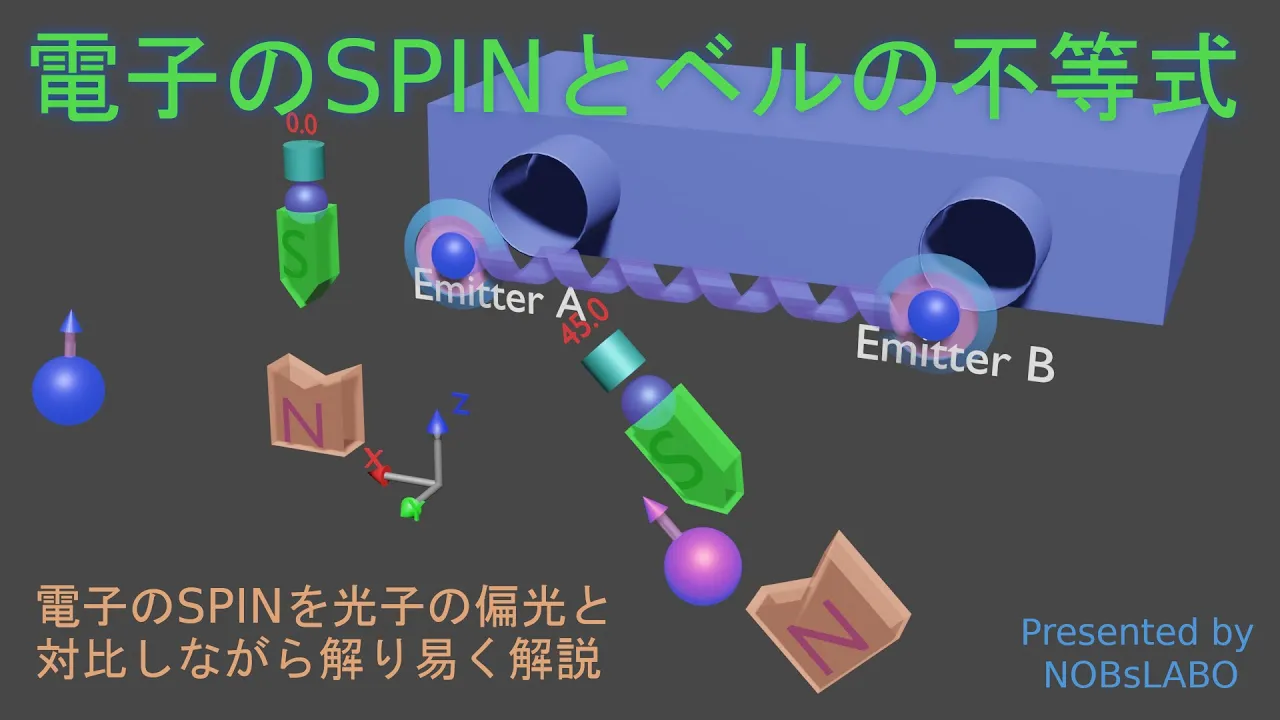













Quantum entanglement creates pairs of particles whose spins are correlated such that measuring one instantly determines the other's state, regardless of distance, but this phenomenon does not allow faster-than-light communication because measurement outcomes remain fundamentally random; John Bell's inequality experiments rigorously tested whether particles contain hidden information about their spins, and the results showing only 50% correlation (rather than the 5/9 predicted by hidden variable theories) confirmed that quantum mechanics correctly describes reality without local hidden variables.
Quantum Entanglement Explained: Spooky Action at a Distance
Added:The concept of quantum superposition, where a system exists in multiple states simultaneously until it is measured.
The probabilistic nature of quantum mechanics and the role of measurement (wavefunction collapse).
Basic understanding of quantum properties like spin or photon polarization, which are commonly used to demonstrate entanglement.
The classical physics assumption of local realism, which posits that objects have definite properties independent of measurement and that information cannot travel faster than light.
The 'No-Communication Theorem' and 'No-Cloning Theorem', which mathematically explain why entanglement cannot be used to transmit classical information faster than light.
Quantum Cryptography and Quantum Key Distribution (QKD), specifically entanglement-based protocols like the Ekert91 (E91) protocol.
The principles of Quantum Teleportation, which utilizes entangled pairs to transfer quantum information from one location to another.
How quantum entanglement is utilized as a resource in Quantum Computing to perform complex computations through entangled qubits.
4.5M views96Klikes9:15Original Release: 2015-01-12
in the 1930s Albert Einstein was upset with quantum mechanics he proposed the thought experiment where according to the theory an event at one point in the universe could instantaneously affect another event arbitrarily far away he called this spooky action at a distance because he thought it was absurd it seemed to imply faster-than-light communication something his theory of relativity ruled out but nowadays we can do this experiment and what we find is indeed spooky but in order to understand it we must first understand spin all fundamental particles have a property called spin no they're not actually spinning but the analogy is appropriate they have angular momentum and they have an orientation in space now we can measure the spin of a particle but we have to choose the direction in which to measure it and this measurement can have only one of two outcomes either the particle spin is aligned with the direction of measurement which we'll call spin up or it is opposite the measurement which we'll call spin down now what happens if the particles spin is vertical but we measure it spin horizontally well then it has a 50% chance of being spin up and a 50% chance of being spin down and after the measurement the particle maintains this spin so measuring it spin actually changes the spin of the particle what if we measure spin at an angle 60 degrees from the vertical well now since the spin of the particle is more aligned to this measurement it will be spin up three-quarters of the time and spin down 1/4 of the time the probability depends on the square of the cosine of half the angle now an experiment like the one I'm Stein proposed can be performed using two of these particles but they must be prepared in a particular way for example formed spontaneously out of energy now since the total angular momentum of the universe must stay constant you know that if one particle is measured to have spin up the other measured in the same direction must have spin down I should point out it's only if the two particles are measured in the same direction that their spins must be opposite now here's where things start to get a little weird you might imagine that each particle is created with a definite well-defined spin but that won't work and here's why imagine their spins were vertical and opposite now if they're both measured in the horizontal direction each one has a 50/50 chance of being spin up so there's actually a 50% chance that both measurements will yield the same spin outcome and this would violate the law of conservation of angular momentum according to quantum mechanics these particles don't have a well-defined spin at all they are entangled which means their spin is simply opposite that of the other particle so when one particle is measured and it's been determined you immediately know what the same measurement of the other particle will be this has been rigorously and repeatedly tested experimentally it doesn't matter at which angle the detectors are set or how far apart they are they always measure opposite spins now just stop for a minute and think about how crazy this is both particles have undefined spins and then you measure one and immediately you know the spin of the other particle which could be light-years away it's as though the choice of the first measurement has influenced the result of the second faster than the speed of light which is indeed how some theorists interpret the result but not Einstein Einstein was really bothered by this he preferred an alternate explanation that all along the particles contained hidden information about which spin they would have if measured in any direction it's just that we didn't know this information until we measured them now since that information was within the particles from the moment they formed at the same point in space no signal would ever have to travel between the two particles faster than light now for a time scientists accepted this view that there were just some things about the particles we couldn't know before we measured them but then Along Came John Bell with a way to test this idea this experiment can determine whether the particles contain hidden information all along or not and this is how it works there are two spin detectors each capable of measuring spin in one of three directions these measurement directions will be selected randomly and independent of each other now pairs of entangled particles will be sent to the two detectors and we record whether the measured spins are the same both up or both down or different we'll repeat this procedure over and over randomly varying those measurement directions to find the percentage of the time the two detectors give different results and this is the key because that percentage depends on whether the particles contain hidden information all along or if they don't now to see why this is the case let's calculate the expected frequency of different readings if the particles do contain hidden information now you can think of this hidden information like a secret plan the particles agreed to and the only criterion that plan must satisfy is that if the particles are ever measured in the same direction they must give opposite spins so for example one plan could be that one particle will give spin up for every measurement direction and it's pair would give spin down for every measurement direction or another plan plan two could be that one particle could give spin up for the first Direction spin down for the second direction and spin up for the third direction whereas its partner would give spin down for the first direction spin up for the second direction and spin down for the third direction all other plans are mathematically equivalent so we can work out the expected frequency of different results using these two plans here I'm visually representing the particles by their plans their hidden information with plan one the results will obviously be different a hundred percent of the time it doesn't matter which measurement directions are selected but it does for particles using the second plan for example if both detectors measure in the first direction particle a gives spin up while particle B gives spin down the results are different but if instead detector be measured in the second direction the result would be spin up so the spins are the same we can continue doing this for all the possible measurement combinations and what we find is the results are different five out of nine so using the second plan the results should be different five ninths of the time and using the first plan the results should be different a hundred percent of the time so overall if the particles contain hidden information you should see different results more than five ninths of the time so what do we actually see an experiment well the results are different only 50% of the time it doesn't work so the experiment rules out the idea that all along these particles contain hidden information about which spin they will give in the different directions so how does quantum mechanics account for this result well let's imagine detector a measure spin in the first direction and the result is spin up now immediately you know that the other particle is spin down if measured in the first direction which would happen randomly one-third of the time however if particle B is measured in one of the other two directions it makes an angle of 60 degrees with these measurement directions and recall from the beginning of this video the resulting measurement should be spin up three quarters of the time since these measurement directions will be randomly selected two-thirds of the time particle B will give spin up 2/3 times 3/4 equals half of the time so both detectors should give the same results half of the time and different results half of the time which is exactly what we see in the experiment so quantum mechanics works but there is debate over how to interpret these results some physicists see them as evidence that there is no hidden information in quantum particles and it only makes sense to talk about spins once they've been measured whereas other physicists believe that entangled particles can signal each other faster than light to update their hidden information when one is measured so does this mean that we can use entangled particles to communicate faster than light well everyone agrees that we can't and that is because the results that you find it either detector are random it doesn't matter which measurement direction you select or what's happening at the other detector there's a 50-50 probability of obtaining spin-up or spin-down only if these observers later met up and compared notebooks would they realize that when they selected the same direction they always got opposite spins both sets of data would be random just the opposite random from the other observer that is indeed spooky but it doesn't allow for the communication the sending of information from one point to another faster than light so it doesn't violate the theory of relativity and that at the very least would make Einstein happy [Music]
Up Next
11:19
Quantum Bell Test: How Stars Validate Entanglement
@physicsgirl
392.7K views•2017-05-11

12:53
21cm Hyperfine Transition in Neutral Hydrogen: Radio Astronomy Basics
@AaronRobertParsons
12.4K views•2011-10-13

6:32
Schlieren Imaging: How to See Air Currents and Temperature Gradients
@veritasium
1.6M views•2017-06-15

27:14
Entropy and the Second Law of Thermodynamics Explained
@veritasium
27.5M views•2023-07-01
Related Study Plans & Knowledge Roadmaps
Structured learning paths in Physics
physics
Nuclear Physics (Decay, Fission & Reactors)
01Atomic Structure and the Binding Force
02Radioactive Decay and Half-Life
03Nuclear Fission Mechanics and Chain Reactions
+ 2 more learning modules
12h5 modules
Explore Roadmap
physics
Soft Matter (Polymers, Colloids & Rheology)
01Foundations of Soft Matter & Thermal Forces
02Polymer Physics and Macromolecules
03Colloids, Surfactants, and Self-Assembly
+ 2 more learning modules
38h5 modules
Explore Roadmap
physics
Analytical Mechanics: Lagrangian & Hamiltonian
01Mathematical Foundations: Calculus of Variations
02From Newtonian Mechanics to Constraint Dynamics
03The Principle of Least Action & Lagrangian Mechanics
+ 3 more learning modules
28h6 modules
Explore Roadmap
physics
General Relativity (Spacetime & Cosmology)
01Foundations of Relativity: Special Relativity
02The Geometry of Spacetime: Equivalence Principle & Curvature
03Einstein's Field Equations: The Mathematics of Gravity
+ 2 more learning modules
55h5 modules
Explore Roadmap