Tort Law is a branch of civil law that protects individuals from harm caused by others' negligent or intentional actions, providing victims with compensation for economic losses, emotional distress, and pain and suffering; torts are classified into intentional torts (like battery), unintentional torts (like negligence in slip-and-fall cases), and strict liability torts, with available remedies including monetary damages, injunctions for ongoing harms, and punitive damages to punish particularly offensive conduct.
Tort Law Explained: Types, Negligence, and Remedies
Added:Deep Dive
The fundamental distinction between civil law (disputes between private parties) and criminal law (offenses against society).

Difference between Civil Law & Criminal Law
3.3K
Civil law deals with disputes between individuals or between individuals and organizations (such as companies), typically involving breach of contract, and provides remedies like monetary compensation, specific performance, or injunction; criminal law addresses offenses against society or the state, involving procedures like FIR filing and investigation, and results in punishment such as imprisonment, fines, or death penalty. The key distinction lies in the parties involved (individuals vs. state), the nature of the dispute (private disputes vs. societal harm), and the purpose (sustaining individual rights vs. maintaining law and order).
Click to watch →

BNSS 01 Explained | BNSS Basics | New Criminal Procedure Law by Sachin Sir \ KRISHNA IAS
173
Civil law deals with civil problems and disputes between private parties, while criminal law deals with crimes and offenses against the public or society. The key distinction lies in the nature of the wrong: civil wrongs involve disputes between individuals, whereas criminal wrongs involve violations of public order and societal norms.
Click to watch →
Concept of Civil Law vs Criminal Law | Explained by Adv.Hrishikesh Deshpande Right Direction Academy
166
Civil law deals with disputes between private parties (individuals or companies) where both parties may have valid positions, such as property disputes, divorce, or child custody cases, governed by the Civil Procedure Code (CPC) with the purpose of settling disputes and enforcing rights. Criminal law addresses offenses against society where one party is always at fault, such as robbery, theft, or extortion, governed by the Criminal Procedure Code (CrPC) with the purpose of punishing wrongdoers and creating deterrence. The key differences include: parties involved (private parties vs. government), procedural codes (CPC vs. CrPC), terminology (plaintiff/defendant vs. petitioner/accused), and remedies (compensation/injunctions vs. fines/imprisonment).
Click to watch →

criminal law | Introduction lecture | Ustad online | Professional law college | LLB 3 and 5 year
701
Civil law deals with private rights and disputes between individuals, while criminal law deals with public rights and offenses against society. In civil law, the infringement is private and the parties involved are private individuals, with outcomes typically involving compensation or damages. In criminal law, the infringement is public and the state prosecutes the offender, with outcomes involving punishment such as imprisonment or fines. The procedures and outcomes differ significantly between the two branches, with civil law following the Civil Procedure Code and criminal law following the Criminal Procedure Code.
Click to watch →
Civil Law and Criminal Law| Difference between Civil Law and Criminal Law| Philosophy of Law|
2.3K
Civil law deals with private disputes between individuals or entities, focusing on resolving conflicts and providing compensation or remedies (such as damages or restitution) to the aggrieved party, while criminal law addresses offenses against society, prescribing punishments (such as imprisonment, fines, or community service) to maintain public order and protect society. The key differences include: (1) Nature - civil law handles private disputes, criminal law handles offenses against society; (2) Parties involved - civil cases involve plaintiff and defendant, criminal cases involve the state (prosecutor) and accused; (3) Burden of proof - civil cases use 'preponderance of evidence' while criminal cases require 'beyond reasonable doubt'; (4) Consequences - civil cases result in compensation or restitution, criminal cases result in punishment; (5) State involvement - minimal in civil cases, central in criminal cases.
Click to watch →
Deep Dive
Basic legal terminology, particularly the definitions and roles of the 'plaintiff' and 'defendant' in a lawsuit.

"Сторони" лектор к.ю.н., доцент Валерій Мамницький
1.2K
The plaintiff is a person who has filed a claim with the court seeking judicial protection of their rights, freedoms, or legal interests that they believe have been violated, contested, or unrecognized. The key legal fact is the opening of proceedings, which grants the claimant the procedural status of plaintiff with a full complex of rights and obligations. The defendant is a subject of procedural activity who, in the opinion of the plaintiff, has violated, contested, or unrecognized the plaintiff's rights or legal interests protected by law, subject to the opening of proceedings based on the claim. Like the plaintiff, the defendant acquires a complex of rights and obligations upon the opening of proceedings. The plaintiff and defendant are the main participants in procedural activity, classified as participants in the proceedings according to Article 2 of the Civil Procedure Code. They can be considered the 'masters of the process' because the process is conducted in their name and for their interests.
Click to watch →

CA Foundation Law Lecture 2 For Sep 25 / Jan 26 Attempt By CA Ankita Patni
20.1K
A plaintiff is a person who brings a case against another person in court. A defendant is a person against whom a case has been filed. The plaintiff is the one who is aggrieved and seeks legal remedy, while the defendant is the one being accused or sued.
Click to watch →

Day 2 CS Executive Group 1 Daksh Batch for Dec 2026 Exam | Vidhyoday
100
The 'plaintiff' is the person who files the plaint (civil suit). The 'defendant' is the person against whom the plaint is filed and who needs to defend themselves. In a case where A files a suit against B, A is the plaintiff and B is the defendant.
Click to watch →

B.A.LL.b|ENGLISH|2nd Semester| SECTION-A|#law #ballb #llb_entrance_exam #gurujiclasses
9.1K
In a legal suit, the 'Plaintiff' is the first party who initiates the legal action by filing the suit. The 'Defendant' is the second party against whom the suit is filed. The plaintiff seeks legal remedy or compensation for some wrong or injury suffered, while the defendant is the party being sued.
Click to watch →

UP TGT 2026 | UP TGT English Marathon 2026 | Complete UP TGT English Revision By Deepak
2K
The instructor explains that 'plaintiff' refers to the person who brings a legal action or complaint. The instructor contrasts 'plaintiff' with 'defendant' who is the person being accused. The instructor notes that 'defendant' is also called 'accused' before proof is established.
Click to watch →
Deep Dive
The conceptual definition of a 'civil wrong' and how it differs from a breach of contract.

M-1のネタ全組リーガルチェックしてみた
233.6K
When a contract is formed between parties, violating that contract constitutes a civil wrong known as 'breach of contract' (債務不履行 - tsumotsu fukyō). The presenter explains that even if a verbal agreement is made, once the contract is established, breaking it becomes a legally actionable offense. This principle applies regardless of whether the breach is intentional or negligent, and it creates civil liability for the breaching party.
Click to watch →

Law of Torts | Complete Legal Reasoning in One shot for CLAT 2025 | Legal Reasoning for clat 2025
27.7K
A tort is a civil wrong where the remedy is unliquidated damages (compensation determined by court based on actual harm), unlike liquidated damages predetermined in contracts. Tort differs from contract law because contract breaches have predetermined remedies while tort damages are always unliquidated. Tort is also distinct from other civil wrongs like contract breaches. The key distinction is that tort cases involve unliquidated damages determined by courts based on actual harm suffered, not pre-agreed amounts.
Click to watch →

Law of Torts | Jurisprudence | JIGL | CS Executive | LLB | Judiciary exam
318
Breach of contract is a civil wrong but not a tort. When a wrong arises out of a contract, the remedy lies under contract law, not tort law. Only a person who procures a breach of contract can incur tort liability for inducement. The inducing party may be liable for tort, while the breaching party incurs contractual liability. This distinction is crucial for determining the appropriate legal remedy.
Click to watch →

CSEET NOV 24 || LEGAL APTITUDE || MAHA MARATHON || CS SHUBHAM MODI
41.5K
A critical distinction in tort law is that a tort is NOT a breach of contract. While both involve legal wrongs, they are fundamentally different. A breach of contract occurs when parties fail to fulfill their agreed-upon obligations (e.g., not selling a phone as promised). A tort involves a civil wrong that causes harm to another person, regardless of any contractual relationship. The instructor emphasizes this distinction repeatedly as it is a common point of confusion.
Click to watch →

Tort v/s Breach of Contract@laweasyclasses #law #legalknowlege #lawoftort
14.1K
Tort is a wrongful act or omission that causes harm to another person, resulting in legal liability for compensation, while breach of contract occurs when a party fails to fulfill their agreed obligations under a contract, which is a legally binding agreement between parties. The key difference lies in the nature of the obligation: tort involves a duty imposed by law to prevent harm to others, whereas contract involves voluntary obligations created by mutual agreement between specific parties.
Click to watch →
Deep Dive
An understanding of how legal systems resolve disputes and the general process of filing a civil lawsuit.

BIANCALOVESMAKEUP91 & ROSALI DELGADO SUED BY CORINA GARCIA FOR $100,000
33.2K
This segment explains the civil lawsuit process, including how lawsuits are filed, the importance of jurisdiction (where the case is filed determines which state's laws apply), and how civil cases are classified by the amount being sued for. In California, cases exceeding $25,000 are unlimited civil cases, while those below are limited. The video emphasizes that legal documents must be properly written to be understood by lawyers and judges, and that poorly written documents may be thrown out of court.
Click to watch →
A Civil Lawsuit Explained in Steps | The Civil Litigation Process
191.1K
A civil lawsuit is a legal proceeding based on non-criminal statutes, following four main steps: pleadings (where the plaintiff files a complaint and the defendant responds with an answer), discovery (where both parties exchange evidence through documents, depositions, and interrogatories), trial (where both sides present their case with opening statements, evidence, witness testimony, and closing arguments before a judge or jury), and appeal (where a party can challenge the verdict in an appellate court that reviews for legal errors).
Click to watch →
![[고태환 강사] 법무2차 민사소송법의 기초를 차근차근 단단히 다질 수 있는 기회!](https://i.ytimg.com/vi_webp/Ywg7QcIwCF0/maxresdefault.webp)
[고태환 강사] 법무2차 민사소송법의 기초를 차근차근 단단히 다질 수 있는 기회!
9.3K
Civil litigation is the process by which individuals resolve disputes through the court system. The course covers the entire civil litigation process, from understanding the distinction between substantive law (which determines rights) and procedural law (which determines how rights are enforced), to the practical steps of filing a lawsuit, presenting arguments, and obtaining a judgment. The goal is to provide students with a comprehensive understanding of how civil disputes are resolved in practice.
Click to watch →

🔴 Antonio David EJECUTA su macro demanda por la docuserie de Rocío Carrasco: LOS DETALLES
48.3K
The video outlines the formal process for filing a civil lawsuit: (1) The plaintiff must specify who they are suing and the amount being claimed; (2) The document must include the facts and legal grounds for the claim; (3) The court admits the case and schedules a preliminary hearing; (4) At the preliminary hearing, the judge determines if the case should proceed and sets the date for the actual trial.
Click to watch →
CPC Demo Class 1 | Shubham Upadhyay | Judiciary Exams | Judiciary world
19.1K
Civil disputes are resolved through civil means without violence, physical harm, or punishment - they are settled through peaceful negotiation and legal processes. A civil suit encompasses everything from the filing of the plaint to the pronouncement of the court's judgment. A plaint is a formal complaint filed in the court of a civil judge, containing the plaintiff's claims, facts, and relief sought. The civil judge summons the defendant, who responds through a written statement addressing each claim. Before the main trial, preliminary issues including jurisdiction and venue must be decided. After preliminary issues are resolved, the trial procedure begins, including examination of parties, production of evidence, examination of witnesses, and submission of documents. During the trial, parties may reach a settlement through alternative dispute resolution mechanisms such as arbitration or conciliation.
Click to watch →
Prerequisite Knowledge
- Concept 01The fundamental distinction between civil law (disputes between private parties) and criminal law (offenses against society).
- Concept 02Basic legal terminology, particularly the definitions and roles of the 'plaintiff' and 'defendant' in a lawsuit.
- Concept 03The conceptual definition of a 'civil wrong' and how it differs from a breach of contract.
- Concept 04An understanding of how legal systems resolve disputes and the general process of filing a civil lawsuit.
Subsequent Learning
- Step 01The doctrines of affirmative defenses in negligence, such as contributory negligence, comparative negligence, and assumption of risk.
- Step 02Advanced tort concepts, including strict liability, product liability, and vicarious liability (respondeat superior).
- Step 03Analysis of dignity and economic torts, such as defamation, invasion of privacy, and tortious interference with contractual relations.
- Step 04Deep-dive analysis of landmark tort cases (e.g., Palsgraf v. Long Island Railroad Co. or Donoghue v. Stevenson) to understand 'proximate cause' and 'duty of care'.
- Step 05The study of tort reform, insurance systems, and how damages are practically calculated and distributed in modern litigation.
Tort Basics
Remedies
Tort Basics
0:00Playing Section
- 1
Defines tort law and its purpose of compensation and deterrence.
- 2
Lists common examples like negligence, assault, and product liability.
- 3
Explains negligence requires duty, breach, and causation of injury.
No-Fault Accident Compensation Systems
While traditional tort law relies on proving fault (negligence) to award damages, critics argue this adversarial system is inefficient, costly, and inequitable, often leaving victims uncompensated due to legal barriers. The 'No-Fault' model—exemplified by New Zealand’s Accident Compensation Corporation (ACC)—replaces personal injury lawsuits entirely. Under this system, injured individuals receive comprehensive state-funded medical and financial support regardless of blame. This alternative perspective argues that society is better served by prioritizing swift rehabilitation and universal coverage over the costly and unpredictable process of assigning individual liability through tort litigation.
Deep Dive
The doctrines of affirmative defenses in negligence, such as contributory negligence, comparative negligence, and assumption of risk.

Torts II Review Comparative Negligence and Assumption of Risk
250
In tort law, pure comparative negligence allows a contributorily negligent plaintiff to recover damages proportionally reduced by their assigned percentage of fault, while assumption of risk (both express and implied) can serve as a complete bar to recovery unless folded into comparative negligence doctrine, where it becomes a factor in damage assessment rather than a complete defense.
Click to watch →
What in the world are affirmative defenses?
3.3K
Contributory negligence is a specific affirmative defense used in certain jurisdictions (including Alabama, Virginia, Maryland, and DC). Under this doctrine, if a plaintiff is found to be even one percent at fault for their own injuries, they are completely barred from recovering any damages. For example, if a plaintiff was running through a red light when struck by another driver, and the defendant claims the plaintiff was one percent at fault, the plaintiff would lose entirely under contributory negligence systems. Most other states use comparative negligence, which allows partial recovery based on fault percentages rather than completely barring recovery.
Click to watch →

Negligence Defenses: Contributory and Assumption of Risk
29.9K
In negligence law, three primary defenses can reduce or eliminate a plaintiff's recovery: (1) Contributory negligence traditionally bars a negligent plaintiff from recovering any damages if they contributed to their own injury, though most states have replaced this with comparative negligence; (2) Comparative negligence apportions recovery based on fault percentages, with pure comparative negligence allowing recovery even if the plaintiff is primarily at fault, while partial comparative negligence bars recovery only when the plaintiff's fault equals or exceeds 50%; (3) Assumption of risk bars recovery when a plaintiff voluntarily enters a dangerous situation with full knowledge of the risks, requiring either expressed or implied consent where the plaintiff had a genuine choice to participate.
Click to watch →
Special Rules in Negligence: Module 5 of 5
5.2K
Comparative negligence systems determine liability based on fault percentages. Arizona allows recovery even if plaintiff is 99% responsible. Modified comparative negligence bars recovery if plaintiff exceeds 50% fault (Utah). Traditional contributory negligence completely bars recovery for any plaintiff fault (Maryland). Assumption of risk provides stronger defenses: implied assumption arises from plaintiff's conduct implying acceptance of known dangers (baseball spectators accepting foul ball risk), while expressed assumption comes from explicit waivers releasing defendants. However, waivers do not protect against gross negligence or extreme duty failures. These doctrines balance encouraging helpful behavior against holding defendants accountable for foreseeable risks.
Click to watch →

Business Law 160 - CSI
164
This section covers defenses to negligence: contributory negligence (plaintiff's own negligence contributed to harm), assumption of risk (voluntarily engaging in dangerous activity and accepting risks), and comparative negligence (fault allocation reducing recovery). The instructor explains that some states follow pure comparative negligence while others follow modified comparative negligence (plaintiff cannot recover if fault is 50% or more).
Click to watch →
Deep Dive
Advanced tort concepts, including strict liability, product liability, and vicarious liability (respondeat superior).
Tort Revision P2 | Strict, Absolute and Vicarious Liability | DU LLB, AILET, BHU, MH CET, LLM
19.8K
This video provides a comprehensive overview of tort liability concepts. Strict liability applies when dangerous objects escape from one's land causing harm, with exceptions for voluntary assumption of risk. Enterprise liability covers inherently dangerous business activities. Vicarious liability follows the 'respondeat superior' principle, holding employers liable for employee actions within the scope of employment, including law firm partners. However, the state is not liable for police officers performing sovereign functions like maintaining law and order. The key distinction lies in whether the person is acting within their employment scope or performing sovereign governmental functions.
Click to watch →

CSEET Legal Aptitude | Law of Torts (Lecture 2) | Adv. Chirag Chotrani
18.8K
This section provides a comprehensive explanation of the three kinds of liability under tort law: (1) Strict/absolute liability, (2) Vicarious liability, and (3) Vicarious liability of the state. Strict liability means the defendant is held liable even without fault, even if there was no intention or negligence. The defendant is liable regardless of their fault or lack thereof. This type of liability applies in certain categories of cases where the law imposes liability regardless of the defendant's conduct. The section explains liability for bringing dangerous substances onto land and keeping dangerous animals - liability arises when damage is caused by the escape of dangerous substances brought onto one's land, regardless of whether the person was negligent. Similarly, a person who keeps dangerous animals on their land is liable for any damage caused by the escape of those animals. The section then explains vicarious liability, which is liability for torts committed by others. This liability is imposed by law on the ground of social policy and expediency. The master-servant relationship is explained where the master is liable for the torts committed by their servant, even if the master was not negligent, because the master benefits from the servant's activities.
Click to watch →
Law of Torts | Complete Legal Reasoning in One shot for CLAT 2025 | Legal Reasoning for clat 2025
27.7K
Three liability principles: (1) Strict liability holds a person liable for damages even without negligence or intent, requiring non-natural use of land, escape of something, and resulting harm, with exceptions for act of God, statutory authority, and consent; (2) Absolute liability holds a person 100% liable with no exceptions for hazardous activities like chemical plants (Bhopal Gas Tragedy); (3) Vicarious liability holds employers liable for employee wrongful acts during employment, requiring master-servant relationship (hiring with wages, control, power to dismiss) and act during course of employment. These principles ensure victims can recover damages from those who create or control dangerous situations.
Click to watch →
Watch Professor Grade Essay
42.2K
This segment covers vicarious liability and the respondeat superior doctrine. The professor explains that employers can be liable for employee torts when employees act within the scope of employment. The key distinction is between frolic (substantial deviation for personal reasons, eliminating liability) and detour (slight deviation for reasonable time, maintaining liability). The professor emphasizes that these concepts should be discussed separately, not conflated. The segment demonstrates how to apply these concepts to the museum case and how to structure the analysis using IRAC format.
Click to watch →

Torts | One Shot | CLAT PG 2027 | Backlog Killer
473
Strict Liability applies when a person is held liable for harm caused by a dangerous activity regardless of negligence. Criteria include: (1) The activity must be inherently dangerous with high risk of substantial injury; (2) The risk cannot be eliminated through reasonable care; (3) The activity is not commonly used in everyday purposes; (4) The activity is undertaken in an inappropriate place; (5) The hazards created outweigh the benefits. Rylands v Fletcher (1868) established this principle: a mill owner was liable when a reservoir overflowed and flooded a neighbor's mine, even though they were not negligent. Three elements emerged: (1) A dangerous thing brought onto the defendant's land; (2) The thing must escape to the area outside their occupation and control; (3) The land must be used for a non-natural purpose. Absolute Liability is one step ahead of strict liability. In M.C. Mehta v Union of India (1987), the Supreme Court held that for hazardous and inherently dangerous activities, absolute liability applies. Unlike strict liability, no defenses are available. Vicarious Liability holds one person liable for another's wrongful acts. The Respondent Superior principle states the superior is liable for the subordinate's acts.
Click to watch →
Deep Dive
Analysis of dignity and economic torts, such as defamation, invasion of privacy, and tortious interference with contractual relations.

Defamation Insider Tips for the Bar Exam
1.6K
Defamatory statements can deter others from associating with the plaintiff, leading to economic losses. Interference with contract requires an existing contract, defendant's intent to interfere, and resulting damages. Interference with prospective advantage protects future business expectations. When analyzing defamation essays, test-takers must determine whether to address economic torts (for business owners) or privacy torts (for true but private information). The presence of true statements in the fact pattern should trigger privacy tort discussion. Four privacy torts may apply: misappropriation of name or likeness, intrusion upon seclusion, public disclosure of private facts, and false light.
Click to watch →

Australian Tort Law: Intentional Torts in 2 Hours | Overview & Exam Review
121K
Trespass to land protects exclusive possession of property. Land extends from earth's core to space theoretically, but practical interference matters. Layers of interest: owner, lessee, substantial licensee, mere licensee, squatters. Only possessors have actionable interests. No natural right to views—building taller structures isn't nuisance. Public nuisance affects communities and requires state action. Defenses include consent, necessity, act of God, third-party causation, and statutory authorization. Economic torts regulate unfair competition: (1) Injurious falsehood spreads false info to destroy trade; (2) Deceit involves false statements with intent to rely; (3) Passing off misrepresents to injure competitors. Aggressive torts include: (1) Interference with contract prevents parties from discharging obligations; (2) Intimidation threatens unlawful acts to cause economic loss; (3) Conspiracy involves joint unlawful action. Claims for harm to others include: death of provider (dependents claim support), loss of consortium (Queensland only), and loss of service (employers claim losses from injured employees).
Click to watch →
![Tort Law [No. 86 LECTURE]](https://i.ytimg.com/vi/18JPqtbuJRI/maxresdefault.jpg)
Tort Law [No. 86 LECTURE]
43.5K
Defamation tort protects against false statements to third parties causing harm, despite no direct contract between parties. Qualified privilege protects innocent misrepresentations made in response to confidential requests, but collapses when speakers knew the truth and lied. New York Times v. Sullivan established actual malice as the standard for public officials, though critics argue this allows devastating false statements to escape liability. Privacy tort covers breach of confidential relationships—revealing secrets received in confidence to third parties. Right of publicity protects against commercial use of likeness without credit, qualifying to commercial contexts only; newsworthiness privilege protects revealing past events unrelated to current affairs. Economic competition receives no tort remedy through damnum absque injuria—pure competition without fraud or force lacks legal injury because allowing recovery would stifle competitive forces. Predatory pricing fails economically: attracting customers initially increases capacity needs, forcing less efficient production units into operation, causing costs to skyrocket. Cartels differ because agreements among sellers to restrict output create stable short-term gains without self-correcting problems. Common law prefers pure competition over cartelization, whereas regulatory approaches prop up prices at consumers' expense.
Click to watch →

3-13-26 Misc Calendars Judge McBurney
1.8K
This segment covers comprehensive tortious interference with contract analysis. Key topics include: (1) Four elements of tortious interference: valid contract existence; defendant's knowledge of the contract; intentional interference causing breach; and resulting damages; (2) The stranger doctrine examining whether the defendant has a legitimate economic interest in the contract; (3) Analysis that VBT's lease would have continued unchanged regardless of who owned the land, as the purchase agreement would have been subject to the existing lease, suggesting VBT lacked a direct economic interest in the sale transaction; (4) Malice definition as any act constituting unauthorized interference or interference without legal justification or excuse; (5) Credibility analysis of witnesses considering their relationship to parties and motivation to testify favorably or unfavorably; (6) Punitive damages availability when defendant's conduct is found to be malicious, oppressive, or fraudulent; (7) Contract damages calculation distinguishing between losses that are the legal and natural result of the breach versus speculative losses; (8) OCGA 51-12-9 and OCGA 13-6-2 requirements that damages must be the legal and natural result of the act done and such as the parties contemplated when the contract was made.
Click to watch →
Schiller Hamilton Podcast Ep 43 | Torts
137
Property torts include trespass to land, trespass to chattels, and conversion (treating another's property as one's own). Conversion claims become complex with multiple parties in transaction chains. Civil and criminal remedies are separate; one can be not guilty criminally but liable civilly. Criminal restitution may compensate victims. Torts against dignity include defamation (false statements harming reputation) and invasion of privacy (unauthorized intrusion). Social media has transformed defamation law by enabling rapid wide dissemination of false statements.
Click to watch →
Deep Dive
Deep-dive analysis of landmark tort cases (e.g., Palsgraf v. Long Island Railroad Co. or Donoghue v. Stevenson) to understand 'proximate cause' and 'duty of care'.
Video Case Brief - Palsgraf v Long Island Rail Road (Torts)
21.5K
In Palsgraf v. Long Island Railroad, the Supreme Court established that a duty of care is only owed to reasonably foreseeable plaintiffs, and proximate cause requires that the defendant's breach be a substantial factor in producing the harm without too many intervening causes that make the connection too attenuated; this case illustrates how courts distinguish between legally protected interests and mere negligence in the air.
Click to watch →
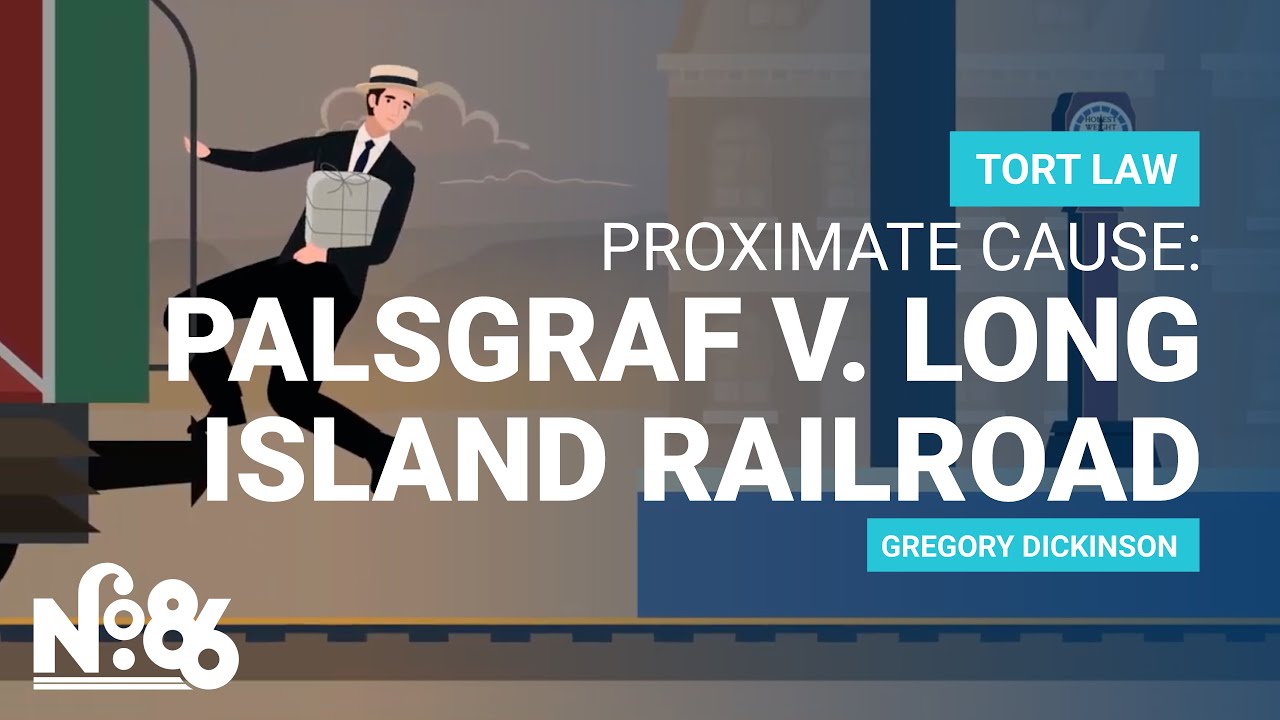
When Proximate Cause Wasn’t a Thing: Palsgraf v. Long Island Railroad
1.6K
In Palsgraf v. Long Island Railroad (1932), Judge Benjamin Cardozo established that liability in tort law depends on whether a defendant owed a duty to the plaintiff, not merely on whether their conduct was a but-for cause of injury; the case involved a bystander injured by an explosion from fireworks dropped by a passenger, where Cardozo held that the railroad owed no duty to the distant bystander despite the direct causal chain, demonstrating that proximate cause analysis in early 20th-century law focused on directness rather than foreseeability, and that modern tort law has evolved to incorporate foreseeability into duty determinations.
Click to watch →

What’s Inside The Box? (The Case Of)
810.6K
In Palsgraf v. Long Island Railroad Co. (1928), Chief Judge Benjamin Cardozo established that tort liability requires a defendant to owe a duty of care to a plaintiff, and this duty exists only when the plaintiff's injury was reasonably foreseeable from the defendant's conduct; thus, the railroad was not liable for Mrs. Palsgraf's injuries because a reasonable person could not have foreseen that a box of fireworks would explode and knock over a scale to injure her, even though the chain of events was continuous and proximate.
Click to watch →

Lego Law: Palsgraf v. Long Island Railroad
173.4K
In tort law, proximate cause requires a legally significant connection between a defendant's actions and the plaintiff's injury; liability cannot be imposed if the harm was too remote or unforeseeable, even if there is a direct physical link, because the law arbitrarily declines to trace events beyond a certain point based on convenience, public policy, and rough sense of justice.
Click to watch →

How to Analyze Negligence on a Torts Essay (Pt. 1): Palsgraf & The Duty of Care
291.6K
In negligence law, courts analyze whether a defendant owed a plaintiff a duty of care through two primary approaches: (1) the 'zone of foreseeable danger' test, which limits duty to those within a defendant's foreseeable risk zone (as articulated by Justice Cardozo in Palsgraf v. Long Island Railroad), and (2) the causation-based approach, which shifts foreseeability analysis to proximate cause rather than duty (as proposed by Justice Andrews). Both approaches typically lead to the same outcome but place the foreseeability question in different parts of the negligence analysis; students should apply both methods on torts essays to maximize exam points.
Click to watch →
Deep Dive
The study of tort reform, insurance systems, and how damages are practically calculated and distributed in modern litigation.
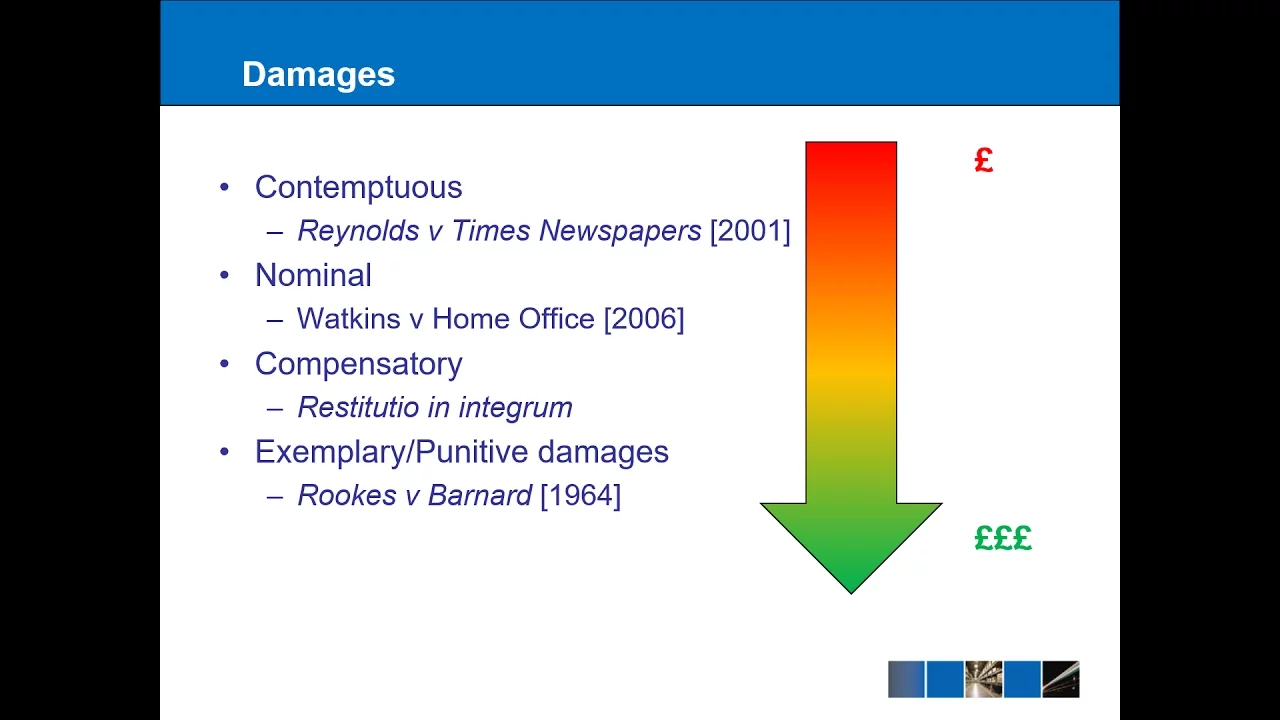
Tort Law - Remedies
36K
Damages calculation divides into pecuniary (quantifiable) and non-pecuniary (non-quantifiable) categories. Pecuniary damages include lost earnings (calculated by multiplying weekly income by weeks lost), medical care costs, and lost years of life expectancy (established in Pickett v R (1980)). NHS availability does not constitute a valid defense against paying for tort-related treatment. Non-pecuniary damages compensate for pain, suffering, and loss of amenity, guided by H. Western Sun v Shepherd (1964), which holds that comatose claimants are not entitled to pain/suffering damages but awards should not be reduced due to inability to utilize funds. Payment methods include lump sums, provisional damages (adjustable later), and structured settlements (regular payments over time). Social Security and occupational sick pay are deducted from damages as defendants are not liable for these third-party payments.
Click to watch →
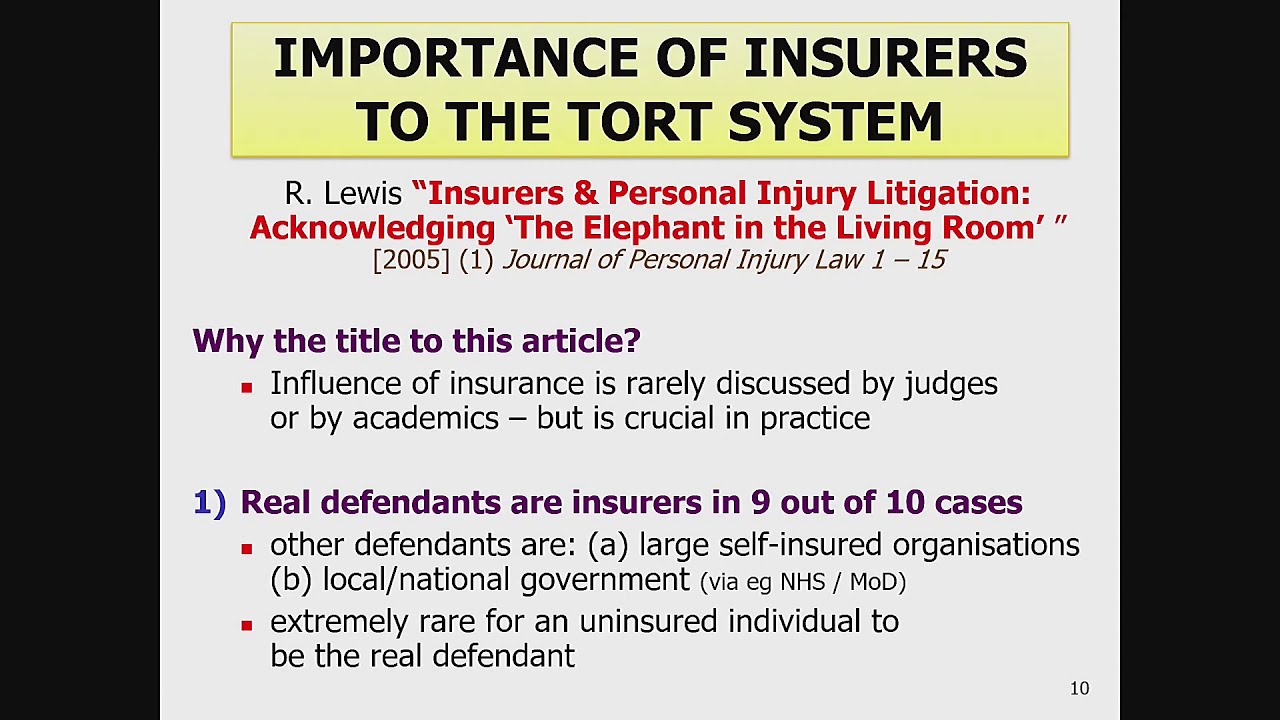
Relationship Between Tort Law & Insurance
740
Insurance is the fundamental infrastructure of the tort system, as insurers are the real defendants in the vast majority of cases (910 out of 1000), control 94% of damages paid, and manage the entire claims process through computerized systems like Colossus, while also lobbying to shape tort law reform; without insurance, the tort system would have collapsed under the weight of compensation demands.
Click to watch →

FreightWaves Today | July 2
183
According to a Chamber of Commerce study, the lack of tort reform creates a $4,200 tax on every family in America. Research shows that while verdict severity increased only 3.7%, settlement severity increased 12%—almost four-fold—driven by risk aversion regarding potential nuclear verdicts. The current situation is described as a 'fraud epidemic' with staged accidents and frivolous lawsuits. Increasing insurance limits and implementing tort reform should be coupled together in a comprehensive package to address the cycle of higher limits attracting more claims.
Click to watch →
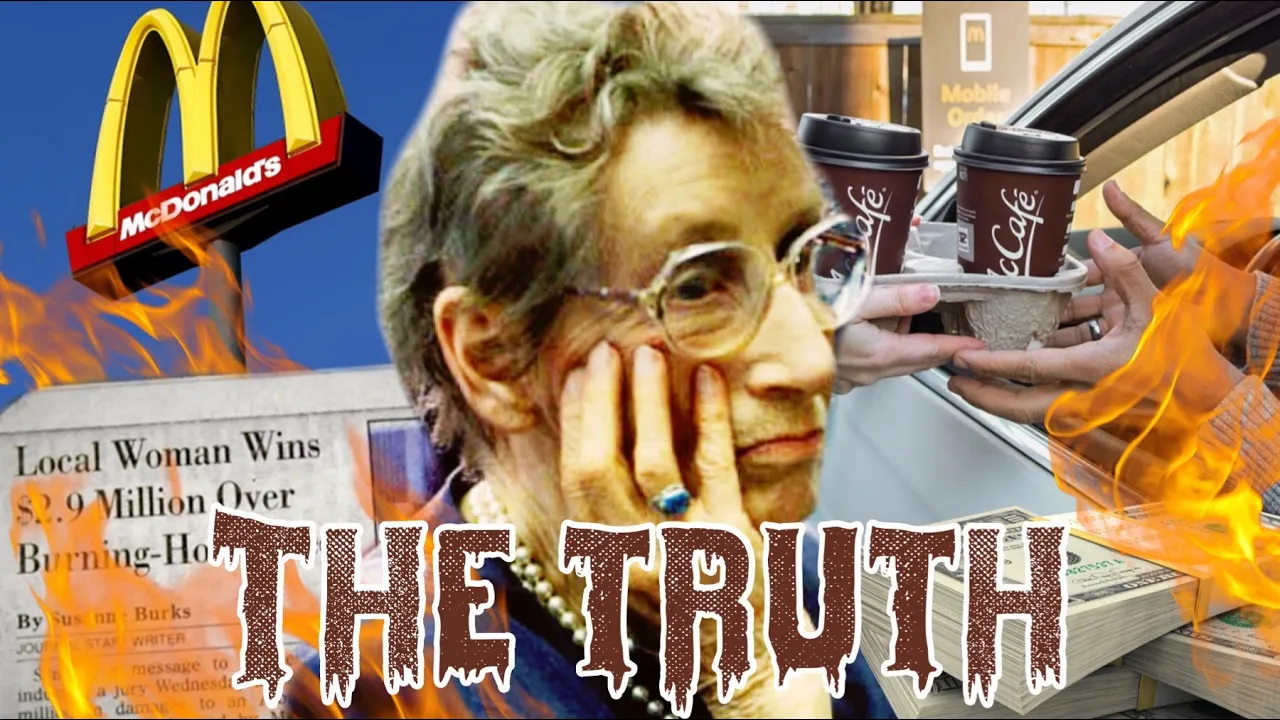
The McDonald's "Hot Coffee" Scandal EXPLAINED
55.4K
Tort reform refers to changes in the civil justice system that reduce plaintiffs' ability to bring tort actions or reduce damages received. Plaintiffs are individuals who file lawsuits seeking compensation, while defendants are those being sued. Comparative negligence principles allow juries to reduce compensatory damages based on the plaintiff's degree of responsibility for their injuries. In Stella's case, the jury found her 20% responsible, reducing her compensatory damages from $200,000 to $160,000. Punitive damages are awarded to punish defendants for egregious conduct; the jury awarded $2.7 million ($2 days of revenue), which the judge reduced to $480,000.
Click to watch →
![1996 Civil Justice and Litigation Conference: Insurance & Litigation Process [Archive Collection]](https://i.ytimg.com/vi/ASENN-_6VDM/maxresdefault.jpg)
1996 Civil Justice and Litigation Conference: Insurance & Litigation Process [Archive Collection]
7K
Insurance fundamentally shapes tort law and litigation outcomes by creating financial incentives that influence settlement behavior, expand litigation volume, and distort the relationship between liability and actual damages; while insurance provides essential protection for policyholders against both their own negligence and systemic tort misfirings, its structural incentives—particularly the separation between policy limits and actual liability, combined with bad faith doctrines that penalize insurers for not settling within limits—tend to increase the flow of money through the tort system rather than reforming underlying tort principles, as insurance companies' contractual obligations to policyholders conflict with their ability to advocate for meaningful tort reform.
Click to watch →
Tort Basics
Remedies
Tort Basics
0:00- 1
Defines tort law and its purpose of compensation and deterrence.
- 2
Lists common examples like negligence, assault, and product liability.
- 3
Explains negligence requires duty, breach, and causation of injury.
No-Fault Accident Compensation Systems
While traditional tort law relies on proving fault (negligence) to award damages, critics argue this adversarial system is inefficient, costly, and inequitable, often leaving victims uncompensated due to legal barriers. The 'No-Fault' model—exemplified by New Zealand’s Accident Compensation Corporation (ACC)—replaces personal injury lawsuits entirely. Under this system, injured individuals receive comprehensive state-funded medical and financial support regardless of blame. This alternative perspective argues that society is better served by prioritizing swift rehabilitation and universal coverage over the costly and unpredictable process of assigning individual liability through tort litigation.
The fundamental distinction between civil law (disputes between private parties) and criminal law (offenses against society).
Basic legal terminology, particularly the definitions and roles of the 'plaintiff' and 'defendant' in a lawsuit.
The conceptual definition of a 'civil wrong' and how it differs from a breach of contract.
An understanding of how legal systems resolve disputes and the general process of filing a civil lawsuit.
The doctrines of affirmative defenses in negligence, such as contributory negligence, comparative negligence, and assumption of risk.
Advanced tort concepts, including strict liability, product liability, and vicarious liability (respondeat superior).
Analysis of dignity and economic torts, such as defamation, invasion of privacy, and tortious interference with contractual relations.
Deep-dive analysis of landmark tort cases (e.g., Palsgraf v. Long Island Railroad Co. or Donoghue v. Stevenson) to understand 'proximate cause' and 'duty of care'.
The study of tort reform, insurance systems, and how damages are practically calculated and distributed in modern litigation.
226.7K views2.6Klikes2:58@LegalMatchOriginal Release: 2019-06-10
What is Tort Law? Tort Law is an area of law that protects people from other people's negligent actions. Its purpose is to make sure that the victim is compensated for any losses caused by the wrongdoer's violation and to discourage them from making the same violation in the future. Some common examples of Tort are negligence-based claims such as Car accidents, Construction accidents, Medical malpractice, and Slip-and-falls. Other examples of Tort are Civil assault or Civil battery, Wrongful death claims, Trespassing, Products liability and Dangerous products, and Intentional infliction of emotional distress. But what is Negligence? To prove negligence, you will need evidence that someone owed you a duty of reasonable care and then breached that duty, which caused your injuries. For example, a shop owner mops the floor and did not put up a "Wet Floor" sign. Then, you slipped, fell, and got injured. The owner could be considered negligent because the owner owes a duty of care to their customers to keep the store safe. But they did not perform their duty, which resulted in an injury.
Torts may be classified into Intentional Torts, Unintentional Torts, and Strict liability Torts. Battery is an example of Intentional Tort. Negligence in a slip and fall case, on the other hand, is considered to be an Unintentional Tort. There are remedies available in a Tort case. If you are a victim of Tort, then you may be entitled for monetary damages awards for your economic losses. You may also receive damages awards for other related losses such as emotional distress, pain and suffering, lost wages, or other costs. If the tort is ongoing, like a store unable to open for business due to construction next door, or cannot be remedied with money, then the court may order an Injunction. This forces the wrongdoer to do something to remedy the situation. For instance, the court may order a company to clean up after causing a toxic spill or force the construction to temporarily (or permanently) stop. You may also be awarded "Punitive damages" if the offense is really damaging or particularly offensive. This is an additional monetary compensation meant to punish the wrongdoer and is awarded with the discretion of the court. Some states however may limit the amount, and will cap it at more than two or three times the amount of your economic losses. There are a lot of things to consider in a Tort law claim. They may vary according to jurisdiction, so it's important to check with a knowledgeable personal injury lawyer if you are unsure of the laws of your area. LegalMatch can help you find the right lawyer. Go to LegalMatch.com. You can post your case or call us at (415) 946-0816. Check our testimonial page to see what our clients think of us. LegalMatch. It's a free, secure, and confidential way to find the right lawyer for your legal needs. Share your thoughts with us in the comments section below.
Up Next
103:46
Australian Tort Law: Intentional Torts in 2 Hours | Overview & Exam Review
@AnthsLawSchool
121K views•2018-06-27

4:27
US Secondary Sanctions Impact on EU Businesses and Blocking Legislation
@Bureauvandijk
1.6K views•2019-03-20

5:27
Forensic Phonetics: Speaker Identification in Legal Cases
@nptel-nociitm9240
539 views•2025-03-19

24:42
Police Interrogation Tactics: False Confessions & Legal Reform
@LastWeekTonight
7M views•2022-04-18
Related Study Plans & Knowledge Roadmaps
Structured learning paths in Law
law
Self-Defense Law: Imminence & Castle Doctrine
01Foundations of Self-Defense Law
02Imminent Threat & Reasonable Belief
03The Principle of Proportionality
+ 3 more learning modules
12h6 modules
Explore Roadmap
law
Defamation Law: First Amendment & Actual Malice
01Introduction to civil torts and the First Amendment
02Elements of Defamation: Libel and Slander
03Public Figures vs. Private Individuals
+ 2 more learning modules
8h5 modules
Explore Roadmap
law
Hearsay Rule: Trial Evidence & Exceptions
01Introduction to Trial Evidence & Courtroom Basics
02Demystifying Hearsay: The Core Definition
03Non-Hearsay: Exclusions Under FRE 801(d)
+ 3 more learning modules
14h6 modules
Explore Roadmap
law
Medical Malpractice: Law, Liability & Care
01Foundations of Tort Law and Civil Liability
02The Four Elements of Medical Malpractice
03Defining and Proving the Standard of Care
+ 2 more learning modules
12h5 modules
Explore Roadmap