





















![[환경기능사 핵심요점] 27강. 제4과목 소음진동방지 Chapter 01 소음2(핵심요점3)](https://i.ytimg.com/vi/vKvSXM11abY/maxresdefault.jpg)







The decibel scale (β = 10 × log₁₀(I/I₀)) is a logarithmic scale used to measure sound loudness, where I is the sound intensity and I₀ = 10⁻¹² W/m² represents the threshold of human hearing—the softest sound a healthy human ear can detect. This logarithmic scale compresses the enormous range of human hearing (from 10⁻¹² to about 1 W/m², spanning 12 orders of magnitude) into a manageable range of 0 to approximately 120 decibels, making it easier to express and compare sound intensities that would otherwise require dealing with extremely large or small numbers.
Understanding the Decibel Scale: Sound Intensity Explained
Added:Basic mathematical understanding of logarithms (specifically base-10) and scientific notation.
The physics of sound waves, including concepts of amplitude, frequency, and wave propagation.
The definition of sound intensity as power per unit area, measured in Watts per square meter (W/m²).
An understanding of the human ear's basic anatomy and its function as a sensory receptor for pressure variations.
The mathematical operations for adding and subtracting decibel levels (logarithmic addition).
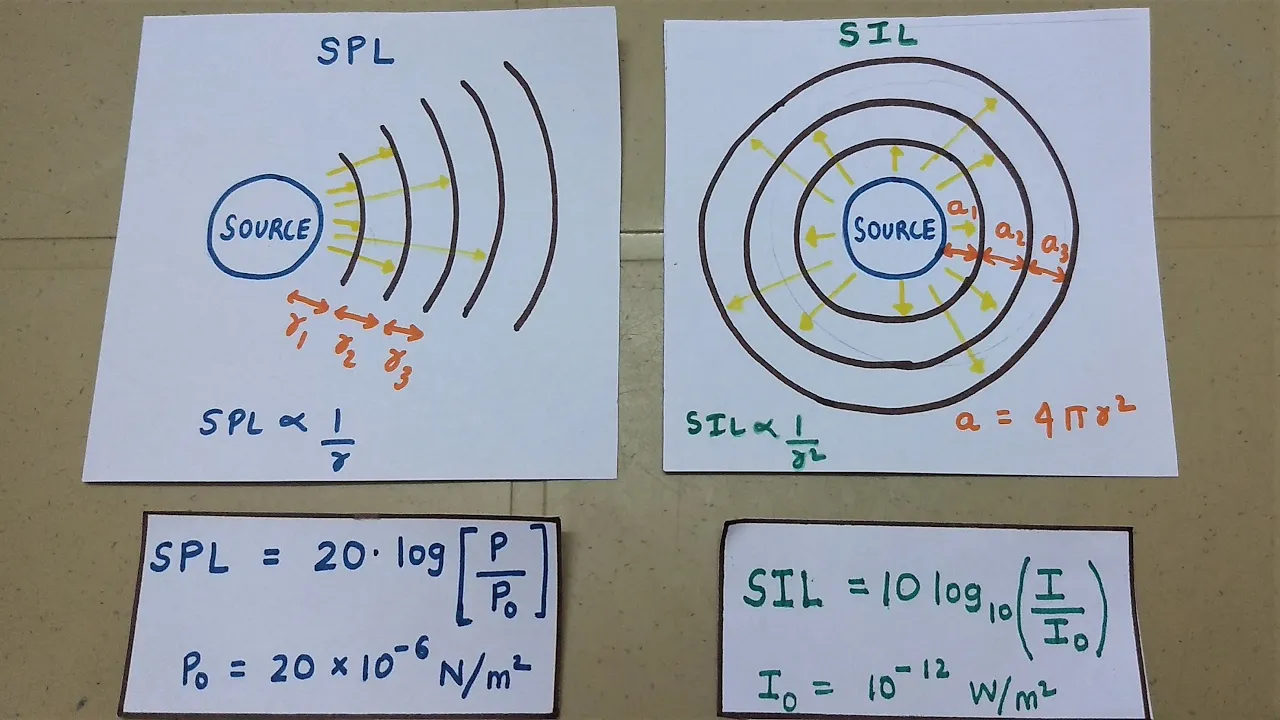
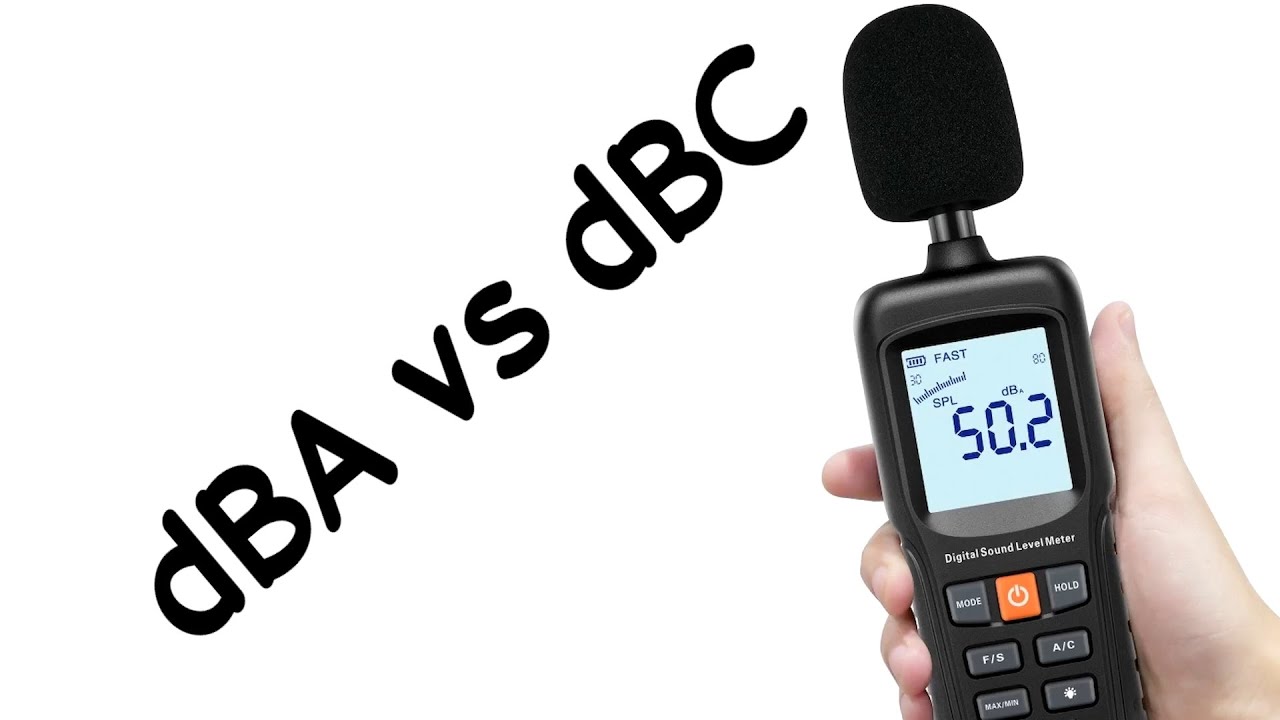
The difference between sound intensity level (dB SIL), sound pressure level (dB SPL), and frequency-weighted scales like dBA and dBC used in safety regulations.
The biological and psychological aspects of hearing, specifically equal-loudness contours (Fletcher-Munson curves) and units like phons and sones.
Practical applications in acoustic engineering, such as architectural acoustics, noise control, and audio mixing/mastering.
379.1K views3.8Klikes10:30Original Release: 2014-07-01
- [Voiceover] All right, I'm going to tell you about the Decibel Scale.
This is the scale that we use to figure out the loudness of a sound.
The equation that goes along with it looks like this.
Beta equals 10 log, or logarithm, base 10 of I divided by 10 to the negative 12 watts per square meter.
This looks intimidating.
Let's talk about it and break it down.
Beta is the number of decibels.
So this side gives you the number of decibels and we abbreviate decibel with a little d, capital B.
This is the number of dBs or decibel.
You've probably seen this number on your stereo.
Somewhere reader just in volume because we're going to measure volume and Decibels.
10, this 10 just denotes the fact that this is the Deci-bel Scale and not just the bel scale.
If you didn't multiply by 10, you'd have the bel scale but this is multiplied by 10.
We like the 10.
We're going to call is Decibel.
Log, we'll talk about log in a minute.
Logarithm here.
I is the intensity of the sound wave.
So this is the intensity.
In Physics, intensity is defined to be the power divided by the area.
What this means, think about it this way.
You got your ear and a sound wave, say, is coming toward your ear.
If you imagine, one.
Power's in, what?
Power measure going to watts.
Area's measure going to square meter.
So think about intensity this way.
If you have one square meter.
Imagine one square meter of area here.
This doesn't have to be an actual physical object.
Just imagine a square meter of area.
The power that passes through that area will be, how many joules?
If you figure you how many joules pass through this one square meter.
If you asked how many joules per second pass through that one square meter.
How many joulels of sound energy per second pass through the one square meter?
That would be the number of watts per meter squared which would be the intensity.
So watts is joules per second.
This gives you an idea of how much energy per second pass through a certain amount of area.
This part of the equation is my favorite.
This is my all-time favorite right here.
This number.
This 10 to the negative 12 watts per square meter represents the threshold of human hearing.
What that means is this is the softest possible sound you can hear.
Any sound with an intensity less than that.
You won't even notice.
But if it's anything bigger than that, a human ear that's healthy should be able to detect it.
Here is why I like this number.
This is unbelievably small.
This is one trillion of a watt per meter square.
A trillion.
What this says is that even if only one trillionth of a joule per second passes through the square meter, your ear would still be able to detect the sound that soft.
If that doesn't impress you, let me put it to you this way.
Imagine we did have one watt.
Let me put it to you this way.
If you have one watt, how big of an area?
A watt isn't really that much.
A watt is not a lot of power.
If you have one watt, how big could you make this area?
How, spread out.
How diluted could one watt be spread over?
How large of an area could this one watt be spread over and still be intense enough for the human ear to hear it?
What do you think?
Football field?
I don't know, a city?
No, it turns out.
If you do the calculation, I suggest you do it.
It's interesting.
You would get, that you can spread one watt over the entire land area of Germany, about three times over, and still it's intense enough for the human ear to hear.
That's how unbelievably sensitive our ears are.
It's actually... I told you it's unbelievable.
I can hardly believe it myself.
Let's come back over to here.
So here's our equation.
This is the Decibel Scale.
Why log?
That's what you're thinking.
"Why in God's name did the physicist have "to put logarithm in here?
"This scare me."
This used to scare me too.
Well, I'll show you why.
Here's the problem.
The fact that we can hear such a soft sound, 10 to the negative 12 watts per meter squared, there's a huge range of human hearing.
This means we can hear from 10 to the negative 12 watts per square meter.
This is your point zero, zero, say three, four, five, six, seven, eight, nine, 10, 11, with a one watts per square meter all the way where there's no upper limit.
It just blow out your ears.
But once you get to about one watt per square meter, this one will start hurting.
This is painful.
You're not going to be happy over here.
You're just going to start hurting.
You'll start getting hearing losses and not good.
So it's a huge range.
12 orders of magnitude.
This one watt per square meter is a trillion times bigger than this side.
This scale is just way too big.
This is awkward.
We want to scale that's small or maybe like one to 100 to measure loudness.
We don't want to measure from one to a trillion or a trillion to one.
That's what log's going to do.
Logs are great.
This is a trick for this use.
This is why I love this trick.
Logarithms take really big or really small numbers and turn them into nice numbers.
That's why we're going to use the logarithm.
Let me show you what I mean.
Logarithm, if you don't remember, here's what a logarithm does.
Log base 10 of a number equals, here's what it does.
I'm going to stick a number in here.
Let's stick 100000.
What log does, log is a curious guy.
Log is always asking a question.
Log always wants to know, okay, if I'm log base 10, log wants to know what number would I raise 10 to in order to get this number in here.
So log looks at this number in the parentheses.
This entire number here and asks what number should I raise 10 to in order to get 100000.
Well, we know the answer to that.
We should raise 10 to the fifth.
If I raise 10 to the fifth, I'll get 100000.
So if five is the number I raised 10 to get 100000, then that's the answer to this that log base 10 of 100000 is five.
Look what happened.
Log took a huge number, 100000, and turned it into five.
Well, that's outstanding.
Log can take huge numbers, turn them into nice numbers.
The logarithm base 10 of one billion would be... One billion is a big number.
That's hard to deal with but log takes 10 and asks what number can I raise 10 to in order to get a billion.
I should raise 10 to the ninth because I got one, two, three, four, five, six, seven, eight, nine zeros here.
I raised 10 to the ninth to get this number.
So the answer to this question for the logarithm is nine.
Oops, that's not nine.
Nine, and that's why logarithms are good.
Logarithm took this enormous number of billion and turned it into nine.
So logarithms take enormous scales turn them in nine scales.
That's why we like this formula which is our Decibel Scale because it takes enormous intensities and small intensities, turns them into nice intensities.
Let me show you an example with this equation really quick.
Let's say you're talking to your friend.
Maybe you're yelling at your friend.
You guys are having a heated exchange.
You're yelling.
He's next to you.
These are the sound waves coming at him.
You're yelling with an intensity of, say 10 to the negative fifth.
That doesn't sound like a lot but that's actually, you're pretty upset here.
That's pretty loud.
I want to know how many decibels is this.
How do we figure out the decibels?
Well, here's what we do.
We use our formula for decibels.
Beta, number of decibels, equals 10 log base 10 of the intensity over always 10 to the negative 12 watts per square meter because that's the softest sound we can hear.
What do I get?
10 to the negative fifth is my intensity.
So I plug this into here.
I'm going to get beta equals 10 times the log base 10 of 10 to the negative fifth, because that's my intensity, divided by 10 to the negative 12.
Now these are both watts per square meter.
So let's cancel.
Well, what's 10 to the negative fifth divided by 10 to the negative 12 turns out that's 10 to the seventh.
I end up with 10 log of 10 to the seventh.
Now I don't like logs.
I'll be honest.
They freak me out but I can even do this one.
Log of 10 to the seventh.
Remember what log does.
It asks what number do I raise 10 to in order to get the thing in the parentheses.
Well, the number I raise 10 to to get the thing in this parentheses, it's already 10 to the seventh.
It's already in this form.
So I've raised 10 to the seventh to get 10 to the seventh.
So the answer to log base 10 of 10 to the seventh is just seven.
My final answer beta, the loudness, the number of decibels is going to be 10 times log of 10 to the seventh was just seven because I have to raise 10 to the seventh to get 10 to the seventh.
10 times seven equals 70.
I'm yelling at 70 decibels.
I need to calm down.
My friend's going to start getting mad at me.
That's how you figure out how loud the sound wave is.
Up Next

58:36
Physics of Musical Instruments: Sound Waves and Pitch Explained
@WilliamsCollege
95.3K views•2010-03-01

12:53
21cm Hyperfine Transition in Neutral Hydrogen: Radio Astronomy Basics
@AaronRobertParsons
12.4K views•2011-10-13
12:56
Lens Power, Diopters & Eye Aberrations | Optics | Khan Academy
@khanacademymedicine
218.3K views•2014-07-06

27:14
Entropy and the Second Law of Thermodynamics Explained
@veritasium
27.5M views•2023-07-01
Related Study Plans & Knowledge Roadmaps
Structured learning paths in Physics
physics
Nuclear Physics (Decay, Fission & Reactors)
01Atomic Structure and the Binding Force
02Radioactive Decay and Half-Life
03Nuclear Fission Mechanics and Chain Reactions
+ 2 more learning modules
12h5 modules
Explore Roadmap
physics
Soft Matter (Polymers, Colloids & Rheology)
01Foundations of Soft Matter & Thermal Forces
02Polymer Physics and Macromolecules
03Colloids, Surfactants, and Self-Assembly
+ 2 more learning modules
38h5 modules
Explore Roadmap
physics
Analytical Mechanics: Lagrangian & Hamiltonian
01Mathematical Foundations: Calculus of Variations
02From Newtonian Mechanics to Constraint Dynamics
03The Principle of Least Action & Lagrangian Mechanics
+ 3 more learning modules
28h6 modules
Explore Roadmap
physics
General Relativity (Spacetime & Cosmology)
01Foundations of Relativity: Special Relativity
02The Geometry of Spacetime: Equivalence Principle & Curvature
03Einstein's Field Equations: The Mathematics of Gravity
+ 2 more learning modules
55h5 modules
Explore Roadmap