Venture capital is a high-risk, high-reward investment strategy where institutional investors, corporations, or wealthy individuals provide funding to startups with transformative potential, typically progressing through seed funding, Series A, Series B, and Series C stages before potentially going public via IPO or being acquired, with VCs expecting only a minority of their portfolio companies to succeed while those that do must generate substantial returns to compensate for failures.
Venture Capital Explained: A Beginner's Guide to VC Funding
Added:Deep Dive
Basic corporate structure and equity ownership, specifically how shares represent company ownership.

Полный разбор экономики: ценные бумаги, акции, облигации | Обществознание ЕГЭ 2025 | Умскул
56.2K
A joint-stock company (акционерное общество) issues shares to represent ownership. When founders establish a company, they can register it as a joint-stock company and issue shares to divide ownership. For example, if a company is worth 100,000 rubles and issues 1,000 shares, each share represents 1/1000 (0.1%) of the company. The number of shares determines ownership percentage: 650 shares represent 65% ownership, 350 shares represent 35%. The company can issue any number of shares it chooses, and the total number of shares determines the value of each share.
Click to watch →

b.com 5th sem | corporate accounting | chapter 1 | issue or forfeiture of shares 2026-27
251
Equity shares are the basic type of shares that represent ownership in a company. They are the last to receive payment in case of liquidation and have equal voting rights among all shareholders. Equity shareholders are considered the true owners of the company and share in the profits through dividends. They participate in company decisions through voting rights.
Click to watch →

Accounting for Corporation: Shareholders Equity
285
A corporation is a legal entity separate from its shareholders, with ownership represented by shares of stock. Shareholders hold these shares, and stock certificates serve as proof of ownership containing share amount, company name, seals, signatures, purchase date, and identification number. Shareholders equity represents the residual interest in net assets (Assets minus Liabilities). Share capital, or contributed capital, consists of ordinary shares (common shares with voting rights and residual profit interest) and preference shares (with preferential dividend and liquidation rights). Share value types include par value (visible on certificate), stated value (in legal documents), and no par/no stated value (minimum Php5 per share).
Click to watch →
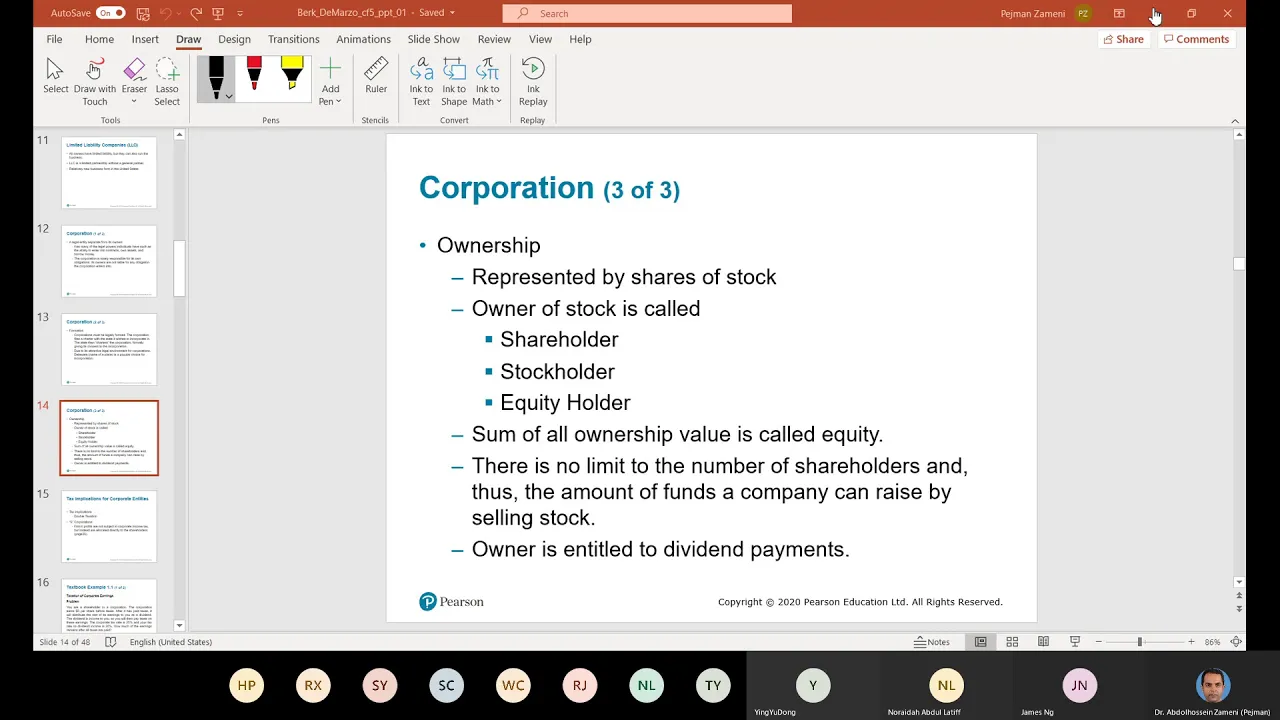
1- Corporate Finance June2020, Corporate Finance,5th Edition, Berk,DeMarzo Chap1
3.6K
Corporate ownership is represented by shares of stock. Owners of stock are called shareholders or equity holders. The sum of all ownership value is called equity. There is no limit to the number of shares a company can issue, allowing it to raise unlimited funds by selling stock. Shareholders are entitled to dividend payments.
Click to watch →

Companies Act 2013, Companies act, Characteristics of Companies, company law revision, mba, bcom
953.9K
Share capital represents the total funds contributed by shareholders to the company, becoming company property. Each shareholder owns shares proportional to their contribution, creating fractional ownership interests. Shares are transferable instruments enabling ownership changes while maintaining company continuity. The Memorandum of Association defines the company's fundamental purpose and scope, while the Articles of Association contain detailed internal governance rules. Together, these documents create the complete governance framework guiding company operations, specifying director powers, shareholder rights, and procedural requirements for conducting business.
Click to watch →
Deep Dive
The difference between traditional small businesses and scalable, high-growth startups.

Incubation To Innovation: AI, Startups and Personal Growth | Ft. Kapeel Kumar | 016 | Educator Voice
221
The speaker distinguishes between traditional business and startups. Traditional business lacks scalability—it remains a small operation for decades. Startups are scalable and grow quickly. He uses the example of a traditional fry vendor versus a scalable business model to illustrate this difference.
Click to watch →
Créer sa startup de A à Z (les vraies étapes)
453
The key difference between scalable startups and traditional businesses is the cost structure. A startup with a platform or product can scale by multiplying clients while fixed costs remain relatively constant. For example, Airbnb's fixed costs are much smaller than its revenues. A traditional agency might have 90% variable costs, meaning to grow from 10 to 100 clients, you need 10 more staff, and the costs scale proportionally, potentially leaving no profit margin. This is why investors are attracted to scalable startups.
Click to watch →
Criar uma EMPRESA ou STARTUP: Qual é a diferença?
403
Scalability is the first major difference between startups and small businesses. Scalability refers to a company's ability to increase its revenue without its costs increasing proportionally. Small businesses typically lack scalability because they must hire more employees proportionally to grow, which reduces profit margins. Startups achieve scalability through software, automation, and technology that allows revenue growth without proportional cost increases.
Click to watch →
Kauffman Entrepreneurship Issue Forum: Spotlighting Rural America
287
It is important to distinguish between local small businesses and scalable tech startups: (1) Local small businesses may want to grow but aren't focused on replacing or disrupting large companies in existing markets, typically don't scale far beyond their local area, don't attract venture capital, and grow via profits or traditional bank financing; (2) Scalable tech entrepreneurs search for repeatable business models they can turn into high-growth profitable companies, entering large markets requiring external risk capital to build and scale, with goals often including acquisition or building valuable intellectual property. With distributed teams and remote work becoming easier, scalable tech startups can now be built outside metropolitan areas, though significant barriers remain.
Click to watch →

Bitta talant butun jamiyatni o'zgartirib yuborishi mumkin — Startup Garage asoschisi bilan suhbat
25.6K
The key difference between startups and traditional businesses is innovation and scalability. Traditional businesses are limited by their physical capacity (e.g., a training center can only teach 5,000 students at once), while startups can scale to millions of users through digital platforms. This scalability allows startups to create much larger impact with fewer resources. The key insight is that innovation and scalability are the defining characteristics that distinguish startups from traditional businesses and enable them to create disproportionate value.
Click to watch →
Deep Dive
Fundamental financial concepts including valuation, revenue vs. profit, and debt vs. equity financing.

CS Executive |Financial and Strategic Management| Calculator Tricks #csexecutive
13.6K
This segment covers the foundational concepts of financial management. When a company needs funds, it has two options: debt (borrowing from lenders with interest payments) or equity (issuing shares to investors for ownership). From an investor's perspective, equity is riskier because returns depend on company profits, while debt provides fixed interest regardless of performance. The fundamental rule of finance is 'Higher Risk, Higher Return' - investors taking more risk expect proportionally higher returns. Companies prefer debt financing because it is less expensive (around 10% return) compared to equity which demands higher returns due to higher risk.
Click to watch →

Finance | Chapter 7 Stock Valuation
1.9K
This section covers the foundational differences between debt and equity financing. Debt (التت) involves borrowed funds that must be repaid with interest according to a schedule, while equity (الاكتي) represents ownership through shares. Key distinctions include: voting rights (debt holders have none, equity holders have voting rights), claim priority (debt holders are paid first in liquidation), maturity dates (debt has fixed maturity, equity has none), and tax treatment (debt interest is tax-deductible, equity dividends are not). These concepts form the basis for understanding corporate capital structure and stakeholder relationships.
Click to watch →
Valuation in Four Lessons | Aswath Damodaran | Talks at Google
1.7M
Every business has only two fundamental ways to fund its operations: debt (borrowing money) or equity (using owner's money). While these can be sliced into various forms like bonds and stocks, the core choice remains between debt financing and equity financing. The optimal capital structure depends on where a company's value primarily originates—mature companies with stable cash flows may use more debt, while young growth companies typically need equity financing because they cannot service debt with unproven revenue streams.
Click to watch →
How to Fund Your SME Without a Bank Loan | Private Equity Explained for African Entrepreneurs
700
Debt represents borrowed capital requiring repayment with interest, including bonds, factoring, bank loans, credit cards, business loans, and mortgages. Equity involves direct ownership stakes in companies without repayment obligations. Interest compensates lenders for capital provision over time. Understanding these distinctions is essential for entrepreneurs choosing appropriate financing strategies based on their business stage, risk tolerance, and growth objectives.
Click to watch →

Debt Financing vs Equity Financing | Real Life Examples |
15.3K
Companies raise capital through two primary methods: equity financing and debt financing. Equity financing involves selling company ownership (equity) to investors in exchange for capital, giving investors voting rights and a share of profits. Debt financing involves borrowing money that must be repaid with interest, representing a debt obligation. Debt is typically cheaper than equity because lenders receive fixed returns while equity holders bear more risk. Interest expenses provide a tax shield benefit, reducing taxable income. However, debt creates fixed obligations that increase financial risk if profits decline.
Click to watch →
Deep Dive
The risk-return spectrum in investing and the basic concept of capital appreciation.

What’s the risk-reward spectrum?
662
The risk-reward spectrum is a fundamental investing principle stating that investments with higher potential returns typically carry higher risk, while safer investments offer lower returns; this spectrum ranges from low-risk, low-return options like cash and savings accounts to moderate-risk, moderate-return corporate bonds, and finally to high-risk, high-return stocks and alternative assets, making it essential for investors to understand this relationship to avoid common mistakes of either chasing excessive returns without understanding risks or staying too conservative for meaningful growth.
Click to watch →
How to Invest in the Stock Market | Full Beginner's Stock Market Investing Masterclass
155.5K
Investments can be arranged along a risk-return spectrum. Low-risk, low-return investments include money market funds, CDs, and bonds. Medium-risk, medium-return investments include stocks and mutual funds. High-risk, high-return investments include options and short selling. The general principle is that higher risk is associated with higher potential returns, and lower risk is associated with lower but more consistent returns.
Click to watch →

Money Works | Key Lessons in 47 Minutes
142.8K
The second investment principle is understanding risk and return. Higher potential returns always come with higher risk—there's no such thing as a guaranteed high return investment. The key is taking appropriate risk for one's timeline and goals. The risk-return spectrum shows how different investments balance risk and return: government bonds are low risk, low return; stocks are high risk, high return. The job is to find the right mix for one's situation based on personal circumstances and objectives.
Click to watch →
BUS123 Chapter 01 - Introduction: What is an Investment? - Slides 01 to 14 - Fall 2025
409
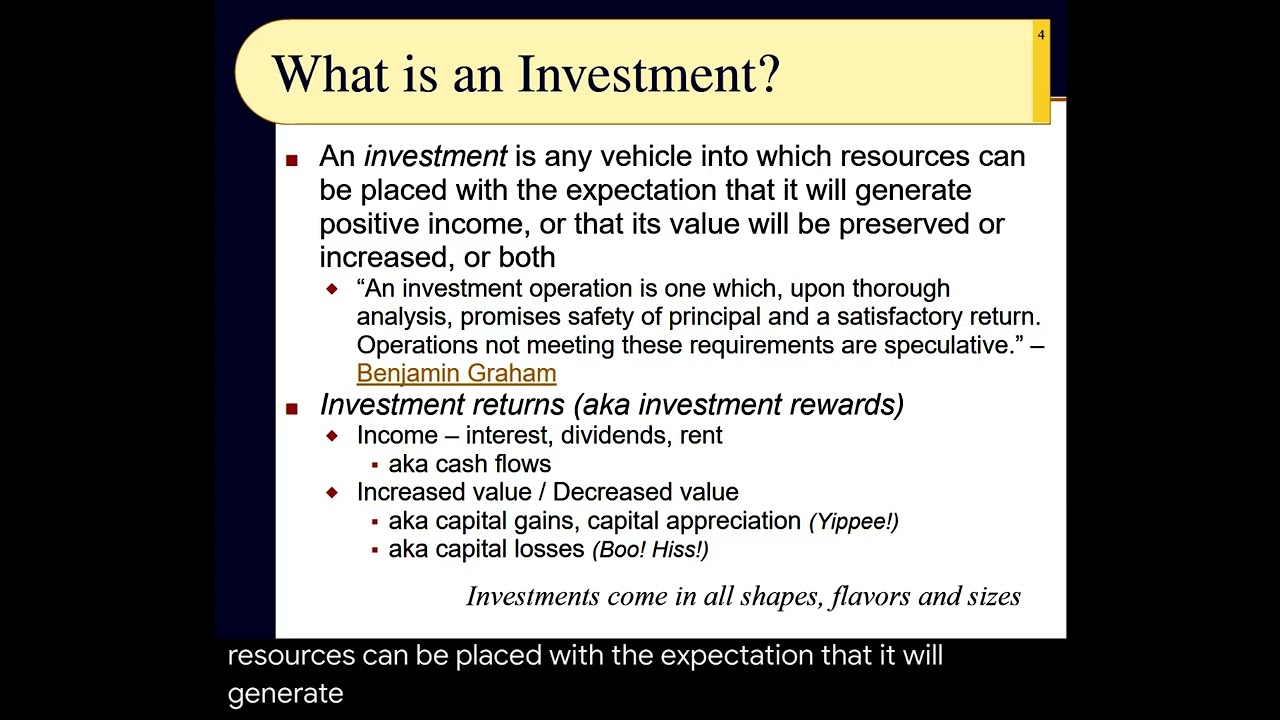
Risk is defined as the chance that actual investment returns will differ from expected returns. In general, higher expected returns come with higher risk levels. The risk-return spectrum is: Low risk (2-4% returns), Moderate risk (4-7% returns), High risk (8-10% returns), and Speculative (greater than 12% returns, which is considered gambling rather than investing).
Click to watch →
Risk ve Getiri (Finans ve Sermaye Piyasaları)
17K
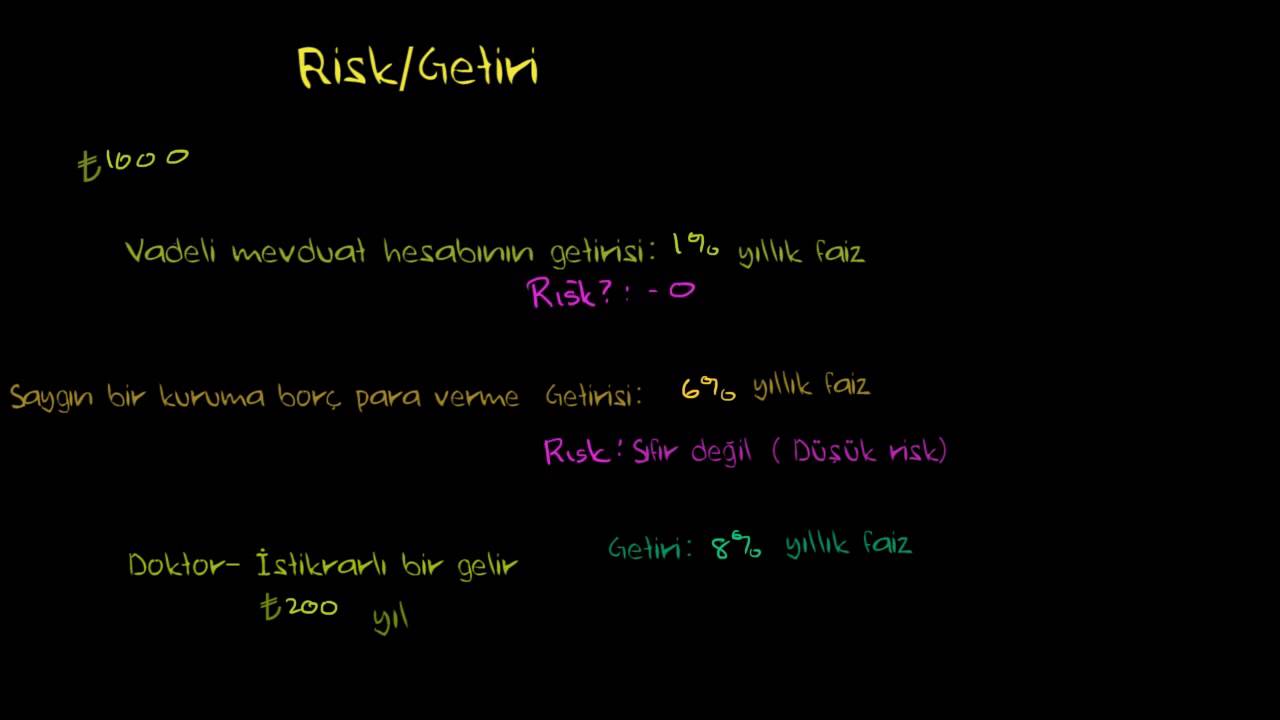
Investments can be ranked along a risk-return spectrum: (1) Bank deposits - zero risk, 1% return; (2) Corporate bonds - moderate risk, 6% return; (3) Personal lending - higher risk, 8% return; (4) Stock market - higher risk, 10% expected return; (5) Venture capital - extremely high risk, very high expected return. This spectrum illustrates the direct relationship between risk level and expected return.
Click to watch →
Prerequisite Knowledge
- Concept 01Basic corporate structure and equity ownership, specifically how shares represent company ownership.
- Concept 02The difference between traditional small businesses and scalable, high-growth startups.
- Concept 03Fundamental financial concepts including valuation, revenue vs. profit, and debt vs. equity financing.
- Concept 04The risk-return spectrum in investing and the basic concept of capital appreciation.
Subsequent Learning
- Step 01Deep dive into VC term sheets, including negotiation dynamics, liquidation preferences, and dilution.
- Step 02The mechanics of startup exits, comparing the processes and implications of Mergers & Acquisitions (M&A) versus IPOs.
- Step 03Alternative financing mechanisms such as venture debt, crowdfunding, angel syndicates, and bootstrapping.
- Step 04The structure of Venture Capital firms, exploring the relationship between Limited Partners (LPs) and General Partners (GPs).
VC Basics
Funding Rounds
VC Basics
0:00Playing Section
- 1
Venture capital funds high-potential startups with investor money.
- 2
Investors expect major returns to offset frequent startup failures.
- 3
Tech firms are favored due to their easy scalability.
Bootstrapping and Sustainable Growth: The Case Against Venture Capital
While venture capital (VC) is often celebrated as the default path for startups, critics argue it is unsuitable for most businesses and can even be detrimental. The "growth-at-all-costs" mentality demanded by VC investors often forces premature scaling, leading to high failure rates. Additionally, founders face massive equity dilution and forfeit control of their company's vision to board members focused solely on a rapid, massive exit. An increasingly popular alternative is "bootstrapping"—funding growth through customer revenue—and focusing on sustainable profitability. This approach, championed by the "Zebra" movement, prioritizes long-term viability, founder autonomy, and social responsibility over the high-risk "Unicorn" pursuit of VC-backed firms. Other alternatives, like revenue-based financing, allow founders to retain ownership while scaling at a manageable pace.
Deep Dive
Deep dive into VC term sheets, including negotiation dynamics, liquidation preferences, and dilution.

KPMG Capital Ideas Podcast - John O'Sullivan ACT Venture Capital
1.9K
Liquidation preference structures resolve disagreements about future value-sharing between founders and VCs. Three variants exist: proportional sharing, investor return-first, and investor return-plus-preferred return. These mechanisms protect VCs against overpayment scenarios where early exits would devastate returns. Most acquisitions occur through pre-existing relationships rather than formal bidding processes. Teams with deep market knowledge naturally gravitate toward strategic contacts who can facilitate acquisitions. Smaller board packs correlate with better business outcomes as they enable focused decision-making and abstraction of relevant data from noise.
Click to watch →
How Do Venture Capitalists Make So Much Money?
110.9K
Because VCs need massive home runs to make their funds work, they are incentivized to take big risks even without substantial data supporting decisions. A VC would prefer investing in a company with a 10% chance of becoming a $10 billion company over a 90% chance of becoming a $200 million company. This risk tolerance manifests in complex term sheets that give VCs special rights including board seats and liquidation preferences (ensuring they get paid first if the company is sold). These terms can allow VCs to force founders out of their own companies or dilute founders so significantly that they receive little if anything upon exit.
Click to watch →
The Most Critical Terms in Venture Capital Termsheets!
603
This video explains two critical terms in venture capital term sheets that entrepreneurs must understand: liquidation preference (which gives VCs priority in receiving their investment back plus potential participation in remaining proceeds, potentially exceeding their ownership percentage) and anti-dilution clauses (which protect earlier investors during down rounds by adjusting conversion ratios to preserve their ownership value). Professor Zeisberger emphasizes that valuation is just the starting point for term sheet negotiations, and entrepreneurs should carefully evaluate these control and economic terms alongside valuation.
Click to watch →
Open Innovation & Venture Financing | With Jensen Liu
58.5K
The VC process has two phases: pre-term sheet and post-term sheet. Pre-term sheet involves initial meetings, follow-up, due diligence (6-8 months), investment memo drafting, and investment committee approval. Post-term sheet involves legal processes (typically 4 weeks) handled by lawyers. The term sheet is the most critical document, outlining control and economics. Key economic terms include: valuation (pre/post-money), option pool (pre/post-closing), liquidation preference, dividend, and anti-dilution. Key control terms include: board control, voting rights, and investor rights (tag-along, pro-rata). The term sheet is not legally binding but reputationally significant—walking away damages industry reputation.
Click to watch →

Ernestine Fu: All You Need to Know About Venture Capital
764.7K
Pre-money valuation represents company worth before investment; post-money equals pre-money plus investment. Liquidation preference ensures VCs recover capital before common shareholders, with participating and non-participating variants. Boards expand from 3 to 5 members with founder, investor, and independent representation. Protective provisions require board approval for major spending. Right of first refusal grants priority purchase rights in secondary sales. Pro rata rights allow maintaining ownership percentages in subsequent rounds. Drag-along rights enable lead investors to compel minority shareholder approvals for major decisions.
Click to watch →
Deep Dive
The mechanics of startup exits, comparing the processes and implications of Mergers & Acquisitions (M&A) versus IPOs.
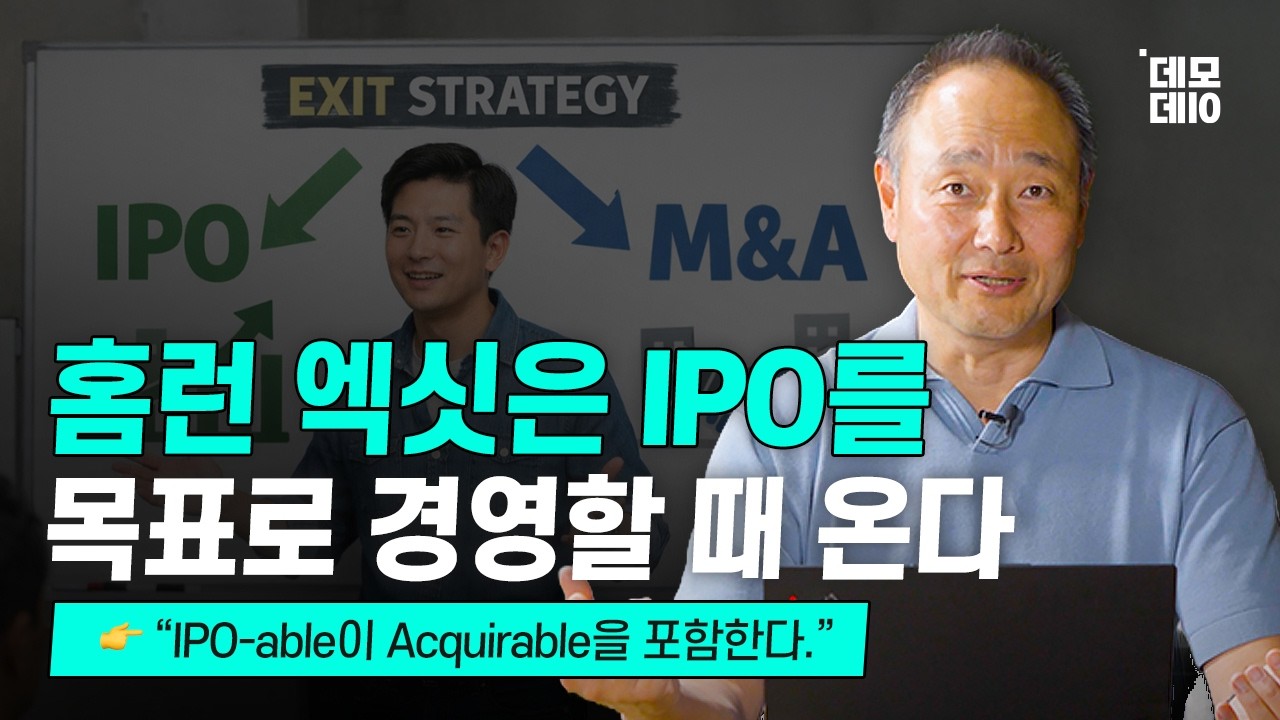
M&A를 원한다면, M&A를 목표로 삼지 마라
1.5K
This segment examines the fundamental differences between M&A and IPO as startup exit strategies. In Silicon Valley, M&A dominates as the primary exit method, with only 1-2 years over a 10-year period showing more IPO exits. Korea contrasts sharply, with IPO through KOSDAQ being overwhelmingly preferred. A critical insight emerges: while all IPO-eligible companies can potentially be acquired, the reverse is not true. Companies that can be acquired do not necessarily have IPO options. This asymmetry means pursuing IPO as a goal is viable, but pursuing M&A as a specific target is fundamentally different and more uncertain.
Click to watch →
How Jed Built a 1,400+ Investor Network from Scratch w/ Jed Ng - Part One
5.9K
Exit strategy evaluation requires analyzing market size, solution potential, and founder intent. M&A exits typically provide more favorable multiples for investors than IPOs. IPOs have become rarer due to market conditions and involve six-month lockup periods preventing investor exits. SPACs (reverse mergers) have emerged as alternatives but approximately 70% lose 70% of value within six months of going public. The key consideration is whether the market is big enough for an IPO or if a trade sale is more appropriate.
Click to watch →
EP #21 | Com RENATO GOYA - APRESENTAÇÃO
108
Exit strategies allow investors to realize returns on their startup investments. Mergers and Acquisitions (M&A) involves selling the company to another entity, which can be a corporation, private equity firm, or investor group. M&A is often preferred when companies are not suitable for IPO. Initial Public Offering (IPO) is the process of becoming publicly traded on a stock exchange, requiring significant maturity in governance and financial controls. IPOs are the final exit strategy for many venture capitalists. The choice between M&A and IPO depends on company characteristics, market conditions, and investor preferences. Both strategies provide liquidity for investors and represent the culmination of the startup funding journey.
Click to watch →

E158: Global trade disrupted, Adobe/Figma canceled, realtors sued, Trump blocked
393.7K
Three major M&A deals have been called off: Adobe-Figma ($20 billion), Signa-Human, and Illumina-Grail. After a 15-month regulatory review, Adobe paid a $1 billion breakup fee. This shows no viable M&A path for early-stage VC businesses. If M&A can't exist, the overwhelming path to liquidity is IPO, but US capital markets aren't ready - banks won't underwrite IPOs, there aren't enough analysts, and banks' revenue models are constrained. This creates a catch-22: more IPOs are needed, but banks need to hire more people, which comes at a cost. The UK is the smallest market but most aggressive on antitrust enforcement and tax. The IPO market used to have research analysts, more coverage, and checks and balances, but this infrastructure is constrained. Regulation FD (Full Disclosure) was passed to level the playing field, but companies now only have organized events like analyst conferences. Without this infrastructure, more companies going public is difficult. The public markets in the 90s had information arbitrage that people profited from, but that changed.
Click to watch →
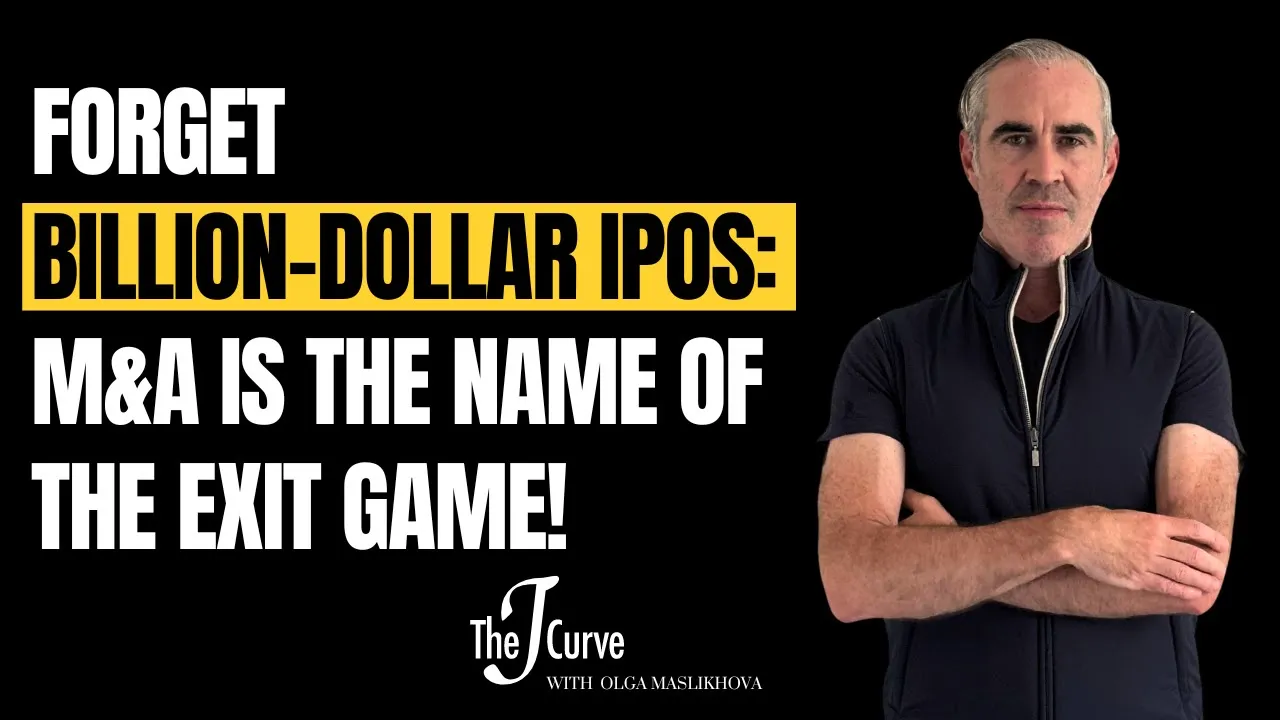
Dave Nangle, CEO at VEF: Forget Billion-Dollar IPOs, M&A is the Name of the Exit Game in VC!
51.7K
In emerging markets venture capital, M&A is often a more reliable and attractive exit strategy than IPOs due to underdeveloped public markets, limited liquidity, and the challenges of navigating complex regulatory environments. VCs should focus on building permanent capital vehicles that allow them to maintain ownership through extended market cycles, invest in companies with strong unit economics and product-market fit, and prioritize single-country, single-product strategies that can achieve scale before considering exits. This approach requires patience, discipline, and the ability to resist herd mentality during market peaks.
Click to watch →
Deep Dive
Alternative financing mechanisms such as venture debt, crowdfunding, angel syndicates, and bootstrapping.

CFA to MBA (ISB) to Private Equity Analyst | Coffee, Careers & More... Episode 05
22K
Venture debt and convertible notes provide alternative financing when equity financing is unavailable. Venture debt offers guaranteed interest returns and seniority over equity holders. Convertible notes allow debt holders to convert to preferred shares when companies raise new financing at higher valuations, with valuation caps providing upside participation. These instruments are typically used when companies cannot close equity rounds or need additional capital between financing rounds.
Click to watch →

Ed Unit 2 |One shot Sanjeevni Booti Marathon| Calcutta University| CCF
4.4K
Venture capital provides financial investment to new and growing businesses with high growth potential, in exchange for equity ownership. Angel investors are wealthy individuals who invest personal funds in startups at early stages, providing both capital and mentorship. Crowdfunding enables entrepreneurs to raise small amounts from many people through online platforms like Facebook and Instagram. Business incubators nurture startups by providing workspace, mentorship, training, and financial guidance during early development stages.
Click to watch →

African Start-up Investment Summit 2020 - Part 1 - Webinar
457
Venture debt is a commercial debt instrument that minimizes dilution for entrepreneurs and equity investors, providing liquidity to extend runway and prove business growth stories. It typically includes warrant components for lenders. Crowdfunding addresses multiple challenges: it provides local investment solutions, digitizes processes, creates SME databases banks lack, and offers alternatives when traditional equity financing is unavailable. Different crowdfunding types serve different purposes: donation-based for immediate relief, equity for ownership stakes, debt for loans, and invoice-based for working capital. The 'missing middle' refers to the financing gap for deals between $20,000 and $500,000 that are too small for venture capital but too large for angel investors.
Click to watch →
Innovating the funding of innovation: Skyler Fernandes at TEDxConnecticutCollege
4.6K
Alternative financing mechanisms address systemic gaps in traditional capital access. Harvard's Entrepreneurial Finance Lab developed psychological credit scoring systems assessing entrepreneurial potential through 45-minute personality analyses, evaluating curiosity, memory, and ethics rather than traditional credit metrics. Standard Bank implemented these approaches in South Africa and Kenya with promising results. Crowdfunding encompasses three models: donation-based (71% of crowdfunding, no returns expected), lending-based (reviving community banking principles used historically in frontier markets), and equity-based (now enabled by the Crowdfund Act). The Crowdfund Act, signed by President Obama on April 5th, permits individuals earning less than $100K to invest in small businesses through crowdfunding structures. This democratization creates access to a massive pool of potential investors, with approximately 1% of all US long-term investments equaling more than ten times the venture capital invested in 2011.
Click to watch →

Fund Your Startup WITHOUT Venture Capital
267
Startups can fund their growth through multiple non-VC options including bootstrapping, corporate grants, government grants, crowdfunding, family and friends, debt financing, accelerators, and angel investors, with venture capital being the last resort rather than the first option.
Click to watch →
Deep Dive
The structure of Venture Capital firms, exploring the relationship between Limited Partners (LPs) and General Partners (GPs).
Shark Tank & Indian Startup World EXPOSED | REAL Shark Archana J - Venture Capital & More | TRS
594.5K
Venture capital firms are managed by general partners (GPs) who raise funds from limited partners (LPs). LPs provide capital without knowing specific investment decisions, while GPs make all investment choices. LPs expect returns that outperform stock markets and inflation, with lower risk exposure.
Click to watch →
Ernestine Fu: All You Need to Know About Venture Capital
764.7K
Standard VC fund fee structures include 2-3% management fees (allowing GPs $2-3 million to manage a $100 million fund) and 20% carried interest on profits. For a $1 billion fund generating $2 billion in profits, LPs receive $800 million and GPs receive $200 million. Critical alignment issues include control over investment committee voting rights and preventing LPs from taking carried interest, which creates misalignment between GP and LP incentives.
Click to watch →
Venture Capital Defined | Claudia Zeisberger
8K
Venture capital funds operate through a partnership structure with General Partners (GPs) who source deals and manage portfolio companies, and Limited Partners (Lps) who provide capital including pension funds, endowments, and high-net-worth individuals. Funds are structured as closed-end limited partnerships with 10-15 year lifespans, creating illiquid investments for LPs. The standard compensation model is 'two and twenty': 2% annual management fee plus 20% of net profits as carried interest. The distribution waterfall requires returning invested capital to LPs before GPs receive carried interest. The fund cycle progresses through LP investment, capital calls for investments, portfolio company management, and exits via IPO or trade sale, with distributions returning capital plus profits to LPs who may reinvest in successor funds.
Click to watch →
How VC works | How VC funds are structured | VC 101
30.8K
Venture capital funds are structured as limited partnerships consisting of General Partners (GPs) who manage the fund and Limited Partners (LPs) who provide capital; GPs have unlimited liability but are typically organized as LLCs to protect individual members, while LPs have limited liability meaning their responsibility is capped at their investment stake.
Click to watch →
![현시국은 제2의 블랙스완인가? '스킨 인 더 게임' - 나심 탈레브 (f.송진호) [투자는 책과함께 #59]](https://i.ytimg.com/vi/nDuQZR63nJw/maxresdefault.jpg)
현시국은 제2의 블랙스완인가? '스킨 인 더 게임' - 나심 탈레브 (f.송진호) [투자는 책과함께 #59]
114.8K
In private equity and venture capital, LP (Limited Partner) refers to investors who provide capital but do not participate in management, while GP (General Partner) refers to the investment firm or company that manages the funds and makes investment decisions. LPs are typically institutional investors or individuals who contribute capital, while GPs are professional investment managers who run the investment operations. The video explains that venture capital firms like Magna Investment operate as GPs, managing funds from LP investors.
Click to watch →
VC Basics
Funding Rounds
VC Basics
0:00- 1
Venture capital funds high-potential startups with investor money.
- 2
Investors expect major returns to offset frequent startup failures.
- 3
Tech firms are favored due to their easy scalability.
Bootstrapping and Sustainable Growth: The Case Against Venture Capital
While venture capital (VC) is often celebrated as the default path for startups, critics argue it is unsuitable for most businesses and can even be detrimental. The "growth-at-all-costs" mentality demanded by VC investors often forces premature scaling, leading to high failure rates. Additionally, founders face massive equity dilution and forfeit control of their company's vision to board members focused solely on a rapid, massive exit. An increasingly popular alternative is "bootstrapping"—funding growth through customer revenue—and focusing on sustainable profitability. This approach, championed by the "Zebra" movement, prioritizes long-term viability, founder autonomy, and social responsibility over the high-risk "Unicorn" pursuit of VC-backed firms. Other alternatives, like revenue-based financing, allow founders to retain ownership while scaling at a manageable pace.
Basic corporate structure and equity ownership, specifically how shares represent company ownership.
The difference between traditional small businesses and scalable, high-growth startups.
Fundamental financial concepts including valuation, revenue vs. profit, and debt vs. equity financing.
The risk-return spectrum in investing and the basic concept of capital appreciation.
Deep dive into VC term sheets, including negotiation dynamics, liquidation preferences, and dilution.
The mechanics of startup exits, comparing the processes and implications of Mergers & Acquisitions (M&A) versus IPOs.
Alternative financing mechanisms such as venture debt, crowdfunding, angel syndicates, and bootstrapping.
The structure of Venture Capital firms, exploring the relationship between Limited Partners (LPs) and General Partners (GPs).
572.9K views11.9Klikes2:22@ForbesOriginal Release: 2016-03-23
venture capital is something you hear about all the time in Tech but do you know what it is or how it works could you explain it to people at a party well if not we got you venture capital is money that is provided by investors to startups that have the potential to reshape markets and grow very fast the money deployed by a VC firm usually comes from institutional investors corporations or wealthy individuals looking to make some serious dop let's say Jane and briyan have a camera app that's getting a lot of customers and media attention they know their little company could be balling one day but the banks are hesitant to lend them money because they think it's too risky but Marcus the successful VC looks at what Jane and Brian have done and thinks the benefits outweigh the risks he gets to know the two learns about their product reads the business plan and finds out how much they've done so far Marcus likes what he sees and decides to invest in Jane and Brian's company he does the same in varying amounts to other startups with similar potential because in the VC game you need a backup plan about three out of every before startups fail so a VC has to make sure the projects that do make money make enough of it to cover the losses of the failures they also have to make sure that the parties who back them get a healthy return on their investment even with the risks VC's love Tech startups because of their ability to scale easily as for how much money Jane and Brian would get that depends on where their company is at seed funding is at the earliest stage basically something to get the party going series A is for when the company has established product and Market it started to make some serious buzz and its customer base is growing fast series B is when the company has started to make some considerable Revenue in select markets and is looking to expand operations series C and onwards is when the company has grown up and is likely operating on a global scale it may be ready for an IPO to be bought out by another company or continue operating as a private firm so let's say Jane and Brian have stayed in the game gone through series C and are now ready for the next step they decide to IPO making their company public on the stock market that goes well and Marcus sees a nice return on his initial investment so there you have it venture capital is a high-risk High reward game that funds innovative ideas and keeps the tech world going
Up Next

11:44
Core Pitch Deck Slides VCs & Angels Expect | Startup Fundraising Guide
@designfordecks
289 views•2023-03-13

46:36
Retention Habits of Top DTC Ecommerce Brands Revealed
@SendItPodcast
44K views•2026-03-03

15:23
Decoy Effect: How Pricing Psychology Influences Consumer Spending
@bobinvestsUS
90K views•2026-01-05

17:30
The Planned Obsolescence of Light Bulbs and Tech
@veritasium
25.3M views•2021-03-26
Related Study Plans & Knowledge Roadmaps
Structured learning paths in Business
business
Pop-Up Retail: Strategy, Design & Execution
01Introduction to Pop-Up Retail & Strategic Goal Setting
02Budgeting, Site Selection, and Legal Essentials
03Experiential Retail Design & Visual Merchandising
+ 2 more learning modules
15h5 modules
Explore Roadmap
business
Reg CF: Startup Funding, Marketing & Launch
01Introduction to Equity Crowdfunding & Reg CF
02Platform Selection & Legal Preparation
03Crafting High-Converting Campaign Assets
+ 2 more learning modules
14h5 modules
Explore Roadmap
business
Productized Services: Scaling Solo Freelance
01Foundations of Productized Services
02Packaging and Scope Definition
03Pricing and Subscription Models
+ 2 more learning modules
15h5 modules
Explore Roadmap
business
Gov Procurement: Find, Bid & Win Contracts
01Introduction to Government Procurement & Business Setup
02Small Business Certifications & Set-Asides
03Finding and Analyzing Contract Opportunities
+ 2 more learning modules
14h5 modules
Explore Roadmap