























Scientific knowledge is socially constructed, meaning that even seemingly objective scientific theories like our understanding of gravity are shaped by social, cultural, and institutional factors rather than being purely objective truths; this is illustrated through the dark matter controversy, where the astronomical community collectively chose to invoke invisible matter rather than modify gravity, demonstrating that scientific choices involve subjective judgments influenced by cultural values such as the preference for elegant, unified explanations.
Gravity as a Social Construct: A Philosophical Analysis
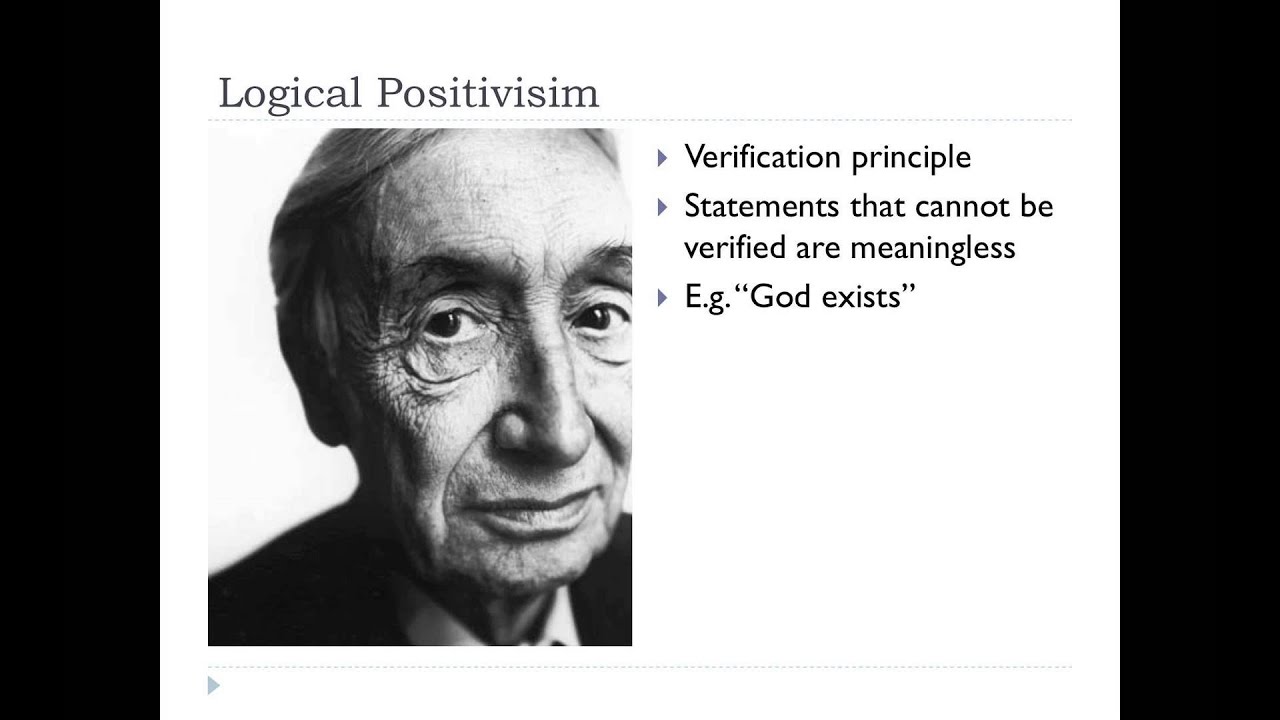
Added:Fundamental concepts of gravity, specifically the transition from Newtonian mechanics to Einstein's General Relativity.
The astrophysical anomalies (like galaxy rotation curves) that led to the opposing hypotheses of Dark Matter and Modified Newtonian Dynamics (MOND).
Basic tenets of the philosophy of science, specifically the debate between scientific realism (science discovers objective reality) and anti-realism/instrumentalism.
Thomas Kuhn's concept of scientific paradigms and how scientific consensus shifts over time.
The Sociology of Scientific Knowledge (SSK) and key frameworks like the 'Strong Programme' or Actor-Network Theory (ANT).
The 'Science Wars' of the 1990s, analyzing the intellectual conflict between scientific realists and postmodern critics.
Advanced studies in the philosophy of space and time, exploring relationalism versus substantivalism.
Current observational astrophysics developments that aim to empirically test and resolve the Dark Matter versus MOND debate.
320.6K views20Klikes1:09:48Original Release: 2023-10-01
In the philosophy of science, constructivism is the perspective that, while reality may exist independent of our silly little human brains, scientific knowledge is socially constructed.
But definitions are boring.
Vibes are far more important.
How do scientists *feel* about this idea?
Let's examine the data.
"A perverse doctrine that subordinates rationality to politics and unbridled subjectivity."
"An indefensible reduction of all claims about nature to equally contingent status."
"A conspiracy of leftists, humanists and social scientists against both science and Western civilization."
Fascinating.
I'm going to go ahead and say that most scientists--you know, I could be wrong about this, but it's the impression I get from years in the field, extensive study on the culture of science, and, you know, being a person online-- most scientists don't find constructivism that helpful an idea.
But lucky for you, I'm not most scientists.
My doctoral research was in astrophysics, but more recently I've been publishing papers and making videos about the more social and political aspects of science.
And the whole point that I'm trying to get across is that even the hardest of the hard sciences are still affected by messy people stuff.
And I get the impression that some people are kind of starting to come around to that idea, especially in fields like medicine or maybe even technology, but not physics, right?
PHYSICS is just the fundamental truths about the universe!
Particles don't care about the political climate.
Radiation doesn't discriminate against women.
Gravity isn't a social construct!
...Right?
In this video I'm going to use gravity, dark matter, and a controversial, but in my opinion, compelling theory to illustrate why even the most objective, rational, definitely not made up facts about the universe are indeed socially constructed.
And don't worry, I'm going to explain what that even means.
But it's going to be a lighthearted and fun video today, I promise.
this isn't going to end up being about racism or something heavy like that. About God-- maybe. But not in the way you think!
Just watch it, trust me, it's going to be a good one.
Before we get into it, I want to lay out a few working definitions because I feel like a lot of conversations about squishy human subjects like this tend to get stuck on semantics, and social constructivism is definitely the kind of term that means different things in different contexts.
So if you're mostly here for the physics, bear with me for just a little while I talk about *sociology*.
Social constructivism is broadly the idea that the natural world just kind of exists, and then scientific knowledge is what we create in our attempt to model the natural world, but it is not the same as transcendent truth about the natural world.
In other words, knowledge is something we construct.
One way to build a stronger intuition for what this means is to consider the opposite philosophy.
Objectivism.
Not that weird, like Ayn Rand objectivism, where productivity is man's most noble calling or whatever.
The scientific objectivist belief that us mere mortals can in fact deduce fundamental truths about the universe transcendent of approximations or models.
But like many things in the social sciences, these philosophies exist on a spectrum.
On one end of the spectrum, we have objectivism and on the other end, strong constructivism.
The two genders. Strong constructivism is where an objective observer independent reality just doesn't exist.
Or at least that us humans are indelibly incapable of accessing it.
So it might as well not exist.
Closer to the objectivist end, we can consider a weak constructivism that proposes The goals of science at any given time can be reflective of the surrounding culture or the vague claim that individual scientists work will tend to follow the money.
But somewhere between the weak and strong versions, we have a whole lot of epistemological question marks that constructivist analysis aims to answer: When does an experiment sufficiently capture a natural phenomenon?
What happens when theories conflict with each other?
How are unexpected outlying data points interpreted? And critically, how are any of these things influenced by the people who are doing them?
I've talked in videos before about the strong constructivists and and the weak constructivists, and so today I'm concerning myself with this middle area that's less about the nature of reality or the influence of politics, and more about the choices made in the process of conducting scientific research.
In Act One, we'll look at the science.
We'll go through a brief history of gravity, do a little primer on dark matter, and introduce a theory that is attempting to challenge it.
In Act two, we'll get to more of the social side.
We'll learn how the scientific method is actually kind of messy, get into how this messiness opens up space for subjective interpretations, and look at what kinds of things can influence those interpretations.
We're going straight philosophy of physics today, and I, for one, am very excited about it.
Everyone ever has known that gravity exists.
I want to like, drop something as a demonstration, but I don't actually have anything I want to drop... Gravity!
Even animals know what gravity is, at least to the extent that their behavior is obviously informed by its existence.
Like, have you ever seen a cat do a really precise jump over something? You can't tell me that that cat doesn't understand what parabolic motion is, just as well as any intro physics college student.
Maybe not in equations or words, but as an experience for sure.
Arguably, the only beings to ever not intuitively understand that gravity exists are astronauts who just got back to Earth and haven't yet remembered that they can't just put things down in midair.
Now, you know, you've got the space station right up there that--- [space confusion] I start with this comically basic understanding of what gravity is because some people will inevitably try to counter the whole social construct thing with this level of argument, about it just being so obviously real and clearly not made up.
So I bring up these examples to illustrate the difference between some inarguably self-evident shared experience and specific scientific descriptions of something, which is the part that I'm arguing is socially constructed.
Me, you, and the cat can all agree that there is definitely some fundamentally real thing that makes some things fall into other things, but that is different than a scientific theory, and it precedes any attempt to characterize it.
The earliest written descriptions of gravity come from Greece and the Indian subcontinent and don't get much more advanced than vague notions of: things tend to fall down towards the earth instead of up towards the sky.
Neat!
Eventually, people started using numbers to describe this tendency more precisely and came to the conclusion that things fall down towards the earth at an acceleration of about 9.8 meters per second squared.
The first mathematical formulation of gravity is often attributed to Galileo in the 17th century, but his work was built on 11th century polymath Ibn Sina's work on projectile motion, as well as 12th century polymath Abu'l Barakat al-Baghdadi's relations between acceleration and force.
Really bummed that I missed the era of interdisciplinary Middle Eastern scientists. Or artist scientists, like, Da Vinci actually helped this whole gravity progression along in between painting seminal masterpieces.
Today's physicists could never!
So with this first quantitative description of gravity, we went from being able to predict that if you drop something, it will hit the ground, to if you drop something, this is how long it will take to hit the ground.
We did it.
We made science.
However, as mathematically rigorous as this description was, it had limitations.
The acceleration due to gravity of 9.8 ish meters per second squared that we use in an intro physics class actually varies depending on latitude.
Someone in Ecuador, for example, would measure a slightly different gravitational acceleration than someone in Sweden, and both of them would measure something completely different than someone on, say, the surface of Mars.
So while this formulation of gravity was true enough to like, hit a rival ship with a cannonball or something, it was by no means internationally true, let alone universally true.
We didn't get that until a guy named Isaac iterated on the work of Galileo and another guy who thought therefore he was, and came up with what we now refer to as Newton's law of universal gravitation.
"Universal" because this description wasn't specific to gravity on the surface of the Earth.
Newton's formulation described the gravitational force between any two bodies with mass: you and the Earth, the Earth and the Sun, Jupiter and the Galilean moons, whatever.
Any two objects with mass will experience a gravitational attraction between them that increases with either object's mass and decreases with the distance separating them.
Boom, We figured it out.
But for real this time. We've cracked the code to predict not only the motion of objects here on Earth, but the orbits of the celestial bodies, and theoretically, anything else in the universe with mass.
We're definitely right this time!
But again, while more broadly useful than the previous Galilean formulation, Newton's law of universal gravitation wasn't quite as universal as he thought.
For example, in the 1800s, astronomers had measured the orbit of the planet Mercury, so precisely that they found it to be inconsistent with what Newton's law of universal gravitation would predict.
So they figured that there has to be another planet in closer to the sun.
Spoiler alert there was no such planet.
It wasn't until Albert Einstein developed his theories of relativity at the start of the 20th century that Mercury's weird orbit could be explained.
The TLDR of relativity is that the rate at which time passes can be altered by extremely high speeds or stronger gravity.
Time is relative, so everything else is too. Relativity is trippy and weird and too complicated to explain here, but the important thing that you need to know for our purposes is that we were able to make even more precise predictions about gravity with it.
And many experiments have supported Einstein's theory of relativity: from Eddington's observations of gravitational lensing during a solar eclipse in 1919, to measurements of stellar orbits around the supermassive black hole SagA* in the middle of our galaxy made just a few years ago.
So we're definitely right this time!
As powerful as this set of theories is, even IT has shortcomings.
Most famously, the relativistic construction of gravity is incompatible with quantum mechanics, which is arguably the other most successful set of theories to come out of the last century of physics.
Both of these paradigms make extremely robust predictions in their own regimes, relativity describing interactions between the most massive objects like stars and black holes, and quantum mechanics describing interactions between the smallest things like particles and light waves.
But they break down if you try to consider them together because they each make different assumptions about the underlying nature of reality.
In quantum mechanics, causality is statistical, almost random seeming, the rate of time passage is static, and the universe has some baseline resolution as if it's made out of really tiny pixels.
For relativity to work, however, causality is necessarily deterministic: one cause can yield only one effect.
Time is relative, like we said before, and the universe is continuous; there isn't some minimum size or mass that things can be.
This is a great opportunity to point out the problem with thinking of scientific knowledge as either right or wrong.
A naive, if not kind of understandable, reaction to these conflicting theories might be to say, well, if they contradict, one of them must be wrong.
But the reality is that they both work.
They both have predictive power, but each one has a particular context in which it's predictive power is reliable.
In fact, it doesn't really make sense to call earlier theories of gravity wrong either.
Newtonian gravity works for certain contexts.
Galilean gravity works for certain contexts.
Hell, even the ancient Greek models that were barely more sophisticated than a cat's understanding of gravity works in certain contexts.
I mean, the cat got over the thing, didn't it?
Sometimes the cat knowledge is enough.
Each model accounts for the knowledge that was available at the time, and was iterated on as are new discoveries and ideas illuminated are ignorance.
And it's easy to look at this history of gravity and feel like we're coming closer and closer to the truth.
But in reality, it only seems like that in hindsight.
When you learn a lineage of increasingly successful theories in a physics class or science documentary, you generally don't learn about the false starts and failed ideas that were necessary to get us to where we are today.
So to complicate matters a bit, we're going to shift gears into a modern problem in astrophysics that continues to illuminate our ignorance about gravity: dark matter.
.
So I'm going to go ahead and hazard a guess that most of you have heard of dark matter before, and are at least vaguely aware of it as something that probably exists.
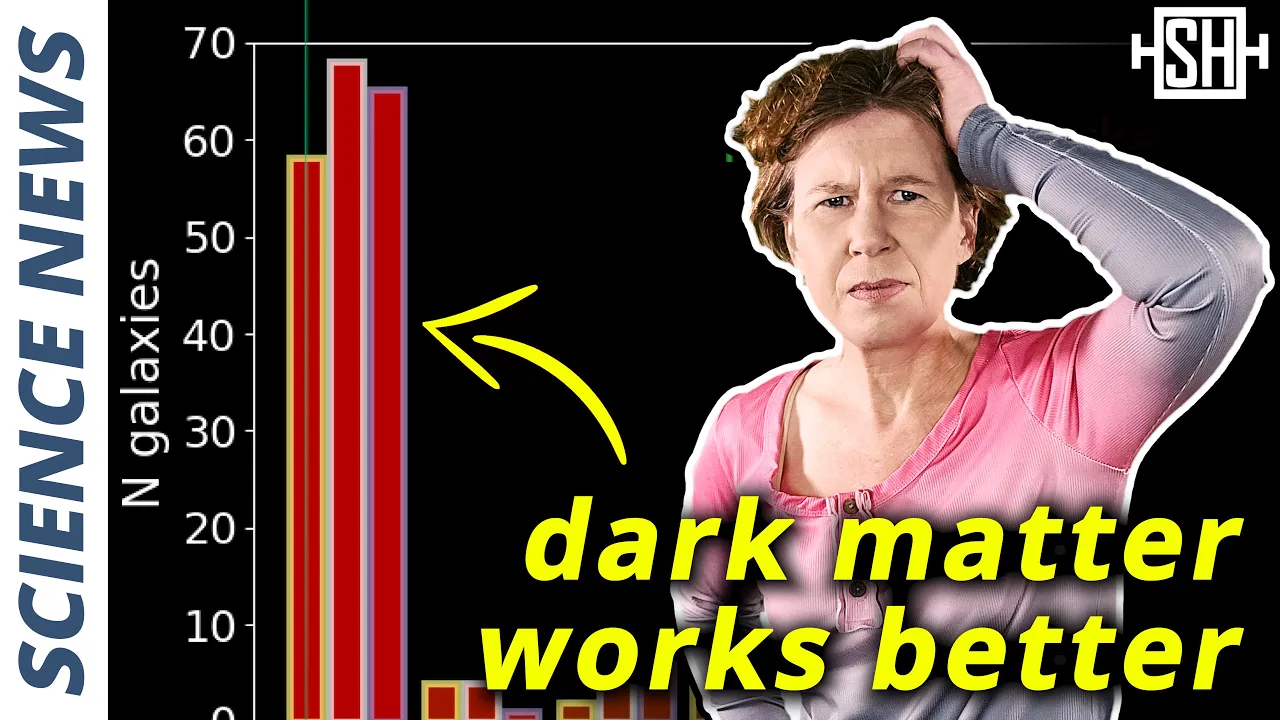
As another astrophysical lady YouTuber who I get compared to a whole lot has explained in a recent video of hers: "Dark matter is not a theory.
It is an observation." For our purposes today, I'm only going to explain one of these observations as a mental foothold for my broader argument, but I will refer to some of these other observations a little in passing.
So if you want a more solid baseline explanation of the full set of observations, go check out her video if for no other reason than to hear the dark matter rap. "Dark matter.
Do we need it?
What is it? Where is it? How much?" Iconic.
So what is this observation that we call dark matter?
The graph I'm going to use to explain this is called a rotation curve, and it shows how the speed objects in orbit around something changes as they get farther away from that thing.
So if we were to make a rotation curve of the solar system, for example, this axis would be each planet's distance from the sun, and each point's height would tell us how fast the planet is orbiting.
And we have a trend: The further the planet is, the slower it orbits, because the force due to gravity, which is what's driving the orbit, gets weaker with distance.
But it's slightly more complicated than that.
The mass that gravitation really drives the orbital speed isn't just the thing in the center---it's everything inside the orbit.
But because the sun is so much more massive than even all the planets put together, the difference in mass inside Mercury's orbit and the mass inside Pluto's orbit isn't that important.
So the variation we see in this rotation curve is mostly just because of the changing distance.
If we were to make the same graph for a galaxy rather than a solar system, we would expect the curve to look a little bit different because the mass isn't as concentrated in the center.
The further you get, the more stuff you're orbiting.
So instead of the graph dropping off quickly, it holds up for a while.
But once you get to the edge of the galaxy where there's not that much more stuff being added, the graph should begin to drop.
Or at least that's what we would have expected.
Turns out, when we measure the speeds of the furthest out orbiting stars and gas and galaxies, they're going much faster than we'd expect.
As if there was a lot more stuff inside those far out orbits than we can see.
And that difference, between the rotation curve we'd predict based on the mass of the matter we can see in the galaxy, and the actual rotation curve we get when we measure how fast things are moving, is what we call dark matter.
"Why would you call it dark matter?
You don't even know if it's matter, so shut the hell up."
The term dark matter is simply a label for a particular way in which our understanding of the universe is wrong.
It is exactly this wrong, and that wrongness is what dark matter is.
It's not a theory, it's a set of observations, and this is one of them.
Now, everything I've said so far is just kind of categorically true.
This is the prediction that our currently accepted models of gravity expect and this is the measurement we see when we try to test those models.
Neither of these things is really up for debate.
I mean, I could probably make it up for debate, but I won't.
But even though what I'm about to say next could be found in any intro astronomy textbook, I want to mark this point as the end of me sharing facts about dark matter and the beginning of me sharing theories about dark matter.
There's a difference and it will make more sense as we go.
Would it be mixing metaphors if I said we're now crossing the event horizon? Whatever, I'm a physicist, not a poet.
So the prevailing explanation for why these two curves look different is because is some invisible stuff in galaxies.
And if this were to be the case, there are two things we could confidently say about it.
First, that it doesn't interact electromagnetically: it doesn't emit light, or absorb light, or reflect light, and is therefore completely undetectable in images that rely on light coming from an object.
Or according to some theories, it doesn't interact electromagnetically much. Hence: "dark".
And secondly, it does interact gravitationally.
Because it's causing these gravitational effects on orbits, it must have mass, which means it must be some kind of matter.
Thus, dark matter stuff with mass that we cannot see.
Hard to see stuff.
And that's a fine idea, but there's kind of a big hole in it and that's that we don't have any real idea of what it actually is.
There are a ton of different models for what dark matter is, but none of them explain the observations completely.
Some theories model dark matter as a kind of particle, like axions or gravitinos or what somebody very cleverly named Weakly Interacting Massive Particles. Feels like projection. Presumably playing off that pun, somebody proposed a theory for dark matter in which it was made of large, dark objects like black holes or brown dwarfs, instead of a fluid of particles, and named them Massive Compact Halo Objects.
So at one point the competing theories for dark matter were WIMPs and MACHOs. This is an astronomers idea of a good joke, by the way.
This is astronomy culture. And it's not like a nickname or something, the title of a paper I published once has the word 'MACHO' in it twice because of the name of the events I'm analyzing. I was looking for black holes and the data I used to identify them came from the MACHO project, because black holes could maybe be a kind of MACHO.
So the maybe black holes for my thesis are named things like MACHO-96-BLG-5.
I always had more hope in that one, I was never convinced by MACHO-98-BLG-6. At 100,000 subscribers, I'll do a video about my old astrophysics research, so if you want to hear more about this overdone tangent: smash that subscribe button! I hate myself when I do this sometimes. Sorry, the pun thing really got me going.
So some people think dark matter is an invisible particle.
Some people think it's big, dark things.
Some people think it's a fifth dimension that somehow makes everything make sense.
There are theories of cold, dark matter and hot dark matter and even warm dark matter.
My personal favorite theory is that of primordial black holes, which are like teeny tiny little black holes that formed right after the Big Bang, because I think it's cute. The uwu theory of dark matter, if you will.
This must be what Contrapoints felt like when she said 'squidwardian'.
"Are you really saying that word out loud? To an audience of millions?
Lol okay," But here's the problem.
None of these theories of dark matter on their own can explain all our observations.
Like I said earlier, there are other kinds of observations besides the rotation curves of galaxies that point to some undetectable mass of an unknown nature, and different models of what dark matter actually is are better able to explain the different observations.
This Balkanization of theories is not dissimilar from the story of luminiferous ether, which 19th century physicists used to explain how light traveled through empty space.
Just like with dark matter, some effectively invisible material was predicted in order to explain unexpected experimental results, and the models fractured further and further until everybody had an ether theory to match their favorite observation.
And just like with ether, some scholars have called this multiplicity of models a crisis for the dark matter community, contrasting the minimal evidence of any one model with the massive amounts of effort that have gone to experimentally testing them.
Dark matter is one of those particles that for decades physicists have been saying they're going to find it in the next ten years, and haven't. We just need to build a particle accelerator the size of Earth's orbit! Then we'll find it.
Given everything I've learned about dark matter, I'm inclined to agree with astrophysicist Mordehai Milgrom's take on the search: "If one does not presuppose anything about what dark matter is, about what its interactions with baryons and with itself are (besides gravity), and about how it got to where it is, then it is hard to rule out. My God, the shade! He is kind of right, though.
It is pretty hard to rule out a theory when you have no evidence.
And you might be thinking, but what about those rotation curves?
We learned a whole graph for it, isn't that evidence of something? Well, it could be.
Or we could just be wrong about gravity again.
.
Remember earlier when I said that Mercury had a weird orbit, and that in order to explain it, astronomers predicted there might be another planet closer in to the sun?
So even though this was wrong, there was good context for it.
French mathematician and astronomer, Urbain Le Verrier--Urbain Le Verrier?
Urbain Le Verrier. Whatever his name was, the guy who identified Mercury's weird orbit had actually predicted the existence of Neptune just a few years earlier based on weirdness in Uranus orbit.
He used Newtonian gravity to analyze the orbit of Uranus and found it to be slightly off from what the observers were measuring.
So he deduced that there must be another planet there that nobody had seen yet causing these gravitational perturbations.
And there was!
He sent his calculations to an observer who identified Neptune literally that same evening.
Truly a testament of Newtonian mechanics is predictive power.
So when he found similar gravitational anomalies in Mercury's orbit, he theorized that there may be once again an unidentified planet to blame.
And since he was so successful last time he did that, the community went all in.
The search began, sub-theories proliferated, and they even gave the putative planet a name: Vulcan.
There's a weirdly high rate of almost having things called Vulcan in astronomy.
Some of it precedes Star Trek. But as we know today, there is no planet Vulcan.
And it wasn't until a century later that Einstein's theories of relativity came along to explain why Newtonian gravity just wasn't adequate to predict an orbit as close to the Sun's gravitational influence as Mercury.
I share this example of planet predictions because it illustrates two diverging responses to failed experiments.
You make a prediction, you take a measurement, your prediction doesn't match your measurements. What do you do?
Well, when it came to Uranus, the answer was to imagine what other stuff might be affecting the data and then look for that stuff.
And sometimes that works.
But when it came to Mercury, it wasn't that there was unaccounted for stuff, it was that the theory the predictions were based on was inadequate.
Do you see where I'm going with this?
On the whole, the astronomy community in the last century ish has determined that in order to resolve the difference between what we see and what we predict in galaxies, there must be some stuff out there that we're not seeing.
Neptune must exist, so to speak.
But what if dark matter isn't like Neptune?
What if it's like Mercury?
What if the assumptions we used to make this were just wrong?
Well, that guy Milgrom, whose brutal dressing down of the search for dark matter I just quoted, kind of developed a whole theory for this.
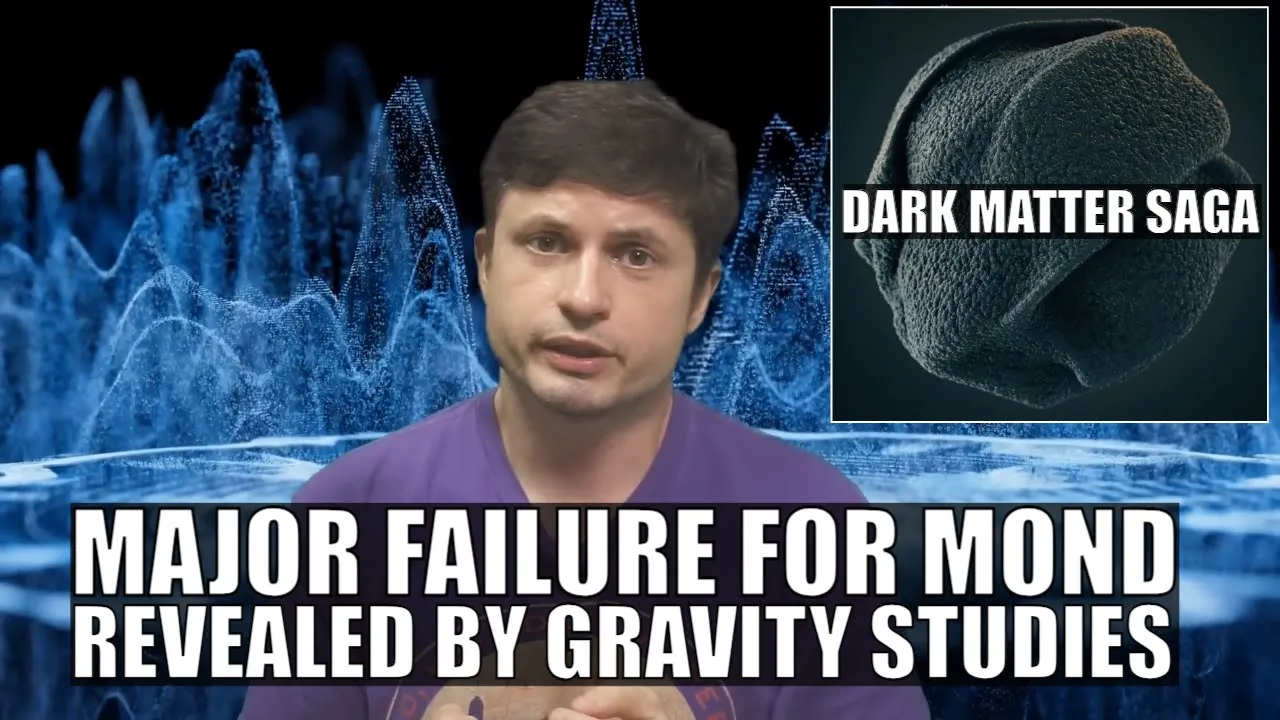
It's called Modified Newtonian dynamics, or MOND, and it's an alternate explanation for the dark matter observations that makes adjustments to our understanding of gravity instead of inventing invisible ether stuff.
Milgrom published his first paper on MOND in 1983, 50 years after the term dark matter was coined by Fritz Zwicky.
And while, as I'll get to in a minute, it's not exactly a popular theory, it is legitimate insofar as there are hundreds of peer reviewed papers on it.
It's fringe, but it's decidedly not in crackpot territory.
Now, I'm not going to get into the mathematics here-- mostly because I refuse to ever show an equation on this channel on principle-- but in the same way that Einstein's relativity usurped Newtonian mechanics because it was more broadly applicable in the situations of extremely high speed or gravity, MOND proposes additions that also account for very low accelerations, which becomes more relevant when you're considering things on the size scale of galaxies, for example. If you want all the math, you can go read the papers yourself.
My references are in the description.
I feel like when my old college professors would like introduce an idea and be like and you can go home and do the derivation for fun if you want!
And it's like, what nerds actually did that??
...I did that.
But the important thing is that by making tweaks to our current understanding of gravity, we would be able to make predictions for the rotation curves of galaxies that match our observations better.
But like previous changes to gravity, MOND doesn't negate what came before it so much as add to it.
MOND makes gravity predictable in a wider range of situations.
And there's actually decently compelling evidence for MOND.
Unlike most models of dark matter, people have actually used it to make successful predictions in advance of seeing data instead of adapting to data after the fact, which you would think would be an important quality to consider when evaluating competing theories.
But as we'll get to later, not the most important.
And to be clear, I'm not going to sit here and pretend that MOND is definitely the more correct hypothesis.
I think the strongest argument against it is that it can't account for everything.
In particular, it's not very good at explaining the cosmological scale dark matter observations that I didn't get into because this video needs SOME bounds.
But when it comes to galaxy scale observations like our rotation curves, papers published as recently as last year argue that MOND actually works better than any one model of dark matter.
I should also mention that there are more theories of modified gravity than just MOND, and some of them do a better job with the cosmology stuff.
Kind of similar to how there are many models of dark matter that each do better or worse at explaining different pieces of evidence.
I'll just say 'MOND' for the rest of the video, but know that I'm using it as a shorthand to refer to the multiplicity of models that solve dark matter by updating gravity rather than inventing space ether.
But as interesting as this theory is, the field doesn't really like it.
As in, and forgive me for generalizing, but most astronomers do not take MOND seriously as an option for explaining dark matter.
Anecdotally, I can say that in my ten years studying astrophysics, I had only ever heard MOND referred to once in earnest and any other time I had heard anybody mention it, it's been as a joke. Like, look at those kooky MOND researchers who think they're going to solve gravity, so silly. Who's even funding them?
MOND is like astronomy's embarrassing cousin that gets lumped in with E.T.
research and is like, in the space of technically legitimate but effectively crackpot-y.
Actually, that's not true. People respect SETI.
I'm going to go out on a limb and say most astronomers take them more seriously than they do the MOND people.
But beyond my own personal experience, you just have to look at an astronomy textbook to see the institutional erasure of MOND as a viable solution for dark matter.
Here's what my first astro textbook says about dark matter: "To explain these nearly uniform orbital speeds in the outer parts of the galaxy, astronomers conclude that a large amount of matter must lie outside the sun's orbit.
This unseen material, which is by far the predominant constituent of our galaxy, is called dark matter."
Not astronomers hypothesize, not astronomers are evaluating.
"Astronomers conclude". There IS unseen material and it is called dark matter.
I look through all of my old textbooks that I had lying around and all of them had sections on, you know, dark matter that describe MACHOs and WIMPs and axions and all that stuff.
But literally no mention of the possibility of other formulations of gravity.
Curious.
Finally, we can compare the distribution of papers published on each topic, doing a quick search on NASA/ADS, which is *the* place to search for astrophysics articles, we get nearly 80,000 hits for papers with the key words 'dark matter' and only 1600 with the keyword 'MOND'.
That's a difference of nearly two orders of magnitude.
That's huge.
I bring all this up: MOND's complete absence from textbooks, the relative lack of research conducted on it, and the way it's literally treated as a joke by people I know to support the claim that as a community, the field of astrophysics has made a choice.
And I'm not saying that the council of astronomers who demoted Pluto got together again to suppress MOND.
I'm saying that we hit this phenomenological fork in the road-- the dark matter observations-- and we had the options of inventing something or adjusting our models.
And despite what I see as a good amount of compelling but non conclusive evidence supporting the validity of either option, the field has very clearly made a decision.
And this is really interesting to me because it is such a good example of the problem in thinking that science is some linear march towards objective truth, where we get closer and closer to the end by using our manly, emotionless rationality.
That attitude towards science lacks the complexity of making choices.
Like a great philosopher once said, "everybody got choices".
Even scientists got choices!
[F-30: Invent a particle we didn't see? NOPE Take another shot at modifying gravity? YUP] That was a pretty deep cut, but I couldn't not.
And I cannot stress this enough: those choices are not a failure of the scientific method.
In fact, they're necessary for the pursuit of science to go anywhere at all.
Wow. What a cliffhanger.
I don't know about you, but I'm excited to see where this is going.
But before we get to that, I got to do my least favorite part of the video: the part where I give you the uncomfortable choice of paying for the content you're watching or not. See, I have this kind of idealistic belief that if I make something good and put it out into the world, that enough people will volunteer to pay me for it that I can keep it free for everybody who can't and not have to succumb to the various sponsor requests in my inbox.
Because wouldn't it be cool if I could get paid for my work without trying to sell my viewers something they probably don't want or need?
I think so, but I do understand it's a choice.
Some reasons one might choose not to support me on Patreon or because they can't afford $3 a month, because they don't think the videos I make are worth that, or because they're three raccoons in a trenchcoat and don't understand the idea of compensation.
I know my sincerity reads as sarcasm sometimes, but I really do sympathize with all those reasons, especially the raccoon one.
You would have no idea what's going on! But some reasons one might choose to subscribe to my Patreon are to watch exclusive videos where I answer questions patrons ask me or interview other creators get access to the ad free versions of my video essays, and help me pay my bills while still making this YouTube stuff.
Both choices are valid, and while they're certainly one that I'd prefer, I do understand that there can be good reasons either way.
So to those already supporting me on Patreon, thank you.
You're amazing. To those who already know they won't, that's fine.
I'm still glad you're here.
And to those considering it... you are the population who will determine how long I can keep doing this.
No pressure!
Just trying to help you make informed decisions.
Okay, that's enough discussion of like, personal finance choices.
Let's get back to the fun stuff: science choices.
So I know a lot of people think that science is just the straightforward application of the scientific method, and that's very cute. The fact that this[gestures at the scientific method] is only kind of sometimes what the process of scientific research looks like is a huge topic that I will probably make a whole video about whenever I get around to reading Against Method.
But today, I want to draw our attention to that ineffable initiation of inquiry: the hypothesis. The formulation of a hypothesis has been called the most mysterious step of the scientific method, because it's kind of hard to explain exactly where a hypothesis comes from.
How a hypothesis is constructed, if you will.
The choice of a hypothesis is so crucial to the whole scientific process, because what you choose to study determines what you're going to find out.
This is especially important when you have multiple or conflicting hypotheses.
How do you decide which one to point the scientific method at? One might naively think, Well, just systematically test all the hypotheses and whichever is the most successful determines where your theory goes. So objective!
But the inherent futility of the strategy is exactly what drove philosopher Robert Pirsig, who was a university biochemistry student at the age of only 15, to abandon science entirely after only a few years of research.
While doing laboratory work, he became obsessed with the idea of hypotheses in and of themselves, and in particular, their tendency to multiply.
As you test one hypothesis, he realized, many more hypotheses will come to mind.
And then when you go to test the first of those, you would get hit by yet another flood of hypotheses.
The more science you do, the more untested hypotheses you have.
At first he thought this is amusing and came up with like a jokey law saying that the number of rational hypotheses that can explain any given phenomenon is infinite.
But over time, his amusement transformed into a deep nihilism about scientific reasoning and its potential to lead humans to true knowledge of nature.
"If the purpose of the scientific method is to select from among a multitude of hypotheses, and if the number of hypotheses grows faster than experimental method can handle, then it is clear that all hypotheses can never be tested.
If all hypotheses cannot be tested, then the results of any experiment are inconclusive and the entire scientific method falls short of its goal of establishing proven knowledge."
"Establishing proven knowledge."
How much you want to bet piercing was one of those science students who picked the subject because of how much he likes that there's only one single definite answer to each question.
I say that like I wasn't also that student at one point. I thought I was sooo clever just choosing to learn absolute truths about the universe! Lolololol. For Pirsig, this realization of infinite hypotheses, along with the lack of rational tools to choose between them, was catastrophic for his ability to do science.
And I guess because he couldn't reconcile these complications with what I'm assuming was his starting point of dogmatic scientific rationalism and objective truth seeking, He dropped out of university just a few years later.
But others have realized these complicating aspects of science without having existed.
Social crises, for example, in "The Island of Knowledge: The Limits of Science and the Search for Meaning", Brazilian astrophysicist Marcelo Gleiser uses a metaphor of an island to describe how increasing knowledge actually takes us further from a final truth.
"As the island of knowledge grows so to the shores of our ignorance, the boundary between the known and unknown.
Learning more about the world doesn't lead to a point closer to a final destination--whose existence is nothing but a hopeful assumption, anyways-- but to more questions and mysteries."
According to Gleiser, Pirsig's problem of infinite hypotheses wasn't a flaw of the scientific method, so much as a fundamental feature of humans knowledge acquisition.
By seeking more and more information, we're not converging on truth, but fractaling out into complexity.
The more you know, the more you know you don't know.
"What I'm saying is that there are known knowns, and that there are known unknowns, but there's also unknown unknowns: things we don't know that we don't know!"
So if trying to answer questions leads to more questions, and if we only have finite time and resources to attempt answering some questions, then we still need to figure out how do we choose which hypotheses to pursue.
Well, we've talked about Einstein some in this video, and he seems to have landed on some pretty good theories, so what did he think about how we should find our way to the best truths?
"The supreme task is to arrive at those universal elementary laws from which the cosmos can be built up by pure deduction.
There is no logical path to these laws, only intuition resting on sympathetic understanding of experience can reach them."
Intuition?
"Sympathetic understanding"???
What do you think all the Einstein fanboys would think if they knew their physics God believed that fEeLiNgS are how we solve the universe?
Einstein is not the only one who says this, by the way, in his writings on how theories are modified over time, the French physicist and philosopher Pierre Duhem suggests that scientists have to follow their "good sense".
And this was directly in response to the philosophical question of how to decide if a challenged theory should change in its foundational premises or the surrounding assumptions.
In other words, the exact kind of fork in the road we see with dark matter and MOND.
Do we go back and revise, or do we press on and add more at the present moment?
I don't think we have enough evidence in either direction to know for sure, but as I've already argued, a decision has been made. And while I agree with Einstein and Duhem's ideas of some kind of intellectual intuition that guides us through the inherently open- ended parts of the scientific method, and, unlike Pirsig, I believe that it's fine for this to be how science works and not evidence of its failure, I think there's an important difference between an individual scientist going off vibes, and a collection of scientists going off vibes in a patterned way. Or there would be... If there was actually such a thing as an individual scientist.
You see, despite their aura of pure objectivity, scientists also live in a society.
So now that we have some context, I want to come back to this question of, what does it mean for science to be socially constructed?
Like I said at the top of this video, today, I'm interested in the mid-strength constructivist regime that claims the substance of scientific theories can be influenced by social factors.
And I have a really good example of this that is not at all related to astrophysics!
Science historian Everett Mendelsohn has done some really fascinating work analyzing the socio-political forces that led to a reductionist approach to biology in 1840s Germany, a time and place characterized by significant political unrest, emerging revolutionary movements, and an anti-autocratic energy among the youths.
The youthhhssss.
Mendelsohn argued that this particular social milieu--the same one that produced a young Karl Marx-- in fact resulted in a young, alienated, intellectual group that sought to create counter concepts. Whether through science or politics, they wanted to challenge the old order and their explanations for the world.
Reductionism--the idea that you can best understand things by breaking them down to their fundamental pieces--was at the time considered controversial and revolutionary, and therefore was in line with the countercultural moment.
And that's cool I guess. The interesting part is that at the exact same time, biologists in France were having their own scientific revolution, except their shift was towards a holistic, organismic paradigm of biology, which is the antithetical approach to reductionism.
They're opposites. Or at least they were opposite at the time.
Apparently modern biology has made some advances towards synthesizing the two approaches, which is cool. Good for them.
Shout out to the biologist who read the script for me!
Of the stark difference between French and German biological paradigms, Mendelsohn says: "The very of such a marked difference almost demands a parallel investigation of the mix of cognitive, institutional and social factors west of the Rhine."
You'll have to read his papers for a more detailed explanation of what those factors were.
But the important thing here is that differences in the social, political or institutional contexts led to differences in the approach to formulating scientific theories.
The dark matter, modern split is, to an extent an analogous situation: two antithetical paradigms for solving a science problem.
But the dichotomy is less visible, because of what I think is the monopolizing tendency of American research.
Interestingly, more of the top cited MOND research comes from outside of the U.S.
as opposed to the top cited dark matter research.
So maybe the split here isn't as clear as Germany versus France, and it's more like the United States research industrial complex versus a small population of random foreign scientists.
I'm not sure about that detail, but the point is different context leads to different science.
And I'm going to get to my theory on the context that produced the dark matter choice.
But first, I want to touch on why this kind of analysis matters at all, because the social constructed ness of science doesn't just dictate how science happens.
It also determines how it will interact with the rest of society.
For example, via policy, education or public communication.
There are so many situations where the subjective decision making necessary to do science has been socially influenced in negative ways.
Like the choice of how much effort to invest in researching a cure for AIDS in the eighties. Or the existence of completely legitimate scientific research that exists solely to sell a particular food product.
Or the kinds of algorithms and software that venture capital is investing in right now. Or the decision to launch the Space Shuttle Challenger when they did.
That one is actually really interesting, there's a whole argument that the particular ways in which people were visualizing data in order to communicate to project leadership is why what happened...happened.
And, you know, data visualization is definitely a subjective choice.
I should do a video on that. Comment below if you want a video on data visualization.
None of these are just outcomes of the straight, logical path towards linear progress. They're choices that are influenced by and subsequently influence politics. And like, please don't reduce this to me saying that science is just a political tool.
Science can be used to many ends and a lot of them are good, but dare I say, some of them, sometimes, are bad.
"Why would you say something so controversial yet so brave?"
And I'm not saying the way to avoid doing socially bad science is to remove the subjectivity.
Frankly, I don't think that's possible.
I think the more productive takeaway is the need for transparency and self-awareness in those choices so they can be as well informed as possible.
In a 1996 paper titled "Is Science Socially Constructed-- and Can It Still Inform Public Policy?"
scholar of Science and Technology Studies Sheila Jasanoff answers both questions with a resounding and well justified 'yes', emphasizing the importance of being aware of this multiplicity of paths scientists can take. "As one probes more deeply into the causes of policy relevant controversies, one finds that science's inability to answer questions is really the most pressing problem.
People are often convinced that they have the right scientific answer.
Constructivist analysis, which seeks even handedly to explain variations in beliefs about the world, discovers in many such instances that disagreements about the right way to answer the 'same' question reflect a deeper disagreement about what the disagreement really is."
So in order to get the maximum benefit of using science to inform any kind of public policy, we have to be able to do the meta-analysis of which questions should we be asking to science.
And that is outside the purview of the scientific method.
It's a skill set nuclear physicist Alvin Weinberg called "trans-science". Understanding science's social constructed-ness is also really important in education. In the US, physics education, especially at the earlier levels, frames learning science as collecting facts and tools that will lead one to uncovering objective truths.
What isn't often taught is the cognitive flexibility required to make the judgment calls necessary to doing science.
Remember Pirsig? If he'd had a more epistemologically mature understanding of what the point of science even is, he probably wouldn't have had a crisis of faith that made him leave the field when he realized you can't be completely rational about all of it all of the time.
If your goal doing science is to find objective truth through purely rational pathways, you're going to get stuck the fuck up when you realize you can't find the 'one true path'.
Or I guess you can convince yourself that you found it, and then everybody around you has to deal with your God complex.
A complaint I hear all the time from research mentors and advisors is that their students don't know how to take initiative over their work, like they're basically just obedient little robots who can do any analysis you instruct them to but really struggle to come up with their own ideas.
I think that struggle comes at least partially from students lack of belief in their own subjective reasoning skills and intuitive curiosity, because we never teach them how to make imperfect decisions.
I don't think we even tell them making imperfect decisions is okay, let alone necessary. For a more detailed discussion on the gap between physics students' learned perfectionism and the decidedly non-perfectionist thinking necessary to do science, check out this article called "Leaving the One True Path: Teaching Physics Without Single Correct Answers", where Mylene DiPenta talks about their experience helping students unlearn rigid, single solution thinking: "Students often accepted the idea that historical models were imperfect, but assumed that the goal of science was to find the single correct model.
But there are no 'completely right' answers.
The finite number of acceptable solutions all have their downsides.
So the skill of using them isn't in memorizing or even deriving, but in discerning which situations a model is well-suited to.
This helps students reject objectivity without rejecting accountability."
And it's not just future scientists who have to have this knowledge flexibility.
A lot of arguments against things like climate change or vaccine efficacy STEM from, 'well, the science changed, so the science must be wrong!'
Maybe if we did a better job of teaching people what science actually is and how we make it, they wouldn't be recreating Pirsig's very rational breakdown every time they're confronted with updated information.
Scientific literacy is a thing, and it's more than just memorizing some fun facts or knowing how to manipulate equations.
And on that note, the social constructed-ness of science plays a huge part in determining what the public believes.
An example of this I really like is the recent scientific validation of millennia old practices in Eastern medicine and spirituality, like yoga or acupuncture.
Today, there's peer reviewed research proving the efficacy of these practices to the point that there sometimes prescribed by doctors are covered by insurance.
But while pointing scientific tools at these ancient methods didn't all of a sudden make them work better, it did make it so that large swaths of the population who would have dismissed them before as mystic bullshit would now take them seriously.
They believe it because science said it was true.
Science made it true for them, even though it had already been true for a lot of people for a long time.
Similarly, at least to the extent that you probably have heard of dark matter and you probably haven't heard of MOND, your scientific knowledge of gravity has been socially constructed.
Because while the physicists in my comment section are currently typing: 'Well, duh.
Scientists know that we're dealing with imperfect models and gravity is obviously incomplete.
Who doesn't know that??'
The public doesn't always know that, and they can only work with what we give them.
So via what I feel safe to assess is the common belief that dark matter exists and gravity is just facts, scientific knowledge is socially constructed. The way scientists do the science has space for variation, while still being science.
But the reasons for that variation are not because of the science; they're because of the science's context.
If you buy that whole German French biology analysis, things like political climate and social milieu can influence the direction scientists pursue the infinite hypotheses available to them.
And like I keep saying, the field of astrophysics has largely made a choice when it comes to dark matter.
The logical conclusion I'm coming to is that there must be some contextual reason for us choosing dark matter.
Which begs the question: "WHAT WAS THE REASON???"
Okay, so this is the highly speculative and squishy part of the video where I share the broader trends that, at least in my mind, seem aligned with the hard lean towards explaining the dark matter observations with space ether instead of more complicated gravity.
I have one pitch for a purely socio political factor, because that's what this video is about, but I would be remiss if I didn't mention the institutional factors that are at play as well.
TLDR, academic publishing in the United States is literally just a business that motivates researchers to heavily invest in whatever is already being heavily invested in.
This isn't something specific to MOND and dark matter, by the way.
This is just saying that if there some small difference in people's interest in the two theories, the financial incentives of publishing would exacerbate and solidify that difference, such that there is an obvious choice of which one you should study if you want a job.
The Matthew Effect--a principle that says that a small advantage early on will snowball into a large advantage later on--has been measured in all aspects of publishing, from journal impact to institutional ranking, and even individual careers.
And papers on novel research are actually biased against in journals, even though they're more likely to become a top 1% most cited paper in the long term.
Basically, financial incentives deter people from rocking the boat, even though boat rocking is fundamentally necessary to progress science.
But that's enough publishing and bibliometrics talk, if you want to hear more about it, go watch this other video that I made.
My point here is that if there's enough of a reason to push scientists towards one direction even a little bit, then institutional incentives would solidify and exacerbate that choice.
But this still begs the question: why the initial push towards dark matter?
What were the post Big Bang inhomogeneities that led to the large scale structure of the universe?
Is a metaphor useful if you need an upper division cosmology course to understand it? I don't know.
This joke is almost as obscure as the E-40 one.
What am I doing? Okay, here's my pitch: I think the collective subjective choice of choosing invisible stuff as an explanation for dark matter is consistent with physics' cultural value of simplicity.
And if you don't think physics has a culture, congratulations, you're thinking like a physicist.
Because believing that physicists have no culture is a well-documented part of physics culture.
But yeah, the physics community, at least in post-Enlightenment, Western science, highly values solutions that are beautiful or elegant, like some kind of horny Occam's Razor that prioritizes solutions so simple they require feminizing for some reason.
Occam's Razor, by the way, also called the principle of parsimony sometimes, is the idea that the solution that makes the fewest assumptions is usually the best solution.
But as much as Occam's Razor can be a helpful rule of thumb that prevents nerds like Pirsig from having a complete mental breakdown, there is no rule that the universe has to be straightforward.
A messy solution can in fact be more useful than a clean one--an *elegant* one.
A really great example of simplicity as a driving value for physics is the search for a theory of everything.
Hypothetically, a theory of everything would explain all aspects of the universe fully in one neat set of equations, or ideally, one equation.
Historically, we have had success with some kinds of unified theories.
For example, Maxwell unified our theories of electricity and magnetism into electromagnetism.
But a unified theory of EVERYTHING that combines the electromagnetic force with the strong nuclear force and the weak nuclear force and even gravity??
That's our Holy Grail.
And I'll grant we've come kind of close.
There are fairly solid models for a grand unified theory that explain all the forces except for gravity.
A whole bunch of famous theories exist to make gravity play nice with other forces.
This is what string theory trying to do, this is what M-theory is trying to do, this is what loop quantum gravity is trying to do, but no one's quite gotten it to work.
Honestly, gravity is just really hard to pin down in general.
Like we can predict what it does in some contexts, but we have absolutely no idea why.
"Fucking magnets, how do they work?"
So the search for theories of everything is illustrative of modern physics' tendency towards simplification. And I think astronomy's attempt to explain the dark matter observations with space ether instead of further revisions to gravity is consistent with a broader desire to reduce everything to a few simple rules.
Because we like for things to be simple.
No, more than that, we EXPECT them to be. So we often study them as if they are.
And I'm not trying to say this tendency is purely monkey brains vibes based.
The principle of parsimony is useful in a lot of contexts, and there are perfectly valid statistical and philosophical arguments for not rejecting it outright.
And it *is* objectively a cool thing when you can explain multiple different problems with a single solution.
And it's awesome that that is sometimes the solution that works best.
But I don't think it's unreasonable to say the assumption of simplicity can affect what scientists choose to study and how they choose to study it.
Not necessarily in bad ways, but in ways that limit the knowledge we generate.
In a second here, I'm going to wax philosophical on why physicists want everything to be simple, but first I want to pose this video's discussion prompt for the comments section.
If you're new here, I've been ending my videos with a question for the viewer at home to answer in the comments, and in the end of the next video, I'll share some of the answers I get from this video.
Prioritizing commenters who also comment on other people's comments, because that's how we make this a conversation.
Today's question is: what are other examples of cultural values influencing the creation of knowledge? In whatever field, discipline, or area of expertise YOU have experience in, what's a subjective principle you've seen affect how people explain things, or even what things people choose to explain?
And it doesn't have to be in academia.
Knowledge creation happens in lots of contexts, and values are always involved.
I know my viewers always come through with super interesting answers, so I'm really excited to see what we get with this one.
So I hope you'll take a moment to share your unique perspective with me and the rest of the audience, and check out other people's perspectives too, so you don't just have to trust mine.
Did you do it? Great. Thanks.
So why do physicists want everything to be simple?
I think the most compelling reason I've heard for this actually comes from an argument against grand unified theories, so it's a good thing that you already know what those are.
That astrophysicist Gleiser that I mentioned earlier, who wrote Island of Knowledge, also wrote a really interesting contribution to a book of essays called "This Idea Must Die: Scientific Theories that Are Blocking Progress", which is a super fun to read, by the way.
In his essay, he points out some of the shortcomings of existing unification theories, argues that the idea is nice, but ultimately kind of naive, and proposes what he sees as an explanation for said naiveté: "The scientific impulse to unify is crypto religious.
The West has bathed in monotheism for thousands of years, and even in polytheistic cultures, there's always an alpha god in charge.
There's something deeply appealing in equating all of nature to a single creative principle.
To decipher the mind of God is to be special, is to answer a higher calling."
Okay, I know there's going to be people who have been with me this whole time whose brains just like, shut off when they heard the word God.
If it makes you feel better, Stephen Hawking, who was a very rational guy whose biopic was literally titled "The Theory of Everything" initially believed in such theories, but eventually abandoned it as well.
But back to the God stuff.
Despite the common belief that science and religion are opposite things that don't have anything to with each other, there's a strong historical record that indicates that Enlightenment science was influenced by the cultural dominance of the church in Europe, and a particular Puritanism that was the predecessor for modern physics's weird secular asceticism in the name of a god of rationality.
Again, this one point we'll probably be a whole hour long video eventually, but for now, let's just say that the intermingling of science and religious thoughts, including Western science and Christianity, is a well-documented part of its history.
And I'm not trying to overstate the chain of causality here, because social evolution is not so easily reducible.
But the Abrahamic holdover of a single point of origin for all things just makes a lot of sense to me as the reason physicists tend towards a simple solution, even in the face of a messy reality.
It really feels like this desire to reduce the universe to a base set of equations is just repackaged monism with some scientific flavor.
We want to make physics simple because deep down we know that we're all one, man!
Damn is this really where this video's landing?
We made up dark matter because scientists want to believe in God?
I guess so. Told you we'd get there!
What a journey this has been.
And lest this video convince anyone that I'm not a serious scientist, I should clarify I'm not some die hard MOND supporter who thinks that dark matter definitely can't exist.
I'm more just trying to make a point that sometimes scientists pedestal theories because of subjective values.
I don't know what's definitely true.
I'm just trying to see what I can glean from the situation by keeping an open mind. And like, who knows, maybe they're both right.
If the biggest problem with either solution is that neither can explain all of the dark matter observations, then maybe there is some combo solution in which both things contributing to what we see.
Real talk though, it barely matters which of these theories is right because it's astrophysics. The stakes are literally just ego.
The thing that matters is that if we don't pay attention to how we construct scientific knowledge, we might not realize the effects it could have on people.
And when it comes to actually materially useful fields like medicine or engineering or computer science or psychology, those impacts can do as much to harm as they can do to help.
And as much as I am deeply a proponent of science for the sake of science, knowledge for the sake of knowledge, and don't need every question we attempt to answer to immediately have a tangible use for humanity, I also think that we should maybe kind of actively try not to make knowledge that is harmful.
Maybe. And it's hard to do that if you can't even admit you're making it.
So yeah, our scientific understanding of gravity is socially constructed, and we are almost certainly wrong about it in the exact same way that people at any point in the past have been wrong about it.
And yet--we've accomplished incredible things with it! Like landing people on the moon, or sending a soundtrack of humanity to the furthest reaches of the solar system.
Like, Einstein predicted gravitational waves 100 years ago, and in the last decade, we started measuring them accurately enough to detect when two black holes smash into each other in another galaxy.
That is nothing short of amazing.
I am AMAZED. Amazed!
But as amazing as it is, we did still make that knowledge up. And we will continue to make knowledge up. And it will continue to be cool, and useful, and interesting.
Social constructivism doesn't negate science, or say that nothing is real, or that everything is relative.
It makes our understanding more complete by giving us a lens to analyze why we do what we do and why we think what we think.
To deny the inherently subjective humanness in the endeavor of doing physics is to deny what pushed us to do it in the first place.
Not ego, or money, or even utility, but curiosity.
That spark that only comes when you realize that you don't know something, and that there might be more to the world than you thought before. That drive to describe the ineffable that we attempt to satisfy through art, and religion, and yeah, even science.
When you hear an astronomer wax poetic about the beauty of the cosmos, that's not rationality, that's mythology.
And a thousand years from now, when future humans look back at whatever remaining record there is about dark matter from today, and they're inevitably mixing up our science with our pop culture and they go, look at those humans from way back in the day that invented this invisible stuff because they didn't understand this super simple thing about gravity that even kids know today, it'll be fine! Because gravity is a social construct, and that's okay.
Hey, everyone, welcome to the end of the video.
Thank you so much for making it here, I had a lot of fun with this video, it might honestly be my favorite one so far, and I appreciate you watching it all the way to the end.
In a second, I'm going to share some of your comments from my last video, which was about the tech industry and the TV show Succession, but first, I got to pay my bills.
I already mentioned my Patreon, and you probably know what Patreon is, but just in case you don't: it's a website where you can sign up to give creators like me a couple of dollars a month in exchange for things like exclusive access to secret content, having your names immortalized in my videos, and that tiny thing of helping me have an income.
Like I said before, I really, really, really, really appreciate everybody who signed up already.
I really encourage you to think about it if you're able to, and if you're not, like, don't worry about it.
Otherwise you can do the free things to support me, like liking the video, sharing it with a friend, leaving a subscribing to the channel, I know they all seem kind of silly and small, but ultimately they make the numbers go up and that is what determines how much I get paid.
So enough of that.
Let's get into the Succession comments.
So for context, this last video was where I used the very popular HBO show Succession to examine how some decisions are made re regulation of the tech industry.
Basically, the gist is that the tech industry can be quite harmful and regulation is often seen as the way to prevent that harm.
And regulation can do some things to prevent harm, but it has limitations because of the fact that it's a top down solution, and therefore is ultimately controlled by people with power.
And my conclusion was that regulation's fine, but we should try to consider a multiplicity of solutions for the problems we've faced with the tech industry.
And so I ask people to share what might be some of those solutions, particularly like, what might be solutions that people can engage in, not like, what should the government do to fix everything.
So before I share the kinds of solutions that people suggested, I want to share one comment that I think is a really good framing for the whole question of the of like, tech and software in like, liberation projects.
So this is from Kevin Hengehold, who I actually know through the Patreon.
"I got really excited learning about data and big tech during lockdown because I saw all the hype around Cambridge Analytica and thought fire with fire, right?
But to build large scale left wing projects, to fight for workers rights, housing rights, commodified existence, etc., we need to develop strong relationships that you can't get by a/b testing email's subject lines.
All that's to say, I think it's better to find the people fighting a good cause and use tech to support it rather than saying how can tech solve x, which I think puts the cart before the horse."
I think he completely hit the nail on the head with that comment.
Like, I see a lot of really well-intentioned people with a lot of very technical expertise try to like, hold up their technical expertise as the solution to whatever problem is ailing society.
And it's not that their expertise has no place in a solution, but it is not enough on its own.
And I think what Kevin pointed out as like, you can't fight fire with fire when you're trying to do something more meaningful than burn everything down.
Becoming the socialist software developer or whatever it was from the last video requires more than just imitating the enemy.
The master's tools will not dismantle the master's house, but for algorithms.
Now I got three lifeboats, or three solutions, that a lot of people seemed to converge on.
The first is open source software, which is when software is made free and publicly available along with the code that created it, so people can use it and modify it and build upon its freely.
NickAllbritton3796, says, "I think it's important to kick start and develop new open source software technologies and to hopefully start building that same concept into hardware technologies, removing the profit drive and leaving only the incentive of why people develop and use that tech in the first place."
And a lot of people said something very similar, and I agree.
But I think something that was really interesting to see was not exactly the criticisms people had of open source, but kind of the caveats that should be kept in mind when trying to implement open source projects that seem really important.
For example, respectableusername says: "Definitely agree on the promoting open source, but also putting in place mechanisms to support people working on open source, as so often, these folks are effectively working for all these big tech companies, literally for free."
And there was another interesting critique I saw from MaryReverie, who says: "Open source software is not without fault either.
It is the transparent aspect of website text that allowed for proprietary realms like GPT to be created.
There is no free lunch, brunch or dinner.
Everyone has to think critically before putting stuff out."
So yeah, open source can be super helpful and making more resources accessible to more people.
But does have the shortcoming that big tech companies can take advantage of it just as easily as you or I.
So the second lifeboat that people converged on was education.
And I know I talked about education in the video, but I was mostly talking about college level education.
There were actually a lot of people talking about like K-12 level education.
So, for example, MatthiasLopez6144 says: "As a high school teacher in Argentina, I have numerous students with different interests and political standpoints.
Many of them want to be programmers and are excited about AI and untrusting of international corporations.
One lifeboat is to foster community building in high schools, opening the debate and showing other ways to live and to understand both society and technology.
Treating our students with respect and engaging with their interests in a manner that fosters their passion, empathy and love for their future profession and for the rest of humanity has the potential for helping in the change."
Something I really appreciate about your comment, Mathias, was that you mentioned empathy, and based in the work I've done in like, college level education for engineering ethics, is that it's really hard to imagine people who are learning engineering and computer science and all these things go on being empathetic in their careers and in the things they create when they weren't necessarily treated very empathetically as they were learning how to do those things.
And I feel like a lot of people might think it's weird to be like, we need to make engineers more empathetic, but I kind of do think that's very important.
And there were quite some other comments from educators talking about engaging those students like this.
JohnHendricks3253 says that since 2016 they've taught a mini unit on media literacy, where students learn strategies to navigate and dismiss fake news, which is a really cool way to try to combat a specific harm of tech.
And there was even one high school student who talked about trying to engage their classmates in conversations about tech and ethics and all this stuff.
MiseryofMica says: "It seems really small, but being a high school student soon to be a college student, I feel starting direct conversations with teachers and classmates about the role of technology in our world would be a first step to decreasing anti techno capitalist sentiment in this education institution."
I love that.
And the last lifeboat I saw again and again was community engagement, which made me very excited because I made a whole video about why that's so important for doing any kind of politics.
But I also saw someone talk about how community engagement can kind of fill the personal hole that so many of us have that we try to fill with social media and stuff like that. Burnedbluefirekay says: "I think on the most individual level, what people need is a sense of fulfillment or entertainment outside of what tech provides.
Most people's use of tech or understanding of it, just as a vehicle for content and or convenience-- addictive but hollow on both the creator and the audience side.
Learn to love something about the place you're in.
It helps to naturally form an investment in seeing it thrive.
Have that be in people's focus rather than all the things we see online that are functionally intangible and feel impossible to do anything about these interests will naturally lead to connections."
To point is, there are so many different ways that so many different people can participate in a resistance against whatever kind of oppressive force, be it big tech or anything else.
And it's so much fun to see the different ideas people come up with.
Thank you so much for everybody who left a comment.
I don't know how to end this.
I kind of want to just like, end on something like, controversial... Exoplanet research is a sham.
Up Next
114:17
The Age of AI: How Artificial Intelligence is Reshaping Society
@frontline
26.9M views•2019-12-02

12:54
Triumph of Orthodoxy Icon: Byzantine Art & History Explained
@BenCallan
2.1K views•2024-08-06

9:49
FastAPI vs Flask vs Django: Choosing the Right Python Web Framework
@TechWithTim
302.5K views•2024-05-26

1:42
Game of Thrones Opening Credits: A Cinematic Analysis
@gameofthrones
46.3M views•2011-04-18
Related Study Plans & Knowledge Roadmaps
Structured learning paths in General & Interdisciplinary Studies
general-studies
Elevator Engineering: History, Physics & Cities
01From Hoists to Safety Brakes: The Dawn of Vertical Lift
02Hydraulic vs. Traction: The Engineering Physics of Elevators
03Modern Speed, Safety, and Algorithms
+ 2 more learning modules
12h5 modules
Explore Roadmap
general-studies
Rubber: Material Science, History & Geopolitics
01Origins of Natural Rubber & Mesoamerican History
02The Chemistry of Natural Rubber & Vulcanization
03The Geopolitics of the Rubber Boom & Colonization
+ 2 more learning modules
12h5 modules
Explore Roadmap
general-studies
Containerization: Evolution, Logistics & Trade
01Ancient Trade & Bulk Cargo: Amphorae to Barrels
02The Industrial Revolution & Cardboard Packaging
03The Containerization Revolution: Malcom McLean
+ 2 more learning modules
12h5 modules
Explore Roadmap
general-studies
Textile Tech: Evolution, Labor & Global Impact
01Pre-Industrial Textiles: Handloom & Cottage Industry
02Mechanization: The Spinning Jenny to the Power Loom
03The Factory System & Global Labor Transformation
+ 2 more learning modules
10h5 modules
Explore Roadmap