




















Monoclonal antibody manufacturing currently operates as an empirical art form due to complex biological processes, regulatory requirements, and the inability to directly measure product quality in real-time, but can be transformed into a science through intensified processes (such as perfusion systems), modular and flexible equipment design, and advanced process control with real-time quality measurements, enabling better quality assurance, reduced costs, and improved supply chain agility.
Monoclonal Antibody Manufacturing: From Art to Science
Added:Fundamentals of Monoclonal Antibodies (mAbs): Understanding their biological structure, therapeutic mechanisms, and importance in targeted drug therapy.
Basic Bioprocess Engineering: Familiarity with the core concepts of upstream processing (cell line development, bioreactors) and downstream processing (purification, chromatography).
Principles of Process Control and Automation: The basics of how sensors, feedback loops, and computer systems monitor and adjust parameters in chemical or biological processes.
Introduction to Quality by Design (QbD): The regulatory framework of building quality directly into pharmaceutical manufacturing processes rather than relying solely on end-product testing.
Modular Facility Design and Single-Use Systems: Exploring the design of flexible, disposable, and scalable manufacturing facilities that replace traditional, rigid stainless-steel plants.
Continuous Bioprocessing: Transitioning from traditional batch processing to fully integrated continuous manufacturing to drastically reduce footprint and operational costs.
Biopharma 4.0 and Digital Twins: Investigating the integration of artificial intelligence, real-time predictive modeling, and Big Data into biopharmaceutical manufacturing systems.
Economic Viability and Biosimilars: Analyzing how manufacturing innovations lower costs to increase patient access and drive competition in the global biosimilars market.
19.3K views285likes1:00:25Original Release: 2021-04-05
good afternoon uh welcome everyone to the georgia tech manufacturing institute lunch and learn lecture series my name is billy brown i'm a research faculty and director of manufacturing education programs with gtmi the georgia tech manufacturing institute is one of 11 georgia tech interdisciplinary research institutes on campus and we uniquely focus on manufacturing research development and deployment we help tackle the grand challenges of today's manufacturers and assist partners in moving innovations from the lab to the market gtmi has a wide variety of facilities and equipment located on main campus for basic research and nearby on 14th street for more applied research in our advanced manufacturing pilot facility gtmi's mission includes education and workforce training collect collaborative partnerships with industry government and academia as well as thought leadership gtmi hosts the lunch and learn series each semester we have live online sessions at on mondays at 12 p.m these sessions are excellent opportunities for georgia tech faculty students undergraduate graduate level students as well as researchers in a global manufacturing community to learn and share advanced manufacturing knowledge to ensure a smooth presentation experience all audience members are automatically muted if you have questions or comments for the speaker please use the question and answer panel and i urge you to submit your your questions as soon as you have them formulated and our speaker will address them at the end of the presentation today i'm pleased to introduce dr olav lingberg who will discuss monoclonal antibody manufacturing transforming our most important biologics manufacturing process and from an art form into a science dr lingberg is a senior scientific fellow within advanced technology a group within a global technolo technical operations and yanson supply chain which is the pharmaceutical arm of johnson johnson he leads a group focused on mechanistic modeling process analytical technology and advanced analytics solution for manufacturing processes dr lingberg holds a phd in chemical engineering from the university of minnesota where he studied under professors ribbons and flickinger he holds a master of science degree in chemical engineering from the technical university of denmark where he studied with professor jens knee olaf started his industrial career in chemical development with bristol meyer squibb in the year 2000 during his tenure with bristol meyer squibb he among other things pioneered the use of mechanistic and engineering-based modeling for small molecule active pharmaceutical ingredient process development he also led an effort to develop and implement a rigorous fmea based process risk assessment approach and he served as the cmc lead for several neuroscience drug candidates in today's session olive will focus on monoclonal antibody manufacturing and its challenges as we transform biologics manufacturing from being new niche drugs to mainstays of modern medicine and thereby it will address key societal needs around access assurance of supply use of biologics and high dose indications in doing so johnson johnson seeks to address the relative high cost of manufacturing the slow pace of technical transfers the lack of mechan manufacturing flexibility and finally to understand quality throughout the process these changes will enable a broader use in indications with high dose requirements and better address worldwide assurance of supply johnson johnson seeks to accomplish these goals by developing more intensified processes executing in modular and flexible equipment while applying advanced process control and real-time release to ensure enhanced quality control with no further due dr lingberg may you may begin your presentation thank you thank you billy d it's my pleasure to be here um it's an honor to be able to give this lecture and what i hope to accomplish today is to um to explain you why i believe that um current monoclonal antibody manufacturing is an art form um it's an art form because we use a lot of empirical data um and we use this empirical data in a way that is maybe less science and and more uh simply proving uh something um you know once or twice or three times so with that what i'm uh would like you to uh to um to maybe what we could go over today is how we could maybe transform that through the use of modern and advanced manufacturing to something that is more of a science and something that could better serve our patients um ability just introduced myself and the group that i work in the advanced technology center of excellence so this is a diverse group um that was created about seven years ago with the with the with the idea of creating more science and technology in supply chain right so normally if you think about a pharmaceutical company you would probably think of innovation and science and technology in the development space and in in the discovery space but what we have learned over the last uh seven or so years is that a lot of innovation is also needed in the manufacturing space to really drive our ability to serve um serve our patients so what we do is we provide deep scientific and engineering capability for all of our platforms which are small molecule and large molecule as well as cell-based products and and of course now vaccines and we have a number of different initiatives things like design standards for data so we can use better modeling advanced process control that we'll go into today continuous manufacturing and modular design for both small molecule and large molecule and then what we call process fit to plant which is a way of making sure our processes fit the plants that we have and then real time release and smart tech transfer which is you know goes to the heart of the agility piece that i'll cover today and then finally of course plant design the vision for our set of excellence is to really enable our supply chain to become the world's most reliable but also customer-centric and agile supply chain right by devoid deploying these advanced technologies um and process digitalization into the next generation facilities so let me start in terms of talking about monoclonal antibodies and i just want to start here right um i i'm i don't know how many people in the audience no monoclonal antibodies and how well you know them right so one that is a youngson product is here on your right it's remicade so people who have rheumatoid arthritis or things like crohn's disease uh or irritable bowel disease or psoriasis right these people may experience uh symptoms that can be um alleviated by a moral antibody so such like remicky right um is say one um monoclonal antibody among a group of antibodies that are targeting those kinds of of diseases but as you see on the left if you look at the top 10 prescription drugs by revenue from 2019 you'll see with where i've put those check marks quite a few of these drugs are monoclonal antibodies and of course there could be many reasons for that but one of the reasons of course is that monoclonal antibodies are very versatile as drugs and because of that they have become i would say the mainstay of of the pharmaceutical industry which used to be small molecule but now i would say it's kind of kind of transitioning and it's certainly more balanced and maybe even tilting towards monoclonal antibodies um so let's talk a little bit about manufacturing of monoclonal antibodies and why why even have this presentation this lecture right so on one hand you have from mit chris love's lab right who's developing an on-demand manufacturing platform and he's doing that to reduce cost and improve agility right and and the idea here is to can you have essentially um a manufacturing platform in a hood more or less right you also see uh um pharmaceutical companies like johnson um having uh looking at continuous end-to-end monoclonal antibody manufacturing and this has come back in focus and it was really wasn't a focus for for a long time and and so the question is why right and and i think you'll see later that it has a lot to do with cost and has a lot to do with demand on on the other hand you have um somebody like brian kelly who's an industrial industry consultant who's been advocating that really there's not that much innovation that is needed um within the monoclonal antibody process because we already can make maps at say 50 per gram right um so so it's fifty dollars per gram the right the right um number and also if is is is that the only number we need to think about when we think about uh making uh biologics like uh like uh a monocle antibody you have the gates foundation thinking uh saying that ten dollars per gram is is the right target and and the question is really is that is that the right target or is it low enough you know as we seek to treat many more diseases with monoclonal antibodies and finally i want to just kind of reflect on on the situation we are now with covet where we are seeing um three to seven grams uh of of doses of of monoclonal antibodies coming out of the clinic and being being put into uh patients right now so if we imagine i just took those numbers because these were numbers that was just in the in the news recently right imagine that we had to supply 2 billion doses like the 2 billion doses that johnson is currently working trying to supply off of the vaccine let's say we had to supply 5 grams of that right that would you know if you kind of back calculate what that would mean in terms of capital investment you need and plan to supply that in a year you would need probably around 500 billion dollars in capital right so so clearly i completely uh herculean task so so thank god we don't need monaco antibodies for covet uh we can we can use vaccines but uh but certainly a daunting task that just speaks to how much potentially our volume uh demand could could explode and and what we and and and maybe how little we would be able to respond to such a thing um so i don't know how much people are sins of course are familial maps so let me cover that and then also cover a little bit about why engineers should be interested um so a monoclonal antibody is an antibody and it's part of your immune systems adaptive immunity right so those probably a lot of people are familiar with this right but these antibodies are secreted by your b lymphocytes as a result of an antigen challenge so if an antigen enters your body your body may recognize that as foreign and then the b lymphocytes after some time will be able to secrete antibodies and this then has a neutralizing effect now when we talk about monoclonal antibodies we are talking about one specific antibody with an exact amino acid sequence that is derived from a single clone and there are many ways you can arrive these clones that i won't really cover today but enough to say that a monopoly antibody is therefore just a single uh antibody that we have uh essentially selected for and that's the the biology we want to produce as you may uh also uh heard there are many types of antibodies in terms of how human or non-human they are uh you have it you know kind of the fully urine model this is a you know mouse and then you know what you have on the market is you have things that are chimeric humanized or even fully humanized fully human antibodies and these are just antibodies that have been humanized uh more or less such that they don't form any other adverse reactions such as uh as reactions from your own immune system to these foreign antibodies um when we look at an antibody and look at its structure right this is maybe a little bit more information than you feel like you would to cover right but if you look at antibodies it's consistent of a heavy chain and a light chain um it has a molecular weight of about 150 000 so that gives us about 1500 and i say 1300 to 1500 amino acids um and what is interesting about an antibody is that you know the amino acid sequence is actually fairly well controlled right and so as much as this is this would be an herculean alfred if you were a organic synthetic chemist to essentially make 1500 amino acids in a row that is not really where the crux of the problem comes from an advanced process control from a manufacturer the crux of the problem really comes kind of here in the middle where you have glycosylation right so glycosylation is a key part of the antibody it is the attachment of sugar moieties to the antibody and these um a lot of this the functions of the antibody in terms of it's how long it will last in your in your body as well as there are functions of the antibody that are specifically um determined by by the right sequence of these um sugars now the problem is that these sugars are attached um post translation and they tend to vary depending on the culture conditions and that is probably one of the major issues that we face today in terms of making antibodies at the right quality every time for every batch and i'll get into more details of how that then reflects on our uh i would say our manufacturing capability so again why are maps so relevant from a uh medicinal perspective right so i think um you know if you look at here on on the right i'm just showing you right i mean basically lily and regeneron was able to um come up here in these covert times with a new antibody in less than 12 months right i mean that is a an extraordinary feat um that i think is on par with uh the field of generating um the vaccines that we now see on the market um and why is why is it we can do that well it's because uh antibodies are able to target new molecular tardis targets really really rapidly we have essentially platforms either in discovery and also for process development that allows us to very rapidly take these antibodies and and make bigger quantities of it um in some cases you can have antibodies that have relatively low low dose frequency maybe once a month maybe once a quarter so as much as antibodies are injectables and some of these injections can come in in the form of little devices they are not necessarily um from a patient perspective as onerous uh as say for example an insulin that you have to take maybe every day or maybe multiple times a day so as much as they are maybe not as good as a tablet they can be fairly patient friendly you know you could do self-administration and those formulations can be stable enough that you can store them at uh sometimes at room temperature but often most often times refrigerated conditions um so if you just look at where antibodies are going uh from a kind of a market perspective and if we kind of reflect on that thinking that that market perspective reflects um kind of the value of of what these antibodies are doing from a patient value perspective you see that um it is it looks essentially like an exponential curve and i think a lot of people uh will argue that antibodies are going to continue to grow at a 10 to maybe 15 annual rate in terms of revenue um for the for the foreseeable future maybe 10 years and i think that's remarkable in the sense that we of course are seeing things like cutie coming along we're seeing things like gene therapies uh and other um and other advances in rnas or dna technology but yet maps um continue to grow at this uh pretty significant rate so so what is what is really the constraint and why you know again like i said before why should engineers really care um well we kind of start here right so an antibodies is really made in a cell and if you look at where we are now we essentially have three cell lines that make antibodies they're of course more but these are the three primary cell lines that that are being used um and under on the left i just showed a chinese uh hamster because the the vast majority of of maps are coming out of cho cell lines uh or chinese hamster ovary cells um and they have a productivity about 20 picograms per cell um and so that gives you uh about 10 grams per liter in a fat bats reactor and and so um and it takes about um you know 14 days it can be can vary somewhere between one and and 10 grams um so really the manufacturing facilities really you know starts starts essentially with a cell but that also is kind of our limitation right so mammalian cells are generally considered difficult to to grow in the sense that they are low yielding relatively speaking compared to others say bacterial systems or yeast systems and their medium is complex sometimes you have serum requirements and they are uh thought to be shear sensitive maybe less gear sensitive than most people think but but certainly they are more shear sensitive than what you might find in a fungal culture or a g-spot and like i said the glycosylation is difficult to control precisely it is really a function of the cell state as the cell is growing and that that leads to um to this glycosylation that i talked about earlier being variable um so let's look at a typical cho process and i'm here showing you a typical uh batch process right so of course there are uh now also continuous processes and janssen actually was a pioneer in in continuous processing but it really doesn't change too much in the sense that you start with a c uh vial that is thought and you go through a set of seed cultures where it's basically growing more cells in slightly bigger bags most of the time now so these are wave rocker bags and then at some point you get into a what we call the n minus one seed reactor or the actual production reactor and you inoculate a a bioreactor of the scale of somewhere between a thousand and fifteen thousand liters and this is where you're planning to make your antibody everything you do from down here is essentially um just purifying what you already made and and so a lot of the quality attributes are established here in this bioreactor but of course um the purification is is nonetheless important to remove uh key things like uh wholesale proteins and also making sure that you don't have viral contamination and the way that this is done is that you take the cells and you centrifuge them filter them and you capture them on a column tends to be a specific uh type of column called a pro a column that then captures the antibody and very quickly brings the purity from relatively low purity up to in the mid 90s um and then from there on you do a viral intact inactivation at a low ph you may have a couple polishing steps um and you have a biofiltration ultrafiltration into the final buffer and then you fill it into uh whatever whatever final um vial that you want so this could be for for the case of remicade i showed you could be a just a little r20 a while or it could be a pre-filled syringe so it could be some other other unit that that is convenient for the patient um now if you look at this process right you think okay this looks fairly simple um you know i just went through this in about five minutes uh for you and and and and what could really uh what is really the issue here um from a kind of advanced process control perspective well what we missed to say in this is that if you look at the regulation and this comes out of of course very early days of making maps where less was understood in biologics the process is there's a saying that says the process is the product which basically means that any change to the process is considered a change to the product or said in other ways that there's testing is not sufficient to establish quality right so you cannot just at the end of so you made a change to the to the process you cannot simply test and say look everything is the same and therefore i have the same uh product you will need to do more than that so um you would have to essentially kind of revalidate and re-establish the product is in fact the same and in some cases you know and they're not so many but this does happen you may even have to do another clinical trial um so the concept so so that's of course a tremendous burden in the sense that you know if we could overcome this so we could have a more direct way of understanding our product you know would speed up the ability to make process changes and therefore be more agile the other piece is that the concept of dmp and a good manufacturing process that is established in small molecule drugs doesn't really apply in biologics in that there are no non-gmp steps in biologics right so in small molecule you tend to have maybe a 10-step synthesis and maybe only the last three are considered gmp the remaining seven up front are non-gmp and everything that is a non-gmp space you can innovate in that space uh with relative uh ease not not without some oversight from from health authorities but certainly faster and and this does not exist in in monoclonal antibodies or in biologics and so because of this issue uh again you face um you face the need to uh update your file if you wanna make a process change and and here comes another um significant hurdle which is that different countries treat these updates very very differently so now if you're looking at something like remicade it's registered in in 100 countries any change that you want to make to that process it's probably like a three or four year uh time cycle from the time you actually start the first filing uh to have full approval in all those countries um so can take away uh the motivation to to innovate uh quite dramatically because if you compare that to say patent expirations and other competitors that might come on the market um the value of that innovation is is is of course diminished because of this so the other thing is that you know as you manufacture um what i just showed you is you know kind of looked just at the the material flow what we are forgetting is that there is the whole analytical piece too and often it takes us a longer time to produce a producer medicine um sorry it takes a long time to release our medicine then it takes us to produce a medicine and if i go back um you know just one slide and go back to here you know this this last piece here is considered the the drug product this is what we call fill finish so just from basically from the bog fill to the final fill that is about a one week worth of manufacturing but it's an eight week release time right so you're so uh you can uh you will spend eight times longer waiting for uh to know whether that that last step actually uh was successful this remaining this this first part might be a two-month manufacturing maybe a little bit less and again before you go from this bulk fill uh to where you can start your final step again probably an eight week uh maybe maybe even longer uh release time so um so that of course creates a lot of bottlenecks as you can imagine in the supply chain in that sense that you have you're holding on to a lot of bulk um and and of course that doesn't necessarily help uh any patient it doesn't necessarily help any um you know with any agility or your ability to to quickly resupply the market um and so the last part i wanted to talk about down here is that um you know so to establish things like what we call business continuity partners which are manufacturing organizations outside our own um can take quite quite a time can often take several years maybe three four years like i said and so you essentially become captive whether it's within your own own manufacturing facility or within a partner in that you cannot quickly move from one facility or another facilities have to be pre-approved um and you have to before you can get them pre-approved you have to validate your process in in in that facility and so when i talked about in my title uh that this is more an art than a science this is the core of what i'm talking about right so if this was a science we should be able to measure product quality in real time and we should be able to know whether our facility is is equivalent or not right we should be able to update our manufacturing processes accordingly and of course the release time would have to come down so that we are not waiting many times more to release a product than to simply make it so before i go into what i think are some of the the things that i would love uh universities like georgia tech but others uh to look at you know more from an academic perspective um let's just look back at where we were in 2009 because you know you can you can argue um what's the you know here i am talking about this in 2021 you know maybe you know maybe maybe the future as i'm protecting it is not going to come to to fruition right so back in 2009 there was some excess uh capacity there was outstanding demand by and not by a lot but by a reasonable amount and and projections were made that there would be plentiful of capacity because guess what tighters were increasing so we were seeing more more increase in productivities in bioreactors and so um but what happened well what happened was exactly what i just uh showed you on the previous slide as much as the title has increased these titles do not go backwards right so you still have processes uh like our own webicade that are running with the tighter at whitsi was originally registered right so these titles are maybe a quarter maybe 10 times lower depending on what product you're looking at compared to what titles that you may have today and the reason for for this is that there simply hasn't been any ability to update so here we are in 2021 there is no global capacity available there is not a plan on this earth right now that is not fully utilized um and and if you are looking to have new map capacity come online you are looking probably two to three years out until um the likes of samsung and other uh big cmos uh build new uh large-scale capacity um and like i said the map volume is projected to grow um you know 10 to 15 percent a year um and so i put on another product that we have down here uh stellar um it's you know i'm just kind of uh placing this as a kind of reminder that these are real products there are real patients who are looking to have have this um and certainly in the in the aids of covert we saw how how quickly uh the demand for say something like what lily came out with for kobe um uh you know how quickly a demand like that uh can be created um i think that you know these this type of constraints are important and something that we need to work on right so so as an engineer as a manufacturing uh institute what can we what can we work on that will really help um solve this right so i think we need to look at of affordability availability the quality or quality control and then of course patient access and i think if we if you look at those as outcomes what is it that we need to hit and there may be more dimensions than i just mentioned here but i just wanted to pick the primary dimension of of where i think we need to go right so for affordability you do need to increase productivity because that is the primary way at which we can get costs down when you talked about availability right flexibility is is critical um because like i said the inability to move a plan from a smaller plant to a bigger plant uh or just simply to another plant to scale it out is something that really could help us um quality is something i think we need to have advanced process control to basically bake in the quality from the get go as opposed to having this end of the process testing and then finally patient access which is in some cases is driven by localization so the ability to produce in different geographies is is also something that we need to consider so i'll try to go through these um a little uh one at a time and then we can i'll take you through what what i think is some of the choices that we can make so let's start with cost of goods and productivity there's there's relatively little information out there that about what is the what are the cost of goods of of monoclonal antibodies and what are the impacts of say tighter and other things um so i picked up a couple of papers that um that i could share because of course it's always hard to share any of that kind of information so here's this one paper by brian kellett from 2009 where he's going through three different scenarios a large scale this is about as large as you get these days in fat beds fifteen thousand liters uh some smaller scales are two thousand liters and a cmo and what he basically is projecting is that you may get to 20 grams per 30 dollars per gram um in your internal plant and maybe you will pay 60 dollars per gram in a cmo plan right um and then yeah i think we can discuss whether this 23 dollars per gram is is uh is something that um that that is real um but certainly you could you could argue that um that maybe these numbers here i think a little aggressive if you look at b park epoch has published data that would suggest that you know probably a couple of a couple of times maybe say 40 to i don't know all the way up to 100 per gram is a little bit more likely and and if you look at cmos um you know it's interesting to see that big big external cmos are actually often more expensive than internal manufacturing now imagine i imagine i kind of adopt this paper which is what i did i took the liberty to adopt it to say we can increase this productivity to 15 grams per liter which is about state of the art as we speak here and what would that do to the cost well if i take the numbers here uh maybe we could get 20 to down to 10 but that is probably somewhat of an if because um you know yes you're increasing the the bioreactor productivity but there's there's more to that than that and then i would say um uh yeah so i calculated what that would do for the small scale and the small scale my numbers were more like 85 to 35 so it's certainly it's certainly helping but you have to remember that say we take the lowest number here ten dollars per gram that is you know at the full production volume of this facility so which which now had just tripled from from what we had previously so that would be 30 ton uh product per year right there's almost no product out there right now that has that kind of demand so it is not necessarily realistic to think that your product would be able to run at these um these productivities and scale because uh you you would have to have cellular of them to to need a plant this way and as you can see cmos may not actually help you out that much so um so where can we go and what is what is it that we need to do right so what i showed you was we used to be down here maybe uh two to four grams per liter uh you know maybe a few years back we were to say eight to ten and now we are having an opportunity space maybe plus 16 so let's say it's 15 to 20 grams per liter if you compare how that looks you know from a fat bats perspective if you want to go to perfusion which is basically a uh continuous bioreactor right where you when you perfuse the product you profuse median and you take out the antibody we we already seeing much much higher productivities maybe as high as four to six grams per liter per day and of course there's a tremendous opportunity in that but even then when you when you read the the the people paper that that also talks about this you would notice that it is not completely clear that that reduces the cost as much as it might appear here because you're also paying for this with a lot of media and other potential complications so so this is definitely a huge improvement but it is not necessarily a a panacea so so what can we do right so i think what we can ask ourselves is we can say okay we are in show and cho is a is a good place to be from a from a patient perspective it makes a very good product however if we want to reach the next level of of cost reductions we need to consider potentially other other host cell lines right so it could be yeast could be plant um you know previous people consider gold milk i'll just put that on as a fun old old fact probably nobody's really considering that now but that could maybe give us another 10 to 20 times you know increase in productivity and of course the cost uh would be in the cost would be lower but you would have to consider things like speed to market installed manufacturing base black constellation and activity as potential downsides that you may have to navigate as you were navigating this new cell line now of course there are papers out there uh here's one that i'm showing you where people are trying to do essentially what i'm also advocating which is can you make the antibodies separate and then you can glycosylate it afterwards right if you could do that um things like a different whole cell line may become much more attractive in that sense that you could quickly make the antibody and to the extent that you had an efficient way of glycosylating it we wouldn't necessarily be in this kind of situation where joe is good because of the glycosylation but it's also variable and then you have these whole cell lines that different hostile lines that have like glycosylation that is um one less less human and also uh equally less controlled so i think the conclusion from kind of a cost of goods is really we can stay in cho and we can go to perfusion systems but we can also look kind of new blue new sky which is host cell lines new wholesale lines um let me touch on agility and flexibility i got to speed up a little bit just because i'm realizing um i would probably be a little longer than i wanted to so so what is limiting our map agility and flexibility right um there's a couple of things from as you go from click you have a significant scale-up factor to manufacturing and as i just mentioned yellow is something that um kind of impacting cho and it impacts um the glycosylation often right um so also if you look at the bat's size uh batch duration right these things are defined at validation so when you register your product and so as you register your product you your process essentially becomes locked in and becomes kind of a monolith at that point right again like i said the production units are qualified and then of course i mentioned the regulatory uh aspects i just uh talked about earlier and then of course the pricing which is something i won't judge too much on but um but in some uh geographies if you update the process and make it more um make it more productive um there is going to be a potential clawback on on pricing so of course that can also limit that so when you look at agility and flexibility there could be like blue sky thinking about the new production platforms i just talked about more plug-and-play equipment and modular plant design that you know we could we could kind of think about that would allow us to be um but of course these all come with the downside that i just talked about of the filing and kind of bringing up maybe um more of the health authorities not necessarily just in us and europe and japan but also in other geographies up to this kind of thinking if we if we're thinking within the current show framework i think we could apply uh advanced process control which might be a a medium show to medium term maybe not a very long term but but certainly a show to medium term that could really help us and this would be real-time quality control applying of sensors and models and trying to make our filing less size scale and equipment dependent so i'll talk a little bit about what i mean by advanced process control and where i see a lot of opportunities um in just in the in the near term so so what what is advanced process control first of all right so if you think about a bioreactor right and i and as i mentioned the bioreactor is probably the heart of the cho process um what we control now is uh we basically have a recipe of set points right so we have feed temperature vo ph um and and and these and a few of these things are measured and then we have some control variables like gases acid and base and a number of other various variables but we run this as essentially as a as a recipe with some uh kind of i would say lower level uh or more fundamental process parameters being controlled right not that these are not important but just understand that this of course is not really telling you whether you're making the right product it's more um telling you that you're doing the same process that uh was prescribed previously if you want to go to advanced process control we kind of need to flip this on his head right we need to say that the the rest is preset points have to be essentially a function of time and we really need to think about what it is we're trying to do and and at the heart of a bioreactor process is to grow cells and grow viable healthy cells so you need to understand your viable cell density and your viability you're tighter and of course if you can understand your glycosylation patterns in real time and you can control for it that is uh ultimately what we're trying to accomplish right so you need to be able to measure some of these variables and i think we are getting closer uh but it is we're not quite there yet and we're certainly not quite there yet from a perspective of registering um a process that is that is run this way right we would still control as up here we would still have the same uh control variables but we would try to control the outcomes of the bioprocess as opposed to um you know kind of just the local variable so so to kind of make this a little bit more tangible for the audience i went up i went and looked at this cmc biotech working group which is a group of pharma companies that back in 2009 came up with a way to register a product in kind of an advanced way using the ich's q8 9 and 10 um guidelines that the fda is is part of and and the reason for showing you this slide is just to kind of show what are the type of quality attributes that we generally are looking at for a map and and where they control right so it's not a completely monolith uh but if you look at it here uh this first part would be the bioreactor right so that's where you make your product so that identity uh your adcc which is your um which is your glycosylation activity based on on your glycosylation pattern um you know aggregates could also be controlled in the bioreactor uh here your oligosaccharide profile and your charge variance i mean these are things that you generally uh control your bioreactor right so you in this case this this map has adc but it could be another cdc right um so so there's so so basically whether you buy your antibody has its activity or not it is determined in the bioreactor and then downstream from that you have things like wholesale protein residual protein a residual dna and other and other chemicals you have in your reaction and of course the bio burden in the toxin and bile safety is also kind of taking care of you i wouldn't spend too much time on looking at what is yellow sorry what is green and red but just to say that um you know this is this in this paper this was kind of the pre-work um so of course they didn't have that many steps that were affecting that many quality attitudes because that would probably be very difficult um to to manage but if we now look at this and ask ourselves like how could we do better right um i think the way we could do better is to say look at the bioreactor and look at the downstream processing what could be what could we do to get us closer to this um real time right a lot of the stuff that is on the top part could be used we could have inline or add line sensors or we could have circuit models right so it could be that we're measuring something close plus a surrogate model would allow us to in real time determine these and then on the bottom here a number of these things can be from your platform can be validated out or you can show from your platform that is already uh handling it so this is common practice for example for viral safety already and of course the the microbial things like fire burning and introduction are essentially standard to most biologics so it's it's not really um anything specific for for your molecule in this case right so i think what this suggests is that or what i'm suggesting here is that they are there there's quite a bit of opportunity to the extent that we build more models we put more sensors um to basically start controlling directly the quality attributes at the place where we're manufacturing them um so so this is what i wanted to talk about for advanced process control and i have just another couple of minutes and then i'll um be ready for questioning so the other piece is uh we need to have modular intensified plants right so this is this this is a picture of uh johnson's most recent plant um it is currently it actually has um completed construction but i like this picture just because it gives you a better idea of just how big this thing is this this plant contains full 15 000 liter bioreactors um it cost um you know about 400 million dollars to build uh probably a little bit more um and as you can imagine this is a long lead time item right so this is not something you do overnight um and such a plan can uh can like you can you can start doing the math if you're making um you know it's a 14 day process you have four bioreactors you know how many bioreactors one can you get out of this it's somewhere between 100 and maybe 200 bioreactor runs at say five grams per liter you can you can do the math on on how much you can really get out of a plant like this size right so what we need to do is we need to we need to get to something like this right so we need to something that is much smaller um but of course also higher productivity because if we were here um this is this would be a plan where in one suite and in a must reduce scale we could we could make antibodies so nothing necessarily against having a large plane but not all products will need to be made at tens of metric ton scale and so therefore it would be very hard to be nimble and agile if if all the capacity you have is at 15 000 liter scale um so if we get more intensified so higher productivity processes and we get more modular mobile we could envision a scenario where you could configure yours your plant um to make this product that you want uh kind of through a wheeling wheel out which will allow us to make many many more uh antibodies and and therefore be more patient-centric in terms of the medicines that we could uh could launch and of course something like this would have to be more digital and would have to have more real-time quality control so so just kind of summarizing what we what we need to get do to get to these modular requirements i think step one is to intensify the process right it's very hard to be modular if you have 15 000 liter bioreactors we need to have a more simplified quality control plan so that it's so so offline testing is is much reduced and of course we have to have this modular equipment design which is something we are currently lacking um and and then i'll just mention the advanced process control real-time quality measurements that are key as well and so here uh i'll wrap up and and kind of um finish with just saying you know so what are the big bucket items for next generation map process that we that we really need to uh to kind of solve to address um you know address the i would say the customer need that is there but even also address um you know other other other regions that may not be able to pay 50 or 100 dollars per gram for for for maps and that is really intensify our processes right whether we go to perfusion systems or whether we can get to new cell host systems or maybe it's a combination of both right we need to have more flexibility in agile systems right um so that is the systems the equipment and the filings not to not to forget because these two these things go in hand in hand and finally the advanced process control right we need to leverage our data our sensors and our models and this uh actually works with the the filings as well in the sense that a lot of times you know for maps if you can imagine one map process is very similar to the to the other one but we treat them as individual we treat them like i said in the beginning as an art where we are not necessarily leveraging uh the platform on knowledge that we have from one process to the next and that then means that everything is kind of a i would say a groundhog day filing if you can call it that um as opposed to one where we where we leverage the science and the data we already and of course at the in the end we need these modular systems that allow us to make many more different products than just the few that we make in most of our our facilities today and so with that i'll um i'll i'll stop and say um you know as part of johnson right until society's most daunting diseases are uh you know are treated um and hopefully are in the history books so with that i would like to thank uh you for listening and i'll address any questions if there are any thank you so much uh dr lingberg for a great presentation and um yeah we do have some questions coming in i urge everyone in the audience to please go ahead and submit your questions and i can start with one here i see from dr kevin wong he says great presentation thank you can you elaborate on the differences in facility aspects between a small molecule gmp lab and a regular gmp lab is it possible to build a small scale portable small molecule gmp facility like lab on a track it certainly is um yeah so i think at gm i mean gmp uh is just a a matter of having qualified running qualified equipment in a qualified uh environment and um yeah it's not a new it's not as it's not a i would say a new idea or it's not an impossibility so for example it is it's not uncommon to have skids that you can build really now in small molecule labs and you can then qualify them on the spot and you can then make a clinical material that's that's a common practice in in the clinical space so so certainly the answer is yes we have another question from professor yan wong he he says uh what type of quantities do you measure from bioreactors with sensors for quality control purposes yeah so so that's a great question so right now um for standard if you look at a standard kind of setup right as as processor five now we generally measure viable cell uh cell density or viability measures glucose a lot of feeds are based on glucose we often have capacitance in there that's kind of a circuit for for cell density and and and viability but we are moving towards more spectroscopic methods where we are measuring in real time tighter and in some cases also glycosylation right so these are you can see there are people publishing these days on those type of topics so that is kind of where we're moving but this is generally not yet i would say practice in a way where you file these processes like that at this moment all right we have um professor todd solcek great seminar are the cho cho cells uh considered clones and identical producers or is there variability in the production of the cho cells that could be selected for producers yes so uh generally so the first so once you identify your antibody right you have something called clone selection so a number of clones are identified and each of these clones are cultured in relatively small scale and during that clone selection you're looking to find a clone that has the best uh the best capabilities from a manufacturing facility manufacturing possible manufacturing uh uh aspects so so yeah so we at the end you select one clone that becomes then you make a master cell bank out of that and that becomes your working you know your master cell bank and you're working still back but of course yes we have uh the clone selection is a critical aspect because as you introduce the gene into the cho cells some of them for whatever reason produce better or worse of the clone and the idea is to set like the best clone yeah i was i was actually just curious about um the previous question for pro sorry professor yan wong i think we talked about the types of um you know critical quality attributes that are measured but he did mention like the the quantities i know i guess it would it would probably depend on which dqa you're measuring as far as the range you know of quantity that you would be able to detect or are you meaning how how what what is the range the level in terms of uh the how yeah so yeah i know maybe i'm not understanding the question but um but so for example in an antibody process you know generally so let's say it's a 14 day process you know it's not making a lot of antibodies in the beginning but but so in the beginning you may not measure tighter if you if you could but then it of course it's it's going from say day 7 to day 14 it's increasing maybe by about a gram per liter per day so you so so you are you would want to measure uh for tighter you might want to measure between half a gram to maybe 10 grams of antibody if you're talking about glucose right i mean most people want glucose in the range of maybe a gram up to five grams lactate maybe similar ranges so to the extent that you can measure in that range as i say half a gram to 0.25 grams per liter accuracy i mean that is kind of the you know for those analytes that's kind of what we're looking at at this point and i was saying i had a question myself just um for you know i guess monoclonal antibodies what is a what is a particular example of a monoclonal antibody that you guys are trying to produce and what um what is a a critical quality attribute that would really help with manufacturing that particular type of antibody right so it's a good example is a very recent uh not very recent but um one of our more recent products is called their tumor map right this is an antibody that is that has two um so apart from having the the recognizing the antigen which is what happens on the top of the antibody right it has this um uh has those glycosylation so it has ddc and adcc right so this is uh cell dependent cyto toxicity and i forget what adcc stands for but it's a it's a different type of cytotoxicity so in order for this antibody to work those two activities um have to be you know correct right so it binds to your it binds to the engineering as it's as your administrative but without the the cdc uh and the adcc activities you're not going to recruit the immune system to um perform the function that the immune system does as part of this so we so you so so a critical quality attribute for this their tumor map and this is not uncommon from for many other antibodies is to be able to understand cdc and adcc activity um as function of time right because those you have to hit those um you know and if you don't then your antibody without a speck and there's nothing you can do about it you can't purify it you can't uh you just simply have to start over got it got it all right well um i don't see any additional questions and we only have about a minute left so i i want to thank you dr lingberg again for a fantastic presentation um and if anyone has additional questions i'm sure they could probably reach out to you um or you could or you could reach out to myself um at billyd.brown godtech.edu and i could um you know forward the question to dr lingberg um so and actually i just had one question come in um are are the sensors um readily adaptable to the profusion culture from the fed batch culture or will new sensors have to be developed yeah i think that the sensors are essentially the same i mean so from a sensor perspective you don't really um there's really not much difference between the fed pipes in fact probably this it's a little bit easier for perfusion because it's a more steady state process so you could probably target it a little bit easier but i think if you can measure it in a fat batch you can probably measure it in a in a perfusion system okay well that that uh wraps up our time for this session um uh i want to thank you again dr greenberg and i want to thank our audience and i do want to remind you we do have one more um session next week and um that one will actually be from monterey hello from nist and going to talk about smart manufacturing um with the nist manufacturing test bed so please join us next week at the same time and um everyone have a great monday thank you very much thank you
Up Next

10:09
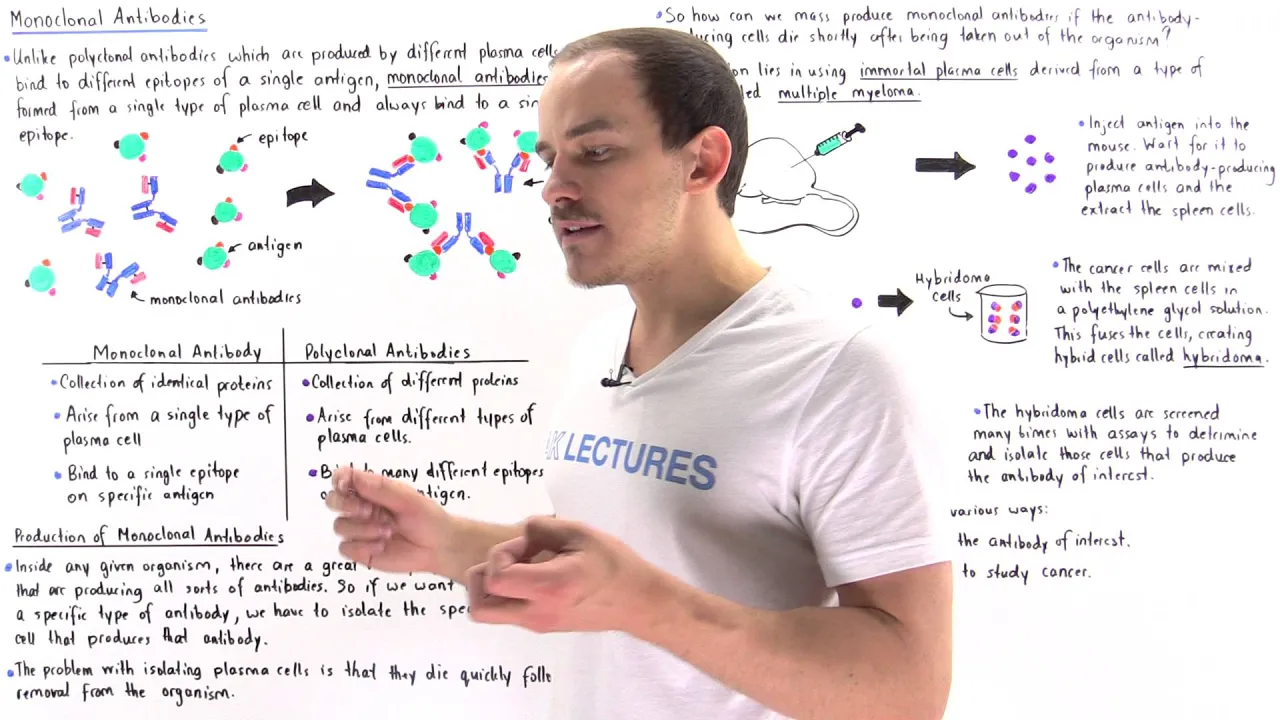
Hybridoma Technology: Monoclonal Antibody Production Explained
@FrankLectures
214.2K views•2017-10-12
14:12
Quantitative Real-Time PCR (qPCR): Principle, Method & Data Analysis
@animatedbiologywitharpan
129.2K views•2023-09-06
23:33
Microbial Degradation of Plastics: Biodegradation Pathways & Sustainability
@majeedhammad
2.9K views•2021-04-11
16:04
CRISPR and Genetic Engineering: How Gene Editing Works and Why It Matters
@kurzgesagt
30.5M views•2016-08-10
Related Study Plans & Knowledge Roadmaps
Structured learning paths in Biotechnology
biotechnology
AAV Production: Transfection, Prep & qPCR
01Introduction to Gene Therapy and AAV Biology
02Mammalian Cell Culture: Suspension HEK293 Cells
03Upstream Bioprocessing: Triple-Transfection Optimization
+ 2 more learning modules
18h5 modules
Explore Roadmap
biotechnology
Building Gut-on-a-Chip: PDMS, Cells & TEER
01Foundations of Microfluidics and Gut Anatomy
02Cleanroom Fabrication & PDMS Soft Lithography
03Epithelial Cell Culture and On-Chip Seeding
+ 2 more learning modules
26h5 modules
Explore Roadmap
biotechnology
Optimizing CFPS: E. coli Extract & Yield
01Fundamentals of Molecular Biology and Translation
02Introduction to Cell-Free Protein Synthesis (CFPS)
03Preparing E. coli Crude Lysate (The Extract)
+ 2 more learning modules
19h5 modules
Explore Roadmap
biotechnology
Haematococcus PBR: Design, Stress & Astaxanthin
01Biology and Life Cycle of Haematococcus pluvialis
02Bench-Scale Photobioreactor (PBR) Design and Engineering
03Culture Media Formulation and Inoculation
+ 2 more learning modules
15h5 modules
Explore Roadmap