









![[𝐏𝐥𝐚𝐲𝐋𝐢𝐬𝐭] k-pop /pop/걸그룹음악💗 괜히 기분 좋아지는 감성.🎧 Work · Study · Focus #카페음악#kpop#ive #ses #POP](https://i.ytimg.com/vi/dKIoc1OyBaY/maxresdefault.jpg)







Tort law is divided into three main categories based on the defendant's conduct: (1) Intentional torts involve deliberate actions causing harm, such as battery or assault; (2) Negligence involves unintentional harm caused by carelessness, like backing into someone while taking a picture; and (3) Strict liability holds defendants responsible for certain dangerous activities regardless of fault, such as selling defective products. Tort law is primarily governed by state common law, with courts relying on precedents and Restatements published by the American Law Institute to resolve disputes.
Overview of Tort Law: Intentional Torts, Negligence & Strict Liability
Added:Distinction between civil law (disputes between private parties) and criminal law (prosecution by the state).
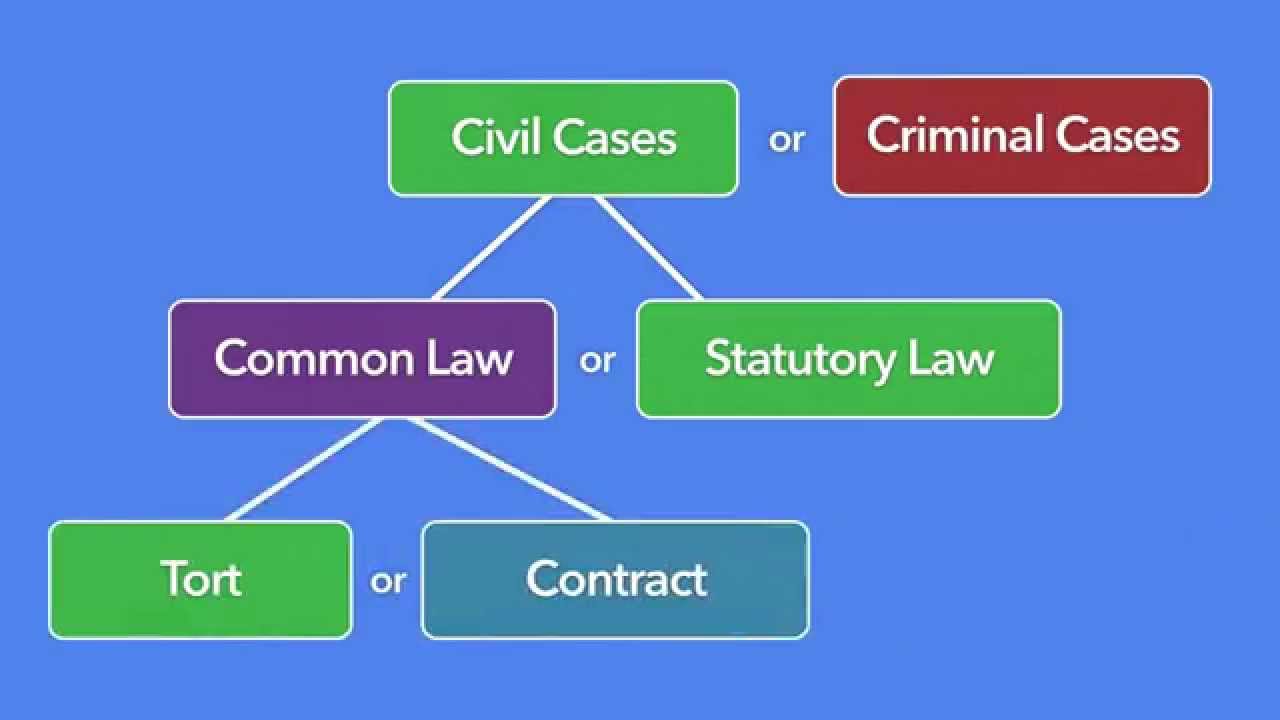
Fundamental structure of the US legal system, including common law, statutory law, and state court jurisdictions.
Basic concept of legal liability, civil wrongs, and the general purpose of seeking damages/remedies.
The meaning of 'prima facie' and how a burden of proof operates in civil litigation.
Affirmative defenses to torts, such as comparative negligence, assumption of risk, consent, and necessity.
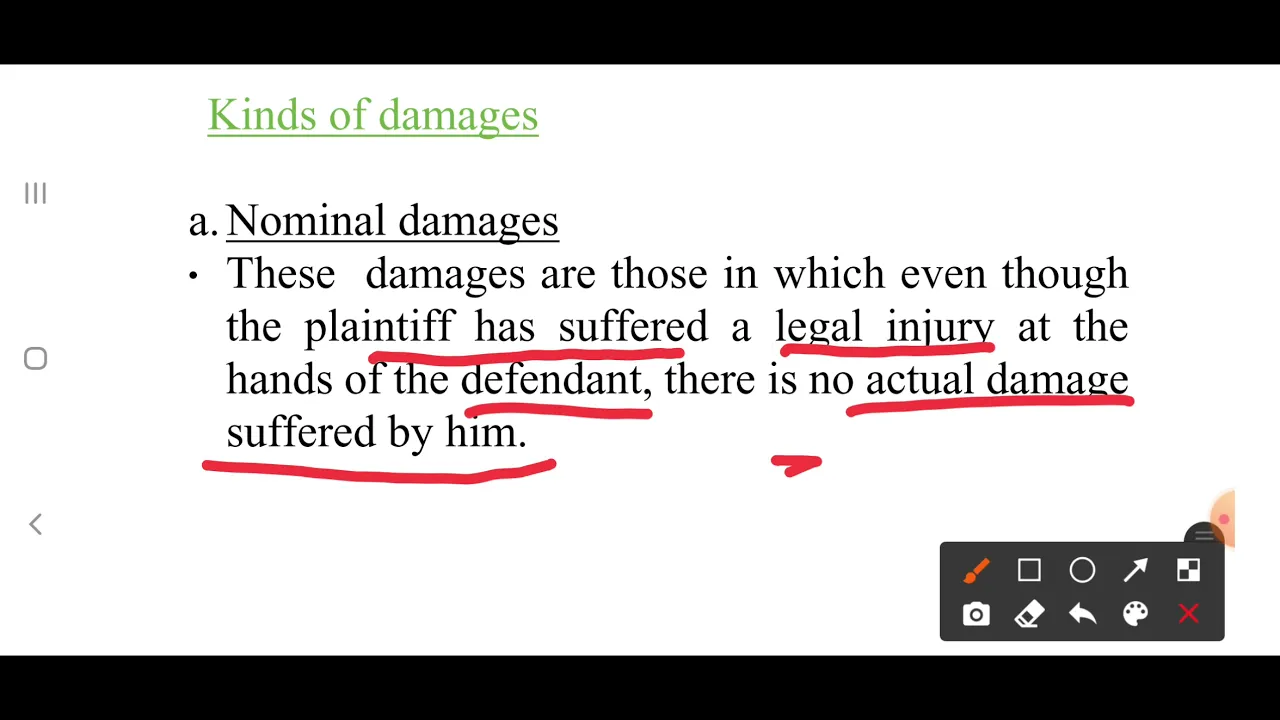
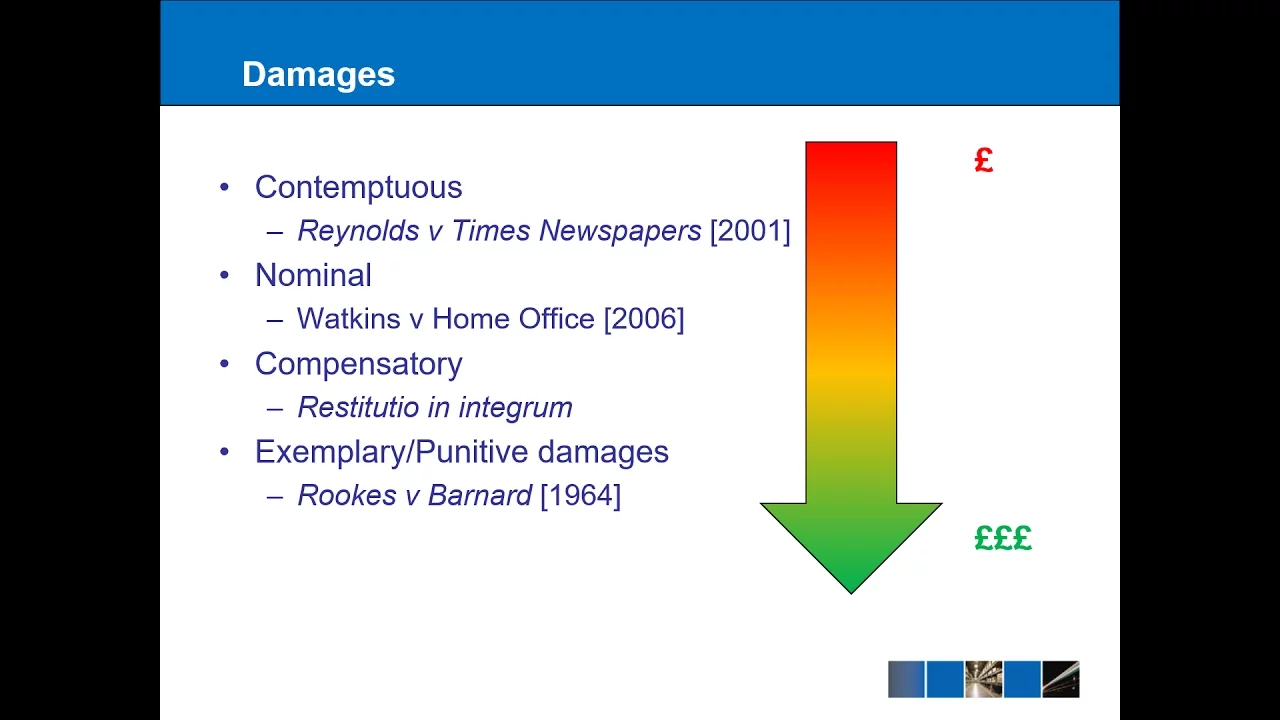
The calculation and types of tort damages, including compensatory, punitive, and nominal damages.
Advanced tort concepts like products liability, vicarious liability (respondeat superior), and joint and several liability.
The role of the Restatements of Law (specifically the Restatements of Torts) in shaping common law across different states.
An exploration of modern tort reform controversies and the economic policy underlying liability allocation.
427.8K views2.5Klikes13:06Original Release: 2014-08-11
>> This episode provides an overview of the three main areas of tort law-- intentional torts, negligence, and strict liability.
Before we get to that overview, though, we need to understand that in our study of tort law, we are going to be making lots of implicit generalizations, because the reality is that tort law varies from state to state.
As explained in Episode 1, tort law is a common law subject.
Most of tort law has evolved through the holdings of individual court decisions.
A published court opinion, arising out of an individual dispute, becomes a precedent, which is applied to future disputes that arise within the same jurisdiction.
Tort law is almost exclusively a matter of state law, meaning that each state has developed its own set of precedents applicable within its jurisdiction.
In some areas of torts, almost all jurisdictions follow the same basic approach.
In other areas of tort law, there are jurisdiction splits, characterized by majority and minority approaches.
When a rule or standard is described as the "majority approach," that means that it is the approach followed by the majority of jurisdictions.
Sometimes, particularly on matters of first impression, meaning that there is no precedent on point from the highest court in the relative jurisdiction, courts will also look to holdings from courts in other jurisdictions, and decide whether or not to follow the same approach.
Early tort law in the United States borrowed from England, so you'll also see some early English cases cited by American courts.
Sometimes, in addition to looking to precedents, courts will also look to something called a "restatement."
A restatement is something less than a code.
It's not like a statute enacted by a legislature, and it's not like the Federal Rules of Civil Procedure or even the Uniform Commercial Code that's used in contracts... but a restatement is something more than a treatise, so it's not just another study aid or reference work.
The restatements are published by the American Law Institute, an organization of legal academics and practitioners that was founded in 1923.
A restatement is essentially an attempt to summarize case law.
The ALI takes the whole body of common law-- judge-made doctrines that have developed gradually over time-- and it tries to synthesize them into a set of rules.
Restatements are not binding authority in and of themselves, but they are highly persuasive.
They are meant to reflect the consensus of the American legal community as to what the law is, and, in some cases, what it should become.
For torts, there are two restatements to keep track of.
For most of tort law, the second restatement is the right place to look.
The ALI has also promulgated a third restatement, but this one is not comprehensive.
It only addresses certain areas of tort law, like products liability.
In torts, the restatements have not been as influential as they have been in some other areas of the law, like contracts.
For that reason, it is not as crucial to know all of the ins and outs of the restatements for torts, but they can be helpful in figuring out doctrinal issues.
We'll use them a fair bit in our discussions of intentional torts and strict liability, but less so for negligence.
Now, let's talk about the three main types of tort liability.
Tort is not a single cause of action the way that breach of contract is.
Rather, it is divided into several different types of claims, or causes of action, all of which may be described as "sounding in tort," meaning that they are based on tort law principles.
Causes of action sounding in tort can be categorized as one of the three main types of tort liability-- intentional torts, negligence, and strict liability.
These categories are based on the differences in the defendant's actions.
Intentional torts involve civil liability for harms that are caused more or less deliberately by the defendant.
For example, the defendant deliberately hits the plaintiff across the side of the head.
Later, in our episode on intent, we will flesh out what "more or less deliberately" means.
Intentional torts is an umbrella term for several distinct causes of action, which include battery, assault, false imprisonment, trespass to land, trespass to chattels, conversion, and others.
Each of these represents an intentional invasion of the plaintiff's legally protected interest.
That might be an interest in being free from harmful, offensive contact with one's person, or in being free from apprehension of harmful or offensive contact, or an interest in freedom of movement, or a possessory interest in property.
Negligence is the most common basis for tort suits.
This is liability for harms that are not caused by the defendant deliberately, but for which the defendant is at fault, because he or she-- or it, in the case of a business-- was careless in some way.
For example, the defendant, posing for a picture, backs up into the plaintiff, knocking him into oncoming traffic.
Negligence is shorthand for an unreasonable but unintentional interference with the plaintiff's legally protected interest.
So, roughly speaking, both intentional torts and negligence are based on wrongdoing or fault on the part of the defendant.
Strict liability is something else altogether.
It's made up a few exceptional situations where the law assigns liability to the defendant even where the harm was caused by accident, unlike intentional torts, and even where the defendant was careful, unlike negligence.
For example, the defendant store owner sells a defectively manufactured blender, which malfunctions, injuring the plaintiff.
The defendant store owner may be liable, even though he wasn't responsible for causing the manufacturing defect, and even though he could not reasonably be expected to have discovered the defect before the sale, because the defective blender looked just like all the other blenders it received from the manufacturer.
The idea behind strict liability is that the law assigns the costs of any consequences of the defendant's activity, no matter how unexpected or unavoidable, to the defendant.
Now, we also need to introduce a different label, and explain that it's not really a distinct TYPE of tort liability, so much as a procedural mechanism for bringing a claim under one of the three types.
In some jurisdictions, it's called "wrongful death," or in others, it might be called a "survival action."
Whichever label is used, the idea is the same.
A wrongful death or survival action is basically just what happens to a regular tort claim when the victim of the tort dies.
Wrongful death and survival actions are made possible by statute.
Under the old common law of England, there were three very restrictive rules concerning what happens when a party involved in a tort dies.
Keep in mind that these are old rules that you don't need to know now.
They simply provide background for understanding why wrongful death and survival actions were not possible under the old common law.
One, if the tortfeasor-- the person who committed the tort-- died before the victim recovered, the victim's right of action used to die with him.
Now, that's no longer true.
You can sue the estate of the tortfeasor.
Two, if the victim of the tort died from the tort itself or any other cause, before he recovered in tort, the victim's right of action also died.
Now, that's no longer true.
The estate of the victim, or the victim's relatives, can sue in his place using a wrongful death or survival action.
Three, finally, if the tortfeasor caused a victim's death, relatives and dependents of the victim who were deprived of financial support, or suffered emotional loss, did not have a cause of action of their own.
Now, that's no longer true.
Not only can relatives sue in the place of the deceased victim, using a wrongful death or survival action, claiming the damages that the victim would have been entitled to, but they can also sue in their own right for the harms that they have suffered as a result of the loss of their relative.
For all intents and purposes, wrongful death and survival actions work exactly the same way that intentional torts, negligence, and strict liability claims do under the common law.
So you'll sometimes see a case that's styled as wrongful death or survival, but the court basically treats it as if it's just another intentional tort, negligence, or strict liability case.
For each cause of action, courts have established the basic elements that a plaintiff is required to demonstrate to establish liability.
Taken together, these elements make up the prima facie case.
For example, battery is an intentional tort cause of action.
As we'll discuss in the next episode, it is made up of the following elements-- one, the plaintiff must show that the defendant intended to cause harmful or offensive contact.
Two, the plaintiff must show that harmful or offensive contact actually occurred.
Three, the plaintiff must show that the defendant's actions caused the plaintiff harm.
And four, the plaintiff must establish damages.
Also, for each type of liability, courts have recognized affirmative defenses that the defendant can raise.
For example, defenses to intentional torts include consent and self-defense.
Defenses to negligence include assumption of risk and contributory negligence.
The plaintiff has the burden of proof with respect to the prima facie case, for whatever claims he, she, or it, makes.
What this means is that for the plaintiff to win, he has to convince a judge that he's going to be able to present sufficient evidence to convince a reasonable jury of facts that would support each of the prima facie elements.
If he can't do that, the judge will throw the case out before it even gets to the jury.
Then, assuming that the parties are unable to reach a settlement agreement, the plaintiff has to actually convince a real jury to a preponderance of the evidence standard, meaning "more likely than not," of facts that would support each of the elements.
Now, a quick note-- we are saying "jury" here for simplicity's sake, but sometimes, in a bench trial, there is no jury, and the judge also acts as fact-finder.
The defendant can respond at each stage in two different ways.
"A," by disputing the plaintiff's prima facie case, meaning presenting evidence to counter the plaintiff's argument that the defendant acted intentionally, and/or, "B," by raising affirmative defenses, meaning presenting evidence to show that the defendant was acting in self-defense.
Up Next

14:47
Product Liability Law: Manufacturing Defects Explained
@LawShelf
21K views•2021-06-28

4:27
US Secondary Sanctions Impact on EU Businesses and Blocking Legislation
@Bureauvandijk
1.6K views•2019-03-20
10:20
Understanding Torts: Civil Wrongs in Law | Episode 1.1
@centerforinnovationinlegal3204
755.6K views•2014-07-30

24:42
Police Interrogation Tactics: False Confessions & Legal Reform
@LastWeekTonight
7M views•2022-04-18
Related Study Plans & Knowledge Roadmaps
Structured learning paths in Law
law
Self-Defense Law: Imminence & Castle Doctrine
01Foundations of Self-Defense Law
02Imminent Threat & Reasonable Belief
03The Principle of Proportionality
+ 3 more learning modules
12h6 modules
Explore Roadmap
law
Defamation Law: First Amendment & Actual Malice
01Introduction to civil torts and the First Amendment
02Elements of Defamation: Libel and Slander
03Public Figures vs. Private Individuals
+ 2 more learning modules
8h5 modules
Explore Roadmap
law
Hearsay Rule: Trial Evidence & Exceptions
01Introduction to Trial Evidence & Courtroom Basics
02Demystifying Hearsay: The Core Definition
03Non-Hearsay: Exclusions Under FRE 801(d)
+ 3 more learning modules
14h6 modules
Explore Roadmap
law
Medical Malpractice: Law, Liability & Care
01Foundations of Tort Law and Civil Liability
02The Four Elements of Medical Malpractice
03Defining and Proving the Standard of Care
+ 2 more learning modules
12h5 modules
Explore Roadmap