





















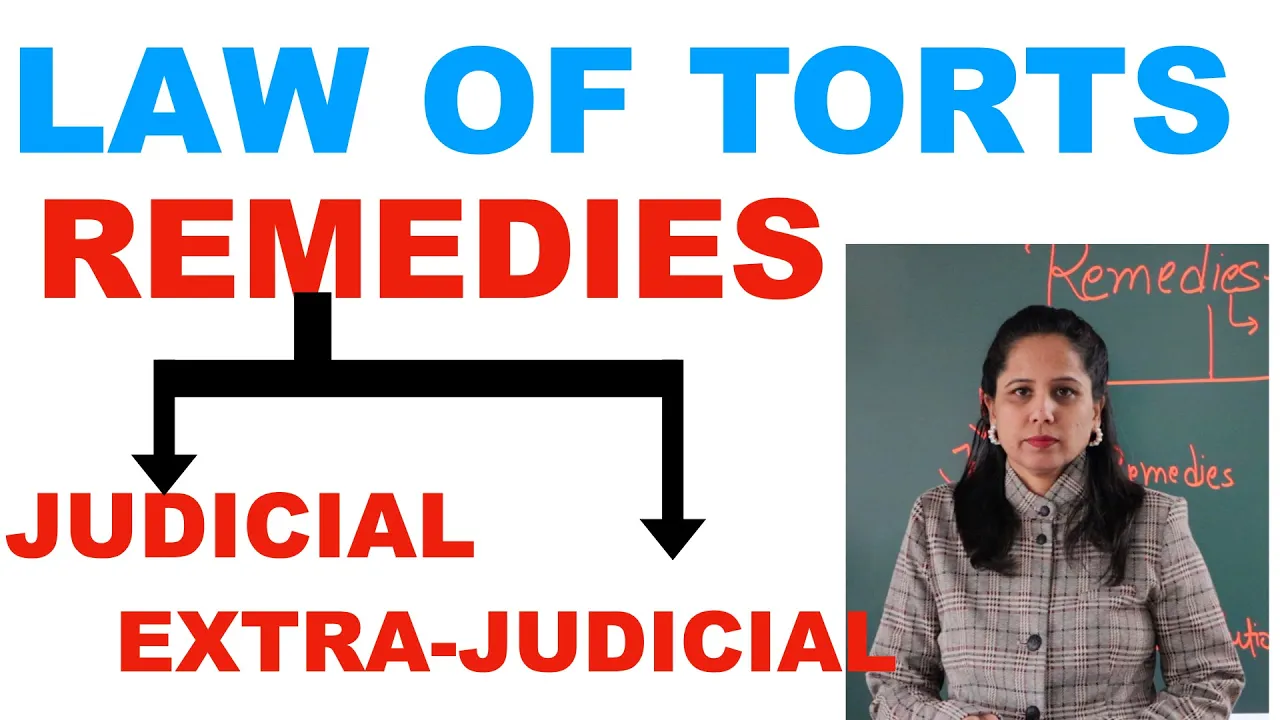


A tort is a wrongful act, other than a breach of contract, that causes injury to another party's person, property, dignity, or reputation and is recognized by statute or common law as a legitimate basis for liability; unlike criminal cases (prosecutor v. defendant, guilt/innocence, beyond reasonable doubt standard, criminal penalties), tort cases involve civil liability (plaintiff v. defendant, liability determination, preponderance of evidence standard, civil damages), and unlike contract cases, torts govern relationships between parties who have not previously agreed to specific rules governing their interactions, serving as default rules for strangers rather than enforcing pre-existing agreements.
Understanding Torts: Civil Wrongs in Law | Episode 1.1
Added:The basic structure of the legal system, including the fundamental differences between civil and criminal court systems.
The concept of common law and how judicial precedent functions to shape legal principles over time.
Introductory legal terminology, specifically the definitions of plaintiff, defendant, liability, and remedy.
A foundational overview of contract law, particularly the concept of legally binding voluntary agreements.
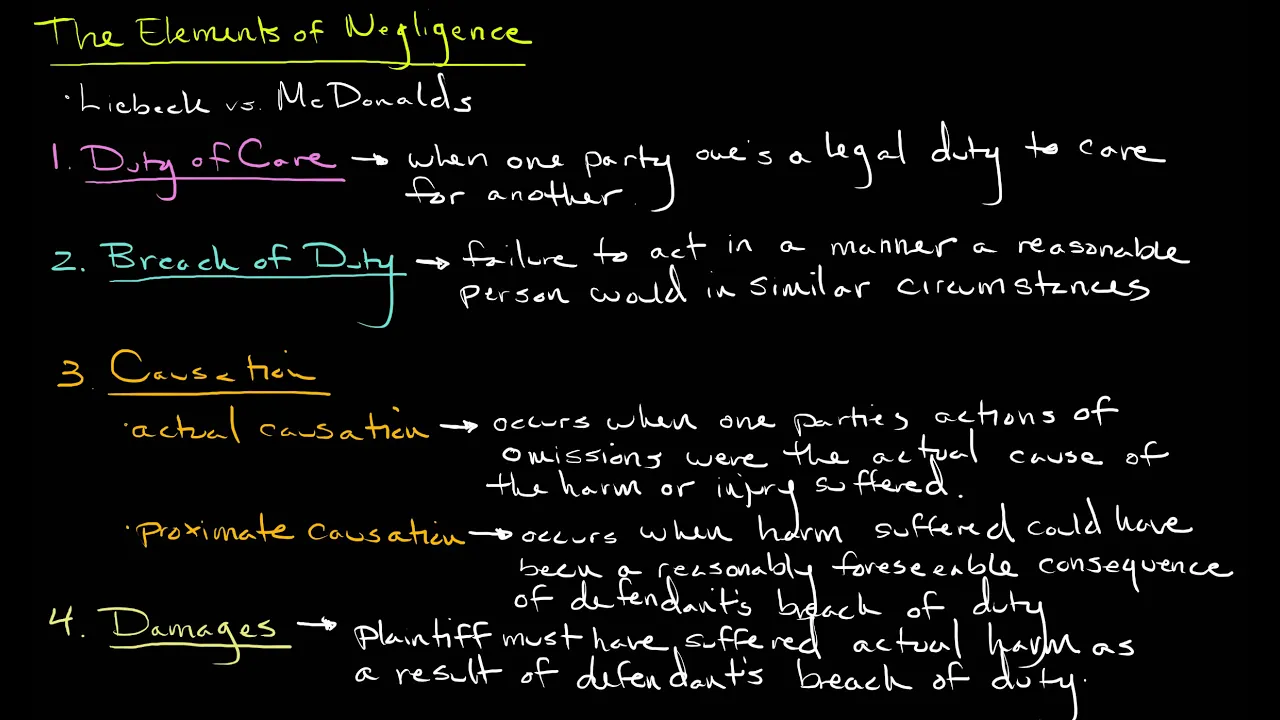
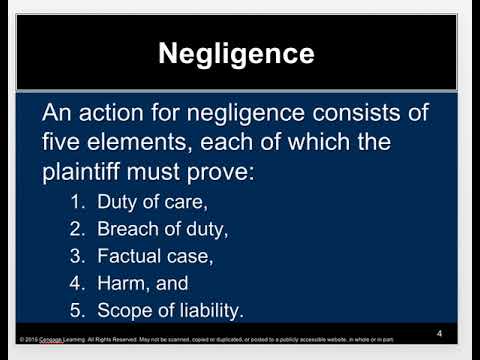
The core elements of Negligence, including duty of care, breach of duty, causation, and damages.
Intentional torts against persons and property, such as assault, battery, trespass, and defamation.
The principles of Strict Liability, especially concerning abnormally dangerous activities and product liability.
Common legal defenses to tort liability, including comparative negligence, assumption of risk, and consent.
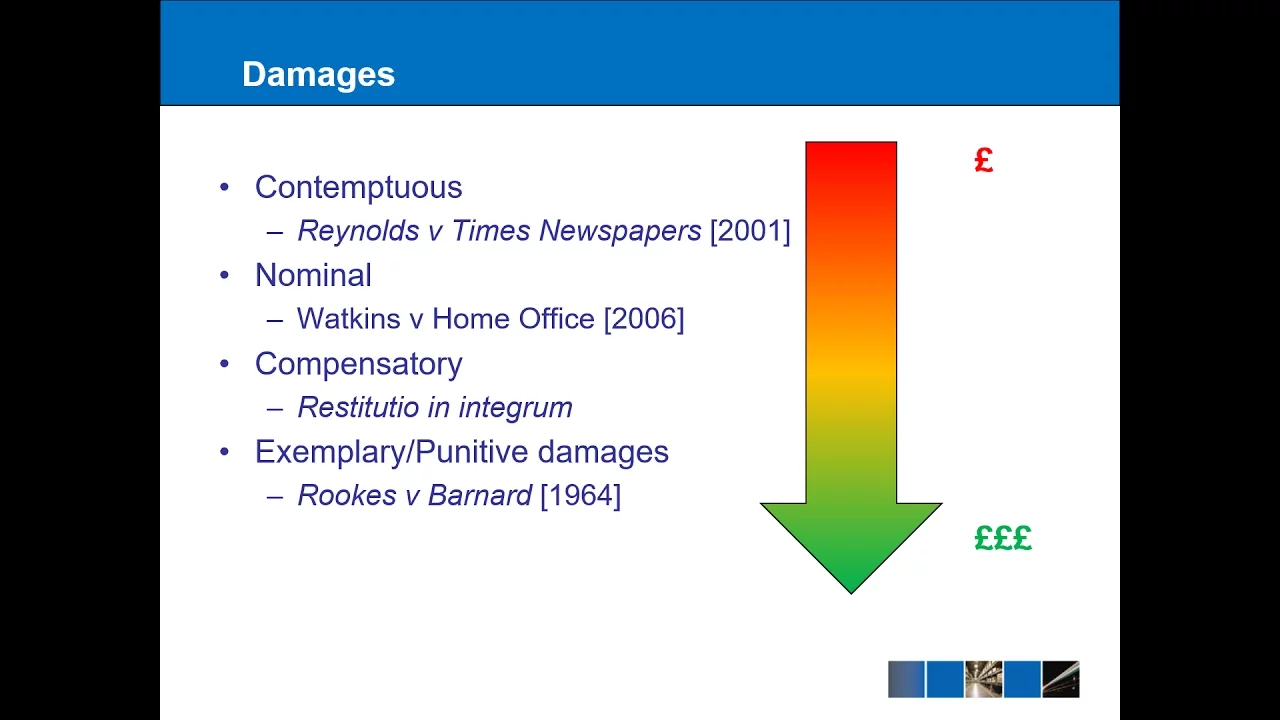
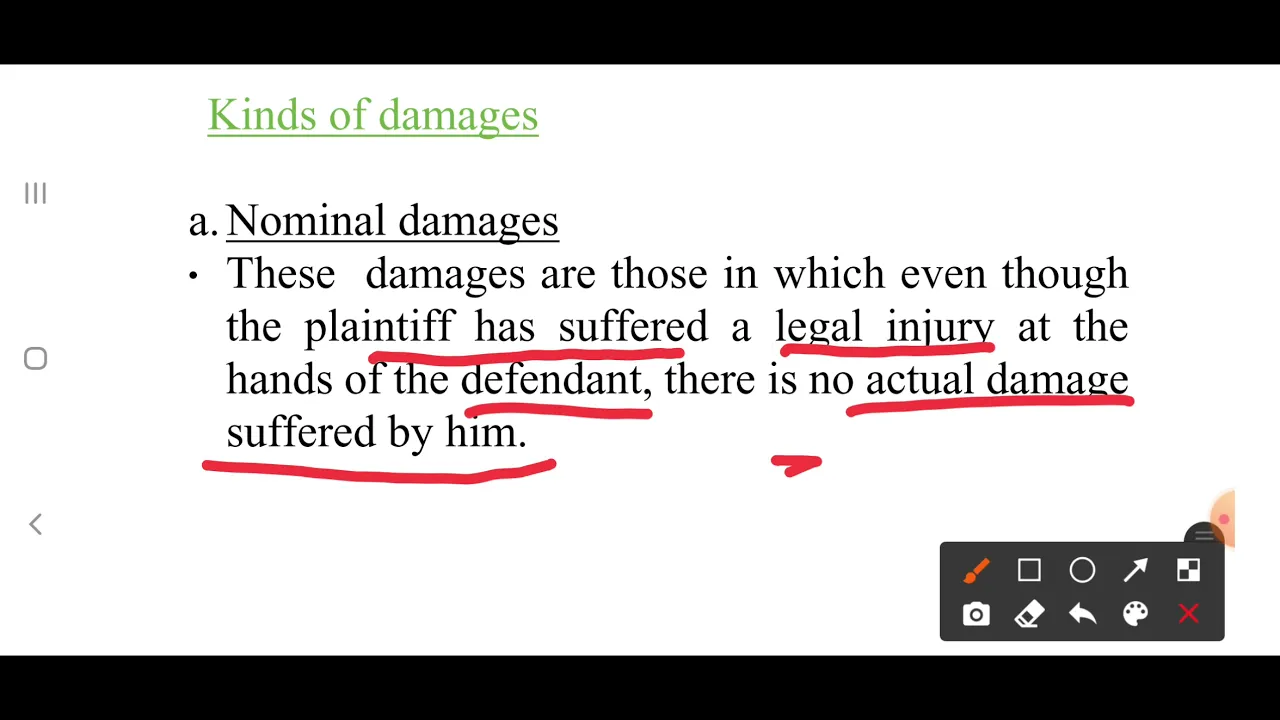
The categorization and calculation of tort damages, such as compensatory, punitive, and nominal damages.
755.6K views7.9Klikes10:20Original Release: 2014-07-30
>> "What is Torts?
"And what Torts is not."
A tort is a wrongful act, other than a breach of contract, that results in injury to another party's person, property, dignity, or reputation, and which is recognized by statute or common law as a legitimate basis for liability.
In other words, torts is the law of civil wrongs.
Now, this definition raises some important distinctions that are worth addressing before we move on.
Civil or criminal cases, common law or statutory law, tort or contract.
Let's go through these one by one.
Civil or criminal cases.
Like contracts and property, tort law provides for civil rather than criminal liability.
There are some crucial distinctions here having to do with, one, who the parties are-- plaintiff as opposed to prosecutor.
Two, what the possible outcomes are-- liable as opposed to guilty.
Three, the applicable standard of proof-- preponderance as opposed to beyond a reasonable doubt.
Four, the consequences for the defendant-- civil damages as opposed to criminal penalties.
And five, the procedural rules that apply-- civil procedure as opposed to criminal procedure.
First, torts are disputes between private parties.
In a tort action, the injured plaintiff brings suit against the defendant for damages, whereas in a criminal action, the prosecutor, acting on behalf of the government, charges the defendant with a crime.
The injuries on which a claim of tort liability is based might also form the basis of a criminal action.
But the two cases would be initiated by different parties, and would proceed separately.
For example, O.J. Simpson was tried by a prosecutor on two counts of murder-- People of the State of California v. Simpson-- and acquitted... AKA, found not guilty.
He was also sued by the families of Nicole Brown Simpson and Ron Goldman for wrongful death-- Goldman v. Simpson-- and found liable.
In some, criminal cases are the people represented by the prosecutor v. defendant, and tort suits are plaintiff v. defendant.
Second, notice that the possible outcomes are also different.
In criminal cases, the defendant is found guilty or not guilty.
In tort suits, the defendant is liable or not liable.
Third, the standard of proof is different.
In a criminal case, the standard of proof is beyond a reasonable doubt, but in a civil case, the standard of proof, with a few narrow exceptions, is a preponderance of the evidence.
The preponderance standard has been interpreted to mean that the finder of fact must be convinced that the plaintiff's assertions are more likely than not accurate.
Some courts have quantified this as more than 50% likely.
The difference between the civil and criminal standard of proof might explain the divergence between the criminal and civil Simpson cases.
Fourth, the consequences for the defendant are different.
If a criminal defendant is found guilty, the penalties might include death, imprisonment, or criminal fines.
In a tort suit, if the defendant is found liable, the most common remedy is that the court will order the defendant to pay damages.
Though, in some cases, equitable relief may be available, meaning that the court can issue an injunction, ordering the defendant to take or refrain from certain actions.
Typically, criminal fines are paid by the dependent to the government.
Civil damages are paid by the defendant to the plaintiff.
Finally, the procedural rules are also different for civil as opposed to criminal cases, meaning civil procedure as opposed to criminal procedure.
There are two types of law that can form the basis of civil liability-- common law or statutory law.
When you think of law, you probably think of statutes passed by legislatures-- the U.S. Congress, the State Legislature, or the City Council-- and signed into law by executives-- the President, Governor, or Mayor.
Sometimes, these statues include private causes of action, meaning that the statute includes a provision allowing private parties to sue each other to enforce the rights recognized in that statute.
For example, employment discrimination law is now dictated largely by statutes.
Those statutes typically create private causes of action, allowing employees who believe that they have been discriminated against to sue their employers for violating the law.
The rules and standards that a court would use to adjudicate such a dispute are derived from the statute itself.
Like contracts and property, tort law is primarily a common law subject, meaning that it is primarily judge-made rather than legislature-made.
Most of tort law has evolved through thousands upon thousands of court decisions arising out of individual disputes.
The holdings of these individual court decisions are treated as precedents, which are then applied to future disputes that arise within the same jurisdiction.
It's worth noting that, particularly in torts, the common law and statutory law interact with each other in a few important ways.
First, in many jurisdictions, at least part of the common law of torts-- created by judges-- has been codified into statutory law at some point by the legislature.
Often the legislature effectively ratifies the rules that judges have developed over time.
In the absence of this kind of ratification, judge-made rules are still valid... but when the legislature has codified an area of common law, attorneys and judges must look to the relevant statute first, not merely to the applicable precedents or restatement sections.
Second, the legislature has authority, pursuant to constitutional restraints, to reject the rules and standards adopted by the judiciary.
You can think of the judiciary and the legislature as being in conversation with each other.
If the judiciary recognizes a common law rule that the legislature doesn't like, the legislature is free to pass a statute adopting a different rule, and judges are then bound by that legislative pronouncement in future cases.
The common law cause of action, or rule, is said to have been "preempted by the legislature."
Third, if the legislature has passed a statute that is relevant to a tort dispute, but does not actually preempt the common law cause of action, the courts might take that legislative pronouncement into account, particularly when applying common law rules that implicate policy considerations.
Tort or contract.
Within civil common law liability, there is also an important distinction between tort liability and contract liability.
Remember, the definition of tort excludes breaches of contract.
One useful way of thinking about the distinction between torts and contracts is that contract law governs the creation and enforcement of agreements, where as tort law dictates the relationships between parties who have not previously agreed to a set of rules that will govern their dealings with each other.
For example, I bump into you on the sidewalk, knocking you into oncoming traffic causing you various injuries.
We've never met before, so we haven't had an opportunity to agree to the rules that will dictate whether I must compensate you for those injuries.
Tort law provides a set of default rules which govern our interactions.
In other situations, two parties have had the opportunity to agree to a set of obligations between them that will govern their dealings, or at least some aspect of those dealings.
If I fail to fulfill an obligation that I have agreed to, then I might be liable for breach of contract.
For example, imagine you and I have entered into a contract whereby I agree to transport a shipment of laptop computers from your manufacturing plant to your distributor across the country.
If those laptops are damaged during shipping, you might sue me for breach of contract.
In adjudicating our dispute, the court would look first to the contract between us.
In our contract, we might have agreed to a set of rules that differ from the default rules found in the law of torts.
This is known as "contracting around "the tort law default rule."
Alternatively, our contract might be silent as to whether I am liable for damage that occurs during shipping.
In that case, the tort law default rules will apply.
Note that a plaintiff can combine tort and contract causes of action in a single civil suit.
This often happens with regard to harms caused by defective consumer products, for example.
If I am injured by a defective blender that you sold me, I might bring suit for breach of warranty, a contract cause of action, and for negligence, a tort cause of action.
And you might be found liable for neither, both, or either basis.
So, a tort is a wrongful act, other than a breach of contract, that results in injury to another party's person, property, dignity, or reputation, and which is recognized by statute or common law as a legitimate basis for liability.
Up Next

10:34
Depp v. Heard Trial Verdict: Defamation and Damages Explained
@SkyNews
676.9K views•2022-06-01

4:27
US Secondary Sanctions Impact on EU Businesses and Blocking Legislation
@Bureauvandijk
1.6K views•2019-03-20

13:06
Overview of Tort Law: Intentional Torts, Negligence & Strict Liability
@centerforinnovationinlegal3204
427.8K views•2014-08-11

24:42
Police Interrogation Tactics: False Confessions & Legal Reform
@LastWeekTonight
7M views•2022-04-18
Related Study Plans & Knowledge Roadmaps
Structured learning paths in Law
law
Self-Defense Law: Imminence & Castle Doctrine
01Foundations of Self-Defense Law
02Imminent Threat & Reasonable Belief
03The Principle of Proportionality
+ 3 more learning modules
12h6 modules
Explore Roadmap
law
Defamation Law: First Amendment & Actual Malice
01Introduction to civil torts and the First Amendment
02Elements of Defamation: Libel and Slander
03Public Figures vs. Private Individuals
+ 2 more learning modules
8h5 modules
Explore Roadmap
law
Hearsay Rule: Trial Evidence & Exceptions
01Introduction to Trial Evidence & Courtroom Basics
02Demystifying Hearsay: The Core Definition
03Non-Hearsay: Exclusions Under FRE 801(d)
+ 3 more learning modules
14h6 modules
Explore Roadmap
law
Medical Malpractice: Law, Liability & Care
01Foundations of Tort Law and Civil Liability
02The Four Elements of Medical Malpractice
03Defining and Proving the Standard of Care
+ 2 more learning modules
12h5 modules
Explore Roadmap