



















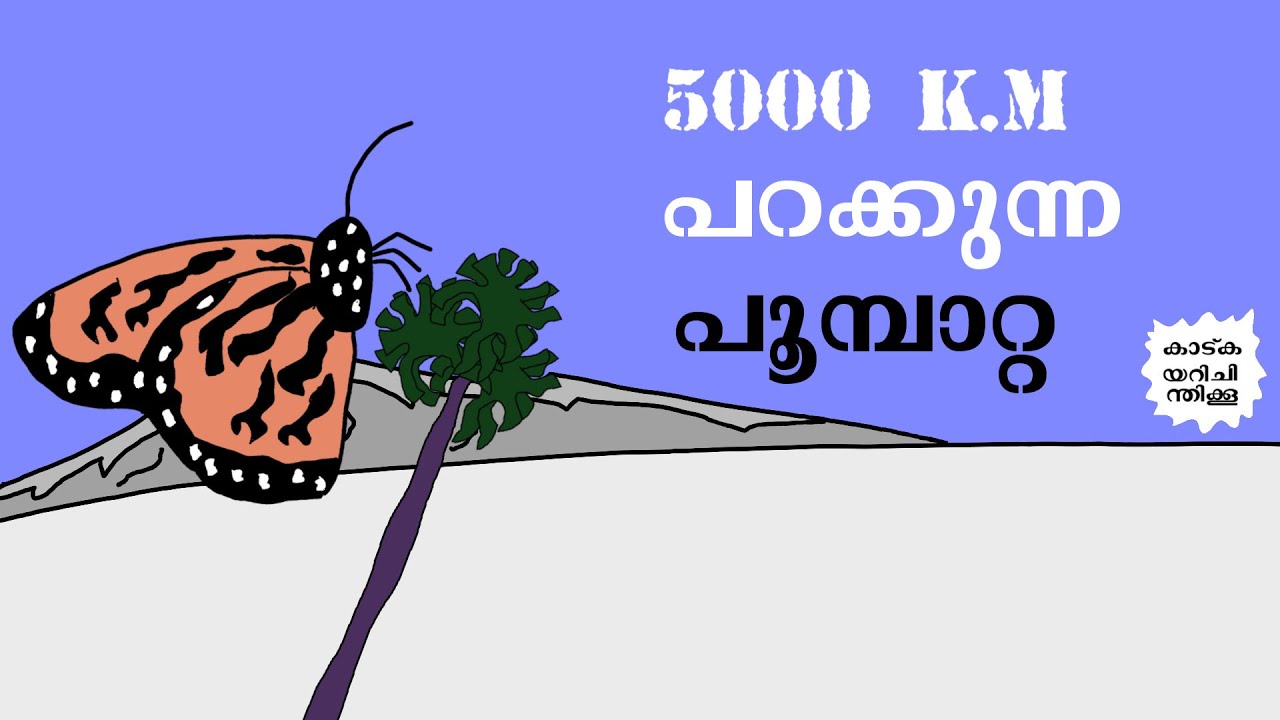





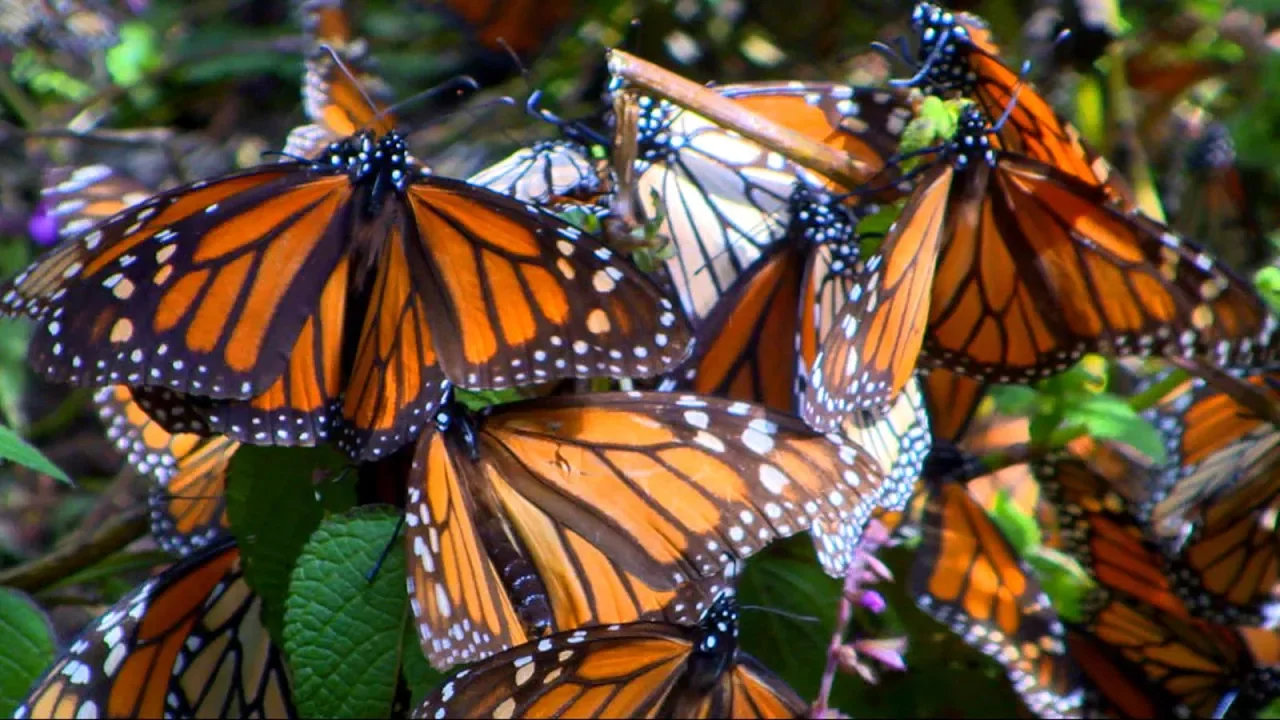
Monarch butterflies accomplish their 4,500 km migration using a sophisticated navigation system involving two internal clocks—a circannual clock that triggers seasonal migration and an antenna-based timekeeping mechanism—and a solar compass that uses polarized light detection to determine direction, enabling these insects with brains the size of a sesame seed to navigate to specific locations thousands of kilometers away without prior experience.
How Monarch Butterflies Navigate Migration: The Science of Their Compass
Added:Understanding the basics of animal migration, including ecological drivers like seasonal changes and resource availability.
The concept of circadian rhythms and biological clocks, particularly how organisms track time on a 24-hour cycle.
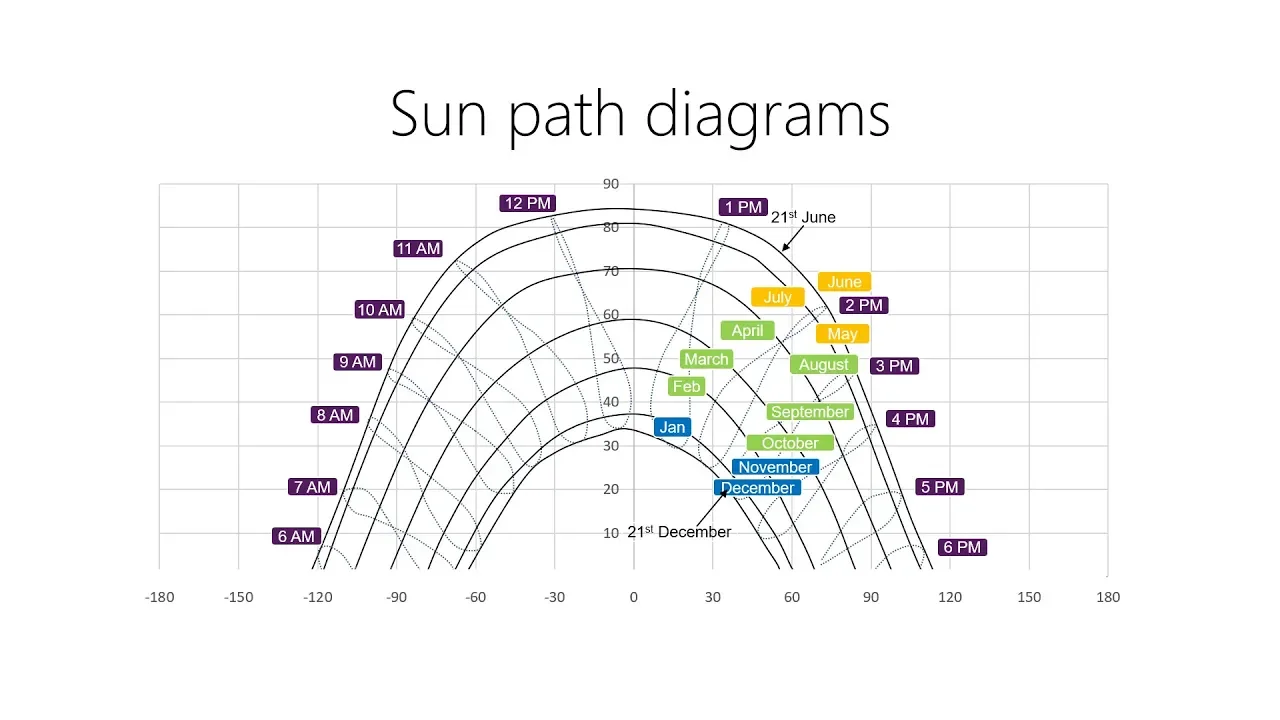
Basic principles of solar geometry, specifically how the sun's position in the sky (azimuth) changes throughout the day relative to cardinal directions.
Elementary insect anatomy, specifically how compound eyes perceive light intensity, wavelength, and polarization.
Exploring magnetoreception, and how monarchs use the Earth's magnetic field as a complementary navigation system on cloudy days.
Investigating the genetic and evolutionary mechanisms of migration, particularly how multi-generational migratory pathways are programmed into insect DNA.
Analyzing the neurobiology of the monarch brain to understand how sensory inputs from the antennae (clocks) and eyes (compass) are integrated.
Examining the ecological impacts of climate change, habitat loss, and pesticide use on the survival and navigational success of migrating monarch populations.
760.9K views17.7Klikes10:16Original Release: 2019-04-09
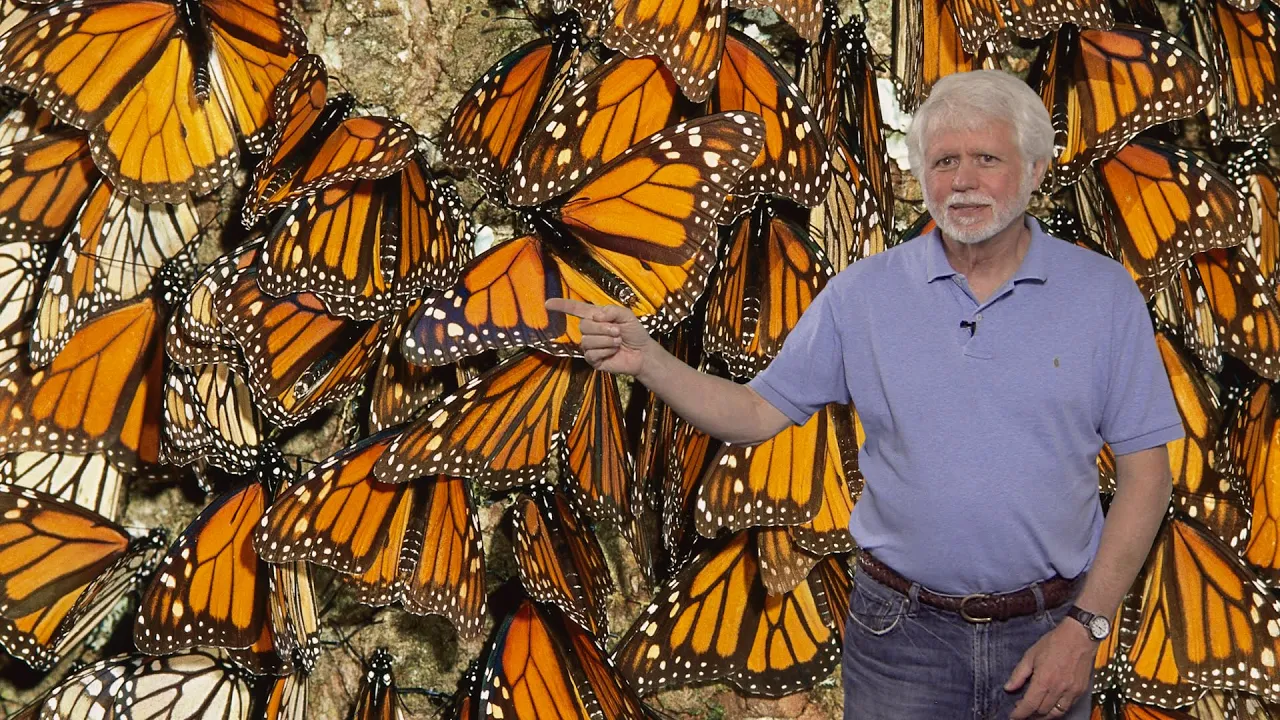
Oh my gosh, the trees are like made of butterflies.
I knew this would be amazing, but I didn’t know it would be this amazing.
That was me, a couple of months ago, on a mountain in central Mexico.
Hey smart people, Joe here.
Nearly every monarch butterfly in North America–tens of millions of them–flies here each winter.
Not gonna lie, one of the most amazing sights I’ve ever witnessed.
And it was not easy to get there.
I had to fly on a plane, drive in a car, ride a horse and hike to get up there.
It’s like 10,000 feet above sea level.
But all those monarch butterflies needed to get there was their wings… Oh, and also some of the coolest frickin’ navigation biology I’ve ever heard of.
Millions of tiny orange compasses with wings.
Yeah, this is gonna totally change how you look at butterflies.
The monarch butterfly migration is one of a kind.
Totally unmatched in the insect world.
It’s more like the migration of some birds.
I mean, we’re talking distances of up to 4,500 km, each way, north and south.
But there’s one big thing that makes this migration different from what birds and other animals do: it actually takes multiple generations of butterflies to do it.
And, as you’re about to learn, that’s what makes it so amazing.
Our journey starts in spring, as monarchs make their way north.
It’s a leap-frog journey.
Each generation flies, mates, lays their eggs, and ultimately dies as it passes the baton to the next generation.
A typical adult monarch only lives for two to six weeks.
So it takes 4, sometimes 5 generations to make the trip north.
The fading light of summer marks the end of their northern migration.
Shorter days and cooler temperatures prompt female butterflies to lay a special generation of eggs.
When they hatch, the caterpillars that emerge are very different from their parents.
They’ll grow up to be part of a “super generation”.
These “super generation” butterflies will fly all the way to Mexico in a single generation.
Now, most things about a monarch’s life–metamorphosis, migrating, mating–are controlled by hormones: chemicals in their bodies that signal different activities.
“Super generation” monarchs make less of one special hormone, and this essentially prevents them from aging.
They live about 8 times longer than other monarchs.
I mean, think about that.
Same species, totally different lifespan, like one of us living past 400.
This “super generation” also develops differently as adults: They’re bigger, they can fly farther, and they can’t reproduce… which is good, because they have a heckuva journey ahead of them.
How does a bug with a brain the size of a sesame seed know it’s supposed to go to a tree, in Mexico, thousands of kilometers away?
And how does it find its way to a place it’s never been?
Luckily my friend Jason was in Mexico with me… My name’s Jason Goldman, And he is literally the perfect person to explain it.
I’m a science journalist on the wildlife and conservation beat but before I was a journalist, I was a scientist, and I studied animal cognition.
So it’s really remarkable that these insects, with like a million neurons, brain the size of a sesame seed, can get from the northernmost parts of North America, 2000-3000 miles to these forests in Mexico, relatively accurately and relatively effectively. Absolutely blows my mind.
almost every biological organism has some kind of internal clock.
In humans, our roughly 24 hour cycle tells us when to wake up, when to go to sleep, when to eat.
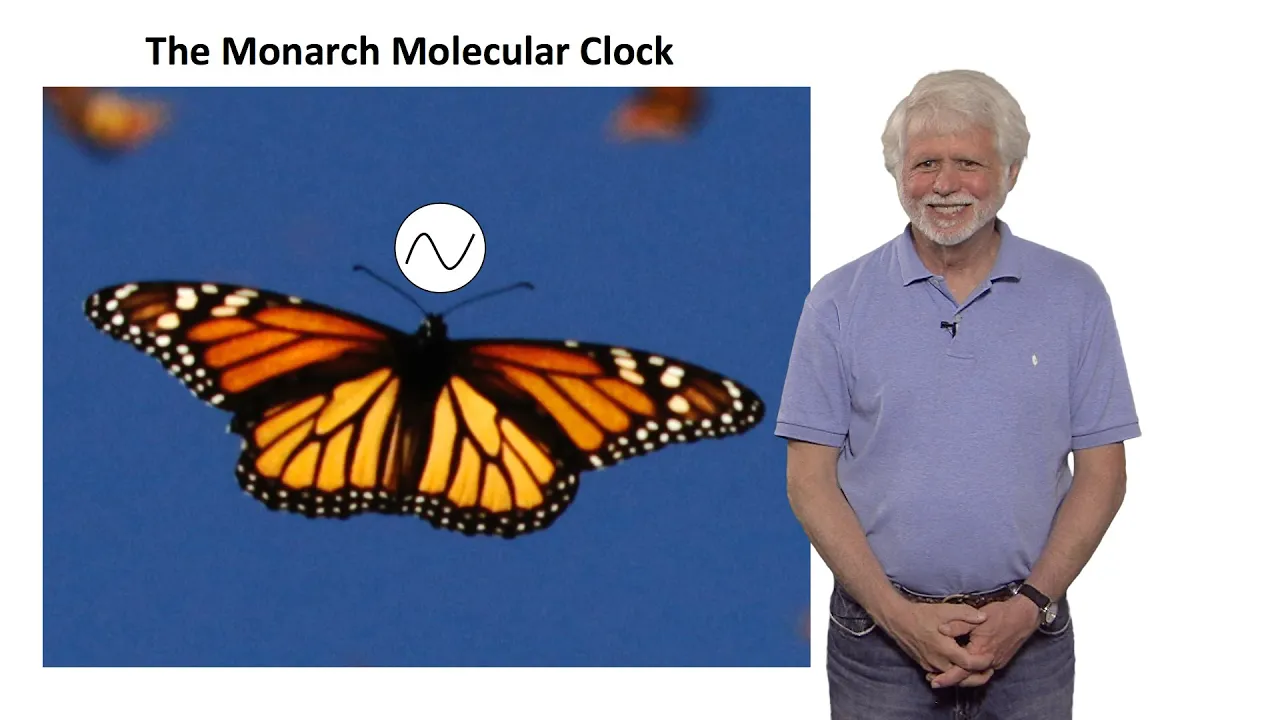
Monarch butterflies actually have two internal clocks.
One clock, inside their brains, is called the circannual clock, it keeps track of annual cycles, its what tells them it’s time to pack their bags and head south for the winter.
The other clock is the key to their navigation.
So there’s very few animals that we know have a true mental map.
Monarch butterflies, they don’t have a route to follow, but they do have a heading.
What we do know is they have a compass in their minds.
It’s a solar compass, that tells time!
Let me explain… Monarchs’ main navigation trick is reading the horizontal position of the sun.
But the sun moves from east to south to west throughout the day.
So to keep pointing yourself in one direction relative to the sun, you also have to know what time it is.
Only butterflies don’t wear wristwatches.
So how do they do it?
Remember earlier, how Jason said monarchs have a second internal clock?
Monarch butterflies actually have two internal clocks.
Well I always thought butterfly antennae were just, like long, skinny noses.
But these antennae do way more than just sniff.
My buddy Phil Torres was down there with me, he’s a butterfly expert, and he blew my mind when he told me this: So that antenna is telling them what time of day it is.
Then they use the information from their eyes and the location of the sun to then orient to the right direction.
Are you kidding me?!
That’s incredible!
That’s how humans navigated at sea for, like, a thousand years, using advanced tools and mathematics.
And these butterflies are doing it with pinhead brains!
Ok, keep it together Hanson.
Let’s break this down how this sun compass works.
Say your internal clock tells you it’s mid-morning.
If you’re supposed to be heading south-southwest, then the sun should be on your left.
If your antennae clock tells you it’s late afternoon, the sun should be on your right.
Special cells in their compound eyes can even find the sun on cloudy days using polarized light.
Pretty genius navigation system.
Scientists have actually tested this by putting monarch butterflies in flight simulators, and watching how they orient themselves.
These monarchs spend all winter here in Mexico, basically hibernating, living off stored energy.
But as spring arrives in these mountain forests, their internal seasonal clock tells them it’s time for the super generation to leave.
And something changes in their bodies.
That hormone they didn’t have, that kept them from aging?
They start making it, and they become reproductively active.
VERY reproductively active.
And they begin their journey north, tracking the sun again.
Their inner sun compass somehow flips direction.
Sadly… in a few short weeks, every one of these super generation butterflies will be dead.
But not before the females lay the eggs that will become the next generation to carry on this great migration.
What makes this so incredible to me it that the butterflies that journey south are reading a map passed down from great-great-grandparents who died half a year before they were born.
It seems like it’s almost magic.
But the truth is that these skills are written into their genetics.
And since the genetics get passed down generation to generation, of course these behaviors get passed down with it.
Even if each generation doesn’t need those skills eventually one of them will take advantage of it.
There’s evidence monarch butterflies have been making this journey for millions of years.
It’s an instinct.
A behavior that’s built into their body.
Their sun compass, their antenna clock, are written in their genes, an unbroken chain of DNA stretching back millions of generations.
But there are still more mysteries to solve.
It’s not enough for the butterflies to know where they’re going.
They also need to know where they are.
And we don’t know what makes them stop here, in this Mexican forest.
And if we want to solve that mystery, we need to make sure the butterflies keep coming back… We're on the lookout for a very special plant.
Where is it?
This is it, this is it right here.
This is milkweed, a native milkweed.
This is the plant that the butterflies need to lay their eggs on so the caterpillars will grow up, eating, or to make the next generation, and, if we're lucky, yes a monarch has been here and laid an egg.
Preserving the monarch migration is about more than just preserving that forest in Mexico.
It’s about preserving plants like this and places like this.
Flowers that give them nectar to fuel that migration, it's about protecting more than just a behavior, it's about protecting a habitat that stretches across an entire continent, and that's something that we can all play a part in.
Give you something to think about maybe something to chew on.
Stay curious.
That was fun, wasn’t it.
Studying a migration this massive is hard.
We just figured it out a few years ago, I mean it took like half the 20th century for scientists to just figure out where they go each year.
Follow me over to the Atlas Obscura YouTube channel, where we tell the story of how scientists found this place in Mexico, and what it means to the people who live there.
Atlas Obscura is the definitive guide to the world's hidden wonders, and this definitely qualifies.
And if you’re wondering what it was like to be there, well grab a headset or a Google cardboard or your phone, because we made a 180˚ VR video inside the butterfly forest.
So beautiful.
You’re gonna love the rest of this story.
Up Next

16:41
Dung Beetle Navigation: Milky Way Compass | Marie Dacke | TEDx
@TEDx
8.4K views•2013-05-07

50:12
Bacterial Communication: Quorum Sensing and Biofilm Formation Explained
@JHUAAP
12.6K views•2011-06-28
6:25
How Baby Sea Turtles Navigate Home Using Earth's Magnetic Field
@besmart
1.6M views•2016-10-17

7:08
Bacteriophages: Earth's Deadliest Killers and Future Antibiotics
@kurzgesagt
34.6M views•2018-05-13
Related Study Plans & Knowledge Roadmaps
Structured learning paths in Biology
biology
RNAi: Biogenesis, RISC & Gene Silencing
01Molecular Biology Foundations: DNA to Protein
02Introduction to RNA Interference (RNAi)
03Molecular Biogenesis of miRNA and siRNA
+ 2 more learning modules
10h5 modules
Explore Roadmap
biology
Mycorrhizae: Signaling, Biophysics & Ecology
01Foundations of Mycorrhizal Symbiosis
02Molecular Signaling and Root Colonization
03Biophysics and Bioenergetics of Nutrient Exchange
+ 1 more learning modules
11h4 modules
Explore Roadmap
biology
Circadian Clocks: TTFL, SCN & Periphery
01Foundations of Molecular Biology & Gene Expression
02Introduction to Chronobiology and Actograms
03The Core TTFL: Molecular Architecture of the Clock
+ 3 more learning modules
14h6 modules
Explore Roadmap
biology
Population Genetics: Math, Drift & Selection
01Genetic & Probability Foundations
02The Hardy-Weinberg Principle and Baseline Models
03Mathematical Modeling of Natural Selection
+ 3 more learning modules
18h6 modules
Explore Roadmap