Einstein derived E=mc² by analyzing a thought experiment where a cat emits light symmetrically in empty space; he showed that for energy conservation to hold in all reference frames, the cat's mass must decrease when it emits light, leading to the conclusion that energy equals mass times the speed of light squared.
Einstein's Proof of E=mc²: Special Relativity Explained
Added:Deep Dive
The fundamental postulates of Special Relativity, specifically the constancy of the speed of light and the principle of relativity.

PHYS 4C - Lecture 10 - Postulates of Special Relativity and Relativity of Simultaneity
315
Special relativity is built on two fundamental postulates: (1) The principle of relativity—the laws of physics are the same in all inertial reference frames; (2) The constancy of the speed of light—the speed of light in vacuum is always c (approximately 3 × 10⁸ m/s) in all inertial reference frames. These postulates can be mathematically derived to produce all consequences of special relativity, unlike most physical theories that require experimental discovery of each law.
Click to watch →
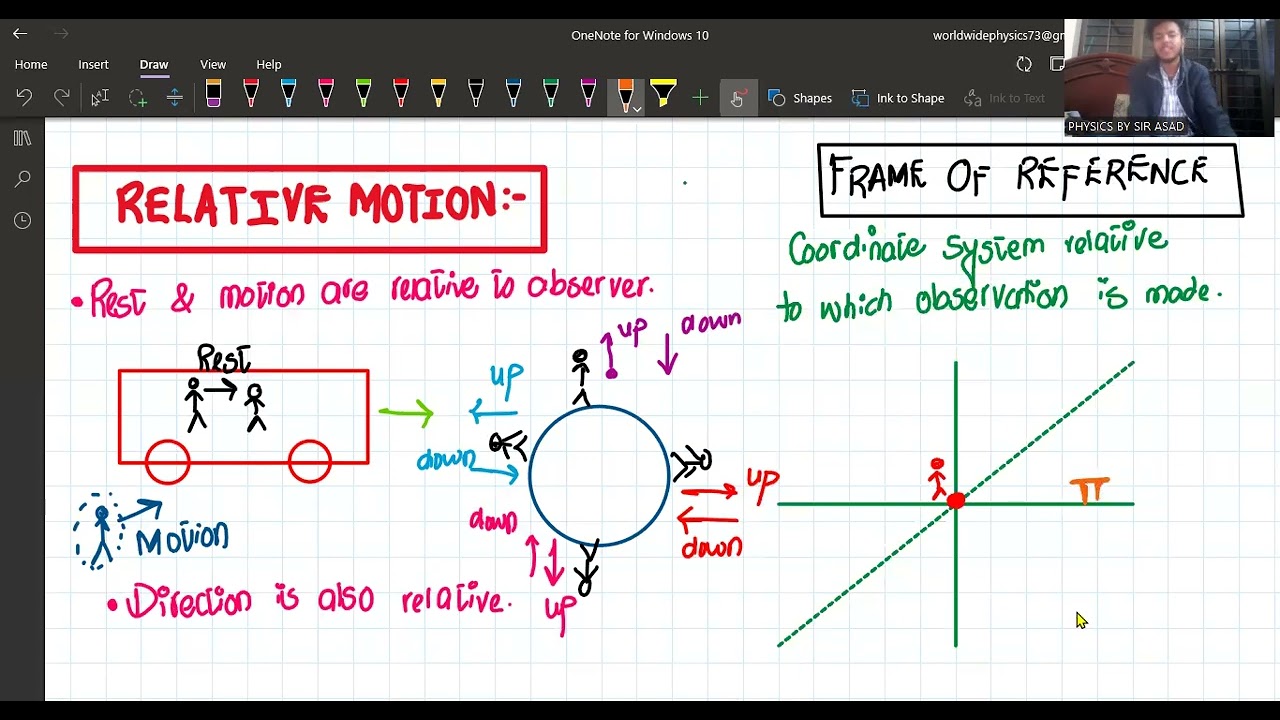
L2: Relative Motion & Frames of Reference | Postulates of Special Relativity Explained | Chapter 19
908
The Special Theory of Relativity is based on two fundamental postulates: (1) The Principle of Relativity - the laws of physics are the same in all inertial frames of reference; (2) The Constancy of the Speed of Light - the speed of light in vacuum is a universal constant (approximately 3×10^8 m/s) and does not change regardless of the motion of the source or observer.
Click to watch →
Relativity and cosmology, msc final mathematics,theory of relativity,math by naresh sir , unit 1st
12K
The Postulates of Special Relativity are fundamental principles accepted as 100% true. Postulate 1 (Principle of Relativity): The laws of physics are the same in all inertial reference frames - no inertial frame is preferred over any other. Postulate 2 (Constancy of Speed of Light): The speed of light in vacuum is constant and independent of the motion of the source or observer. The speed of light is approximately 3 × 10^8 m/s and is denoted by 'c'. These postulates form the foundation of Special Relativity.
Click to watch →
Time Measuring: UNIZOR.COM - Relativity 4 All - Einstein View
102
Special relativity rests on two fundamental postulates: (1) The principle of relativity states that no experiment can distinguish between different inertial frames - all physical laws are identical in every inertial frame, and no frame is privileged as 'at rest' in space. (2) The speed of light in vacuum is constant and has the same value in all inertial reference frames, regardless of the motion of the source or observer. These postulates, supported by experimental evidence like the Michelson-Morley experiment, form the foundation for understanding how time and space behave differently than classical physics predicts.
Click to watch →

Special Relativity with special focus on what it implies for physical particles#ch32sp#swayamprabha
12.9K
Special relativity is based on two postulates: (1) The principle of relativity: The laws of physics are the same in form in all inertial frames of reference (frames moving uniformly relative to each other). (2) The constancy of the speed of light: The speed of light in vacuum is the same for all observers, regardless of their motion or the motion of the light source. These postulates replace Galilean relativity and lead to counterintuitive results about space and time.
Click to watch →
Deep Dive
The classical Doppler effect, to understand how wave frequencies shift due to relative motion before applying relativistic corrections.

Wellen Frequenzen & Bewegung • Der klassische Dopplereffekt | Peter Kroll
1K
The classical Doppler effect describes how the observed frequency of waves changes when there is relative motion between the wave source and the observer. When a source moves toward an observer, the observed frequency increases (higher pitch for sound, blue shift for light), while when the source moves away, the observed frequency decreases (lower pitch, red shift). The observed frequency f' is given by f' = f₀ × (c ± v₀)/(c ∓ v_s), where f₀ is the source frequency, c is the wave speed, v₀ is the observer's velocity, and v_s is the source's velocity. This effect occurs because motion compresses or stretches the wavelength, changing how many wave crests pass the observer per unit time.
Click to watch →
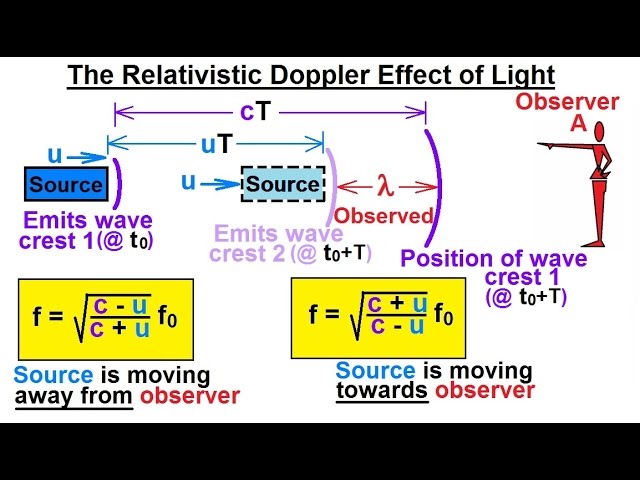
Physics 62 Special Relativity (26 of 43) The Relativistic Doppler Effect for Light
69.7K
The relativistic Doppler effect describes how electromagnetic radiation frequency changes when the source moves relative to an observer. When a source approaches, light appears blue-shifted (higher frequency); when receding, it appears red-shifted (lower frequency). A source emits radiation with intrinsic frequency f₀, period T₀, and wavelength λ₀. For a source moving toward an observer at velocity u, the observed wavelength λ = (c - u) × T, derived from the distance between successive wave crests minus the source's movement during emission. The observed frequency follows f = c/λ, establishing the classical foundation before incorporating relativistic effects.
Click to watch →
4 Doppler effect in light | Blue shift | Red shift | Relativistic Doppler effect | Wave optics
75.1K
The relativistic Doppler effect describes frequency and wavelength changes in electromagnetic waves due to relative motion between source and observer, incorporating Einstein's Special Theory of Relativity. Unlike classical Doppler for sound which depends on a medium, relativistic Doppler applies to light and requires only two cases: source approaching or receding. Time dilation is fundamental—moving clocks run slower relative to stationary observers. This time dilation effect modifies wave propagation predictions at high velocities, distinguishing relativistic from classical treatments.
Click to watch →

Mechanics | lecture 29|| Aberration & Doppler effect || IIT JAM Physics | Csir Net | Jest | Tifr
1.3K
When velocities are much smaller than the speed of light (β << 1), the relativistic Doppler formula reduces to the classical approximation f ≈ f'(1 - βcosθ'). This shows that for low velocities, the relativistic corrections become negligible, and the classical Doppler effect is recovered. The classical approximation is valid when β << 1, which is the case for everyday speeds.
Click to watch →
A questão + DIFÍCIL do ITA!!! (Efeito Doppler Relativístico)
227.2K
In the relativistic Doppler effect, two competing effects determine the observed frequency: (1) The classical kinematic effect of relative motion, which increases the observed frequency when the source approaches, and (2) The relativistic time dilation effect, which decreases the observed frequency because moving clocks run slower. For approaching sources, the classical effect dominates, resulting in a higher observed frequency. The formula f = f₀ × √[(1 + β)/(1 - β)] shows that the numerator (1 + β) > 1 and the denominator (1 - β) < 1, so the overall factor is greater than 1, confirming the frequency increase.
Click to watch →
Deep Dive
Basic principles of classical mechanics, particularly energy conservation, momentum, and the work-energy theorem.

01: Introduction and Fundamental principles
233.2K
This comprehensive section establishes the foundational principles of classical mechanics. Beginning with Newton's Second Law (dP/dt = F), it derives key conservation laws: linear momentum is conserved when net external force is zero, and angular momentum is conserved when net torque is zero. The work-energy theorem shows work equals change in kinetic energy (W = T₂ - T₁). For conservative systems where forces derive from potentials (F = -∇V), mechanical energy (kinetic plus potential) is conserved (T + V = constant). These principles form the analytical framework for solving mechanical problems systematically.
Click to watch →

CICLO FREE CEPRE UNI 2025-2
454
This comprehensive section covers the fundamental principles of work, energy, and momentum in classical mechanics. Key topics include: (1) Only force components parallel to displacement do work; perpendicular components do not. (2) The Work-Energy Theorem states that net work equals the change in kinetic energy (W_net = ΔK). (3) Kinetic energy is calculated as K = (1/2)mv². (4) Newton's Second Law (ΣF = ma) allows finding unknown forces. (5) The work of non-conservative forces equals the change in mechanical energy (W_nc = ΔE_mech). (6) Elastic potential energy is given by U = (1/2)kx². (7) Conservation of mechanical energy applies when only conservative forces do work. (8) Linear momentum is a vector quantity defined as p = mv. (9) For systems subject only to internal forces, total momentum is conserved. (10) Impulse is a vector quantity defined as the integral of force with respect to time (J = ∫F dt). (11) For constant forces, impulse equals force multiplied by time (J = FΔt). (12) Power is the rate at which work is done, given by P = F·v. These principles form the foundation for analyzing forces, motion, and energy in physics.
Click to watch →

Classical Mechanics 02 | Classical Mechanics For BSC 1st Year | Classical Mechanics | By Ak
34.3K
Work is energy transferred when force causes displacement, calculated as W = F·d = Fd cosθ. Work is positive when force and displacement align, negative when opposite, and zero when perpendicular. Power is the rate of doing work, P = W/t or P = F·v, measured in watts. Energy is the capacity to do work, with kinetic energy (motion) derived as KE = ½mv² and potential energy (position) as PE = mgh. The work-energy theorem states net work equals change in kinetic energy. Conservative forces (gravity, electrostatic) have work independent of path with zero work in closed loops. Non-conservative forces (friction) depend on path. Central forces act along the line to a fixed point, with magnitude depending on distance, and conserve angular momentum.
Click to watch →

Most important models for EAMCET/EAPCET Physics AP and TS
272
This comprehensive section covers fundamental principles of classical mechanics including work, energy, and momentum. Work done equals force times displacement (W = F × S), with displacement found using kinematic equations. The work-energy theorem states that work done equals change in kinetic energy. Momentum change equals force times time (Δp = F × t). Connected systems on frictionless surfaces follow tension and contact force formulas. Energy conservation allows solving problems by equating potential and kinetic energy changes. For inclined planes, opposing forces are found using work-energy principles. These principles enable calculation of velocities, forces, and positions through energy methods rather than force analysis alone.
Click to watch →

Work Power Energy (Part-2) | Applied Physics-I | 1st Semester Polytechnic | NatiTute
5.5K
This comprehensive section covers fundamental principles of classical mechanics: (1) Mechanical energy is conserved during free fall under gravity, defined as the sum of kinetic energy (1/2)mv² and potential energy mgh; (2) Kinetic energy is always positive due to the velocity squared term; (3) BTU is a unit of energy equivalent to one kilowatt-hour; (4) Kinetic energy can be expressed in terms of momentum as E = p²/(2m); (5) When kinetic energies are equal, momentum ratio equals the square root of mass ratio; (6) A body at rest has zero kinetic energy and momentum but may possess potential energy; (7) For equal momentum, lighter bodies have greater kinetic energy; (8) Work is a scalar quantity, not a vector. These principles form the foundation for understanding energy conservation, momentum relationships, and mechanical work in physics.
Click to watch →
Deep Dive
An introductory familiarity with Lorentz transformations, space-time intervals, and time dilation.

Intro to Special Relativity
223
The lecturer derives time dilation from the space-time interval equation. Starting with c²dt² - dx² = c²dt'² - dx'², and considering a frame where dx' = 0 (the moving particle's rest frame), the equation simplifies to c²dt'² = c²dt² - dx². Dividing by dt'² and recognizing that dx/dt = v (the particle's velocity), we get dt'²/dt² = 1 - v²/c². Taking the square root gives dt' = dt√(1 - v²/c²). This shows that moving clocks run slower—the proper time interval dt' is shorter than the coordinate time interval dt. The Lorentz factor γ = 1/√(1 - v²/c²) is always greater than or equal to 1, with γ = 1 when v = 0 and γ → ∞ as v → c. The lecturer derives the Lorentz transformations by assuming a linear transformation between frames: t = γ(t' + vx'/c²) and x = γ(x' + vt'). The inverse transformations are t' = γ(t - vx/c²) and x' = γ(x - vt). These transformations are symmetric and allow conversion between any two inertial frames. The lecturer explains that the rate at which proper time accumulates depends on the object's velocity relative to the chosen inertial frame. As velocity increases toward the speed of light, proper time accumulates more slowly.
Click to watch →

Transformação de Lorentz - Exemplos
14.5K
The Lorentz transformation converts space-time coordinates between reference frames. For v = 0.8c, γ = 5/3. Position transforms as x' = γ(x - vt), time as t' = γ(t - vx/c²). Events simultaneous in one frame are not simultaneous in a moving frame (relativity of simultaneity). Proper length (1000m in S') contracts to 600m in S. The space-time interval s² = (cΔt)² - (Δx)² is invariant across frames. For relativistic problems: identify events, use Lorentz transformations, create visualizations, and apply shortcuts when proper time/length or interval invariance applies.
Click to watch →

Time dilation | Special relativity | Physics | Khan Academy
95.8K
Time dilation is the phenomenon where events occurring at the same location in one inertial frame appear separated by more time in another moving frame. Using space-time diagrams with ct (time multiplied by speed of light) on the vertical axis and x on the horizontal, events at the same position in one frame show different time separations in another. The Lorentz transformation equation Δct' = γ(Δct - βΔx) demonstrates this mathematically. When events occur at the same position (Δx=0), Δct' = γΔct, showing time intervals increase by the Lorentz factor γ. For v=0.8c, γ=5/3≈1.67, meaning moving clocks run slower from the stationary frame's perspective.
Click to watch →
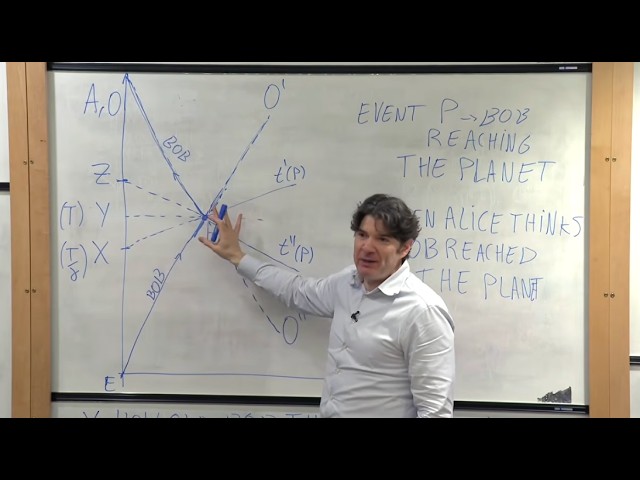
Special Relativity, Lecture 6: The Twin Paradox - 3rd Year Student Lecture
337
Lorentz transformations are the fundamental mathematical framework for converting coordinates between reference frames in special relativity. Unlike Galilean transformations, which are only valid approximations at speeds much smaller than light, Lorentz transformations accurately describe how space and time work at all speeds. This represents a historic breakthrough in understanding the nature of space and time. Time dilation is a key consequence: a clock moving at speed V relative to an observer appears to tick more slowly. If a clock ticks with period Δ in its rest frame, the observed period is γΔ, where γ = 1/√(1 - V²/c²) > 1. This effect applies to all clocks, including biological ones, and has been experimentally verified with muons traveling at speeds exceeding 90% the speed of light.
Click to watch →

Spacetime rotations, understanding Lorentz transformations
587.9K
Lorentz transformations, which describe how space and time coordinates change between different observers moving at constant velocities relative to each other, can be understood as hyperbolic rotations in spacetime geometry rather than simple spatial rotations; this geometric interpretation, developed by Poincaré and Minkowski through the Minkowski metric, reveals that time and space are unified dimensions of a single entity called spacetime, where the invariance of the speed of light emerges naturally from the properties of these hyperbolic rotations, and explains phenomena like time dilation, length contraction, and the unification of electric and magnetic fields as different aspects of the same underlying spacetime structure.
Click to watch →
Prerequisite Knowledge
- Concept 01The fundamental postulates of Special Relativity, specifically the constancy of the speed of light and the principle of relativity.
- Concept 02The classical Doppler effect, to understand how wave frequencies shift due to relative motion before applying relativistic corrections.
- Concept 03Basic principles of classical mechanics, particularly energy conservation, momentum, and the work-energy theorem.
- Concept 04An introductory familiarity with Lorentz transformations, space-time intervals, and time dilation.
Subsequent Learning
- Step 01The relativistic energy-momentum relation, exploring how energy and momentum are linked for particles with and without mass (E² = (pc)² + (m₀c²)²).
- Step 02Real-world applications of mass-energy equivalence in nuclear physics, such as mass defect, nuclear binding energy, fission, and fusion.
- Step 03The concept of matter-energy conversion in particle physics, including pair production, annihilation, and particle accelerators.
- Step 04An introduction to General Relativity, studying how mass and energy curve spacetime to describe gravity.
E=mc² Derivation
E=mc² Derivation
0:00Playing Section
- 1
Explains Einstein's 1905 derivation of mass-energy equivalence.
- 2
Uses a thought experiment with a cat emitting light.
- 3
Shows relativistic Doppler effect leads to mass change.
Historical and Logical Critiques of Einstein's 1905 Derivation
While E=mc² is a cornerstone of modern physics, physicists and historians of science have raised valid critiques regarding Albert Einstein's original 1905 derivation. A prominent criticism, notably advanced by physicist Herbert Ives in 1952, argues that Einstein's initial proof was circular. Ives contended that Einstein implicitly assumed the very relationship he set out to prove by assuming the same velocity for the frame of reference before and after the emission of light, effectively begging the question. Additionally, historical counterpoints highlight that Einstein was not the first to propose a relationship between mass and energy; earlier physicists, such as Oliver Heaviside, Henri Poincaré, and Fritz Hasenöhrl, had already derived similar formulations relating mass and electromagnetic energy before 1905. These critiques do not invalidate the modern validity of mass-energy equivalence, which has been verified experimentally, but they challenge the pedagogical narrative of a singular, flawless initial proof.
Deep Dive
The relativistic energy-momentum relation, exploring how energy and momentum are linked for particles with and without mass (E² = (pc)² + (m₀c²)²).

IIT JAM & GATE 2025 : Physics | Quantum/Modern - Let's Do PYQ, Part -1 | IIT JAM 2025
6K
The relativistic energy-momentum relation is E² = (pc)² + (m₀c²)², where E is total energy, p is momentum, m₀ is rest mass, and c is the speed of light. This equation is valid for all particles, including photons (where m₀ = 0, reducing to E = pc). The relation shows that total energy has two components: rest mass energy (m₀c²) and kinetic energy (the pc term). For particles with non-zero rest mass, the kinetic energy increases with velocity but the rest mass energy remains constant regardless of velocity.
Click to watch →
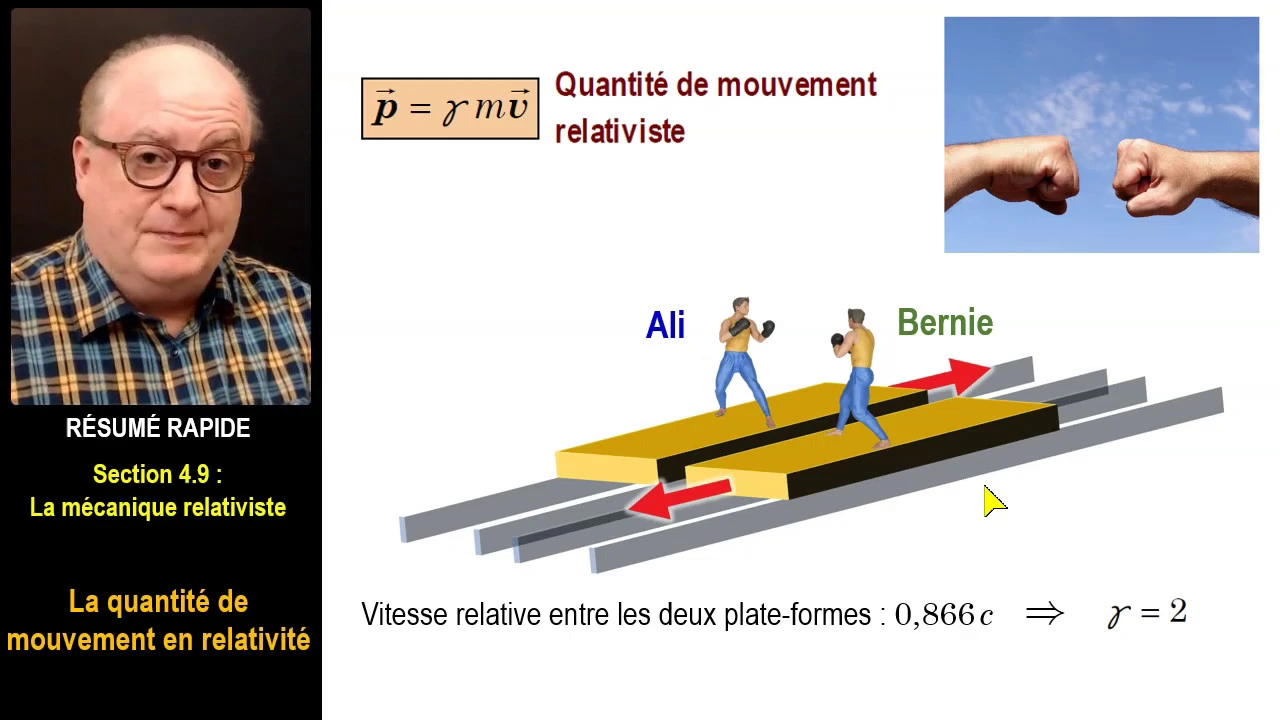
Relativité 8: E = mc² et la mécanique relativiste (Physique XXI, tome C, section 4.9)
2K
The fundamental relativistic relation connecting energy, momentum, and mass is E² = (pc)² + (mc²)². This equation applies to all particles regardless of whether they have mass or not. For objects at rest (p = 0), it simplifies to E = mc², giving the rest energy. For massless particles like photons (m = 0), it simplifies to E = pc, which describes their energy-momentum relationship. This unified equation shows how energy, momentum, and mass are interrelated in special relativity.
Click to watch →

Milliy sertifikat Fizika 13-may 2025 -yil yechimlari.
3.7K
The relativistic energy-momentum relation is E² = (pc)² + (m₀c²)², where E is the total energy, p is the momentum, m₀ is the rest mass, and c is the speed of light. This relation holds for all particles, including massless particles like photons (where m₀ = 0, so E = pc).
Click to watch →

Lec 12: Massless Particles || Special Relativity
409
The relativistic energy-momentum relation is given by E² = (pc)² + (m₀c²)², where E is total energy, p is momentum, m₀ is rest mass, and c is the speed of light. This equation shows that particles can have energy and momentum even when their rest mass is zero.
Click to watch →

Lezione 50a
4.9K
The relativistic energy-momentum relation is E² = (pc)² + (m₀c²)², where E is total energy, p is momentum, m₀ is rest mass, and c is the speed of light. For non-relativistic particles (pc << m₀c²), this reduces to E ≈ m₀c² + (1/2)m₀v². For ultra-relativistic particles (pc >> m₀c²), E ≈ pc. Photons have m₀ = 0, so E = pc.
Click to watch →
Deep Dive
Real-world applications of mass-energy equivalence in nuclear physics, such as mass defect, nuclear binding energy, fission, and fusion.

Nuclei | One Shot | Nishchay 2.0 NEET 2022/23 | Unacademy NEET | Mahendra Singh
58.7K
Einstein's mass-energy equivalence (E = mc²) explains why nuclear reactions release enormous energy. The atomic mass unit (amu) is defined as 1/12 the mass of a carbon-12 atom. The mass defect represents binding energy, with iron-56 having the highest binding energy per nucleon (8.8 MeV/nucleon). Nuclear fusion combines light nuclei to form heavier nuclei, releasing energy because binding energy per nucleon increases. For example, two deuterium nuclei fuse to form helium-4, releasing approximately 23.8 MeV. Nuclear fission splits heavy nuclei into lighter nuclei, releasing energy because binding energy per nucleon decreases for heavy nuclei. For uranium-235 fission, approximately 200 MeV is released per fission event. Nuclear reactors use controlled fission with moderators and control rods for electricity generation.
Click to watch →

NUCLEI in 29 Minutes | Physics Chapter 13 | Full Chapter Revision Class 12th
420.2K
Einstein's E = mc² shows mass and energy equivalence. One atomic mass unit equals approximately 931 MeV of energy. Mass defect occurs when nucleons bind into a nucleus, losing mass that converts to binding energy. Binding energy per nucleon determines nuclear stability, with iron-56 having the highest value. This explains why heavy nuclei release energy when splitting (fission) and light nuclei release energy when combining (fusion).
Click to watch →

فيزياء السادس علمي || 1- الفصل التاسع || الفيزياء النووية وخصائص النواة
79.6K
This section covers nuclear binding energy and the mass-energy equivalence principle. Nuclear binding energy is the energy released when nucleons combine to form a nucleus, or required to separate them. It equals the mass defect (difference between nucleus mass and sum of nucleon masses) multiplied by c² (E = Δmc²). This energy holds the nucleus together. Mass defect occurs because the bound nucleus has less mass than its individual components, with the missing mass converted to binding energy. Einstein's equation E = mc² states that mass and energy are equivalent and can be converted into each other. In nuclear reactions, a small amount of mass (mass defect) is converted into a large amount of energy. For example, 1 gram of mass can be converted into approximately 90 trillion joules of energy, which is enough to power a city for 2000 years.
Click to watch →

ታዋቂው E=mc2 ምንድን ነው? || Nuclear Energy, Atomic Bomb || Physics እንደዚህ ቀሎ አያውቅም!
115.4K
Einstein's theory of relativity introduced the revolutionary concept that mass and energy are equivalent forms of the same thing, expressed by the famous equation E = mc². This means mass can be converted into energy and vice versa. A small amount of mass contains enormous energy—for example, 1 milligram of mass contains approximately 900 billion joules of energy. Atoms consist of protons, neutrons, and electrons, with protons and neutrons forming the nucleus. Nuclear fission occurs when heavy nuclei like uranium split into smaller nuclei when struck by neutrons, releasing enormous energy through chain reactions. Nuclear fusion occurs when light nuclei like hydrogen combine to form heavier nuclei like helium, releasing energy that powers stars including our Sun. Both processes convert mass to energy according to E = mc², with fusion being the primary energy source of stars and fission being used in nuclear power generation.
Click to watch →

Michelson Morley Deneyi ve Özel Görelilik | İzafiyet Teorisi | 2025 AYT Fizik kampı
64.2K
Einstein's equation E = mc² states that mass and energy are equivalent and can be converted into each other. A small amount of mass can be converted into enormous energy because c² is very large. In nuclear reactions, the mass of a nucleus is less than the sum of its protons and neutrons - this 'mass defect' has been converted into binding energy that holds the nucleus together. This principle explains nuclear power and atomic bombs, where small mass losses release tremendous energy.
Click to watch →
Deep Dive
The concept of matter-energy conversion in particle physics, including pair production, annihilation, and particle accelerators.

14 PARTICLE PHYSICS LONG Q5- end | quarks HADRONS baryon PHYSICS CLASS 11 NBF FBISE 2025 26 solved
104
Particle annihilation occurs when matter meets antimatter, converting mass to energy (E=mc²). Electron-positron annihilation produces two gamma-ray photons to conserve momentum. Pair production is the reverse: energy converts to matter-antimatter pairs. Particle accelerators accelerate charged particles to high energies: linear accelerators (like SLAC's 2-mile accelerator) use alternating electric fields in a straight line; synchrotrons (like the LHC) use magnetic fields to bend particles in circular paths; cyclotrons accelerate particles in spiral paths. The LHC accelerates protons to nearly light speed for collisions that produce new particles.
Click to watch →

JEE Mains: Radioactivity - L 3 | IIT Physics | Unacademy JEE | Jayant Sir
88.3K
Pair production converts high-energy gamma rays (≥1.02 MeV) into electron-positron pairs, demonstrating mass-energy equivalence. The minimum energy equals the combined rest mass (2×0.511 MeV). Electron-positron annihilation is the reverse process, where particles disappear and produce gamma rays. Conservation laws (mass-energy, momentum, charge, baryon number, lepton number) govern all nuclear reactions. These processes are fundamental to particle physics and demonstrate the deep connection between matter and energy.
Click to watch →

LV2005Presentation
159
Einstein's equation E=mc² demonstrates that mass can be converted into pure energy. This is demonstrated by annihilating electron-positron pairs. A sodium-22 radioactive source emits positrons (anti-particles of electrons with the same mass but opposite charge). When a positron encounters an electron in surrounding material, they annihilate and produce two photons ejected in exactly opposite directions (180° apart). These photons carry energy equivalent to the mass of the electron and positron. The demonstration uses two scintillation detectors with collimators to detect these coincident photons. Photons interact with matter in different ways: the Compton effect demonstrates that X-rays or gamma rays can be scattered by electrons, losing energy in the process. Beta decay produces a continuous energy distribution rather than a single energy value, which indicated that an additional neutral particle (the neutrino) was being emitted, carrying away part of the energy. This hypothesis was later confirmed, resolving the apparent violation of energy conservation in beta decay.
Click to watch →
e=mc2, equivalenza massa energia Einstein - la fisica che ci piace
120.6K
In particle accelerators, particles accelerated near light speed gain kinetic energy that can convert to mass upon collision, producing many new particles. CERN produces 800 million collisions per second. This demonstrates E=mc²: energy becomes matter. If everyday objects collided at these speeds, they could produce enormous matter (cars, buildings, schools). This principle enabled discovery of antimatter, muons, and the Higgs boson (14 TeV collisions), revolutionizing our understanding of matter's fundamental nature.
Click to watch →

pair production and annihilation
22.7K
Pair production and annihilation are fundamental processes in particle physics where an electron and positron (each with mass 511 MeV/c²) can convert into each other or into gamma radiation; however, these processes require conservation of momentum, meaning a nucleus must be present to absorb excess momentum, and they demonstrate that space is not truly empty due to Heisenberg's uncertainty principle allowing virtual particles to briefly appear and disappear, with significant implications for black hole physics through Hawking radiation.
Click to watch →
Deep Dive
An introduction to General Relativity, studying how mass and energy curve spacetime to describe gravity.

General Theory of Relativity | General Relativity Explained | General Relativity Lecture
657
General Relativity is the study of spacetime curvature caused by mass and energy. The rubber sheet analogy illustrates this: a heavy mass creates a depression in spacetime, causing objects to follow curved paths. This curvature is what we perceive as gravity. The theory unifies space and time into a single four-dimensional continuum, fundamentally changing our understanding of reality.
Click to watch →
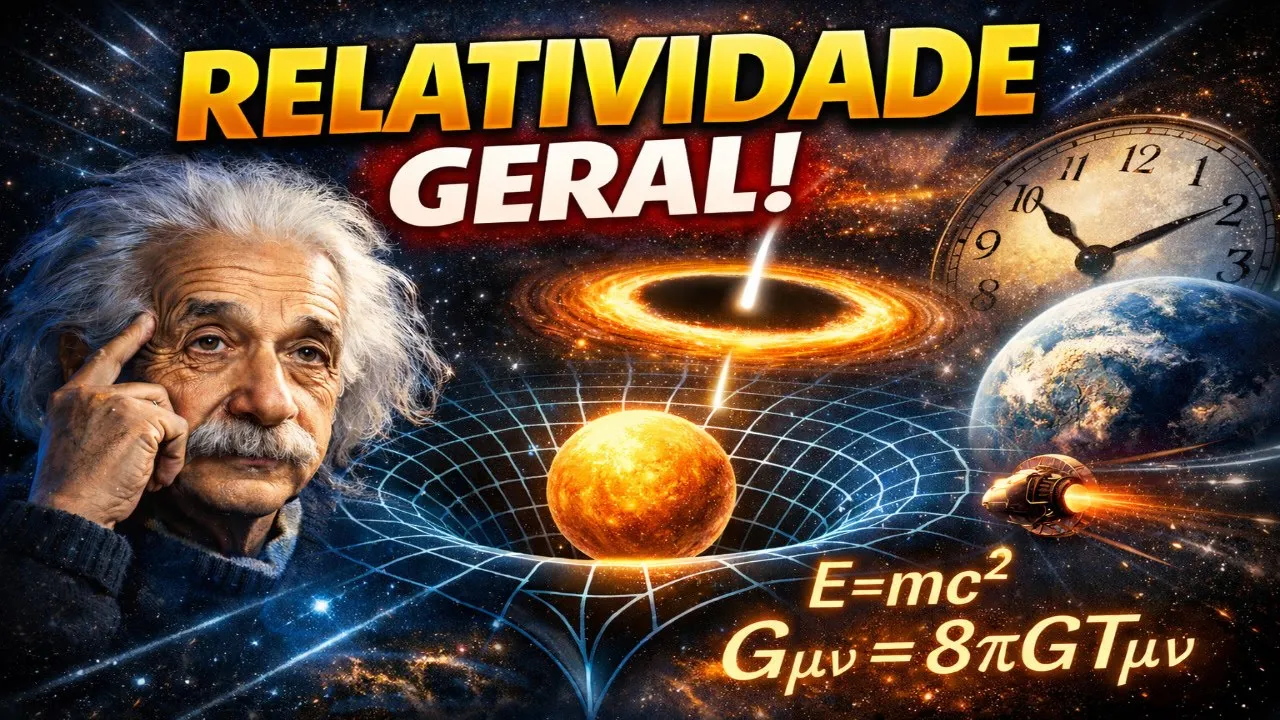
Relatividade Geral: Um Guia
237
The central insight of general relativity is that mass and energy curve the fabric of space-time. Using the analogy of a heavy ball placed on a stretched rubber sheet, which creates a depression or curve, Einstein showed that massive objects like the Earth and Sun create similar curves in the space-time fabric. This curvature is what we experience as gravity.
Click to watch →

Introduction to General Relativity | General Relativity for Dummies | General Relativity Lecture
1K
In general relativity, mass-energy tells spacetime how to curve, and spacetime curvature tells matter how to move. When mass is placed on spacetime, it creates curvature, which then dictates the paths that other masses will follow. This is fundamentally different from Newtonian gravity, where gravity is treated as a force acting at a distance rather than as a geometric property of spacetime itself.
Click to watch →
Brian Greene, Frederick Lepore and Thomas Levenson: The Genius of Einstein
160.7K
Einstein's general relativity explains gravity not as a force acting at a distance, but as the curvature of spacetime caused by mass and energy. Massive objects like the Sun warp the fabric of spacetime around them, and other objects follow curved paths through this warped geometry, which we perceive as gravitational attraction. The mathematical formulation Rμν - ½gμνR = (8πG/c⁴)Tμν compactly describes how matter and energy determine the geometry of spacetime, and vice versa.
Click to watch →

CCM0222 - Aula 13 - Introdução à Relatividade Geral
160
The presence of mass (or energy) curves spacetime, which is described by modifying the metric tensor. In flat spacetime (no gravity), the metric is the Minkowski metric ds² = dx² + dy² + dz² - c²dt². In the presence of mass, this metric is modified at each point in space according to the local gravitational field. This means that the geometry of spacetime is not uniform but depends on the distribution of mass-energy, which is the central idea of general relativity.
Click to watch →
E=mc² Derivation
E=mc² Derivation
0:00- 1
Explains Einstein's 1905 derivation of mass-energy equivalence.
- 2
Uses a thought experiment with a cat emitting light.
- 3
Shows relativistic Doppler effect leads to mass change.
Historical and Logical Critiques of Einstein's 1905 Derivation
While E=mc² is a cornerstone of modern physics, physicists and historians of science have raised valid critiques regarding Albert Einstein's original 1905 derivation. A prominent criticism, notably advanced by physicist Herbert Ives in 1952, argues that Einstein's initial proof was circular. Ives contended that Einstein implicitly assumed the very relationship he set out to prove by assuming the same velocity for the frame of reference before and after the emission of light, effectively begging the question. Additionally, historical counterpoints highlight that Einstein was not the first to propose a relationship between mass and energy; earlier physicists, such as Oliver Heaviside, Henri Poincaré, and Fritz Hasenöhrl, had already derived similar formulations relating mass and electromagnetic energy before 1905. These critiques do not invalidate the modern validity of mass-energy equivalence, which has been verified experimentally, but they challenge the pedagogical narrative of a singular, flawless initial proof.
The fundamental postulates of Special Relativity, specifically the constancy of the speed of light and the principle of relativity.
The classical Doppler effect, to understand how wave frequencies shift due to relative motion before applying relativistic corrections.
Basic principles of classical mechanics, particularly energy conservation, momentum, and the work-energy theorem.
An introductory familiarity with Lorentz transformations, space-time intervals, and time dilation.
The relativistic energy-momentum relation, exploring how energy and momentum are linked for particles with and without mass (E² = (pc)² + (m₀c²)²).
Real-world applications of mass-energy equivalence in nuclear physics, such as mass defect, nuclear binding energy, fission, and fusion.
The concept of matter-energy conversion in particle physics, including pair production, annihilation, and particle accelerators.
An introduction to General Relativity, studying how mass and energy curve spacetime to describe gravity.
6.2M views97.3Klikes2:11@MinutePhysicsOriginal Release: 2012-03-29
In mid 1905, Albert Einstein derived what is now the most famous equation in the world: E equals M C squared. But he didn't just write this down out of the blue – it followed directly from his paper on special relativity that we talked about in last week's video… and here's how he did it: Suppose you're watching a cat float freely in empty space, when suddenly it emits a flash of light in all directions. The light carries away some energy, we'll call it "E", so by conservation of energy the cat must have lost energy E… but since the light was emitted symmetrically in all directions, it won't have changed the cat's velocity. So where did the energy for the light come from?
Never mind that now… let's imagine you get bored and zoom off in a spaceship in the middle of the experiment. But from your new perspective, you're sitting still in your spaceship and the cat is the one moving past outside the window! Therefore you'll calculate that the cat has some kinetic energy, that is, energy of motion… and when you see the cat emit the flash of light, you'll again measure that its energy decreases by the energy of the light.
Except now that you're moving, special relativity tells us that time passes at different rates for you and the cat, so you'll measure a different value for the frequency, and thus energy of the flash of light. This is the relativistic doppler effect, and for our purposes, it amounts to multiplying the energy of the light by one plus your velocity squared divided by twice the speed of light squared.
So to recap, if you take off at velocity v, you'll see the cat gain some kinetic energy KE1, then at the flash you'll see the cat's energy decrease by E times one plus v squared over two c squared. On the other hand, if you wait, you'll see the cat's energy decrease by E, and now when you take off you'll see it gain kinetic energy KE2.
But this is silly! You never touch or otherwise influence the cat in either case, so you should get the same total energy at the end… Rearranging, we see that the kinetic energy before and after the flash must be different! And the kinetic energy of an object is one-half of its mass times velocity squared, but we know that the velocity was the same in both cases… so in order to account for the difference, the cat's mass must change when it emits the flash of light!
Now if we cancel things out, you can see that the change in mass of the cat must be equal to the energy divided by c squared – or, as you've heard before, E equals M C squared!
Up Next
10:44
Twins Paradox Explained: Special Relativity Solution
@ScienceAsylum
191.8K views•2018-04-27

12:53
21cm Hyperfine Transition in Neutral Hydrogen: Radio Astronomy Basics
@AaronRobertParsons
12.4K views•2011-10-13
21:43
Feynman's Lost Lecture: Why Planets Orbit in Ellipses | Physics Explained
@MinutePhysics
3.7M views•2018-07-20

27:14
Entropy and the Second Law of Thermodynamics Explained
@veritasium
27.5M views•2023-07-01
Related Study Plans & Knowledge Roadmaps
Structured learning paths in Physics
physics
Nuclear Physics (Decay, Fission & Reactors)
01Atomic Structure and the Binding Force
02Radioactive Decay and Half-Life
03Nuclear Fission Mechanics and Chain Reactions
+ 2 more learning modules
12h5 modules
Explore Roadmap
physics
Soft Matter (Polymers, Colloids & Rheology)
01Foundations of Soft Matter & Thermal Forces
02Polymer Physics and Macromolecules
03Colloids, Surfactants, and Self-Assembly
+ 2 more learning modules
38h5 modules
Explore Roadmap
physics
Analytical Mechanics: Lagrangian & Hamiltonian
01Mathematical Foundations: Calculus of Variations
02From Newtonian Mechanics to Constraint Dynamics
03The Principle of Least Action & Lagrangian Mechanics
+ 3 more learning modules
28h6 modules
Explore Roadmap
physics
General Relativity (Spacetime & Cosmology)
01Foundations of Relativity: Special Relativity
02The Geometry of Spacetime: Equivalence Principle & Curvature
03Einstein's Field Equations: The Mathematics of Gravity
+ 2 more learning modules
55h5 modules
Explore Roadmap