













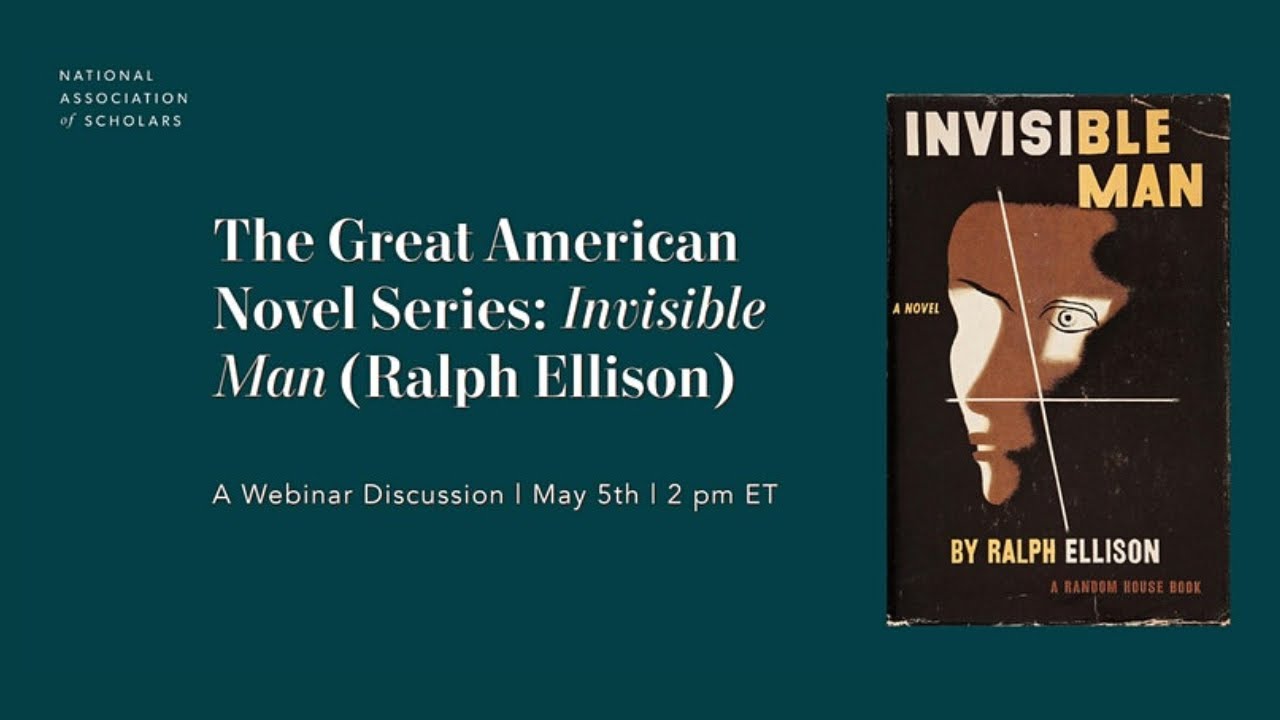
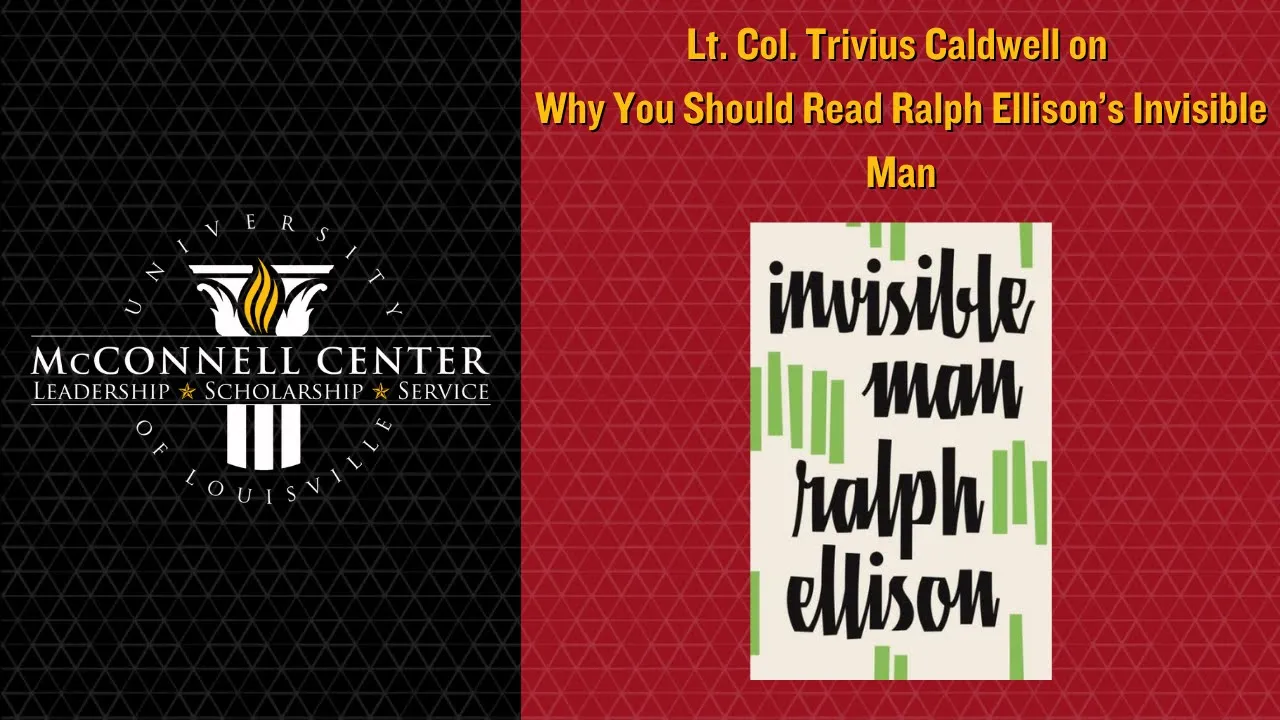





Ralph Ellison's Invisible Man (1952), which won the National Book Award, follows an unnamed African American narrator's journey from the segregated South to New York City, exploring how systemic racism renders Black individuals invisible and dehumanized; through a series of disillusioning experiences—including a traumatic 'Battle Royale' at his college graduation, expulsion from school, employment with a revolutionary organization called The Brotherhood, and witnessing police violence—the narrator learns that true self-discovery requires rejecting external definitions of identity and embracing one's own humanity, ultimately concluding that 'who knows but that, on the lower frequencies, I speak for you?' as he prepares to emerge from self-imposed exile to participate in shaping society.
Invisible Man by Ralph Ellison: Race & Identity in America | Literature Analysis
Added:Hi I'm John Green, this is Crash Course Literature and today we're discussing Ralph Ellison's Invisible Man, which is not the H.G. Wells novel from 1897, THE Invisible Man.
That's a different book. This one came out in 1952, won the national book award that year.
And it's less about science experiments gone wrong, more about racial prejudice in America.
The other way you can tell the difference between them is that Invisible Man is better.
And today we're going to talk about why Invisible Man is such an important American novel.
[Theme Music] So David Denby writing in the New Yorker said: "Whatever else it is, the book is an intricately wrought structure of myth and symbol, a novel devoted to initiations, rites of passages, testing, annihilation and rebirth... (Ellison) struggled to define a black culture as something precious but indissolubly linked to white culture – a task always difficult and always controversial."
And Invisible Man was published at a time when racial attitudes in the United States were in flux.
I mean, there was a growing sense that racial inequality and segregation that had been the norm for centuries was about to change.
Let's go to the Thought Bubble.
Invisible Man was published not long after the end of World War II, in which 1 million African Americans had served, all in segregated units.
And many of these soldiers felt that segregation conflicted with the US's espoused ideas of equality.
African Americans were fighting in Europe at least partially for racial equality, and they were returning home to a country where they weren't afforded equal rights.
And this dissonance is part of what led African Americans to demand equal rights as citizens of the country for which they had risked their lives.
Shortly before Ellison began writing the book, the Pittsburgh Courier started its "Double V" campaign, calling for democracy: Victory at Home!, Victory Abroad!
The idea was that black citizens should support the war effort and that they also deserved to be supported in their own country.
The campaign featured photos of black and white people together, emphasizing that equality was good for the war effort and good for the country.
The Supreme Court's Brown vs. Board of Education decision wouldn't happen until two years after the publication of Invisible Man, and the 1964 Civil Rights Act took another 12 years.
By then, Invisible Man was a famous book and an important voice in the Civil Rights Movement, but it remains so today.
Invisible Man was a product of its time and place, but it also sprung from Ellison's personal experiences.
He was born in 1913 and grew up in poverty.
He attended the Tuskegee Institute in Alabama, and met Langston Hughes and Richard Wright one summer in New York while working to earn money for school.
Wright encouraged him to become a writer, and Ellison spent the next seven years crafting Invisible Man.
He said, "When I was a kid, I read...novels...and always, I was the hero. I identified with the hero.
Literature is integrated. And I'm not just talking about color, race.
I'm talking about the power of literature to make us recognize again and again the wholeness of human experience."
Thanks, Thought Bubble.
So the essential failure that made segregation possible was the failure by white people to understand African Americans as fully human.
And when Ellison talks about the wholeness of human experience, that's one of the things he gives his unnamed narrator in Invisible Man.
The narrator is a black man on a quest to find his true self while facing racism and disrespect from all sides.
We follow him from his childhood in the south where he's awarded a scholarship to the state's black college.
But he gets expelled from college in his junior year and he goes to New York City to find work, and then his workplace explodes.
During his recovery he happens upon an eviction.
This elderly couple's possessions are being roughly moved out onto the street, and he speaks on their behalf.
And this leads to a job with an organization called The Brotherhood, where he briefly feels that he's found his place in the world.
But the Brotherhood also doesn't work out for him and he becomes disillusioned.
His friend from the organization is then shot by the police.
And now it's time for the Open Letter. An open letter to police shootings: Hello, Police Shootings. It's me, John Green.
It's been 64 years since Invisible Man was published.
In 1952, as in today, African American men were disproportionately likely to be injured or killed in interactions with police.
That isn't a political statement, or a subject for debate; I actually made a video about this talking about the immense amounts of data on the subject.
The difference between then and now, and I do live in hope that there is a difference, is that today those shootings are much more visible.
64 years after the publication of Invisible Man, systemic racism remains a very real part of American life.
That's part of why the book continues to feel so relevant; it reminds us that all people everywhere have the right not to be invisible, to develop their own identities, and to be respected.
Best wishes, John Green.
But to get back to the story, near the end of the book, a riot breaks out.
Our narrator is grazed by a bullet and joins in with a band of looters, ultimately helping them burn down the tenement apartment building where most of them live.
He finds himself running from a group of young men and he falls through an open manhole where he decides to stop fighting and remain underground.
So in the 1952 review of the book, Orville Prescott wrote of Ellison, "He is not interested in literal realistic truth, but in an emotional, atmospheric truth which he drives home with violence, writing about grotesquely violent situations.
With gruesome power he has given 'Invisible Man' the frenzied tension of a nightmare."
And like a nightmare, Invisible Man isn't only about what happens, it's also about how it feels.
The story is structured as a series of episodes, and in each of these episodes we see the narrator become more and more disillusioned.
Like before being awarded a college scholarship he's first made to participate in a fight, a "Battle Royale" with other boys from his school.
He worries that the dignity of his speech accepting the scholarship will be compromised and he has to deliver it with a mouth full of blood.
Nathaniel Rich describes the scene as "a masterpiece of storytelling, transfixing and indelible.
But it is also the purest expression of Ellison's argument: a race stripped of volition and dignity, divided against itself, callously exploited, rendered both invisible and blind."
Later when he's expelled from college, he's surprised to find the headmaster, who he always admires, scolding him saying, "You don't even know the difference between the way things are and the way they're supposed to be."
The narrator is astonished to hear the headmaster imply that he would sacrifice anything, including others' lives, to hold onto his position in power.
And then in the Brotherhood he again feels like he's found a place to belong, where he can be successful, but as he takes on a position of leadership, he gets an anonymous note in the mail, telling him to be careful not to go too fast and risk upsetting people who don't want to see a black person succeed.
This is something civil rights activists heard again and again in the 1950's and 60's: "Go slow! Let's not make too much change!"
And when the narrator sets the warning aside, he finds himself undermined and he's eventually abandoned by the Brotherhood which leads to the bloody and destructive riot.
At every turn, the narrator finds that the things he believes in most deeply turn out to be not what they seem.
And in each of these situations and in others, the narrator's invisibility is made apparent.
The people in power disregard his humanity and they turn their backs on him or the things he cares about.
And throughout the novel, Ellison uses imagery that invokes vision to help reinforce these ideas of invisibility and lack of insight.
The boys wear blindfolds during their Battle Royale.
A speaker at the college who praises the founder of the school turns out to be blind.
And Brother Jack, the leader of the Brotherhood is revealed to have a glass eye just as he and the narrator start to express their conflicting views.
And when the narrator obstructs his own vision using dark glasses, he's mistaken for another person altogether – a man named Rinehart who's been using his own invisibility to create several different personas in Harlem.
And much of this experience of invisibility has to do with race, and people's perceptions and prejudices.
The narrator's search for a strategy to escape prejudice leads him on this path through many other characters who believe that they've found the solution.
And that if everybody, including the narrator, would just follow their lead everything would be fixed.
Like, his grandfather advocates that he should: "...overcome 'em with yeses, undermine 'em with grins, agree 'em to death and destruction..." and in that process diminishing himself before white people he'll somehow achieve equality.
The headmaster believes the solution lies in modeling your behavior on white people who've achieved power; he thinks that's how he's become powerful.
And then there's Ras the Exhorter who thinks destruction of whites is the key for black people to gain their freedom.
Our invisible narrator doesn't find a viable path in any of these options.
Through all his experiences and disillusionments, the narrator begins to understand that he needs to develop his own identity and beliefs, and that he'll be of no help to himself or his community if he prescribes one path to freedom for all people, or blindly follow someone else's path.
In the end he comes around to the idea that understanding who we are as individuals is what enables us to move forward.
This is reinforced brilliantly in the Epilogue. The narrator says: "When one is invisible, he finds such problems as good and evil, honesty and dishonesty, of such shifting shapes that he confuses one with the other, depending on who happens to be looking through him at the time.
Well now I've been trying to look through myself and there's a risk in it.
I was pulled this way and that for longer than I can remember and my problem was that I always tried to go in everyone's way but my own.
So after years of trying to adopt the opinion of others, I finally rebelled.
I am an invisible man."
The critique Nathaniel Rich wrote: "Ellison's hero discovers his own identity through a process of negation.
Disenchanted and Disenchanted and sickened by his experiences in society, he comes to realize the cruel extent of his powerlessness.
The only escape available to him appears in the form of a manhole, through which he escapes underground.
An invisible man can’t be a college president, or a business leader, or a politician.
But at least he is spared the indignities of an oppressed class.
If you can’t see him, he might be anywhere. He might be everywhere."
But then again, at the end of the book, the narrator is planning to emerge from his hibernation and to take his place among society once again.
In the cellar, alone, he has found himself.
And while he's unsure of what his place in the social order will be, he recognizes that he can't make the impact he wants to, from underground.
His final words to us are: "Who knows but that, on the lower frequencies, I speak for you?"
And indeed, parts of his story are universal.
It's up to us to find ourselves and to carry our responsibilities to improve the social order in which we live.
But it's the phrase "lower frequencies" in that sentence that's always stuck with me.
Ellison here has made into a great American hero a character who in most great American novels would play a bit part.
Ellison said later of the novel: "The hero's invisibility is not a matter of being seen, but a refusal to run the risk of his own humanity, which involves guilt.
This is not an attack upon white society!
It is what the hero refuses to do in each section which leads to further action.
He must assert and achieve his own humanity; he cannot run with the pack and do this – this is the reason for all the reversals."
And by telling his individual story, the Invisible Man brings light and visibility to many stories.
Thanks for watching. I'll see you next week.
Crash Course is filmed in The Chad and Stacy Emigholz Studio here in Indianapolis and it's made by of all these lovely people.
It's made possible by you and your support at Patreon, a voluntary subscription service that allows you to support Crash Course directly.
You can also get lots of great perks so please check out the Patreon: patreon.com/crashcourse Thank you again for watching and as we say in my hometown: Don't Forget to be Awesome.
Up Next

Philip Roth on Saul Bellow: Final Interview & Literary Friendship
@americanmasters
29.4K views•2022-12-07

Formalism in Literary Criticism: An Academic Lecture Overview
@mattalberhasky9952
39.1K views•2015-08-05
Frankenstein, Part 2: Romanticism and Critical Readings
@crashcourse
1.1M views•2014-04-03

1984: Orwell's Dystopian World and the Mechanisms of Totalitarianism
@AlternateHistoryHub
7M views•2017-03-04
Related Study Plans & Knowledge Roadmaps
Structured learning paths in Literature