A Delaware LLC is generally more flexible and suitable for most business owners, offering superior liability protection, customizable operating agreements, and flexible tax options including pass-through taxation or S-corporation election, while corporations are better suited for businesses seeking venture capital investment due to their stock structure; LLCs can also be converted to corporations if needed, making them the preferred choice for most entrepreneurs.
Corporation vs LLC: Delaware Business Entity Comparison
Added:Deep Dive
The concept of limited liability and how it protects personal assets from business-related legal actions and debts.

11th SP One Shot Complete Marathon | 11th SP Complete Book Revision in 1 Video | JR College |
2.3K
Limited liability means that the owner's personal assets are protected from business debts. If a business fails, only the business assets can be used to repay creditors, not the owner's personal property. This protection applies to companies and other business structures where the business is considered a separate legal entity from its owners.
Click to watch →

¿Es legal tener plata afuera de Argentina? Mitos, LLC y como proteger tu patrimonio - NeoFinanzas
3.5K
Limited liability means business owners are only responsible for debts up to invested capital. Personal assets are protected from business debts. This concept originated from colonial shipping risks where investors should not lose personal wealth if a ship failed. Companies are legal persons with their own assets, and creditors can only pursue company assets. Forming a company makes sense when business operations have consolidated and there is risk of lawsuits, even for monotributists.
Click to watch →
Elements of Company Law CSEET | Legal Aptitude | In English | Part 1
2.9K
Limited liability means that the personal assets of shareholders are protected from the company's debts. Shareholders are only liable for the amount they have invested in the company. If the company goes bankrupt, shareholders can lose their investment but their personal assets are not at risk. In unlimited liability structures, business income and personal assets are not separated, and creditors can pursue personal assets to satisfy business debts. This creates a direct connection between business obligations and personal financial security.
Click to watch →

Como funciona la Bolsa de valores ¿Qué es la Bolsa?//PARA PRINCIPIANTES
521.9K
Limited liability means that if something goes wrong in a business, only the company is responsible, not its owners. If a company is sued, owners may lose all company assets but their personal assets (like cars, houses, savings) remain protected. This concept originated from merchant ship owners who created limited liability companies to avoid being personally responsible for accidents at sea.
Click to watch →

Companies Act-1994│Part-1│ Business law │Anwaruzzaman FCA│CA Certificate Level│ICAB
6.7K
Limited liability means that shareholders are only liable up to the amount of shares they hold or the guarantee they have given. This protects personal assets from business debts beyond their investment in the company.
Click to watch →
Deep Dive
Fundamental differences in business taxation, particularly the distinction between pass-through taxation and corporate double taxation.

Enrolled Agent - Part - 2, Lecture No. 1 by Abhinav Raparia
867
Business entities are broadly classified into two categories: Double Tax (DT) entities and Pass Through (PT) entities. Double Tax entities are taxed twice - once at the corporate level on profits and again at the shareholder level on dividends. Pass Through entities are taxed only once at the shareholder level, as the entity itself does not pay taxes. Examples of Double Tax entities include C Corporations, while S Corporations and Partnerships are Pass Through entities.
Click to watch →

College Finance Chapter 1: The Financial Manager, Part One
4.3K
Business taxation differs significantly by entity type. Pass-through entities (sole proprietorships, partnerships) report business income on owners' personal tax returns, facing marginal tax rates where different income portions are taxed at different rates. Corporations face double taxation: income is taxed at the corporate level, then dividends face additional taxation at the shareholder level. This makes corporations more expensive to operate. Statistics show 73% of U.S. businesses are sole proprietorships generating only 10% of income, while corporations represent 17% of firms but generate 64% of national income, reflecting their efficiency at large-scale operations.
Click to watch →
Tax Benefits of LLC | LLC Taxes Explained by a CPA - How does a LLC save taxes?
390.3K
Pass-through taxation means that all business income is subject to taxation even if not distributed to owners. LLCs benefit from pass-through taxation, meaning they are only taxed once on business income. In contrast, C corporations face double taxation where the business is taxed first, and then owners are taxed again on personal income distributions.
Click to watch →
![비즈니스 세금 절감을 위한 LLC와 S Corporation, 올바른 선택을 하려면 ‘이 차이’확인하세요. [203강 S Corporation vs. LLC]](https://i.ytimg.com/vi_webp/HUBeZIvWO48/maxresdefault.webp)
비즈니스 세금 절감을 위한 LLC와 S Corporation, 올바른 선택을 하려면 ‘이 차이’확인하세요. [203강 S Corporation vs. LLC]
9K
C-Corporations face double taxation: the corporation pays corporate income tax on profits, and then shareholders pay additional tax on dividends received. In contrast, pass-through entities like LLC and S-Corporation avoid this double taxation because income is taxed only once at the owner level. This makes pass-through entities generally more tax-efficient for small businesses.
Click to watch →

Business Law - Corporations Overview
37.3K
Corporations face double taxation because they are treated as legal persons subject to income tax. The corporation pays taxes on its profits, and when those profits are distributed to shareholders as dividends, the shareholders pay additional taxes on those distributions. This contrasts with pass-through entities like partnerships where income is taxed only once at the shareholder level.
Click to watch →
Deep Dive
Basic legal terminology associated with business entities, including stakeholders, shareholders, members, and directors.

Unit 1 Video 4 Stakeholders, shareholders and Shares
126
A stakeholder is any individual or organization with an interest in a business's activities and decisions, including internal stakeholders (employees, shareholders, owners), connected stakeholders (customers, suppliers, creditors), and external stakeholders (competitors, government, society). Shareholders are individuals or institutions who legally own shares in a corporation, distinguishing them from other stakeholders who have an interest but do not own the business. Shares represent ownership stakes in a company, with private limited companies having fewer shareholders and shares that cannot be publicly traded, while public limited companies can have many shareholders with shares traded on the stock market. Shareholders receive dividends from profits and benefit from capital growth when share prices increase. Market capitalization is calculated by multiplying share price by the number of shares issued, and share prices are influenced by factors like financial performance, dividend policy, management reputation, economic conditions, and market expectations.
Click to watch →

Peranan Stakeholder dan Stockholder
132
This presentation covers corporate governance concepts including stakeholders (all parties with relationships and interests in organizations, classified as primary, secondary, and key stakeholders, or internal and external), shareholders (individuals or groups holding company shares), and the Board of Directors (corporate organ responsible for management). Key differences between shareholders and stakeholders include ownership rights, decision-making influence, and impact exposure. The Board of Directors is classified as executive or non-executive, with directors appointed by Shareholders' General Meeting approval. Corporate governance paradigms include shareholder-focused (maximizing returns) and stakeholder-focused (broader prosperity) approaches.
Click to watch →

Members and shareholders of a company | company law | mdu | B. com
2.6K
In company law, members are individuals whose names are recorded in the company's register of members, while shareholders are those who hold shares in the company; normally, shareholders are also members, but in certain situations like companies without share capital, share warrants, death of shareholders, insolvency, or transfer of shares, a person may be a shareholder without being a member, and vice versa. Eligibility to become a company member includes individuals with sound mind, corporations, registered societies, married women, and foreign nationals (with RBI permission), while minors and partnership firms cannot become members.
Click to watch →
![Ch - 1 Stakeholders In Commercial Organisation [ Class - X ] (Part -1) ICSE](https://i.ytimg.com/vi/ORIVWfxldiM/sddefault.jpg)
Ch - 1 Stakeholders In Commercial Organisation [ Class - X ] (Part -1) ICSE
8.7K
This segment introduces the fundamental concepts of shareholders and stakeholders in business. A shareholder is defined as a person or institution that has purchased shares in a company, making them a partial owner. A stakeholder is any person or organization with an interest in the company, including employees, managers, suppliers, and customers. Shareholders are essentially the owners of the company, as exemplified by Mark Zuckerberg's ownership stake in Facebook. The video explains that shareholders have financial stakes in company performance and can benefit from company success through dividends and capital appreciation.
Click to watch →

CMA Inter Corporate Accounting Lecture 1 | Fast Track Batch | Issue of Shares (Class 1)
7.9K
Shareholders and members are essentially the same - they are the owners of the company. When a person purchases company shares, they become a shareholder and member. Since companies often have many owners, shareholders elect representatives (directors) to manage the company on their behalf. Directors are elected by shareholders to run the company's operations. A common seal is a company's official stamp used to authenticate documents, though it is optional under the Companies Act 2013. If a company does not have a valid common seal, documents can be authenticated by the signatures of two directors or by one director and the company secretary.
Click to watch →
Deep Dive
The role of state-level jurisdiction in US business law and why companies choose specific states for incorporation.

Should I Incorporate In Nevada, Wyoming, Delaware or Alaska?
283
The appropriate state for business incorporation depends on the type of business: real estate and brick-and-mortar businesses should be incorporated in the state where they are located to establish legal standing and protect assets, while purely online businesses can be incorporated in states like Nevada, Delaware, or Wyoming for favorable tax and charging order protection; brokerage accounts should be incorporated in states with strong charging order protection to shield assets from lawsuits, though income taxes will apply when funds are withdrawn for personal use.
Click to watch →
Incorporation of a Company
120
Corporations must choose a state of incorporation, determining which state's law governs internal affairs—relationships among shareholders, directors, and officers. Delaware dominates this space, with ~75% of IPO corporations choosing it due to flexible statutes, experienced courts, and extensive case law. The internal affairs doctrine requires courts to apply the corporation's home state law even when cases are heard elsewhere. External matters like contracts and labor disputes follow forum state law. This creates a separation between internal governance and external obligations, with businesses balancing incorporation costs against operational benefits across multiple states. The choice involves tax considerations, corporate law flexibility, and costs of qualifying to do business as a foreign corporation in other states where operations occur.
Click to watch →
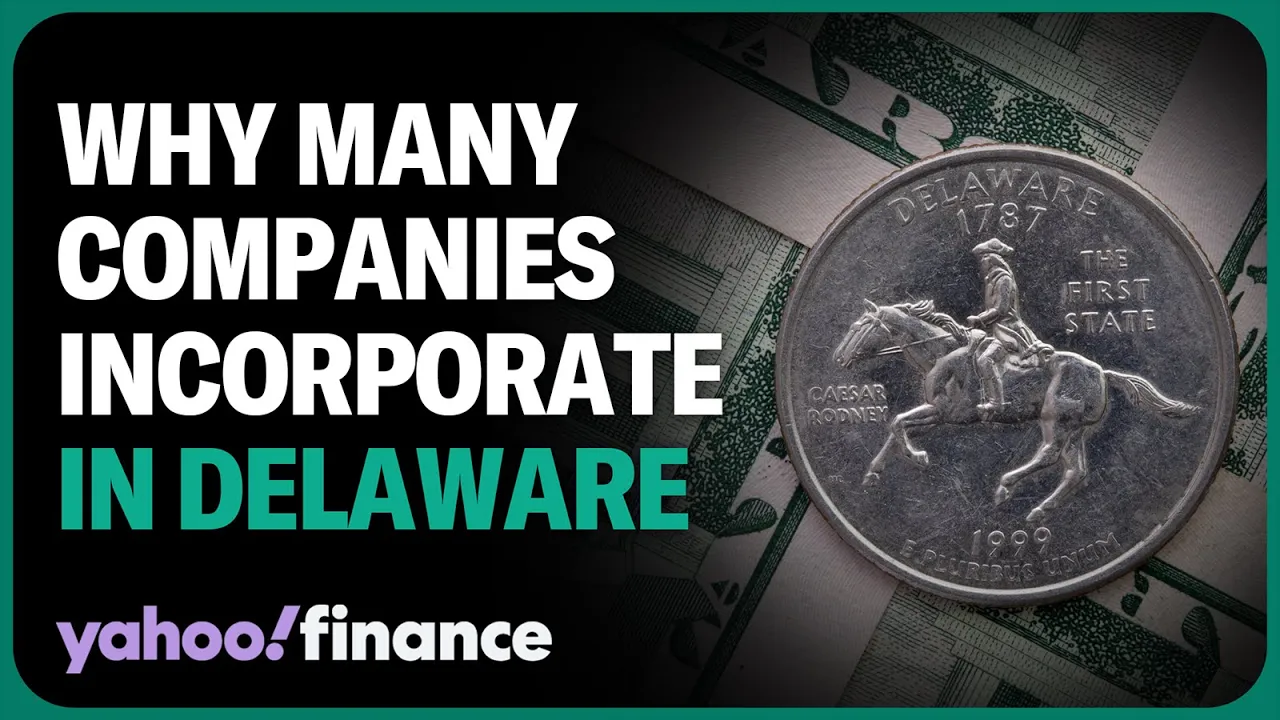
Not just Tesla: Why so many companies incorporate in Delaware
7K
Delaware became the preferred state for corporate incorporation in the early 1900s due to its flexible corporate law and specialized Chancery Court system, which features seven business law expert judges who hear cases quickly without juries, creating a reliable and predictable body of corporate law that generates a network effect attracting approximately two-thirds of Fortune 500 companies; this specialized judicial system allows for faster, more consistent legal outcomes compared to generalist courts in other states, though alternatives like Nevada offer different trade-offs between managerial flexibility and shareholder protections.
Click to watch →

Cómo crear una C-Corp o LLC en Delaware para Startup Latinas
16.4K
Delaware is the preferred state for startup incorporation due to two primary reasons: (1) Investor security - Delaware's predictable legal framework reduces uncertainty for investors, who know how courts will likely rule in disputes; (2) Investor familiarity - Non-US investors are more familiar with Delaware laws than their home country's laws. Additionally, Delaware's corporate legislation is more flexible and efficient than other jurisdictions, allowing faster company formation (weeks instead of months) and enabling creation of different stock classes for investor benefits.
Click to watch →
BIZLAW C.3.01 Incorporation Process
297
Corporations can incorporate in any state regardless of where they do business. The internal affairs doctrine states that a corporation is governed by the laws of its state of incorporation. Delaware is the preferred state for most companies seeking outside funding or going public due to: (1) Specialty courts that exclusively handle corporate law, providing expertise and more legal precedent; (2) Manager-friendly laws that make corporate management easier; (3) Efficient services including expedited filings and the Delaware One-Stop website; (4) Strong customer service with live phone support. However, Delaware is expensive due to taxes and fees, and foreign corporations must comply with both Delaware and home state regulations.
Click to watch →
Prerequisite Knowledge
- Concept 01The concept of limited liability and how it protects personal assets from business-related legal actions and debts.
- Concept 02Fundamental differences in business taxation, particularly the distinction between pass-through taxation and corporate double taxation.
- Concept 03Basic legal terminology associated with business entities, including stakeholders, shareholders, members, and directors.
- Concept 04The role of state-level jurisdiction in US business law and why companies choose specific states for incorporation.
Subsequent Learning
- Step 01The step-by-step legal process of registering a Delaware entity, including securing a registered agent and filing Certificate of Formation/Incorporation.
- Step 02Drafting essential governance agreements, such as LLC Operating Agreements, Corporate Bylaws, and Shareholder Agreements.
- Step 03The requirements for 'Foreign Qualification' to legally operate a Delaware-registered entity in a different home state.
- Step 04How venture capital funding and equity distribution (such as stock options) are handled differently in C-Corporations versus LLCs.
- Step 05Delaware-specific compliance obligations, including the annual Franchise Tax and the role of the Delaware Court of Chancery.
LLC vs Corp
Tax & Choice
LLC vs Corp
0:01Playing Section
- 1
Corporations suit VC funding with stock issuance.
- 2
LLCs offer supreme flexibility for small business owners.
- 3
Delaware law provides strong personal asset protection.
The Drawbacks of Delaware LLCs: Home-State Registration and C-Corp Venture Preferences
While Delaware LLCs offer flexibility, this setup is often inefficient and costly for small businesses, which face double registration fees, franchise taxes, and registered agent costs in both Delaware and their home state. Furthermore, for high-growth startups seeking venture capital, the LLC structure is highly disadvantageous. Institutional investors overwhelmingly prefer Delaware C-Corporations over LLCs due to the ease of issuing stock, standardized governance, and eligibility for the Qualified Small Business Stock (QSBS) tax exclusion, which can eliminate federal capital gains taxes on gains up to $10 million.
Deep Dive
The step-by-step legal process of registering a Delaware entity, including securing a registered agent and filing Certificate of Formation/Incorporation.
Delaware LLC - How to Start an LLC in Delaware Step by Step Guide
46.6K
Forming a Delaware LLC requires completing six essential steps. First, choose a compliant name containing 'LLC' and verify uniqueness through the Delaware Department of State's free entity search. Second, appoint a registered agent who receives legal documents on behalf of the business. Third, file the Certificate of Formation with the Delaware Department of State for a $90 fee. Fourth, create an operating agreement to outline ownership and operations. Fifth, obtain an Employer Identification Number (EIN) from the IRS for tax and banking purposes. Sixth, file the Beneficial Ownership Information (BOI) report with FinCEN starting January 2024.
Click to watch →

How to Start an LLC in Delaware 2026 (Step by Step Guide)
4K
Forming an LLC in Delaware involves seven key steps: (1) Choose a unique name including 'LLC' or 'limited liability company' and reserve it for 120 days; (2) Appoint a registered agent with a Delaware address, preferably a professional service for privacy and document handling; (3) File the Certificate of Formation with a $90 fee, requiring LLC name and registered agent information; (4) Create an operating agreement, which Delaware doesn't require filing but is essential for maximizing flexibility in ownership, management, and profit allocation; (5) Obtain an EIN from the IRS, which is the same process regardless of state; (6) Open a business bank account using the Certificate of Formation and EIN; (7) Register as a foreign LLC in any other states where you operate. Ongoing requirements include filing an annual report by June 1st ($300 fee) and maintaining registered agent service ($150-$200/year).
Click to watch →
Delaware LLC | How to Start an LLC in Delaware (Easy Setup Guide in 2026)
241
Forming an LLC in Delaware involves six key steps: (1) Choose a unique name including 'LLC' or 'Limited Liability Company' that isn't similar to existing businesses, avoiding prohibited words like 'bank'; (2) Appoint a registered agent who must be a Delaware resident or authorized business entity available during state hours; (3) File the Certificate of Formation online or by mail with a $90 state fee; (4) Create an operating agreement outlining ownership, rights, responsibilities, profit distribution, dispute resolution, and member departure procedures; (5) Obtain a free EIN from the IRS for banking, loans, and tax purposes; (6) Comply with tax obligations including federal, state, and local taxes, self-employment tax, and payroll taxes if hiring employees. Delaware LLCs pay a flat $300 annual tax due June 1st but don't require annual reports.
Click to watch →
Delaware LLC: How to Start an LLC in Delaware in 2026 (Step-by-Step for Beginners)
1.5K
Forming an LLC in Delaware requires designating a registered agent and filing the Certificate of Formation with the Division of Corporations for a $110 state fee. A registered agent is legally required to receive legal documents on behalf of your business and can be yourself (if Delaware resident over 18), a Delaware business with a physical address, or a professional service like Northwest Registered Agent ($39 + one free year). Professional services maintain privacy by using their address instead of your home address and ensure compliance with legal obligations. This foundational step establishes your business legally and protects your personal information.
Click to watch →

How to Start an LLC in Delaware | Step-by-Step Guide for Startups in 2026
241
Forming an LLC in Delaware involves six key steps: (1) Choose a unique name using the Division of Corporations name search tool, including 'LLC' or 'limited liability company' at the end, avoiding restricted words like 'bank' or 'university'. (2) Appoint a registered agent who must be a Delaware resident or authorized to do business there, available during state business hours. (3) File the Certificate of Formation online or by mail with the LLC name, address, and registered agent information, with a $90 state fee. (4) Create an operating agreement (not required but recommended) outlining ownership, member rights, profit distribution, and dispute resolution. (5) Obtain an EIN from the IRS (free, online or mail) for banking, loans, and tax purposes. (6) Pay federal, state, and local taxes as a pass-through entity, with a $300 annual Delaware tax due June 1st.
Click to watch →
Deep Dive
Drafting essential governance agreements, such as LLC Operating Agreements, Corporate Bylaws, and Shareholder Agreements.

Business Entities Basics for Legal Aid Clients
131
Different entities require different governance documents: corporations need bylaws (governing governance, directors, officers, meetings) and shareholder agreements (governing shareholder relationships and transfer restrictions); LLCs need operating agreements (combining bylaws and shareholder agreement functions). These documents specify capital contributions, distribution policies, and transfer restrictions. Shareholder agreements and operating agreements are essential because they define owner responsibilities, prevent phantom income tax liabilities, and establish how ownership interests can be transferred.
Click to watch →

Corporate Bylaws Vs. Operating Agreements: Which Legal Document Do I Need?
2.6K
Corporate bylaws are internal documents approved by the board of directors that establish operational standards, meeting procedures, voting rights, and governance rules for corporations, while operating agreements serve the same purpose for LLCs by outlining ownership percentages, member responsibilities, profit distribution, and amendment procedures; both documents are highly recommended for businesses regardless of state requirements, as they provide a customized framework for internal operations and help ensure all stakeholders are aligned from the start.
Click to watch →

Operating Agreement for LLC (Free Template and Walkthrough)
87.9K
An LLC operating agreement is essential for protecting personal assets and establishing clear governance rules, whether you're a single-member or multi-member LLC; the key elements to include are broad company purpose, member details and capital contributions, voting requirements based on ownership share, management structure (member-managed or manager-managed), tax classification (typically S-corporation), financial reporting requirements, and limitations on manager authority such as requiring member approval for major transactions over $25,000 or asset sales.
Click to watch →
Mastering LLCs – Episode 4: Operating Agreement Design
182
The operating agreement serves as the LLC's constitutional charter, customizing virtually every governance facet including voting rights, profit distribution, and member admission. ULLCA Section 105 defines permissible and prohibited terms: permissible terms include defining good faith interpretation, narrowing fiduciary duties, and creating special voting classes; prohibited terms include overriding incorporation requirements, eliminating good faith obligations, and contravening state/federal law. ULLCA Section 105E allows modifying fiduciary duties so long as they're not manifestly unreasonable, requiring fact-specific analysis considering LLC activities and potential harm. LLCs can customize voting rights (ownership percentage vs. one-person-one-vote, supermajority requirements) and profit allocations (guaranteed returns, preferred returns, waterfall distributions). However, complex allocations require skilled attorneys to avoid phantom income problems. LLCs can implement transfer restrictions (right of first refusal, unanimous consent) creating partnership-like dynamics. Poorly drafted agreements create litigation risks from ambiguity and boilerplate recycling. The instructor recommends 30-50 page agreements handled by corporate law specialists, reviewed periodically for changes.
Click to watch →

What's Next? (8 Tips AFTER you form an LLC)
13.5K
An operating agreement is essential for LLCs and should be drafted and signed after formation. For single-member LLCs, templates are available through legal services. For multi-member LLCs, entrepreneurs should consult a lawyer in their jurisdiction to negotiate and draft an appropriate operating agreement. This document establishes the internal rules and governance structure of the LLC.
Click to watch →
Deep Dive
The requirements for 'Foreign Qualification' to legally operate a Delaware-registered entity in a different home state.
Startup Formation, Equity, and Early Legal: Avoid Thousands of Dollars in Corporate Cleanup
266
If you incorporate in Delaware but operate out of another state (like New Jersey or California), you must file foreign qualification (also called foreign registration or authority to operate) in that state. This typically costs around $200-$800 annually depending on the state. States vary in their requirements - some have franchise taxes, others require biennial reports. Common triggers for foreign qualification include having a headquarters in the state, employing W-2 employees there, or generating significant revenue. Many startups defer this until pushed by funding rounds, accountant requirements, or when adding W-2 employees.
Click to watch →
Doing Business Outside Your State: Foreign Qualification
211
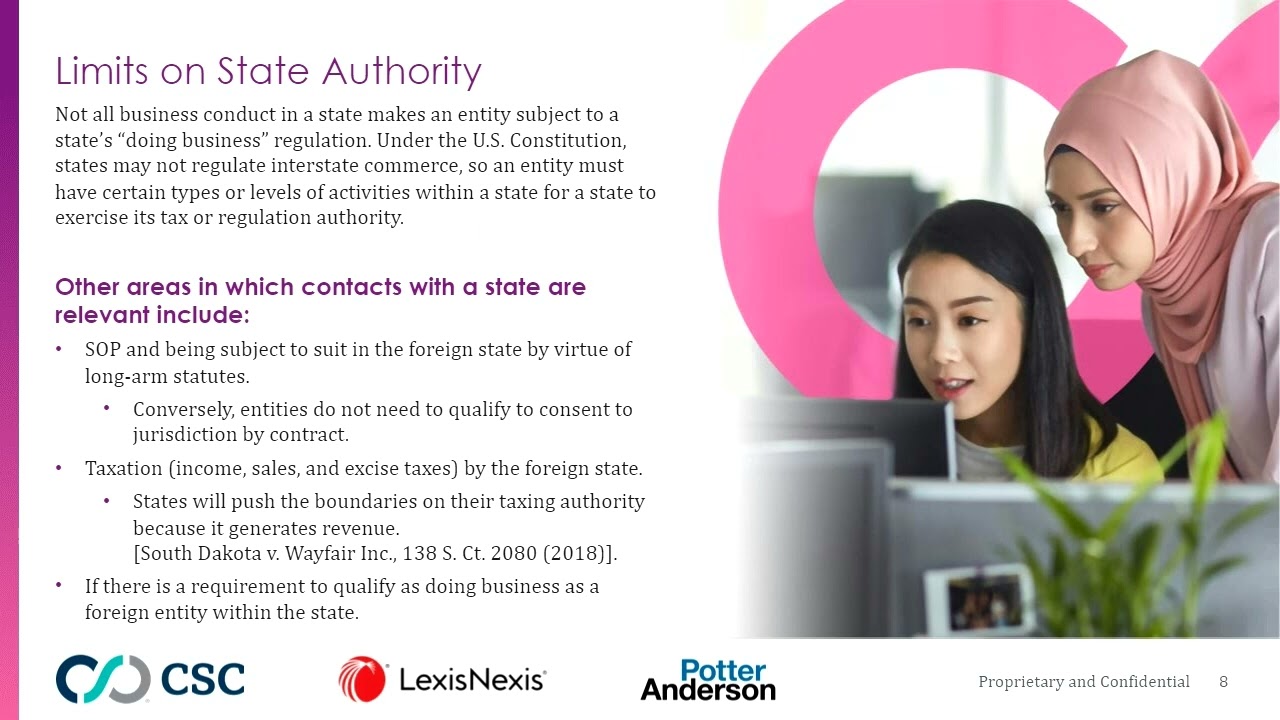
Foreign qualification is the legal process by which a business entity formed in one U.S. state must register to conduct business in another state, ensuring compliance with that state's jurisdictional and regulatory requirements. States require foreign entities to qualify primarily to establish court jurisdiction, collect filing fees, protect local businesses, and ensure compliance with licensing and tax requirements. The determination of whether an entity is 'doing business' in a foreign state is highly fact-specific and depends on the nature, frequency, and continuity of the entity's activities, with many states providing exceptions for activities like maintaining bank accounts, holding board meetings, or conducting isolated transactions. Failure to qualify can result in significant consequences including monetary penalties, inability to maintain lawsuits in that state, and potential personal liability for directors and officers. The practical qualification process involves name availability checks, obtaining certificates of good standing, appointing a registered agent, and filing required documents with state agencies, with ongoing obligations including annual reports and fees.
Click to watch →

How to Move Your Business to a New State
643
Foreign qualification is the process of taking your home state (domestic state) business and qualifying to do business in another state (foreign state). The process involves: (1) obtaining a certificate of good standing from your home state, (2) getting forms and fees filed with the secretary of state in the new state, (3) selecting a registered agent, and (4) waiting for documents to be processed. Once completed, the business becomes qualified to operate in the new state.
Click to watch →
Delaware Companies for Non U.S. Residents | Harvard Business Services, Inc.
7.9K
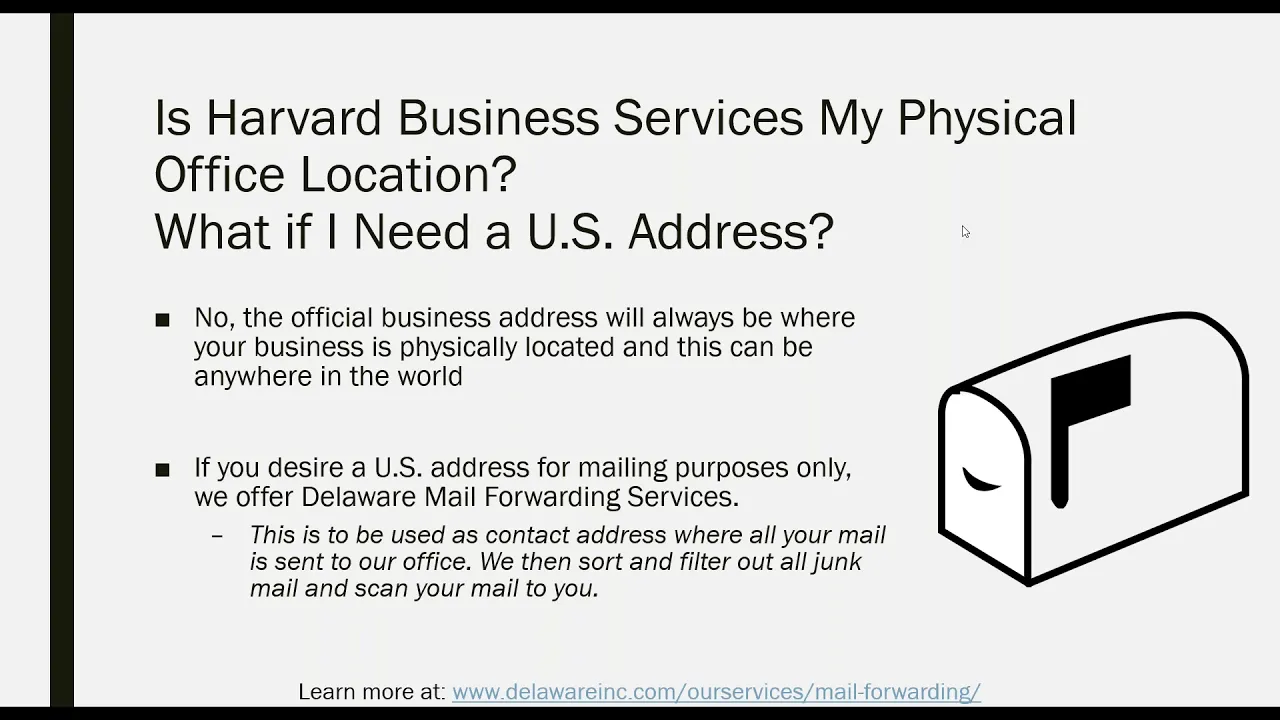
When a Delaware company is physically operating in another state's jurisdiction, the company must file for a certificate of authority or qualification in that state. This process allows the Delaware company to legally conduct business in the additional state while remaining governed by Delaware law. Each state generally requires its own qualification, and the company will be subject to both Delaware law and the laws of the state where it is physically operating. This ensures compliance with local and state compliance matters and allows the company to operate legally across multiple jurisdictions.
Click to watch →

6 Reasons Why You Shouldn’t Form an LLC in Delaware (for U.S. residents)
78.8K
When a business owner forms an LLC in one state but operates primarily in another state, they must register their out-of-state LLC as a Foreign LLC in their home state. This is a legal requirement that applies when conducting business activities in a state other than where the LLC was originally formed.
Click to watch →
Deep Dive
How venture capital funding and equity distribution (such as stock options) are handled differently in C-Corporations versus LLCs.

How to incorporate your startup, split equity, and set up your cap table
135
Delaware C-Corps are the standard structure for startups seeking VC funding. LLCs are pass-through entities that don't issue preferred stock, making them unsuitable for VC investment. C-Corps enable founders to receive common stock while investors receive preferred stock, and allow equity grants through stock options. LLCs are better for service businesses. Founders should avoid non-standard legal structures since VCs expect market practices.
Click to watch →

Early Growth Financial Services at Rackspace
104
C-Corps are preferred for venture capital-backed companies because they facilitate equity ownership and stock options. S-Corps and LLCs are simpler but have limitations for outside investment. Stock options are equity compensation typically with 4-year vest schedules and 1-year cliffs. After Sarbanes-Oxley, companies must conduct 409A valuations annually or at funding rounds to determine option fair market value. These valuations are necessary for tax compliance and proper equity compensation.
Click to watch →
Corporate Law and IP Law - Perkins Coie LLP
113
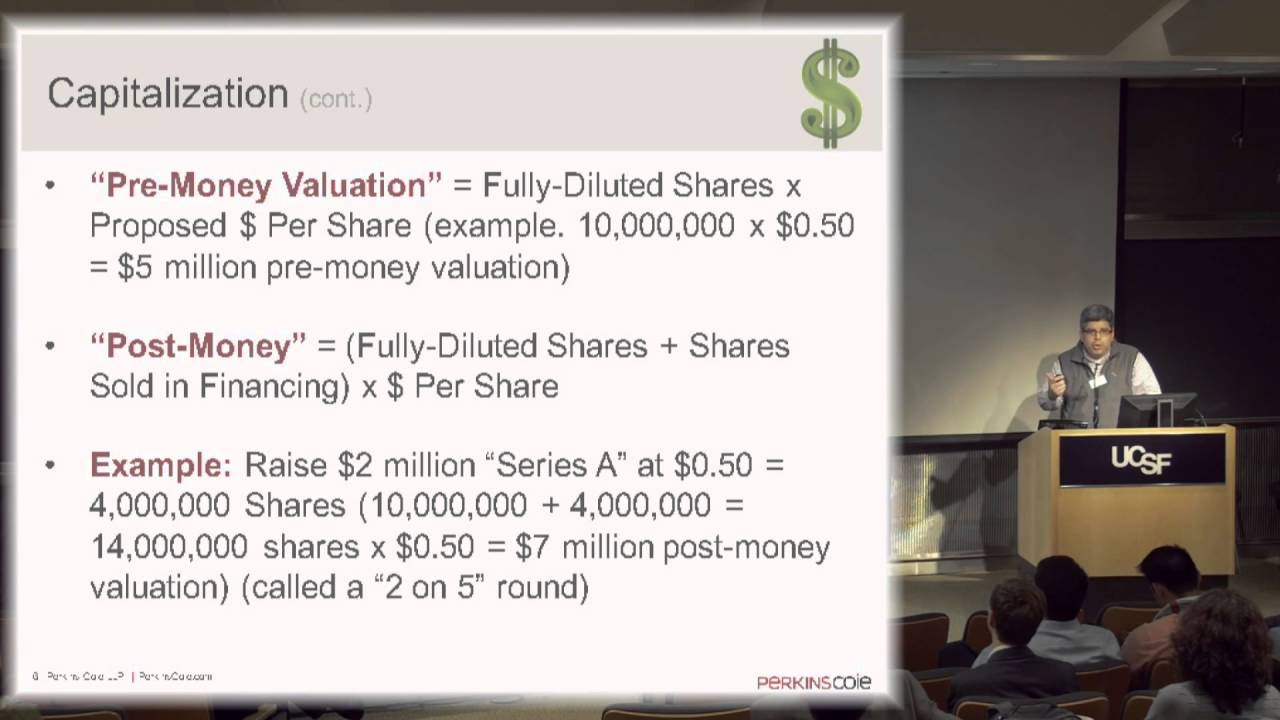
Venture-backed startups use Delaware C corporations for limited liability protection, double taxation that rarely affects startups, and ability to issue stock options. Delaware has been preferred since the 1900s due to well-developed statutes, specialized courts, and management-protective laws. Venture Capital firms prefer C corporations over LLCs to avoid complex tax allocations. Capitalization involves authorized shares, fully diluted capitalization (typically 10 million shares including 10-20% option pool), and valuation calculations. Pre-money valuation equals fully diluted shares multiplied by financing price per share. Post-money equals pre-money plus new investment. Founders receive Class A common stock with enhanced rights including convertibility, multiple votes, and director election. Founder stock is subject to four-year vesting with company repurchase rights for unvested shares if founders leave.
Click to watch →

Avoiding Co-Founder legal disputes & C-Corp vs LLC | Wilson Sonsini Startup Legal Basics
21.2K
Venture-backed startups should choose C-Corps over LLCs because VCs prefer C-Corps due to their ability to issue preferred stock and handle complex equity structures, while LLCs have pass-through tax treatment that creates administrative burdens for funds with multiple Limited Partners; for early-stage founders, start as an LLC if bootstrapping, then convert to C-Corp before taking VC funding, and always document founder agreements and IP assignments in writing to prevent costly disputes later.
Click to watch →

He Built AI/Robotics Startup on a F1 Visa & Self Sponsored OPT
7.5K
C-Corps are preferred for startups because they offer the easiest equity distribution structure, making them investor-friendly. LLCs are simpler but have limited equity options. Delaware C-Corps are preferred due to business-friendly regulations, and students can register remotely without living there. Equity splits between co-founders are documented in internal contracts rather than public registration. ESOP pools compensate early employees with equity, while advisory shares reward mentors who provide guidance. Vesting schedules ensure advisors contribute over time before receiving shares.
Click to watch →
Deep Dive
Delaware-specific compliance obligations, including the annual Franchise Tax and the role of the Delaware Court of Chancery.
Delaware Franchise Tax Explained: What Businesses Must Know
873
Delaware Franchise Tax is a state tax for corporations doing business in Delaware, calculated using two methods: the Authorized Share Method (minimum $175 + $50 filing fee for under 5,000 shares, $86,000 for 10 million shares) and the Assumed Par Value Method (minimum $400 + $50 filing fee, $400 per million shares up to $200,000 maximum). The tax is due annually by March 1st with no extensions, and common compliance issues include not issuing shares, using zero par value shares, having multiple share classes, reporting zero assets, and inconsistent share information across years. Companies must file income tax returns annually and stay current on franchise tax to avoid penalties and interest when closing the corporation.
Click to watch →

Paying Delaware Franchise Taxes and Filing Annual Report
3.6K
Delaware C-corporations must file annual reports and pay franchise taxes by March 1, with the Assumed Par Value Capital Method calculating the tax based on issued shares and gross assets (total assets from Form 1120), where assets under $500,000 result in a minimum $400 tax, and the annual report requires principal place of business, officer information, and director details.
Click to watch →

How to Form an LLC in Delaware | Step-by-Step Guide for 2026
185
Every Delaware LLC must pay an annual franchise tax of $300, filed through the Delaware Division of Corporations website by June 1st each year. Missing this deadline results in a $200 late fee plus 1.5% interest per month until paid. Failure to pay can result in LLC dissolution. Unlike many states, Delaware does not require LLCs to file an annual report - simply paying the tax satisfies compliance requirements for the year.
Click to watch →

ELON IS TRYING TO SCREW US AGAIN!!
210.2K
This segment explores Delaware's corporate law system, which has been the envy of the world for decades. Delaware's Court of Chancery, a historically significant institution, provides fair, quick, and efficient resolutions for corporate matters, attracting 2/3 of Fortune 500 companies. Last year, Delaware collected $1.3 billion in franchise fees. The segment reveals that claims of corporate exodus are misleading—only 8 companies left while registrations grew by 275,000. The video argues that corporate leaders attack judicial independence when rulings don't favor them, using this as a pattern to undermine democratic governance. The Court of Chancery's expertise in business matters makes it a preferred venue for corporate disputes, challenging claims of bias toward 'woke leftism.'
Click to watch →

BREAKING: Elon Gets China War Plans, Tesla Vandals THREATENED w/ Gulag, Bernie AOC HUGE Rallies
125.3K
Delaware's state budget relies heavily on corporate franchise tax revenue, with approximately $1.3 billion annually, potentially representing nearly half of the state's budget. The state has about 2 million corporate entities, but only about 3,000 are major revenue contributors, and fewer than 300 are controlled companies. The proposed legislation would benefit a small minority of companies (like those controlled by Elon Musk and Mark Zuckerberg) while potentially alienating the majority of customers. The concern is that the bill was pushed quickly to save Zuckerberg billions in court fees, and it may be written to benefit a select few at the expense of the broader corporate community.
Click to watch →
LLC vs Corp
Tax & Choice
LLC vs Corp
0:01- 1
Corporations suit VC funding with stock issuance.
- 2
LLCs offer supreme flexibility for small business owners.
- 3
Delaware law provides strong personal asset protection.
The Drawbacks of Delaware LLCs: Home-State Registration and C-Corp Venture Preferences
While Delaware LLCs offer flexibility, this setup is often inefficient and costly for small businesses, which face double registration fees, franchise taxes, and registered agent costs in both Delaware and their home state. Furthermore, for high-growth startups seeking venture capital, the LLC structure is highly disadvantageous. Institutional investors overwhelmingly prefer Delaware C-Corporations over LLCs due to the ease of issuing stock, standardized governance, and eligibility for the Qualified Small Business Stock (QSBS) tax exclusion, which can eliminate federal capital gains taxes on gains up to $10 million.
The concept of limited liability and how it protects personal assets from business-related legal actions and debts.
Fundamental differences in business taxation, particularly the distinction between pass-through taxation and corporate double taxation.
Basic legal terminology associated with business entities, including stakeholders, shareholders, members, and directors.
The role of state-level jurisdiction in US business law and why companies choose specific states for incorporation.
The step-by-step legal process of registering a Delaware entity, including securing a registered agent and filing Certificate of Formation/Incorporation.
Drafting essential governance agreements, such as LLC Operating Agreements, Corporate Bylaws, and Shareholder Agreements.
The requirements for 'Foreign Qualification' to legally operate a Delaware-registered entity in a different home state.
How venture capital funding and equity distribution (such as stock options) are handled differently in C-Corporations versus LLCs.
Delaware-specific compliance obligations, including the annual Franchise Tax and the role of the Delaware Court of Chancery.
19.2K views33likes3:28@IncNowOriginal Release: 2008-05-13
One of the first questions we get from prospective customers is from prospective customers What's the difference between a corporation and an LLC and why would I use a corporation or an LLC As I've thought about it and we've analyzed it ourselves You need a corporation which is often something that venture capitalists suggest if you're going to attract other investors because it has stock and you're going to be issuing stock The best and most flexible form for the individual or small business owner or a few owners together is a limited liability company the LLC The question you may have though is Why go with the Delaware LLC?
The Delaware LLC is superior to other states.
You may not be located in Delaware, most of our customers are not and you can use the Delaware LLC anywhere across the country, or from our experience, around the world You can use this company for all types of activities From owning boats and airplanes and land to running active businesses from all types of construction firms to consulting firms Anything you can imagine, you can do through a Delaware LLC Delaware LLCs are also particularly good if you have business partners because the Delaware LLC is very flexible Your business partnership agreement can incorporate all types of items that you may want to put into your particular deal That's more difficult to do with a corporation The Delaware LLC is also superior because it's like a bullet-proof jacket The Delaware LLC insulates you from liability You have personal assets in your own name You've worked hard to save for these assets They're stocks, bonds you have bank accounts, you have a house, you have a car and you don't want to necessarily hold those out to the public if you have a problem with your business or the business goes south and what we'd like to do it help you protect your personal assets from your business with the Delaware LLC As far as tax selections, you've got the greatest flexibility it starts out to a path to an entity you can elect to have a taxing incorporation Some people have heard about a chapter S corporation You can make a sub-chapter S corporation The LLC, in effect, is very flexible because It's a private agreement that controls it, anybody can own it and it's very flexible as far as taxes and just like a corporation, the LLC can qualify to do business anyplace in the world or in the United States That's the reason that LLCs are perhaps the most alternative, called alternative entities and we're finding that most people that are starting will start with an LLC If you need a corporation later, the law does permit you to convert an LLC to a corporation and that can be done fairly simply as well having gone through that we find that most customers that come to us once they hear that helps them make the choice They typically make the choice to form a limited liability company and a limited liability company in Delaware because the laws here really do protect the LLC no matter where it does business
Up Next

13:48
LLC vs S Corp: Tax Implications for Business Owners
@LYFEAccounting
22.5K views•2023-11-08

46:36
Retention Habits of Top DTC Ecommerce Brands Revealed
@SendItPodcast
44K views•2026-03-03

15:23
Decoy Effect: How Pricing Psychology Influences Consumer Spending
@bobinvestsUS
90K views•2026-01-05

17:30
The Planned Obsolescence of Light Bulbs and Tech
@veritasium
25.3M views•2021-03-26
Related Study Plans & Knowledge Roadmaps
Structured learning paths in Business
business
Pop-Up Retail: Strategy, Design & Execution
01Introduction to Pop-Up Retail & Strategic Goal Setting
02Budgeting, Site Selection, and Legal Essentials
03Experiential Retail Design & Visual Merchandising
+ 2 more learning modules
15h5 modules
Explore Roadmap
business
Reg CF: Startup Funding, Marketing & Launch
01Introduction to Equity Crowdfunding & Reg CF
02Platform Selection & Legal Preparation
03Crafting High-Converting Campaign Assets
+ 2 more learning modules
14h5 modules
Explore Roadmap
business
Productized Services: Scaling Solo Freelance
01Foundations of Productized Services
02Packaging and Scope Definition
03Pricing and Subscription Models
+ 2 more learning modules
15h5 modules
Explore Roadmap
business
Gov Procurement: Find, Bid & Win Contracts
01Introduction to Government Procurement & Business Setup
02Small Business Certifications & Set-Asides
03Finding and Analyzing Contract Opportunities
+ 2 more learning modules
14h5 modules
Explore Roadmap