



![[Introduction to Linguistics] Constituency Tests](https://i.ytimg.com/vi_webp/5wTem6TBbPI/maxresdefault.webp)




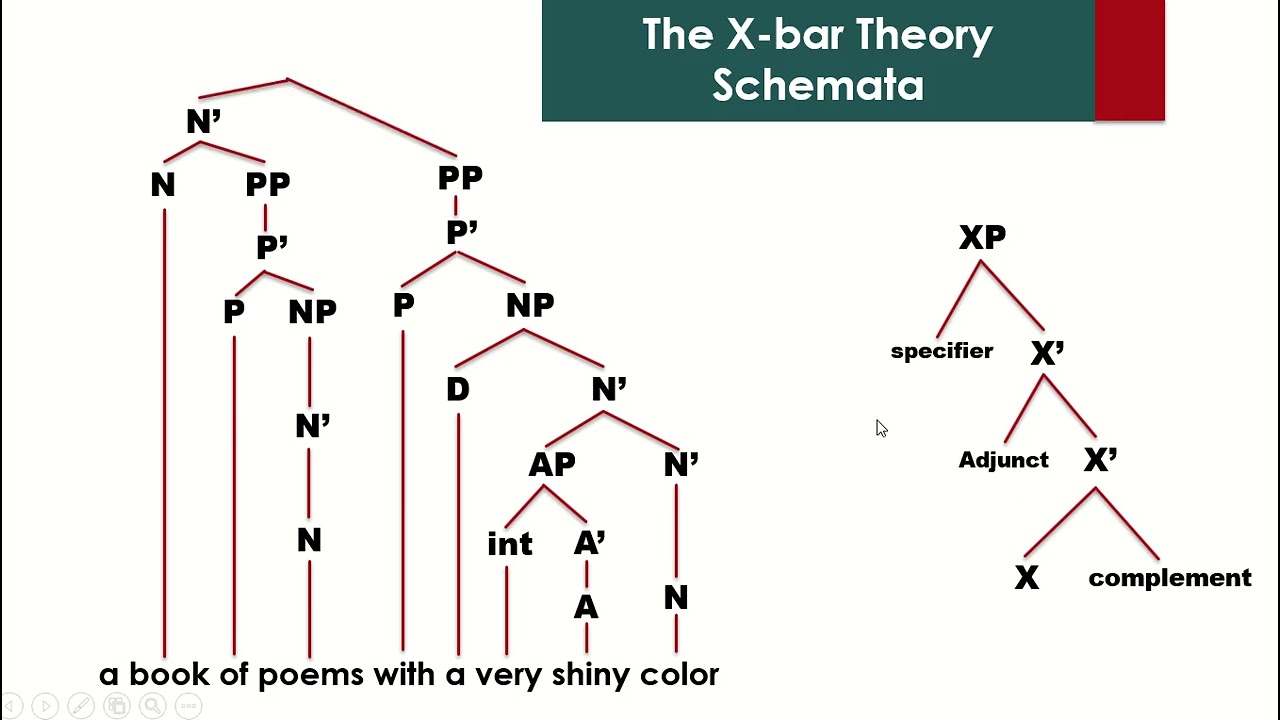









The X-bar schema is a general framework for representing phrase structure in generative grammar, where any phrase consists of a head (X) that projects to an intermediate level (X-bar, containing the head and its complement) and then to a full phrase (XP, containing the specifier). This schema applies universally to phrases of different categories such as verb phrases (VP), adjective phrases (AP), and noun phrases (NP), with the complement being the sister to the head and the specifier being the sister to X-bar. The schema allows for optional elements depending on the specific properties of the head, though it may need extensions to account for complex cases like ditransitive verbs with three arguments or unlimited modifiers.
X-bar Schema in Generative Syntax: Phrase Structure
Added:Basic syntactic categories (parts of speech) such as nouns, verbs, adjectives, prepositions, and determiners.
Traditional Phrase Structure Rules (PSG) and how they represent sentence structure via rewrite rules.
The concept of constituency and standard constituency tests, such as movement, substitution, and coordination.
The foundational goals of Generative Grammar, specifically the idea of an innate, rule-governed mental system for language.
Functional projections (IP/TP and CP) and how the X-bar schema is applied to non-lexical, sentential structures.
Syntactic movement theories, including Head-to-Head movement and XP-movement (such as Wh-movement and NP-movement).
Theta Theory and the mapping of thematic roles (like Agent and Patient) onto structural X-bar positions.
Bare Phrase Structure (BPS) in the Minimalist Program, which serves as the modern successor to the rigid X-bar schema.
151.8K views2.5Klikes6:07Original Release: 2014-10-02
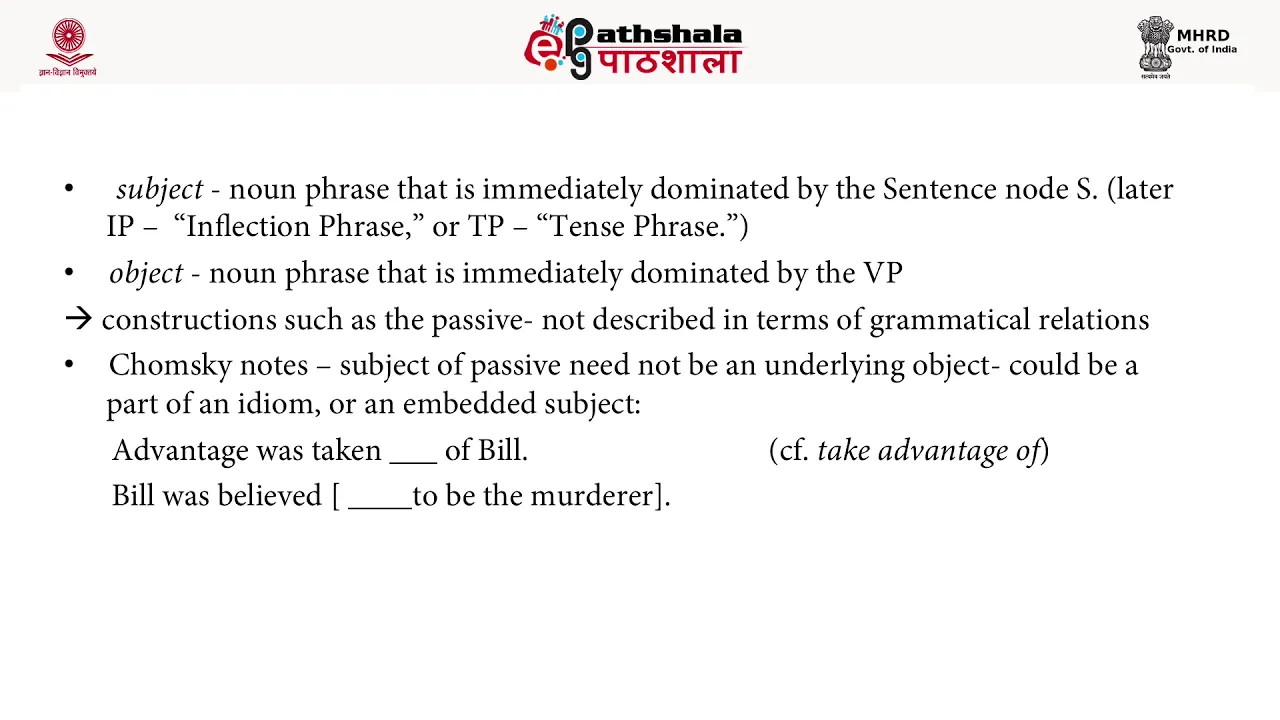
[Music] We've seen that a transitive verb combines with two arguments. The subject, which frequently expresses the agent, although not necessarily, and the object, which again, not necessarily, but frequently expresses the theme. And we've also seen that these arguments are combined with a verb in a particular order. So the verb combines first with the object and forms a constituent with that and then combine and then the result of that combines with the subject to form a larger constituent.
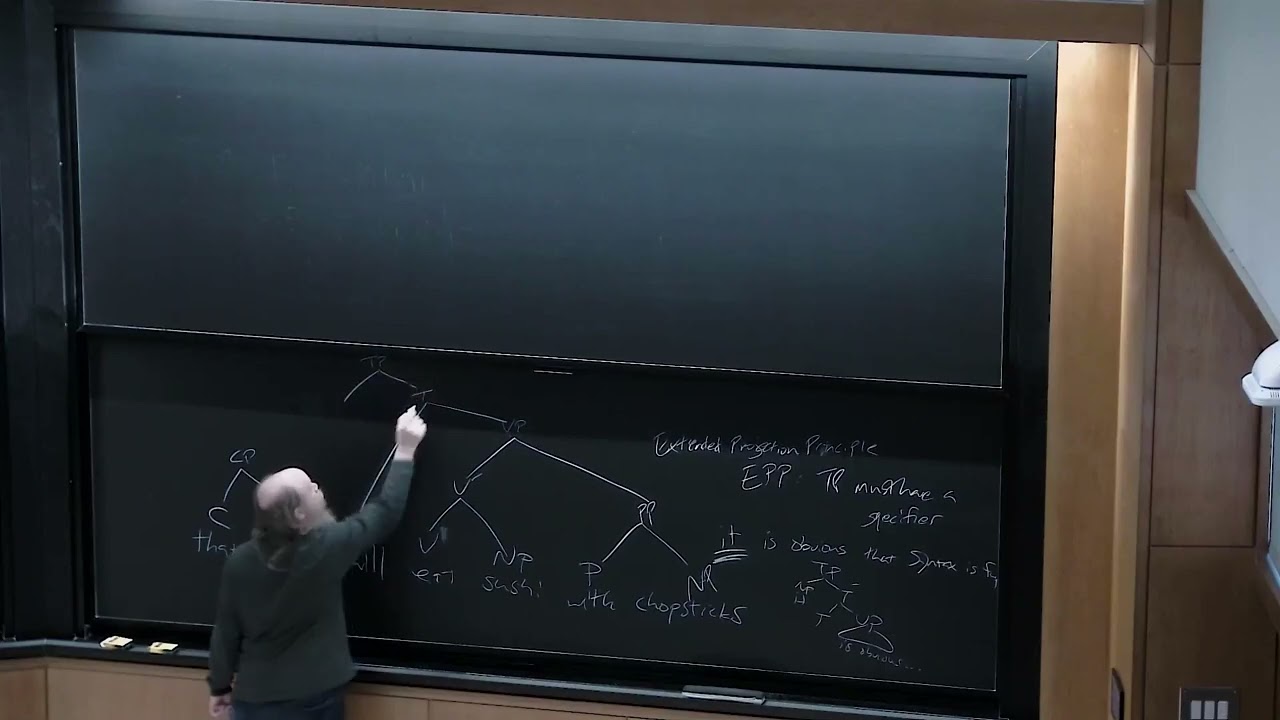
And we've also seen that we would want to associate or express these selectional properties of the verb by representing in the lexicon an elementary tree for the verb that shows these positions for the two arguments.
Further, as we've already discussed, the properties of a phrase depend on the properties of the head. So in this case, since the head is a verb, it projects a verb phrase. So in this more elaborate structure, you can see that the lexical category of the head, the V, projects first to this larger constituent, the VB bar, and then to an even larger constituent, VP. We've seen phrases, of course, that have heads other than V. So we can have phrases headed by prepositions, pps or postpositions. Also we've seen that you can have phrases headed by adjectives. So you have adjective phrases.
We could hypothesize that phrases might all have a similar kind of structure.
The kind of structure we've just seen for the VP.
That hypothesis is sometimes called the Xbar schema. So according to the Xbar schema, all phrases have a similar structure to what we've just seen for the VP. One way to represent that is to take a variable to stand for the actual lexical category. So the head X, which could be V or A, will combine with one phrase and form a constituent XAR. So when V combines with its complement, you get a V bar. If an adjective combined with a complement, you get an A bar. and then the resulting phrase combines with another phrase. So the Vbar combines with another phrase and you would get the VP or more generally an Xbar combines with another phrase and you get the XP.
So those two positions for phrases that are inside this Xbar schema have names just for these positions. So the complement of X is the sister to the head and then the phrase which is higher up in the structure which is the sister to the Xbar is called the specifier.
So just to summarize a head an X projects two levels of phrase. It projects to an XAR which can contain the head and its and the complement of the head and it can project further to the XP which would contain also the specifier.
So far, we've seen this for verb phrases, but you could come up with a possible hypothesis for the structure of noun phrases along the kind of lines that people have already been considering in class, where a noun phrase would also have a head n in this case, which would project an nbar, which would contain also the complement of the the nominal head, and then it would project further to an np.
So that's one possible structure for nominal phrases. As we've already discussed, in fact, there's alternative way of looking at nominal phrases, which is to to consider that rather than being projections of the noun, they're projections of the determiner. We'll be looking at that in more detail later. In that case, the structure of a nominal phrase, we would actually want to say that it's a DP because it's projected from the D rather than NP projected from the N. And in the other diagrams that you'll see, I've actually assumed that's the case. So you'll see DPS everywhere, but that's not important for the point here. We're going to look at DPS and NPS later. The point is just that this Xbar schema is intended as a general scheme for phrases of different categories.
As it stands, it looks like that schema is not going to allow for all of the variety we've already seen. In particular, it seems in some cases it's going to give us too much structure. So for example, for although a transitive verb takes a complement as well as a subject, we've seen plenty of cases of intransitive verbs which have subjects but no objects. So we'll assume that that complement position is actually optional and the specified position we can assume also may be optional and so it will depend on the particular properties of the head whether it occurs with a complement and whether it occurs with a specifier.
There are also cases where it seems that the structure that we get from the expert schema isn't actually enough that we don't have enough positions within the phrase if that's all there is. So two cases you could already think of are dransitive verbs where you actually have three arguments to accommodate and also all these cases of modifiers that we've seen where it seems you have a an unlimited number of modifiers that can be included in a phrase. We'll come back to dritive verbs in another class but uh we'll get back to modifiers very shortly.
This production is brought to you by the University of Edinburgh.
Up Next

17:47
Constituency Tests in Syntax | Generative Introduction
@CarnieSyntaxthEdition
16.2K views•2020-08-10
36:52
Constraint Interaction in Optimality Theory: Epenthesis & Deletion
@Vidyamitra
180 views•2018-08-20

13:19
The DP Hypothesis in Generative Syntax | Noun Phrase Structure
@edinburghLangScience
47.1K views•2014-10-08

21:32
Accent Expert Explains U.S. Regional Dialects | Part 1
@WIRED
9.3M views•2021-01-21
Related Study Plans & Knowledge Roadmaps
Structured learning paths in Linguistics
linguistics
Optimality Theory: Tableaux & Constraints
01Phonological Basics: Sounds, Syllables & Rules
02Foundations of Optimality Theory: GEN, CON, and EVAL
03The Constraint Inventory: Markedness vs. Faithfulness
+ 2 more learning modules
15h5 modules
Explore Roadmap
linguistics
Morphosyntactic Alignment: S, A & P Systems
01Foundations of Syntax: Transitivity and Arguments
02The Linguistic Variables: Mapping S, A, and P
03Nominative-Accusative Alignment
+ 3 more learning modules
12h6 modules
Explore Roadmap
linguistics
Analyzing Sign Language: Phonology & Syntax
01Foundations of Sign Language Linguistics
02Phonology: The Five Parameters of a Sign
03Morphology: Word Formation and Classifiers
+ 2 more learning modules
14h5 modules
Explore Roadmap
linguistics
Pragmatics: Speech Acts, Grice & Politeness
01Introduction to Pragmatics: Meaning in Context
02Grice’s Cooperative Principle & Implicature
03Speech Act Theory
+ 2 more learning modules
14h5 modules
Explore Roadmap