









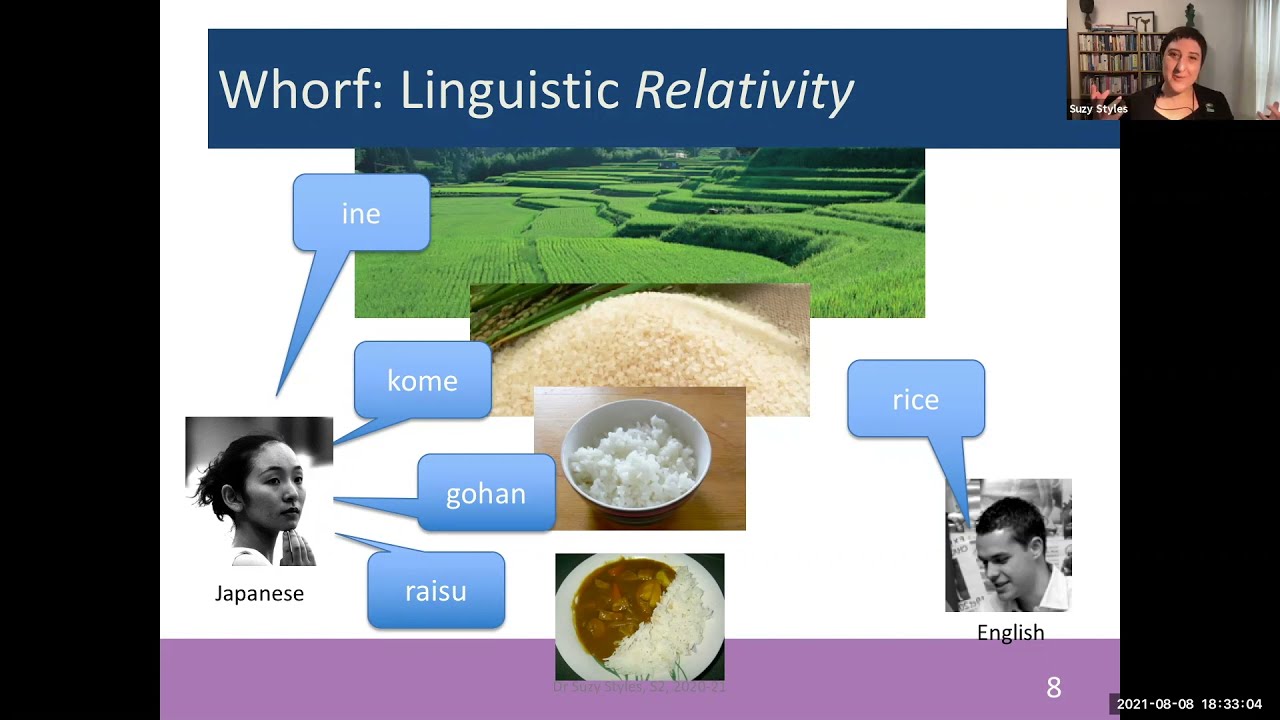









While languages do influence perception to some extent (e.g., Russian speakers distinguish dark and light blue slightly better than English speakers), these differences are minimal and do not fundamentally shape how people see the world; the appeal of exotic language examples often leads to oversimplified stereotypes that ignore the complexity of human cognition and cultural context.
Does Language Shape Thought? John McWhorter on the Sapir-Whorf Hypothesis
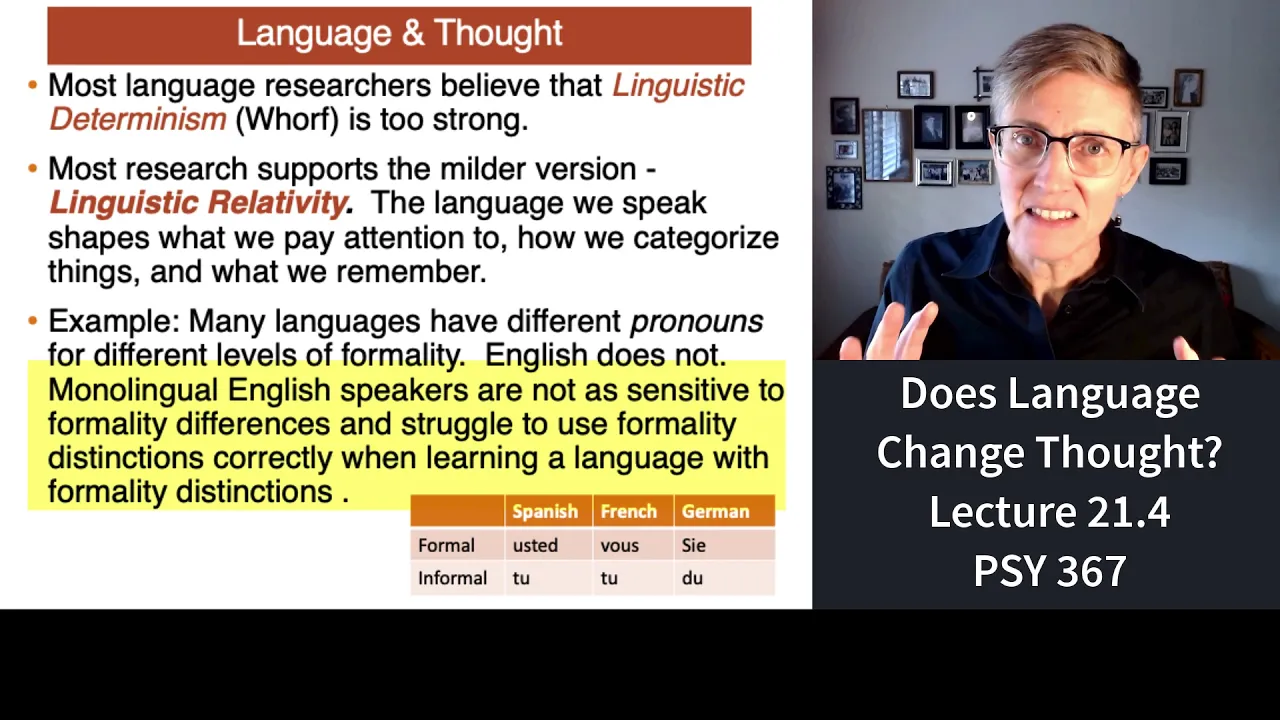
Added:The core definition of the Sapir-Whorf Hypothesis, specifically the distinction between linguistic determinism (the strong version) and linguistic relativity (the weak version).
Fundamental concepts in cognitive psychology, particularly how the human brain processes sensory perception, categorization, and memory prior to linguistic labeling.
Basic knowledge of cross-linguistic diversity, such as how different languages structurally encode concepts like grammatical gender, spatial relations, and tense.
The distinction between 'thought' (internal cognitive representation) and 'language' (the symbolic communication system used to express those thoughts).
The 'Neo-Whorfian' perspective, exploring modern empirical research (such as Lera Boroditsky's studies) that identifies subtle, non-transformative ways language influences aspects of cognitive processing.
Noam Chomsky's theory of Universal Grammar and the innatist framework, which views language structures as biologically hardwired rather than culturally relative.
Experimental methodologies in psycholinguistics, including how researchers design color-discrimination and spatial-navigation experiments to test linguistic influence.
The debate's implications for artificial intelligence and natural language processing, exploring whether large language models 'think' differently based on their training languages.
25.6K views374likes3:57Original Release: 2019-02-11
how do I get sin is the Institute of arson ideas unique festival combining days full of talks and debates in philosophy politics arts and science with evenings full of music and dance get your tickets for the world's largest music and philosophy festival but how do I get in Donald was a book that I wrote called the language folks several years ago where I was just writing about this sapir-whorf hypothesis that languages make you see the world in different way and I reiterate that to a small extent they do but it's a really small extent that I don't think qualifies as something that most humanists would be interested in and so for example in Russian they're two words for blue one of them refers to dark blue one of them refers to the blue that's the cap on that bottle there is no just blue blue word and if you do an experiment you can show that Russians are very very very very very slightly better than English speakers at delineating exactly where dark blue shades off into light blue it's just that color it's a very tiny difference and so that's neat in itself but what you know if you know any Russian what does that have to do with Russian this and all of the experiments come out that way and so what I worry about with the quote unquote hoax is that you are you are always given the cool examples so Wow Russians see blue in a landscape like this right here supposedly to be Russian is to see that somehow more vibrantly than most of us see it and you think well wow that's really interesting or you learned that Japanese people because of one of the quirks of their grammar are more sensitive to materials than we are and so you think well they're more sensitive and we English speakers are kind of these dullards and it really ends up feeling good but there are all sorts of crummy things you can end up saying about people based on what is or what isn't in their language and I won't go through them now so we take up too much time but you can look at any language and based on that perspective designate people as sexist as racist things that are not in a language can make people look frankly kind of dim this includes everybody in China and so that whole perspective that what's in the grammar or how they cut the world up with words makes people cool ends up also making people seem uncool and if you don't want the uncool which I don't think most of us do you immediately learn these things and you say well that that couldn't have anything to do with what the people are like then that has to also go for the cool things too and so that's why I think of these differences as dancing upon what most of us would find crucial but it's not that those things aren't there but for example very quickly Mandarin Chinese speakers have been shown to process counterfactual tea a tiny bit more slowly than other people because you can't say had had been would have in Mandarin Chinese tiny bit less sensitive do you want to say that people who speak Mandarin aren't as good at processing hypothetic ality it's the rest of us of course not we just reject that well and same thing with the Russians and the blues you have to we have to be you have to be uniform better a necessary thing that there's no control during that you don't you can't ever take the first that's the same individual and induct them compulsorily from birth into English and then take that individual and induct them into Mandarin Chinese and look at the differences in their perception of the world I mean he needs that individual to obediently bifurcates and live their life twice in two different and that would be a experiment it's quite hot sometimes yeah they definitely looked at people with different amounts experienced with English at different times in their lives and the more Chinese you've got the less you are good at pressing buttons at certain times are resolving certain elaborate little word games you don't do them as quickly and that's a disturbing experiment that you kind of wish the person hadn't done which shapes my perception and so to speak of all of the war feein experiments get your tickets for the world's largest music and philosophy festival at how the light gets in aaaggghhh
Up Next

10:45
How Metaphor Shapes Thought and Language | James Geary
@TED
146.2K views•2009-12-18
36:52
Constraint Interaction in Optimality Theory: Epenthesis & Deletion
@Vidyamitra
180 views•2018-08-20

8:59
Forensic Linguistics: How Language Solves Crimes | PBS
@pbsstoried
1M views•2024-01-25

21:32
Accent Expert Explains U.S. Regional Dialects | Part 1
@WIRED
9.3M views•2021-01-21
Related Study Plans & Knowledge Roadmaps
Structured learning paths in Linguistics
linguistics
Optimality Theory: Tableaux & Constraints
01Phonological Basics: Sounds, Syllables & Rules
02Foundations of Optimality Theory: GEN, CON, and EVAL
03The Constraint Inventory: Markedness vs. Faithfulness
+ 2 more learning modules
15h5 modules
Explore Roadmap
linguistics
Morphosyntactic Alignment: S, A & P Systems
01Foundations of Syntax: Transitivity and Arguments
02The Linguistic Variables: Mapping S, A, and P
03Nominative-Accusative Alignment
+ 3 more learning modules
12h6 modules
Explore Roadmap
linguistics
Analyzing Sign Language: Phonology & Syntax
01Foundations of Sign Language Linguistics
02Phonology: The Five Parameters of a Sign
03Morphology: Word Formation and Classifiers
+ 2 more learning modules
14h5 modules
Explore Roadmap
linguistics
Pragmatics: Speech Acts, Grice & Politeness
01Introduction to Pragmatics: Meaning in Context
02Grice’s Cooperative Principle & Implicature
03Speech Act Theory
+ 2 more learning modules
14h5 modules
Explore Roadmap