





















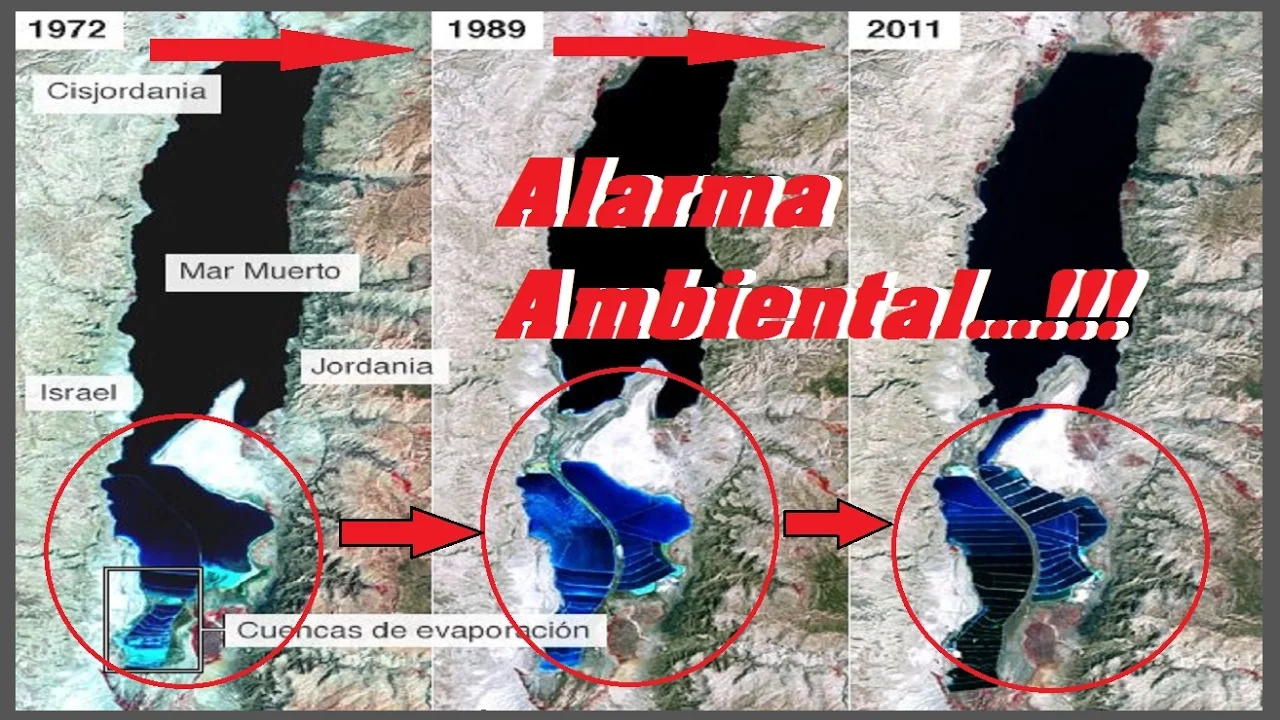


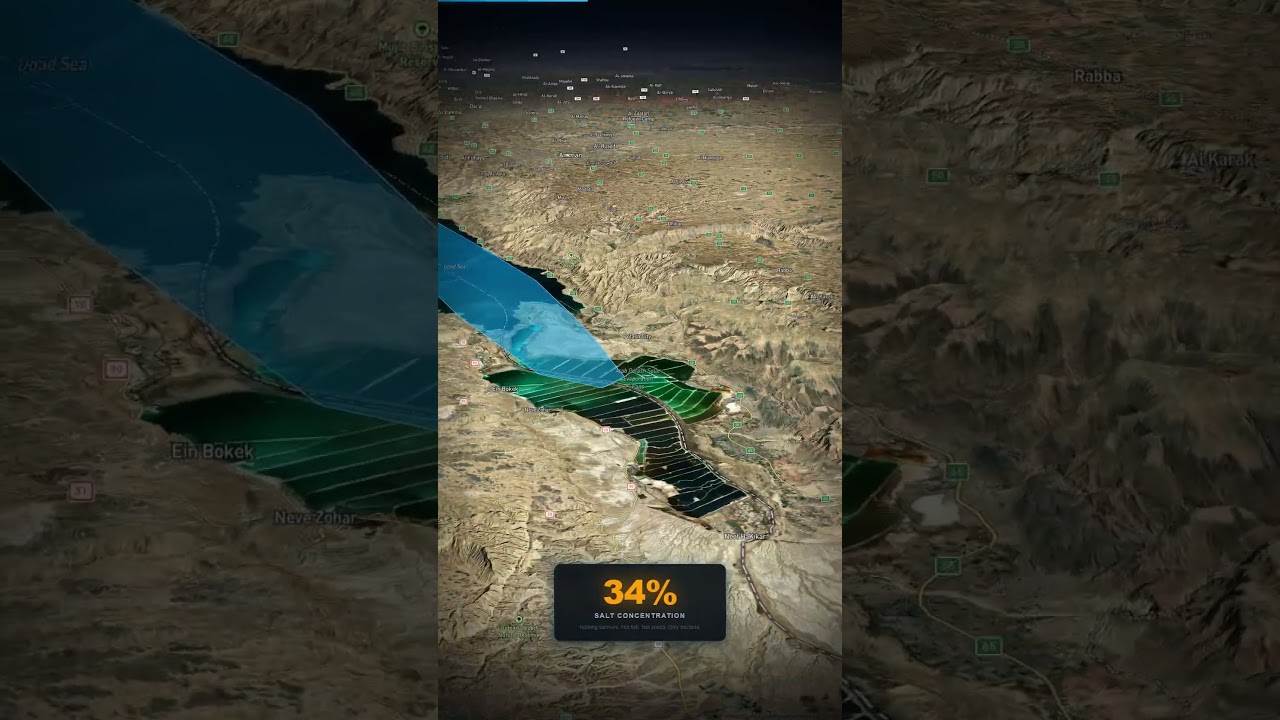

The Dead Sea, despite its name suggesting sterility, hosts unique microbial communities that have adapted to survive in one of Earth's most extreme hypersaline environments, demonstrating how life can negotiate and thrive under conditions that should be lethal, with implications for understanding potential life in similarly extreme environments like ancient Martian lakes.
The Dead Sea's Toxic Waters Hide Unexpected Microbial Life
Added:The principles of osmosis and diffusion, specifically how water moves across semipermeable cell membranes in hypertonic environments.
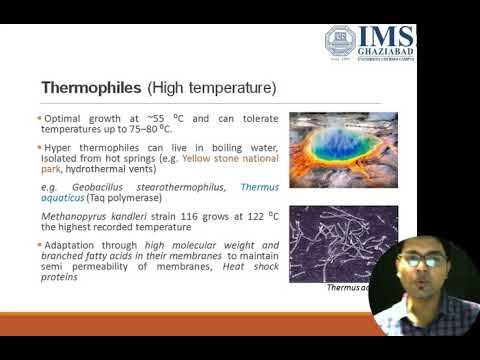
The definition and basic classification of extremophiles, particularly halophiles (salt-loving organisms) and how they differ from standard mesophiles.
Fundamental cell biology concepts, including how high ionic strength typically denatures proteins and disrupts cell membrane integrity.
The basic chemical composition of the Dead Sea, noting that its toxicity arises from a unique saturation of magnesium, calcium, and potassium ions rather than just sodium chloride.
Astrobiology and planetary analog studies, specifically how studying halophiles on Earth informs the search for microbial life in Martian brines or icy moons like Europa.
The molecular survival mechanisms of halophiles, including the 'salt-in' strategy versus the accumulation of compatible organic osmolytes.
Biotechnological applications of 'extremozymes' (proteins adapted to high salinity) in industries such as biofuel production, food processing, and waste-water treatment.
The ecological consequences of the shrinking Dead Sea, analyzing how human water diversion and climate change alter its chemical properties and microbial dynamics.
1.8K views27likes14:51Original Release: 2026-03-03
The Dead Sea is not dead. It never was.
The name is a translation error that calcified into accepted truth over centuries and was never seriously corrected because it was useful. It simplified something complicated into something memorable. It told a story in two words, and like most two-word stories, it left out almost everything that actually mattered.
The body of water sitting between Jordan and Israel at the lowest point on the surface of the earth, 430 m below sea level, contains life. Has always contained life. The specific life it contains is in certain respects unlike anything found anywhere else on the planet. The mechanisms by which that life survives in conditions that should by every reasonable framework of biology be lethal are not fully understood. And beneath the floor of the Dead Sea, in freshwater springs that push up through the lake bed in conditions of extraordinary chemical violence, something is happening that researchers are still trying to find the correct language to describe. Subscribe now because the Dead Sea is not a story about a place where nothing lives. It is a story about what life looks like when it refuses to accept the terms it has been given. The salt concentration of the Dead Sea sits at approximately 340 g per liter. The ocean averages 35. That is not a difference of degree. It is a difference of category. In water that saline, the osmotic pressure on any cell membrane is so extreme that conventional biological machinery fails almost immediately. Water is drawn out of cells faster than any standard physiological process can compensate for. The cell collapses. the organism dies. This is why most things that enter the Dead Sea do not survive it. Fish carried in by the Jordan River during floods die within minutes of contact with the hypers saline water. The surface is largely clear of the algae and microorganisms that make most lakes visibly green or murky. It looks sterile because for most categories of life it is, but not for all. The floor of the Dead Sea is not uniform. In certain locations, freshwater springs rise through the lake bed, pushed up by geological pressure from aquifers in the surrounding rock. Where those springs emerge, they create small zones of diluted water, not fresh water, not anywhere close to what you could drink or what a surface organism could survive in. But water with a lower salt concentration than the surrounding lake, sitting in pockets and channels on the floor, mixing at the edges with the brine above. In those zones, researchers diving with specialized equipment in 2011 found something that stopped the expedition in a way that took time to process. Microbial mats. Dense layered communities of microorganisms growing on the sediment around the freshwater springs, visible to the naked eye as dark patches on the lake bed. structured in the way that microbial mats are structured in environments where a complex community of organisms has established stable relationships over extended time. This was not expected.
The Dead Sea had been studied for decades. Its chemistry was well characterized. The consensus was that microbial life existed in the water column during specific seasonal conditions when winter rains temporarily diluted the surface layer enough to allow haloilic organisms, salt loving microbes to bloom in sufficient numbers to turn the lake pink. Those blooms were documented. They were understood. They fit inside the existing framework. The mats on the floor did not fit inside any existing framework. Microbial mats of that kind require stable conditions over long periods. They are not a temporary response to seasonal dilution. They are a permanent community built over time in a specific location by organisms that had found a way to live at the intersection of two chemically incompatible water bodies and make that intersection their home. The researchers who found them spent time on the boat afterwards trying to work out what they had seen before they wrote it up. Not because the observation was ambiguous, because the implications needed to be followed somewhere before they could be communicated.
What those mats contained at the microbial level is still being analyzed.
The species composition, the metabolic strategies, the genetic lineages present in the community around those springs represent a biological environment that has been running in one of the most extreme chemical conditions on Earth for a period that correlates with the geological history of the lake itself.
The Dead Sea has existed in roughly its current hypers saline state for about 10,000 years following a period of fresher water that preceded the current geological configuration. 10,000 years of selection pressure in extreme salinity with the specific chemistry of the Dead Sea producing microbial communities optimized for an environment that exists nowhere else. The halopiles in the Dead Sea water column are better understood. Archa, a domain of life distinct from bacteria and from ukarotes, single-sellled organisms without a cell nucleus, are the primary inhabitants of the open brine. They belong to lineages that have been evolving strategies for extreme salinity for hundreds of millions of years, long before the Dead Sea existed. The Dead Sea's archa are not newly adapted to salt. They are representatives of ancient lineages that found in the Dead Seas chemistry conditions compatible with machinery refined across geological time. What makes them interesting is not that they survive high salt. It is how the strategy used by most halophilic archa is called the saltin strategy.
Rather than expending energy to pump salt out of their cells, they allow the salt concentration inside the cell to equilibrate with the outside. This solves the osmotic pressure problem. The cell is no longer being osmotically compressed because its interior matches its exterior. But it creates a different problem. The proteins inside the cell are now functioning in a high salt environment. Most proteins from non-halophilic organisms would unfold and lose function under those conditions. The proteins of Dead Sea aria are specifically adapted at the molecular level to remain stable and functional in salt concentrations that would dene almost any other biological molecule. Their entire internal biochemistry has been rebuilt around the constraint. The degree of that rebuilding when you look at it in detail is not minor. The surface charges of halophilic proteins differ systematically from their non-halophilic equivalents in ways that stabilize their structure in high salt conditions. The cell membranes of these organisms contain ether lipids rather than the esther lipids of most living things. a chemical difference that affects membrane stability across a wide range of environmental extremes. These are not tweaks, they are architectural revisions, and they accumulate across millions of years of evolution in environments where getting them wrong meant instant death.
The Dead Sea has not had a consistent chemistry across its history. The concentrations have varied. The mineral composition has shifted. The lake has at various points been much larger and much fresher and at other points has retreated to smaller, even more concentrated remnants. The organisms alive in it today carry in their genomes the evolutionary record of all of those variations. What can be read in that record about how halophilic biology adapts to changing chemical conditions over long time scales is information that exists nowhere else because no other body of water has the Dead Sea's specific combination of chemistry, age, and geological history. The lake is also disappearing, not slowly. The water level has been dropping at approximately 1 meter per year for decades. the result of the Jordan River being diverted for agriculture and municipal water supply to the degree that the inflow no longer compensates for evaporation. Sink holes appear along the receding shoreline where salt deposits dissolved by freshwater infiltration collapse the ground without warning. Hotels built decades ago on the shore now sit hundreds of meters from the water. The infrastructure of the tourist industry that grew up around the lake is being progressively abandoned as the shoreline retreats. What this means for the biological communities at depth, for the microbial mats around the freshwater springs, for the ecosystems that have developed over 10,000 years in a stable chemical environment, is not fully modeled. The chemistry of the Dead Sea is changing as the lake concentrates further. The springs that push up through the floor are encountering increasing salinity in the water above them. As the lake shrinks, the diluted zones around those springs are becoming smaller. Whether the microbial communities documented in 2011 are contracting with them, whether they can persist through a transition to even more extreme conditions, or whether the lake is approaching a threshold beyond which even its most extreme inhabitants cannot adapt is not known. The researchers who study the Dead Sea are working against a timeline they did not choose. The ecosystem they are trying to understand is changing faster than the research can keep pace with. There is a geological layer in the sediment of the Dead Sea called the Holysine Hall sequence. Alternating layers of salt crystals and thin dark bands of organic sediment laid down over thousands of years as the lakes's chemistry fluctuated between periods of evaporation and inflow. Each dark band represents a period when enough fresh water entered the system to support a bloom of life. Each salt layer represents the concentrated brine that followed. The sequence is a biological diary written in chemistry layer by layer across 10 millennia. In those salt crystals, researchers have found fluid inclusions, tiny pockets of ancient brine trapped in the crystal structure as it formed, sealed inside the mineral, preserved at the chemistry of the moment of crystallization. In inclusions from crystals thousands of years old, there are organic compounds. In some cases, there are structures consistent with microbial cells. Whether those cells are viable, whether organisms can survive encased in salt crystals for thousands of years and be revived when the crystal is dissolved is one of the genuinely contested questions in extreophile biology. The claim has been made for other hallite deposits, including inclusions in Peran salt from 250 million years ago, where researchers reported reviving bacteria from fluid inclusions of that age. The claim is controversial. The contamination arguments against it are serious. The debate has not been resolved, but the Dead Seasite layers offer a more tractable version of the same question.
The inclusions are thousands of years old, not millions. The contamination risk is different. The organisms potentially preserved in them would be directly ancestral to the community alive in the lake today, representatives of lineages that were present when the layers were deposited, sealed into the rock record of the lakes's own history.
If they can be recovered and characterized, they would provide a direct window into how the Dead Sea's biology has changed across historical time, which species were present in which periods, how the community responded to the climatic and hydraological events recorded in the sediment layers above them. This work is in its early stages. The methods are difficult. The interpretive challenges are significant. But the Dead Sea's sediment contains in principle a biological archive of its own history that no other lake possesses in the same form. The reason all of this connects to something larger than a shrinking lake in the Middle East is the same reason the other extreme environments in this series connect to something larger. Mars had liquid water. The evidence for ancient standing water on the Martian surface, for rivers and lakes and possibly oceans in the planet's early history, is not speculative. It is recorded in the geology. What happened to that water as the planet dried and its atmosphere thinned is well modeled.
The water retreated, concentrated. The lakes that remained became progressively the most saline and most chemically extreme bodies of water on a planet, losing the capacity to support them. The trajectory of Martian water in its final stages before disappearing entirely into the subsurface or into space passed through conditions that are not unlike the conditions of the Dead Sea today and possibly through conditions more extreme. If haloilic biology could persist in those conditions, as it has persisted in the Dead Sea across 10,000 years of extreme chemistry, then the question of whether something survived in Martian brines longer than the models currently suggest is not answered by the dryness of the present surface. It is answered by what we find in places like the Dead Sea, by whether the biology of extreme salt environments has the range and the flexibility to persist through the kind of transition Mars underwent.
The Dead Sea archa and the microbial communities on the lake bed and the organisms potentially preserved in halli inclusions in the sediment are not just interesting in their own right. They are a reference data set. They are what survival in extreme hypersaline conditions looks like when it works. And they are disappearing along with the lake that produced them faster than the science can document what they are. The name was wrong from the beginning. The two-word story was always incomplete.
What the Dead Sea actually is biologically is a place where life negotiated terms with chemistry so extreme that the negotiation itself became remarkable. Where organisms rewrote their internal architecture at the molecular level to match conditions that should have excluded them. where microbial communities built homes in the space between incompatible water bodies on the floor of a lake that most of the world still calls dead. The lake is shrinking. The shoreline moves back every year. The sink holes open without warning along the old margins. And somewhere on the floor around the freshwater springs in the space where two chemical worlds meet at the lowest point on the surface of the earth, something that has no right to be alive continues quietly to be alive.
It has been doing this for 10,000 years.
It does not need us to understand it in order to continue. But the window for understanding it before the lake changes beyond the point where the understanding is still possible is not open indefinitely. It is in fact closing at approximately 1 meter per
Up Next

93:37
Bacterial and Archaeal Growth: Cell Cycle, Division and Population Dynamics
@drqclemson
146 views•2026-03-25
50:12
Bacterial Communication: Quorum Sensing and Biofilm Formation Explained
@JHUAAP
12.6K views•2011-06-28

5:35
Enteric Nervous System Explained: The Gut's Brain | Neurobiology Lecture
@alumniu6029
438 views•2018-09-12
7:08
Bacteriophages: Earth's Deadliest Killers and Future Antibiotics
@kurzgesagt
34.6M views•2018-05-13
Related Study Plans & Knowledge Roadmaps
Structured learning paths in Biology
biology
RNAi: Biogenesis, RISC & Gene Silencing
01Molecular Biology Foundations: DNA to Protein
02Introduction to RNA Interference (RNAi)
03Molecular Biogenesis of miRNA and siRNA
+ 2 more learning modules
10h5 modules
Explore Roadmap
biology
Mycorrhizae: Signaling, Biophysics & Ecology
01Foundations of Mycorrhizal Symbiosis
02Molecular Signaling and Root Colonization
03Biophysics and Bioenergetics of Nutrient Exchange
+ 1 more learning modules
11h4 modules
Explore Roadmap
biology
Circadian Clocks: TTFL, SCN & Periphery
01Foundations of Molecular Biology & Gene Expression
02Introduction to Chronobiology and Actograms
03The Core TTFL: Molecular Architecture of the Clock
+ 3 more learning modules
14h6 modules
Explore Roadmap
biology
Population Genetics: Math, Drift & Selection
01Genetic & Probability Foundations
02The Hardy-Weinberg Principle and Baseline Models
03Mathematical Modeling of Natural Selection
+ 3 more learning modules
18h6 modules
Explore Roadmap