















![[홍사훈의 경제쇼] 박종훈ㅡ세계화는 끝났다! 이걸 못깨달으면 망한다!!|KBS 220607 방송](https://i.ytimg.com/vi/GBNMtIk-eyY/maxresdefault.jpg)









Geoeconomics is the strategic use of economic power to achieve geopolitical objectives, distinct from pure economics or military strategy. It operates through two main blueprints: the liberal strategy, which uses free markets and soft/hard economic power to achieve long-term dominance, and the developmentalist strategy, which employs state-directed capital accumulation and industrial policy to build competitive economic sectors. The key insight is that economic power can substitute for military power in achieving geopolitical goals, as demonstrated by how economic dominance allows states to suppress hostile activities of dependent countries and win conflicts by default.
Geoeconomics Strategy: Liberal vs Developmentalist Blueprints
Added:Fundamental understanding of Geopolitics vs. Geoeconomics, specifically how sovereign states project power through economic assets and policies rather than just military force.
Core tenets of Liberal Economic Theory, focusing on free trade, market-driven resource allocation, and the role of international organizations like the WTO and IMF.
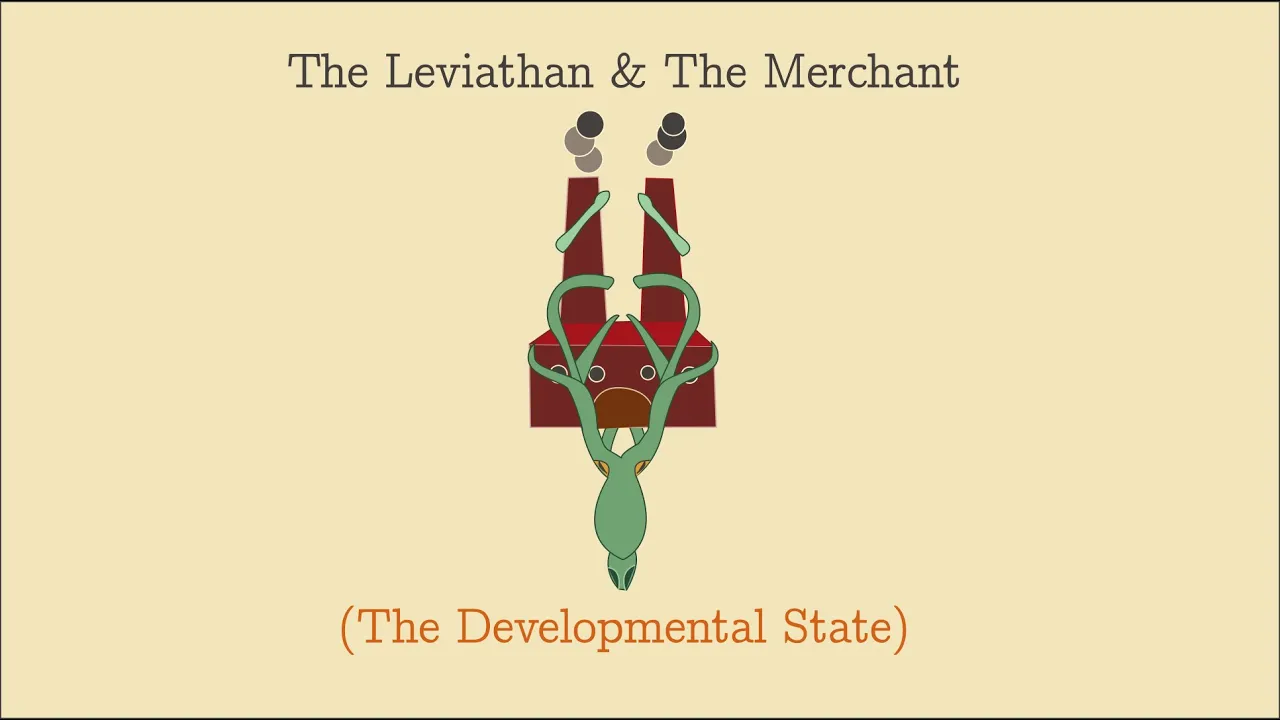
The concept of the 'Developmental State' and Mercantilism, where the government actively directs investment, protects domestic industries, and guides national economic development.
Basic instruments of economic statecraft, such as trade tariffs, sanctions, foreign direct investment (FDI), and currency manipulation.
Case studies of modern geoeconomic competition, specifically analyzing the trade and technological rivalry between the United States and China.
The theory of 'Weaponized Interdependence' and how states leverage global physical and financial networks (like SWIFT or semiconductor supply chains) for political coercion.
Analysis of China's Belt and Road Initiative (BRI) as a real-world execution of a developmentalist geoeconomic blueprint.
The resurgence of contemporary industrial policies, such as the US CHIPS and Science Act and European green transition strategies, as responses to systemic geoeconomic shifts.
130.4K views4.4Klikes30:38Original Release: 2018-12-02
== The Strategy of Geoeconomics == This video will be about the strategy of geoeconomics, which covers how states use, or should use, their economic power in pursuit of geopolitical goals.
This video aims to introduce the concept, outline the elements of geoeconomic strategy, and finally come up with two strategic blueprints that states can use to achieve their goals.
== Geoeconomics: Introduction == First, we have to be clear about what geoeconomics is not.
- Geoeconomics is not about states pursuing economic instead of geopolitical ends.
- Geoeconomics is not about foreign policy being driven by economic concerns.
- And geoeconomics is not about states using their economy to fuel a military machine.
One way of thinking about geoeconomics is to think of it as “4th Generation Geopolitics”.
This refers to “4th Generation (Dimension) Warfare”, which proposes that in modern war, the decisive contest may not actually be on the physical battlefield.
Instead, targeting the meta-dimensions of modern warfare: communications, logistics, legal and especially political, may well prevent the enemy from even coming to the battle in the first place.
Russia’s actions in Crimea are an example, where speed, ambiguity, propaganda and legal procedure all combined to deny the West a viable reason for intervention, leaving Russia in sole possession of the field by default.
In the same way, the economic meta-dimension within geopolitics can also be targeted.
States that achieve economic dominance are in a good position to achieve geopolitical goals, as rivals either compromise or are compromised due to their economic dependency.
The rise of geoeconomics is due to several factors.
Firstly, the high costs of modern war have diminished the power of diplomatic and military threats.
Secondly, while states still prioritize their own security, citizens also expect them to ensure their economic well-being, and will replace governments based on the state of the economy.
Lastly, today’s globalized economy has created a new dimension of strategic competition.
Power is no longer limited to controlling geopolitical territories and chokepoints, but also on ownership of key industrial sectors, markets and supply chains.
Mastering this new arena is, essentially, the point of geoeconomics.
== Geoeconomics and Economics == So we have seen how geoeconomics offers potential solutions to geopolitical questions.
But why geo-economics instead of plain old economics?
After all, economists can argue that if states run the economy based on purely economic rather than geopolitical principles, they will grow faster, which in turn gives them greater options and leverage against geopolitical enemies.
Running the economy with an eye towards geopolitical goals will only be counterproductive as state meddling interferes with growth.
The geoeconomic response comes in a critique of Ricardo’s Principle of Comparative Advantage, a key model mathematically demonstrating the benefits of free trade.
Suppose two countries and two initial goods: Britain is better at making cloth, Portugal is better at making wine.
If both countries try to produce both goods by themselves, they get a small amount of each.
Ricardo demonstrated that if each country focuses on its advantage: Portugal on wine and Britain on cloth, they will make a larger amount of their chosen product.
Trade with each other, and they will both end up with more goods compared with going it alone.
This relationship holds even if Portugal is better than Britain at producing both wine and cloth.
So here, we see how economic principles encourage specialization and trade, which in turn leads to both countries having more resources.
In response, geoeconomists point out two things: firstly, the relationship must be analyzed in terms of its long-term impact, not just short-term economic gains.
So let’s specify that this example of Comparative Advantage analyses long-term gains, which leads to the second point, which is that this model assumes that the economic effect of specializing in wine and specializing in cloth are the same.
But they are not.
Cloth is a standard ‘gateway industry’: it encourages urbanization, social development, industrial growth and mechanization; it also stimulates derivative industries like dyes, design and machine tools.
These characteristics exist to a much lesser degree, if at all, when it comes to wine.
So in our model, cloth-focused Britain is set for industrial takeoff.
It will stimulate the rapid and massive growth of simple manufacturing firms, educating entrepreneurs on the intricacies of mechanization and industrial management.
These firms will drive the development of an internal market, earning profits that can be used to invest in increasingly complex and innovative production, which in turn stimulates entrepreneurs and internal markets even more in a positive feedback loop.
In such a way, Britain easily become richer and more developed than a Portugal that has dumped its cloth industry.
OK, the economist says, but Portugal still remains better-off in this scenario.
By specializing and trading, it will still get more than it would producing everything by itself, and furthermore, through trading with developed Britain, Portugal gets goods that it can’t even produce at all.
The result is still more resources to potentially spend on geopolitics.
But this argument ignores the geoeconomic and geopolitical consequences of lopsided economic development.
In war, wealthy Britain will naturally prevail over poor Portugal; but even in peace, Britain’s wealth will give it significant geoeconomic advantages over Portugal.
Britain can use its money to buy up Portugal’s resources and firms, gaining a say in how Portugal’s economy is run.
This British economic dominance means that Portugal actually needs Britain’s cooperation to fund its activities.
Needless to say, this means in a geopolitical dispute between Portugal and Britain, Britain wins by default.
So we can see how blindly following economic principles has resulted in negative geopolitical benefit for Portugal.
It has gained more resources, but they have been rendered irrelevant since geoeconomic dependence has already led to Britain’s geopolitical victory.
Under a geoeconomic strategy Portugal would have insisted on keeping its own cloth industry, sacrificing short-term economic benefit for long-term geoeconomic and geopolitical gains.
To update Clemenceau’s quote, “the economy has become too important to be left to economists”.
== Geoeconomic Strategy: Aims == As repeatedly stressed, the point of geoeconomics is to support broader geopolitical strategy.
In practice, this support comes in the form of ‘hard’ or ‘soft’ economic power.
‘Hard’ economic power coerces and deters by threatening economic destruction: embargoes, withdrawal of investment, currency and stock manipulation and the like.
‘Soft power’ is about shaping rivals’ behavior and goals through enticements, structures and links: for example, the US will only allow states to use the IMF or US dollar if they conform to certain behavioral standards, while states conform to Chinese geopolitical desires in order to obtain loans.
‘Hard’ and ‘soft’ economic power are of course not mutually exclusive and in most cases are two sides of the same coin.
What is relevant for our purposes is that both methods require a strong and influential economy.
Clearly, embargoes and enticements do not work if the economy is too small or too irrelevant to have a meaningful effect on a rival.
Geoeconomic strategy therefore aims for two things in general: firstly, the creation of a large economy; and secondly, the creation of a relevant economy, either in the sense of controlling critical industrial links or being in the relevant markets.
How this is done will be the subject of the remaining part of this video.
== Geoeconomic Strategy: Elements == The core element in military strategy is force or firepower: everything is about creating, deploying and supporting units so that the right arrangement of firepower is in place to achieve the strategic goal.
In a similar vein, the core element in geoeconomic strategy is capital: everything is about creating, deploying and supporting firms so that the right arrangement of capital is in place to achieve the strategic goal.
Capital is needed to invest in production and grow the economy, and capital is what firms need to expand and maintain their positions within markets.
Capital is generated by firms in industrial sectors.
As implied in the analysis of Comparative Advantage, not all industrial sectors are created equal, and firms in capital-rich sectors, mostly services, will generate outsize profit and capital compared to others.
These rich economic territories are of course needed to fund geoeconomic strategy, but the nature of geoeconomics means that it is more interested in industries that also have geopolitical impact.
These strategic industries, perhaps less cash-rich but certainly more influential, include: - One: scarce yet critical industrial resources like oil, machine tools or microchips; - Two: services that underwrite the modern economy like communications and finance; - Three: high-tech, high-innovation industries that create and monopolize entirely new markets.
Additionally, apart from industrial sectors, states also need to consider the value chain dimension of geoeconomics.
When we look at the value chain ‘smile curve’, we find that the bottom of the ‘smile’, consisting of simple, labor-intensive work like assembly – is powerless and capital-poor.
By contrast, the capital- or knowledge-intensive ‘tips’: R&D, design, management, marketing are not only capital-rich, they are inherently powerful positions that impose their aims and values on subordinates and customers.
Needless to say, geoeconomic strategy aims to occupy these positions.
Last is the concept of markets, which generally still correspond to political borders.
There are capital-rich markets, of course, but generally strategic targets here tend to be selected for purely geopolitical reasons, either because they bring great political benefits or because they can neutralize the opposition of a broader political bloc.
== Geoeconomic Strategy: Means == Now that we know what the elements of geoeconomic strategy are, we can think about how states can manipulate them to achieve strategic goals.
States can use the means at their disposal either in an offensive fashion – deploying capital to seize control of strategic economic territory – or in a defensive fashion – preventing others from doing the same.
Here, we group these means into three categories: regulatory, financial, and directional, representing increasing state intervention in the economy.
= Regulatory = Regulatory means set out the “rules of the game” within an economy, consisting of laws, standards and bureaucratic procedure.
Barring additional intervention, firms playing within the rules are free to deploy and direct capital in the most efficient way possible.
States can of course still tweak the rules to loosely guide firms towards offensive geoeconomic goals, such as by raising minimum standards to stimulate the innovation needed to capture sectors or rise up the value chain.
More commonly, however, regulatory means are used defensively to prevent firms from sacrificing geoeconomic imperatives in search of maximum profit.
Minimum standards keep out firms who try to undercut innovative firms based on cost, while Committees on Foreign Investment review acquisitions to ensure that economic secrets are not sold out to geoeconomic rivals.
= Financial = Financial means redistribute or inject capital into certain national champions, usually in situations where the free market is unable or unprepared to.
They are used offensively to fund unprofitable investments that serve geopolitical purposes, and defensively to allow firms to maintain sectoral or market positions in response to a rival’s offensive.
There are two types of financial means: the first one is direct capital injection, where the state directly funds a national champion through subsidies, loans and tech transfers.
The other is the protected market, where the state erects tariffs to keep external competition out and allows the formation of cartels to do the same against internal competition.
The result is that the monopolistic national champion can jack up prices, thus redistributing capital from the public to the champion without too much overt intervention.
= Directional = Directional means straight-up direct national champions to compete for strategic sectors, positions and markets regardless of short-term profit.
The less-common defensive variant orders firms to hold on to legacy businesses for geopolitical benefit.
The state can also direct firms to abandon investments and deals for purely geopolitical reasons, as China is infamous for doing.
All in all, states can select from a broad array of tools in order to influence capital and firms towards desired sectors, value chain positions, and markets in line with their geoeconomic and geopolitical goals.
Free market economies may be more associated with regulatory means and command economies with directional ones, but in reality most economies utilize all three means to some degree: the US, for example, finances Boeing’s exports through the Export-Import Bank while European states financed and directed Airbus to seize the strategic high-tech sector of airplane production.
That said, the geoeconomic strategies of liberal and less-liberal economies are distinctly different and this will be examined below.
== Geoeconomic Strategy: The Liberal Blueprint == We can think of geoeconomic strategy as divided into three separate phases: firstly, the capital phase where firms receive capital to compete in the global market; secondly, the directional phase where firms decide which sectors or markets to aim for; and thirdly, the maintenance phase where firms attempt to maintain their hard-won position in the market or sector.
A liberal geoeconomic strategy is a ‘short-term defensive, long-term offensive’ strategy.
In it, the capital and directional phases are overseen by market forces.
Through the profit mechanism, markets will naturally direct capital towards the most capital-rich sectors and markets, and distribute capital according to firm quality with the most capable getting the most capital.
Firms are therefore incentivized to be constantly targeting capital-rich sectors, the capital-rich value chain positions within those sectors, and capital-rich markets.
Over the long-term, this creates a hyper-competitive economy that will naturally dominate economic sectors and markets, generating significant geoeconomic and geopolitical benefits for the state.
The state’s support during these phases should mainly consist of getting out of the way, with intervention limited to smoothing out market failures, providing public goods and infrastructure, and spearheading research in areas where the market has not yet caught up to.
Note that the liberal geoeconomic strategy is not the state abdicating all control to the market, and it is in the maintenance phase that the state’s role becomes paramount.
This is because the liberal strategy is based on free and fair markets: no firm, no matter how hyper-competitive, can compete for longagainst free or cheating.
The state must therefore use the regulatory means at its disposal to set up, enforce and update a set of rules that would maximize the effect of its liberal strategy: internally, it should promote things like competitiveness, free movement of capital and labor and so on, perhaps using standards to encourage innovation and upgrading within the economy.
Externally – which is far more important – the state should also insist that the only way others can compete on an equal basis is by conforming to the state’s own rules and geopolitical outlook.
Ideally, the choice is for rivals to concede geopolitical victory to the state in return for participating in the state’s economic dynamism, or to refuse and lose in the long-run anyway as the state outcompetes and dominates the rival’s economy.
As such, the state should neither hesitate in creating a protected market that keeps out unreformed rivals, nor should it shy away from financially supporting a firm that is disadvantaged against an external rival.
This blueprint can be seen as a purist and more aggressive version of the proposed Trans-Pacific and Trans-Atlantic free trade partnerships, which sought to create a free-trade bloc that forced geopolitical rivals to either adopt Western economic and geopolitical norms or be unable to benefit from the Western market.
The liberal strategy is fairly straightforward, but it is not without drawbacks.
The key one is that in a liberal strategy, the state has limited control over direction.
In practice states retain many tools to incentivize market forces in the desired geoeconomic direction, but in general they have little control over where specific capital goes.
This, of course, becomes a problem when it comes to capital-poor but strategic sectors and markets, where lack of market interest creates vacuums which a less market-conscious rival can exploit.
The geoeconomic successes that Chinese companies have enjoyed in the transport and communications infrastructure sectors, as well as in developing markets from the South Pacific to Africa to Latin America, are a product of Western disinterest as much as Chinese strategy.
Related to this is the broader issue that liberal geoeconomics tends to devolve into pure economics, where the state, driven by dogma and entrenched interests, gets out of the market regardless of its impact on geoeconomic goals.
A liberal strategy requires constant management to prevent market forces from overpowering geoeconomic logic.
Current worries may include excessive financialization, where firms cut production or underinvest for the sake of stock prices; and perhaps Western underinvestment in the public goods, especially education and infrastructure, that are necessary to a competitive and high-value-chain economy.
In short, a liberal strategy is not an excuse for governments to forget about the economy.
Free markets are a means, not the end, and they should be curbed when they start interfering with geoeconomic or geopolitical goals.
The trick is to find that sweet spot, where economically-dominant firms take the offensive thanks to helpful market forces, and are defended from unhelpful ones through government intervention.
== Geoeconomic Strategy: The Developmentalist Blueprint == Contrasted with the liberal blueprint is the developmentalist blueprint, so-called because of its origins in German and East Asian developmental economics.
Here, the state directs capital towards favored ‘national champions’, directs them towards certain targets, and supports them so that they can maintain their positions in the long-run.
In short, it is a ‘short-term offensive, long-term defensive’ strategy.
The developmentalist strategy is especially relevant where the free market is unwilling or unable to achieve geoeconomic goals.
We have seen how markets can ignore geopolitically-significant but capital-poor territory.
In poor, underdeveloped countries, markets may not even be able to concentrate enough capital to achieve meaningful economic growth.
State intervention is therefore the alternative.
Financial means are liberally used to infuse select champions with capital.
Externally- and internally-protected markets allow champions to extract as much capital as possible from the public.
Direct state support will be financed by taxation or by a negative-real-interest-rate regime that converts the public’s savings into usable capital.
In both cases, the state suppresses domestic consumption and transfers the money saved into investment.
In return for the support, champions must follow the state’s direction and target specific industries.
Competent bureaucracies will tailor targets to ensure that the limited capital is focused on capital-rich or geoeconomically-significant sectors, and are within the technological capabilities of the champions.
And since champions cannot rely on the suppressed domestic market to buy their goods, they have to export overseas for their profits, which in the East Asian case meant exporting to the US.
Given the many cost advantages they are working under, champions should easily undercut the firms in their chosen market and quickly become a relevant force in their sector.
The profits they earn will either be used to invest in themselves and advance up the value chain, or be repaid to the state who will use the money to fuel another national champion.
With appropriate state financing and direction, most champions can easily dominate the lower segments of a value chain based on cost advantage.
But these positions are not capital-rich nor powerful, and a champion here will always be vulnerable to political or market developments that can make it obsolete in an instant.
To maintain the state’s foothold in this sector, therefore, a firm must continue to receive constant support as it attempts to advance up the value chain.
Some level of innovation is required for a champion to advance up the value chain.
Long-term this requires the state to pour additional capital into building the required knowledge and educational structures; in the meantime, it can have champions compete with each other for subsidies or loans, weeding out the unfit in the process.
Alternatively, the state can cheat and support its champions through enforced tech transfers and industrial espionage, allowing them to keep abreast of the latest developments.
Repeat this cycle enough times, and eventually the champion will reach a scale and value-chain position where it can actually begin making a genuine profit and start contributing to state coffers.
Long before that, however, it would have already become a ‘growth pole’, stimulating internal development and bringing the economy closer to the level where it can start fueling itself.
The meteoric rise of Japan, South Korea and now China is proof of the power of this blueprint.
But there are also glaring drawbacks: Firstly, state intervention on this scale and timeline creates significant market distortions.
Cronyism and inefficiencies are to be expected, but to scrounge up the capital to fuel champions, states either take on massive debt or manipulate currencies and capital flows to get the real interest rates they want.
And few states have been able to forever defy the laws of economic gravity: from the Japanese asset bubble of the late 80s to the Asian Financial Crisis of 1997 to China’s current debt overhang.
The second drawback – which is less of a drawback and more of a tough prerequisite – is that the developmentalist strategy requires international tolerance.
A key step in this strategy is to have states gain capital by exporting to overseas markets under pretty unfair conditions, undercutting other firms in the process.
There is no reason why the export destination should tolerate this.
Indeed, the liberal strategy’s emphasis on ‘free and fair markets’ was to prevent this sort of one-sided deal in the first place.
During the Cold War, the US tolerated Japanese and South Korean practices because their increased strength was a geopolitical gain.
This is not the case for China and accordingly US tolerance is wearing thin.
It’s not clear whether the developmentalist strategy will be as successful in a less unconditionally-open trade environment.
In short, the developmentalist strategy has the state put the economy into capital-generating gear.
Domestic consumption is suppressed, capital earned from overseas exports is brought in, and the money is invested into select national champions, whose task is to exploit their many advantages to seize the desired geoeconomic territory.
Its historical effectiveness is undeniable, but it may be a product of circumstance.
Additionally, the state can only defy economic logic for so long before coming back to reality in the form of an economic crisis.
== Conclusion == Over the course of this video, we have seen how geoeconomics is relevant to modern geopolitics.
By dominating key industrial sectors, value chain positions and markets, geoeconomic powers can suppress hostile activities of dependent countries and thus win geopolitical conflicts by default.
Domination requires abundant and strategic use of capital, leading to two general strategic blueprints: a liberal one where the free market directs capital, and a developmentalist one where the state provides direction.
Most countries recognize the need for both dynamism and direction and will combine elements of both in their strategy.
In an age of muted political conflict, geoeconomic competition is becoming more relevant in the quest for global power and influence.
It is important to remember, however, that geoeconomics is not a substitute for geopolitics.
In the last counting, states still value security and political control over economic comfort, and geoeconomics provides the means, not the end, of achieving that.
Thanks for watching the video, and please like and subscribe!
If you have any comments or questions, I’ll be happy to respond to them in the comments section.
Up Next
47:41
US Secondary Sanctions on Russian Oil: Impacts
@Gametheory101
214.7K views•2025-08-05
5:07
Impact of Yuan in Indo-Russian Trade Amid Sanctions
@WION
261.9K views•2022-07-01

10:33
Behavioral Economics Explained: Rationality, Nudges, and Risk
@crashcourse
1.1M views•2016-03-12

113:18
The Age of Easy Money: Fed & Inflation | Full Documentary
@frontline
21.2M views•2023-03-15
Related Study Plans & Knowledge Roadmaps
Structured learning paths in Economics
economics
Sovereign Debt: Defaults, IMF & Restructuring
01Introduction to Sovereign Debt & Government Bonds
02Debt Sustainability & Credit Ratings
03Anatomy and History of Debt Crises
+ 2 more learning modules
12h5 modules
Explore Roadmap
economics
Market Design: Matching Theory & Gale-Shapley
01Introduction to Market Design and Price-Free Markets
02Two-Sided Matching & The Gale-Shapley Algorithm
03School Choice Systems and Mechanism Design
+ 2 more learning modules
10h5 modules
Explore Roadmap
economics
Impossible Trinity: Forex, Capital & Policy
01Introduction to Monetary Policy and Central Banking
02Exchange Rates and International Capital Flows
03The Mundell-Fleming Model
+ 2 more learning modules
8h5 modules
Explore Roadmap
economics
Healthcare Economics: Market Failures & Systems
01Introduction to Healthcare Markets and Market Failure
02Asymmetric Information and Adverse Selection
03Moral Hazard and Insurance Design
+ 2 more learning modules
12h5 modules
Explore Roadmap