The setting in a short story encompasses both the physical environment (time and place such as daytime/nighttime, cities, offices, schools, seasons) and the sociocultural context (economic status, education level, emotional atmosphere, cultural and religious factors), and effective analysis requires examining when and where the action takes place, understanding the social and cultural setting, exploring connections between characters and their environment, and determining whether the setting serves as a backdrop or plays a more significant role in the narrative.
Analyzing Setting in Short Stories: Time, Place, and Culture
Added:Deep Dive
Basic familiarity with the core elements of fiction, such as plot, character, theme, and conflict.

The Elements of Fiction (and the most important one)
30.8K
All good stories are built upon four essential elements: setting, plot, theme, and characters. Setting establishes the world, time, and tone of the story. Plot consists of events with conflict, requiring structure like Freytag's Pyramid for satisfaction. Theme represents the underlying message and life lessons, rarely stated directly. Characters provide emotional connection and drive the narrative forward. Together, these elements form the complete recipe for compelling fiction.
Click to watch →

From Inkling to Ink Presented by James R Hannibal
115
The basic elements of fiction include character, plot, setting, and theme. These are the fundamental building blocks that every story contains. The instructor uses these elements as the starting point for developing a story idea, beginning with a single inkling or concept and then expanding it into a full story using these elements.
Click to watch →

5 Basic Elements of Fiction
44.1K
The five basic elements of fiction are plot (the sequence of events), setting (time and place), characters (people, animals, or objects with personality), conflict (the opposition that drives the story), and theme (the central message or universal idea). Short stories typically have a single setting, one plot, few characters, and one main conflict, while novels have multiple settings, subplots, and complex character development. These elements work together to create engaging narratives that explore the human condition.
Click to watch →
Elements of Fiction
1.2K
Fiction elements—plot, character, setting, theme, point of view, conflict, symbolism, tone, mood, and style—work together to create engaging narratives; plot is the sequence of events with beginning, middle, and end; characters can be round, flat, static, or dynamic; point of view includes first-person, second-person, and omniscient narrators; conflict can be internal or external; and themes are the underlying messages or ideas the author conveys to readers.
Click to watch →
Theme And Plot #englishprose
402
Theme is the central idea or meaning of a story, representing the author's thoughts about general beliefs about how things are or should be. It is an argument or issue on which the story revolves, providing a unifying point around which plot, characters, setting, and other elements are organized. Theme must be distinguished from plot (sequence of actions) and subject (what the story is about). Theme is usually an abstract concept like love, marriage, corruption, or justice, not written down anywhere in the work, requiring readers to decipher it through careful analysis. Plot is the arrangement of events that make up a story, where authors dramatize human conditions through characters engaging in actions arranged in a particular sequence. Freytag's Pyramid outlines the basic structure: Exposition introduces characters and conflict; Rising Action develops complications; Climax is the moment of greatest tension; Falling Action resolves complications; Resolution provides the solution. Common conflict types include Man vs Man, Man vs Nature, Man vs Society, and Man vs Self. Narrative devices include Flashback (inserting scenes from the fictional past), Flash Forward (inserting scenes from the fictional future), and Foreshadowing (hints about future events).
Click to watch →
Deep Dive
A foundational understanding of the short story genre, particularly its brevity and focus on a single narrative arc.

REET Pre English Class 2025 | Short Story Part - 01 | REET पात्रता परीक्षा 2025 | #10 | Manish Sir
50.2K
Short stories are minor forms of English literature - fictional narrative pieces in condensed form. Key characteristics include: length of 3,000-16,500 words (shorter than novels at 40,000-50,000 words), typically one main character (though 2-3 may be included), single setting, and unified plot. The structure includes arrangement of events and incidents in proper sequence. Theme depends on the plot and represents the central message. Short stories are brief, concise works readable in one sitting, focusing on a single incident or theme.
Click to watch →
La Nouvelle Réaliste - 4e
5.1K
The short story is a concise literary genre focusing on a single, unique event. Due to its brevity, narrators must quickly establish settings, introduce characters, and develop plots without deeply exploring thoughts and emotions. Realistic short stories use precise descriptions of recognizable settings, accurate social class depictions, and authentic dialogue to create authenticity. Narrative perspectives include external (camera-like observation), omniscient (all-knowing narrator), and internal (single character's perspective). The inciting incident launches the action, while the resolution provides closure. The genre's defining characteristic is its unexpected ending (chute), which prompts readers to reflect on human behavior and social conventions.
Click to watch →

NOITE - LP - 25.02.25 - 1ª série
312
A short story (conto) is a narrative genre characterized by a single conflict, few characters, and reduced time and space settings. The narrative typically begins with 'Era uma vez' (Once upon a time), connecting it to childhood imagination. Key elements include: a single conflict with opposition between forces, few characters, and language that can be formal or informal. The conflict creates tension that captures the reader's attention throughout the narrative. The narrative structure follows: introduction (presentation of characters and setting), complication (initial events placing characters in new situations), evolution (development of conflict), climax (moment of maximum tension), and resolution (final outcome). The climax is particularly important as it is the moment readers have been waiting for throughout the narrative.
Click to watch →

حكاية القصة القصيرة | حكايات الأدب للثانوية العامة | سلسلة الحكواتي مع مستر رضا الفاروق
8.1K
A short story is a prose literary genre characterized by specific quantitative and qualitative criteria. It differs fundamentally from novels in structure: short stories feature limited characters, locations, and time periods, while novels encompass multiple interconnected lives across various settings. The word count ranges from under 1,000 to 12,000 words, with reading time from a few minutes to 2 hours. Short stories employ extreme conciseness where removing even a single word can disrupt the artistic structure. They serve a specific purpose: conveying a particular message, idea, or emotional impression through narrative rather than direct exposition. The genre emerged in the early 20th century, with Mikhail Naimy's 1914 work marking its beginning, followed by Muhammad Taimur in 1917, and later developed by authors like Naguib Mahfouz and Yusuf Idris.
Click to watch →

القصة القصيرة (الجزء الأول) || الأدب والنصوص
213.3K
The short story has a simple idea and a single, specific event, condensing meaningful content into one moment. It presents a complete idea that conveys deep meaning and implication, allowing readers to understand profound concepts from the beginning. The short story is shorter than a novel and cannot cover complete events or character development. It focuses on a specific part or aspect of an event or character rather than developing multiple events, settings, and characters. The short story deals with a single, specific event or character aspect rather than branching into multiple events, settings, and characters. It does not develop events, settings, and characters like a novel does. The short story is meant to be concise and focused, presenting a meaningful event in a single moment.
Click to watch →
Deep Dive
The ability to perform active reading, including highlighting key descriptive details and finding textual evidence.

5 Active Reading Strategies for Textbook Assignments - College Info Geek
981.2K
Active reading involves five key strategies: (1) Pseudo-skimming—skim paragraphs quickly to identify important sections; (2) Reading backwards—examine summaries and review questions first to understand chapter goals; (3) Generating questions—note unknowns and rephrase headings as questions; (4) Paying attention to formatting—focus on bolded items and lists which often indicate test-relevant content; (5) Marking up materials—use flags, highlights, or handwritten notes to capture key points in your own words.
Click to watch →

LEITURA ATIVA: a habilidade MAIS VALIOSA na sua leitura
1.7K
Active reading is when readers participate actively in the process, including reading with attention, questioning, and annotating. The reader is not passively accepting information but is constructing understanding and becoming part of the comprehension process. Mortimer Adler states that the art of reading is 'the art of asking questions and finding answers on your own.'
Click to watch →

7 pasos para COMPRENDER todo lo que LEES | ft. @PabloLomeli
46.5K
In passive reading, you remain on the surface and learn almost nothing. In active reading, you make total immersion in the text and understand it much better. This is done through a system of quick notes and marks within the book or text. Write personal comments or brief explanations about the most important ideas at the margins. This is a way to converse directly with the author and combine your current knowledge with new knowledge from the text. Use different colored symbols with specific meanings: asterisks for hard data or key words, circles for important ideas, underlining for main arguments and ideas, brackets for very important paragraphs like arguments, arrows to relate information to each other, and numbers to order the main ideas of the text. Build this system gradually.
Click to watch →

Sách nói Học Viện Thành Công - Og Mandino - Bài Học Từ 50 Bậc Thầy Vĩ Đại | Voiz FM
1.6K
To avoid the trap of passive reading, always have a pen or pencil ready when opening the book. When you encounter a meaningful sentence or passage, highlight it. This simple action triples what you retain of the thought or principle and makes it easier to find later.
Click to watch →

Comment MÉMORISER n'importe quoi 10X PLUS VITE
1.4K
Active reading involves four key elements: (1) Questioning the text systematically before and during reading - asking what the section will cover, what you already know, and what questions you have. This creates mental 'empty slots' that the text fills. (2) Establishing constant connections between new information and existing knowledge, which creates new neural pathways. (3) Strategic highlighting and annotating - only key ideas, important definitions, and examples, plus personal notes in margins. (4) Regular mental summarization at the end of each paragraph or section to force active processing.
Click to watch →
Deep Dive
A basic, surface-level definition of 'setting' as simply the time and place of a story's events.

What is a Setting?
551
Setting is the time and place of a story. It answers two fundamental questions: 'when' (the time when the story is set) and 'where' (the place where the story happens).
Click to watch →

Kindergarten: ELA Unit 8 Week 3 pp. 93, 94
126
The setting is the time and place of a story's events. The setting establishes where and when the story takes place. It helps readers understand the context of the story.
Click to watch →

Settings of Stories - Where and When a Story Takes Place
201
Setting is defined as where and when a story takes place. A story's setting can include various combinations of locations and time periods, such as a busy city in the future, a quiet library at night, or an old Western town from long ago. Every story has its own setting, and stories can have multiple settings that change throughout the narrative.
Click to watch →
Elements of a Story | Basic English Literature for SST General | Plot, Characters, Setting
268
Setting is the time and place where the story takes place. It includes two components: (1) Time - the era or period of the story (e.g., 1980, 2007, 1800), (2) Place - the location or geographical setting (e.g., England). Together, time and place establish the context for the story.
Click to watch →

PLOT, SETTING AND CHARACTERIZATION | ENGLISH GRADE 10 QUARTER 1
1.4K
Setting refers to the time and location where a story takes place or happens. It answers the questions of when and where the story occurs. Setting is not just about place and time but also includes different aspects that elaborate on the environment and background information of a particular story.
Click to watch →
Prerequisite Knowledge
- Concept 01Basic familiarity with the core elements of fiction, such as plot, character, theme, and conflict.
- Concept 02A foundational understanding of the short story genre, particularly its brevity and focus on a single narrative arc.
- Concept 03The ability to perform active reading, including highlighting key descriptive details and finding textual evidence.
- Concept 04A basic, surface-level definition of 'setting' as simply the time and place of a story's events.
Subsequent Learning
- Step 01Analyzing how setting actively shapes and influences character development, plot progression, and overall mood.
- Step 02Exploring 'setting as symbol,' examining how physical environments reflect thematic conflicts or characters' psychological states.
- Step 03Applying advanced setting analysis to longer literary forms, such as novels, plays, or epic poetry, which may feature multiple shifting settings.
- Step 04Introduction to literary theories related to setting, such as Historical Criticism, Ecocriticism, or Regionalism.
Setting Analysis
Setting Analysis
0:00Playing Section
- 1
Examines physical setting: time, place, and season details.
- 2
Explores sociocultural context: wealth, education, and atmosphere.
- 3
Highlights key questions for deeper scene evaluation.
New Criticism and Textual Autonomy
While traditional analysis emphasizes the physical, temporal, and sociocultural settings of a short story, New Criticism (or Formalism) argues that a literary work should be treated as a self-contained, autonomous object. From this perspective, over-analyzing a story's historical or cultural setting risks committing the 'genetic fallacy'—interpreting a text based on external historical origins rather than its intrinsic qualities. New Critics advocate for 'close reading,' focusing strictly on the internal mechanics of the text, such as syntax, irony, and figurative language, rather than looking outward to the real-world context the setting represents. This counterpoint suggests that a story's meaning resides entirely within its linguistic structure, and that a deep, valid interpretation can be achieved without relying on external historical or cultural knowledge.
Deep Dive
Analyzing how setting actively shapes and influences character development, plot progression, and overall mood.

Storytelling Techniques in English || Improve English Listening Skills
4.2K
Setting is often underestimated but is not just the backdrop (where and when) of a story. It actively shapes mood, influences character choices, and sometimes acts like a character itself. In Wuthering Heights, the wild, desolate moors are not merely scenery—they reflect and intensify the fierce, untamed passions of Heathcliff, Catherine, and others. The harshness of the land mirrors the harshness in their souls, demonstrating how setting can function as an active force that shapes and reflects the narrative's emotional core.
Click to watch →

6th Unit 3 Lesson 2 Influence of Setting on Character and Plot
184
To properly analyze setting's influence on a story, one should move beyond simple questions of 'where' and 'when' to deeper inquiries about human behavior within that context. Key analytical questions include: How do people behave in this world? Why do they behave this way? What rules, expectations, threats, or dangers shape their actions? Understanding these factors reveals how setting fundamentally shapes both character choices and plot developments.
Click to watch →

Je lis VOS histoires de M*RDE (ENCORE) | Le DeepWeb Littéraire #17 SPECIAL ABONNÉS
7.2K
Setting influences character development and plot progression in fiction. The story demonstrates how the isolated villa setting creates conditions for character growth and plot development. The narrative shows how environmental factors can isolate characters, forcing them to confront their fears and develop new skills. This illustrates the literary principle that setting serves as both backdrop and active force in shaping character development and narrative direction.
Click to watch →

Setting Shapes Everything: Character, Conflict, Theme
316
Setting should function as an active character that shapes emotion, conflict, and meaning, not merely as decorative backdrop. Writers often treat setting as 'wallpaper'—descriptions that add no meaning. Effective settings like Hogwarts (safe home and mysterious danger), Panem's districts (revealing inequality), and Moria (providing historical context) demonstrate how setting drives narrative. The biggest struggle is information overload—writers should weave setting throughout scenes rather than presenting blocks of description. Setting must be specific enough that scenes cannot happen elsewhere. Setting impacts stories on multiple levels: shaping character motivation, creating conflict and limits, conveying theme through symbolism, and reflecting emotional states. The Chekhov's Gun principle applies: every element mentioned must be important to the story.
Click to watch →

7 Writing Exercises to Improve Your Story's Setting
5.6K
Setting is far more than a passive backdrop—it actively shapes mood, influences plot development, and reveals character traits. Writers must recognize that setting impacts both the story's emotional tone and character behavior. To develop strong settings, writers should practice describing the same location in opposing emotional tones (tranquil vs. menacing), conduct thorough research on unfamiliar locations, and describe settings through multiple character perspectives to reveal how each character uniquely experiences and interacts with their environment.
Click to watch →
Deep Dive
Exploring 'setting as symbol,' examining how physical environments reflect thematic conflicts or characters' psychological states.
Writers Chat: Book Chat ~ Word Painting
129
Setting transforms from place on a map to landscape of character's inner conflicts and symbol of the heart's journey. Eudora Welty's work demonstrates how physical setting becomes symbolic of internal struggles. Exercises include describing the same neighborhood from three different perspectives, the same place at three different life periods, and natural settings across seasons or times of day. These exercises reveal how the same setting can mean different things to different characters.
Click to watch →

Why is a story's setting important?
291.8K
Physical settings can serve as symbols for abstract ideas and themes. A boring, beige desert might symbolize the absence of caring people, lack of growth, support, and stimulation in a character's life. Conversely, a colorful place full of trees, rainbows, and flowers might symbolize improvement and positive change in the character's circumstances.
Click to watch →

Is Gary Hiding Teri… Or Something Worse Happened? | Paradise S2 Episode 5 Explained
2.2K
Physical environments in narratives often serve as symbolic extensions of character psychology. A setting like a post office with hidden nuclear shelters can represent a character who is ostensibly ordinary and functional on the outside but conceals deeper secrets within. Such spaces become stages for moral conflict, emotional negotiation, and violent acts of betrayal, where survival strategy intersects with personal desire, reflecting how physical environments are almost always extensions of character psychology.
Click to watch →
Setting Shapes Everything: Character, Conflict, Theme
316
The fourth layer of setting transforms the environment into a metaphor or reflection of character state, theme, or story transformation. For example, Elsa's frozen palace in Frozen is not merely a cool animation but symbolizes her isolation, hidden beauty, and the powers she fears. Symbolic setting elevates the environment from background to meaningful narrative device that reflects deeper story themes.
Click to watch →

BBC2 | The Film Club | 1990
761
The Italian setting serves symbolic functions in revealing character psychology. The numerous pregnant women Catherine sees in Naples contrast with her own childlessness, highlighting the emptiness of her marriage. The local cult of Dolce Far Niente (the pleasure of doing nothing) contrasts with the arid materialism of the English couple's existence. Katherine's encounter with nude statues in the Museum of Naples, filmed with ecstatic camera movement, underscores the absence of sensuality in her relationship. These elements demonstrate how setting can function as a mirror to internal states.
Click to watch →
Deep Dive
Applying advanced setting analysis to longer literary forms, such as novels, plays, or epic poetry, which may feature multiple shifting settings.
Literary Analysis Introduced
717
Setting analysis encompasses atmosphere, historical period, physical setting, and mood. Readers should observe: place (physical or psychological locations), time (progression of events), chronological settings (linear forward, backward, circular reflection), flashbacks, historical settings (grounded in real periods), in medias res (beginning in middle), projections (looking forward), fragmented settings (combining chronologies), atmosphere (physical descriptions), and mood (emotional descriptions).
Click to watch →

Broward College | English 1102 Refresher - What is Setting?
185
Setting in literature can be analyzed using a four-cell matrix that examines two dimensions: time (immediate time like time of day versus historic time like years or centuries) and place (immediate place like a room versus geographic place like a city or country). Changing any variable in this matrix significantly impacts the story, as demonstrated by how a classroom in Broward College differs from one in Shanghai, or how shifting historic time by 50 years creates a totally different environment.
Click to watch →

بث مباشر : منهجية القصة والمسرحية
8.7K
Setting analysis (تحليل المكان) involves identifying the primary location (المكان الرئيسي) where the main events occur and secondary locations (المكان الثانوي) that provide context. The primary setting is where the story's main action takes place, while the secondary setting provides additional context and contrast.
Click to watch →
Literary Analysis Illustrated
349
Setting analysis includes examining: atmosphere, historical period, physical setting, and mood; the place and time of the story; flashbacks and projections; whether the setting is historical, chronological, backward, forward, circular, or fragmented; and whether the story starts in medias res (in the middle of things). These elements establish the context and environment of the narrative.
Click to watch →

LITERATURE FORM III THEORIES OF LITERATURE 11 OF 13
161
Setting is the first element of form in literature, referring to the time and place in which a literary work takes place. Setting can be real (geographically located and truly existing, such as Mwanza or Mount Kilimanjaro) or imaginary (places that do not exist and must be imagined by the reader). Setting can also be categorized as main setting (which dominates the literary work from beginning to end) or minor setting (smaller areas or parts where different actions take place, such as a room, classroom, school, or market). Understanding setting helps readers visualize and connect with the literary work.
Click to watch →
Deep Dive
Introduction to literary theories related to setting, such as Historical Criticism, Ecocriticism, or Regionalism.
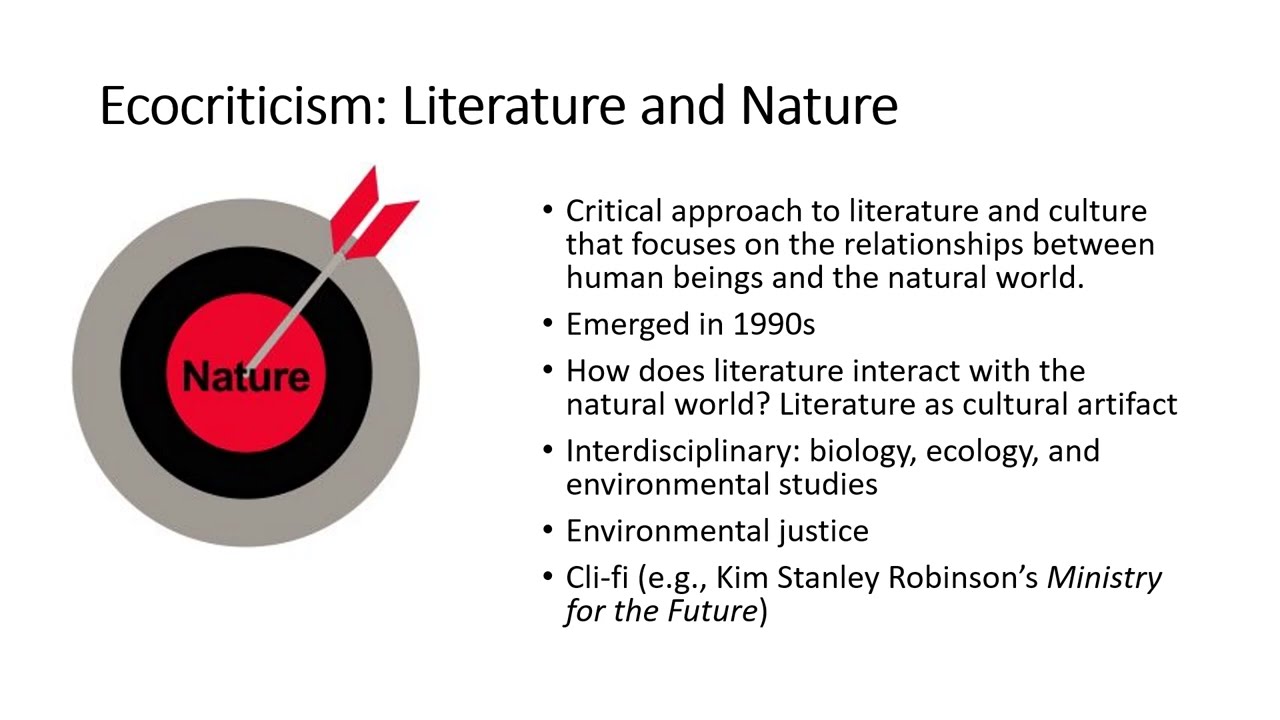
Ecocriticism
132
Ecocriticism is a literary criticism approach that examines the intersection of literature and nature, placing environmental concerns at the center of analysis; it emerged in the 1990s as an interdisciplinary field that considers how texts reflect human impacts on the environment, climate change, and environmental justice, using methods like analyzing setting, landscape, symbolism, and place while challenging anthropocentric worldviews.
Click to watch →
What is ECOCRITICISM: Literary Theory| Pradeep Hariharan Malayalam
20K
Ecocriticism is a literary theory that examines the relationship between literature and the physical environment, coined by William Rueckert in 1978, which takes an earth-centred approach to literary studies where PLACE becomes a new critical category alongside race, class, and gender; it has two phases: the first wave (1980s) focused on natural writing and search for nature, while the second wave (1990s) became a political movement addressing climate change and global warming; ecocriticism is committed to environmental protection and distinguishes between deep ecology (which emphasizes the inherent value and interdependence of all living beings and treats everything in the environment equally) and shallow ecology (which rejects ecocentrism and biocentrism, viewing nature only as valuable when it serves human interests).
Click to watch →

ECO CRITICISM : INTRODUCTION Part 1 UGC NTA NET English Literary Theory and Criticism
742
Eco-criticism is a literary theory that examines the relationship between literature and the physical environment, expanding the traditional literary concept of 'world' from purely social/societal dimensions to include the entire ecosphere; it emerged in the late 20th century as a response to environmental degradation, with key milestones including Rachel Carson's 'Silent Spring' (1962), William Rueckert's 1978 essay, and Cheryl Glotfelty's revival of the term at the 1989 WLA conference, culminating in seminal works like 'The Eco-Criticism Reader' (1996) and 'The Environmental Imagination' (1995).
Click to watch →
Literary Theory: An Introduction
26.6K
New historicism understands intellectual history through literature and its cultural context, developed by Stephen Greenblatt in the 1980s. Cultural materialism, tracing to Raymond Williams, applies Frankfurt School critical theory to early modern literature. Postcolonial studies analyzes the cultural legacy of colonialism and imperialism, examining power relations, economics, politics, religion, and culture in relation to colonial hegemony. Cultural studies is an interdisciplinary field examining how culture is constructed and evolves, emerging from the Birmingham Center for Contemporary Cultural Studies under Stuart Hall. Ecocriticism studies literature and the environment from interdisciplinary perspectives, analyzing texts illustrating environmental concerns and examining how literature treats nature, informed by ecology, sustainable design, and environmental history.
Click to watch →

Critical Approaches to the Study of English Literature Basic Concepts Of Each Approach With Notes
15.1K
Historical criticism examines literature within its historical, cultural, and intellectual context. This approach considers the time period, geographical region, and social conditions in which a work was written. It analyzes how the author's historical background, the intellectual climate of the era, and the social circumstances influenced both the creation and reception of the work. Historical criticism helps readers understand what the author intended to communicate and what the original audience's expectations and demands were.
Click to watch →
Setting Analysis
Setting Analysis
0:00- 1
Examines physical setting: time, place, and season details.
- 2
Explores sociocultural context: wealth, education, and atmosphere.
- 3
Highlights key questions for deeper scene evaluation.
New Criticism and Textual Autonomy
While traditional analysis emphasizes the physical, temporal, and sociocultural settings of a short story, New Criticism (or Formalism) argues that a literary work should be treated as a self-contained, autonomous object. From this perspective, over-analyzing a story's historical or cultural setting risks committing the 'genetic fallacy'—interpreting a text based on external historical origins rather than its intrinsic qualities. New Critics advocate for 'close reading,' focusing strictly on the internal mechanics of the text, such as syntax, irony, and figurative language, rather than looking outward to the real-world context the setting represents. This counterpoint suggests that a story's meaning resides entirely within its linguistic structure, and that a deep, valid interpretation can be achieved without relying on external historical or cultural knowledge.
Basic familiarity with the core elements of fiction, such as plot, character, theme, and conflict.
A foundational understanding of the short story genre, particularly its brevity and focus on a single narrative arc.
The ability to perform active reading, including highlighting key descriptive details and finding textual evidence.
A basic, surface-level definition of 'setting' as simply the time and place of a story's events.
Analyzing how setting actively shapes and influences character development, plot progression, and overall mood.
Exploring 'setting as symbol,' examining how physical environments reflect thematic conflicts or characters' psychological states.
Applying advanced setting analysis to longer literary forms, such as novels, plays, or epic poetry, which may feature multiple shifting settings.
Introduction to literary theories related to setting, such as Historical Criticism, Ecocriticism, or Regionalism.
13.2K views71likes1:51@stinebrynildsen4593Original Release: 2015-04-10
how to analyze short stories the setting the setting in a short story it deals with the time and place of the action the setting can be in the daytime in a city in a bus or in a plane or in a UFO well you get the idea or it can be in the nighttime in the city the setting can be on a bench in a Street in the city it can be in somebody's office the setting can be in a house more specifically the living room the setting can be in a school in a classroom or it can be a season like the winter time the sociocultural setting deals with other aspects than the physical setting like is it a rich or a poor environment are people well educated or not is it a loving environment or is it more a toxic one is it a happy friendly or is it sad and bad is it a modern environment or more old-fashioned what about culture and religious any religious clashes some important questions to ask about the setting are when and where is the action taking place what about the social cultural setting what connections are there between the characters and the setting and is a setting more important in itself or or is it just a backdrop to the plot okay so you're ready to begin analyzing if not you can read more in our course material at nd. and in your textbooks so good luck analyzing the setting
Up Next

17:00
Campus Novel in English Literature | Academic Novel Explained
@LiteratureGuide
1.2K views•2020-11-03

13:43
Formalism in Literary Criticism: An Academic Lecture Overview
@mattalberhasky9952
39.1K views•2015-08-05

6:08
Point of View in Fiction: First Person vs. Third Person
@magicalthriftyteacher
153.8K views•2014-03-31

15:25
1984: Orwell's Dystopian World and the Mechanisms of Totalitarianism
@AlternateHistoryHub
7M views•2017-03-04
Related Study Plans & Knowledge Roadmaps
Structured learning paths in Literature
literature
Graphic Memoirs: Visual Art, Trauma & History
01Foundations of Sequential Art and Visual Language
02Autographics and Processing Historical Trauma
03Visualizing Personal Trauma, Grief, and Graphic Medicine
+ 2 more learning modules
14h5 modules
Explore Roadmap
literature
Campus Novels: Evolution, Themes & Critique
01Introduction to the Campus Novel Genre
02Mid-Century Satire and the Post-War Academy
03Dark Academia and the Critique of Privilege
+ 2 more learning modules
14h5 modules
Explore Roadmap
literature
Theater of the Absurd: Philosophy & Plays
01Postwar Existentialism & Historical Roots
02Dismantling Narrative: Esslin & Absurdist Conventions
03Samuel Beckett and Tragicomic Existentialism
+ 2 more learning modules
12h5 modules
Explore Roadmap
literature
Revenge Tragedy: Justice, Madness & State
01Foundations of Early Modern English Theatre
02Anatomy of Revenge: Structural Conventions
03Psychological Complexity: Madness and Melancholy
+ 2 more learning modules
15h5 modules
Explore Roadmap