



















![[JEE Adv] Find Normal Reaction| Rotating Wheel and Axle | Morin](https://i.ytimg.com/vi_webp/MxePiszNxjg/maxresdefault.webp)



This lecture introduces the dynamics of rigid bodies, explaining that rigid bodies maintain constant shape during motion and can undergo both translation and rotation. Key concepts include angular displacement measured in radians (where one radian equals the angle subtended by an arc equal to the radius), angular velocity (ω = dθ/dt), and angular acceleration (α = dω/dt). The lecture derives the rotational kinetic energy formula K = ½Iω², where I is the moment of inertia (I = Σmr² for discrete masses or ∫r²dm for continuous bodies), and introduces angular momentum L = Iω. The fundamental equation τ = Iα relates torque to angular acceleration, analogous to Newton's second law F = ma. The lecture demonstrates how to calculate moments of inertia for common shapes including rings (I = MR²), disks (I = ½MR²), and rods (I = ⅓ML² about one end, I = ¼ML² about center), and explains the parallel axis theorem for finding moments of inertia about different axes.
Rotations Part I: Dynamics of Rigid Bodies | Physics Lecture
Added:Professor Ramamurti Shankar: Okay, so this is a new topic called Physics or Dynamics of Rigid Bodies. So, a rigid body is something that will not bend, will not change its shape when you apply forces to it, and one example could be a dime, a coin, or a meter stick.
Of course, nobody is absolutely rigid.
You can always bend anything, but we'll take the approximation that we have in our hands, a completely rigid body. A technical definition of a rigid body is that if you pick a couple of points, the distance between them does not change during the motion of the body. So, the dynamics of rigid bodies, in three dimensions, is fairly complicated, because what I want you to imagine now is not a point mass but some object with some shape, like this guy.
You take this; you throw it up in the air; you can see it does something fairly complicated.
In fact, we can characterize what it does using two expressions. I think you can guess what they are. One is, if this had been a point mass, then the point mass will just go back and forth or up and down. It will do what's called "translations." It'll go from a place to another place, maybe on a straight line, maybe on a curve. But as it goes, the point mass has no further information; you've got to tell me where it is, and how fast it's moving.
That's the whole story. But if you have a body like this, it's not enough to tell me where it is, because if I throw this up in the air you can imagine that as it travels along some parabolic path one instant the eraser may look like this, the next instant and the eraser may look like this; so, we say that it is translating and rotating.
It's a non-obvious theorem that anything the body does from one instant to the next instant can be achieved by first translating it, then doing a slight rotation to bring it to the configuration you want.
In other words, you can go from here to here by a translation, followed by a rotation.
Now, a translation is what we've been studying all the time, because for point particles there is no notion of rotation. They take a point mass and rotate it. You don't even know it's rotating. It has no internal variables, so that was the problem we've been focusing on, but now we're going to enlarge our study to objects which have a size and which have a shape, therefore, which have an orientation. It's not enough to say the football is here. The football could be here but its long pointy end could be up to down or side to side.
So, what we want to do is to break the problem into two parts. We want to focus on a body which is only rotating but not translating.
Once we've sharpened our skills, we will then put back the ability of the body to translate.
So, we're going to focus initially on a body that cannot translate. So, what that means is, you take the body and you grab one point in it; then, you can ask, "What can it do if I grab one point in it?" Well, any motion it does will be such that that point is not moving.
Now, in three dimensions, if you take a football and a certain point is held fixed, it can gyrate in many ways.
But at any instant you can show what it'll be doing.
It's to be doing a rotation around an axis, passing through the point where you're grabbing it, because if it rotates to an axis, points on the axis don't move, and the point where you're grabbing it better lie on the axis. Now, that's also pretty complicated. You can see why I gave you a little precautionary thing. It's hard to visualize these things. So again, I want to take the simplest possible problem; then, make it more and more complex. Well, you might say the simplest thing you've been doing all semester long is to take things in one dimension. But that turns out to be too low. If you're in one dimension and you've got a rigid body--By the way, a rigid body means not only extended but actually rigid. For example, if you take a cat or a snake, a snake you can grab at one point but the snake is not simply doing rotations around the one point, right, trying to bite you, trying to move around; a snake is not a rigid body.
A dead snake could be a rigid body.
A living snake -- definitely not a rigid body.
Now, you've got to remember that I've given you a break by studying rigid bodies, but real bodies can actually not only wobble and twist and turn, they can also vibrate and they can move their arms around. That's much more difficult, so we won't go there, and we'll try to take the simplest rigid body. But I said, if I take a rigid body in one dimension, it cannot rotate at all because there's not room in one dimension to rotate.
It can only go back and forth. So, to show you there is some new possibility, I have to go at least to two dimensions. Here's one example where one dimension's not enough. So, I'm going to imagine rigid bodies, which are living in the plane of the blackboard.
Now, one way to do that is to take a piece of metal, just cut out a shape, and that's a rigid body.
And of course this has a slight thickness, because anything you make of matter has some thickness, at least one atom thick, but imagine that thickness is negligible so it's like a piece of metal, a piece of foil or something, but it's rigid, and this is the rigid body we're going to study.
This rigid body can move in the plane of the blackboard and rotate, but we're going to grab it at one point.
So, let's pick some point here. If I grab it at that point and I ask you, "What can this fellow do?"
So, imagine skewering it through the blackboard, you say, "Okay, do whatever you want."
You realize that all it can do is to rotate around an axis, penetrating that point. So, let's say at t = 0, the body looked like this, a little later it's going to look rotated. I have to tell you what it is doing at a given instant. I have to tell you how it's oriented. So, what we do for that is, we draw through the point of rotation some line.
You can pick any line you like. Pick a line like that and we say what angle that line makes with a standard chosen direction, usually the x axis.
So, if I give you θ, I think you'll have to think about it and you have to agree I have told you where the body is.
You can reconstruct everything, right, because that point is nailed; it cannot move.
You take the body; you turn it by an angle θ. In other words, here is a question. Suppose you're not in this room; you're in another room and I want to tell you what the rigid body is doing. What information do I have to communicate to you, without seeing the picture?
I claim, if I tell you how the line was drawn in the body, which is something you do once and for all, a ruled line, then I say the ruled line makes an angle θ with the x axis.
I believe you can imagine in another room what this body is doing, and that's the meaning of saying, "I've given complete information." Of course, that's not the complete dynamical information, because it also depends on how fast it's rotating. But to simply say the analog of where the body is in one dimension is this angle θ. So, what we are going to set up, you'll find, is an analogy between one dimensional translation and two dimensional rotations.
You'll find the analogy is very helpful.
So, I'm going to use a piece of the blackboard where I'll keep drawing that analogy. I do this because the number of things you have to remember will be reduced if you map this problem mathematically to the problem of translation in one dimension. In other words, in one dimension, when a body is moving, x tells you where it is, right?
I give you a number, 3, or π, or -14; you know where it is.
For this rigid body, living in the plane of the blackboard, this angle θ tells you what the body is doing. So, even though the body is in two dimensions, you need this one angle θ to tell you what its orientation is.
You don't need two numbers; a single number tells you what the rigid body is doing. So a little later, it could be rotated by an angle Δθ.
That's the analog of saying it moved from x to x + Δx. The first thing you've got to do is, how do you want to measure θ?
For x we know, we have agreed.
We're going to measure in meters θ, the standard preference for people at elementary status, is to measure it in degrees. You measure it in degrees and when the body completes one full revolution, you like to say it has turned by an angle of 360 degrees.
Now, that is not the preferred way to measure angles in more advanced dynamics. We're going to use something else. You can imagine what it is.
You know what I'm driving at. aAnybody know where I'm going?
Students: Radians. Professor Ramamurti Shankar: Radians. I'm going towards radians, and you can ask yourself, why would anybody think of a radian? What's wrong with 360 degrees?
I mean, all the textbooks--I mean, all the novels say, "When I was going down the wrong path, then I did a 180."
Right? So, everyone knows.
In fact, I saw a book by a violinist who said, "I was going down all the wrong things and I did a 360."
So, you realize that 360 is not really a way to reform your life, but among the physicists it struck a chord.
In physics, a 360 is really not a trivial thing to do.
It turns out, the particles in the world are divided into bosons and fermions, and half of the particles are bosons and roughly half are fermions.
An electron is a fermion; the light quantum is a boson, the photon. For all the guys who are photons, or bosons, if you turn them by 360, they come back to what they're doing.
An electron, it turns out, when you turn it by 360, all the numbers are going to minus those numbers, and only when you turn by 720, you'll come back to technically what you're doing.
So, it's quite possible this person had in mind the behavior; maybe she was a fermion, but that's what it said, "I did a 360." I've gone through a 360 many times, so if you use it you better back it up with the kind of information I gave otherwise you're just off by a factor of two. Anyway, 360 is very nice.
I think the Babylonians liked 360 for a lot of reasons.
It's divisible by a whole bunch of numbers.
It's easy to partition into smaller and smaller pieces.
I believe, in some engineering circles, a circle is 400 and something else, some other engineering degree.
So, you can decide what a circle is, but we like radian.
So, let's ask, "Why do we like a radian?"
For that purpose, I want you to take a point here, at a distance r from the center, and let it move to a new location with an angle Δθ. You agree that if the rigid body is rotating, this guy will be traversing a circle of radius r. Because it's a rigid body, it cannot change the distance from this point.
So, we're going around in a circle, and I'm asking you how big is that segment, that arc length ΔS that it has traveled, when it's rotated by an angle Δθ. So, one way to calculate that is to say look, if I did a full circle I'd have done 2πR. r is the distance of this point in the rigid body from the center.
I haven't gone a distance 2πr but I've gone Δθ, so the fraction of the circle I've covered is Δθ over 360 if θ is measured in degrees; so, let me indicate that in this fashion. So, we can write π over180 Δθ times r.
If you measured θ in degrees, this is what you have to do to convert an angular traverse to an actual distance along the tangent to the circle. The linear distance you travel is connected with the angle by which you rotate, by the distance r from the center, and this number here. So, people say, "Look, why don't we make life easy by calling θ times π /180 as a new angle." And let's call it Δθ times r. So, Δθ, without any little zero on top of it, stands for radians from now on, and it's related to θ, so if you ignore the Δ's, θ itself is θ in degrees, π/180.
Then, the advantage is the distance you travel -- linear distance you travel -- bears a simple relation to the angle you travel, by the arm length r from the center. So, you don't have to carry this 180 and π and everything, you can write the simple result. But now, when you do this, you are measuring it in radians, so you've got to have an idea how big is a radian. Well, a full circle, if you go a full circle; the distance you travel should be 2πr so a full circle will Δθ = 2π.
So, a circle is worth 2π radians; 2π is like 6. So, one radian is roughly 1/6 of 360, which is 60 degrees. The real answer is close to 58-something degrees. It looks like an odd thing to pick. It's odd only if you start with 360 degrees. But if you met people from an alien culture, you just got to go to the supermarket to run into these people, those people may not be using 360 at all; 360 is a human artifact, nothing special about 360 that's independent of our own culture or biases. It may be connected to how many fingers we have. It may be connected to how long a year is, and so on. But there's nothing natural about the number 360. 2π on the other hand, I believe, would be discovered in any advanced civilization.
If you haven't figured out π, you're not an advanced civilization. If you haven't figured out 2, you're way behind. So, you know 2, and you know π, and that's what other cultures and other planets and galaxies will be using.
That's the unit we like to use. You'll find, over and over, people using units which are natural to us. But later on, if you want to communicate with people in another planet, you will have to use different lengths.
For example, the height of a human or the length of Napoleon's arm, they're not very good units, because if you don't have a Napoleon in your background you don't know what you're talking about.
But if you measure distances in how big it is in terms of a hydrogen atom, hydrogen atoms all over the universe, that's a natural length scale to use.
This was a very popular issue in the old days.
When they sent off a rocket or they buried something underground for aliens to find out, you want to show how tall we are; no use giving the answer in meters or feet or anything. But if you can somehow relate your size, and the size of a hydrogen atom, then that number will make sense to people in all civilizations, because hydrogen atoms conveniently are manufactured and scattered all over the universe and they have the same size.
Okay anyway, that's a long thing about radians, that's why we like to use radians.
You have to know a few popular angles in radian measure.
I'll be using only radians most of the time.
You've got to know a circle is 2π; π is a half a circle, and π/2 is a quarter of a circle and when you are by 90 degrees that is π/2; that's something you should know.
Once you write it this way--Let's get another result that's very useful. Take the distance it travels along the tangents by the time over which it does that.
This is the actual tangential speed, or the magnitude of the velocity in the tangential direction.
I think you all agree with that; that's what you and I would mean by speed. If at an instant, this piece of the sample just broke and flew off, it'll keep flying with that speed.
This thing, we have a symbol for it, ω, and ω is called the angular velocity, and is measured in radians per second.
So, you can calculate angular velocity for various things.
For example, what's the angular velocity of the Moon as it goes around the Earth?
Well, the angular velocity will be one revolution every 28 days, right? One revolution is 2π radians. At 28 days you do 28 times 24 times 3600; it's that many radians per second. Or there's a chainsaw blade, and the chainsaw is spinning at some number of rpm -- maybe 3,000 rpm -- you can take revolutions per minute to revolutions per second, but you've got to remember every revolution is 2π radians.
So, the angular velocity of a blade that's spinning with frequency f is 2πf.
You understand that? f is the number of complete revolutions it does. Therefore, if you pick a point on it, it does a traverse of 2πf radians.
So, the dictionary has got a second member here, which is the velocity, which is dx/dt, is now replaced by angular velocity, which is dθ/dt. This is an analogy, by the way.
This is to help you say ω is like what velocity used to be in the old days when things were moving back and forth. But now they're going round and round, but even here there's a notion of velocity, but it's not in meters per second, it's measured in radians per second. Now, here is something you guys have got to keep very clear in your head.
I can only mention it to you but I cannot do it for you.
This ω is an analogous thing to ordinary velocity but it's also an actual velocity here, the good old velocity, that's the tangential velocity of points which are part of a rotating rigid body.
That is not part of my dictionary but it's a very useful result to know. The tangential velocity is the angular velocity times the distance of that point from the center of the rotation. So the rigid body as a whole has a single angular velocity. That's what it means to be rigid. The whole thing is rotating.
You cannot say the angular velocity is so and so here and so and so there; it's the property of the entire body. With a linear velocity, it's not the same everywhere; points near here in the same time go that far, and points near here in the same time go that far. Therefore, the linear velocity increases from the center. The angular velocity is constant, and a rigid body cannot have two angular velocities. It can have only one angular velocity. Okay, then, what we do is we say okay, let's take a problem where the angular velocity is itself changing. Fine, that's the analog of saying there is a rate of change of velocity, and here we have a quantity called α, which is the rate of change of angular velocity, or the second rate of change of the angle, and that's denoted by α.
So, if you took one of these rotating circular saws, and it was spinning at a certain speed, and due to friction, let us say, it was slowing down, or when you turn on the motor it's speeding up, suppose you just turned down the saw motor and it's speeding up in its rotation, you've got to be very clear that the acceleration of parts--This is the saw blade okay? I'm trying to draw for you one of these saw blades and it's spinning.
If you pick a point, say on the circumference; you remember long back we learned, even if it's going at a constant speed, a constant angular speed, it has a tangential velocity, which is ω times r. And because of that, it'll have an acceleration towards the center, centripetal acceleration, which is v^(2)/r and you can write it as ω^(2)r. That's one acceleration it has even if it's spinning at a steady rate.
But I'm saying it can also have a tangential acceleration, if on top of everything else, the angular speed itself is changing. Well, let's take our time digesting that. This is not too hard but I want you guys to understand. If it's spinning at a steady ω, we have learned anything going in a circle has an old-fashioned linear acceleration towards the center, which is v^(2)/r. But we have realized v in the tangential direction is ωr, so if you put that in -- if you want you can call it v tangential -- that gives me ω^(2)r, that's just the v^(2)/r.
But if you put the brakes on this by speeding it up or slowing down it'll have in addition, an acceleration in this direction. So, the acceleration of a point on the edge or anywhere else can have two components.
The tangential one will be there only if you speed up or slow down the rotating disk, but the radial one will always be there as long as it's rotating.
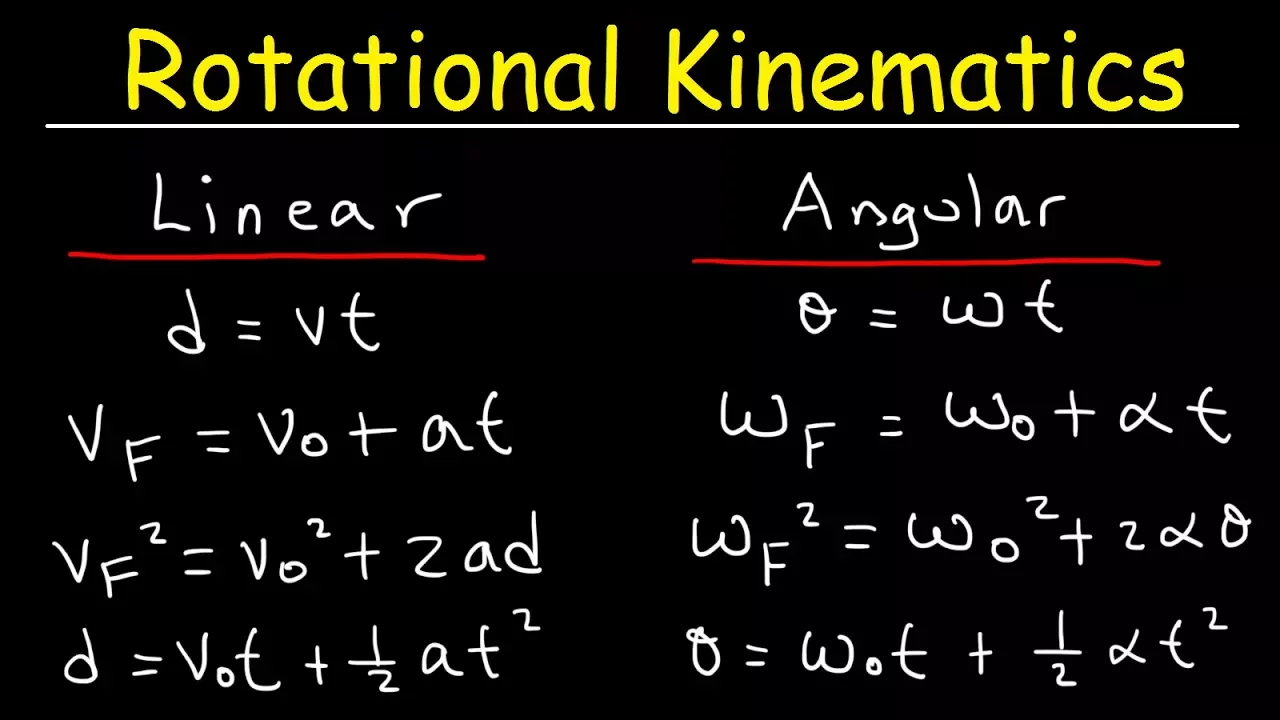
Okay, once you've got this dictionary, you can have a whole bunch of analogous quantities. For example, if you focus on problems where the body has a constant angle of acceleration α, what can you say?
Well, you can already say that θ would be the θ_0 + ω_0 + ½ αt^(2).
This is because θ is behaving just like x.
If x had a constant acceleration a, we all knew x was equal to the starting x + initial velocity times time plus ½ at^(2).
Similarly, the angle by which it rotates will be the initial angle. The initial angular velocity times t plus something involving t^(2).
This is only if α is a constant, just like I hope you guys know this is true only if a is a constant.
All right, now I'm going to pursue the analogy and ask what is the kinetic energy of a rigid body, when it's rotating?
Yes? Student: Could you please explain [inaudible] Professor Ramamurti Shankar: Here? Student: No, the acceleration with α.
Professor Ramamurti Shankar: Here?
Student: Right next to the saw blade.
Professor Ramamurti Shankar: Oh here?
Student: Up. Professor Ramamurti Shankar: This one? Student: Yeah.
Professor Ramamurti Shankar: Okay, I'm saying, if you have a rotating disk, take any point on the rotating disk, even if the disk is going at constant angular velocity, it has a tangential velocity, and the direction of the velocity is constantly changing.
This is the oldest thing we learned, so it has an acceleration towards the center. But it's not an angular acceleration; it just a standard acceleration towards the center of anything going in a circle.
That's always going to be there. But on top of it, if you speed up or slow down this rotation rate of the disk, you'll also have a tangential acceleration, which is α times r.
Not clear yet, or? That's the acceleration lay people would know. If you're on a rotating platform and somebody sped up the rotation rate, you will notice you're going faster.
That's the acceleration in the tangential direction.
The acceleration towards the center is a more sophisticated one we have learned, and it's due to the fact that velocity's a vector and not a scalar.
So, if the direction is changing there is an acceleration we associate with that, and it's as real as any other acceleration; it needs a force to make it happen. Maybe the better way to ask you is this. Suppose this little speck here is you, okay? You happen to be stuck on a rotating chainsaw blade, and you're clinging to it for dear life. What force do you have to apply to stay onto that rotating blade?
This may not happen to you and me but if you're in organized crime this is not a very unusual situation.
You can find yourself intermingled with all kinds of machinery, and you want to know what do I do to stay on.
Well, Newton tells you the answer.
Newton says, if you want to be on this rotating chainsaw blade, your acceleration towards the center has to be paid for, and if the blade is picking up speed, that's got to be paid for too.
That's the net acceleration; that, times your mass will be the force that has to be applied to you.
So, you will cling onto it with that force, and that force will be applied in turn by the third law by the disk on you.
For example, suppose it's a top view of a rotating platform. You're just standing there and the platform is rotating. You can ask, "What frictional force do I need to stay on the platform?"
Well, you need the force to provide you with ma, and I'm telling you that your a has two parts.
Even if the merry-go-round is spinning at a steady rate, you will need to have a frictional force directed towards the center to bend you into a circle.
Now, if on top of it, the merry-go-round starts increasing its speed, or decreasing its speed.
We'll also need a tangential component of force to provide the tangential acceleration. Okay, now this is kinematics of rotation at constant angular acceleration, which is identical to this one mathematically, because mathematically, if you know d^(2)θ/dt^(2) is α, the answer is just like d^(2)x/dt^(2) = a.
You change the symbols, you get the same answer.
So, you can imagine a variety of problems I don't feel like doing. I think you guys can easily do with that. I'd rather focus on more difficult ones. For example, a chainsaw blade, spinning at 3,600 rpm, is decelerated at some rate α.
How long does it take to come to rest?
Well, for that you will write the second formula, ω = ω_0 + αt.
That's the analog of v = v_0 + at.
And you start with some ω_0, you put on the brakes; α it's a negative number, you see at what time this ω goes to 0; that's when it'll stop. Another result which I will use today in fact is the following: ω^(2) = ω_0^(2) +2α(θ - θ_0). That is the analog of v^(2) = v_0^(2) + 2a(x - x_0).
This says that if the body has an acceleration α, then it's going to pick up speed, of course, and the final speed squared is related to the initial angular velocity squared plus 2 times the acceleration times the angle rotated. So, this is the analogy, so we don't have to reinvent all of these things.
They just come from the fact that things which are mathematically the same have the same mathematical results.
They obey the same equation; they have the same results.
All right, now let's find the kinetic energy of a rigid body.
It's got mass, and if it's spinning, all the little atoms making up the body are moving, and they've got their own ½ mv^(2).
And we want to ask, "What is the total ½ mv^(2) summed over all the particles?"
For that purpose, it's convenient to take the following simpler rigid body. We take a rigid body by taking a mass m_1 at a distance r_1, connected to some central hub with a massless rod, and you take another mass, and you take a third mass.
This is m_2, at a distance r_2, there's m_3, at a distance r_3, and so on. You can make a rigid body by modeling it in this simple fashion.
If you are a little more abstract, you can take a continuous rigid body and do the same thing; but let's start with the simple thing.
Here's a rigid body, three rigid rods with masses m_1, m_2, m_3, and it's nailed here and there is a skewer going through the board, and the things can only rotate around that.
By the way, I should tell you the convention for ω.
In one dimensional motion, velocity is positive, you're moving to the right, and negative you're moving to the left. With angular velocity, we've got to have a convention on what's positive and what's negative. This thing which is spinning can only spin clockwise or counter-clockwise.
It turns out to be that ω is positive for counter-clockwise. That just happens to be the convention people use. In fact, you notice the way I drew the rigid body when I did Δθ, I had rotating counter-clockwise. That's the preferred direction for measuring the angle θ from the x axis. Okay now, let's take this rigid body. It is rotating with a common angular velocity. I hope you all understand that's the meaning of being rigid.
So, everybody's got the same angular velocity ω.
So, what's the kinetic energy of this object?
Well, it's the kinetic energy of each mass summed over all the masses i, m_iv _i^(2). Now, what's the velocity of each object? If you take this body, m_1, its velocity is necessarily perpendicular to the line joining it to the point of rotation. This one is moving this way; it cannot move in the line joining it, because if it is it's not a rigid body. For a rigid body, all distances are maintained. So, you don't come near the center and you don't go far from the center.
So, all you can do is rotate around the center.
So, the velocity of this guy, v_1 = ωr_1. The velocity of this guy, v_2, is the same ωr_2, and so on.
So, you can then add it all up. And what do you get?
You get ½ sum over i m_ir _i^(2)ω^(2). And you have to do the summation over all the bodies. In my example, the summation goes from 1 to 3. You may have 1 to infinity, and 1 to a million; it doesn't matter.
That's the kinetic energy. You guys follow this?
This is not a new kinetic energy; this is what we know to be kinetic energy, just ½ mv^(2) for every piece that makes up the rigid body. For convenience, I've taken the rigid body to be made up of a discreet set of masses. But now, if you notice, as you go from 1 to 3, m_1 and m_2 and m_3 are three different numbers. We don't know what the masses are. r_1 and r_2 and r_3 are three different numbers. We don't know; each one could be at a different distance from the origin. But the ω doesn't have a subscript i; there's nothing called ω for this one and ω for that one.
There's only one ω for everything.
So, you can pull it out of the sum and write it this way.
Then, the answer we write as identical to ½ Iω^(2), and we give this I a name; I is called the moment of inertia.
So, continuing with the analogy, this board is going to be used for analogy, we used to have K = ½ mv^(2). Yet, we can have K = ½ Iω^(2) and I is called the moment of inertia.
So, the moment of inertia is determined not only by the masses that make up the body but how far they are from the center. If all the masses just fell on top of the center, the body would have no moment of inertia. It'll weigh the same; the moment of inertia would vanish.
And likewise, if the mass is spread out the moment of inertia is more. For example, if I'm standing around here, and you come along and decide to spin me, I'm standing like this, you try to spin me, I stick my hands out, my moment of inertia has changed because the sum of my mass now is further away from the axis of rotation.
So, the moment of inertia depends on the arrangement of the masses. We're taking a rigid body; it's not like ice dancers who do this.
We're talking about a rigid body; therefore, the moment of inertia is constant.
But it requires a calculation to find the moment of inertia.
And here's another important thing.
If I decide to rotate the body about a new location, say around this point, the moment of inertia will change, because all the distances r will change. The moment of inertia--If someone says, "Here are the masses, here's where they are, please find me the moment of inertia," you will say, "I cannot do it."
You will say, "I cannot do it until you tell me the point around which you plan to rotate the body.
Unless that is given I cannot tell you what the moment of inertia is." Therefore, the moment of inertia is with respect to a point, and there's nothing called the mass with the respect to the point.
The mass is just the mass. The moment of inertia depends on the point around which you're computing the moment of inertia; it's a variable. It's also worth knowing that if the body's being rotated about mass m_3, then m_3 doesn't contribute to the moment of inertia; it's out.
Anything sitting on the axis doesn't contribute.
Things which are further away contribute more in proportion to their mass, in proportion to the square of the distance from the axis. So, this is my dictionary here.
So, who is playing the role of mass?
The mass is played by moment of inertia.
It's got units of kilogram, meters squared, and no one has given a name for that.
For example, Newton times meter is called a joule. You can ask, well this is kilogram times meter squared, maybe it's named after somebody.
So far, it's not been named after anybody, it is just called Newton meter squared.
So, this is going to be the analog of mass in our world of rotations. You remember, in the world of rotation [correction: should have said "translation"], we define something called momentum, which is mass times velocity.
Here, we are going to call something called angular momentum is going to be I times ω.
This L is called the angular momentum.
One extremely important point that you guys should notice is that all the concepts I'm using, like mass and energy, they are the same old concepts that we learned earlier on.
The fact that it's a rotating body doesn't change anything, okay? Kinetic energy still means the same; this K, though it looks so different, is in fact the ½ mv^(2) of every part of the body, summed over the bodies.
All right, so this L is called angular momentum.
It'll take a while to get used to this, but right now it's the product of the moment of inertia and the angle of velocity.
So, now we are looking for the most important equation in mechanics, which is F = ma.
That's going to be equal to some mystery object.
Now, you should be able to guess what goes on the right-hand side, okay?
You should know by now, by analogy, it can be written as dL/dt, if you like, the rate of change of momentum, or it can be written as I times α; it doesn't matter.
I hope you understand that if you take rate of change of momentum, you will get ma, because when you take the derivative, m is not changing. Likewise here, if you take dL/dt, I is not changing, ω is changing to give you the dω/dt which is α. I is not changing because as the body rotates of course particles in the body are moving around, but their distance from the point of rotation is not changing.
Even though the bodies are moving to new locations, the r^(2) is the same, because they're just rotating.
That's why in the time derivative you don't have to take the time derivative of the moment of inertia.
But we don't know who's going to play the role on the left-hand side, okay?
So, we're going to find that. We're going to find out the analog of that. So, I'm going to tell you there are many ways to find this out. It's a lot more subtle than generally appreciated, on what the correct law is.
You can hear the law stated quite often, but some of the reasoning behind it is incorrect.
So, let me tell you one way to get to the law.
I hope you know what I'm looking at.
I'm trying to find out what is the entity that is possible for the rate of change of angular momentum, or what's the analog of the left-hand side for ma.
I know the right-hand side is Iα.
By analogy, who's on the left-hand side?
First of all, it's pretty clear that if you want the angular momentum of the body to change, ω has to change. You can see if something's spinning around at some fixed ω, you want to change it, you've got to push or pull or do something.
So obviously, you're going to apply a force, but the thing that comes on the left-hand side is not simply the force but something else and we'll find out what the something is. And that's done by the following device. I'm going to use the good old Work Energy Theorem that says: when the force acts on a body, the work that it does, which is the force times the distance it travels, is equal to the change in the kinetic energy.
That is the standard Work Energy Theorem that we established. So, if you took a rigid body like this, and let's apply to the rigid body, I'm just going to take a simpler case of a rigid body with these two masses, m_2 and m_1; it doesn't matter.
I apply a force now, F, a perpendicular to that body, at the distance r from the point of rotation.
And let it that turn the body during that time; let's say the body moves by an amount Δθ.
Maybe I should draw you a better picture for this because this is very, very important.
So, here is the body; I just took the simplest one, with two masses, m_1, m_2. I'm just going to push it here and I decide to push it in this direction, and it's at a distance r from the point of rotation.
And let it turn by a small angle and come to this position, and this angle is Δθ.
What is the work done by this force?
I'm going to write it down but I want you to think about it.
The work done by the force is the force multiplied by the distance over which it has moved.
And basically, I'm asking you what is that distance it has moved, and if you remember anything at all from what I did earlier, it's approximately this arc length, which we have seen, is r times Δθ.
In other words, if you apply a force F and you rotate the body by Δθ, the distance you actually move is rΔθ; so, this is force times distance. Now, that's got to be equal to the change in kinetic energy. It's got to be equal to the change in kinetic energy. Kinetic energy, I remind you, is ½ Iω^(2).
Therefore, the change in kinetic energy is going to be ½ I(ω^(2) - ω_0^(2)).
By the way, these are two very neighboring instants of time.
If in the neighboring instants of time, during that brief period we may take the body to have a constant acceleration; therefore, α is constant.
So, this formula you can also calculate when α is constant, period. In a real body, when it's rotating, α need not be constant, but for a small enough interval, as small as you wish, we may apply the formula that works when α is a constant.
In that case, you will write it as ½ times 2α times the rotation angle.
Right? Look at this formula here.
I'm referring to this result, ω final squared -ω initial squared is 2 times α times the change in angle. So, I want you to then equate this work done to this change in kinetic energy.
I want you to equate this guy to this guy, and we get our great result that F times r = I times α.
Iα is ma; that's what I'm looking for.
So, this fellow here, Fr, is the analog of force, and it's called the torque.
It's very important to notice that the torque due to this force is the value of the force times the distance from the point of rotation, and it's only the external force that I'm talking about. There are also internal forces in a rod. Every part of the rod is being dragged along by another part of the rod, but that analysis in terms of forces can be done but it's very tricky and complicated. It's much easier to look at the energy where the energy changes only due to external forces.
If you only look at forces you've got to be careful.
This pivot point is also applying a force on the rod, but it's not moving and not doing any work.
So, the only external force is the one I'm applying and is responsible for the change in the kinetic energy.
There are other forces inside the rod.
In other words, this mass is going to pick up speed, not because I'm directly pushing it.
I'm probably pushing this part of the rod and that's pushing the part next to it, and it finally pushes this one.
So, I'm not directly applying the force law to this mass.
I'm saying, whatever is happening internally, I don't care; the external force times distance is a change in the kinetic energy of an object.
Yes? Student: But how are you saying the angular [inaudible] Professor Ramamurti Shankar: No, I said this quantity, the change in kinetic energy, is the final kinetic energy, ½ times ω^(2) minus the initial kinetic energy; but final/initial referred to when the rod was there and the rod had rotated by a small amount.
Student: Right. Professor Ramamurti Shankar: Okay. Student: So, do you say it's 2α of the [inaudible] Professor Ramamurti Shankar: Right.
Student: You said there needs to be something about velocity [inaudible] Professor Ramamurti Shankar: Here. No, I used this equation, the change, the ω^(2) at the end, minus the ω^(2) at the beginning, is 2 times the acceleration and the angle of acceleration times θ - θnot is the change in θ over that time, right. In other words, that formula can be used for even finite periods of time provided α is constant. We are applying it for a tiny period of time, small enough for us to believe that the acceleration during that tiny period is some number α. So, this ω^(2) - ω_0^(2) is that really if you want the change in ω^(2), and that's proportional to α times the change in angle.
So, α is not a constant; α can vary from instant to instant. But at that one instant, depending on the forces, there'll be some α, and this thing called torque is I times α.
Now, I think it's very clear that if I had several forces acting on the body, then the torque will be F_ir _i, and there's just one final caveat to this thing, one final qualification, which is that, in practice, the forces that are used to rotate a body may not always be perpendicular.
You can apply a force in some other direction, like that.
Now, you've got to realize that torque is the ability to change the rotational state of a body, and what we are realizing is that it depends on the force you apply and depends on how far away the force is from the point of rotation.
So, if you have a door, you're trying to open a door, here is the door, here are the hinges, and you want to open this door by applying a force.
The question is, "Where do you put the doorknob?" Okay?
You suddenly invented the door, you thought about hinges, but you haven't quite figured out where to put the doorknob.
You're going to ask yourself, "Well, I've complete freedom, maybe it'll look nice if I put it there right next to the hinges," then you realize that there are parts of the universe, like Moron Land, where if you go, all the hinges, all the doorknobs are here and they're saying, "You know, we're applying a lot of force, we're not getting anywhere. What's wrong?"
Well, what we're realizing is that whereas force was everything in linear motion, force is not everything in rotational motion. If you want to get your money's worth, you've got to take the doorknob as far as you can and put it near the end. Okay, then, you figure that out.
Then you come along and you say, "Okay, I've put the doorknob at the right place, open the door," then you're applying enormous force this way.
And again frustrated, again you're getting no results, you say, "I'm going as far as I can from the hinge," and it dawns on you that if you really want to get something going, you should really take the line of separation between where it's rotating and where you're applying the force, and apply a force perpendicular to it. Any part parallel to it is not doing anything, unless you kind of rip it off the hinges. You don't want to do that.
So, here this force has got a useless part, and got a useful part, and the useless part, which is trying to pull the rod off the hinges, is going to be balanced by a force from the hinges, because the rod is a rigid rod, it's not going to move.
But the one perpendicular to the rod can, in fact, turn the rod without affecting the rigidity.
So, we need an extra factor here, which is sin θ_i, where θ_i is defined as follows. If you're at a point r_i, and you apply a force F that way, θ is the angle between the line joining the point of application of the force, and the direction of the force. You are here and you're separated by this vector and as the angle between that separation vector and the force, that angle θ can vary from force to force. But this force F_i, the angle could be θ_i. That's the final formula for the torque, okay? So, we have built up all the pieces, and this is the final answer.
This is the definition of torque, and with this torque we can now complete the dictionary and say what we want.
On the left-hand side is the torque, where the torque is defined as F_ir_i sin θ_i. F sin θ is just a component of the force perpendicular to the separation r. That's what F sin θ does. I hope you can see that.
If you've got a force acting this way, F cos θ is this part, which is no good, and F sin θ is that part, which is good for rotations.
Also, if you want, in terms of work done, you want the force times the distance traveled.
The distance traveled is only in this direction.
There is no distance traveled in this direction.
So, the distance traveled is F dot product with the direction in which you move, and that applies only to the force perpendicular to the separation, not to the part that's parallel. Anyway, I hope we understand intuitively why this is the guy that's responsible for rotating objects. You want to rotate something around some axis, you've got a certain amount of force, you're best off applying the force as far as you can from the point of rotation.
In other words, suppose we want the rear end of this table here, keeping this end fixed, but I want to turn it so it's this way.
Then I'm saying, I think we all know, we want to start pushing here. Also, we don't want to apply a force this way or that way, we want to apply a force perpendicular. If, for some reason, we are tied to a rope and can only pull in that direction, then the component of the force this way is to be discounted, no use, this is the part that does the turning and that's the part that also does the work. Any force perpendicular to the motion is not going to do any work.
Any force perpendicular to the displacement is not going to do any work. This rigid body can only be later in that position, so the displacement is the tangential direction, and only the force in the tangential direction contributes to the work.
And in my work energy argument that's what comes here.
This is the reason why you come up with this definition of torque. Okay, so we've got most of the pieces for this. I will write one more thing by analogy. The work done by a force that displaces a body by an amount dx is this.
The work done by a torque will be τ times -- I think you can guess what I want to put there -- times dθ or Δθ. When a torque rotates a body by an angle Δθ, then the work done is τ times Δθ. You can see that even here you can write the work done as F times r times Δθ; but that is the torque, that's the Δθ. So, it's very useful to know.
So, if you guys are going to reason by analogy, I would ask you to know the counterparts, only then you can do the problems.
So, let's get used to this formula here, ΔW = τΔθ. I'll show you one example.
Suppose I have a rod hanging from the ceiling.
Well, let's say it's massless and there is a mass m at the bottom and it's got some length L; it's a pendulum. So, I'm going to take this pendulum and I'm going to bring it to this position, by an angle θ_0, which unfortunately θ_0 stands for the final angle. I want to know how much work I do; that's what we're going to calculate. So, we take some intermediate position when we are here. What is the force acting on this guy? This rod is massless; the force on this is mg.
If that angle is θ, you can see that angle is the same θ, so mg cos θ acts this way, and mg sin θ acts that way.
To hold the pendulum from falling when the angle is θ, I have to apply a tangential force in this direction of size mg sin θ.
I hope you guys can see that. The mg cos θ is going to be provided by the rod. Because the rod is a rigid body, it won't let the mass move in this direction.
It'll provide whatever force it takes to keep the mass moving radially. In the tangential direction, to keep it from sliding back to where it began I have to apply a force mg sin θ. So, the torque that I apply is mg sin θ times L. So, I did all that by taking the force, finding the component of the force perpendicular to the thing, and balancing it with a countering force.
You can equally say the torque that I have to apply is really mg, which is the force, R, which happens to be L here, and sine of the angle between them. No matter how we write it, that's the torque. Let's find the work done by that torque when I rotate it from the starting angle to some final angle. That'll be mgL sin θ dθ from 0 to some final angle θ_0.
I'm just saying, the work done is τΔθ summed over all the angles; that means integrate.
So, you've got to go back to your calculus thing and you've got to remember that the integral of sin θ is - cos θ, and you want to start from θ = 0 to θ equal to some final angle θ_0. And if you crank it out, you will find it's mgL times 1 - cos θ.
So, that's the work done to take a pendulum which is horizontal, which is vertical and turn it to an angle θ_0.
I'm going to do a cross-check on this to tell you that it works out from another point of view.
This mass was down here, now it's climbed up there.
So, you can ask, "What happened to the work I did?" Going back to the Work Energy Theorem, let's take this mass here.
Forces were acting on it. One was the rod, but the force of the rod was always perpendicular to the motion of this bob here, so it couldn't do any work.
The only work was done by me. What happened to the work I did?
The work I did has to be changing the total energy of the body, but the bob was not moving before, and it's not moving after, because I give just the right force to cancel gravity; I didn't give it any speed.
So, it must be that the potential energy of this bob when it's here should explain the work I did.
That's exactly what it is, because let me rewrite this as [mg] - mgL + mgL cos θ.
But maybe we can see that it is mg + mgL.
This one, well, I think it's best to write it as L - L cos θ, and you guys can see what's going on. L is this distance here, L cos θ is that distance, and L - L cos θ is the increase in the height of this bob.
This height here is in fact L - L cos θ, because if that is L and that is θ, this is L cos θ till that point.
So, this is just mg times h, and that's where your work went in.
So, what's the point of this exercise?
This exercise is to get you used to the notion of calculating work done, not as force times distance, but as torque times angle. And here's the problem where the torque itself is changing with the angle.
The torque is itself a function of θ, so you have to do an integral and that's how you get the work.
Okay, so now, we've got all the machinery we need, got all the machinery we need to do kinematics or dynamics of rigid bodies in this analogy.
So, let me summarize what it is. You've got a rigid body; it's got a moment of inertia; it's got an angular velocity.
The product of the two is called the angular momentum, L, and to change it you've got to apply a torque.
To find the torque, find all the external forces acting on the body, multiply each force by the distance from the point of rotation, but the component of each force perpendicular to the line of separation times the distance of separation, that's the Fr sin θ, and add it up.
Again, when you do the torques, you've got to give it a sign.
If a torque tends to rotate a body counter-clockwise, we will take it as positive, and if the torque tends to rotate a body clockwise, we'll take it as negative.
So, it's possible that in a given body, there could be torques trying to move it in different directions.
So, for example, in the simplest rigid body made up of, say, two masses, you could be pushing this way and I could be pushing that way. We're all trying to rotate them in opposite directions. The torque you apply would be your force times that distance; this is called positive because you're going counter-clockwise. The torque that I'm applying would be my force times the smaller distance, and that'll be considered negative because it's clockwise.
And you'll add them up; you'll get a net torque.
That net torque will cause an acceleration of this dumbbell-like object. What acceleration will it cause?
It'll be my force times my distance, sin θ happens to be 1, minus your force, times the distance over which you're doing it, times the moment of inertia.
The moment of inertia for the simple problem is m_1r _1^(2) + m_2r<s ub>2^(2), if this is m_1 and this is r_1, and this is m_2 and that distance is r_2. So, this is the simplest problem you could do in rigid body dynamics.
Take a couple of forces, work out the torques, divide it by moment of inertia and get the angle of acceleration. If the torque is a constant, it's hard to maintain that. What do I have to do to keep the torque constant? I've got to start running around with this as it rotates, and you could imagine doing that; then, the torque will be constant, αa will be constant, α constant is like a constant, and you can do the whole bunch of problems you guys did before. Okay, now there is one technical obstacle you've got to overcome if you want to do rigid body dynamics, and that is to know how to compute the moment of inertia for all kinds of objects.
If I give you 37 masses, each with a distance r from the point of rotation, it's a trivial thing.
Do mr^(2) for each one and add it.
But here is the kind of objects you may be given, not a discreet set of masses but a continuous blob.
Just like in the case of center of mass, when you had a bunch of masses, you took m_1x_1 + m_2x_2 + m_3x_3 and so on. But if you had a rod which is continuous, you have to do an integral.
So you will have to do an integral here also.
So, let's take certain rigid bodies and try to find the moment of inertia, which are rigid bodies which are continuous. So, here is a ring of radius r and mass M. It's not a disk, in spite of what it looks like. It is a ring and I want to find its moment of inertia. So, you have to think about what you will do. So, you think for a second, and I'll tell you the way I will do that is to partition it into tiny pieces, each of which is small enough for me to consider a point. This tiny piece has a mass Δm_i, and i goes from 1,2, 3,4 to whatever, 10 million, till I go around the circle. The moment of inertia would be--I use Δm_i to tell you it's a tiny mass for this section. But what is the r^(2)?
If I'm planning to rotate it around that point, I plan to rotate around that point; it is the same r^(2) for everybody.
So, you can pull it out of the summation and you just get Mr^(2). So, this is a very easy problem.
This is as easy as this problem, but you clearly had only one mass and all of it was at distance r from the point of rotation, it's Mr^(2).
Here, you got the mass spread out, but luckily spread it out in such a way that every part of it is the same distance r from the center, so it's very easy to do the summation. Pull out the r^(2), do the sum over mass and get the total mass.
Then we're going to do--Any questions about this?
Everything is going to be built on understanding this.
So, for the ring, this is the moment of inertia, which is Mr^(2). But now, I want to do the following. I want to take a disk now, of radius r; I've got to do the sum of Mr^(2) for every mass in the problem. So, here is where you have to organize your thinking. I plan to do the moment of inertia through the center. First of all, if I didn't tell you the moment of inertia through where you cannot even start; I tell you I want it through the center. To want it through the center we have the ability then to think of this as made up of a whole bunch of concentric rings, each one at radius r and of thickness dr. If you can find the moment of inertia of this tiny shaded region, I sum over all the little washers, the annuli that I have, to fill up the whole disk. So, what's the moment of inertia of this annulus? Well, I already told you.
If the annulus has a mass M, then it's Mr^(2) is the moment of inertia of that annulus.
So, the question is, "What is the mass of the shaded region?" Clearly, the r^(2) we use is the r at which it is sitting.
But what's the mass I should use?
Well, for the mass I should use, I argue that if the total mass is that [M] that times [should have said "over"] πR^(2) is the mass per unit area. Then, I need the area of this shaded region. That's the tricky part.
Have you got that? Yes?
Student: 2πrdr. Professor Ramamurti Shankar: Right, so let's ask why it's 2πrdr. If you take this annulus, and you take a pair of scissors and you cut it out, and you open it out, it's going to look like a long rectangle whose thickness will be dr; its length will be 2πr. So, 2πrdr is the--that says contribution, here is the dr. Now, you've got to add it up over everything.
Adding it up is what we do by doing the integral.
Now, I don't want to do this integral; you guys can at least guess what's going to happen.
There's going to be no π in the answer; π is gone. You've got rr^(2) is r^(3), r^(4)/4 and that'll, if you combine it with that, you get this MR^(2)/2.
So, the moment of inertia of a disk is MR^(2)/2.
That's because if I came and told you moment of--suppose I made a calculation with a mistake somewhere, and I said it's MR^(2), will you know I'm wrong?
And why will you argue that it cannot be the right answer?
Yes? Student: Well, it's like the ring but the radii are smaller.
Professor Ramamurti Shankar: Right.
In other words, his answer, the correct answer is if it is MR^(2) it means the entire mass is at a distance R^(2). But we know some of the mass is a lot closer to the center. In fact, some of it is right at the center, so you cannot get the same R^(2) as a contribution from all the pieces.
Some will be at 0 distance; some will be at the full distance. So, whenever you do the moment of inertia for a disk, it's got to look like MR^(2) times a number which is definitely less than 1.
It turns out it's half; if we got a third or a fourth you wouldn't know it's obviously wrong.
But if I got 1 in front, or worse, if I got 2 times MR^(2), then you know I've made a mistake. Okay, now, the last of the objects I want to look at today, is a rod, I want to take--This is actually the example that's done quite often as the first example but I will do it now. So, here is a rod, okay?
It has length L, mass M, and I say, what's the moment of inertia?
Do you know what you could do? What's the first question you will ask when I say, "What's the moment of inertia?
Student: Around what point?
Professor Ramamurti Shankar: Around what point, right? Till I tell you that, you cannot begin. So, I will say, "Let's find the moment of inertia around this end."
So, what you should imagine in that case is--You stick a nail through here and the guy rotates like that on a big circle with that as the center. If you stuck the nail through this midpoint, it's a different story, and the answer is different. So here, what I do is I take a distance x. I take a sliver of thickness dx. That sliver is small enough for me to consider there's a point mass.
Therefore, the moment of inertia of that tiny portion will look like the square of the distance times the mass of the tiny portion. The mass of the tiny portion looks like this.
Let me see; that's the mass per unit length, that's the length, that's the mass of the object.
Then I have to do the integral from 0 to L.
Well, x^(2) will give me x^(3)/3.
That'll give me ML^(2)/3, and that's the moment of inertia of the rod.
Again, it looks like ML^(2), it's got to have a number in front of it that's less than 1, because if you're measuring from here the furthest you can be is L; a lot of the guys had a lot closer. So, the weighted average of the square of the distance cannot be all L^(2); it's got to be something less than L^(2).
The fact that it's 1/3 is of course what you do all the work for. Student: You need an L too. Professor Ramamurti Shankar: Pardon me? Student: An L too.
Professor Ramamurti Shankar: You forgot the L here? Student: Yeah.
Professor Ramamurti Shankar: Also, the dimension for the moment of inertia should be in the end mass times length squared. Yes?
You're not happy with that? Student: No, I'm not.
Professor Ramamurti Shankar: You agree, okay. Look, sometimes I do get these things wrong, so you should always try to keep an eye on this. The last thing I want to do is to find the--Well, when I say last thing I want to do, I don't mean I'm reluctant to do it, I'm just saying I'm near the end of the day.
The final thing that I will now calculate is the moment of inertia around the center. Let's see what's going to happen. It's the same integral, x^(2), dx/L, M/L, but the range of integration for x will now go from -L/2 to + L/2.
Then, I simplify my life by writing it as 2M/L times x^(2)dx from 0 to L/2.
This is something I encourage you to do all the time.
If an integral is an even function of x, namely, -x contributes as much as +x, then you can take half the reason of integration and double the answer. You can do it only if it's an even function, so if x and--yes?
Student: How come it's still over L if you put x in with the other one? Professor Ramamurti Shankar: Oh, I'm sorry, you're absolutely right. The way to do that would be here. See, you keep trying, you will catch me. That's right, that's correct.
Okay, so let's do this now, 2M/L, okay, now I'm really anxious, because this L^(3), it's the X^(3)/3, but the thing that's being cubed is L/2, and that's giving me ML^(2)/12.
So, the moment of inertia is not a fixed number.
It got a lot smaller when I took it around the center of mass. When I took it around the left edge, I got ML^(2)/3; I went to the midpoint, I got ML^(2)/12. I think it's pretty clear that I'm going from here I reduce the answer.
So, when I keep going, it will get even smaller.
That's where your common sense will tell you that if you got some answer from there you're going to get the same answer from here and you hit the best possible moment of inertia you can. You should be able to argue intuitively, and if you do the calculation, it'll come out to be the same. Now, the thing to check if you do this, the moment of inertia around one end is the moment of inertia around the center less the mass times (L/2)^(2).
This is something you can actually verify.
Just take the numbers I gave you and you'll find that this answer plus M times (L/2)^(2) will be equal to that answer. And this happens to be a very general theorem I'll talk about next time.
If you know the moment of inertia through the center of mass, you're done, okay?
If I want the moment of inertia through any other point, I take the moment of inertia through the center of mass and add to it the total mass of the object and the square of the distance by which you made me move my axis, which here happens to be L/2.
I will of course prove this; I don't want to give you anything without proof. We can actually, in our class actually, satisfy ourselves that this is true. Not only is it true for a rod, it's even true for a disk. It's true for any object in two dimensions, that if you've got the moment of inertia of this creature, through the center of mass, and you want it through that point, just take the answer through the center of mass and add to it Md^(2) where d is that distance. That'll be proven next time.
Up Next

Simple Harmonic Motion & Problem Solving | MIT Physics Introduction
@mitocw
462.4K views•2013-10-25

21cm Hyperfine Transition in Neutral Hydrogen: Radio Astronomy Basics
@AaronRobertParsons
12.4K views•2011-10-13

Ray or Geometrical Optics I | Yale Physics 201 Lecture 16
@YaleCourses
181.3K views•2011-03-24

Entropy and the Second Law of Thermodynamics Explained
@veritasium
27.5M views•2023-07-01
Related Study Plans & Knowledge Roadmaps
Structured learning paths in Physics