The quantum measurement problem is the fundamental challenge in quantum mechanics of explaining how the fuzzy, probabilistic nature of quantum systems—where particles can exist in multiple locations simultaneously with different likelihoods—transitions to the single, definite reality we observe when we perform a measurement, despite scientists being able to test quantum mechanics by comparing observed frequencies with mathematical probabilities.
The Quantum Measurement Problem: An Academic Overview
Added:Deep Dive
The concept of quantum superposition, where a system exists in a linear combination of multiple states simultaneously.
Quantum Mechanics short notes | Revision of quantum mechanics | Quick revision for CSIR NET JRF
5K
A quantum mechanical system can exist in a linear superposition of multiple states. When we take a linear combination of different quantum states, the resulting state is also a valid quantum state. This principle of superposition is fundamental to quantum mechanics and allows quantum systems to exist in multiple configurations simultaneously until measured.
Click to watch →

From Quantum Weirdness to Quantum Simulations
726
Superposition is the ability of quantum systems to exist in multiple states simultaneously. A qubit (quantum bit) can be in a combination of states—both 0 and 1 at the same time—to varying degrees. This is mathematically described as a linear combination of states, meaning the system has properties of all possible states simultaneously until measured.
Click to watch →
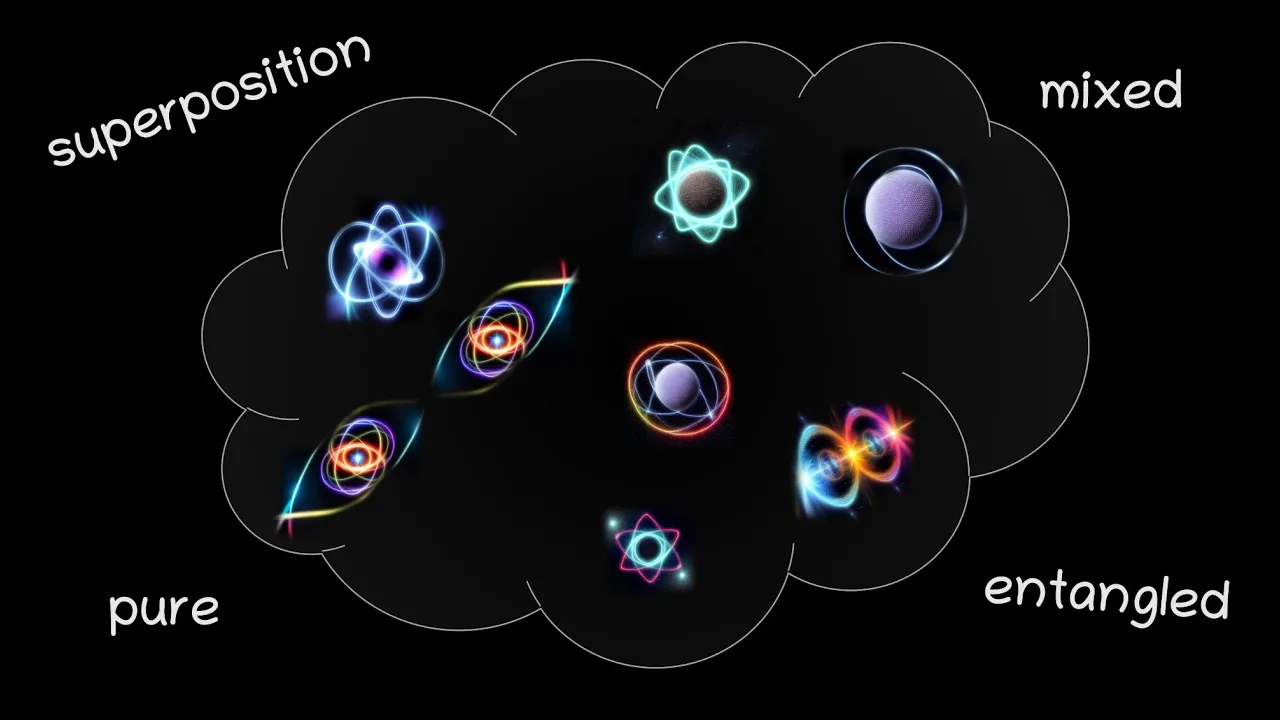
Quantum states and their relations
1.4K
Superposition is the ability of a quantum system to exist in multiple states simultaneously. In a single qubit system, superposition allows the qubit to exist as a linear combination of its basis states (0 and 1) with complex probability amplitudes. The general state of a k-qubit quantum register can be written as a linear superposition of the basis vectors. This concept can be visualized using a Bloch sphere representation where the quantum state is represented as a vector.
Click to watch →

Introduction of Quantum mechanics | E-1 | Quantum mechanics
204
Quantum superposition is the principle that a quantum system can exist in multiple states simultaneously until it is measured. According to this principle, a particle can be in a combination of different states at the same time, described by a wave function that is a linear combination of possible states. When a measurement is made, the system 'collapses' to one of the possible states. This principle is demonstrated in experiments like the double-slit experiment and is fundamental to quantum computing.
Click to watch →
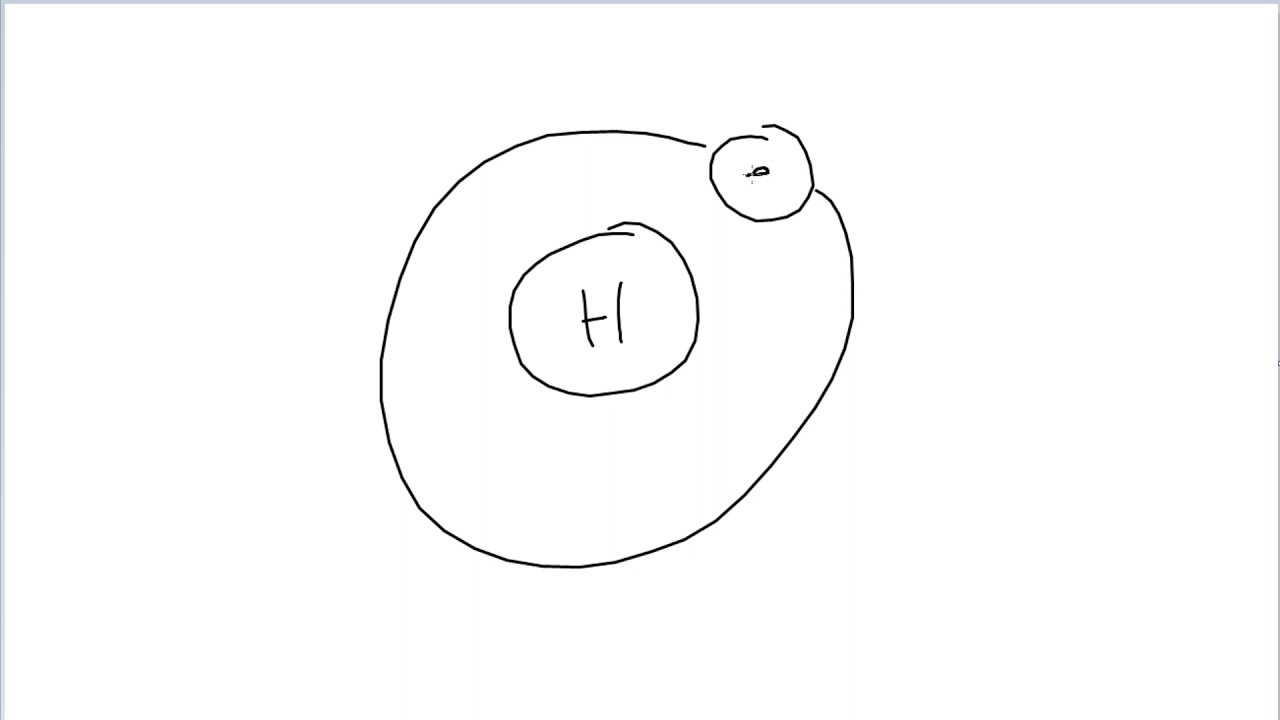
What is Superposition | Fundamentals of Quantum Computing | Q-munity Tech
124
A quantum system can exist in a superposition of multiple definite states simultaneously. Using a coin analogy, this means the coin can be both heads and tails at the same time until measured. Similarly, an electron can be in both ground and excited states simultaneously with certain probabilities. This superposition is a fundamental property of quantum systems.
Click to watch →
Deep Dive
The Schrödinger Equation and how it describes the deterministic wave-like evolution of physical systems.

Квантовая реальность: что там существует и чем мы можем управлять? (После Нобелевской премии 2022)
129.3K
The Schrödinger equation describes how the wave function evolves over time. Despite the probabilistic nature of quantum mechanics, this equation is deterministic - if you know the wave function at one time, you can calculate it at any future time. The equation states that the rate of change of the wave function equals the action of the energy operator on the wave function. This deterministic evolution of possibilities contrasts with the probabilistic nature of actual measurement outcomes.
Click to watch →

The quantum world: Dreams and delusions | Roger Penrose, Sabine Hossenfelder, Michio Kaku, and more!
443.3K
The Schrödinger equation is the fundamental equation of quantum mechanics that describes how quantum states evolve over time. It is deterministic, meaning that if you know the current state of a quantum system and the Hamiltonian (the energy operator), you can predict exactly what the system will be at any future time. However, this deterministic evolution only applies to small, uncluttered quantum systems. When systems become too large or complex, they no longer follow the Schrödinger equation, and the wave function collapses instead.
Click to watch →

МУЛЬТИВСЕЛЕННЫЕ: ГДЕ-ТО ЕСТЬ ТАКИЕ ЖЕ МЫ? Алексей Семихатов и Владимир Сурдин
151.6K
The Schrödinger equation describes how the quantum state of a physical system changes over time. It is a deterministic equation that predicts the evolution of the wavefunction, which contains all information about the system.
Click to watch →

"Standard" quantum mechanics is obviously wrong
157.4K
The Schrödinger equation is the fundamental rule governing how quantum systems evolve over time, analogous to Newton's laws in classical mechanics. It takes initial conditions and deterministically predicts the future state of a quantum system. For example, an electron in a double-well potential evolves into a superposition state where it is partly in the left well and partly in the right well, represented by coefficients like √(2/3) and √(1/3). Crucially, this is not a state of ignorance (where we don't know which location the particle is in) but a genuine superposition state, which is experimentally distinguishable from ignorance.
Click to watch →

ШОН КЭРРОЛЛ | ЗАГАДКИ СОВРЕМЕННОЙ ФИЗИКИ (Ч1)
272K
The Schrödinger equation is the fundamental equation of quantum mechanics that describes how the wave function of a quantum system evolves over time. It plays the same role for quantum mechanics that Newton's laws play for classical mechanics—providing a mathematical framework to predict system behavior. However, this equation describes wave-like behavior, which conflicts with our everyday experience of particles as discrete objects.
Click to watch →
Deep Dive
Born's Rule, which explains how to calculate the probability of obtaining a specific outcome from a quantum measurement.
The Problem with Quantum Measurement
255.5K
The Born rule, formulated by Max Born, provides the method to calculate the probability of obtaining a specific measurement outcome from a wave function. According to this rule, the probability equals the absolute square of the amplitude of the wave function component corresponding to that particular measurement outcome.
Click to watch →

Regra de Born - Um dos postulados da Física Quântica
567
Born's Rule is a fundamental postulate of quantum mechanics that provides the mathematical framework for calculating the probability of obtaining specific measurement outcomes from a quantum system. The rule states that the probability of finding a system in a particular state is equal to the square of the absolute value of the inner product between the system's state vector and the target state vector. This rule serves as the critical bridge between the abstract mathematical representation of quantum states and the empirical, observable results obtained in laboratory experiments, allowing scientists to connect theoretical predictions with experimental verification.
Click to watch →

Ph CS 219A Lecture 2 Density Operator
24.7K
The Born rule describes how to calculate the probabilities of different measurement outcomes in quantum mechanics. If a quantum system is in state |ψ⟩ and we measure an observable A with spectral decomposition A = Σ a_n P_n, where P_n are orthogonal projection operators onto eigenspaces with eigenvalues a_n, then the probability of obtaining outcome a_n is given by ||P_n|ψ⟩||², which equals ⟨ψ|P_n|ψ⟩. After the measurement, the post-measurement state is |ψ_n⟩ = P_n|ψ⟩ / ||P_n|ψ⟩||, normalized to unit length. This rule makes quantum measurements fundamentally probabilistic rather than deterministic, distinguishing quantum mechanics from classical physics.
Click to watch →
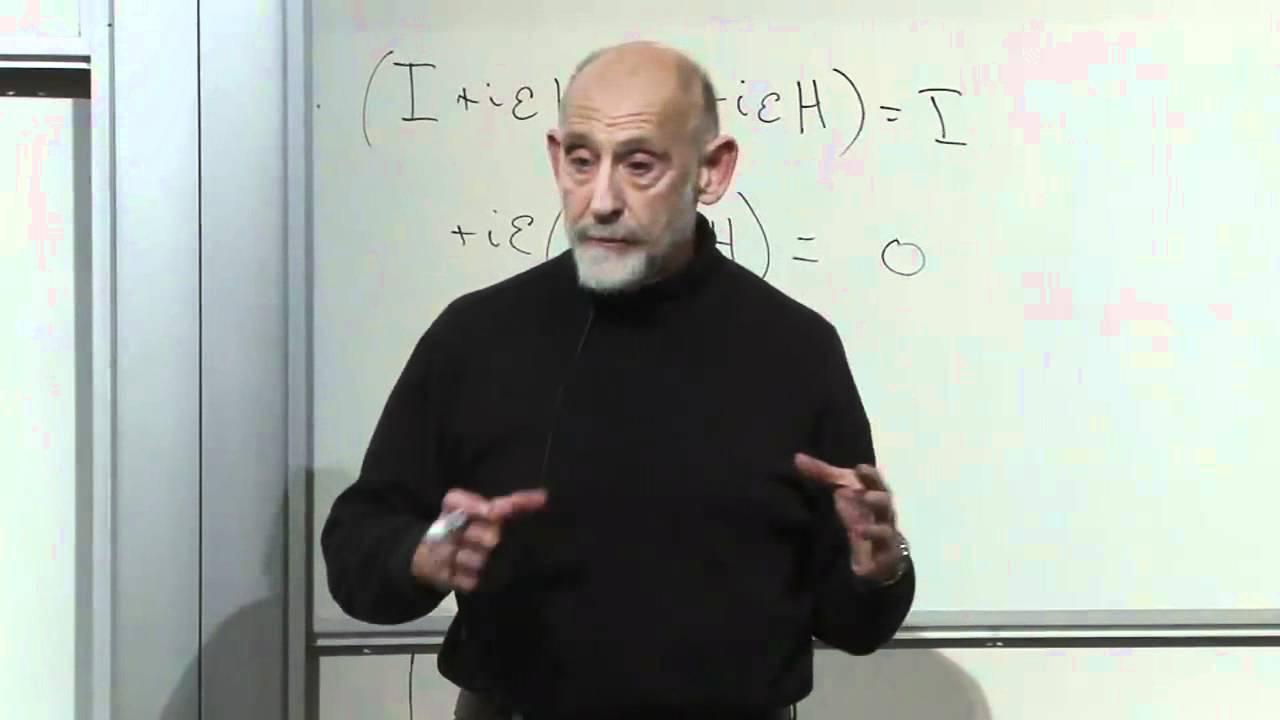
Lecture 4 | The Theoretical Minimum
135.1K
Born's rule provides the method for calculating probabilities in quantum mechanics. If a quantum system is prepared in state |A⟩ and observable L is measured, the probability of obtaining eigenvalue λ is equal to the square of the absolute value of the inner product between the state vector |A⟩ and the normalized eigenvector corresponding to λ. Mathematically, this is expressed as P(λ) = |⟨λ|A⟩|².
Click to watch →

Díky tomuto začne kvantový dvojštěrbinový experiment dávat trochu smysl.
7.4K
Max Born proposed Born's rule, which explains how to use the wave function to predict measurement outcomes. This rule is not part of the complete closed mathematical theory of quantum mechanics but rather additional rules that must be applied. The rule states that: (1) quantum systems have measurable properties like position, (2) when measured, we obtain clear results described by classical Newtonian physics, (3) from the wave function we can calculate the probability of detecting the particle in different regions of space, and (4) at the moment of measurement, the particle is found with 100% probability at the detected location, and the wave function collapses to a state corresponding to that measurement result.
Click to watch →
Deep Dive
Wave-particle duality and the historical significance of the double-slit experiment.

MIT Quantum Experiment Proves Einstein Wrong After 100 years
523.7K
The double-slit experiment, first conducted by Thomas Young in 1801, established that light exhibits wave-like behavior through interference patterns. When particles pass through two slits, they create bright and dark fringes due to self-interference, persisting even when fired one at a time. This demonstrated wave-particle duality—the concept that all matter possesses both particle and wave properties. The paradox emerged: observing which path a particle takes destroys the interference pattern, collapsing wave behavior into particle behavior. This fundamental principle, tested with photons, electrons, and molecules, established that observation fundamentally alters quantum reality, creating one of physics' most profound mysteries.
Click to watch →

Storia della meccanica quantistica FOR DUMMIES
546.1K
Louis de Broglie proposed that all matter exhibits wave-particle duality. Arthur Compton demonstrated this with the Compton effect (1923), showing photons behave like particles colliding with electrons. George Thomson confirmed electron wave behavior through the double-slit experiment, observing interference patterns. This established that wave-particle duality is a fundamental property of all matter, not just light.
Click to watch →

A FÍSICA QUÂNTICA E EXPERIMENTO DA DUPLA FENDA (PARTE II) - INCERTEZA E DUALIDADE
71.5K
This section traces the evolution of understanding light and matter from classical wave theory to quantum mechanics. Einstein resolved the photoelectric effect by proposing light as particles (photons), while de Broglie extended this duality to matter, proposing that electrons and other particles can exhibit wave-like behavior. Experiments by Klaus and Tonomura demonstrated that electrons fired one at a time through a double-slit apparatus produce interference patterns, proving that individual electrons can interfere with themselves. This challenges the classical distinction between particles and waves, establishing that quantum entities exhibit both properties depending on how they are measured.
Click to watch →

Quantenphysiker beweist: Wir leben in einer Simulation! | Lukas Neumeier
197K
The Double-Slit Experiment demonstrates that quantum particles behave as waves when not observed but as particles when measured. When particles pass through two slits without observation, they create interference patterns (multiple bands) instead of two distinct bands. This wave-particle duality contradicts everyday experience where things are either waves or particles, not both. The experiment reveals that reality is more complex than our everyday perception suggests.
Click to watch →

The Wild Project #353 - Juan Ignacio Cirac | Alucinante charla con un Genio de la Física Cuántica
2.3M
The double-slit experiment demonstrates wave-particle duality. When particles (like photons) pass through two slits, they create an interference pattern on a screen behind them, as if they were waves. However, when you observe which slit each particle passes through, the interference pattern disappears and particles behave like classical objects. This experiment shows that quantum particles exist in superpositions of passing through both slits simultaneously, and observation collapses this superposition. The experiment reveals that quantum mechanics is fundamentally different from classical physics and that observation plays a crucial role in determining reality.
Click to watch →
Prerequisite Knowledge
- Concept 01The concept of quantum superposition, where a system exists in a linear combination of multiple states simultaneously.
- Concept 02The Schrödinger Equation and how it describes the deterministic wave-like evolution of physical systems.
- Concept 03Born's Rule, which explains how to calculate the probability of obtaining a specific outcome from a quantum measurement.
- Concept 04Wave-particle duality and the historical significance of the double-slit experiment.
Subsequent Learning
- Step 01A deep dive into specific Interpretations of Quantum Mechanics, such as the Copenhagen interpretation, Many-Worlds, and Pilot Wave theory.
- Step 02The concept of Quantum Decoherence and how environmental interactions explain the emergence of classical behavior from quantum systems.
- Step 03Bell's Theorem and the experimental tests of local realism, which rule out local hidden variables.
- Step 04Quantum Information Theory and the practical challenges of state measurement, error correction, and decoherence in quantum computing.
Quantum puzzle
Testing limits
Quantum puzzle
0:00Playing Section
- 1
Identifies the quantum measurement problem's core issue.
- 2
Explains the gap between probability waves and observed reality.
- 3
Highlights the long-standing nature of this physics mystery.
QBism (Quantum Bayesianism) and the Information-Theoretic Dissolution of the Measurement Problem
While the traditional quantum measurement problem assumes the wavefunction is an objective physical entity that undergoes a mysterious collapse, Quantum Bayesianism (QBism) offers a radical counterpoint by treating the wavefunction as a purely subjective tool. In QBism, quantum states do not represent external physical reality; instead, they represent an agent’s personal degrees of belief about the potential outcomes of future measurements. Consequently, a 'measurement' is not a physical process that requires a dynamical explanation of collapse, but rather an agent's act of acquiring new information and updating their subjective probabilities. By reframing quantum mechanics as a normative framework for decision-making under uncertainty rather than a direct description of objective physical wavefunctions, QBism dissolves the measurement problem entirely, arguing that the classic puzzle is simply a category mistake of treating subjective probabilities as physical entities.
Deep Dive
A deep dive into specific Interpretations of Quantum Mechanics, such as the Copenhagen interpretation, Many-Worlds, and Pilot Wave theory.
Will scientists ever agree on quantum? | Sabine Hossenfelder and Matt O'Dowd FULL TALK
254.1K
Three major interpretations attempt to resolve quantum mysteries. The Copenhagen interpretation (Bohr) says wave functions collapse upon measurement without explaining the mechanism. Pilot wave theory (de Broglie-Bohm) maintains particles have definite trajectories guided by a pilot wave, sacrificing locality. Many worlds interpretation proposes every measurement splits the universe into parallel branches containing all possible outcomes. Each interpretation addresses different aspects of quantum weirdness while leaving fundamental questions unresolved.
Click to watch →

Javier Santaolalla EDUCA a Filósofo sobre la Historia de la Cuántica | Por el Amor de Higgs #22
81.4K
Heisenberg's uncertainty principle states that there is a fundamental limit to how precisely we can know certain pairs of properties of a quantum system, such as position and momentum. The more precisely we know one property, the less precisely we can know the other. The Copenhagen interpretation, developed by Niels Bohr and Heisenberg, became the dominant interpretation of quantum mechanics. This interpretation holds that quantum systems do not have definite properties until they are measured, and that the act of measurement causes the wave function to 'collapse' into a definite state. Born proposed that the wave function represents a probability distribution, not a physical wave. Albert Einstein was a prominent critic, believing that quantum mechanics was incomplete and that there must be underlying deterministic laws. Einstein famously stated that 'God does not play dice.' Schrödinger's cat is a thought experiment designed to illustrate the apparent absurdity of the Copenhagen interpretation. The EPR (Einstein-Podolsky-Rosen) paradox is a thought experiment designed to show that quantum mechanics is incomplete. The pilot wave theory (de Broglie-Bohm theory) is an alternative interpretation that is realist and deterministic, with particles having definite positions and trajectories at all times, guided by a wave function.
Click to watch →

Quantum Physics – list of Philosophical Interpretations
220K
Quantum Mechanics has multiple interpretations that attempt to explain the nature of reality at the quantum level, including the Copenhagen Interpretation (wave functions collapse upon observation), Objective Collapse theories (wave functions collapse spontaneously), Retro-causality (information travels backward in time), Transactional Interpretation (waves travel forward and backward in time), Super-determinism (everything was predetermined), QBism (probabilities represent subjective beliefs), Many Worlds (all outcomes occur in parallel universes), Pilot Wave (particles have definite positions guided by waves), Consciousness Role (conscious observers cause collapse), Relational Interpretation (different observers can disagree on wave function status), and Quantum Logic (classical logic doesn't apply to quantum systems).
Click to watch →

Teoria da Onda Piloto: TUDO no Universo Estaria Conectado (Incluindo VOCÊ)
94K
This video explores two major interpretations of quantum mechanics. The Copenhagen interpretation treats particles as probability clouds described by wave functions that evolve via the Schrödinger equation, with definite positions only emerging upon measurement. In contrast, the Pilot Wave Theory (de Broglie-Bohm) proposes particles have definite positions at all times, guided by a pilot wave. This theory is deterministic but inherently non-local, meaning particles can influence each other across vast distances. The double-slit experiment demonstrates wave-particle duality, while the Many-Worlds Interpretation suggests parallel universes. A 1992 experiment by Rafael Steinberg tested Pilot Wave Theory using entangled photons, revealing that information about particle paths becomes less precise over distance, suggesting the universe may operate according to rules allowing information transfer at speeds exceeding light.
Click to watch →
The Physicist Who Found Quantum Theory's Unnoticed Assumption
148.3K
Three major interpretations address quantum foundations: (1) Copenhagen Interpretation treats quantum states as mathematical tools relating classical preparations to results, with collapse representing information update; (2) Bohmian Mechanics introduces particle trajectories guided by pilot waves, preserving determinism but facing generalization challenges to relativistic field theories; (3) Many-Worlds Interpretation posits all outcomes occur in separate branches, with probability derivation remaining controversial. Each interpretation struggles with empirical adequacy, macroscopic emergence, or excessive assumptions. The Copenhagen approach is criticized for taking classical reality for granted without explanation. Bohmian mechanics cannot generalize to relativistic quantum field theories accommodating the Standard Model. Many-Worlds fails to derive probability from deterministic branching. These limitations motivate seeking alternative approaches that meet rigorous criteria for acceptable physical interpretations.
Click to watch →
Deep Dive
The concept of Quantum Decoherence and how environmental interactions explain the emergence of classical behavior from quantum systems.
Why Everything You Thought You Knew About Quantum Physics is Different - with Philip Ball
1.7M
When quantum objects interact with their environment, their quantum properties become entangled with environmental degrees of freedom. This process, called decoherence, causes quantum superpositions to spread outward like ink in water, making quantum effects harder to observe in the original system. This explains why macroscopic objects appear to follow classical physics—quantum weirdness isn't confined to small scales but becomes hidden as quantumness gets distributed throughout the environment. The weirdness of quantum mechanics is actually the fundamental nature of reality, and classical behavior emerges when quantumness gets washed away by environmental interactions.
Click to watch →
Javier Santaolalla EDUCA a Filósofo sobre la Historia de la Cuántica | Por el Amor de Higgs #22
81.4K
Decoherence is the process by which quantum systems interact with their environment and lose their quantum coherence. This process explains why we don't observe quantum superpositions in everyday life - environmental interactions cause quantum systems to behave classically. Decoherence provides a mechanism for the transition from quantum to classical behavior, though it does not fully solve the measurement problem.
Click to watch →

Cientistas do Brasil - Luiz Davidovich
356.1K
Quantum decoherence explains why we don't observe quantum superpositions in everyday life. When quantum systems interact with their environment, the environment 'measures' the system, causing quantum superpositions to collapse into definite states. This process explains how quantum systems transition to classical behavior. The environment constantly interacts with macroscopic objects (like the moon or our bodies), causing them to behave classically despite being composed of quantum particles. This same environmental effect that makes macroscopic objects classical also threatens quantum computation, as environmental interactions destroy the quantum information essential for quantum computing.
Click to watch →

Sean Carroll: The many worlds of quantum mechanics
173.1K
Decoherence explains how quantum systems interact with their environment, causing different branches of the wave function to become isolated from each other. Once this happens, different versions of reality can never interact again. This process, analogous to cream mixing with coffee, provides a natural explanation for why we perceive a single classical world despite the underlying quantum reality.
Click to watch →

Come fa la realtà a emergere dalle leggi della meccanica quantistica?
23.2K
Quantum decoherence explains how quantum systems lose their quantum properties (like superposition and interference) through continuous interactions with their environment, causing the transition from quantum to classical behavior. When a quantum system interacts with its surroundings (such as air molecules or measurement apparatus), its wave function gradually loses coherence and transforms from a pure quantum state into a mixed state, where quantum interference effects disappear. This process occurs extremely rapidly for macroscopic objects (around 10^-40 seconds), which is why we don't observe quantum phenomena in everyday life despite the underlying quantum nature of all matter.
Click to watch →
Deep Dive
Bell's Theorem and the experimental tests of local realism, which rule out local hidden variables.
Неравенства Белла, Квантовая физика, Локальный реализм
6K
Bell's Inequalities are mathematical relationships that must hold for any local hidden variable theory. Quantum mechanics predicts that entangled particles will violate these inequalities, and experiments have confirmed this violation. Local realism combines two assumptions: (1) Realism - particles have definite properties independent of measurement, and (2) Locality - no influence can travel faster than light. Bell's Theorem and experiments show that quantum mechanics violates local realism. This means either particles do not have definite properties before measurement (violating realism), or influences can travel faster than light (violating locality), or both. The first loophole-free Bell test was completed in 2015, definitively ruling out local hidden variable theories.
Click to watch →
Experimental tests of local realism and the birth of quantum technology
387
John Stewart Bell formalized Einstein's intuitions into a testable framework called local realism, which combines two assumptions: locality (physical influences cannot travel faster than light) and realism (particles have definite properties regardless of measurement). Bell showed that any local realistic theory must satisfy certain inequalities (Bell inequalities), while quantum mechanics predicts violations of these inequalities. This provided an experimental way to determine whether nature follows local realism or requires quantum mechanics' non-local correlations.
Click to watch →
Todo lo que VES es MENTIRA. La verdad sobre los FOTONES
2.8K
In 1964, John Bell demonstrated that if entangled particles carried predetermined instructions (local hidden variables), measured correlations must satisfy Bell's inequalities. Any theory based on local realism—objects have definite properties independent of measurement and no influence travels faster than light—predicts these inequalities cannot be violated. In 1982, Aspect, Dalibard, and Roger performed experiments with entangled photons separated by 12 meters, using acousto-optic switches changing polarizer orientations at 50 MHz (faster than light could communicate). They violated Bell's inequalities by 5 standard deviations. In 2015, three independent experiments closed all remaining loopholes, definitively ruling out local hidden variable theories.
Click to watch →
НИЧЕГО НЕ РАБОТАЕТ | PROXY
89.5K
In 1964, John Stewart Bell formulated inequalities that any local realistic theory must satisfy. Local realism assumes that particles have definite properties independent of measurement and that influences cannot travel faster than light. Bell's inequalities are always satisfied in classical physics but can be violated in quantum mechanics. Experiments with entangled particles have confirmed violations of Bell's inequalities, demonstrating that either locality or realism (or both) must be abandoned. This means particles do not have definite properties until measured, and quantum correlations cannot be explained by hidden variables.
Click to watch →

常識が全く通用しない究極理論!「量子力学」完全解説
71.5K
In 1964, John Bell derived a mathematical inequality that any local hidden variable theory must satisfy. Bell showed that if particles have pre-existing properties and no faster-than-light influence exists, correlations between measurements on entangled particles must be limited. Quantum mechanics predicts correlations that can exceed this limit. Experiments testing Bell's inequality (starting with Alain Aspect in the 1980s) have consistently confirmed that quantum mechanics violates Bell's inequality, ruling out local hidden variable theories. The measured correlation values exceed the maximum value of 2 allowed by local realism, reaching approximately 2.4-2.7. These experiments, including loophole-free tests completed around 2015, earned the 2022 Nobel Prize in Physics.
Click to watch →
Deep Dive
Quantum Information Theory and the practical challenges of state measurement, error correction, and decoherence in quantum computing.

Александр Шень. Сложность вычислений и квантовые компьютеры
4.4K
Quantum measurement fundamentally differs from classical observation: (1) Measurement collapses superposition to definite states, (2) This destroys quantum information, (3) Error correction must work within coherence time limits. These principles create fundamental constraints on quantum computer design and operation.
Click to watch →

量子デコヒーレンス
1.5K
This section explores the practical implications of decoherence in quantum technology. In quantum computers, qubits can exist in superposition states representing both 0 and 1 simultaneously, but environmental interactions cause decoherence, collapsing superpositions and creating calculation errors. Scientists are developing error correction techniques to detect and correct these errors before information is lost. The challenge is compounded by the fact that observing quantum systems can itself cause decoherence. Quantum information theory addresses these challenges by developing methods to manage decoherence sufficiently to enable useful information processing. Despite the difficulty of completely isolating quantum systems from all external influences, researchers continue working toward controlling decoherence to advance quantum computing and quantum communication technologies.
Click to watch →
Quantum Computing in the Cloud • Stig E. Rasmussen, Søren Gammelmark & James Lewis • GOTO 2023
888
Current quantum computers are very fragile and decohere (lose their quantum state) very quickly, often within fractions of a millisecond. This means qubits start doing random operations that are not desired. Error correction is needed but is more complicated on quantum computers because measuring a qubit to check for errors destroys the quantum state. Error correction requires measuring in aggregate ways over several bits to detect parity or other features without destroying the overall state.
Click to watch →
Inside a Quantum Computer! with Andrea Morello (Part 1 of 2)
55.6K
Quantum measurement projects superposition states into definite classical outcomes, collapsing wave functions upon observation. Quantum error correction requires at least three physical qubits per logical qubit to detect and correct errors. Antimony's eight-level nuclear spins can encode multiple logical qubits within single atoms, potentially simplifying error correction architectures. Early practical applications focus on quantum simulation of complex molecules (like pharmaceutical compounds) that classical computers cannot efficiently simulate due to exponential computational complexity.
Click to watch →

Quantum Information (Dr. William D. Phillips)
477
Quantum decoherence is the main challenge in quantum computing: qubits couple to their environment, which destroys the superposition states. To combat this, quantum error correction is needed, which requires many more qubits (hundreds per logical qubit) and fast classical computers to manage the overhead. A 300-qubit machine might need 300,000 physical qubits to achieve useful computation.
Click to watch →
Quantum puzzle
Testing limits
Quantum puzzle
0:00- 1
Identifies the quantum measurement problem's core issue.
- 2
Explains the gap between probability waves and observed reality.
- 3
Highlights the long-standing nature of this physics mystery.
QBism (Quantum Bayesianism) and the Information-Theoretic Dissolution of the Measurement Problem
While the traditional quantum measurement problem assumes the wavefunction is an objective physical entity that undergoes a mysterious collapse, Quantum Bayesianism (QBism) offers a radical counterpoint by treating the wavefunction as a purely subjective tool. In QBism, quantum states do not represent external physical reality; instead, they represent an agent’s personal degrees of belief about the potential outcomes of future measurements. Consequently, a 'measurement' is not a physical process that requires a dynamical explanation of collapse, but rather an agent's act of acquiring new information and updating their subjective probabilities. By reframing quantum mechanics as a normative framework for decision-making under uncertainty rather than a direct description of objective physical wavefunctions, QBism dissolves the measurement problem entirely, arguing that the classic puzzle is simply a category mistake of treating subjective probabilities as physical entities.
The concept of quantum superposition, where a system exists in a linear combination of multiple states simultaneously.
The Schrödinger Equation and how it describes the deterministic wave-like evolution of physical systems.
Born's Rule, which explains how to calculate the probability of obtaining a specific outcome from a quantum measurement.
Wave-particle duality and the historical significance of the double-slit experiment.
A deep dive into specific Interpretations of Quantum Mechanics, such as the Copenhagen interpretation, Many-Worlds, and Pilot Wave theory.
The concept of Quantum Decoherence and how environmental interactions explain the emergence of classical behavior from quantum systems.
Bell's Theorem and the experimental tests of local realism, which rule out local hidden variables.
Quantum Information Theory and the practical challenges of state measurement, error correction, and decoherence in quantum computing.
7.9K views0likes0:43@WorldScienceUOriginal Release: 2018-04-05
There's something called the quantum measurement problem which has been with us since the early days of quantum mechanics. How do you go from the fuzzy hazy reality of quantum probabilities where things can be in many locations with different likelihoods to the single definite reality we observe when we do a measurement. We don't know how we go from one to the other. Even so, we can still test quantum mechanics. We do the observations and simply determine how often we see a particle at one location or another. And we hope that those frequencies match the probabilities that come from the mathematics. But we've not been able to fill in the details of how to go from the fuzzy probabilities to the definite reality we all observe.
Up Next
16:30
Is the Future Predetermined by Quantum Mechanics? Space Time
@pbsspacetime
1.2M views•2020-10-20

12:53
21cm Hyperfine Transition in Neutral Hydrogen: Radio Astronomy Basics
@AaronRobertParsons
12.4K views•2011-10-13
688:59
Special Relativity: From Light to E=mc² | Full Course by Brian Greene
@WorldScienceU
236.9K views•2020-09-02

27:14
Entropy and the Second Law of Thermodynamics Explained
@veritasium
27.5M views•2023-07-01
Related Study Plans & Knowledge Roadmaps
Structured learning paths in Physics
physics
Nuclear Physics (Decay, Fission & Reactors)
01Atomic Structure and the Binding Force
02Radioactive Decay and Half-Life
03Nuclear Fission Mechanics and Chain Reactions
+ 2 more learning modules
12h5 modules
Explore Roadmap
physics
Soft Matter (Polymers, Colloids & Rheology)
01Foundations of Soft Matter & Thermal Forces
02Polymer Physics and Macromolecules
03Colloids, Surfactants, and Self-Assembly
+ 2 more learning modules
38h5 modules
Explore Roadmap
physics
Analytical Mechanics: Lagrangian & Hamiltonian
01Mathematical Foundations: Calculus of Variations
02From Newtonian Mechanics to Constraint Dynamics
03The Principle of Least Action & Lagrangian Mechanics
+ 3 more learning modules
28h6 modules
Explore Roadmap
physics
General Relativity (Spacetime & Cosmology)
01Foundations of Relativity: Special Relativity
02The Geometry of Spacetime: Equivalence Principle & Curvature
03Einstein's Field Equations: The Mathematics of Gravity
+ 2 more learning modules
55h5 modules
Explore Roadmap