











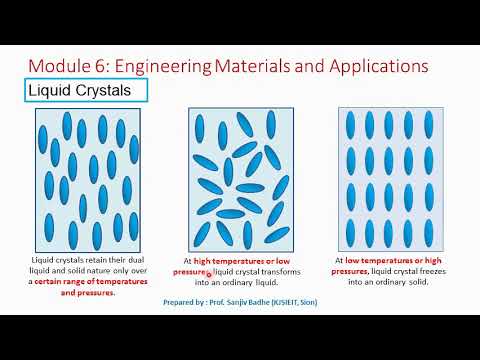







Liquid crystals are orientationally ordered fluids that exhibit remarkable responsiveness to external stimuli due to broken continuous symmetry, which creates low-energy Goldstone modes; they possess an order parameter tensor (for uniaxial systems simplified to scalar S and director n) that quantifies orientational order, and their phase behavior is governed by free energy expansions with quadratic and cubic terms, where the cubic term enables first-order phase transitions and makes these materials uniquely responsive to electric, magnetic, and mechanical fields.
Liquid Crystals: Order, Phases, and Physics | Lecture 1
Added:Basic thermodynamics and the physics of phase transitions, particularly the concepts of free energy, entropy, and latent heat.
Fundamentals of statistical mechanics, including the definition of an order parameter and the Boltzmann distribution.
The concepts of spatial isotropy versus anisotropy in materials and how physical properties vary with orientation.
Basic molecular physics, specifically intermolecular forces (such as van der Waals interactions) and the structural geometry of polar/non-polar molecules.
Detailed study of specific liquid crystal mesophases, including Nematic, Smectic (A and C), and Cholesteric (chiral nematic) phases.
Mathematical modeling of orientational order using Maier-Saupe self-consistent mean-field theory and Landau-de Gennes theory.
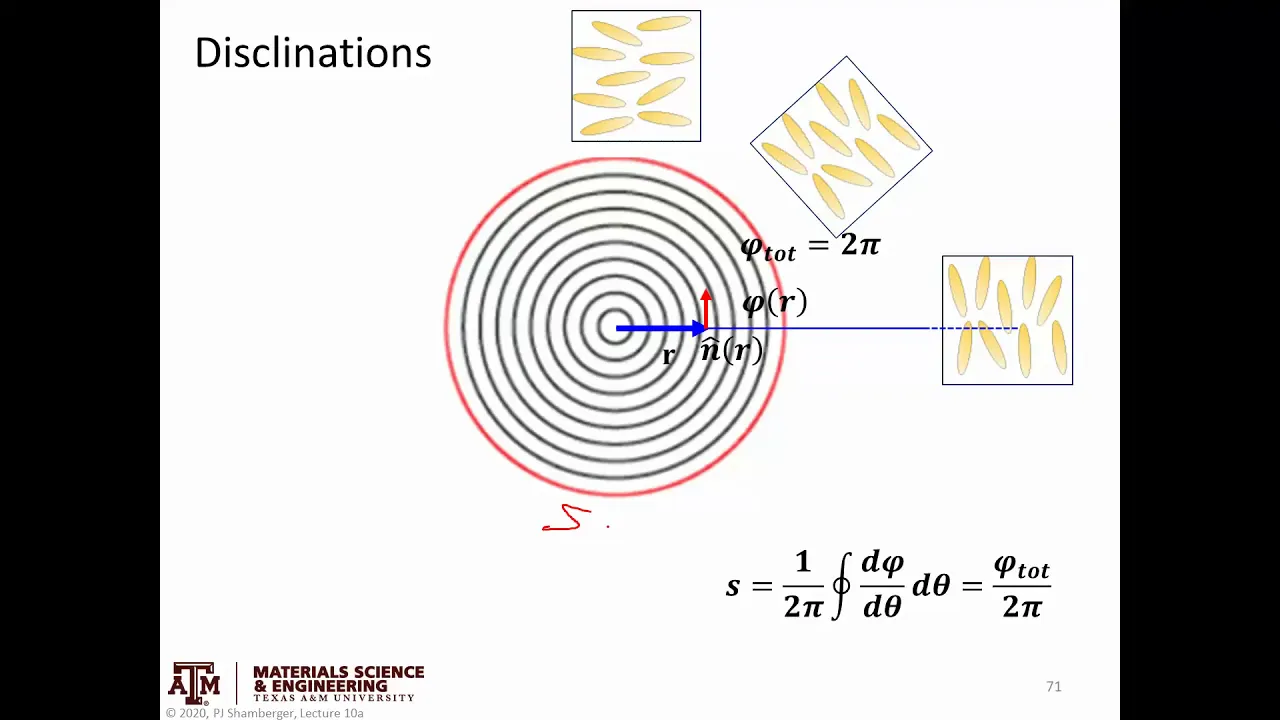
The physics of topological defects (disclinations) in liquid crystal director fields and their optical signatures under polarized microscopy.
Electro-optic and magneto-optic effects in liquid crystals, leading to practical applications like Liquid Crystal Displays (LCDs) and spatial light modulators.
3.6K views34likes1:28:04Original Release: 2016-06-11
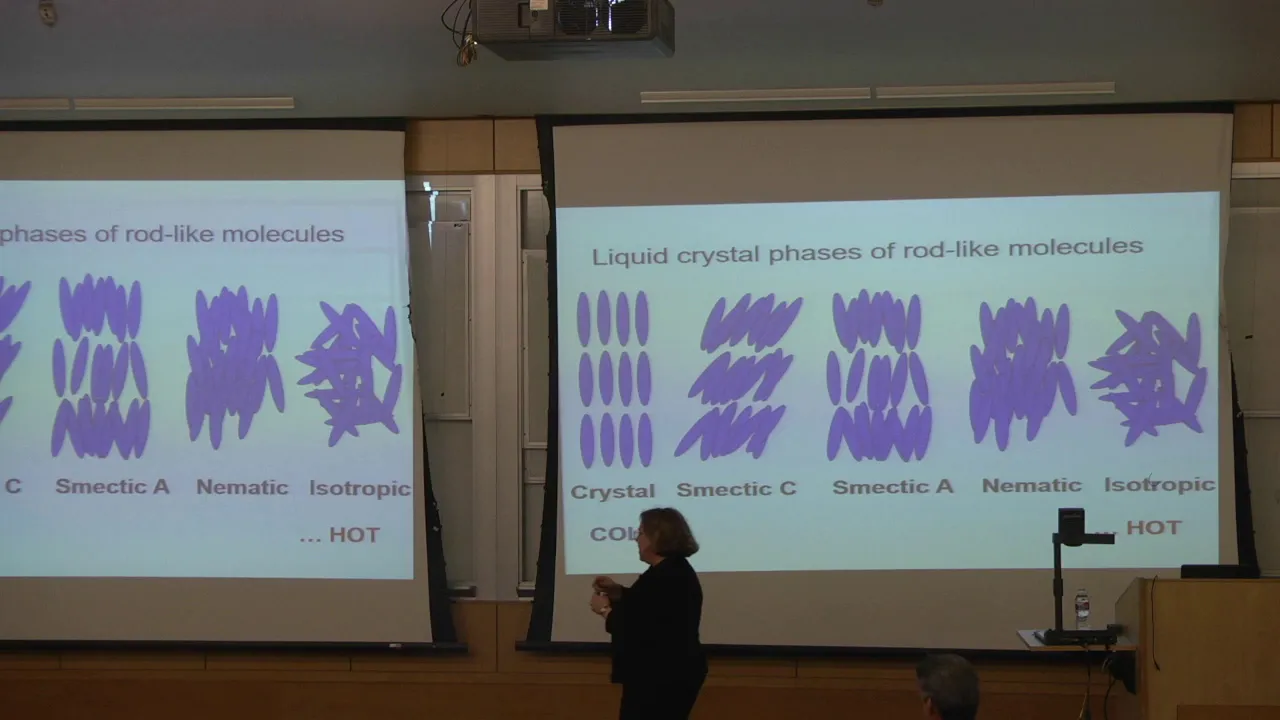
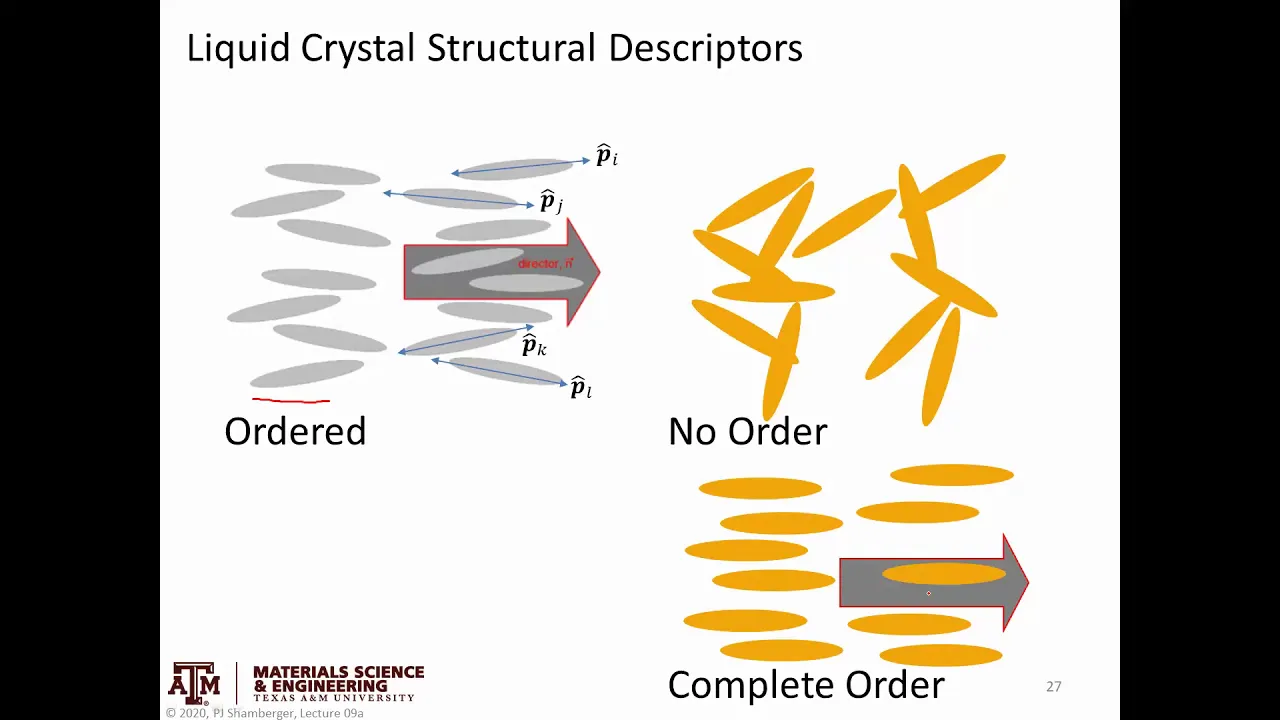
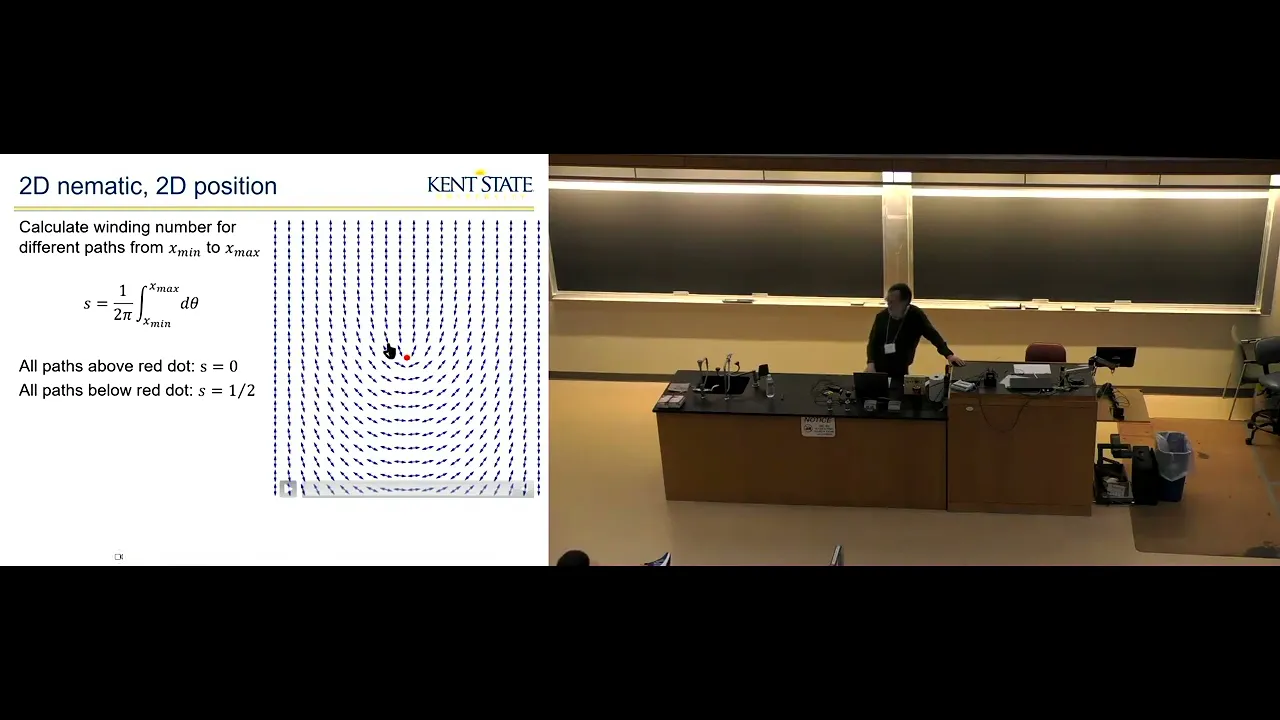
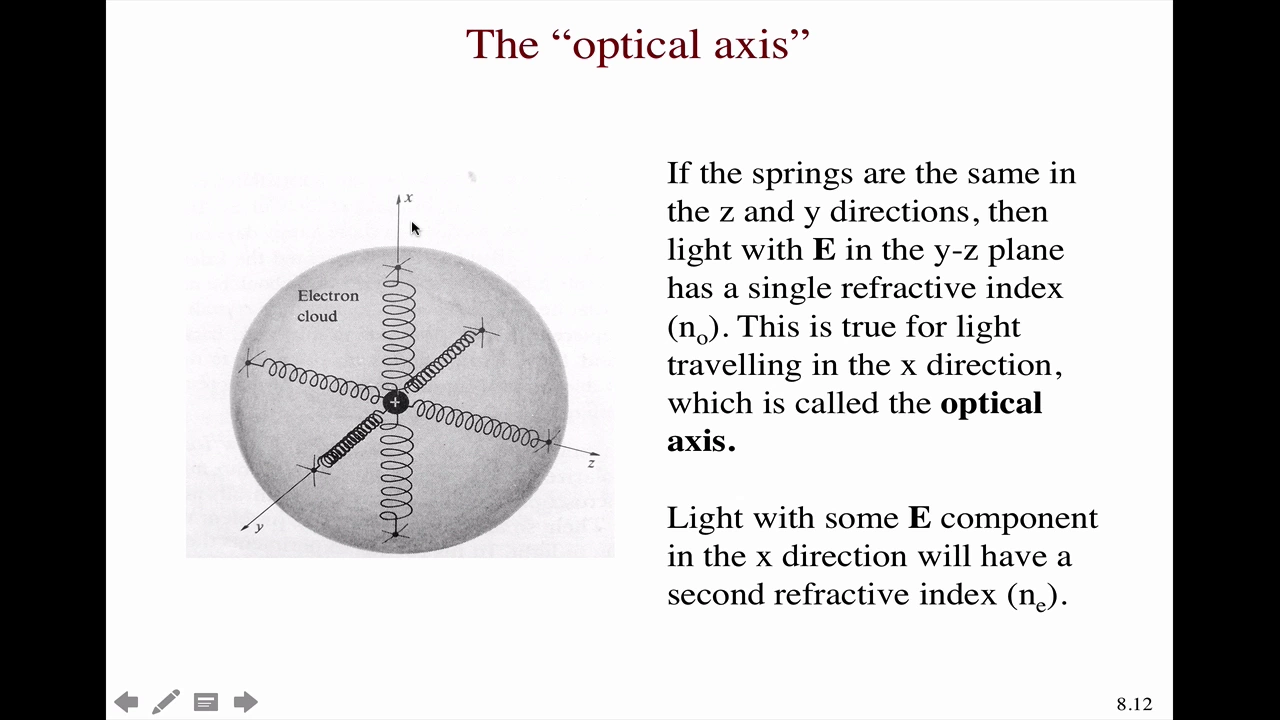
and he's going to tell us his three talks amazing liquid crystals one two and three thank you okay so yeah my name is Peter py and um um Mike and pek asked me to talk about this is what went in the program so this is what I'm showing you and there really are some pretty amazing things that liquid crystals do uh when I was a graduate student uh I did some work in critical phenomena and also liquid crystals I was in Vancouver at the time the Jen was in Vancouver writing his book on liquid crystals with a lot of excitement and uh so I did some liquid work then and I thought I'll just do liquid till it gets boring and then I'll do something else and then hasn't got born yet just when you think okay you know we're kind of at the end of the thing new things come along and so um so I think it's a pretty interesting de now um my talk will be a kind of a compliment to Mike talk he talked about hydrodynamics I will not I will talk about everything else so to speak and he um he basically showed a few slides and did a lot of black board work and I will show a lot of slides and a little black uh here is U so how I imagine doing this so the main main thing I want to talk about is liquid Crystal elers and there are three lectures and uh in the first one I want to talk about liquid crystals to to Really to understand Liquid Crystal elastomers uh one needs to understand this first bit uh I think is not well now liquid interesting because they're really responsive materials so they are they're active materials that do all kinds of remarkable things and they're being used as actuators and motors and so what I really want to talk about kind of the soft Motors using Liquid Crystal alers but to understand these you really have to understand a little bit about Liquid Crystal so I assume that you don't know uh anything about the crystals you probably do uh just bear with me but basically I going to go through basic liquid gal physics and try to understand a liquid gal respond to stimulant and in the second lecture I'll talk about liquid gal elastomers some of the funny things they do and then the third one talk about soft Motors so I'll be I'll using PowerPoint and and some stuff on a Blackboard um and I would like to keep you know these lectures as informal as possible so feel free to interrupt anytime with questions comments jokes whatever okay so this is lecture one then liquid crystals now here a kind of a quick outline I want to say few words about the history and about this whole business of orientation and orientational Order uh softness order parameters phases some free energy and phase Behavior and the effect of fields how Fields influence the um but before doing that I want to do something completely different okay um I I want to talk about a little experiment that uh you can easily do and I didn't bring one with me but you can imagine it so suppose you have a rigid cylinder like a wine bottle for example and you put it on the table and you take a plastic ruler and you balance the ruler on this wine bottle and uh then push down on the end and a kind of an interesting thing happens so so here's your cylinder I heard once that the degree of spiritual Perfection of a person can be assessed by how good a Sur okay so now you take your ruler and you and you balance it here and and the point is this ruler makes contact essentially along a single line order to project into the plan of the Blackboard a single point and then you start pushing down with some force on the ends of this ruler and for a while nothing interesting happens of course the ruler will bend but the contact will remain a single point but there will come a time when and the ruler will do something like this and it's going to be in contact with the cylinder over an extended region so this point is going to somehow spread out into a line or the line will spread over into a clite area region so there's a kind of a transition that happens and it's kind of interesting and you can play with it um and uh and I want to think a little bit about this transition and this will become relevant in the last lecture when I'll talk about some liqu Motors so suppose you want to understand this transition some so one can think of um essentially an order parameter um which will be this angle Theta that is the you know the half angle subtended by the contact reg now now how does this work so suppose I going to plot Theta as a function of the force and clearly for a for a while nothing happens so nothing nothing nothing nothing this sta is zero and then that will be a critical Force when something will happen and if you sort of do the experiment then you find that something like you will get a bunch of points maybe something like this so this is kind of like a transition and uh one way of describing phase transitions in general is to write down land out free energy and so suppose we try to do that here um how would it work so suppose we take some free energy I'll write it squiggly out and uh we want to write it in terms of theta and just like in regular phase transitions uh for quite a while nothing happen so presumably we want to have a quadratic term here uh with something like some constant f c - F so so long as my force is smaller than FC if I only look at this first term I want this guy to be zero to minimize the energy and then I can add other terms here and that's kind of what I want to think about so when f is equal to FC the convexity will change and when F exceeds FC this guy is going to want to be different different from zero to minimize the energy um but the question is what should the next term be that I and U so this is a question of symmetry and this comes up a lot liquid crystals and other systems and the question is do we have clearly we'll have a quadratic term here so you have something like this some constant time to the the question is is there a cubic term in here and it's pretty clear that it doesn't make much sense for Theta to be negative or if it were negative somehow the energy would have to be pretty different from what it is in this case so the fact that the situation for negative Theta being very different from positive Theta suggest that it should be a cubic term here so there should be a cubic term Thea cu and then the question is what should the sign of the coefficient be and let's put a positive coefficient in here just for font so suppose we put 13 D here and let's see what we get H what do you mean by well one can imagine that somehow this point goes on the other side so all I'm saying is is that negative Theta in this context is just not physical yeah that's so clearly the free energy must recognize that some so we have to have a situation that distinguishes at this level positive and negative T so that's why we need to have a cubic term here because if we didn't have it and the see oh plus or minus Thea equivalent I mean you probably you don't want to have a minimum of I don't think we want to allow a negative and so all right so now if we do it like this then you can see that what will happen um if you just minimize the free energy with respect to Theta and even forget this term here you take the derivative set equal to Z um then we have u a linear term here Theta squar we can get rid of that by dividing through by Thea so setting the derivative equal to Z tells us that Theta should be - a fc - F / the one half is gone I guess divided by B and so we see that um we get essentially um the result that the slope of theta at the transition is going to be final so this says that this first of all we must have a cubic term and this cubic term says that we get a finite slope here now this is interesting because it's unusual most of the time in Phase transitions you have an infinite slope here you got a kind of pitch for vcation many cases so having a finite slope here is somewhat unusual and if you do the experiment carefully you find that this is really what happens and if if B were to get really small then you would see that this slope goes to Infinity like you would see in the typical pH trans case Okay the other thing that is maybe worth thinking about is the magnitude of these coefficients one can sort of speculate how big um this critical Force should be how it will depend on the elasticity and the geometry of the D and so on but I'll leave that to later so all I wanted to indicate here is that even in the simple experiment there's a first of all an unusual transition which is funny in that there's a cubic term that gives rise to finite slope here um and the transition and uh as we go along we'll see some other examples of free energy are similar but uh some of the um consequences will be different than this okay so leave this for the moment and U get on with the get on with the Liquid Crystal stuff okay so Peter it seems like in this in this model you have a first transition as well what can you have a first so yeah so if you were to plot the free energy um you would have uh on on this side so this is the free energy versus Theta so on this side it just goes up and on this side you will have some local minimum before it goes up again and this guy could be up here or they could be down here so many many things could happen but we are restricted to be on this side and uh more importantly is when the convexity changes we want to go smoothly from this minimum to a nearby minimum here so yeah so there interesting possibilities of this side and in fact in the Liquid Crystal energy we're going to be exploring what happens over here but interestingly in this scenario because we are obliged to stay on this half we are looking at uh this branch of the F okay so first of all uh I want to argue that liquid crystals are pretty ubiquitous they're all over the place um in in displays in projectors as you know cavlar is a liquid Crystal to some extent strength comes from liquid crystalinity spider silk liquid crystalin silk worm silk Liquid Crystal U cell membranes are liquid Crystal and lot of properties um that are essential for life come from there soaps and detergents um slugs slime um fat transport in our bodies is is is deviated by by liid Crystal phases a lot of high strength Plastics are liquid crystal in there are liquid crystals in crude oil things called asphalting s of plat likee molecules that have orientational order lots of beetles and things are liqu color basically comes from that and then there's all sorts of devices goggles and so on so they really are pretty ubiquitous they were discovered in 1888 by this Bist riter who observed two melting points in in cholesterol benate that he uh he he isolated from plants and uh and basically the problem was that he had a solid Crystal and then he heated it and it melted into a hazy liquid and then later on that hazy liquid at a higher temperature changed into a clear liquid and so what was the hay liquid and it turned out that this was a new phase of matter a liquid Crystal phase um and for a long time people thought that there really wasn't such a thing they thought it was due to impurities and it was a kind of a disreputable uh field as it were and it was also disruptive it just interfered with the conventional view of the world and there's a lot of uh lack of willingness to embrace the notion of a new phase [Music] so um because it's an intermediate phase between a conventional Crystal and isotopic liquid it's it's a mesophase and uh and and this prefix meso appears a lot so meso gens are things that make mesophases so liquid cryst so things make liquid Crystal phases are called mesens for that reason now what makes liquid crystals well all sorts of things typically molecules or other things that I'll talk about but the main idea is that liqu cryst orientationally ordered fluids so there's some kind of anisotropic things that that you can talk about as having orientation and that can be rods or discs or recently people started to work with these soal banana shaped molecules and there lots of other possibilities as well and uh and the sent featur this long range orientational order and this leads to anisotropic physical properties and U so a typical molecule may look like that but again I want to stress that it's not just molecules crystals but uh nanop particles and other micro particles as well and I want to say a few few words now about orientational order and orientation in general so why why worry about orientation at all so position we know is is is a kind of a key variable uh if you have u a bunch of Point particles all you need to know is where they are and you don't need to worry about anything else but if you have a rigid object with a whole bunch of Point particles which are all somehow moving together then you have an option of either specifying the position of all the individual components or to specify the say the coordinate of the cental mass Central Mass and the orientation so it becomes economical for rigid bodies to talk about position of center of mass and orientation and orientation is a kind of a it's a it's a sort of a stepchild um most of most of solid state physics comes from uh from um crystals that have uh periodic structure in position in in in in in in in in position uh space um and all the consequences you come out of this regularity but relatively little is known about the consequences of orientation so positional order a ton of attention orientation order much less so and one sort of interesting thing you might think about is that you can have two objects but you cannot put them in the same place you canot put them at the same position but you can put them with the same orientation give the same orientation of Fons regarding position B on when it comes to orientation okay um so now what kinds of things may with crystals I just want to indicate a few things so obviously molecules are typical essential buing blocks and every time a new shape is considered a whole bunch of new phases are discovered and a lot of excitement uh happens in the community and so bananas um end up being like that but that can be macro molecules and U and for example DNA igers make really interesting part this here I guess there done a lot of work on these uh that can be uh crossling alas so these are actually um solid liquid crystals and they they show all kinds of really interesting behavior um that can be Aggregates of molecules and there are these nice uh soal harmonic liquid crystals which are basically molecules of whose edges like water so these are hydrophilic but the Centers do not you know they're hydrophobic lipic and so when you put these guys in water they tend to stack up uh so that only the edges are exposed to the water but not the interior highly conjugated portions and the interesting thing about these guys is they form rods and these rods are oriented but that can change their length as well depending on what kind of stresses there are you know they can change their shape to accommodate the the uh exitation nanop particles make liquid crystals both naturally occurring things like gibside platelets and uh various Clays and then uh gold nanor rods are make liquid Crystal phases both in solution and this is a sort of a need phase and arguably this looks like a layered structure uh which could be uh atic type uh order that I'll talk a little more about what's that picture of which looks like a painting what are you just pointing at it's all really beautiful this what is it this is uh this is t uh of of gold nanor rods so the individual nanor rods are lying in here and uh you can see the lines which indicated they sort of staging layers and it looks like that there's not much order positional order in the layers but the layers are pretty well defined so that just a TM picture um there are microp particles so uh you know people have been making uh funny shaped uh uh colloidal particles and form liqu Crystal phases so these are soft pmma ooids in some sort of solvent by Sol um then there are active pneumatics this is human mocy and so there's a cell with dries and this is 100 m long and these guys are orientationally ordered but they also swim on and do other interesting things course you can go the other way uh L scale it terms of the what's aanes where are they're in the skin somewhere but I cannot give you um so yeah it turns out that the neutron stars in their mantle have iron nuclei and these iron nuclei form either Rod or slabik configurations and they form Liquid Crystal phases and the mechanical properties of the man of neutron star depends on cinity and so the time evolution of neutron stars when you have starquakes for example is determined by the the mechanical properties that come from so I don't have a picture what I found this AR transition of a star what it's wor and uh and finally getting down to uh very small L scale um there are some exotic Liquid Crystal States and in SW to magnets and so this is a low PC pherom under pressure and it shows a nematic uh electronic nematic phase which means that the symmetry of the phase of least is the same as that so the story is that uh on on all sorts of blank scales one finds these orientational or systems so this is the key uh underlying feature um and this is what sort of uh brings them all together now one one key uh key thing about liquid crystals is uh the impacted on by gold Stone's theorem which says that if you have broken continuous symmetry you will have low energy exitation U um and this makes these materials really responsive so you have these gold stone modes and and because there such low energy excitations it means that these systems are naturally responsive to almost any stimulus and um and I want to say a few words about where this comes from and I don't know how many of you are familiar with with the proof of this but it's it's not trivial but what can make a rather simple um kind of intuitive um intuitive explanation of of of how this works so broken continuous symmetry means that I have an isotropic fluid say out in space and there are no preferred directions but if I cool it down the molecules will align more or less parallel to each other and and that will choose a direction and that direction can be anywhere there's no referred Direction it's continuous symmetry that direction can be anywhere on the surface of the sphere that's what broken continous symmetry is and now if you think of uh the implications of this this s of means that it doesn't matter anywhere where the molecules point you could you could rotate the system and there will be no change in the energy so you would think okay well maybe if I rotate molecules here just a little bit it's not going to cost me very much energy because there's nothing there to kind of uh tell you that you have rotated away from the preferred Direction and basically this is where this comes from and the energy of such a distortion basically goes as one over the length Square so the consequences is that the energy ends up going as the gradient of some order parameter whatever that is square um and so that that that's sort of intuitively clear then you say okay well what's a counter example to that and the counter example would be um say the ferroelectric transition in something like barium Titanic so at high temperatures you have a crystal and so you have aagon Crystal you have well defined axes and when you cool the system down and the electric polarization vory is looking for some direction to go there's a crystal field that tells it where it really should go and if you try to change that then you're going to pay the price at each point inside the crystal so there the energy of the deformation is going to scale as the volume whereas here the energy density just scales as gradient and long wavelength uh distortions basically cost you very little energy but if you if you don't have the brok convenient symmetry then the energy is going to scale as the volume of your object okay so because we have broken continous Sy crystals these materials are really soft and they are I think uniquely responsive and there's one more thing I think that makes it interesting is that they are anisotropic materials so not only are they responsive but you can really see the responsivity you can really see the change in the material properties because of the uny so the thing is soft and the response is really obviously manifest okay so it turns out then that there's this orientational order underlying all these systems and any kind of stimulus and we'll talk about some of these in more detail is going to affect the orientational order and then this is going to change uh essentially all the properties that weend on it so electric susceptibility active index and so on and uh this uh enormously lucrative uh LCD industry is based on just one couple of Galactic field to refractive index in principle one can exploit any other of these um as well okay now there are basically two types of liquid crystals um and although the the N clature isn't particularly good one kind is called thermotropic which means that the properties are temperature dependent and the other is lot Tropic which means solvent concentration dependent and uh the the real difference is that these guys only have me constituents like pure liquid crystals for example or mixtures of liquid Crystal or lot Tropics where you have a solvent somehow and um and so these are materials like The Chronic one that I showed you where you have molecules that form the crystal in a solvent and typically all anilic molecules soaps surfactant so on uh form these liopic phes this is the kind of a distinction that you will hear I'm going to mainly focus on thermotropic materials okay so Liquid Crystal phases one of the phases the most common is anomatic Phase where simply there's long range orientational order molecules want to be parallel and point more or less along the same uh same direction and and if you put these between cross polarizer are really beautiful um you get nice uh pictures like this these are Point defect at the surface in a thin ntic film these are called bus and uh and basically uh what happens is the material is by the fingent the optic axis is rotating in space and whatever the optic axis uh lines up with the polarizer or the analyzer these are cross uh things are black otherwise there so really there some pictures that uh one can see something with distance uh lots of applications of course uh and then you could ask why why do molecules want to do this why do they want to be parallel and there's sort of two reasons one is energetic uh and isotropic attraction you can imagine having two rods and it be some big polariz abilities along the long axis then you will have spontaneous Z Point fluctuation instantaneous spontaneous dipole creates field polarizes the other molecule it creates a field goes back to the first guy and if you look at this you find that the energy is minimized when the two molecules are parall so there's an energy reason why they want to be parallel and there's also an entropic reason the simply pag better um and uh so it's kind interesting even if there was no energy you just had hard rods that would still order if you squeeze them together uh for entropic reasons and it turns out that it pays to give up orientational entropy and become order because you get more translational entropy so it this interesting case of getting order through disorder you give up one kind of one kind of Randomness to maximize another so it turns out that either one of these reases is sufficient to form these phases uh in reality both are present uh probably the energy is dominant but it just depends on the system that you have the second uh maybe most Comm phase is the SMC phase that I show you which is basically anomatic but the molecules are organized into layers and uh again the reason for doing this is uh is twofold uh you have better pairing between the molecules if they are adjacent centers are kind of side by side not like this and also there's a more available volume U to explore and you can imagine that if a molecule here wanted to wander around this layer it can do it having to worry about bumping into the molecules above and below if you didn't have a layer the guy would be halfing in between and it would have to find a vacancy both in this region and above to be able to move so again this is now of course translational order but it pays to give up some translational disorder that is make layers in this direction in order to be able to explore more configuration space these layers so these specs are essentially onedimensional solvents and two dimensional liquids how much volume change is there between is much um very very small surprisingly small 10 to that per perhaps uh now an interesting thing is what happens in the constituents of CYO so so what does that mean so instead of a rodlike molecule you imagine that you have something like a a screw or a threaded Raod and if you take two of these so if you take two two bolts and you cut the heads off and you put them side by side you find that because the threads are at an angle they like to make a twist relative to one another and so that's that's basically what happens and if you take anamatic they form the soal U first of all they they form these helical chics which means that uh there are planes uh where all the molecules are say pointing vertically then you move a little bit this way in this plane all the molecules are tilted towards you you move more they're tilted and so the thing chases of hels um K is just a strange animal and uh you can imagine that if you have a if you have a cylinder and you draw a line along it well that's not CYO obviously but if you draw a helix on it now it will be Cyro now the thing is Cyro if you cannot superpose it on its mirror image or you can do an inversion and you cannot superpose the thing over parver image now so okay so you take a straight line on a cylinder non Cyro make a helix now it's Cyro so you would think that the more tightly you want the Helix the more kle it would be and yet when you put these two things side by side a very tightly wound Helix that's hardly any tilt but on the very coarse thread there going to be a big so that's that's kind of surprising the more kyal the thing the less still there is so anyway so there's lots of mysteries about cality okay so this is this is what a hel coleric does so you either if you make these molecules chyro or just add a little chyo DOA that will do this and one really interesting thing about this guy is that this is a spatially periodic structure and it's a spatially periodic dialectic structure so it's a photonic band Gap material it's a self assembl photonic band Gap material and optically this is really cool because that means that there's a a finite region of wavelengths where light cannot propagate not at all and so you can do all kinds of things with these make mirrors out of them make lasers out of them you can take these materials pour into a glass pump it and it will L beautifully for you um all by itself now if you make the things more chyal then they want to twist more so they want to form these double twist cylinder so you have one molecule the next one will want to twist so as you go it wants to twist this way but if you put a molecule here it too wants to twist right so it doesn't matter which way you go you end up with this uh double twist structure but of course at some point things uh aren't going to work so there are these phases these so col glue phases which are made up uh from various packings of these double twist cylinders and whereas the if if you were to look at the molecules where the cylinder join you would find that they go smoothly and continuously you will necessarily have defects in between so they form these defect gles uh either simple cubic or Body Center cubic or something so they form this pretty complicated structures um the same thing happens with colics sorry with smacs if you make a smac U Cyro then um it it it somehow wants to twist but it cannot because the layer is preventing so you have to uh make defects and you got this really interesting twist grain boundary phases where basically you have a region where you parallel slabs with the normal point up then another block where these are twisted and twisted and twisted like that so you have defect everywhere in between and this is another defect um defect lce so um this is just a picture of what a coltic HELOC coltic looks like this really iridescent highly reflective region this is an image of an English bu carrier written with a laser into a coleric cell uh this is a liquid Crystal Blue phase it turns out that because of this periodicity you have reflection of very specific wavel so they kind of nice looking things and this is a picture of Mr G face okay so uh main thing that is that there's a huge variety of phases and I've only talked about a few of them it's ftic phases blue phases TST gra b bananas all sorts uh and this is only the uh the thermotropic okay so now let's talk about orientation and orientational order so question is how to how to uh quantify orientation and orientation order because you want to have some kind of statistical description and then relate physical properties to this and then predict what the material does when you put some field on so one needs an orientation descript and an order parameter and uh so question is how how to do this and U of course we're talking essentially about rigid bodies so you can say well why don't just use oil angles we all know how this works orientation distribution is all the information but it turns out that that's not really u a perfect solution because such a description may not respect the symmetry of the object that you have and it may have just too much information often you don't want to know all the information you just kind of want to know the essential bits uh so it's interesting to look at orientation order parameters that are being used in practice so in pherom magnets we have magnetic moments and there's a magnetization which is just uh the number density times the average magnetic moment and so that's a vector and in fertic it's kind of the same story with ELC polarization that's other Vector so convenient order parameters are then vectors which are related to the symmetry of the constituents obviously nization has a Direction so is polarization um so suppose that you want to come up with an order parameter for anip soid sort of Revolution so there are two equivalent directions obviously there's nothing that distinguishes this direction from that direction so we can't do the unique to put a vector on this thing we don't know where to put the arrow so we have two equivalent vectors I want to ask U how can we come up with Expressions that that treat these two vectors somehow the same way and uh one thing we can do is we can just add them together but that's not a really good strategy because we get zero um the other thing is we could make a diad uh by essentially taking the first and the second the second and the first maybe divide by two and uh what about this well it turns out that this is pretty good uh it turns out that in fact the two terms are the same and so we could just take either one of these and and that'll work pretty well for us so that looks like that's a good for an orientation descrip we could continue we can take something like this but it turns out a that that quantity is zero and it's not necessary because we already have something that describes the orientation so um it looks like this diet is a good candidate to describe the orientation and so the the idea is that this thing is invariant under the allowed symmetry operations of the object and so that's what makes a good Orient and so uh it's convenient to to subtract the trace so if you think about this LL guy the trace of that is just Unity uh so if you take three times that minus the identity then this is a traceless thing and then it's nice to normalize it you'll see why uh so put a half in front of it so this is a good orientation descriptor for object of this Symmetry and uh and it's a it's a matrix it's a it's a secondary two index penser and these are all the elements and then the average value of that makes a good order parameter for the system so I collection of these things this guy makes good order TR a symmetric uh quantity that tells us uh what the order is so so these are two important ideas uh that I kind of like you to remember uh because these are the uh proper order parameters for the matx and of course it's a it's a real positive um it's a real symmetric Matrix so you can diagonalize it it has three values but the sum is zero so this is a kind of a typical representation you can imagine that a three vectors say j m and n and then uh you can uh relate the uh these I values to the uh projections of the original molecules onto these axes and and these averages are the U are the I values in this representation and so one can write Q in this way in terms of the vectors and the values and uh that this look a little messy but happily usually p z see p is what distinguishes those two Ang usually that's zero so the material is uni aial and and in that case things got a bit simpler so the order parameter tenser can be written uh in terms of just the dominant value s and the I Vector associated with it which is the directional average orientation so this is this is typically the framework in which people uh discuss thematics so uh one can uh indicate the direction of average orientation as as the vector asso rant value whether you put the arrow on top lot it doesn't matter because it appears like this s is uh basically scalar measure of how well the molecules align um in that direction so all the mo aligned with that direction S isal one if they are random the average of this guy is a third because they're going equally in all directions and if they're all perpendicular to this direction s is- a half so s goes from one to Z and to- a half okay now there are three levels of description that people use when I talk about thematics particularly they talk about just a director and nothing else um which is really not not ideal because uh again it doesn't sort of have the right symmetry uh the Q T picture which is the right way and then the most complete description is thought with the probability density and one usually has uh Dynamics in terms of these uh different quantities uh with different uh levels of accuracy now the first uh the first uh T monological description of the energy of a liquid Crystal was by Frank and that is basically uh talked about how much work it took to distort a uniform pneumatic and we identify three canonical distortions play where the molecules kind of spay out like this twist as I described in the case of aleric and then uh going look like that and uh so this is a free energy density and it's really not even a free energy there's no thermodynamics here this is just energy and the elastic constants if you sort of think about this have to have units of force that's a useful thing to recall right so units of force that each term is energy density and the deorations are gold Stone Mod you have a sinos soidal uh variation in space that each of these go as uh the wavelength uh so the wave Vector squared so it is this structure exactly um and um the problem is this director description doesn't have the right symet now I want to say a few words um about uh these gold stone modes because it's really nice to have soft material but it's a problem also because thermal excitations can destroy orientational order so imagine that you have a director field which is some constant and then there's some variation in space and suppose that you write this variation as uh some f expansion so I have some f amplitude there are three indices typically in three dimensions associated with a wave Vector let's write this as e R where Q would be I don't know m 2 m l and so on so we have these indices m l m and n and then if you calculate the energy associated with this by sticking it into the Frank form which is just Square gradient terms then you find that the energy of the system is going to be basically so we have these gradient Square terms you substitute this into those terms all the cross terms will vanish when you integrate so basically when you do this then you end up with just the sum of the Delta squares uh times the volume and there the elastic constant here maybe a factor of so this is what the energy looks like and equ partition says that each of these guys is half [Applause] KT little KT so basically one gets a measure of how big the theral fluctuations are and Delta squ is equal to K T / by the elastic constant times the volume so this gives you some sense of how big the thermal fluctuations are and then when you try to reassemble things and ask how big are the fluctuations in real space you get that the real space of mean squ amplitude okay again you have the Fier description here you put the two sums there when you do the sum the cross terms cancel out so basically you end up getting the sum single sum over L MN of these amplitudes uhop sorry there's uh there a q s here and so and so we have to do the sum over these indices and we can do that as an integral so for getting all these PR factors when you do this as an integral basically you have a q^2 in the denominator and then here you have integration over Q space summing over L and N depending on what you have and Here Comes now the problem suppose that we are in 1 D then I just have DQ here so this is the situation want and if you do the integral you get 1 / q and the maximum sorry the minimum value of Q is zero because elements of Q uh goes one over the sample size the sample size goes to Infinity the minimum value of Q goes to zero and you have a Divergence so the mean squar amplitude diverges and this is the P's instability and if you do it in 2D then you have a qdq and you still have a logarithmic Divergence and that's the merman V theorem and finally when you go to three D then everything is okay so a consequence of these soft modes is that you can have orientational order in lower dimensions and so for example example the pactic layers that I showed you suffer from this problem as well and that's why you don't have long grain smectic order because you have the P instability basically killing long grain order when you get the large L STS okay so this is one uh one thing that's I'm sorry could you summize the essence of the merner the the 2D the 2D case basically says that the fluctuations will still diverge just logarithmically now instead of algebraically still diver thank okay the other problem I just want to mention quickly is um this question of a director picture being somehow inappropriate suppose that you have a situation uh where the molecules are basically uh organized something like this in space okay so in a case like this you have a defect but let's not worry about what happens in here but if you try to put arrows on these directions kind of consistently you see that you end up with a problem you end up with a singularity so it looks like if you only have this Frank free energy then you get into a problem if you label things consistently you must have a place where the derivative dverg and this is artificial obviously there's no problem about the molecules are all parallel but not using an order parameter of the right symmetry that's you problem uh okay what happens in here is interesting this is AAG but we talk about that right now um I thought I would have too much time I I have too little time okay the other thing that that's kind of interesting is that uh this layered structure is not consistent with curl or B so imagine that you have a layer structure so suppose you have a layer St to just is kind of indicated before and let suppose it's pretty nice so we have molecules in these layers and uh and we assign a director locally everywhere it's going un4 more or less in this case and suppose I do a con integral in here as indicator that so I have d l is some Vector element of length and you can see that this Contour integral is basically just counting the layers as it goes right that's all that happens and if I don't have any defects when I got back to here that integral must be zero so if I have no defects that integral must be there um but of course I can write that integral as the curl of that retive field integrated over the area so it turns out that to have layers one must have the curl of n expelled from the material otherwise you would have defect and so there's this nice story that when you take an Ematic and you pull it down into the smack tap you have to expel the curve of n so the elastic constants associated with the term raining these diverge at the transition and one can make this nice analogy that n corresponds to the magnetic potential and the curl end is like the B field which is expelled from the Liquid Crystal in analogy to the MOs that kind of nice okay mean field theories of liquid Crystal so um the first meanfield theory was created by Max borne famous guy he assumed the vector order parameter and was singularly unsuccessful this is like bad poetry written by a good poet so nice to see that uh all of us are not not we're not always infallible so um the the first successful the was by Alfred Sala my Sala Theory and basically uh the idea was that suppose that we have an isotropic polarizability and then the interaction energy of two molecules will have this form where the sigma is the orientation descriptor and then you can build a single particle potential basically say that uh let me add up all the contributions to all the other molecules so you can replace this by average and there perennial problem of this is the energy of a pair and that gives you the right torqus and forces but you overcome so we have to subtract half the average and now you have a single particle potential you can just bang ahead in the usual way uh the partition function once you have that you have the free energy and you're pretty much done so free energy is a function of the order parameter tensor uh and that describes pretty accur what happens in in the m and um so when you do the minimization you get the selfconsistent equation two here two in here you can solve itally no problem um now it it's kind of interesting to take this l so so take this my sua energy and you can just expand it as a power Series in Cube and then you get a l expansion and you get this nice uh change possibility of change of sign with temperature in the quadratic term and this comes out because of the competion of energy and entropy and again here you got a cubic term as well and this is uh interesting and here the sign ends up being negative and then people can say okay we can relax the condition that these coefficients come from here we can just coefficients in here see what happens this is in 3D in 2D there will not be a cubic term in two two Dimensions there will not be a cubic term in two Dimensions because there are no difference there's no difference between a disc and a rod in 2D because you can't have a cubic invariant in 2D well so you can have molecules in 2D that point in in 3D and in that case you would have it but if you restrict the orientation to line then that's right you wouldn't have that and so so that's a really good point and so what you want to ask yourself is simply can I make a cubic term with the order parameter that I have and uh it it it turns out that in in this case you can because you have a q that you can contract with itself three times so so you can make a scaler out of these guys right no problem so you have a cubic term but if you had magnetization for example you couldn't have a cubic term because you cannot make a scaler out of 3 amp no way to do so symmetry plays an important role and in fact so this is this interesting notion that if you have a phase transition between phases of the same symmetry then you can always make a cubic term because even if you need Vector you will have a vector there because the original state will have the same symmetry [Music] so phas transitions between between states of the same symmetry will always have a cutic ter and so that typically are first order transitions for that reason and uh phase transitions between phases of different symmetry may or may not have a cuic okay because here weaking Sy okay uh forging ahead um all right so then you can just minimize the thing you can write Q in terms of the I value not too exciting main point is uh is is that um you have a you have a number of solutions uh when you minimize the free energy one is that s looks like this the other is that s is just equal to zero everywhere and the corresponding free energy corresponding to this line which is this and uh free energy corresponding to this line is this so this guy corresponds to the stop curve okay and then of course what does the system do but it goes along here and then fall on that so typically there's a phas transition of if if you were to heat your system slowly you would end up up you would go up to here at this point you cannot sustain in order stain anymore you must fall down if you're cooling that correspond to this if you're cooling the thing down uh then uh you can undercool and have a phase transition here this state becomes unstable there but the phase transition uh actually happens somewhere in between so there's hysteresis uh both you can both super heat and super cooles place at this point first okay and then one can do land nothing which is even easier replace the Q DES in ter of values get something that you can solve trivially you get the same okay so this is kind of important main thing is is that you can easily describe the temperature dependence of the Border in the system now onager uh show that if you pack hard rods something could be similar happens um so if you imagine um if you try to ask yourself this question if I have a rod here um how will it prevent the center of this molecule from occupying bits of configuration space and so this guy here will exclude a volume this big uh to the center of this mod and uh on the other hand if the is a perpendicular then you get a different volume and you see that they're pretty different this goes as d s l this goes as DL s so it's a huge difference in this volume depending on orientation and uh so then you can write this in terms of the orientation descrip Sigma not the main thing is is that orientation really you know really has a lot to do with how much volume there is um and U you can then ride this uh sort of on the average one guy interacting with his neighbors and the average volume molecule and so there a lot like what happens in the case of the attractive potential this kind of coupling there some average value so the structure is really similar and I don't want to spend time uh uh dealing with this basically one can uh derive the orientational distribution function only due to static interactions or one can put both static and attack Parts together and one can get the whole story in in a pretty straightforward way um so one get a self consistent U pseudo potential that has the attractive part and a hard St part which means if you pack things hard enough you know this thing is going to really play an important Ro okay but it doesn't matter too much so you can get equational State you can get everything order parameter density change pretty much everything okay now one important thing is is is is is this question of how do these materials interact with fields and so the whole notion is that the uh the uh polarizabilities and tropy so if you want to know how big a dipole moment you make when you put a molecule like this a particle like this in a field you have to project the field along One Direction and assign the right polarizability and in the other direction assign that polarizability and so you find that the polarizability is a tensor that depends on the orientation linearly and if you take the average polarizability then you see that it's linear paret cancel and then if you forge ahead and calulate the dialectic cancer usual way you like the polarization as the polarizability the number density then you find that the dtic tensor has an isotropic part and a part which is proportional order tens and the same thing is true for the magnetic case these things are pretty isotropic the relative di constant typically is an anisotropy of 10 pretty big um but there's also di magnetic typically but also an isotropic oropy is is really small and then when you write on the free energy you got say the landar expansion and then uh the coupling to the is quadratic second and cancer so we have the two electric field of couple to it or if you write it in terms of the scalar part then it just as Co squa in both field the electric field and the magnetic field okay so you could ask uh can you make a can you make a linear coupling for example between can and E and you cannot because you can't make a scale energy so the coupling is quadratic uh but interestingly I don't know oh yeah I just wanted to make the point here is that the molecules with the pre energies minimized if the molecules align with the electric field because of this anisotropic polarizer that's that's what happens in your L this this here makes all of these line up um if if uh they're not parallel torque is exerted on the material and the torque is just B cross e that's the torque density in the ball and you can think of it in two ways if you have a DC field then you get S of positive charges at one end the negative charges on the other end and uh and the positive charges want to go up negative chares go down and so we have a net torque aligning the molecules with the field if you have light things get a little more interesting it turns out that in that case uh you have a light say propagating this way with linear momentum and there's actually a displacement of U of the uh Photon projectory changing the angular momentum the extensive angular momentum of the fon just like if you had a had a periscope here with two mirrors light would cause it to turn that the radiation pressure so light will also cause these mon the same way interestingly the magnitude ends up being just the same um okay so the applications of these torqus um what happens if Q is in space so we just put in the Square gradient terms the possibilities and then one gets a whole bunch of terms including the Frank terms that I mentioned in the very beginning of my ump now there are some interesting uh questions one could ask how big are the uh coefficients in the landal expansion and that's kind of important and uh and and you can easily see that they are basically KP divided by a molecular volume it has to be got four dimensional reasons and so you can right away estimate how big these things are U so that's a good thing to remember how large are the caves well dimensional analysis says that they have units of force so there's some energy presumably TNI is the transition temperature so there's some energy and to make that into elastic Conant we have to buy by a length and the only length you have is a length of molecule and the uh beautifully and right away you have it and uh you try to measure this experimentally it things you all time so so this is really a beautiful uh you can ask how much work do you have to do to vary the scale of order parameter and because of the LDA coefficients that basically scale like this uh the energy density but what is the cost of changing the direction of alignment the director that just goes as the elastic constant time q^2 and you can see that this turn is going to be a whole lot smaller than this if the wavelength of distortion is longer than aular W right so it turns out that distorting the direction is a whole lot easier than changing the Dee of water um all right the remaining minutes um what happens at surfaces so while at surfaces again this is the Symmetry argument you can Define two vectors as a surface normal that's a good vector and you can do something to the surface you can rub it you can uh corrugate it you can do something to it so you can introduce another Vector u in the plane of the surface uh and then then you just construct an energy which looks something like this you have q and it must couple to these vectors only of low of the couple you have are these and these in fact form the experimentally verified surface energy structure so this is pretty much as uh as you might expect now there's a really interesting thing that happen you know there's this always this issue of surface versus volume and uh essentially all animals of North are big because they want the bul to dominate over the surface when it comes to heat loss whales go south to have babies because the babies are small so typically um when things get big the bul dominates over the surface but in liquid crystals if you this gold stone mode business if you look at this term um you know this will go if I have a sample of size R and I have some Distortion this guy will go as one over r² this guy will go as R Cub so this thing is linear in R whereas the surface there just scales as r s so one has this really unusual situation that for large samples the surface dominates so you have a big job of liquid Crystal on the surface tells it what to do if you have a tiny droplet the bulk tells it what to do they're all par so surface effect dominate for large s okay uh surface preparation um not that interesting there lots of interesting ways you can modify the surface you can SM for example you can direction and you can use light to to modify the surface um okay now Dynamics how to do Dynamics well the basic idea is essentially to look at entropy production you know this is a typical approach that people have you have dissipation is equal to the rate of decrease of the free energy and if your dissipation is essentially just friction someity time some velocity squared then uh you can write the free energy uh time dependence as a dependence on Q and you get the simple dynamical equation which is basically a nonar diffusion equation for the order parameter tens I won't talk too much about that there's various examples that are interesting but I don't want to talk about that I don't want to talk about how um typical Display Devices work unless somebody's interested in that but I want to say a few words of symmetry because symmetry argument an important role and what is allowed by symmetry is is is essentially something observed and uh so back at this issue of you cannot make a linear coupling between q and E because you cannot make a scaler but if you have a gradient of Q now you can make a scale so you can make a linear coupling if you have a gradient uh of Q so if you have a spatially variant Q tensor you can have a gradient but now if this is in the energy then this guy must be the polarization because can be anything else so what has a really strange business now suppose you take the dialectic cancer of a liquid Crystal which is linear in Cube and you say let's see what happens if it varies in space so you take it um you take its Divergence and you end up with a vector and if you write Q in terms of the erector and the scalar value and you get uh these terms and you get these uh uh remarkable terms you find that U if s is a constant you get these terms here and you find that if you distort the director field you must have elect polarization and you do so it's kind of like flexal electricity youor antic somehow and you have atic polarization that you can measure and this may be useful for energy production you can take a material you can play with it you can make electrical energy maybe more interesting is that if you let this degree of order in space you can get electric polarization so if you have a say a temperature field so s is Big here small here you will get electric polarization as a um okay that is this whole business of uh vectors and Pudo vectors and so on so everybody knows about proper vectors and Pudo vectors um but this story is true in general for ters of every rank it's to for scalers so they proper scalers vectors cancers canc and so on and pseudo ones and so the pseudo ones basically change signs under inversion and if tality is is a good example of a SLE scaler you take the cross product of two of these vectors and Dot the third when you invert your coordinate system the scaler changes sign so pseudo scal is kind of a signature of parity and the magnetic fields are pseudo vors because they come from a cross product of uh current and uh distance um the Le symmetric symbol is AO and so the world can be divided into these things and you're saying what the use but it turns out that you can say some things about it so suppose you have a damatic then you can form a diet can form a back you can form a diet if you have a smack tape you can you have the layer normal you can make diet on of it and if the material is SK you have AO scale and from these quantities you can form a proper Vector you just take these things and you can make a quantity which is a proper Vector there a leev which is pseudo pseudo scaler two pseudo things make a proper thing and so you will have a vector a copper vector and if you know that there's a vector there an electron will know that there is a VOR there and you will have fertic polarization and Bob Meer predicted this uh God knows back in the 70s and since then people made like 50,000 materials that are ferals based on this symmetric simulation there's the same story about banana molecules which are ayal so they have no parity uh but it turns out that form of P structures again because of similar symmetry arguments there's some director di layer normal di these guys have real dipole moments and so from these things you can create a super scaler there go you must have okay so the Symmetry arguments are kind of interesting you can do lots of fun things there this is a a graduate student this work of to theal from layers um Nano particles make crystals I won't talk about that and it's interesting to think about particles of other symmetry so suppose you don't just have rods or discs or bananas suppose you have tahra what what would the order parameter be how would you define it um how somebody gave you a bunch of them how would you know that it's order what physical measurement Pro that it turns out interesting that the order parameter ofra is a third R cancer is kind of we don't deal with these there's no sort of standard ion value decomposition values vory it's a pretty interesting animal in its own d u is a theory Well turns out that lny F did a nice New Field Theory and uh are Leo here and so it's interesting to think about other systems with other symmetries and what kinds of structur they can form okay so here's a summary Orient isqu soft Sy considerations give some Sor had to rush through but I think it's a really interesting thing and when I talk to more I mention this again and there's lots of prospects for interesting new stuff now uh what to remember for the next lecture basically this definition of the order parameter and how we write it in terms of a scal Anda vector and the free energy has this structure this kind of coupl to the field temperature dependence and uh and the Lambda coefficients basically scale as K dni over and then so next time I'll talk about elastomers and what the consequences ofing orientational order to okay thank you any questions nice tradeoff in that tcus one that's trof between energy and entropy right and then in the next section you talk about hard particles so is there an anal tradeoff between free volume and ENT in that one um well the the there's no energy in a hard part inter right right only only entropy so so you don't have this against temperature the distrib function and the free energy temperat is trying to make everything the volume is trying to make everything yeah so you you have competition between translational entropy and orientation and and and you have they're kind of pushing against each other and then you see pack and P up then the translation only wins and the orientation gets up and every but the competition is okay thanks [Applause]
Up Next
18:54
Liquid Crystal Theory: Order Parameters Explained
@Crystallographer
2.9K views•2020-03-16

12:53
21cm Hyperfine Transition in Neutral Hydrogen: Radio Astronomy Basics
@AaronRobertParsons
12.4K views•2011-10-13

69:26
Self-Propelled Hard Rods in Active Matter Physics
@ICAMI2CAMpresentations
202 views•2016-04-26

27:14
Entropy and the Second Law of Thermodynamics Explained
@veritasium
27.5M views•2023-07-01
Related Study Plans & Knowledge Roadmaps
Structured learning paths in Physics
physics
Nuclear Physics (Decay, Fission & Reactors)
01Atomic Structure and the Binding Force
02Radioactive Decay and Half-Life
03Nuclear Fission Mechanics and Chain Reactions
+ 2 more learning modules
12h5 modules
Explore Roadmap
physics
Soft Matter (Polymers, Colloids & Rheology)
01Foundations of Soft Matter & Thermal Forces
02Polymer Physics and Macromolecules
03Colloids, Surfactants, and Self-Assembly
+ 2 more learning modules
38h5 modules
Explore Roadmap
physics
Analytical Mechanics: Lagrangian & Hamiltonian
01Mathematical Foundations: Calculus of Variations
02From Newtonian Mechanics to Constraint Dynamics
03The Principle of Least Action & Lagrangian Mechanics
+ 3 more learning modules
28h6 modules
Explore Roadmap
physics
General Relativity (Spacetime & Cosmology)
01Foundations of Relativity: Special Relativity
02The Geometry of Spacetime: Equivalence Principle & Curvature
03Einstein's Field Equations: The Mathematics of Gravity
+ 2 more learning modules
55h5 modules
Explore Roadmap