


![Life processes one shot [Animation video]](https://i.ytimg.com/vi/4jiZ-6NqXDo/maxresdefault.jpg)
![[IRPA#06 ] "Mecanismos de Hipoxemia". Com Prof. Fernando Batista / Parte 06](https://i.ytimg.com/vi/PTjL6waSbM4/maxresdefault.jpg)












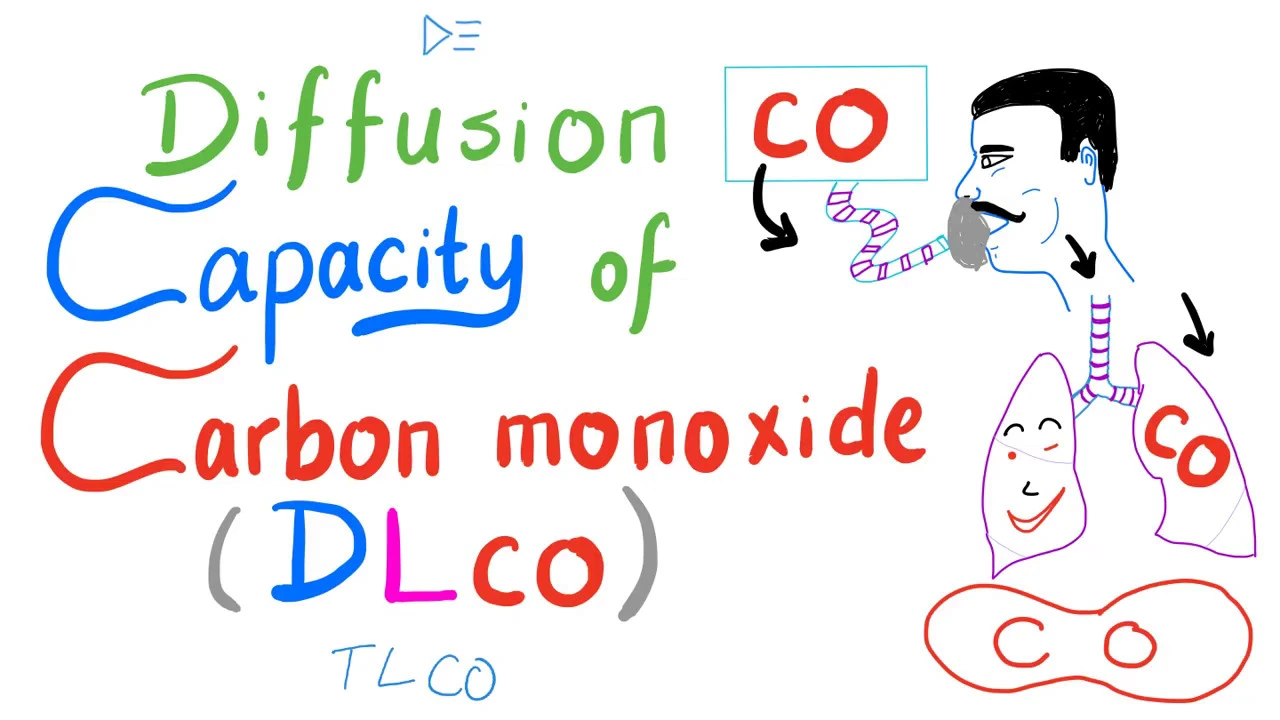












The respiratory membrane consists of five layers: alveolar epithelium (pneumocytes), basement membrane, interstitium, capillary endothelium basement membrane, and capillary endothelium; the diffusing capacity (DLco) is measured as 23-25 ml/min/mmHg under normal conditions, representing the volume of gas diffusing per minute per mmHg pressure gradient, and carbon monoxide is used for this measurement because it is diffusion-limited (it never reaches equilibrium between alveoli and blood due to its 200x higher affinity for hemoglobin compared to oxygen, unlike perfusion-limited gases like oxygen and CO2 which reach equilibrium within 3 seconds).
Diffusing Capacity of Respiratory Membrane: DLCO Explained in Physiology
Added:Basic anatomy of the respiratory system, specifically the structure of alveoli and pulmonary capillaries.
Fick's Law of Diffusion and the physical factors that influence gas diffusion across biological membranes.
The concept of partial pressures of gases and how pressure gradients drive gas exchange.
Hemoglobin structure and its affinity properties for oxygen, carbon dioxide, and carbon monoxide.
Clinical diagnostic applications of DLCO in distinguishing restrictive vs. obstructive lung diseases (e.g., emphysema vs. pulmonary fibrosis).
Ventilation-Perfusion (V/Q) mismatching and its clinical consequences, such as shunts and dead space.
The impact of extreme environments (e.g., high altitude) and heavy exercise on oxygen diffusion limitations.
Pathophysiological conditions affecting the alveolar-capillary barrier, such as pulmonary edema and ARDS.
10.6K views285likes28:41Original Release: 2019-12-05
Hi, uh this video is about the respiratory system.
A concept related to the diffusion of the gases uh across the respiratory membrane.
So let's uh understand first what is this respiratory membrane? What are the layers of the respiratory membrane?
how uh would the gases diffuse uh across this respiratory membrane uh and what would be the rate of diffusion of those gases and how do we measure the diffusing capacity.
So starting with the very basic we inspire oxygen it go through the uh it goes through the respiratory passage the passages and finally uh it reaches the alvoli.
This is a diagrammatic representation the inspired oxygen uh traveling through the respiratory passages.
finally reaching the alvoli and from the alvoli the oxygen will diffuse into the pulmonary blood and the carbon dioxide coming from the tissues and having entered the lungs it will diffuse in the opposite direction from the blood into the alvoli so that it can be expelled out via the expiration.
So we are talking about this alvolo capillary membrane. There is alvolus and there is pulmonary capillary.
Therefore the diffusion of gases occurs across this uh respiratory membrane.
Let's try to understand uh the layers of this respiratory membrane first.
U here is the alvolus and here is the pulmonary capillary.
So first thing the first layer and I'm talking about the uh layer from alvulus to the pulmonary capillary. Therefore starting from alvulus uh in that direction first layer would be that of would that be of alvolar epithelial cells epithelial lining of the alvoli.
You know uh these uh epithelial cells are called as pumosytes.
There are two types type one and type two. And the gas diffusion occurs across type one pumoytes. So first layer for the of the respiratory membrane would that be of uh alvolar epithelial cells epithelial lining.
Then next the basement membrane on which this uh these epithelial cells uh are based.
So second layer is uh of the basement membrane.
That's the basement membrane uh for the alvular epithelial cells.
Then uh the intersticium as you can see between the alvular wall and the pulmonary capillary pulmonary blood vessel there would be intersticial space.
So uh there would be intersticium.
This is the alvolus epithelial lining. then the basement membrane then the interthesium and now starts the pulmonary capillary the pulmonary blood vessel.
So it starts with the basement membrane of the endothelial cells.
So the basement membrane uh of these endothelial cells or endothelial lining has the basement membrane and then the endothelial cells that line the pulmonary capillaries.
endothelial cells lining the pulmonary vessels or pulmonary capillaries.
So oxygen which has reached the alvolus now has to cross all these layers to reach the blood vessel. It has to cross all these layers to finally enter the blood. Having entered the blood vessel, having entered the blood, it has one more membrane to cross actually and that is the RBC membrane because oxygen is going to enter the red cells and going to combine with the hemoglobin.
So even RBC membrane has to be crossed.
Therefore, this is the capillary, pulmonary capillary and here is a blood vess uh here is the red cell, red blood cell.
Oxygen has to cross all these layers. uh let's just summarize pulmonary I pardon alvular epithelial cells pneumocytes then the basement membrane then the interthesium then there starts the pulmonary capillary as we saw here the pulmonary capillary the basement membrane of the endothelial cells then the endothelial lining endothelial cells and finally entered the blood and then it has to enter the red cell RBCs. So red cell membrane these are the layers of the respiratory membrane and carbon dioxide of course has to diffuse in the opposite direction. It diffuses from the blood into the alvolus and it will be expelled out. So this carbon dioxide has to cross all these layers in the opposite the endothelial lining then the basement membrane intersticium and then uh it has to enter the alvulus crossing the layers. So that's the respiratory membrane uh the layers of the respiratory membrane as we have enumerated. Now next point is what all factors that influence this diffusion of gases.
For instance uh and you know we are talking about the diffusion.
So there are factors influencing the rate of diffusion which are applicable very much here. For instance, thickness of the respiratory membrane.
You know, uh the rate of diffusion is inversely proportional to the thickness of the membrane or diffusion distance.
Uh greater the thickness, lesser will be the rate of diffusion.
For instance, uh pulmonary edema, accumulation of fluid uh in let's say interstial space uh will increase the thickness of this respiratory membrane and therefore uh oxygen diffusion uh would be uh its rate of diffusion will decrease. Oxygen carbon dioxide the rate would decrease. So inverse relationship or interstatial lung disease interial lung disease will also increase the thickness of the interthesium and therefore thickness of this respiratory membrane.
Uh therefore the gas diffusion rate would decrease.
Second surface area available for diffusion.
As we all know uh greater the surface area available uh greater would be the rate of diffusion. Diffusion of gases uh is proportional uh directly proportional to surface area. Now there is a condition called as M5 SEMA pulmonary M5 SEMA.
What happens in this condition is that the surface area available decreases. What happens here in M5 SEMA is that there is destruction of the alvolar septa. Just to show it diagrammatically there is destruction of the alvular septa and alvoli coles to form larger cavities. But what happened in the bargain is surface area available for gas diffusion would decrease and therefore the rate of oxygen and carbon dioxide would also uh decrease. So decrease in the surface area as caused in micema um decrease rate of gas diffusion. These are some of the factors influencing the rate of u diffusion of gases through this respiratory membrane.
Now the real question is what is the rate of diffusion of gases through the respiratory membrane? What is the diffusion capacity of the respiratory membrane?
So under normal circumstances the diffusing capacity of this respiratory membrane is said to be uh 23 to 25 ml per minute per mm of HG.
23 to 25 ml per minute per mm of hg.
What does it mean? It means if the gra pressure gradient across the membrane is 1 mm of hg then in 1 minute about 23 to 25 ml gas will diffuse.
Now the point is I'm talking about the pressure gradient across the respiratory membrane means from alvulus to the blood what is the pressure gradient. Uh if it is 1 mm of HG then in 1 minute this much gas will diffuse 23 to 25 ml gas will diffuse oxygen will diffuse. Uh normal alvolo capillary pressure gradient.
Alvola capillary pressure gradient from alvolus to the pulmonary capillary blood for the oxygen is set to be about uh 11 mm of Hg from the alvulus to the pulmonary capillary blood. The pressure gradient uh across this respiratory membrane is set to be 11 mm of Ag. So you know for every 1 mm of FG in 1 minute uh about 23 to 25 ml gas will diffuse. If it is if the pressure gradient is 11 mm of Hg how much gas will diffuse? 230 to 250 ml roughly about uh let's say 250 ml per minute.
So remember about 250 ml of oxygen diffuses across this respiratory membrane per minute every minute. And also remember that 250 ml per minute is the g is the oxygen which is consumed by the body every minute. Under basal conditions of metabolism about 250 ml of oxygen uh is consumed by the body per minute.
So this much gas diffuses across the respiratory membrane from alulus into the into the blood and this much gas is this much oxygen is utilized uh by the body every minute. Now the most important part of this discussion, how do we measure the diffusing capacity of the respiratory membrane? Diffusing capacity of the me respiratory membrane is generally denoted as DOC diffusion limited carbon monoxide.
Diffusion limited carbon monoxide. This is how it is denoted the the diffusing capacity of the respiratory membrane and it means the first point is we can use carbon monoxide to measure the diffusing capacity of the respiratory membrane.
The question is why why do we use carbon monoxide to uh to measure this diffusing capacity?
Uh now the point here is we are going to give a gas by inhalation. Let's imagine that we give a gas by inhalation.
It reaches the alvoli and it diffuses through the respiratory membrane.
Now we want such a gas that continues to diffuse continues to diffuse through the respiratory membrane.
It means we don't want a such a gas that will reach the alvolus after given by inhalation. it reaches the alvolus and instantly reaches equilibrium from the alvolus to the pulmonary capillary blood.
If the gas that was given by inhalation, it reached the alvoli and instantly I mean it diffused through the membrane and instantly reached equilibrium from alvolus to the pulmonary capillary blood means its partial pressure in the alvolus and its partial pressure in the pulmonary blood becomes equal. it equilibrates.
If the gas instantly equilibrates, very rapidly reaches equilibrium, then that gas is useless for us. What are we talking here? We are talking about diffusing capacity of the respiratory membrane to be measured.
So we are looking at such a gas which should I mean we give by inhalation and it continues to diffuse. It continues to diffuse. It continues to diffuse through the respiratory membrane. It never reaches equilibrium.
Its partial pressure in the alvolus becomes high because we have given it by inhalation and it has reached the alvolus. So partial pressure of that gas becomes uh higher but its partial pressure in the blood does not rise.
So that means there is a pressure gradient and it will continue to diffuse and from its rate of diffusion we will measure the diffusing capacity of the respiratory membrane.
So uh let me give an example to explain this further. Let's take some example for instance let's talk about oxygen.
Can we use oxygen uh to measure the diffusing capacity of the respiratory membrane? No, we can't.
Why? What's the reason?
The reason simply is if you if we inhale the oxygen it reaches the alvolus and within next 3 seconds it reaches equilibrium from the alvolus into the pulmonary capillary blood.
Within 3 seconds it reaches equilibrium.
It equilibrates from alvulus to the pulmonary capillary blood.
That means the partial pressure of oxygen in the alvulus and partial pressure uh in the blood will become equal. It has reached equilibrium. So that means it diffuses so rapidly that almost instantly it reaches equilibrium.
This gas is useless for us to measure the diffusing capacity of the respiratory membrane. We are looking at such a gas which will not reach equilibrium this rapidly. it in fact it won't reach equilibrium at all. It will continue to diffuse continue to diffuse.
Such a gas is carbon monoxide.
Why? Why carbon monoxide?
Because if we give carbon monoxide by inhalation, it will reach the alvolus and uh partial pressure of carbon monoxide in the alvolus will increase. It will start diffusing into the pulmonary capillary blood.
But the partial pressure of carbon monoxide in the pulmonary blood will be zero. It will never rise.
Why is that? That's because carbon monoxide as soon as it enters the blood, it will be taken up by the RBC's and it will combine with the hemoglobin very rapidly.
Carbon monoxide as you may be aware has got 200 times more affinity for hemoglobin as compared to the oxygen affinity for hemoglobin very high affinity. So carbon monoxide reached the alvolus then it diffused through the membrane reached the blood but instantly taken up by hemoglobin inside the RBC which means carbon monoxide does not remain free in the plasma.
Now the most important part is partial pressure of any gas is exerted by that gas which remains free.
The gas that combines with something would not it does not exert the partial pressure. So in this instance as you can see that we gave carbon monoxide by inhalation it reached the alvolus. In the alvolus its partial pressure increased.
It started diffusing into the pulmonary blood and it immediately was taken up by the hemoglobin inside the RBC. It it does not remain free in the plasma at all. So it will not exert any partial pressure in the plasma in the blood.
That means partial pressure of carbon monoxide in the blood will remain zero.
No free gas available to exert the partial pressure. All of it taken up by hemoglobin instantly. Which means what?
Which means it will never reach equilibrium. I mean partial pressure in the alvolus is high. We have given it by inhalation and it has reached the alvolus. So it's partial pressure high in the alvolus and zero in the pulmonary capillary blood.
So that means it will continue to diffuse, continue to diffuse, continue to diffuse. It will not reach equilibrium at all. It will never reach equilibrium.
So that's the gas we are looking at.
That's the gas that is actually ideal to measure the diffusing capacity of the uh respiratory membrane. Remember we were talking about measuring the diffusing capacity of the respiratory membrane.
How much gas diffuses through the respiratory membrane per unit time? We were going to measure that and we are looking at such a gas which will continue to diffuse continue to diffuse through the respiratory membrane would not reach equilibrium. Oxygen was reaching equilibrium from alles to the blood instantly almost instantly but carbon monoxide never reaches equilibrium continues to diffuse and therefore from its diffusion rate we can actually measure the diffusing capacity of the respiratory membrane.
So diffusion limits its equilibrium and therefore carbon monoxide is said to be the diffusion limited gas. Diffusion limited carbon monoxide diffusion limits its equilibrium and therefore carbon monoxide is used for this purpose. What you got to uh remember is that carbon monoxide if given by inhalation would never reach equilibrium from alvulus to the pulmonary capillary blood its partial pressure in the pulmonary capillary blood will will remain almost zero. In fact that is one reason that carbon monoxide is dangerous apart from the other reasons of course one reason is that since it never reaches equilibrium from alulus to the blood it continues to diffuse. it continues to diffuse. Remember if a gas reaches equilibrium from alivulous to the blood then the diffusion will stop but carbon monoxide is never going to reach equilibrium and therefore it will continue to diffuse.
That's one uh dangerous fact about the carbon monoxide or carbon monoxide poisoning. Right? So diffusion limited diffusion limits its equilibrium. It's therefore it's called as a diffusion limited gas and uh diffusing capacity of the respiratory membrane is measured by carbon monoxide and it is denoted as DLCO diffusion limited carbon monoxide.
What about the oxygen or carbon dioxide?
What can what can we say about these gases? These gases are said to be perfusion limited gases.
perfusion limited gases. Now what is the meaning of this?
As I mentioned just now that if we give oxygen by inhalation oxygen reached the alvoli and within next 3 seconds oxygen reaches equilibrium. It diffuses from alvulus uh to the blood and within 3 seconds it reaches equilibrium means partial pressure of oxygen in the alvulus and partial pressure of oxygen in the pulmonary capillary blood will become equal. So oxygen equilibbrates in uh.3 seconds.
Now uh just add to this one more fact.
The fact is that the perfusion rate to the alvoli what is the rate of perfusion in the lungs and how do we denote it?
The rate of perfusion is set to be like this that an average RBC stays in the pulmonary capillary blood for 75 seconds.
This is the normal perfusion rate to the alvoli.
The blood perfusion the rate of blood flow in the lungs is denoted like this.
The speed with which the RBC's travel the speed with which blood travels the rate of perfusion in the lungs is said to be 75 seconds means an average RBC stays in the pulmonary capillary blood for about 75 seconds. Now look at this oxygen does it need that much time 75 seconds to reach the equil reach equilibrium from alvulus to the blood no in 3 seconds only oxygen is reaching equilibrium from alvulus to the pulmonary capillary blood it needs only.3 seconds but it but now the next point oxygen does need.3 seconds. It does not utilize all 75 seconds that apart oxygen needs at least.3 seconds to reach equilibrium from alvulus to the pulmonary capillary blood.
Now imagine a certain condition. Imagine a circulatory condition in which the rate of perfusion in the lungs is altered and an average RBC stays in the pulmonary capillary blood for less than.3 seconds.
The rate of perfusion is altered. The rate of blood flow is altered in the lungs. So much so that an average RBC which normally stays for 75 seconds in the lungs now stays for only.3 seconds in the lungs. I mean that's the perfume rate has decreased to.3 seconds or less.
What will then happen? Then oxygen will not be able to reach equilibrium from alivolus to the blood.
Why? Because oxygen takes at least.3 seconds to reach equilibrium. It needs at least.3 seconds. And now there is a circulatory condition in which the rate of blood flow through the lungs is less than.3 seconds. An average RBC stays near the alvula for less than.3 seconds.
That means not the adequate time for oxygen to reach the equilibrium. So oxygen will not be able to reach equilibrium in such a condition in such a circulatory condition. For instance, severe intense exercise this may happen and in such a condition oxygen does not reach equilibrium cannot reach equilibrium because perfusion rate to the alvoli was altered. It was it became less than.3 seconds. For this reason oxygen and of also carbon dioxide they are called as perfusion limited gases.
They are called as perfusion limited gases because perfusion is the factor that limits the equilibrium uh of these gases. perfusion rate was altered and that was the limiting factor for oxygen and carbon dioxide also uh to reach equilibrium between alvulus and pulmonary capillary blood. So therefore they are called as perfusion limited gases. Perfusion limits the equilibrium. However, uh our main point was it's the carbon monoxide that we can use to measure the diffusing capacity of the respiratory membrane because carbon monoxide uh if given by inhalation never reaches equilibrium from alvulus to the blood because its partial pressure in the blood never rises.
The reason being the carbon monoxide does not remain free in the plasma. it's instantly taken up by hemoglobin and as I mentioned partial pressure is exerted by that gas which is free and not by that gas which combines.
So that's uh in short the diffusing capacity of the respiratory membrane and how we measure
Up Next

71:54
Basic Neuroanatomy: Brain Structures and Terms
@DrIsomS
1.3K views•2021-08-25

39:12
Taste Matters: Why We Like the Food We Do | Professor John Prescott
@smagforlivet-video
409 views•2015-12-07

5:35
Enteric Nervous System Explained: The Gut's Brain | Neurobiology Lecture
@alumniu6029
438 views•2018-09-12

7:08
Bacteriophages: Earth's Deadliest Killers and Future Antibiotics
@kurzgesagt
34.6M views•2018-05-13
Related Study Plans & Knowledge Roadmaps
Structured learning paths in Biology
biology
Analyzing Animal Venoms: Genetics & Pharma
01Molecular Biology & Physiology Foundations
02Venom Evolution & Toxin Gene Recruitment
03Neurotoxins & Ion Channel Pharmacology
+ 2 more learning modules
18h5 modules
Explore Roadmap
biology
RNAi: Biogenesis, RISC & Gene Silencing
01Molecular Biology Foundations: DNA to Protein
02Introduction to RNA Interference (RNAi)
03Molecular Biogenesis of miRNA and siRNA
+ 2 more learning modules
10h5 modules
Explore Roadmap
biology
Mycorrhizae: Signaling, Biophysics & Ecology
01Foundations of Mycorrhizal Symbiosis
02Molecular Signaling and Root Colonization
03Biophysics and Bioenergetics of Nutrient Exchange
+ 1 more learning modules
11h4 modules
Explore Roadmap
biology
Circadian Clocks: TTFL, SCN & Periphery
01Foundations of Molecular Biology & Gene Expression
02Introduction to Chronobiology and Actograms
03The Core TTFL: Molecular Architecture of the Clock
+ 3 more learning modules
14h6 modules
Explore Roadmap