





![[TALK 2] NGBS2025: Mechanism of DNA opening by molecular motor – Xiaodong Zhang](https://i.ytimg.com/vi/MZYsuLe3PB0/maxresdefault.jpg)
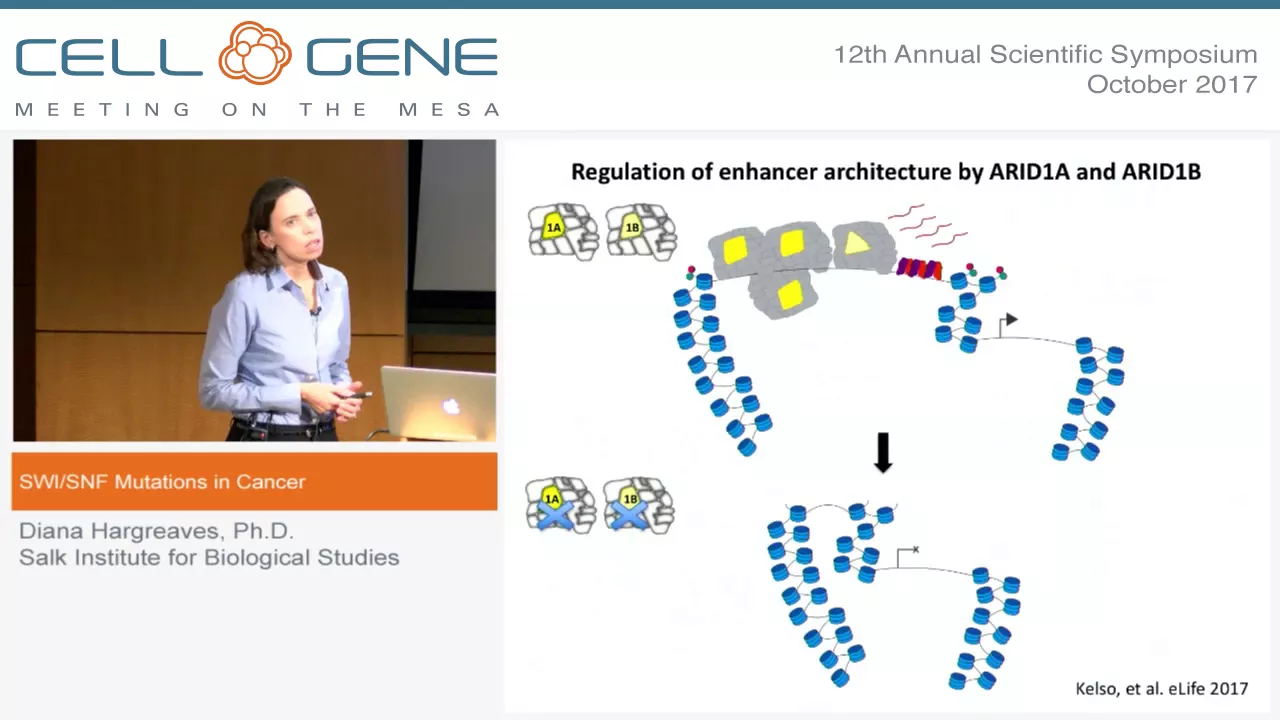
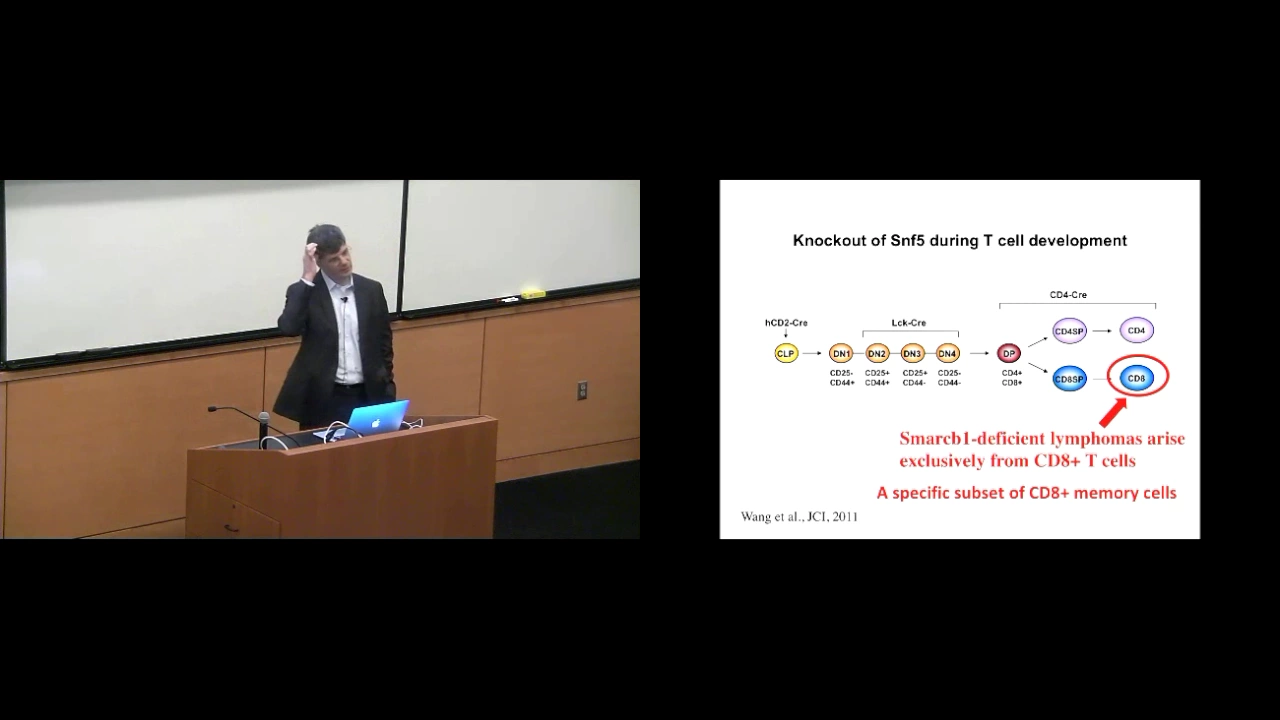


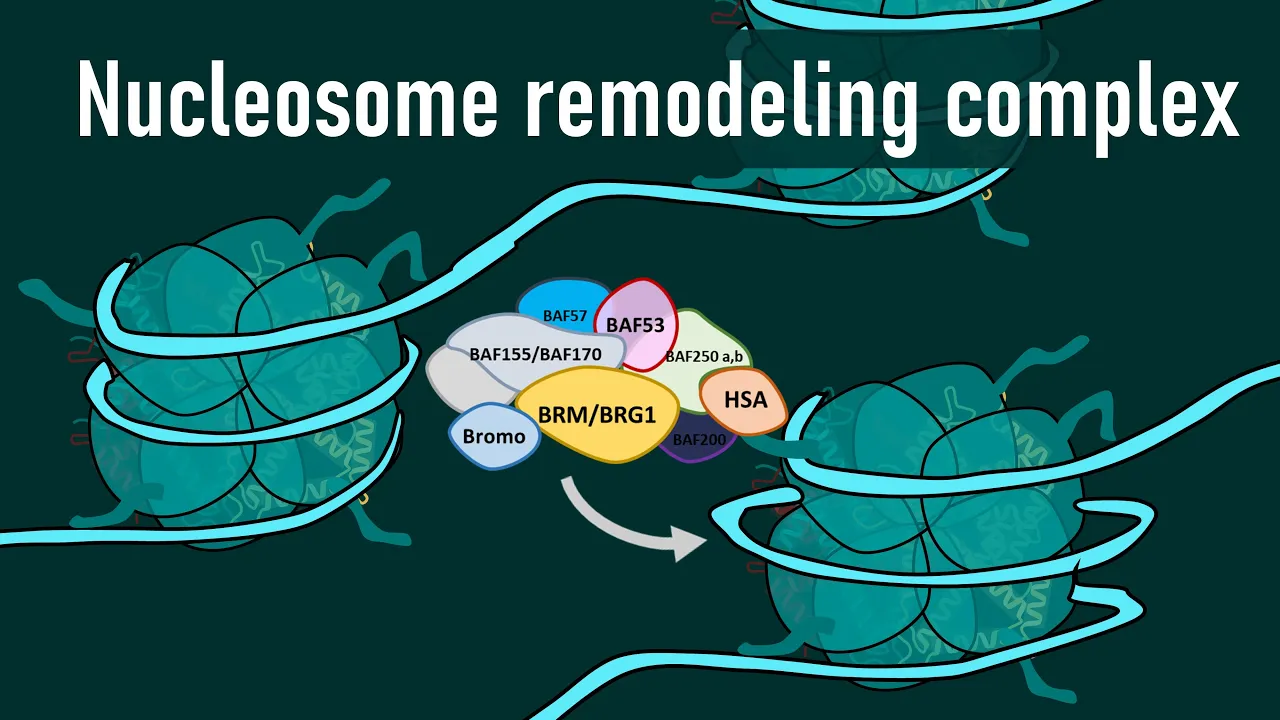






The SWI/SNF chromatin remodeling complex is a multi-subunit protein complex that uses ATP hydrolysis to reposition nucleosomes and alter chromatin structure, thereby regulating gene expression by making specific DNA regions more or less accessible to transcription factors; originally identified in yeast mutants with defective mating type switching and sucrose fermentation, this complex contains a catalytic ATPase subunit belonging to the SNF2 family and can employ multiple mechanisms including DNA looping, nucleosome sliding, histone transfer, and chromatin opening to control gene accessibility.
SWI/SNF Chromatin Remodeling Complex: Mechanism & Function
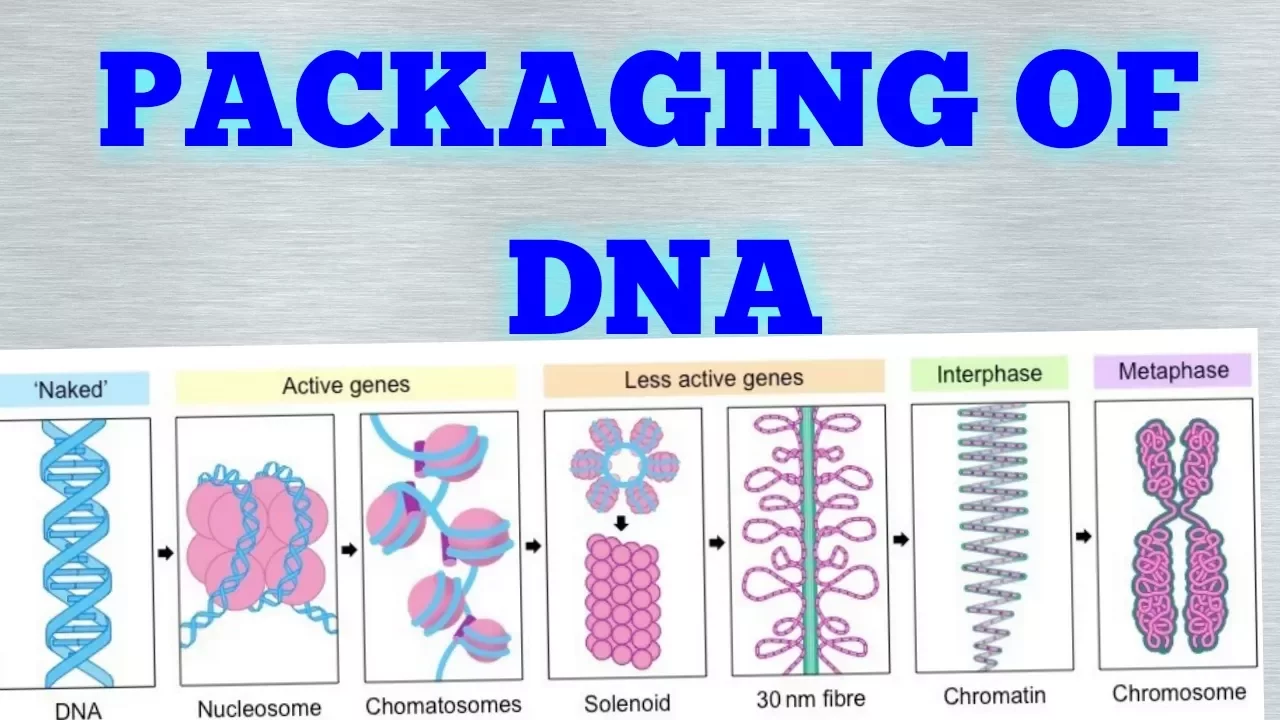
Added:Structure of the nucleosome, including histone octamers, linker DNA, and the 'beads-on-a-string' chromatin organization.
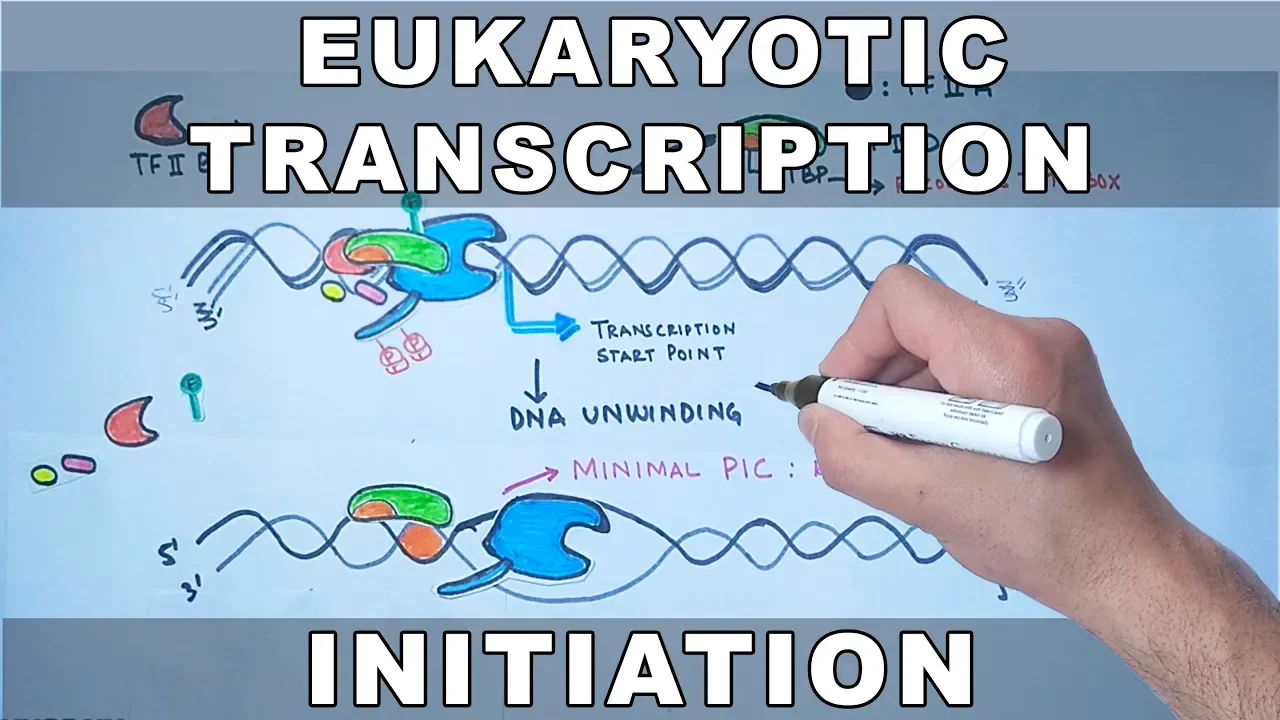
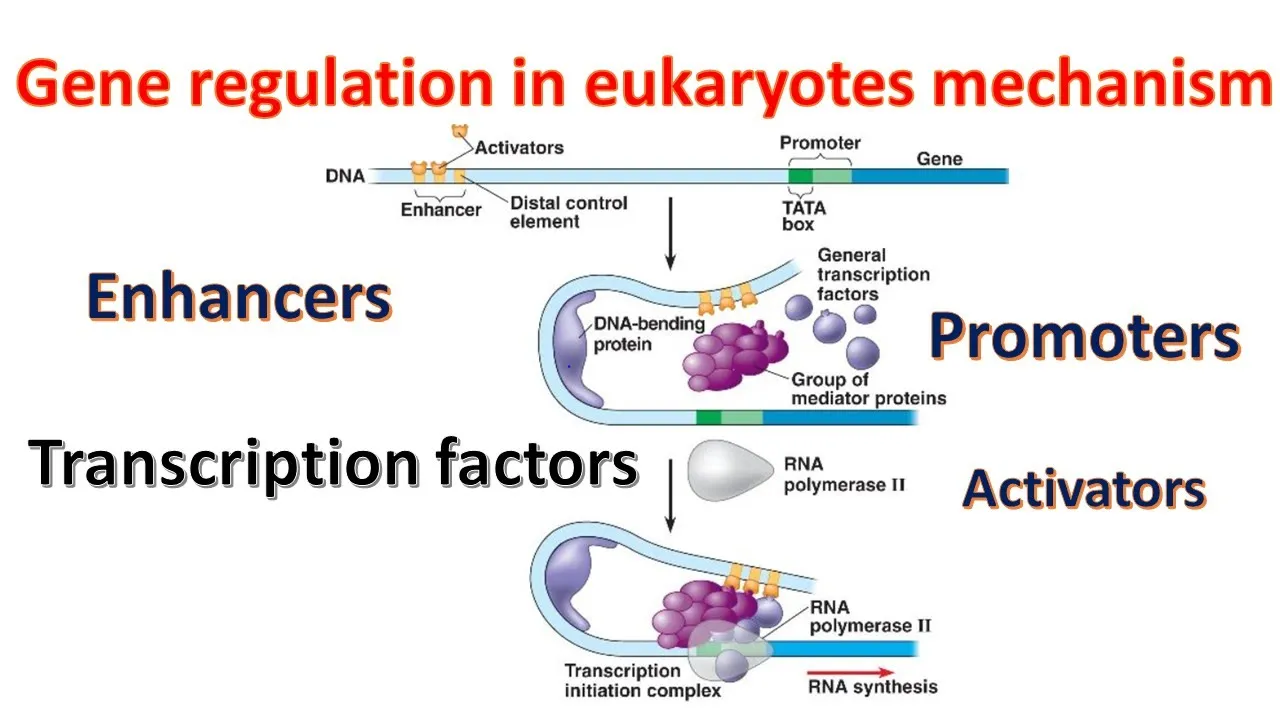
Basic mechanism of eukaryotic gene transcription, including the roles of promoters, enhancers, and RNA Polymerase II.
The concept of chromatin accessibility, specifically the functional differences between transcriptionally active euchromatin and inactive heterochromatin.
The role of ATP hydrolysis in driving conformational changes in biological macromolecules and molecular motors.
The physiological consequences of SWI/SNF mutations, particularly their prevalent role as tumor suppressors in various human cancers.
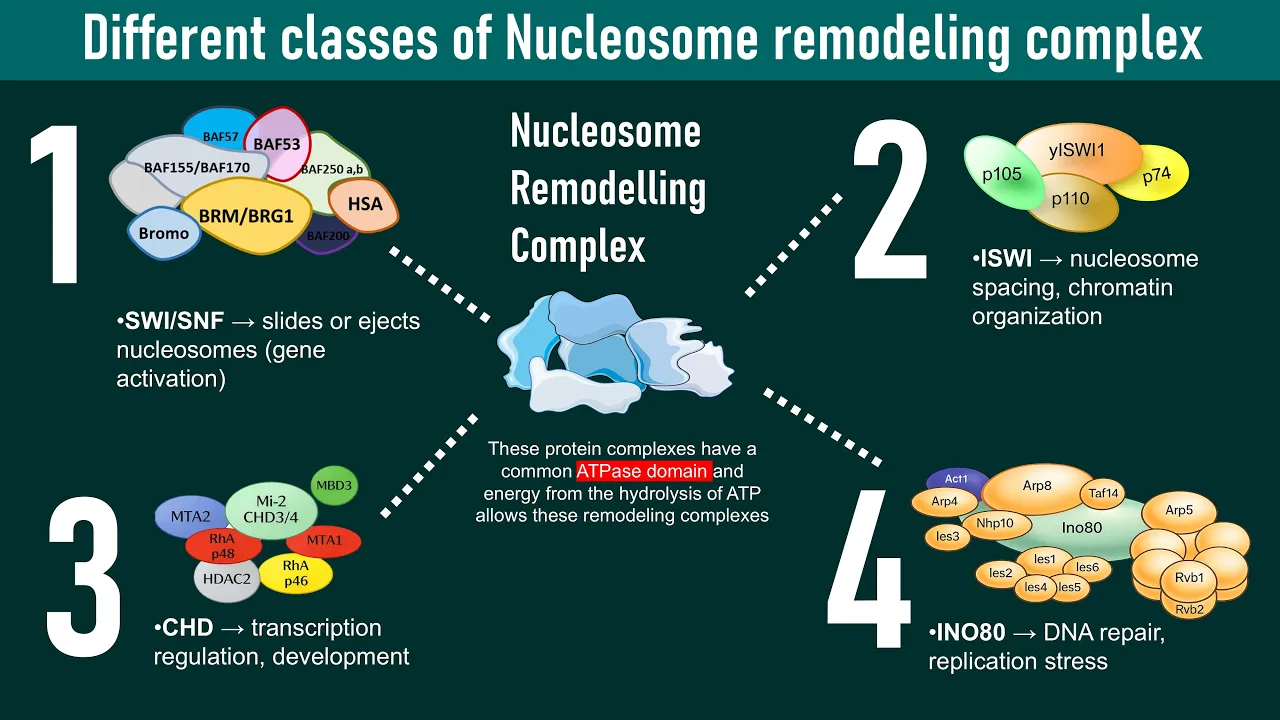
Comparative mechanisms of other ATP-dependent chromatin remodeling families, such as the ISWI, CHD, and INO80 complexes.
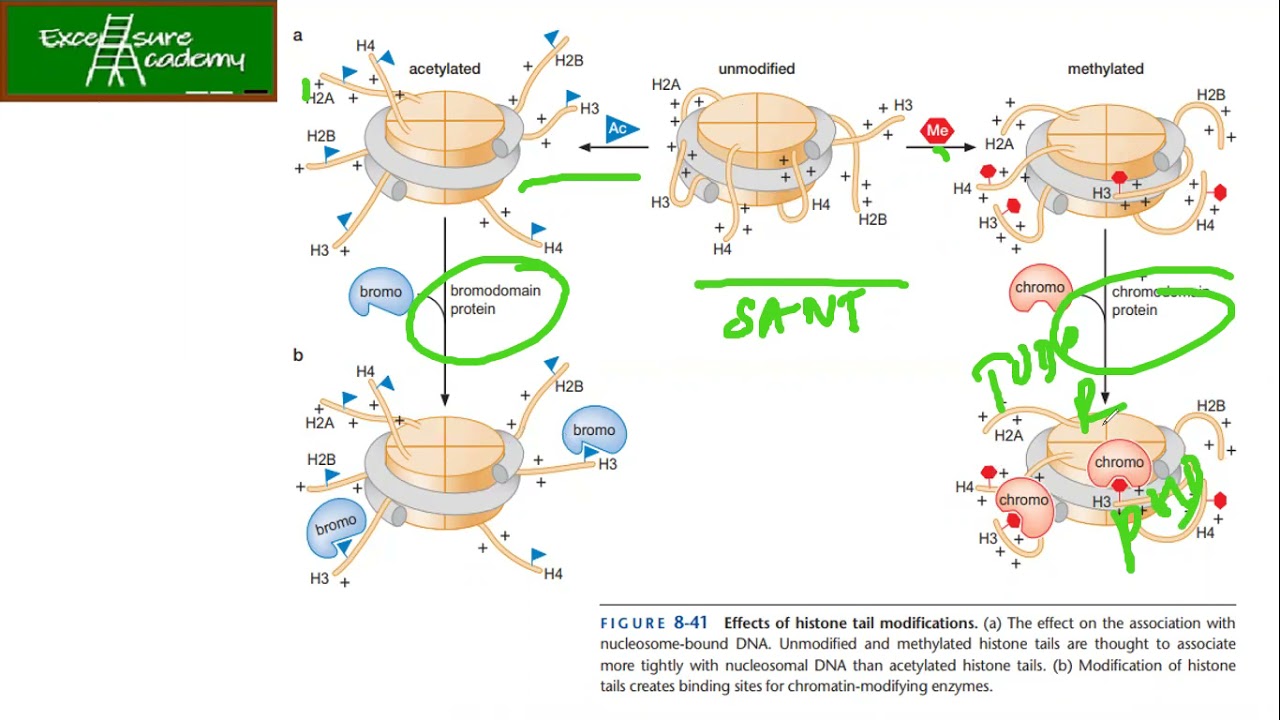
The functional crosstalk between chromatin remodeling complexes and covalent histone modifications (such as acetylation and methylation).
Current therapeutic strategies targeting chromatin remodeling and epigenetic machinery in oncology and regenerative medicine.
592 views16likes10:07Original Release: 2024-10-25
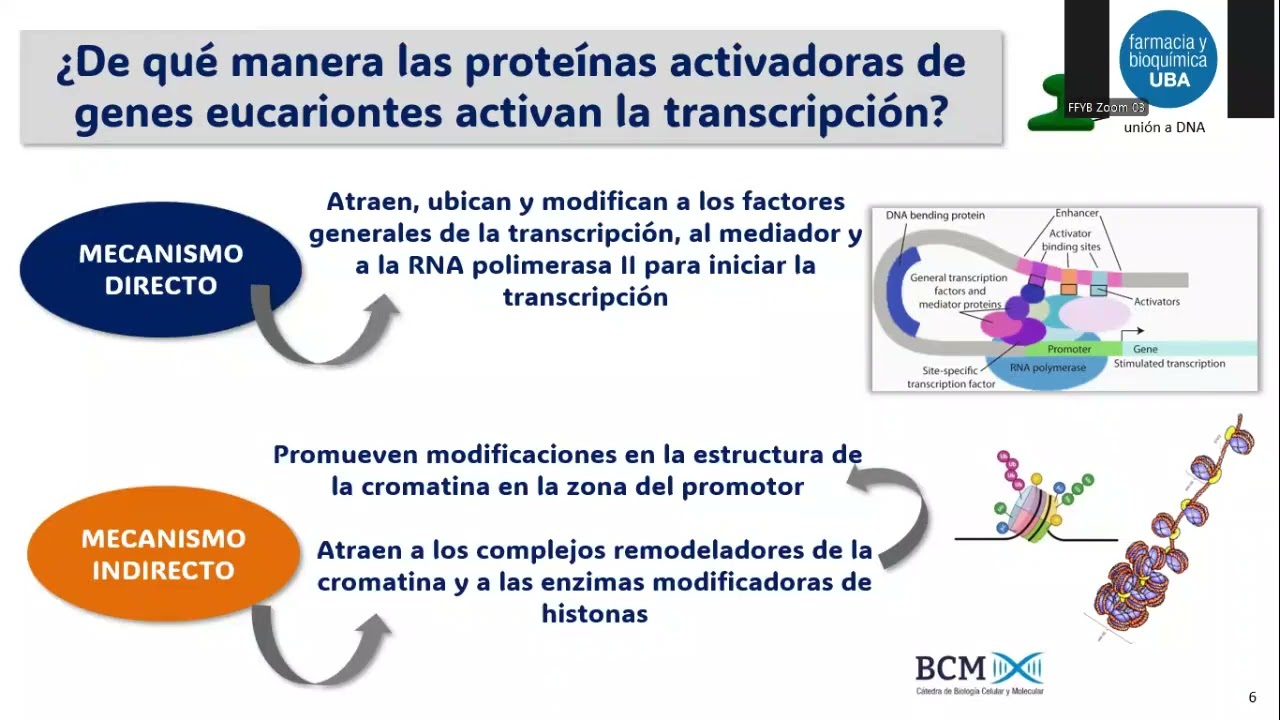
hello and welcome everyone so today we'll be learning about a chromatin remodeling complex which is known as s SNF complex so when researchers were studying East mutants the mutants which had reduced ability to grow in sugr uh media while the mutants which had aberant meeting switching type so while studying those mutants they found out a complex which was Lattin named as C SNF complex so uh a few years later they extracted this complex and the role of this complex in chromatin remodeling was known so the S the s in the S SNF complex stands for switching meting types switching meting type and SNF means sucrose nonfermenting mutants so the complex was found in switching meting type nutrients and sucrose non-fermenting mutant and that's why the complex is named after that so the complex is known as csnf complex nowadays so this csnf complex has a catalytic subunit so it it is made up of a lot of proteins right so it has a catalytic subunit which has atps activity you know atps activity uh which hydrolyzes ATP and that energy is required for chromatin remodeling so it has a atps subunit which belongs to snf2 family of the DNA dependent atpss so this snf2 family of DNA dependent atps have different subfamilies the C SNF family atps family the imitations which atpases which are also known as iswi the Chromo domain and helic like do atpases CHD you remember when we were learning about nucleosomes the nucleosomal assembly we learned about a research paper which was published in 2005 and they used the chd1 this chromatin remodeler to establish the fact that both um histone chapons as well as chromatin remodelers alongside the ATP they enhance the nucleosomal assembly so I hope you remember the CHD one so that is the chrom domain and helicase like domain atps okay and the other one is inositol requiring at I so these are the sub families of the catalytic domain of the chromatin remodeling complexes okay so uh what was Observe that um there are two meeting types in East Alpha and a so when uh when they have the East has to switch those meting types it is possible due to Ho endonuclear this is only possible in the presence of H ucle so the gene encoding hon nucleus is in closed chromatin configuration so then V SNF complex works on this close chromatin and it converts it into the open chromatin configuration so that the gene encoding ho IND nucleus is now accessible so the PO polymer is can come and it can transcribe the Gene and Hendon nucleus is formed so when the S when the East were mutated and it didn't the csnf complexes were mutated it could it was unable to convert this closed chromatin structure to open chromating configuration and that's why it couldn't uh the gene couldn't encode the H IND nucleus and that that's why the aant switching type was observed so uh the mechanism by which s SNF complex works is uh different so let's have a look at the mechanism first so the possible mechanism which was suggested was something like this so assume that this is a DNA this is a DNS brand okay so the V SNF complex this is what's happening just a second okay so assume this is a DNS Strand and this is V SNF complex and this DNA is uted by nucleosomes reminder that this Nu this is not a normal DNA this is a nucleosomal DNA okay so this vnf uh complex can they are recruited by some site specific or sequence specific binding proteins we have already uh learned it in the previous videos you can uh check that in the playlist okay so those side specific binding proteins guide the um chromatin the this complex to the DNA and once this is recruited once this is recruited what happens that it it uh it is recruited um around 20 base pairs Upstream the uh its own binding sequence okay so when it is recruited over here then the catalytic the atps domain the catalytic domain of the V SNF it hydrolyzes ATP okay and this creates the energy so this energy is so due to the help of this energy a DNA Loop is formed okay so a DNA Loop is formed so this is the DNA looping out of the nucleosome okay and now uh the more the more you uh the more you hydroly ATP the longer the DNA Loop becomes so thus due to the looping out of the DNA now this the this region this region is accessible to the transcription factors and the uh and the polymerases okay so that that this is how the C SNF complex works so the major consequence of this process is that when the you know when this DNA is looped out of the nucleosomal structure what happens is that the Linker DNA you know the Linker okay Linker DNA it get it gets shot okay so so what happens this is uh this is nucleosome okay this is uh hisone core around which around which okay this is the so this is the DNA okay so this is the nucleos of core around which the DNA is wrapped so what happens is due to the V SNF complex this DNA Loops out okay so this DNA is now looping looped out so the due to the looping of this DNA the Linker DNA the Linker DNA becomes shorten so imagine that you are pulling this thread from this direction okay you are pulling it from here so when you are pulling it you you're going to form something like this so due to this looping out of DNA this becomes short okay so this is the major consequence of s SNF working so this is how csnf work and uh what does it do so what does v SNF do it either disrupts the nucleosome okay for converting the closed chromatin configuration to open chromatin configuration these are the possible mechanisms which csnf adapts it either disrupts nucleosome or it increases The Binding of transcription factors to nucleosomes it can mobilize nucleosome on the same DNA stretch it can transfer histone OCT to different DNA stretch so due to the transfer of histone octamer now that DNA stretch is available for the transcription it can displace the H2 chumi diers again the DNA Stone interaction is disrupted non-covalently then it it can generate the super helical Torin in DNA it can bind preferentially to DNA and nucleosomes without DNA sequence specificity this is a very important fact that it can bind to the uh nucleosomes without the DNA specific uh DNA sequence specificity it it can interact with transcription factors to localize the chromatin region whose transcription level is to be altered by nucleosome repositioning so these are the all possible mechanisms that csnf complex adapts for making the for changing the chromatin configuration so the protein complex vnf has 12 subunits okay as discussed is it was first discovered in East so the catalytic subunit in the East is known as V SN s SNF in the humans it is known as BF while in drosophila it is known as Bap here let me show you the uh diagram so in the humans it is known as BF uh the hbrm is the center of this BF the catalytic subdomain so along with this catalytic subdomain along with this atps other proteins come together and it forms the Holo complex which performs the chromatin function so that's it for today in the next class we'll learn about the assay for chromatin remodeling till then see you bye-bye
Up Next
5:17
X Chromosome Inactivation: How Women Get Stripy Epigenetics
@veritasium
9.9M views•2014-06-04
50:12
Bacterial Communication: Quorum Sensing and Biofilm Formation Explained
@JHUAAP
12.6K views•2011-06-28

5:35
Enteric Nervous System Explained: The Gut's Brain | Neurobiology Lecture
@alumniu6029
438 views•2018-09-12
7:08
Bacteriophages: Earth's Deadliest Killers and Future Antibiotics
@kurzgesagt
34.6M views•2018-05-13
Related Study Plans & Knowledge Roadmaps
Structured learning paths in Biology
biology
RNAi: Biogenesis, RISC & Gene Silencing
01Molecular Biology Foundations: DNA to Protein
02Introduction to RNA Interference (RNAi)
03Molecular Biogenesis of miRNA and siRNA
+ 2 more learning modules
10h5 modules
Explore Roadmap
biology
Mycorrhizae: Signaling, Biophysics & Ecology
01Foundations of Mycorrhizal Symbiosis
02Molecular Signaling and Root Colonization
03Biophysics and Bioenergetics of Nutrient Exchange
+ 1 more learning modules
11h4 modules
Explore Roadmap
biology
Circadian Clocks: TTFL, SCN & Periphery
01Foundations of Molecular Biology & Gene Expression
02Introduction to Chronobiology and Actograms
03The Core TTFL: Molecular Architecture of the Clock
+ 3 more learning modules
14h6 modules
Explore Roadmap
biology
Population Genetics: Math, Drift & Selection
01Genetic & Probability Foundations
02The Hardy-Weinberg Principle and Baseline Models
03Mathematical Modeling of Natural Selection
+ 3 more learning modules
18h6 modules
Explore Roadmap