






















The nervous system performs three principal functions—sensory input, integration, and motor output—to control all bodily activities. It is organized into the central nervous system (brain and spinal cord) and peripheral nervous system (nerves connecting to the body), with the peripheral system further divided into afferent (sensory) and efferent (motor) divisions. The autonomic nervous system regulates involuntary functions through sympathetic (action) and parasympathetic (rest) divisions. Nervous tissue consists mainly of neurons (signal-transmitting cells) surrounded by glial cells, which outnumber neurons 10:1 and perform critical supportive functions including insulation, protection, and material exchange. Neurons share common structures—the soma (cell body), dendrites (receiving signals), and axons (transmitting signals)—and are classified structurally as multipolar (most common), bipolar, or unipolar, and functionally as sensory (afferent), motor (efferent), or interneurons (association).
Nervous System Anatomy & Physiology: Neurons, Glial Cells | Crash Course
Added:This morning was a typical morning for me. I woke up thinking about that dream that I keep having about the guy in the sloth suit, and then I got dressed because I was cold, and then I made some toast with butter ‘cause I was hungry, and then I let the dog out ‘cause she was whining and staring and me, and then I made some tea but I let it cool off before I drank it because I burned my mouth yesterday.
In addition to being just part of my morning ritual, all of these actions are examples of what my nervous system does for me.
The weirdo dream, the sensation of cold air and hot tea, deciding what to put on the toast, going to the door at the sound of the dog -- all that was processed and executed by electrical and chemical signals to and from nerve cells.
You can’t oversell the importance of the nervous system.
It controls ALL THE THINGS!
All your organs, all your physiological and psychological reactions, even your body’s other major controlling force, the endocrine system, bows down before the nervous system.
There is no “you” without it. There is no “me” without it. There’s no dogs without it. There’s no animals. There’s no -- there’s no things -- there’s things.
It’s important. That’s why we’re dedicating the next several episodes to the fundamentals of the nervous system -- its anatomy and organization, how it communicates, and what happens when it gets damaged.
This is mission control, people!
Even though pretty much all animals -- except super simple ones like sponges -- have a nervous system, ours is probably the most distinctive feature of our species.
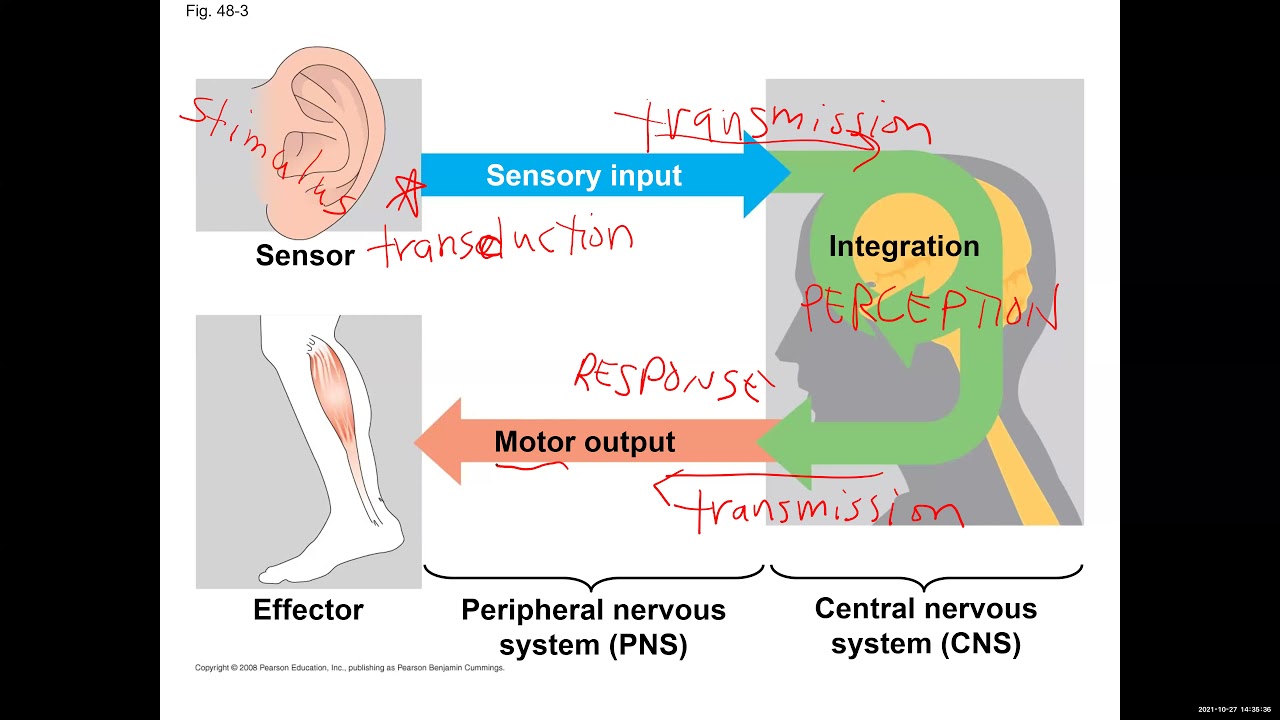
From writing novels, to debating time travel, to juggling knives -- all of your thoughts, and actions, and emotions can be boiled down into three principal functions -- sensory input, integration, and motor output.
Imagine a spider walking onto your bare knee.
The sensory receptors on your skin detect those eight little legs -- that information is your sensory input.
From there your nervous system processes that input, and decides what should be done about it. That’s called integration -- like, should I be all zen about it and just let it walk over me, or should I not be zen and freak out and run around screaming, “SPIDER!”?
Your hand lashing out to remove the spider, and maybe your accompanying banshee scream, is the motor output -- the response that occurs when your nervous system activates certain parts of your body.
As you can imagine, it takes a highly integrated system to detect, process, and act on data like this, all the time.
And when we talk about the nervous system, we’re really talking about several levels of organization, starting with two main parts: the central and peripheral nervous systems.
The central nervous system is your brain and spinal cord -- the main control center. It’s what decided to remove the spider, and gave the order to your hand.
Your peripheral system is composed of all the nerves that branch off from the brain and spine that allow your central nervous system to communicate with the rest of your body.
And since its job is communication, your peripheral system is set up to work in both directions: The sensory, or afferent division is what picks up sensory stimuli -- like, “hey, there’s an arachnid on you” -- and slings that information to the brain.
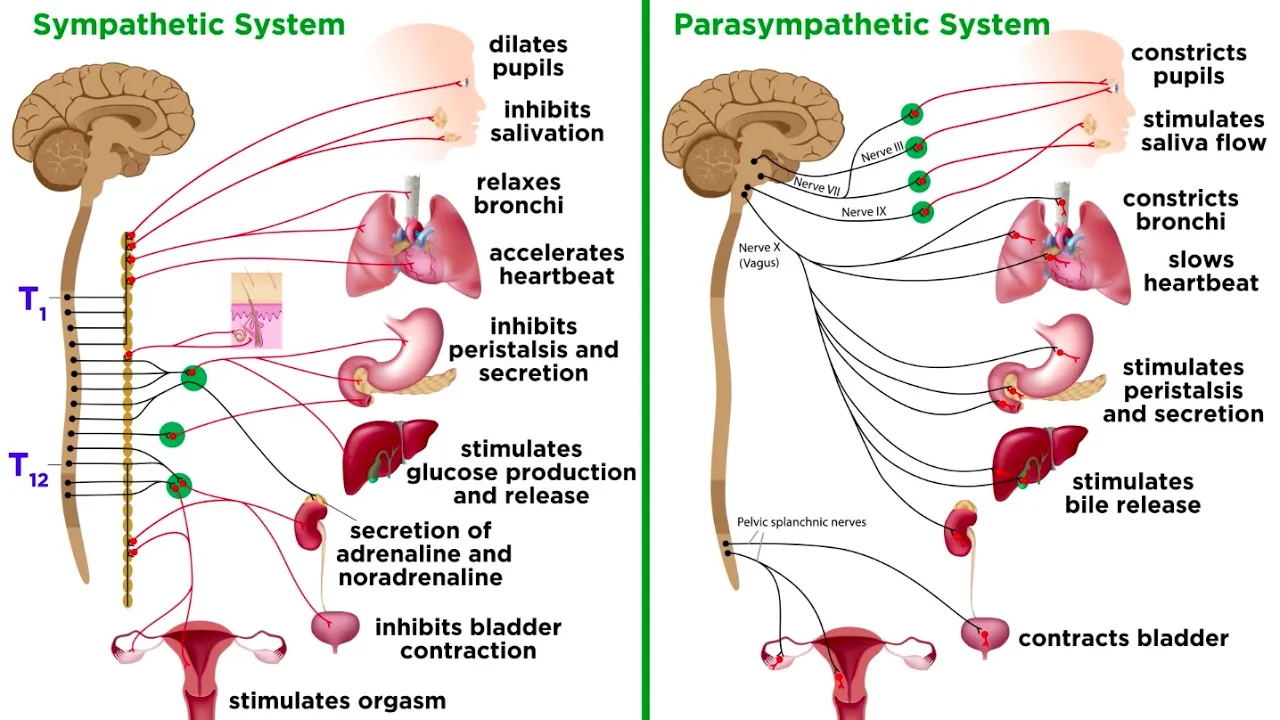
Your motor, or efferent division is the part that sends directions from your brain to the muscles and glands -- like, “hey hand part, how ‘bout you do something about that spider.” The motor division also includes the somatic, or voluntary nervous system, that rules your skeletal muscle movement, and the autonomic, or involuntary nervous system, that keeps your heart beating, and your lungs breathing, and your stomach churning.
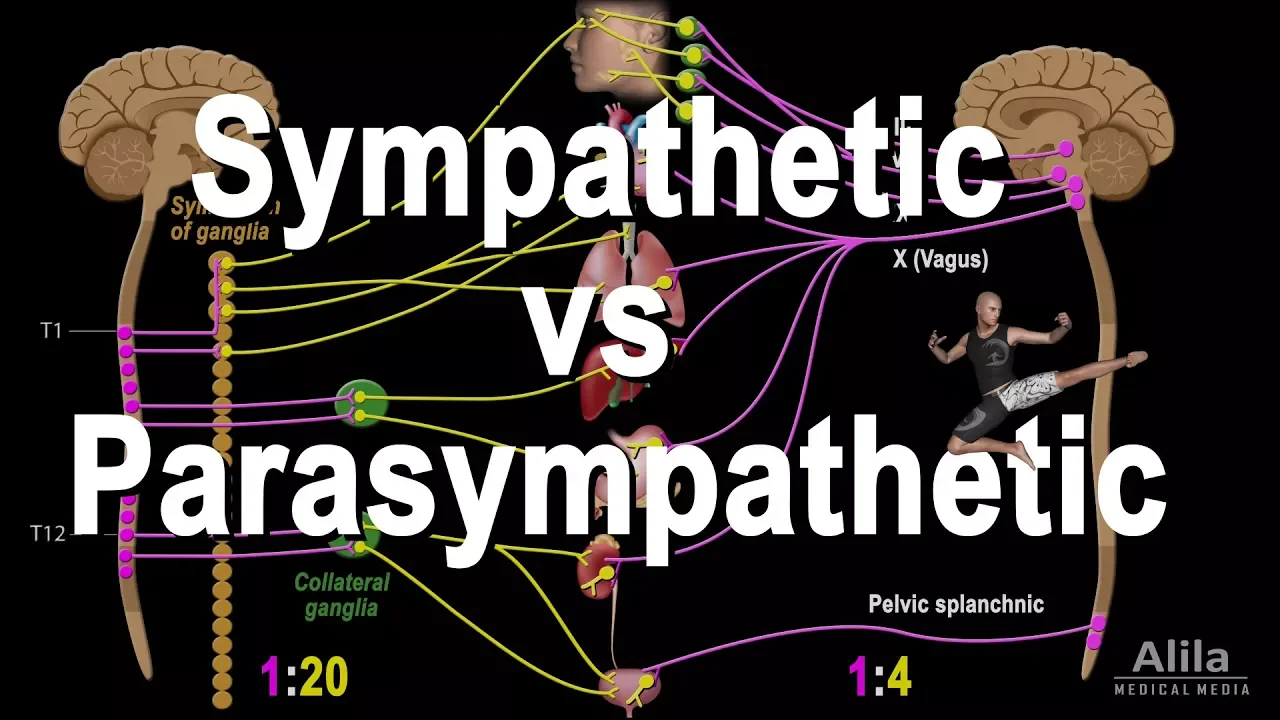
And finally, that autonomic system, too, has its own complementary forces. Its sympathetic division mobilizes the body into action and gets it all fired up, like “Gah! SPIDER!” -- while the parasympathetic division relaxes the body and talks it down… Like, “it wasn’t a black widow or anything; you’re fine, breathe!” So that’s the organization of your nervous system in a nutshell. But no matter what part you’re talking about, they’re all made up of mainly nervous tissue, which you’ll remember is densely packed with cells.
Maybe less than 20 percent of that tissue consists of extracellular space. Everything else? Cells.
The type of cells you’ve most likely heard of are the neurons, or nerve cells, which respond to stimuli and transmit signals.
These cells get all the publicity -- they’re the ones that we’re always thanking every time we ace an exam or think up a snappy comeback to an argument.
But these wise guys really account for just a small part of your nervous tissue because they are surrounded and protected by gaggles of neuroglia, or glial cells.
Once considered just the scaffolding or glue that held neurons together, we now know that our different glial cell types serve many other important functions, and they make up about half of the mass of your brain, outnumbering their neuron colleagues by about 10 to 1.
Star-shaped astrocytes are found in your central nervous system and are your most abundant and versatile glial cells. They anchor neurons to their blood supply, and govern the exchange of materials between neurons and capillaries.
Also in your central nervous system are your protective microglial cells -- they’re smaller and kinda thorny-looking, and act as the main source of immune defense against invading microorganisms in the brain and spinal cord.
Your ependymal cells line cavities in your brain and spinal cord and create, secrete, and circulate cerebrospinal fluid that fills those cavities and cushions those organs.
And finally your central nervous system’s oligodendrocytes wrap around neurons, producing an insulating barrier called the myelin sheath.
Now, over in your peripheral nervous system, there are just two kinds of glial cells. Satellite cells do mainly in the peripheral system what astrocyte cells do in the central system -- they surround and support neuron cell bodies. While Schwann cells are similar to your oligodendrocytes, in that they wrap around axons and make that insulating myelin sheath.
So don’t sell your glial cells short -- they’re in the majority, cell-wise. But of course when it comes to passing tests and winning arguments, most of the heavy lifting is done by the neurons. And they’re not all the same -- they’re actually highly specialized, coming in all shapes and sizes -- from tiny ones in your brain to the ones that run the entire length of your leg.
But they do all share three super-cool things in common.
Number 1. They’re some of the longest-lived cells in your body. There’s a lot of debate right now about whether you’re actually born with all of the neurons you’ll ever have, but some research suggests that, at least in your brain’s cerebral cortex, your neurons will live as long as you do.
Cool fact number 2. They are irreplaceable. It’s a good thing that they have such longevity, because your neurons aren’t like your constantly- renewing skin cells. Most neurons are amitotic, so once they take on their given roles in the nervous system, they lose their ability to divide. So take care of ‘em!
And number 3. They have huge appetites. Like a soccer-playing teenager, neurons have a crazy-high metabolic rate. They need a steady and abundant supply of glucose and oxygen, and about 25 percent of the calories that you take in every day are consumed by your brain’s activity.
Along with all these wonderful qualities, your neurons also share the same basic structure.
The soma, or cell body, is the neuron’s life support. It’s got all the normal cell goodies like a nucleus, and DNA, mitochondria, ribosomes, cytoplasm.
The bushy, branch-like things projecting out from the soma are dendrites. They’re the listeners -- they pick up messages, news, gossip from other cells and convey that information to the cell body.
The neuron’s axon, meanwhile, is like the talker. This long extension, or fiber, can be super short, or run a full meter from your spine down to your ankle. We’ve got a few different axon layouts in our body, but in the most abundant type of neuron, the axons transmit electrical impulses away from the cell body to other cells.
For us students of biology, it’s a good thing that nerve cells aren’t all identical.
Because their differences in structure are one of the ways that we tell them apart, and classify them.
The main feature we look at is how many processes extend out from the cell body.
A “process” in this case being a projecting part of an organic structure.
99 percent of all your neurons are multipolar neurons, with three or more processes sticking out from the soma -- including one axon, and a bunch of dendrites.
Bipolar neurons have two processes -- an axon and a single dendrite -- extending from opposite sides of the cell body. They’re pretty rare, found only in a few special sensory places, like the retina of your eye.
Unipolar neurons, on the other hand, have just one process, and are found mostly in your sensory receptors.
So, if you ever find yourself probing around someone’s nervous tissue, remember these three terms to help you figure out what you’re looking at.
But because we’re talking physiology here as well as anatomy, we have to classify these cells in terms of their function, and that basically comes down to which way an impulse travels through a neuron in relation to the brain and spine.
Our sensory, or afferent, neurons pick up messages and transmit impulses from sensory receptors in say, the skin or internal organs, and send them toward the central nervous system.
Most sensory neurons are unipolar.
Motor, or efferent, neurons do the opposite -- they’re mostly multipolar, and transmit impulses away from the central nervous system and out to your body’s muscles and glands.
And then there are interneurons, or association neurons, which live in the central nervous system and transmit impulses between those sensory and motor neurons. Interneurons are the most abundant of your body’s neurons and are mostly multipolar.
OK! It’s applied knowledge time! Let’s review everything we’ve learned so far in terms of that spider on your knee.
Those eight creeping legs first activate your unipolar sensory neurons in the skin on your knee, when they sense something crawling on you. The signal travels up an axon wrapped in Schwann cells and into your spinal cord, where it gets passed on to several multipolar interneurons.
Now, some of those interneurons might send a signal straight down a bunch of multipolar neurons to your quadriceps muscle on your thigh, triggering you to kick your leg out before you even know what’s going on.
Other interneurons will pass that signal to neurons that carry it up your spinal cord to your brain.
That’s where your body first recognizes that thing as a spider, and the connections between neurons interpret and split the signal so that you can either scream, and start swinging your arms wildly about...or...remain calm, and with dignity remove the spider from your person.
It’s all based on the connections between neurons.
Which brings me to a whole new question: How?
How in the name of Jean-Martin Charcot do nerve cells use chemistry and electricity to communicate with each other?
It’s one of the most stupifyingly awesome and complicated aspects of your nervous system, and basically of all life and it is what we will cover in our next lesson.
Today you learned how sensory input, integration, and motor output of your nervous system basically rules your world. We talked about how the central and peripheral systems are organized, and what they do, and looked at the role of different glial cells in nervous tissue function.
We also looked at the role, anatomy, and function of neuron types in the body, both structurally and functionally, and how everything plays out when you find a spider crawling on your skin.
Thank you for watching, especially to all of our Subbable subscribers, who make Crash Course possible for themselves and for the whole rest of the world. To find out how you can become a supporter, just go to subbable.com.
This episode was written by Kathleen Yale, the script was edited by Blake de Pastino, and our consultant is Dr. Brandon Jackson. It was directed by Nicholas Jenkins and Michael Aranda, and our graphics team is Thought Café.
Up Next
Enteric Nervous System: Myenteric & Meissner's Plexus
@EduClubOfficial
125.8K views•2020-10-15

Bacterial Communication: Quorum Sensing and Biofilm Formation Explained
@JHUAAP
12.6K views•2011-06-28

Population Genetics: Darwin Meets Mendel | HHMI BioInteractive
@crashcourse
1.8M views•2012-05-28
Bacteriophages: Earth's Deadliest Killers and Future Antibiotics
@kurzgesagt
34.6M views•2018-05-13
Related Study Plans & Knowledge Roadmaps
Structured learning paths in Biology