
























Entropy is fundamentally a measure of the number of microstates (specific microscopic arrangements) corresponding to a macrostate (observable state), not disorder; this statistical definition explains why irreversible processes like gas expansion and coffee-milk mixing occur naturally - because high-entropy macrostates have vastly more microstates and are therefore overwhelmingly probable, making entropy increase the statistical norm rather than a physical law.
Entropy and the Second Law of Thermodynamics Explained
Added:The First Law of Thermodynamics and the concepts of thermal energy, heat, and work.
Basic probability and combinatorics, specifically how to calculate permutations and combinations.
The Kinetic Theory of Gases and the molecular definition of temperature and kinetic energy.
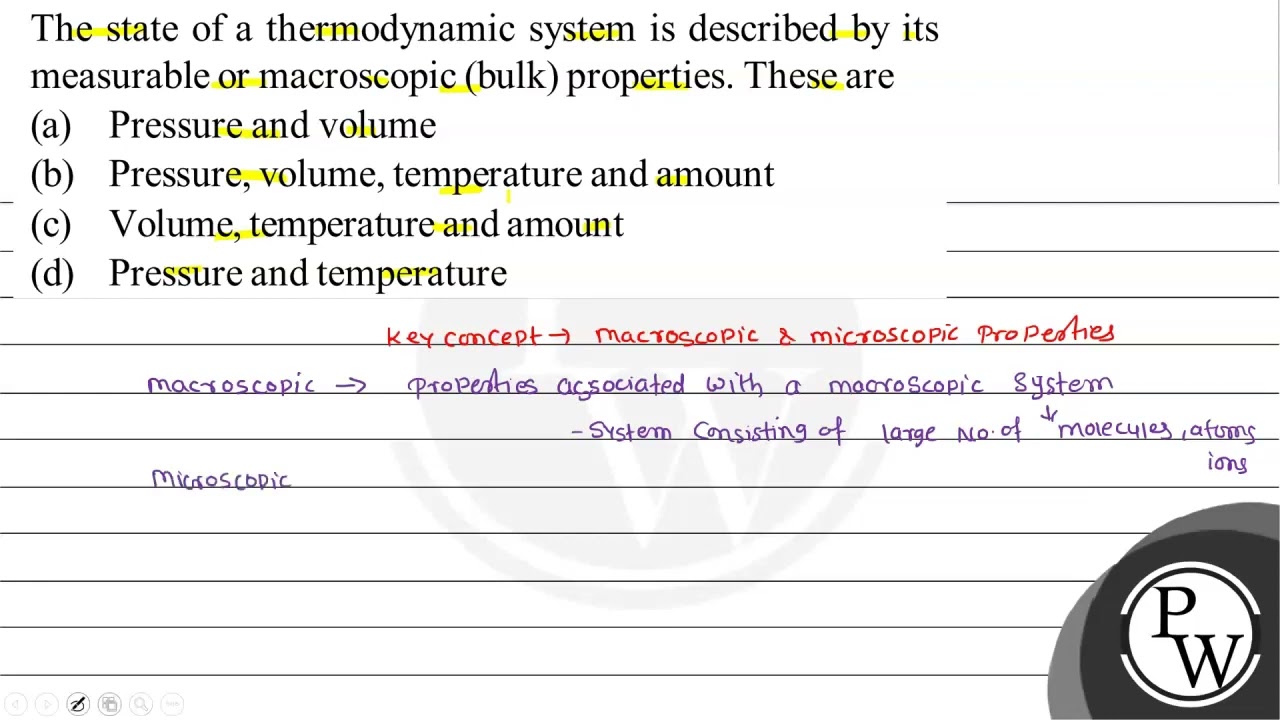
The distinction between macroscopic properties (like pressure and volume) and microscopic components of a system.
Statistical Mechanics, including Boltzmann's entropy formula (S = k ln W) and partition functions.
The Carnot Cycle and how the Second Law of Thermodynamics limits the efficiency of heat engines.
Information Theory and Shannon Entropy, exploring the deep connection between physical entropy and data.
Cosmological implications of entropy, such as the thermodynamic arrow of time and the 'heat death' of the universe.
327.1K views16Klikes31:58Original Release: 2024-11-14
this video is sponsored by ground news I used to think that entropy is a measure of disorder um if you look at my room for example this is pretty ordered so it's very low entropy but give it a few hours and it'll become highly disordered very high entropy so look the entropy of the universe naturally tends to increase the second law of Thermodynamics it all makes perfect sense or does it if you pour milk into coffee then there's a point in time where the milk and the coffee are just mixing together right but then after a few more minutes if you give it some time then eventually it'll all be nice and mixed so look over here did the universe just go from highly disordered to being ordered meaning did the entropy of the universe decrease no this is actually low entropy State and this is actually High entropy state but how does that make any sense and when you think from the point of view of order and disorder it was all confusing for me and that's why entropy and second La of therms actually did not make a lot of sense until I started reading P1 lectures oh my God then my mind was blown so the goal of this video is not just to ReDiscover the ideas of entropy or the second law of themodynamics no no no it's also to gain a deep intuition behind why it's called the error of time or how it makes its way into information Theory or how does it even allow life to exist in the first place so if you're ready for this let's begin so fman where do we start fman says mahes since we on a journey of rediscovery forget what whatever you know about entropy or second law of Thermodynamics which is easy for me and look at these two videos one of them is a video that's being played in forwards and another one is just the reverse of it which one is the reverse and I'm like that's pretty easy the second one because coffee and milk spontaneously does not unmix itself so that's the Reversed one but Fon asks why I mean look at it at the microscopic level if you could see individual atoms or molecules in motion then in one of the cases you might see a motion that looks like this it's completely called lighting and it's moving in a very random manner now if you look at the reverse of it it looks like this and fin ask mes now can you tell which is going forward in time and which is going backwards in time and I'm like no now you can't tell both of them look like they're going forward in time there's there's no distinction between them so this means at the microscopic level you know you cannot tell whether atom's motion or moleculars motion is going forwards or backwards in time and yet if you look at the collection of these very same atoms at a microscopic level you can tell whether you're looking at something that's going forwards or backwards in time in other words atoms or moleculars motion is completely reversible the laws of physics whether you consider classical mechanics or quantum mechanics whatever does not care about going forwards or backwards in time does not distinguish between them so it's completely reversible and yet at the macroscopic level the collection of these very same atoms and molecules their processes are are purely irreversible how how do you get these irreversible processes from completely reversible events that is a key question and I'm like wow you know people say that learning is about asking the right question and this is a profound question how do you get irreversibility from completely reversible microscopic events what's going on over here fan well since the motion of every single particle like atoms or molecules is complet completely reversible the answer does not lies in physics but because when you consider the collection of large number of atoms or molecules that's where the irreversibility comes which means the answer actually should lie in statistics wow but fin one statistics I'm pretty bad at it and F says don't worry we'll do it step by step in fact we'll start with a warm-up example consider you have 10 marbles with you and you have a box and you're going to close your eyes and you're going to throw these marbles randomly into the box after throwing all of 10 of them you'll get some pattern right I'm going to show you two patterns and you have to tell me which one's more likely so here's the first one you might get a pattern that looks like this after throwing them into the box and the second pattern you might get it looks like this mahes which of these two patterns look more likely to you once you have thrown them randomly in fact if you can answer this correctly then that's it you'll be able to ReDiscover everything else all by yourself so those Saks are pretty high I'm like that's peasy the second one and F's like why I'm like well that's because what I mean what's the chances of it getting like you know all the marbles lining up right next to each other that should be very low the second one therefore is much more likely and Fon says all right let's compute this and I'm like wait a second how do we do the math that looks complicated no no no we'll we'll simplify in fact what we can do over here is we can um assume that there are five rows and there are you know eight columns which means there are total of 40 slots now come come over here and think of it this way okay mahes what is the you know probability of the first marble which you throw lands exactly over here how do you compute that well think about it there are slots and the chances of Landing in in any one of these slots is exactly the same so the probability of Landing in this particular slot is 1 out of 40 right okay now what is the chance of the second marble Landing over here well again now there are 39 slots available I mean we we can assume that if it lands on top of this marble we will repeat the experiment okay so there are 39 marble slots available and each one is equally likely so now the chances of Landing over here is 1 over 39 similarly the chances of Landing over here is 1 over 38 and so on and so forth and of course we need to do a little bit more work to actually compute the probability but that's not important what matters is this is how we would go about it right if you do the first one now let's try do the second one and see what we get again mahes what is the chance of the first marble Landing over here exactly it's 1 over 40 what about the second marble Landing over here 1 over 39 and so on and so forth this means the probability that you would get for this specific pattern is exactly the same as you would get for this pattern they're both equally likely or both equally unlikely wait a second that why why that does not make any intuitive sense what's going on over here well think of it this way here you said what are the chances that all the marbles will land right next to each other so this must be highly unlikely right but the same is the case over here what is the CH what are the chances that you know one marble lands exactly one square to the right another marble lands exactly two squares to the left and so on and so forth if you think of it that way even this pattern is very very unlikely isn't it yeah that makes sense so that means any pattern must have the same probability yes any pattern you take must have exactly the same probability it's just that the pattern on the top looks much more ordered to us and therefore we think that it's much more rare but as the match shows us it's not any more rare than any other pattern that you take which is incredible if you think about it but F why did my brain make that mistake because I did not pause and try to verify my conclusion as a result I had an error in my judgment and that's a simple this is a simple example mes but consider what would happen if you were reading an article like this astronaut rushed to the hospital after returning to Earth with a mystery medical condition you might conclude that there must be some mystery space dis is going on over here and you might have even more questions like which astronaut over here is this even real or fake but by going to ground news I can see that this article is actually covered by 87 different sources which gives me more confidence in it and if I read other headlines I will immediately see that oh this is about Sunita Williams and uh she was in space for over 8 months and the main problem over here was Extended Stay in space in a few seconds we got way more confidence and context in this news and that's why I love ground news who are sponsoring this video one of my favorite features over here is how I can immediately see the factuality r here you can see that 75% of the sources are rated high and I can just filter the high factuality ones like physics.org and then just go over and read that news article in detail ground news also has a blind spot feature which highlights stories that are heavily covered by one set of the political Spectrum but under reported on the other this way you can see what you might be missing and get a fuller view of the news it's a simple way to spot gaps in coverage and make sure you're getting a balanced perspective and I think ground new is so cool because it was founded by a former NASA engineer to make news easier to understand without telling you what to think with bias ratings coverage from different perspectives and factuality scores it helps you see the full picture and you can make up your own mind so if you go to ground. news/ flad or just scan this QR code you'll get a 50% off on their Vantage subscription and remember when you're supporting my sponsor you're also supporting my channel so now back to rediscovering OV now let's see if you can answer an original question using a simple example let's consider a gas which is trapped in one corner of a a small box and then we'll let go of it and we know naturally that the gas tends to expand again this is irreversible yet at the microscopic level we know that all the molecules are you know their motion is completely irreversible so why does this happen well let's see if we can answer this question first of all we can identify three distinct stages of this particular gas let's say it goes from being in one corner to it occupying the half of the box and then occupying the complete box over there our big question is why doesn't it go backwards let's try to answer this question by looking at things microscopically so over here in this particular case we can model this by saying hey it's kind of like that marble where we have 40 slots but we are restricting those 10 marbles to only 10 slots because we're asking them to be in one particular Corner how many ways can you arrange that well if you have 10 Marbles and you have to restrict them to just 10 slots there's only one way to arrange that like this so there's only one Arrangement available to get this particular um this particular state but now for this particular State it's kind kind of like modeling it and saying that hey now those 10 marbles can occupy you know half the box which means about 20 slots they can occupy 20 slots how many ways can you arrange them well now there are a lot of ways you can arrange them because there'll be a lot of empty spaces right in fact if you do the math it turns out the total number of Arrangements would be a staggering about.18 million that many Arrangements will now be available for this particular State and finally for the fully exponent gas we can model it by saying that hey now these 10 marbles can occupy all the 40 Slots of our box and now because there are more empty spaces there are even more Arrangements available over here in fact if you add them up turns out you'll get 850 million Arrangements again the numbers are not important how we got that is not important but you can kind of intuitively Mak sense right more empty space means more number of ways you can arrange them so the number should be very high so look the total number of Arrangements we have is 850 +18 + 1 which is about 850 million Arrangements all right so now let's let's imagine that our gas is in this state our question is what's going to happen in the future well it can go backwards right because at the microscopic level everything is reversible so it can go backwards but what is the probability let's figure that out what's the probability of it going backwards well if it has to go backwards then how many Arrangements do we have that goes backwards well there's only one Arrangement belonging to this particular thing out of 850 million arrangements so if all of these arrangements are equally likely the chances of this Arrangement spontaneously occurring from here is 1 over 850 million and the chance of that is almost zero that's why the chances of gas going back is almost zero similarly what is the chance that the gas can stay in that same Arrangement because they have so many Arrangements it's possible the gas can stay in that same state well again there are.18 million Arrangements available for this particular state so the chances of you know picking any one of these is18 million out of the total 850 million which is is again almost zero so the chances of gas staying in that state is also pretty much zero now what is the chances that the gas goes to this state well for that we ask how many arrangements are available there are 850 almost all the arrangements over here belongs to this state so the probability of getting that is almost 100% so look right in front of your eyes we have the answer to our original question why is it that even though at the microscopic level things are reversible each every single Arrangement is equally likely so things are reversible what happens at a macroscopic level at the macroscopic level the number of Arrangements belonging to this one is so much low that it cannot go backwards for all practical purposes the chances of going backwards is zero there and the number of Arrangements available for this one is so much High the the chances of it going forward is much more you know it's almost 100% and that's why at the macroscopic level it goes in One Direction things tend to be IR reversible does that make sense so now we can Define what entropy is let's first introduce some jargons what we see at the microscopic level we call them macro States so macro state is basically what you see at the macros level um there are three differ macro States over here okay now for each Macro State the number of different Arrangements that you have is what we call the micro States because that's the microscopic level all right now what is entropy entropy is a measure of of the number of micro States that's what we Define entropy as and now we can understand why this is low entropy because it has only one micro State and therefore very low entropy but this one has a lot of micro States so there is very high entropy and so if you take any system the chances of the entropy decreasing is negligibly low and that's why we can now intely come up with second law of Thermodynamics which would we can say that the entropy of an isolated system will never decrease beautiful isn't it but fin then wait a second shouldn't we say that the entropy of a closed system and we'll come back to closed system a little bit later as to why it is called a closed system anyways shouldn't it be shouldn't we say that it is most it will most likely not decrease because it's all about probability there's a good chance I mean there's a very tiny chance it can decrease well fan says yeah technically mahes you're right but look at the numbers I mean even with just 10 Marbles and 40 slots look the chances of it going back is so low now imagine what would happen in the realistic case where we have 10 to the 27 atoms and we're dealing with so many more empty spaces and so many more slots the chances of it going back would be astronomically low so yes technically there's a small chance that a gas in a room will spontaneously go into a corner but the probability of that is ridiculously small it's so small that you'll have to wait more than the age of the universe something like that right and so what's fascinating to me is that this whole irreversibility is just probabilistic it's not laws of physics but it's the laws of statistic it's math that makes things irreversible that is awesome anyways we can now also understand the whole idea behind order and disorder when we say something is ordered we basically mean a macro state in which there are less number of micro States less number of way to arrange that and we say something is disorder what we really mean is a macro state in which there are more number of micro States more number of ways to arrange that that's what we mean but now that we have a much more concrete definition of micro State and micro States let's not use the word order and disorder anymore now let's go back to our coffee and the milk example why does it go from this state completely being you know separated to mixing together why doesn't it go backwards well again if we can model it we can say that this one is kind of like having a micro State like this there's only one arrange for that and therefore this has the lowest entropy lowest number of micro States over here it's kind of like saying that hey you know what you can mix or here in this particular section probably coffee and milk particles can mix so now we start getting more number of Arrangements available and so the number of micro States increases and therefore the entropy is higher okay but in this particular case it's kind of like saying hey you know what the coffee particles and milk particles can occupy whatever States It Whatever slots it wants and now you will have the highest number of arrangements for this and therefore this is the highest entropy and so now you can see why is this low entropy because there are less number of micro States this is high entropy because there are more number of micro States and naturally you tend to go from a macro state of low entropy to a macro state of high entropy its probability beautiful isn't it and this now explains why entropy decides the arrow of the time if you look at things at a microscopic level you can't tell whether you're looking at an evolution that's going forward in time or you're going backwards in time because all micro states are equally likely so there is no error of time at the microscopic level but it's only when you look at its corresponding macro States the picture becomes much more clear it is evident that as we go forward in time we can only go towards macro state that has high entropy because that's a high probability chance and that's the reason why at a macroscopic level things are irreversible giving us a particular Arrow of time from the past to the Future so what's profound and blows my mind away is that the arrow of time does not come from physics it actually comes from statistics and probability that is insane if you ask me understanding why entropy of an isolated system can never decrease makes perfect sense when you think in terms of micro States or does it finally I think I can break the second law of Thermodynamics very easily just go back to that particular gas and I'm just going to introduce a piston over here and I'm just going to flick that piston and then look the gas gets compressed doesn't that mean that the entropy of the gas is reduced I've brok on the second law of thermodynamics now in my heart I know this does not break the second law of Thermodynamics but this is the most powerful way to learn when you learn something new try to critique it try to break it and see what the logical flaw is that's how you deepen your understanding and gain Mastery your teachers may not like it but that is the best way to learn so over here I now know that entropy is a number of micro States compressing the gas reduces the number of micro States so shouldn't the entropy reduce answer in terms of the number of microstates fan and fman says yes mahes as you compress the gas the number number of ways you can arrange the particles will reduce so you might think that it reduces the number of micro States but so far we ignored something see when you compress a gas this way it Heats it up meaning it increases its temperature temperature is a measure of the average kinetic energy which means now there is more kinetic energy for these particles if you give it more kinetic energy you can distribute that kinetic energy in various ways and each of them now adds to to its micro States so although in this model there is only one way to arrange that particles but there are so many ways to arrange that kinetic energy distribute that kinetic energy that you end up with lots and lots of micro States so you have a lot of micro States because even kinetic energy can be distributed for a given particle arrangement so when you compress a gas this way the number of micro states does not decrease in fact it actually increases and I'm like this makes so much more sense now this is the reason why if you have a if you have a gas at high temperature it has a high entropy compared to an identical gas of low temperature it has lower entropy well earlier I should think that high temperature means more Randomness but now we can think more concretely high temperature means more kinetic energy available so there are more ways in which you can distribute it adding to the number of micro States increasing the entropy beautiful isn't it but wait we're not going to give up there's another way to try and break this law of thermodynamics what if we could compress this gas without increasing its temperature one way to do that is by introducing Maxwell's demon James Maxwell came up with an interesting thought experiment he asked what if there was a hyper intelligent being or some kind of an advanced computer system whatever it is we're going to call that Max steon if she could learn the positions and the velocities of every single particle then she can have a trap door over here and she can make sure that whenever there's a high energy particle coming from the right to the left she allows that particle to go through but if there's a high energy particle coming from the left to the right she will not allow it to go through this way she can ensure that all the high energy particles from the right will eventually end up towards the left in other words she would have compressed the gas without changing its kinetic energy there you have it we have reduced the entropy of the system what you got to say about that finin and fan says M first of all calm down okay second of all you are right the entropy of the gas might have reduced but what about the entropy of the Maxwell's Demon's brain let's consider the state of her brain before and after she learns about the velocities and the positions and all of that okay now before learning about the position and the velocities she has no information and we can model that by saying that all the bits of that particular part of her brain is zero right so no information means all zeros and how many ways can you arrange all zeros in a particular section of the brain there only one way all zeros there's only one Arrangement you have which means this represents low entropy because there's only one micro State now once she learns about the positions and all of that that specific part of the brain will now have some information and how do we model some information well she will have some zeros and some ones how can you now arrange some zeros and some ones there are so many ways to arrange it you can arrange it this way and this way and this way so there are so many Arrangements available that means the number of micro States explodes which means this now represents High entropy so just by learning she hasn't done anything else just by learning about the position just by acquiring information the entropy of her brain has exploded it's makes sense right so earlier the gas had high entropy and her brain had low entropy now once she finishes all her tricks the gas gets compressed and ends up having low entropy but her brain ends up having high entropy if you consider the total entropy of the the system it would not have reduced at Max it would stay the same but it would not reduce and for me what's blowing my mind at this point is look at how far we have come just by the idea of micro States we can Now understand that when something acquires information its entropy must increase the number of micros increases the entropy increases acquiring information increases the entropy of that object this is how entropy makes its way into information Theory this is is beautiful isn't it but wait I have another silly idea to break the second law of Thermodynamics I'm not going to stop what if I just take a hot gas and just keep it in touch with a cold gas then we know heat will start flowing from the hot gas to cold gas until the temperature equalizes and in doing so look the uh the temperature of the hot gas has reduced meaning the entropy must have reduced the number of you know the kinetic energy has reduced number of Arrangements has reduced so look I have reduced the entropy of the gas and fan says yes but remember the second law of Thermodynamics says the entropy of an isolated system cannot decrease an isolated system is where you cannot exchange matter or energy this first box is not an isolated system it is exchanging matter or exchanging energy with something else so now we need to look at the whole thing together and compare its entropy and see what happens if you think in terms of particle Arrangements well it will be the same because same number of particles and the same volume everything else is the same so we need to think in terms of the kinetic energy Arrangements over here well in the first case because all the high kinetic energy is restricted to the left and all the low kinetic energies is restricted to the right I can arrange in multiple ways but that restriction means there are less number of ways I can arrange you know I can have this Arrangement on the other hand over here there is no restriction I can take the total energy and distribute it arrange it however I want so you can see obviously there will be way more Arrangements available over here this is very similar to how if you restrict coffee and milk on one side then there is less number of Arrangements where if you allow them to mix there will be more number of Arrangements the difference is instead of particles mixing it is the energy that is mixing so clearly this is at low entropy and this is at high entropy and so indeed when you go from here to here look the entropy is increasing but look look we now have a new perspective on entropy we thought of entropy in terms of micro States entropy in terms of information but now we can think in terms of ENT ropy as how concentrated the energy is low entropy means the energy is very concentrated High entropy means the energy is more spread out so the universe's entropy tends to increase because energy tends to spread out more because there are more number of micro states that way this is the reason why heat tends to flow from a high temperature region to a low temperature region because that way the energy gets more spread out the number of micro States increases we now have an intuition behind the most fundamental law as to why heat flows from high temperature to low temperature it's all about the number of micro States and probability amazing isn't it but I have one final question fin one final counter what about refrigerators if you have a refrigerator in a room and it's not yet turned on then it is like this where the entropy is very high the temperature everywhere is the same but the moment I turn on the refrigerator it pumps the heat out and we go to this state and look fin one we just saw that this not just the refrigerator but the refrigerator and the room the entire State entire system is at low entropy so hasn't the entire system gone to lower entropy hasn't it broken the second law of Thermodynamics what are you going to say about that and fan says mahes remember this now is not an isolated system because refrigerators require a power supply so you need to also consider the power supply as a part of your isolated system so let's do that so if if you consider the power supply like say a battery then a battery has a lot of concentrated energy o juicy low entropy energy so if you look at this entire system now there is a very low entropy energy over here so the overall entropy is pretty low then when you turn on the refrigerator it uses this low entropy energy to pump out the Heat and in doing so look at what has happened the entropy of the RO room and the entropy of the source has gone up and so if you compare it to what it was before look the entropy of the refrigerator's inside is lower than before but the entropy of the room and the power source is much higher than before because the energy is much more distributed than before which means the overall entropy ends up increasing refrigerators I used to think that they try to fight the increase in entropy they try to fight the second law of Thermodynamics but you you can see they don't fight it they too help in increasing the entropy they reduce their local entropy but increase the global entropy they too are riding the wave of the second law of Thermodynamics but what's more interesting is that in order for a refrigerator to work in order to be able to lower your you know local entropy you need a low entropy energy source if you have a low entropy energy source you can do this increase the number of micro States and this second of thermodynamics will love you and that's exactly what life does for example if you take plants and you know plants and trees and everything they take the low entropy energy from the Sun and they use that to you know reduce their local entropy so that they can stay alive and they can stay ordered if you may and in doing so they increase the global entropy increasing the number of micro States increasing the you know the entropy of the whole universe so life does not fight the second law of Thermodynamics life also rides the way of second law of Thermodynamics it's it's used up in increasing it also increases the global entropy so as far as second law of Thermodynamics is concerned life is an entropy increasing machine and in doing so now it creates fruits and vegetables and animals will use the low entropy energy in the fruits and vegetables to keep their local entropy you know small to reduce their local entropy and again increasing the global entropy life is an entropy increasing machine and this also helps me understand a confusion that I always had before so I used to always think that hey what does it mean when we say that don't waste energy or don't consume too much energy because energy can neither be created nor destroyed right well now you can see what we talking about when we say that don't waste energy what we really mean is don't waste low entropy energy okay low entropy energy is the one that can be you know that is useful to us High entropy energy is useless to us so when we talk in our terms we are consuming energy what we really doing is we are consuming low entropy energy and making the entropy you know the entropy of the energy higher that's what we're continuously doing and we're increasing the entropy of the universe this also means we can Now counter people who say that hey you know there's ENT there's energy all around us channel that ENT energy inside no you can't channel that energy inside because that's a high entropy energy that's not useful if you want to channel anything Channel low entropy energy from the fruits or food into your body not the high entropy energy that you have outside but anyways since life is an entropy increasing machine this means a planet with life is much more probabilistic than a planet without life that is amazing right I would have never thought of it that way but it indeed is because these are Global entropy increasing machines however you all you do need a low entropy Source something like the sun and that's why people believe that there must be life outside as long as you have a habitable planet and you have the right ingredients and you have a low entropy Starlight on it for example continuously life is an probabilistic eventually High probabilistic event eventually life must you know evolve but guess what's better than a planet with life planet with intelligent life because intelligent life not only increases the global entropy using our own bodies but we also increase Global entropy using a lot of things that we do and so intelligent life is even more probabilistic than normal life which means if you have planets with life there should also be planets with intelligent life given enough time but that's a problem because even with a small amount of time humanity has gone from living in caves to going to different planets imagine what could life do intelligent life do if they had millions of years they could colonize galaxies or Galaxy clusters and if they do so we should see some signs of them but we don't see anything when we look out where are they so intelligent life does not exist meaning life does not exist exist everywhere this is the famous for me Paradox maybe a topic for another video and this is where we're going to finally stop but we have barely scratched the surface I mean there was so much more about information entropy there's about entropy with gravity and eventually what happens to entropy of black holes the holographic principle so much more if I see interest in that I will do more research and make a separate video on that in this video we will explore why too many neutrons will make a nucleus extremely unstable another question that I had for a long time see you
Up Next

17:40
Statistical Definition of Entropy | Boltzmann's Law Explained
@mevansthechemist
12.7K views•2015-06-30

12:53
21cm Hyperfine Transition in Neutral Hydrogen: Radio Astronomy Basics
@AaronRobertParsons
12.4K views•2011-10-13

15:00
Huygens Principle: Deriving Reflection & Refraction | Wave Optics
@Mahesh_Shenoy
241.2K views•2014-12-02

27:14
Entropy and the Second Law of Thermodynamics Explained
@veritasium
27.5M views•2023-07-01
Related Study Plans & Knowledge Roadmaps
Structured learning paths in Physics
physics
Nuclear Physics (Decay, Fission & Reactors)
01Atomic Structure and the Binding Force
02Radioactive Decay and Half-Life
03Nuclear Fission Mechanics and Chain Reactions
+ 2 more learning modules
12h5 modules
Explore Roadmap
physics
Soft Matter (Polymers, Colloids & Rheology)
01Foundations of Soft Matter & Thermal Forces
02Polymer Physics and Macromolecules
03Colloids, Surfactants, and Self-Assembly
+ 2 more learning modules
38h5 modules
Explore Roadmap
physics
Analytical Mechanics: Lagrangian & Hamiltonian
01Mathematical Foundations: Calculus of Variations
02From Newtonian Mechanics to Constraint Dynamics
03The Principle of Least Action & Lagrangian Mechanics
+ 3 more learning modules
28h6 modules
Explore Roadmap
physics
General Relativity (Spacetime & Cosmology)
01Foundations of Relativity: Special Relativity
02The Geometry of Spacetime: Equivalence Principle & Curvature
03Einstein's Field Equations: The Mathematics of Gravity
+ 2 more learning modules
55h5 modules
Explore Roadmap