
















![[E-Learning] Chuyên đề 17 I Kỹ năng khiếu nại hành vi vi phạm hợp đồng](https://i.ytimg.com/vi/FWCKjk4OGa8/maxresdefault.jpg)



Teaming agreements and subcontracts are complementary components of the government contracting continuum rather than conflicting approaches; teaming agreements memorialize contract team arrangements (horizontal joint ventures or vertical prime-subcontractor relationships) and should include specific, enforceable terms such as scope, pricing, workshare, and mandatory subcontracting provisions to avoid 'agreement to agree' pitfalls that courts often reject, while subcontracts represent the ultimate goal of the teaming process and require careful attention to flow-down clauses, liability limitations, and change management provisions.
Teaming Agreements vs Subcontracting in Federal Contracting
Added:Basic understanding of the Federal Acquisition Regulation (FAR) framework and how the U.S. federal government solicits and awards contracts.
The fundamental distinction between a Prime Contractor (the entity with a direct relationship with the government agency) and a Subcontractor.
Core principles of contract law, specifically the concepts of offer, acceptance, consideration, and what makes an agreement legally binding versus a letter of intent.
An awareness of federal socio-economic set-aside programs (e.g., 8(a), SDVOSB, WOSB) which often motivate prime-subcontractor partnerships.
How to draft and negotiate mandatory and discretionary 'flow-down' clauses from a federal prime contract to a subcontract agreement.
Exploring the Small Business Administration (SBA) Mentor-Protégé Program and the legal structures of formal Joint Ventures as alternative teaming methods.
Strategies for resolving post-award disputes, including breach of teaming agreements, non-performance, and prime-subcontractor litigation.
Managing compliance audits, specifically focusing on limitation on subcontracting rules (the 50% rule) and subcontracting plan requirements for large businesses.
633 views11likes27:29Original Release: 2019-10-23
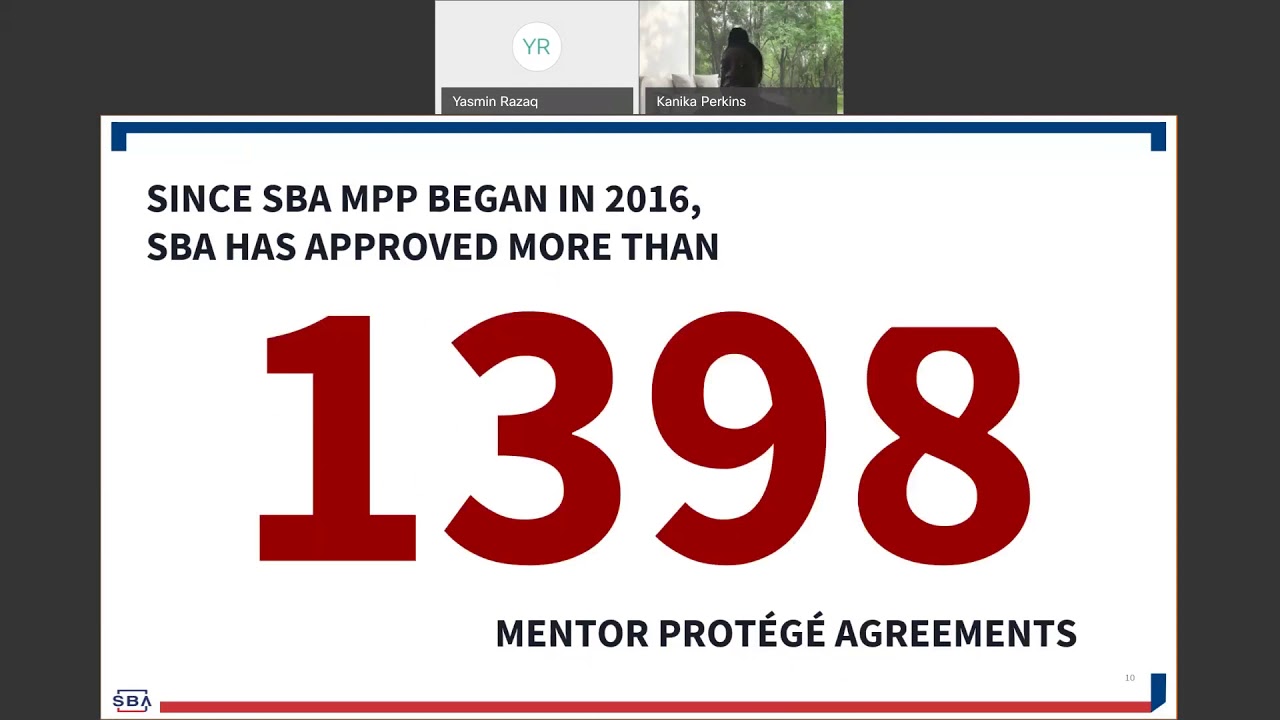
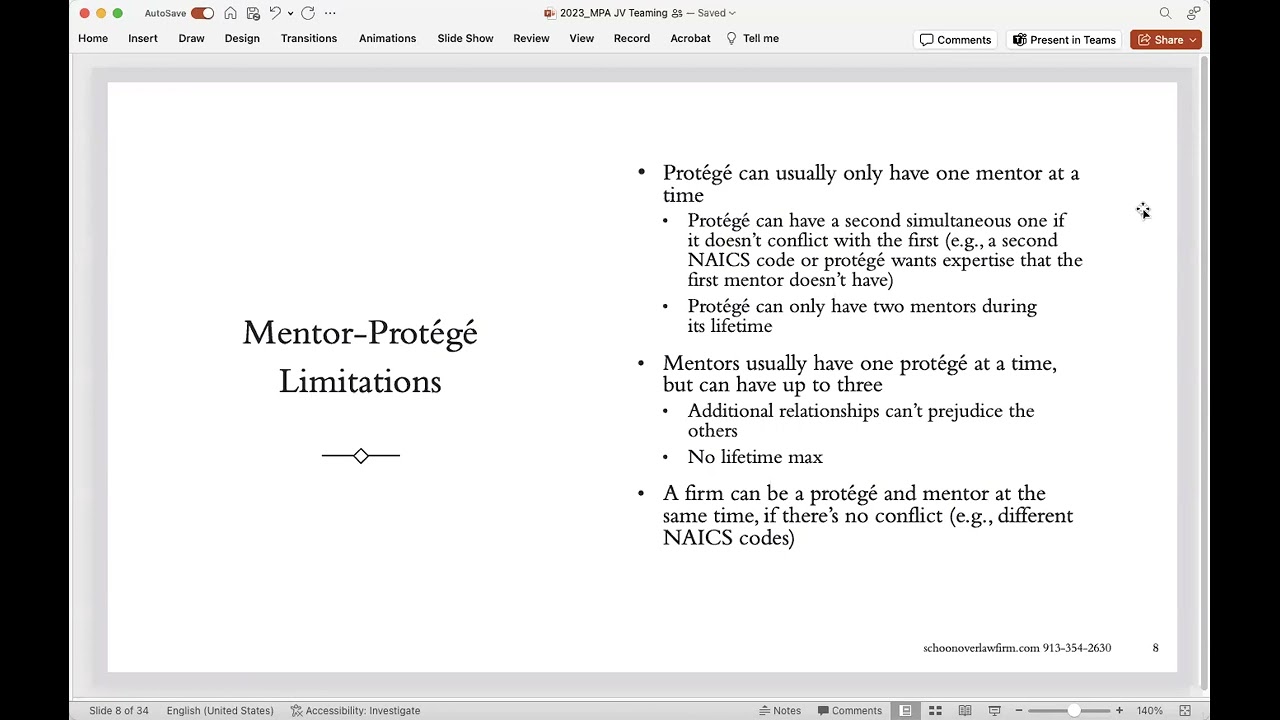
thank you for joining Jennifer Shelton associates in our 2019 webinar Wednesday series we're coming to you live from downtown Washington DC our webinars are every Wednesday and you find the upcoming schedule on our website hasslein our normal cords are on a website not a YouTube channel along with over 160 of recordings on federal contracting topics all are complementary if you have questions for our speaker today you can email him directly with the contact information you'll see on the last slide all right message is a little bit about us we are Washington DC based firm and provide services for federal contractors this ranges from market analysis reports to proposal writing and also post award compliance more information is on our website so please visit us there these are a couple of coming events they can find more information here also on our website and we do offer advertising in our newsletter so you can email this email if you'd like more information on that all right our speaker today is Anthony antiques and he's going to be covering teaming agreements vs. subcontracting Anthony thank you for joining us and I'm going to go ahead and huge over to you thank you very much I appreciate the opportunity to visit I lead up the government contracts practice at Williams Mullen along with my co-lead Bob quark and represent a variety of small emerging in large businesses domestically and internationally throughout the lifecycle of the government contract cycle the title that we're talking today I'm glad you joined us is the first of two related topics that are going to talk about sub contracts and teaming next please so as we get into the subject a little bit on the title itself is a little bit of a misnomer and that teaming agreements and sub contracts are not really in conflict of each other what we'll be covering should establish that teaming and sub contract agreements are really part of a larger government contracts continuum process and that's what we'll be addressing today how the two teaming agreements or Arrangements really are nestled into the overall process and then some of the details about teaming agreements and subcontracts and and some pointers as a practice point the other seminar will focus a little more heavily on teaming agreements themselves next please so as we dive into this a little bit all too often our experiences we receive calls from clients or prospects asking us to dash off a teaming agreement or a subcontract and surprisingly we find that many of them are seeking us to have us draft this type of document more because that's what's expected than considering the context of the situation it's important to consider that these documents are really part of an overall continuum in which one needs to think about one's particular situation and the goals one's seeking to achieve first of all is it necessary to team at all and if so why certainly their pros and cons to doing both which we'll discuss but if you can go it along that may go it alone that may be the best solution if you think you're going to move forward you need to do market research with regard to your potential teammates and you're going to be sharing secret or private information so you'll want to enter into a non-disclosure agreement which is a document that sets out the rights and responsibilities of the parties when sharing confidential or proprietary information it's a document that will continue to live through the teaming agreement process and unless replaced in the subcontract will continue into the subcontract as well it's also necessary as you narrow it down to do due diligence on your potential teammate or potential subcontractor and that involves things as simple as checking Sam to see that they're not debarred checking dun and bradstreet looking at their webpage on the Internet in more serious situations that might involve interviewing them and talking to some of their customers and with that you'll be moving into the teaming agreement process which will hopefully lead to a subcontract next please so let's look a little bit about what a teaming agreement is and what the far has to say interestingly the far does not define a teaming agreement what it provides for it is a contract team arrangement and in fact there are two types there's a horizontal teaming arrangement which is for the most part a joint venture situation which will deal with briefly and then the second type of situation which is a vertical teaming agreement which is the more traditional prime and subcontractor arrangement the teaming agreement itself without a far definition is simply the document that is used to memorialize the contract team arrangement the far under the far are part 9.60 3 the government will approve any teaming arrangement if it's properly disclosed in full at the appropriate time next so why should your team or not and it really depends on the perspective that you have it may differ for a prime or a sub a big or a small company and experienced or new entity there are certainly pros for entering into one they fall really into two groups the first is to expand your offering capability in terms of experience or technical capability or staffing or meeting particular requirements of the government and the second is to reduce risk in terms of the cost of developing a proposal or sharing the cost in case you lose if you're a small business there's also the possibility of entering into a new market and gaining market share there are also negatives you lose independence and control as compared to when you do it yourself you have to rely on others and you have to risk the possibility that they'll let you down you lose the ability for organic skill development internally you have to share the revenues in the profits and you risk the loss although slight if you've done a good NDA you risk the loss of internal information that's proprietary and if you're helping out small business you may be generating a new competitor next please so let's first look at the horizontal teaming situation which is really a joint venture and it comes up in a variety of situations you're creating a new entity it could be a contractual partnership it could be the formation of an LLC or a corporation you're whether you're a partner or a member shareholder you're really creating a new type of entity that whose goal is going to be to bid on a on a pending solicitation or future solicitation or group of solicitations it's important to note that a JB itself has no history experience or past performance so it's necessary to see if the agency that you're going to be dealing with will consider the past performance of its members which may or may not be possible there's no single far definition about it there a variety of definitions throughout the far depending on the circumstances and the key decision that people make often or whether they're populated or unpopulated populated being one where the JV itself hires its own people to perform the work unpopulated JVs require its members to provide the substantive staffing although they're entitled to have some administrative staff it's important to note that now the SBA has borrowed the use of populated jayvees both for small business joint ventures and mentor-protege joint ventures which we'll be discussing in a bit and the reason is that the SBA believes that a populated joint venture will shut out the small business from getting its benefits let's return to the next slide in which we'll talk a little bit about the key terms of a joint venture really there's nothing very special it's a lot like the operating agreement or the articles and corporations or bylaws of the corporation or LLC that you're currently a part of you need to have its scope which is what are we going to be doing usually going after a solicitation or something like that we need to talk about the ownership who's going to own it control it manage it who's putting skin in the game or money in the game and distribution what's the return on investment it's necessary to deal with succession in terms of one or more people dropping out of a joint venture and in that regard I might note that joint ventures are not necessarily limited to two parties they can be multi party ventures one needs to deal with the liabilities and how that's going to occur what's the term usually they're not they don't last forever and for certain small business rules they're limited really to a two-year period and how can they be terminated we'll note later that the SBA has a variety of requirements for met or protege and small business programs but that's really the the jv's in a nutshell and we can now move on to some of the specialized programs on the next page please two of these programs which have become quite common are one the all small mentor-protege program which was developed in 2016 which is a follow-on to the SBA's old 8a small business program mental program and then the small business set-aside the mentor-protege program is interesting because it is a horizontal joint that a horizontal teaming agreement in the form of a joint venture a large other than small that's the proper term entity can apply with a small business to seek a mentor-protege JV creation that will provide assistance that is needed by the small or business in in developing its skills and capabilities the large company can own up to about 40 percent of the Protege it leads to a written JV agreement which will ID the small business's needs and can continue on for a period of three years with a potential three year extension parties are required to file annual reports and have to adhere to the requirements of the mentor-protege program they can also pursue if the small business is qualified you can pursue both small business set-asides and those four specialized small businesses such as veteran-owned businesses and the like it's important to keep in mind the risk of non-compliance which can lead to the disqualification of the large business from engaging in this kind of program in the future and there have been over the past several years increased interest from the Justice Department under the False Claims Act the small business set-aside program is a similar program it's been around for a long time and it really allows to small businesses that are qualified to pursue opportunities together to increase their capabilities there a series of rules that must be followed but again that's a joint venture horizontal teaming arrangement that states please let us turn to the vertical teaming arrangement which is often thought of as the more traditional one it of course involves a situation where there's a prime contractor and a potential subcontractor and in those situations both parties retain their separate identities in theory the teaming agreement is supposed to be a promise from the prime contractor that it will end up engaging the subcontractor if the prime wins an award of the government contract I say in theory because despite the apparent intent of these agreements this is the source of the greatest amount of litigation and disputes between primes and subs when the prime fails to deliver to the subcontractor all of the work that the subcontractor might have been expecting although many who call us ask us to - up a teaming agreement we're surprised that few come in to us having thought through their unique circumstances they fail to recognize that a team II agreement involves a negotiation which reflects the 10 and that naturally exists between a prime and a sub in terms of the goals that it's looking for and in terms of flexibility enforcement and exclusivity for the most part prime contractors would like to delay and keep a teaming agreement loose for as long as possible so that it can maximize its options if it finds somebody better a subcontractor wants to tie the prime in as much as possible and get guaranteed work which is what it's seeking in that type of effort that said the tables can be reversed if a prime is negotiating with a critical subcontractor and it's critical to tie them up during the process and of course both parties want to be able to have some flexibility if things go south all of this gets manifested in negotiations in the precision of terms the enforce ability and the escape ability of the parties next page let's look at the the key components of a teaming agreement and in doing this we're not going to go through each of the terms bit by bit by bit but really a conceptual approach to the nature of a teaming agreement so first of all it has to identify the scope the solicitation that you're working towards and then it needs to specify the relationship of each party and what they're going to do it often describes what the prime the suburb irresponsible for in developing the proposal to the government agency who is going to take charge things like that both parties are entering exclusivity each party probably wants to tie up the other party at least for that particular procurement it becomes sensitive because one can't limit the ability of the subcontractor to otherwise market its services or products to the government and so there's often a negotiation on how one might get out of that exclusive arrangement and certainly when one's in it it limits one's abilities to pursue other opportunities perhaps with that agency of course one is going to be dealing with proprietary information and IP and one needs to deal with how one's going to handle that I note that the continuation of the NDA and incorporation of the NDA into the teaming agreement is something that facilitates that process the critical parts are going to be the process for entering into a subcontract the terms of the subcontract division of labor pricing things like that those is we're going to see in a moment are the absolute critical part of a teaming agreement because that is what determines its enforceability in the courts of the United States it's important as we get into that that one avoid what is also common and what's determined by the courts to be an agreement to agree ie a situation where if the prime receives a contract they agreed to negotiate in good faith for 60 days and at that point they can simply terminate the agreement that has been the source of a great number of lawsuits over the years where the subcontract put a lot of effort into it only to find that the prime contractor cuts it out of the deal either in the original teaming agreement or in a subsequent one because of this the governing law that one puts into a teaming agreement becomes critical let's go to the next page please what this is leading up to is the critical issue in teaming agreements which is enforceability throughout the United States the various states have taken different approaches to how they deal with teaming agreements and the biggest challenge for the parties is the enforceability of a teaming agreement the states in this part of the country Virginia Maryland in DC all follow a fairly strict approach and require that really all the t's we cross the eyes be dotted on a teaming agreement if it's to be enforced and by that there can't be an agreement to agree which we talked about a moment ago there can't be any undefined subcontract a statement of work or pricing terms and with respect to pricing if the exact price isn't known at the time that there needs to be an objective means to determine price when one is available there also shouldn't be other open ends like a loose open ended opportunity to be terminated subject to government approval the need to have a proper term for the agreement exclusivity things like that New York has been thought to be a somewhat looser jurisdiction in terms of allowing these type of agreements to be enforced it really focuses on a bit looser attitude about pricing a California is the most loose and liberal about it there is a court decision that allowed an oral teaming agreement to be enforced our thought is that teaming agreements always should be in writing so in this regard the negotiations for a teaming agreement in the choice of law is an important element of the entire process let's go to the next slide please so what are the key terms that are necessary to create an enforceable teaming agreement the first one I note is the preamble it is the often overlooked stepchild of an agreement and discarded or not considered to be a substantive part and we would encourage that that is in fact the best place to set out one story of why the two companies or more have gotten together what their particular plans are with regard to a solicitation and a state that there is a binding commitment that the parties will enter into a subcontract at the time it's also important to set out the term of the agreement the duration and terminations one wants to avoid a situation where the prime or the sub can simply terminate because they haven't been able to come to an agreement within a set period of time it's probably appropriate to either not have that kind of clause or to tie it to some specific damages in the alternative which we discuss in a moment I'm having an exclusive arrangement helps but obviously the parties want to be cautious about what they're signing up to the really important part is the mandatory subcontracting it would be ideal if the parties were able to negotiate a fully-formed subcontract and making an attachment to the teaming agreement those are the situations where the courts have had little difficulty in enforcing the teaming agreement because the ultimate agreement is there but that failing one can certainly agree to a number of terms in the subcontract the most are the subcontractors workshare as being defined in specific and best if tied to the scope of work the subcontractor pricing ideally specific but if not tied to an objective standard those and then there are a number of others the term exclusivity things like that the more that get included in the teaming agreement either within the body of the teaming agreement as a mandatory subcontract to the teaming agreement the better chances are that will be enforced this also might include the incorporation of flow down clauses that will be included the remedies is important all too often those are overlooked it doesn't help in the enforceability but it may help in securing a teaming agreement whereas instead of just leaving it to litigation or arbitration one were to agree to the imposition of liquidated damages if the subcontractor were not to obtain the desired subcontract next page please let us now turn to the subcontract which as I said is the ultimate goal it's the end of the process it's defined in the far on these pages and it's really any kind of agreement between a prime Minnesota some are surprised to find that it includes purchase orders and things like that and the definition of a subcontractor is not just somebody who is going to perform part of the subcontracted work itself but suppliers distributors or vendors they be included which raises a number of issues that are a little bit outside the scope of this seminar next week subcontract T terms you know when we get people calling up and asking for a subcontract they also have not thought about exactly what they want and we've also seen subcontract agreements that are but a few pages to those running sixty and seventy pages with small print but it is core they're really some terms that should be part of it and the rest is not necessarily fluff but an effort to try and address all the potential things that might go wrong in the subcontract the key terms obviously are the statement of work what are we going to be doing on this project how long is it going to last and what is the respective you know job that the subcontractor will have what am I going to get paid or what am I going to have to pay for the work how do I get to inspect and accept the work and obviously how it's going to be delivered all of which leads hopefully to you getting paid we've talked about throughout the process about confidentiality of information and proprietary information in IP that is certainly something that needs to be addressed and particularly from a subcontractors point of view that its rights be preserved through the process of what is really a private sector agreement between two private parties to which there are some government benefits attached one also wants to talk about changes and whether the prime contractor can change things separate and apart from the government or whether it's tied to the government termination similarly whether it has to be tied to government action governing law although often imposed by the prime contractor as the law it prefers that is something that can be of negotiation perhaps as to the location of where the work is going to be performed disputes and liability how do you how do you resolve things when things go south and then liability getting it can you limit it to some amount obviously want to get rid of various unexpected damages lost profits and things like that the other aspect that gets brought in is the prime contract slowdowns from a Prime's perspective they will seek often to flow down all of the prime contract flow down clauses the far clauses a subcontractor may have a different view and we mentioned them as being included in the teaming agreement we have noticed over the years that the flow down clauses may change between a teaming and agreement and a subcontract it's important to review them and it's important for a subcontractor to push back as appropriate on those clauses that may be extraneous or burdensome there are a host of other clauses of course that one could could have and we've noted them there at the point of interest next page we note we just note quickly in passing that you should keep in mind that when dealing with small businesses the concept of affiliation which is the Association which the SBA does between two or more companies it's something that you need to watch out for there's an exception for approved mentor-protege and small business JPS but it's something that one needs to worry about next page in terms of practice tips you know I think what's important is that one needs to consider a teammate agreement and subcontract not just in isolation but in relationship to your overall business goals in doing so what are the factors that the government is looking for in a solicitation and how can you use a team to improve your chances it's essential to conduct due diligence on your prospective teaming agreements depending on how much they're how important they are to the deal if they're a critical subcontractor you also might seek to escrow their IP and other things or you might seek to do additional due diligence confirm the source selection negotiate a complete and enforceable teaming agreement and certainly beware the implications for small business I'm I thank you for your time this afternoon I appreciate you spending part of your afternoon with me and should you have any questions please feel free to email me thank you very much and with that I turn it back over to Jennifer Allison company thank you very much thank you so much Anthony for joining us today and like so if you have any questions please feel free to reach out with time with the email is on now phone number shown on your screen this concludes welcome a thank you
Up Next

113:58
Selling to the Government Without Proposals: DLA Strategies
@EricCoffie
13K views•2023-12-20
46:36
Retention Habits of Top DTC Ecommerce Brands Revealed
@SendItPodcast
44K views•2026-03-03

49:40
SBA 8(a) Certification: A Guide to Federal Contracting Eligibility
@jenniferschaus
11.9K views•2013-04-30

17:30
The Planned Obsolescence of Light Bulbs and Tech
@veritasium
25.3M views•2021-03-26
Related Study Plans & Knowledge Roadmaps
Structured learning paths in Business
business
Pop-Up Retail: Strategy, Design & Execution
01Introduction to Pop-Up Retail & Strategic Goal Setting
02Budgeting, Site Selection, and Legal Essentials
03Experiential Retail Design & Visual Merchandising
+ 2 more learning modules
15h5 modules
Explore Roadmap
business
Reg CF: Startup Funding, Marketing & Launch
01Introduction to Equity Crowdfunding & Reg CF
02Platform Selection & Legal Preparation
03Crafting High-Converting Campaign Assets
+ 2 more learning modules
14h5 modules
Explore Roadmap
business
Productized Services: Scaling Solo Freelance
01Foundations of Productized Services
02Packaging and Scope Definition
03Pricing and Subscription Models
+ 2 more learning modules
15h5 modules
Explore Roadmap
business
Gov Procurement: Find, Bid & Win Contracts
01Introduction to Government Procurement & Business Setup
02Small Business Certifications & Set-Asides
03Finding and Analyzing Contract Opportunities
+ 2 more learning modules
14h5 modules
Explore Roadmap