

![Quartiles, Percentiles, Quintiles, Interquartile Range, Box Plots [worked examples! Oh wow]](https://i.ytimg.com/vi/fhFDjxcOrb8/maxresdefault.jpg)


















In America, social mobility is limited: over one-third of people born in the bottom income quintile remain stuck at the bottom, while only about 10% reach the top; this disparity is even greater for Black Americans (50% chance of remaining at the bottom, only 3% reaching the top) and children raised by unmarried parents, though completing a four-year college degree significantly improves upward mobility chances.
Social Mobility in America: A Quintile Analysis
Added:Understanding of basic statistical concepts, specifically how a population is divided into quintiles (20% intervals) to measure income distribution.
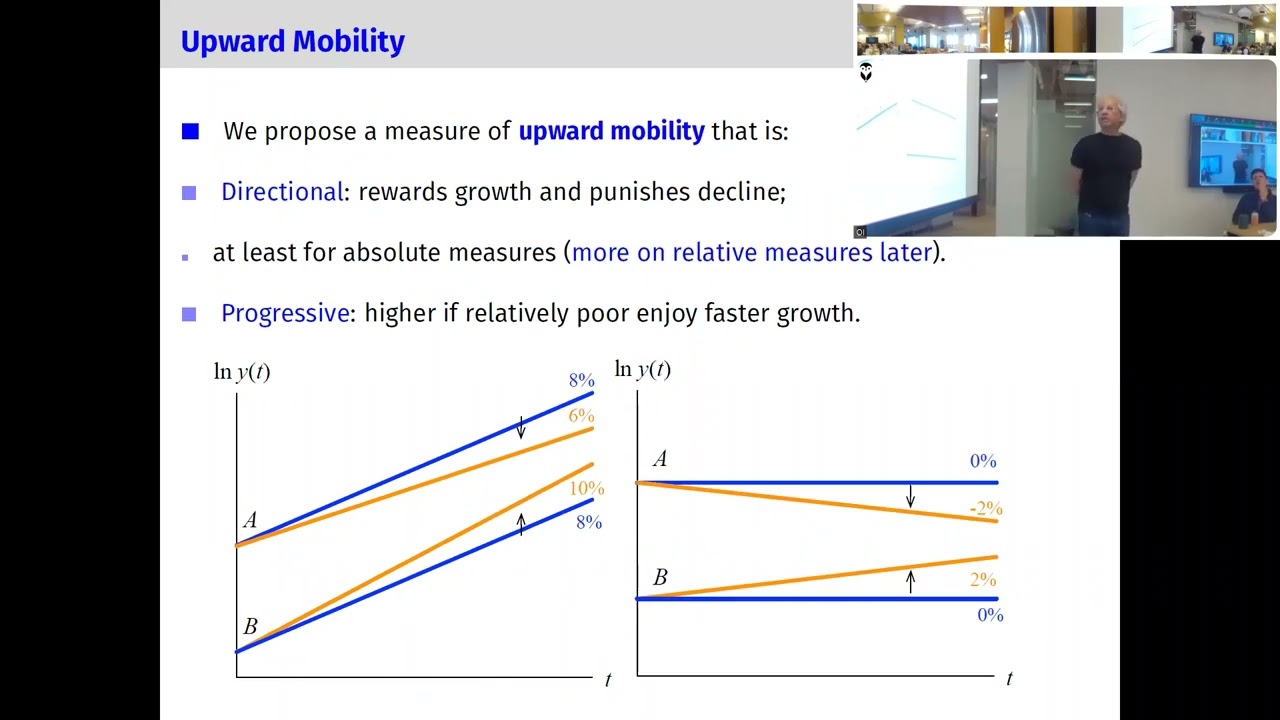
The conceptual distinction between absolute mobility (earning more income than one's parents) and relative mobility (changing one's rank or quintile in the social hierarchy).
Familiarity with the historical and systemic factors in America that link socioeconomic status to race, family structure, and educational attainment.
Investigation into targeted policy interventions designed to close mobility gaps, such as early childhood education programs, criminal justice reform, and progressive taxation.
Analysis of Richard Reeves' concept of 'opportunity hoarding' and how the upper-middle class maintains its socioeconomic status across generations.
Comparative study of global social mobility, specifically comparing the United States to peer OECD countries using metrics like the 'Great Gatsby Curve'.
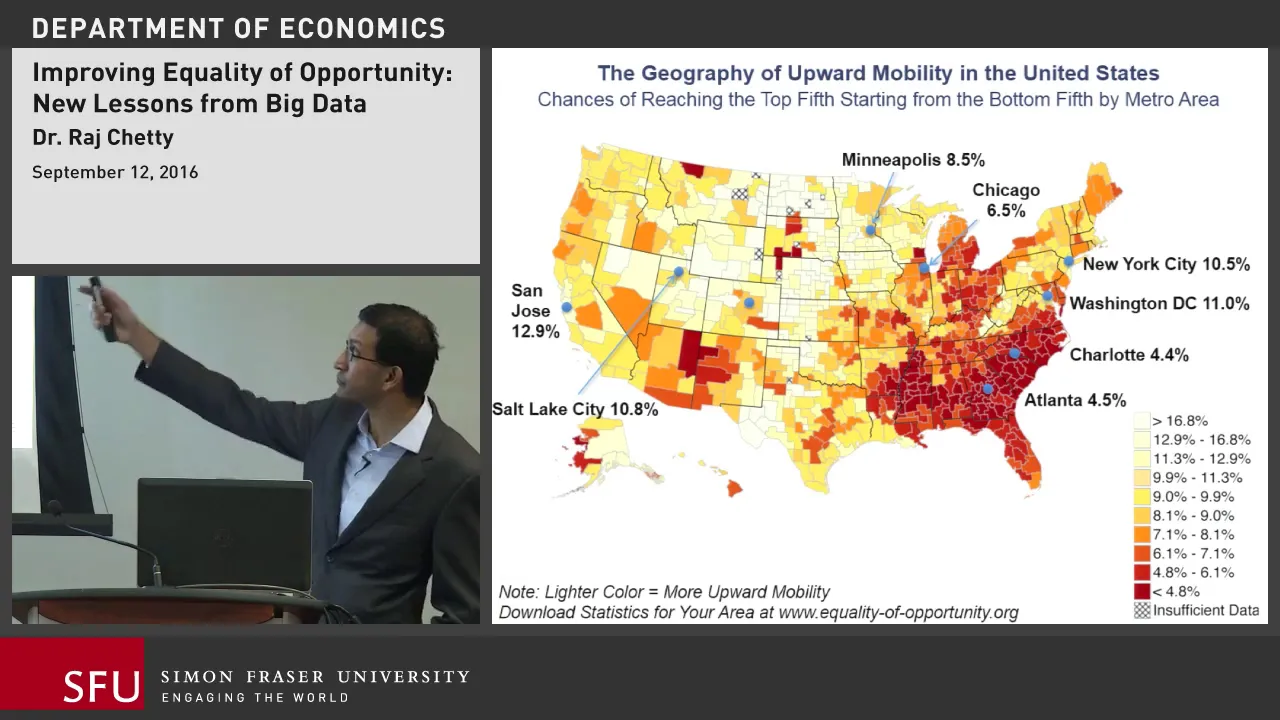
Exploration of spatial mobility and geographic inequality using advanced empirical data, such as the Opportunity Atlas developed by Raj Chetty and Opportunity Insights.
667.9K views4.3Klikes3:41Original Release: 2014-08-20
We're going to talk about inequality and opportunity in America. Let's start by dividing the population up into five equally sized slices. If you're boring like me, you might call them quintiles.
In an absolutely equal society where everybody had the same amount of money, each fifth of the distribution would get a fifth of the money. It would look like this. Of course, that's not how it is in the real world. The bottom quintile, the bottom fifth gets 5% of the money and the top fifth get more than half the money. But I think in terms of fairness and certainly in terms of American fairness, the question is less what's the gap between the bottom and the top? And it's more what if your chances of making it from the bottom to the top? How mobile is society? How far does where you're born on the ladder affect where you end up on the ladder? So, in a a perfectly mobile society, an opportunity utopia, being born down here in the bottom quintile would have no effect on where you ended up. You'd be equally likely to make it to the top as to stay at the bottom. But now, I want to show you what it's really like.
Right now, for the people born at the bottom, more than one in three of them will remain stuck at the bottom. And just one in 10 are going to make it all the way up to the top. That's bad enough, but it's it's even worse for certain groups in the population. If you're born in the bottom quintile and you're a black American, you have a 50% chance of remaining stuck at the bottom and just a 3% chance of making it a ratio style all the way to the top.
So this is the picture for black America. For white Americans, the picture looks close to that utopia with roughly the same chances of making it to the top of the distribution as of being stuck at the bottom. Those who are born at the bottom and are raised by parents who are never married. And for that group, the odds of making it to the top are pretty slim as well. For them, it looks like this.
For those raised by married parents, it looks like this. Again, it's pretty close to what you might hope for in a perfectly mobile society. Those who are born at the bottom, if they're raised by married parents, have a pretty good chance of making it to the top.
So, if you don't complete high school, there's a 50% chance you're going to stay stuck at the bottom if you were born at the bottom and a 1% chance that you're going to make it to the top 20% of the income distribution as an adult yourself. So, for them, looks like this.
If you're born at the bottom, born in this bottom fifth, but you're one of the few born down here who managed to get a four-year college degree, transforms your chances of moving up the income distribution. Go to college. We can have a long argument about the gap between the rich and the poor, but I think we can all agree that we don't want to live in a society where where you're born determines so strongly your chances in life or where you end up.
America has a dream of equal opportunity and we're a very long way right now from that dream. We have a big problem and we need big solutions.
Up Next
5:29
Cultural Capital Explained: Bourdieu's Theory of Social Inequality
@sociologylive4343
481.5K views•2015-11-17
54:57
Contemporary Sociological Theory: Micro, Macro, Integrative
@NaSESYNC
45.7K views•2016-02-17

19:23
How to Analyze Conversations Scientifically | Elizabeth Stokoe | TEDx
@TEDx
1M views•2014-12-04
9:41
What is Sociology? The Sociological Perspective Explained
@crashcourse
4.6M views•2017-03-13
Related Study Plans & Knowledge Roadmaps
Structured learning paths in Sociology
sociology
Celebrity Culture: From Hollywood to TikTok
01Foundations of Celebrity Sociology
02The Rise of Micro-Celebrity & Digital Platforms
03Parasocial Relationships & Algorithmic Intimacy
+ 2 more learning modules
12h5 modules
Explore Roadmap
sociology
Hostile Architecture: Space, Power & Control
01Introduction to the Sociology of Space
02Social Control and Surveillance in the City
03Hostile Architecture and Defensive Design
+ 2 more learning modules
12h5 modules
Explore Roadmap
sociology
Loneliness Epidemic: Third Places & Isolation
01Foundations of Social Capital and Community Cohesion
02The Death of Third Places and Urban Space Erosion
03The Privatization of Leisure and Atomization
+ 2 more learning modules
12h5 modules
Explore Roadmap
sociology
Sociology of Tourism: Gaze, Power & Heritage
01Foundations of the Sociology of Travel and Leisure
02John Urry and the 'Tourist Gaze'
03Staged Authenticity and Cultural Commodification
+ 2 more learning modules
14h5 modules
Explore Roadmap