


























This video explains the major sustainability reporting frameworks used by companies worldwide: GRI (Global Reporting Initiative) provides comprehensive ESG reporting standards organized into universal standards and four series (100, 200, 300, 400) covering economic, environmental, and social parameters; SASB (Sustainability Accounting Standards Board) offers industry-specific standards focused on financial materiality with over 77 standards across sectors; IFRS S1/S2 (International Sustainability Standards Board) creates global benchmarks for general sustainability and climate-related disclosures; ESRS/CSRD (European Sustainability Reporting Standards) establishes comprehensive EU-wide requirements with 12 material topics and 1,140 subtopics; TCFD (Task Force on Climate-related Financial Disclosures) focuses exclusively on climate-related financial disclosures through four pillars (governance, strategy, risk management, metrics/targets); and CDP (Climate Disclosure Project) serves as both a reporting framework and rating system based on data disclosure quantity. The video emphasizes that GRI provides foundational ESG reporting knowledge, while CSRD offers the most comprehensive framework integrating requirements from other standards, making it essential for professionals preparing for ESG job interviews and sustainability reporting careers.
Sustainability Reporting Frameworks Explained for ESG Careers
Added:Did you know that more than 90% of big companies are today reporting on their sustainability report and in 2025 sustainability report is not something which is just nice to have but is rather mandatory in most countries and jurisdictions. And now I totally get you. You might have heard words like GRI, SASBY, TCFD, IFRS, ESRS and all of these are just sounding like alphabets to you one after the other and you feel like you're walking in a ESG themed park and turning the wheel of fortune and not getting to understand what is all of this and totally confused. then don't worry this video is exactly for you because in this video I am going to break down for you all of the main sustainability reporting frameworks go through them one by one understand what they are and what they require to make you ready for your next ESG job interview and also to thrive in your ESG and sustainability job. So whether you're a fresher looking to crack your first job interview or if you're someone who is tired of listening to these words in board meetings, this video is exactly for you. So watch the video till the end to become a ESG reporting pro. Let's get started.
[music] [bell] Okay. Okay. So there are several reporting standards and frameworks but I think let's first start with GRI or global reporting initiative which is the most widely used reporting framework and which is also like the basic stepping stone into the world of sustainability reporting. So if you understand GRI very well all the other reporting standards are sort of built on the base of GRI and they are not very difficult to navigate.
So GRI reporting is like your first go-to step to enter into the world of not just reporting but the world of entire ESG in general. Now GRI reporting standards are designed to help companies report on their economic environment and social parameters. Now here's how the GR reporting standards are organized. So the first is the universal GRI standards which has GR 1 2 and three which are mandatory disclosures which the companies need to report on if they are reporting in accordance with GRI. Now GRI 1 are the foundation standards which give a brief overview about how to report in accordance with GRI. Then comes GRI2 which provides framework for companies to report on some of the essential parameters of the company like their governance structure, stakeholder engagement, workforce etc. And GRI3 covers what material topics are and how they can be identified with the help of double materiality assessment. Now, double materiality assessment in itself is a vast topic and if you want me to cover it in detail, please let me know in the comments below and I will make a separate detailed video about what double materiality is and how to identify material topics with the help of double materiality assessment. And beyond this, GRI has four series to report on that is the 100 series, 200 series, 300 series and 400 series. Now the 100 series has now replaced the foundation standards which give an overview of the company and the basis to report on. So the 200 series covers information related to the economic or the governance parameters. So for example the series contains of 201 is the economic performance 202 market presence 203 indirect economic impacts 204 procurement practices and then you have a lot other topics like anti-corruption anti-competitive behavior tax etc. Then comes the 300 series which is about the environmental indicators. Now again here you have different topics like 301 is disclosure about the materials 302 is about energy 303 water and fu and so on you have a lot of indicators related to environment and once you're done with environment the 400 series is about the social parameters. So again here you have topics ranging from 401 is about employment 402 labor and market relations and so on you have indicators up to 418 to report on social parameters. GRI also has sector specific standards to report on. So currently there are sector standards for oil and gas, coal, mining and agriculture and for several other sectors the GRI standards are going to come up soon. So these sector standards help companies to report on the most relevant material topic as per the sector of the company and to make relevant disclosures based on it. Now as you can see on this screen when you're reporting basis GRI you need to also publish a content index the GRI content index at the end of your report and this content index essentially consists a brief summary of how each of the material topic is covered and in which section you can find the information related to each of the material topic. Now when your reporting basis GRI so as you can see on the screen GRI has nine principles which are accuracy, balance, clarity, comparability, completeness, sustainability, context, timeliness and verifiability. So now the GRI reporting can be done in two formats. So one is in accordance with GRI. So when you're reporting in accordance with GRI, you need to make sure that your report aligns with all of these nine principles. And if for some reason your company is not able to fulfill these nine requirements, you can report in with reference to GRI which means that you have used GRI framework as the basis for preparing your report but you haven't fulfilled all of the nine principles in your report. And lastly, companies are encouraged to do a third party assurance of their report when they are reporting in alignment or in reference with GRI. And companies also need to notify GRI with the help of an email when they report basis the GRI framework. So now let's understand how to report on a material topic basis GRI standards with the help of the material topic 302 energy. So as you can see on the screen the first section are the requirements which states what are the requirements you need to report on to disclose uh in accordance or in reference with GR. So here you need to disclose on information like the energy consumption, total fuel consumption from non-renewable sources, renewable sources, then the electricity consumption, heating consumption, cooling, steam consumption as well as um the electricity sold, heating, cooling or steam sold within the organization.
Once you fulfill the requirement section, as you scroll down, you can see on the screen that there are compliance requirements which sort of give a guidance to make sure that you are reporting your data accurately and correctly. Then when you go on the next page, you can see that there are some calculation guidelines or formulas provided to accurately um calculate your data which needs to be reported. And then you have the recommendation section which provides some recommendations for calculations as well as reporting. And then you have a guidance section which provides some guidance on how you can collect the data or why the data is important and the interdependency of different data sets. So this is how the GRI reporting is done for each of the material topic. Now let's move to the next reporting framework which is sustainability accounting and standards board which is also known as SASBY. Now SASB has industry specific standards which provides material topics which are the most important topic for each industry wise and which can impact the financial materiality of the company from an ESG perspective. Now SASBY has more than 77 standards for each of the industries ranging from healthcare, technology, retail, manufacturing, energy, construction etc. which capture the risks and impacts that each of the particular industry or sector can face and what are the most important material topics for the particular industry. So now let's understand how reporting basis SASB is done. So as you can see on the screen there are several broad industries which are mentioned. Now from these broad industries we can select one industry. So let's select e-commerce.
Now further within e-commerce you can see that there are different subindustries like like hardware infrastructure energy and water management data privacy and advertising standards data security etc. So here we can select any one. So let's go for data privacy and advertising standards. Now within this as you can see there are other matrix which are provided like the number of users whose information is used for secondary purpose and this is a quantitative category uh in which the figure needs to be disclosed in terms of a number. The unit is a number.
Similarly the next one is description of policies and practices related to targeted advertising and user privacy.
So now this is a discussion and analysis based category question and here there is no unit. So here you need to disclose um text based response. Similarly, if you go into some other parameter, let's say product packing and distribution and click on the matrix section. Here you will again have matrix basis which you need to report on such as the total greenhouse gas footprint of product shipments. So again it's a quantitative matrix and the unit is matrix tons. And then the next question is discussion of strategies to reduce the environmental impact of product delivery. Again this is a discussion based question. So there is no unit and it would be a descriptive answer to report on the particular question. Now SASBY standards are designed to make investor focused decisions. So these standards align more with the financial impacts the material topics will have on the company. Whereas in GRI standards the reporting is more broad basis the ESG impacts that the company would have in relation to the material topics or it is broadly related to ESG data which the company can report on with the help of GRI. This is the basic difference between SASB standards and GRI standards. And most of the times companies report bases both the standards or framework like SASBY and GRI together in their sustainability report and then only have SASBY index or a GRI index at the end of their report to then bifurcate on how the information in the report aligns with each of the data parameters required in both of the standards. Now the IFRS which is international financial reporting standards created a global benchmark for sustainability reporting which is the international sustainability standards board ISSB to report on sustainability related data of companies. Now the IFRS S1 standards covers disclosures related to general sustainability parameters and the IFRS S2 standards focuses on climate related disclosures which are aligned well with TCFD standards. Now the IFRS standards requires companies to report on the governance, risk management, performance matrix and strategies of the company with related to sustainability, risks and opportunities. Now these standards are incorporated and built upon the SASP standards to maintain the industry relevance and the IFRS standards specially focus on digital tagging so that the reports are machine readable which helps regulators and investors to do efficient analysis of the data reported. Today several countries like Australia, Malaysia, Sri Lanka are making it mandatory to report the sustainability data of companies.
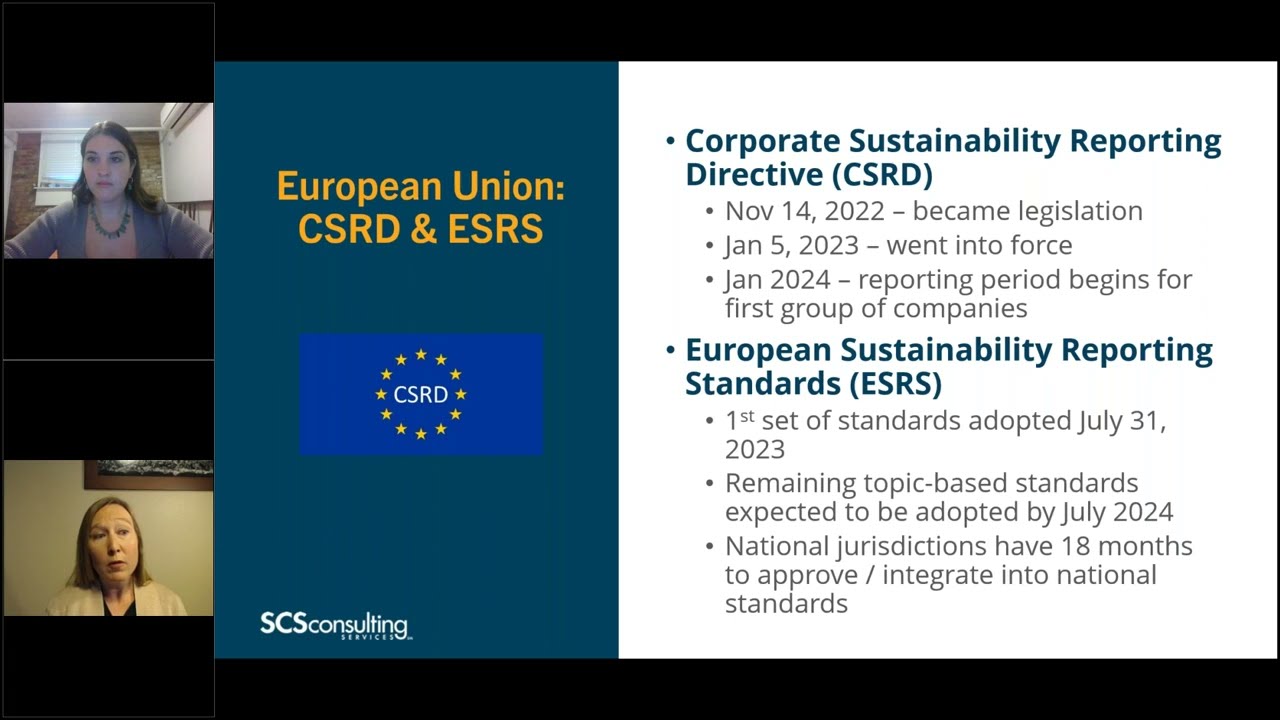
Bases the ISSP standards. So ISSB standards are one of the most essential skills or the most relevant skills that you need to develop if you want to work in any of these countries. Now the next one is European sustainability reporting standards which is also known as the ESRS. Now the ESRS has developed the CSRD which is the corporate sustainability reporting directive basis which the top EU listed companies need to disclose on their sustainability related information. Now the ESRS CSRD standards they cover a range of material topics which are related to the environmental social and governance parameters and it also lays out the foundation for the double materiality assessment basis which the companies need to identify their most relevant or important material topics and report basis the topic specific standards provided. Now the CSRB standards have all of the requirements of frameworks like GRRI, SASBY, TCFD well integrated within them. So if your reporting basis CSRD your report already becomes very comprehensive to align with rest of the reporting standards. Now the CSRD has 12 material topics to report on and basis each of the material topic there are further 1140 subtopics which are either quantitative or qualitative disclosures basis which the companies need to make their report. Companies also need to digitally tag their report and get a third party assurance for their report and all of these things together make CSRD one of the most complicated or challenging reporting standards in the world. Now the roll out of the CSRD reporting was earlier planned in a phased wise manner but with the omnimus proposal and you can refer to it in my video here. So currently there is the stop the clock requirement which has come out due to which the rollout is further postponed for smaller companies to align and report on CSR. Then the next reporting framework is task force for climate related financial disclosures or TCFT. Now TCFT solely focuses on climate related disclosures and it has four pillars. Now these four pillars as you can see on the screen are governance strategy risk management matrix and targets. So in governance you need to disclose on what are the governance related policies or frameworks that the company has undertaken for climate related risks and opportunities. Then in the strategy section, you need to report on what are your strategies to adapt and mitigate to climate change scenarios. In risk management, you need to identify the actual and the potential risks that your companies might face bases different climate scenarios and what are the steps that you would take to adapt and mitigate to these risks. And in the matrix and target section, you need to report on what are your actual numerical targets and the matrix that you have currently achieved to align with your long-term strategy. Now, TCFD is one of the most important frameworks that you need to know if you want to specially work in the sector of climate change and if you want to work on climate risk analysis because the role of climate risk analyst requires knowledge of TCFD and TCFD knowledge also helps a lot if you're preparing for certifications like GARP SCR because TCFD has the scenario analysis model developed in it. Now bases these scenario analysis you need to develop different scenarios for temperature change ranging from 1.5° C to 2°C. So here you need to make an assumption that if the temperature changes over time by 1.5° C or 2°C or 2.5° C, how would the risk for your companies look in each of the scenarios and what are the mitigation measures that your companies would take to mitigate these risks and how are and how is the company preparing for each of the scenarios. Now TCFT reporting is also the mandatory reporting in UK. So if you're especially looking to work in UK, you should get a good hold of TCFD reporting standards. Now the last one is climate disclosure project or CDP. Now CDP is a reporting framework as well as it is also a rating standard. So basis the reporting that you do in CDP your company also gets a rating on how well the reporting is or how much data a company has for its sustainability or climate change related disclosures. Now just to give a brief difference between CDP ratings and other ratings like DJSI or EcoAdis. So in CDP your company is given rating only for how much data they have been disclosed. Whereas in DJSI or EcoAdis your company gets a rating basis how well the company is prepared or what are the actions that the company is taking for ESG and sustainability. So this is the basic difference between CDP and other rating standards that you need to keep in mind if you are preparing for interviews. So now that we know what are the different reporting frameworks, let's see how all of these frameworks are interdependent on each other and how companies need to align their data to actually report on each of these frameworks. So beginning with GRI standards. So in GR your companies need to report on the material topics. So here your companies first need to identify which are the most important topics which are called the material topics related to ESG for the company and then report on each of the material topics. Whereas when you go to other frameworks like say SASBY. Now SASBY already provides you with a material topic list for each sector but SASB is more focused towards the financial implications or the financial risks. So the material topics are not exactly showing the risk or the impact related to sustainability but what the sustainability related parameters can do in terms of the financial risks that the company might face and it is a similar case with the IFRS ISSB reporting standard. So both SASP and ISSB standards are bases the IFRS framework and hence these standards are interdependent on each other to identify the financial risks and opportunities basis the sustainability related material topics. But now when you further move on to reporting standards like TCFD or CSRD here the difference is that TCFD focuses only on climate related parameters whereas CSRD ESRS CSRD has an overall holistic perspective related to risks opportunities has a whereas if you go to the CSRD reporting it has a very broad overview which covers material topics related to ESG as well as what implications they will have related to company's financial risks and opportunities. So if you see broadly CSRD is the most comprehensive reporting framework and when you get a good hold of the CSRD reporting framework, you can easily navigate the frameworks very well. So if you're preparing for reporting, the first step is to start with GRI because they are the most easiest standards to understand and to get a hold of. Once you have a good hold of GRI standards, it's a good time to then understand reporting basis CSRD because CSRD is way more comprehensive. And once you get a hold of both of these standards, then understanding rest of the standards like TCFD, CDP, SASP wouldn't be very difficult because your basics are already clear as well as the interlinkage or interdependency between sustainability and financial risks and opportunities are also cleared with the help of CSRB. So this should be your step-by-step guide if you're preparing for reporting related interviews. So this was all for today's reporting related disclosures. Now if you want me to cover any of these specific reporting standards in detail, do let me know in the comments below that which is the reporting standard which you're struggling with or which reporting standard you have been coming across most frequently in the interviews that you might be appearing in. So I would create a detailed video for each of these reporting standards um separately basis whatever you guys want me to create a video on and that video could be much more elaborate and much more detailed for each of the reporting framework and how you can actually prepare a report stepbystep basis any of the frameworks that you prepare on. So do let me know that in the comments below and till we come back with another such video stay impactful stage and sustainable. Bye-bye.
Up Next

Mastering the EcoVadis Methodology: 2022 Assessors Guide
@nexioprojects
10.6K views•2022-06-17

Retention Habits of Top DTC Ecommerce Brands Revealed
@SendItPodcast
44K views•2026-03-03

Decoy Effect: How Pricing Psychology Influences Consumer Spending
@bobinvestsUS
90K views•2026-01-05

The Planned Obsolescence of Light Bulbs and Tech
@veritasium
25.3M views•2021-03-26
Related Study Plans & Knowledge Roadmaps
Structured learning paths in Business