Symmetric encryption uses a single shared key for both encrypting and decrypting messages, similar to a house safe that anyone in the household can open with the same key; asymmetric encryption uses two keys—a public key for encryption and a private key for decryption—like a bank locker where you have your own key and need the banker's key to access it, making it more secure since the private key is never shared.
Symmetric vs Asymmetric Encryption Explained
Added:Deep Dive
Basic terminology of cryptography, including concepts like plaintext, ciphertext, encryption, and decryption.

Basics things you should know about cryptography | intro to cryptography | basics of encryption
263
Plaintext is the unencrypted readable message that anyone can read, which is what a sender wants to send to the receiver. Encryption is the process of applying a mathematical function to plaintext to convert it into an unreadable meaningless message called ciphertext. Ciphertext is the output of the encryption algorithm that attackers cannot understand or decode. Decryption is the algorithm used at the receiver end to recover the plaintext from the ciphertext.
Click to watch →
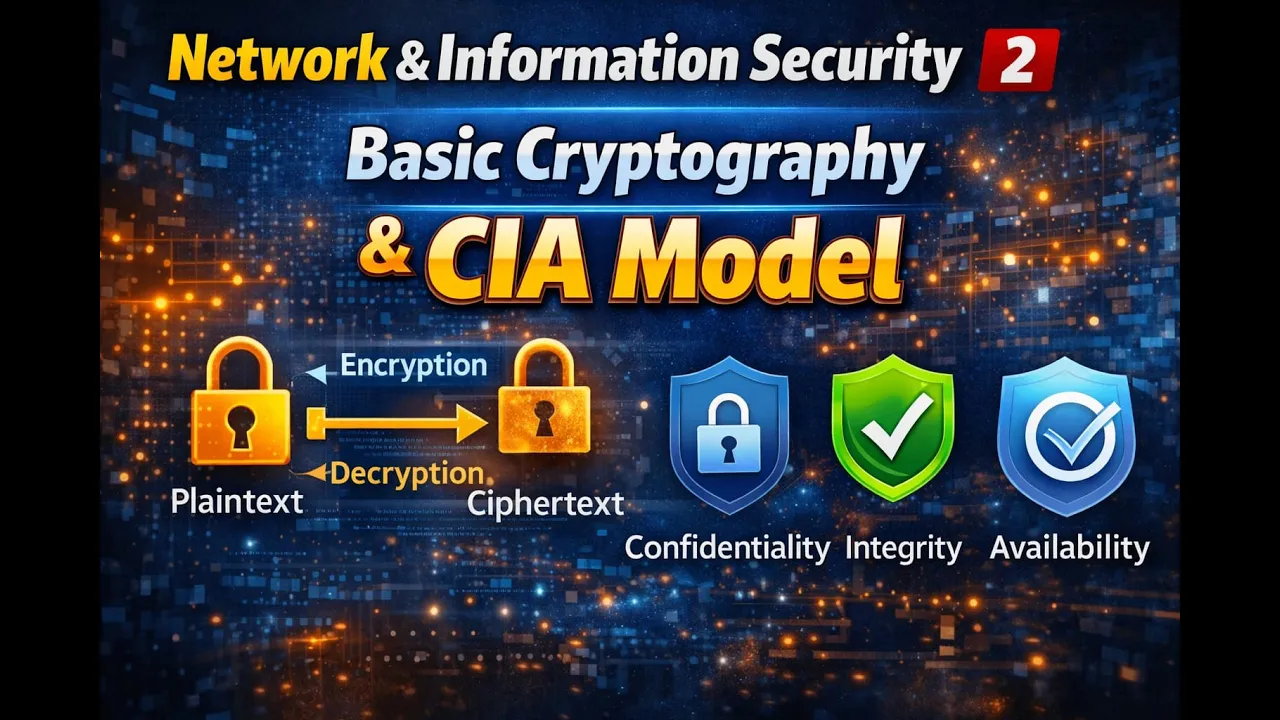
Basic Cryptography Terminology | Network & Information Security | Lecture 2
221
Cryptography is the science of transforming readable plaintext into unreadable ciphertext to protect information. The process involves four key components: plaintext (original readable data), ciphertext (encrypted unreadable output), ciphers (mathematical algorithms for transformation), and keys (secret values controlling encryption/decryption). Encryption converts plaintext to ciphertext, while decryption reverses this process using the correct key. Practical applications include end-to-end messaging apps like WhatsApp, where plaintext messages are systematically converted to ciphertext before transmission, ensuring that only intended recipients with the proper decryption keys can access the original content.
Click to watch →

CISSP Cryptographic Algorithms - Domain 3 Security Architecture & Engineering | Urdu | Hindi |
107
In cryptography, plaintext refers to readable text or data in its original form. Ciphertext is the transformed version of plaintext that appears unreadable. Encryption is the process of converting plaintext into ciphertext to protect information. Decryption is the reverse process of converting ciphertext back to its original plaintext form. These fundamental concepts form the basis of all cryptographic systems.
Click to watch →

blockchain - unit 1- Mathematical Foundation For Blockchain
346
The basic terminologies of cryptography include: (1) Plain text - the original message that is human readable or the data that needs protection, (2) Cipher text - a scrambled or unreadable message after encryption, (3) Encryption - the process of converting plain text into cipher text using algorithms and key, (4) Decryption - the reverse process of encryption where cipher text is converted back to original text, (5) Key - a secret key (number or string) used in encryption and decryption process.
Click to watch →

13 정보보안 일반(암호학)
13K
In cryptography, 'plaintext' (평문) refers to readable, unencrypted data that can be understood by humans. 'Ciphertext' (암호문) is the encrypted form of plaintext that appears as random characters. The process of converting plaintext to ciphertext is called 'encryption' (암호화), while converting ciphertext back to plaintext is called 'decryption' (복호화). These fundamental concepts form the basis of all cryptographic systems.
Click to watch →
Deep Dive
The general concept of a 'key' in computer science and how it is used to lock and unlock data.

Cryptography Tutorial For Beginners | Cybersecurity Training | Edureka | Cybersecurity Live - 2
10K
A key in cryptography is a critical component used to lock and unlock encrypted data. Similar to a physical key for a door, a cryptographic key can consist of numbers, characters, or alphanumeric combinations. The key determines how the encryption algorithm transforms plain text into cipher text and vice versa during decryption.
Click to watch →

Types of Cryptography Algorithms | Cryptography in Network Security | Edureka | Cybersecurity Live-2
13.5K
A key in cryptography is similar to a password or lock mechanism—it is used to lock (encrypt) and unlock (decrypt) data. The key can consist of numbers, characters, or alphanumeric combinations. The security of encrypted data depends heavily on keeping the key confidential.
Click to watch →

Encryption, Hashing & Threat Defense Teams
135
Encryption requires a key to lock and unlock data, similar to a physical lock on a storage box. The key is essential for both encrypting (locking) and decrypting (unlocking) the data. Without the correct key, the encrypted data remains unreadable and inaccessible.
Click to watch →

The System Unit
405
The key lock is used to enable or disable data input to the computer. When the key lock is in off mode, the system cannot accept data. For the system to accept data, the key lock must be turned on. This provides a physical security mechanism to prevent accidental key presses.
Click to watch →
أمن المعلومات / مقدمة في علم التشفير (Cryptography)/ الجزء 1
18.1K
The key is a specific value used by the cryptographic algorithm to encrypt or decrypt messages. It is the most critical and sensitive component of cryptography, as it must be kept secret and known only to the sender and receiver. The key acts like a lock mechanism - without the correct key, the data cannot be accessed or decrypted.
Click to watch →
Deep Dive
The fundamental goals of information security, specifically confidentiality and data integrity.

What is ISO 27001? Simple explanation with examples
414.1K
The three main goals of information security are confidentiality, integrity, and availability. Confidentiality ensures that only authorized parties know about sensitive information (e.g., only the bank and government bodies should know about your savings account). Integrity ensures data accuracy and prevents unauthorized changes (e.g., the bank must calculate savings and interest correctly). Availability ensures that information is accessible when needed (e.g., bank systems must be online when you need to access your account).
Click to watch →

Schutzziele in der Informationssicherheit - Vertraulichkeit, Integrität, Verfügbarkeit und mehr
14K
Security is a relative concept that varies by context. In IT, security is decomposed into specific protection goals (IT Schutzziele) for systematic verification. The three classical goals are Confidentiality, Integrity, and Availability. Additional goals include Authenticity, Accountability, Data Protection, and Anonymity. Authenticity verifies the credibility of subjects through unique identities and characteristic properties, serving as an overarching goal. Authentication methods include possession (chip cards), knowledge (passwords), and biometrics (fingerprints), with hybrid approaches combining multiple criteria.
Click to watch →

RESOLUÇÃO DE PROVA | FUNDATEC | INFORMÁTICA
10.2K
The CIA Triad consists of three fundamental principles of information security: Confidentiality (garante que dados só sejam acessíveis por quem tem direito), Integrity (garante que dados estejam completos, íntegros e não adulterados), and Availability (garante que dados estejam disponíveis para quem tem direito). A fourth principle, Authenticity (autenticidade), ensures that information is genuine and comes from a verified source. These principles form the foundation of information security frameworks.
Click to watch →

#Aula 01 - Introdução a CiberSegurança
43.4K
The CIA Triad is the foundation of information security. Confidentiality determines who should have access to data and establishes appropriate access levels. Integrity ensures data remains unchanged and accurate, both at rest (stored on disks) and in transit (being transferred). Tools like encryption and access control mechanisms help maintain these security properties.
Click to watch →

Security fundamentals: how networks stay protected?
14K
Assets requiring protection include hardware (computers, servers), software (applications, operating systems), and data (personal information, financial records, intellectual property), with data often being most valuable. The primary security goals are confidentiality (information accessible only to authorized users), integrity (data accurate and unaltered), and availability (systems accessible when needed). Services achieve these goals: access control regulates who accesses resources and what actions they perform; authentication verifies user identity; non-repudiation ensures actions cannot be denied after occurrence. Computer security is defined as protection preserving confidentiality, integrity, and availability of hardware, software, data, and communication systems from unauthorized access, misuse, and damage.
Click to watch →
Deep Dive
An understanding of how data is transmitted over networks and the potential risks of interception.

Learn about plain text, encryption, decryption, and ciphers | HTTP, TCP/IP, | online security
104
When data travels over the internet, it passes through multiple devices including routers and ISPs. Attackers can intercept these packets and modify them before forwarding. Plain text data is especially vulnerable because anyone who intercepts it can read and change the message. Hotspots pose particular risks because all data passes through the provider's device, allowing them to monitor and potentially steal sensitive information like passwords and personal data.
Click to watch →

Data Interception and Public Key Encryption - Information Security Lesson #9 of 12
28.9K
Data interception represents a fundamental network security threat where malicious parties capture or manipulate messages during transmission. The vulnerability stems from the very purpose of computer networks—to enable information flow between nodes—which inherently exposes data to interception. Security personnel must protect both confidentiality (preventing unauthorized access) and integrity (preventing unauthorized modification). Transmission medium significantly impacts security: wired networks require physical access for interception, while wireless methods expose data more readily. Two primary vulnerabilities exist: lack of privacy (messages received by unintended recipients) and lack of authentication (messages delivered to wrong recipients). Wiretapping manifests as passive eavesdropping (capturing metadata) or active modification (fabricating/falsifying messages). Confidentiality threats include misdelivery, message exposure at network links, and traffic flow analysis revealing communication patterns. Integrity threats manifest through falsification, modification, and noise/interference. Encryption serves as the primary defense mechanism, with link encryption protecting messages during transit over each link using network hardware, and end-to-end encryption protecting messages throughout the entire journey using software at the highest network protocol layer.
Click to watch →

KoChaiwat: Basic Network Part 1
47.1K
Without proper security measures, data transmitted over networks can be intercepted by unauthorized parties. Attackers can physically tap into network cables to read data passing through them. This is why encryption is essential for protecting sensitive information during network transmission.
Click to watch →

O-level (2210) | IGCSE (0478) | Computer Science | Ch#3 | Cyber Security
189
Data interception is a form of data theft where attackers tap into private networks (wired or wireless) to capture transmitted data. Attackers use packet sniffers—software or hardware that sits within a network to monitor all data packets passing through it. The sniffer examines data packets, decodes them to understand what information is being sent and received, then sends the intercepted data back to the attacker. Wireless data interception, called war driving, uses a laptop, smartphone, antenna, GPS device, and specialized software to monitor wireless communications. Attackers can identify which devices are communicating and what data is being exchanged. To protect wireless networks, WEP (Wired Equivalent Privacy) encryption protocol encrypts data sent over wireless networks. Firewalls monitor and control incoming and outgoing network traffic based on predetermined security rules. A Denial of Service (DoS) attack prevents legitimate users from accessing a network or server by overwhelming it with malicious requests. The attacker sends a massive amount of useless data to the server, consuming its processing capacity and making it unable to respond to legitimate users.
Click to watch →

Man in the Middle Attacks & Superfish - Computerphile
1.1M
ARP spoofing is a technique where an attacker connects to an open Wi-Fi network and announces themselves as the router. Since networks are built on trust, computers automatically send all their packets to this fake router first, allowing the attacker to intercept and read all traffic passing through the network. This was particularly dangerous 10-15 years ago when most data was transmitted in plain text, enabling attackers to easily capture passwords and sensitive information.
Click to watch →
Prerequisite Knowledge
- Concept 01Basic terminology of cryptography, including concepts like plaintext, ciphertext, encryption, and decryption.
- Concept 02The general concept of a 'key' in computer science and how it is used to lock and unlock data.
- Concept 03The fundamental goals of information security, specifically confidentiality and data integrity.
- Concept 04An understanding of how data is transmitted over networks and the potential risks of interception.
Subsequent Learning
- Step 01Real-world implementations of hybrid encryption, such as the SSL/TLS handshake used to secure HTTPS traffic.
- Step 02Specific cryptographic algorithms of each type, such as AES (symmetric) versus RSA and Elliptic Curve Cryptography (asymmetric).
- Step 03The concept of Public Key Infrastructure (PKI), including Digital Certificates and Certificate Authorities (CAs).
- Step 04How asymmetric key pairs enable digital signatures to ensure message authenticity and non-repudiation.
- Step 05Key management challenges, such as secure key exchange protocols (e.g., Diffie-Hellman) and key storage.
Key Difference
Asymmetric Model
Dual Key Security
Key Difference
0:00Playing Section
- 1
Symmetric encryption uses one shared key for both encrypting and decrypting messages.
- 2
This single key is held by both the client and server involved in communication.
- 3
Operation mirrors a house safe accessible with one key by any household member.
The Post-Quantum Vulnerability Shift
While traditional guides present symmetric and asymmetric encryption as complementary options with stable trade-offs, the advent of quantum computing introduces a critical vulnerability that disrupts this balance. Shor’s algorithm can easily break almost all widely used asymmetric algorithms (like RSA and ECC) by solving prime factorization and discrete logarithms in polynomial time. Conversely, symmetric encryption (like AES-256) remains highly resilient against quantum attacks, requiring only larger key sizes to maintain security under Grover's algorithm. This looming paradigm shift—often addressed through Post-Quantum Cryptography (PQC)—reveals that the convenient key-sharing advantages of asymmetric encryption are fundamentally fragile. For students, this reframes the 'symmetric vs. asymmetric' debate from a simple choice of utility to an urgent discussion about long-term cryptographic survival.
Deep Dive
Real-world implementations of hybrid encryption, such as the SSL/TLS handshake used to secure HTTPS traffic.

CISSP Live Questions and Answer Session and Asymmetric Encryption - May 18, 2022 6PM EST
3.4K
Hybrid encryption works through a specific process: (1) Sender generates a random symmetric session key; (2) Sender encrypts actual data with this symmetric key; (3) Sender encrypts the symmetric key with the receiver's public key; (4) Both encrypted data and encrypted symmetric key are sent; (5) Receiver decrypts the symmetric key using their private key; (6) Receiver uses the decrypted symmetric key to decrypt the data. This is the basis of TLS/SSL protocols used in HTTPS web communications. The receiver uses their private key to decrypt the symmetric key, then uses that symmetric key to decrypt the actual data.
Click to watch →

SSL Man in the MIddle Attack using SSL Strip - Part 1
101.4K
The SSL/TLS handshake establishes secure communication through a hybrid encryption process. The client initiates with a request, and the server responds by sending its SSL certificate containing the public key. The client generates a secret pre-shared key (e.g., '1234'), encrypts it with the server's public key, and transmits it securely. The server decrypts using its private key, establishing shared secret knowledge. This creates an encrypted tunnel using symmetric encryption, combining asymmetric (public/private key) and symmetric cryptography—hence the term 'hybrid encryption.' This mechanism transitions websites from HTTP (clear text) to HTTPS (encrypted tunnel), providing the security users expect when logging into banks or email services.
Click to watch →

社会人なら抑えておきたいIT用語20個をピックアップ。
22.6K
Hybrid encryption is widely used in modern secure communications, particularly in HTTPS (HyperText Transfer Protocol Secure) - the secure version of HTTP used for secure web browsing. In HTTPS: (1) The client and server perform a handshake to establish a secure connection; (2) The server sends its public key to the client; (3) The client generates a random symmetric key and encrypts it with the server's public key; (4) The client encrypts the actual data with the symmetric key; (5) The server decrypts the symmetric key with its private key, then decrypts the data. This ensures both confidentiality (through symmetric encryption) and secure key exchange (through asymmetric encryption).
Click to watch →

Шифрование, основы, как работает https, готовимся к собесу (Криптография для чайников, часть 1)
28.3K
Modern HTTPS uses a hybrid approach combining symmetric and asymmetric encryption for optimal security and performance. The process: (1) Server presents its SSL/TLS certificate with public key, (2) Browser generates a random symmetric key, (3) Browser encrypts this symmetric key with the server's public key and sends it, (4) Server decrypts it with its private key, (5) Both parties use the symmetric key for fast, secure communication. This hybrid approach leverages asymmetric encryption's security for key exchange and symmetric encryption's speed for data transmission.
Click to watch →

Как работает шифрование в HTTPS (SSL и TLS)
31.8K
HTTPS использует комбинированное шифрование: сначала асимметричное (через SSL-сертификат с публичным/приватным ключами) для безопасной передачи сеансового ключа, затем симметричное с этим ключом для быстрой шифровки данных, что обеспечивает безопасность передачи логина, пароля и других чувствительных данных.
Click to watch →
Deep Dive
Specific cryptographic algorithms of each type, such as AES (symmetric) versus RSA and Elliptic Curve Cryptography (asymmetric).
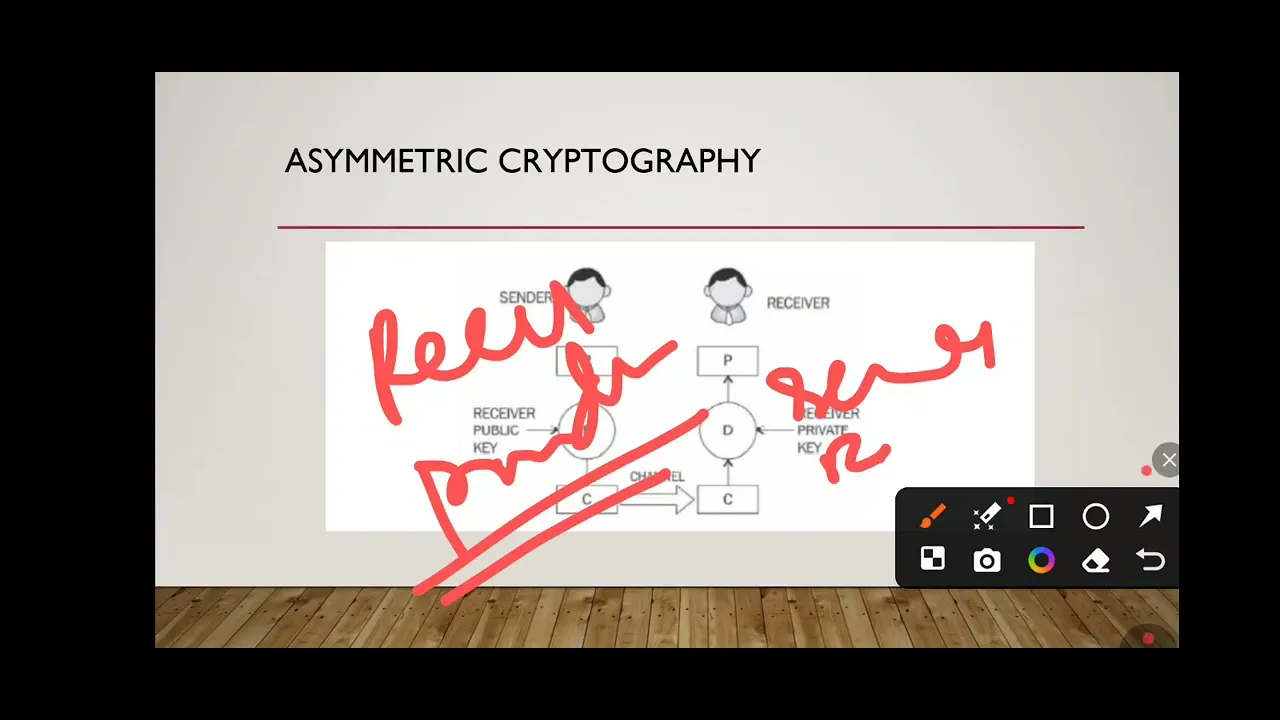
AES, RSA-Blockchain Module 1
103
This video explains two fundamental cryptographic algorithms: AES (Advanced Encryption Standard), a symmetric encryption algorithm that uses the same key for encryption and decryption with 128-bit plaintext and keys of 128, 192, or 256 bits, involving 10-14 rounds of operations including SubBytes, ShiftRows, MixColumns, and AddRoundKey; and RSA, an asymmetric encryption algorithm based on integer factorization that uses public and private key pairs for encryption and decryption, where the public key (n, e) encrypts messages and the private key (n, d) decrypts them, with key generation involving selecting two large primes p and q, computing n = p×q, φ(n) = (p-1)(q-1), choosing e such that gcd(e, φ(n)) = 1, and finding d such that (d×e) mod φ(n) = 1.
Click to watch →
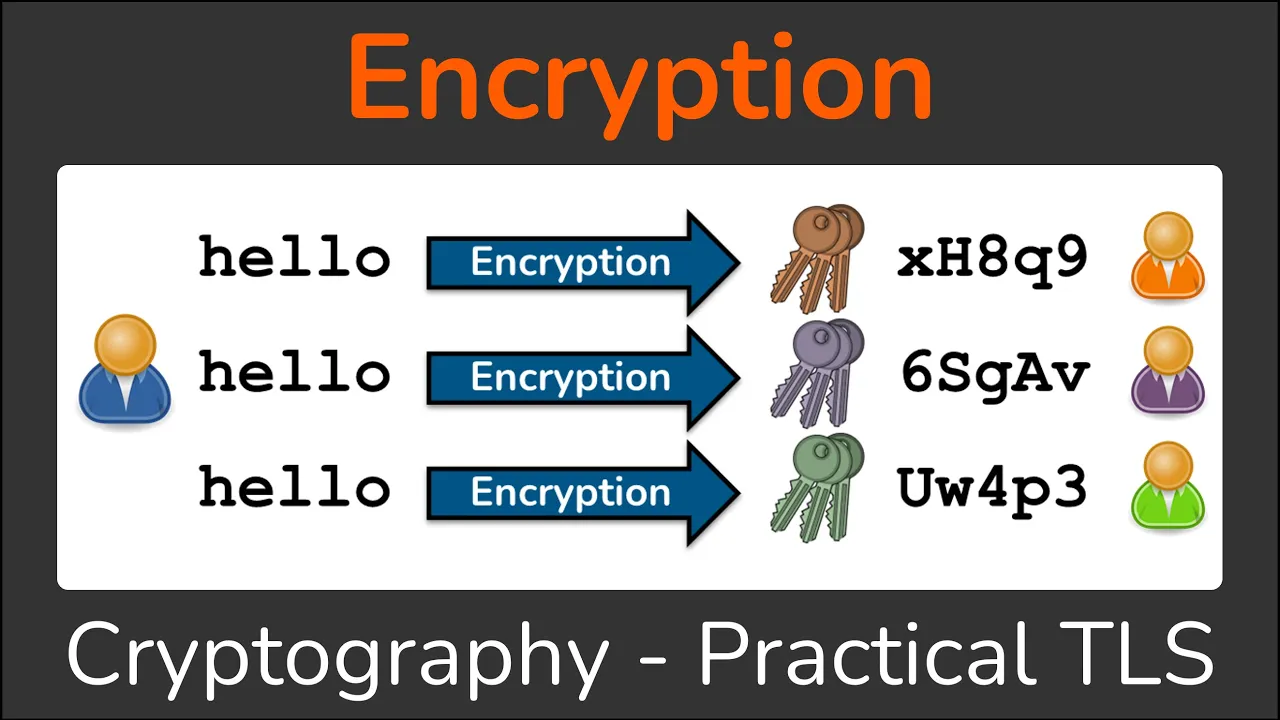
Encryption - Symmetric Encryption vs Asymmetric Encryption - Cryptography - Practical TLS
218.9K
Asymmetric encryption algorithms include DSA, RSA, Diffie-Hellman, elliptic curve DSA, and elliptic curve Diffie-Hellman. These algorithms involve public keys and private keys and are more computationally intensive. Symmetric encryption algorithms include AES, ChaCha20, Triple DES, and RC4. Note that DES and RC4 are considered completely insecure by modern standards. Larger key sizes generally provide greater security, though this isn't always directly proportional.
Click to watch →

Aulão de Criptografia (direto ao ponto)
3.8K
Cryptography algorithms are divided into reversible (encryption/decryption) and irreversible (one-way hashing) families. Reversible algorithms use either symmetric keys (single key for encryption/decryption) or asymmetric keys (public key for encryption, private key for decryption). AES (Advanced Encryption Standard) is the most widely used symmetric algorithm, with 2021 recommendations of 256-bit keys. RSA is the most famous asymmetric algorithm, with 2048-bit keys recommended. Symmetric algorithms offer excellent performance but have a central key vulnerability. Asymmetric algorithms provide better security for distributed systems but are slower. Hybrid approaches like TLS/SSL combine both: asymmetric algorithms secure initial key exchange, while symmetric algorithms handle bulk data encryption for performance.
Click to watch →
Trzy algorytmy, które musisz znać
3.9K
Cryptography protects three key aspects: confidentiality (keeping data secret), integrity (preventing unauthorized modification), and authentication (verifying communication partners). AES is a symmetric encryption algorithm using the same key for encryption and decryption, with key lengths of 128, 192, or 256 bits, dividing data into 128-bit blocks and applying mathematical operations called rounds for high-speed data protection. RSA is an asymmetric algorithm using public and private key pairs based on the mathematical difficulty of factoring large numbers, enabling secure key exchange and digital signatures but being slower than symmetric methods. SHA-256 is a hash function that generates unique 256-bit fingerprints from any input through deterministic mathematical operations, providing data integrity verification through the avalanche effect where even minimal input changes produce completely different outputs. These three algorithms commonly work together in protocols like HTTPS, where RSA establishes secure channels, AES encrypts data transmission, and SHA ensures data integrity.
Click to watch →

정보처리기사 필기 2021년 3회 - 정보시스템 구축 관리
11.1K
Encryption algorithms are categorized into symmetric and asymmetric types. Symmetric encryption uses the same key for both encryption and decryption, with examples including stream ciphers (like RC4, LFSR) and block ciphers (like DES, AES, IDEA, Twofish). Asymmetric encryption uses a pair of keys: a public key for encryption and a private key for decryption. RSA is the most widely used asymmetric algorithm, based on the mathematical difficulty of factoring large numbers into their prime factors. Other asymmetric algorithms include ElGamal (based on discrete logarithm difficulty) and ECC (Elliptic Curve Cryptography, based on elliptic curve point multiplication difficulty).
Click to watch →
Deep Dive
The concept of Public Key Infrastructure (PKI), including Digital Certificates and Certificate Authorities (CAs).

010 Public Key Infrastructure
269
Digital certificates are electronic documents that verify the ownership of public keys, solving the problem of asymmetric algorithm attacks where attackers can spoof identities. Public Key Infrastructure (PKI) is the framework that maps digital certificates with public keys, stores them in centralized databases, and manages revocation. PKI consists of three components: Certificate Authorities (CAs) as trusted third parties that verify and issue certificates, digital certificates themselves signed with the CA's private key, and applicants who request certificates. The CA's private key signing ensures that any attempt to spoof an identity will be detected, as the certificate will not match the claimed owner.
Click to watch →
Public Key Infrastructure - SY0-601 CompTIA Security+ : 3.9
113.5K
Public Key Infrastructure (PKI) manages every aspect of digital certificates including policies, hardware, software, and the complete lifecycle from creation through revocation. The Certificate Authority (CA) serves as the central trust point, creating and signing certificates that establish organizational trust. PKI administrators handle key creation with specific cryptographic strengths, certificate generation, secure distribution, storage, and revocation management. Digital certificates combine public keys with digital signatures from trusted authorities. Organizations can choose between centralized CA models with commercial trusted authorities or decentralized web-of-trust models where users vouch for each other. Commercial CAs provide certificates trusted by major browsers and operating systems, while internal CAs offer cost-effective solutions for organizations with in-house infrastructure needs.
Click to watch →

Tech Talk: What is Public Key Infrastructure (PKI)?
210.4K
Public Key Infrastructure (PKI) is a cryptographic system that uses asymmetric cryptography, involving a pair of mathematically related keys—one public key that can be freely shared and one private key that must be kept secret—to solve the key distribution problem in symmetric encryption; PKI works through digital certificates issued by trusted Certificate Authorities (CAs), which bind a public key to an entity's identity and use digital signatures (created by hashing certificate data and encrypting it with the CA's private key) to establish a chain of trust, enabling secure communication over untrusted networks like the internet.
Click to watch →
What is PKI? Public Key Infrastructure
12.4K
PKI is a system that manages public key cryptography through interconnected entities including Registration Authorities (which verify entity identities and certificate information) and Certificate Authorities (which issue, revoke, and manage digital certificates), enabling secure communication by allowing parties to verify each other's public keys via digitally signed certificates that contain the holder's public key, identity information, and expiration details, following the X.509 version 3 standard.
Click to watch →

20201211 DARMAJAYA kuliah Cyber Security: Data Enkripsi
11.1K
Public Key Infrastructure (PKI) manages digital certificates and public keys. Each user has a public key (shared openly) and private key (kept secret). Certificate Authorities (CAs) issue certificates verifying identity, containing public keys signed by trusted entities. The trust chain extends from root CAs to intermediate CAs to end entities. Modern internet trust is controlled by browser developers rather than national governments, creating sovereignty concerns. Countries without representation in CA approval processes may lack trusted certificates for their websites.
Click to watch →
Deep Dive
How asymmetric key pairs enable digital signatures to ensure message authenticity and non-repudiation.

1.1 Introduction to Cryptography - Cryptography by Syed @PBA4
2.1K
Asymmetric cryptography uses mathematically linked public-private key pairs where public keys enable encryption or signature verification while private keys enable decryption or signature creation. Digital signatures prove message authenticity and non-repudiation by demonstrating knowledge of the private key without revealing it. The signing process typically involves hashing the message first, then applying the private key to create a signature that verifies against the public key. This enables secure authentication, integrity verification, and irrefutable proof of origin.
Click to watch →

暗号技術入門シリーズ 4/5
685
Digital signatures use asymmetric cryptography where the signer encrypts a message hash with their private key, and verifiers decrypt with the public key. This provides authentication and non-repudiation because only the private key holder could have created the signature. Unlike symmetric authentication where both parties share keys, asymmetric signatures ensure the signer cannot deny sending the message. However, the public key must be verified through certificates to prevent impersonation attacks.
Click to watch →

Criptografía y aplicaciones
488
Asymmetric encryption uses public-private key pairs where messages encrypted with a public key can only be decrypted with the corresponding private key. This solves key distribution problems and enables digital signatures for authentication. When a sender encrypts with their private key, only the holder of that private key could have created it, providing non-repudiation and message authenticity.
Click to watch →

Unit 2.1 Cryptography and Symmetric Key Algorithms (CISSP Chapter 6)
1.4K
Asymmetric keys can provide non-repudiation by using the private key for encryption. If you encrypt with your private key, anyone can decrypt with your public key, but only you could have encrypted it. This proves you sent the message. Combined with digital signatures, asymmetric keys provide confidentiality, integrity, authenticity, and non-repudiation.
Click to watch →

Intro to Cryptography / Ciphers, Encryption, Decryption, Hashing / Security Engineer Training
817
Beyond confidentiality, asymmetric encryption enables digital signatures for integrity, authenticity, and non-repudiation. To sign a message, the sender encrypts a hash of the original message with their private key. Recipients verify the signature by decrypting it with the sender's public key. If decryption succeeds, it proves: (1) the message was not altered in transit (integrity), (2) the sender possesses the private key (authenticity), and (3) the sender cannot deny sending it (non-repudiation). This mechanism underlies secure communications like HTTPS website certificates and email authentication.
Click to watch →
Deep Dive
Key management challenges, such as secure key exchange protocols (e.g., Diffie-Hellman) and key storage.
Symmetric Key and Public Key Encryption
681.2K
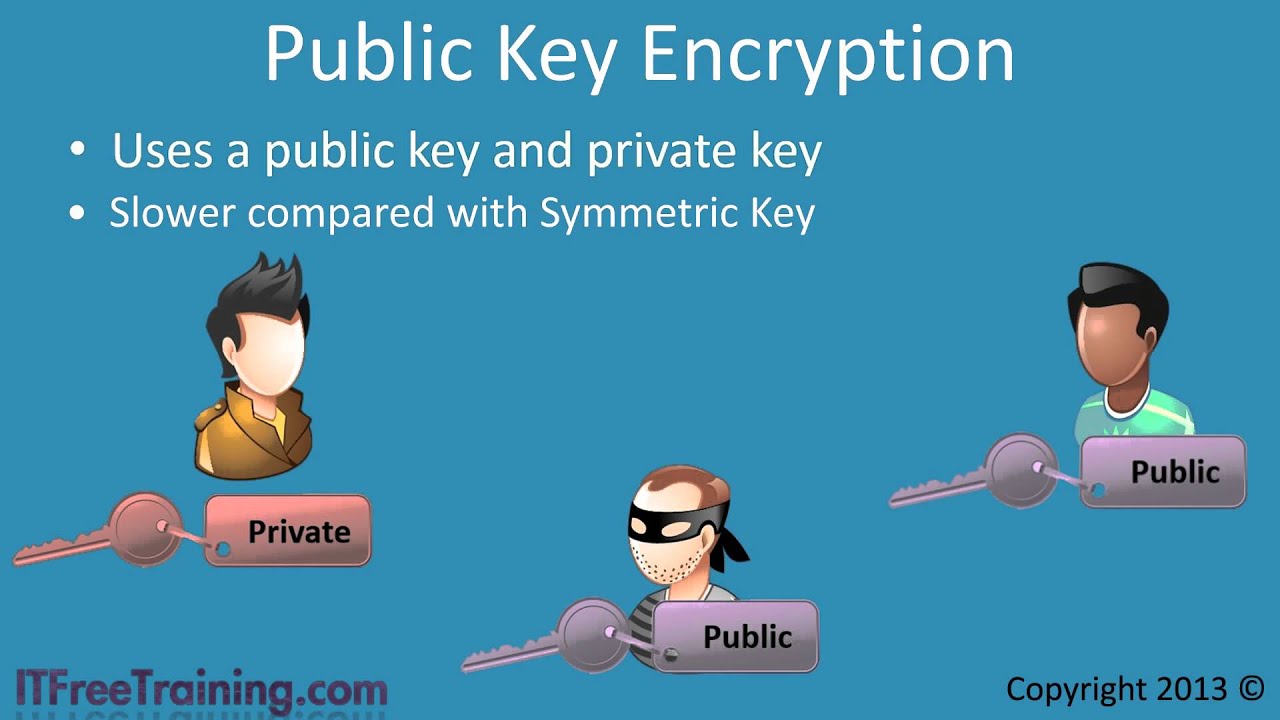
Symmetric encryption faces two major challenges: (1) The key must be stored securely, as attackers who gain access to the key can decrypt all data encrypted with it; (2) A secure channel is required to transfer the key to other parties who need to decrypt the information. Common practice involves transferring keys through telephone conversations.
Click to watch →

Asymmetric Encryptions Part I
201
Key management is critical because keys are the only secrets requiring protection. Main challenges include: (1) Key sharing - distributing keys to authorized users. (2) Key strength - choosing keys that cannot be easily guessed. (3) Key distribution - securely transmitting keys over networks. (4) Key reuse - using the same key multiple times creates vulnerabilities. (5) Key wrapping - securely encrypting keys for transmission. (6) Rekeying - determining when to change keys. Key distribution methods include person-to-person (not practical digitally) and electronic distribution via AAA servers. Challenges include sniffing (interception) and undesired copies (unauthorized duplication).
Click to watch →

Computer System Security (CSS) Unit 5 | Full Explanation | AKTU | Exams | Unique AppSites
24.1K
Key Management Protocol handles secure key distribution for encryption systems, involving key generation, distribution, storage, and change. The protocol is scalable with centralized key management. However, it has significant disadvantages: no built-in support for key compromise detection, vulnerability during key distribution transmission, reduced reliability if keys are stolen, and trust issues with central authorities. If keys are compromised, attackers can decrypt all encrypted data. The main challenge is securely distributing keys without interception, making key management a critical security challenge requiring careful implementation and additional security measures.
Click to watch →

Teleco Renta | Lemnismath | Distribución de claves
10.2K
The Diffie-Hellman key exchange protocol solves the fundamental problem of securely sharing encryption keys between two parties without prior communication, by leveraging mathematical operations that are easy to perform in one direction but extremely difficult to reverse, such as mixing colors (easy) versus separating them back to original colors (hard), or multiplying two large prime numbers (easy) versus factoring their product (hard). This allows two strangers to establish a shared secret key that only they can compute, even if an eavesdropper intercepts all their communications, forming the foundation of modern asymmetric cryptography and secure digital communication.
Click to watch →

Cyber security lecture 6
753
Key management is the process of securely storing, protecting, and managing encryption keys. The main challenges include: ensuring keys are stored securely without being compromised, maintaining key confidentiality, and implementing proper key rotation procedures. If keys are compromised, attackers can decrypt all encrypted data, making key management critical for overall database security.
Click to watch →
Key Difference
Asymmetric Model
Dual Key Security
Key Difference
0:00- 1
Symmetric encryption uses one shared key for both encrypting and decrypting messages.
- 2
This single key is held by both the client and server involved in communication.
- 3
Operation mirrors a house safe accessible with one key by any household member.
The Post-Quantum Vulnerability Shift
While traditional guides present symmetric and asymmetric encryption as complementary options with stable trade-offs, the advent of quantum computing introduces a critical vulnerability that disrupts this balance. Shor’s algorithm can easily break almost all widely used asymmetric algorithms (like RSA and ECC) by solving prime factorization and discrete logarithms in polynomial time. Conversely, symmetric encryption (like AES-256) remains highly resilient against quantum attacks, requiring only larger key sizes to maintain security under Grover's algorithm. This looming paradigm shift—often addressed through Post-Quantum Cryptography (PQC)—reveals that the convenient key-sharing advantages of asymmetric encryption are fundamentally fragile. For students, this reframes the 'symmetric vs. asymmetric' debate from a simple choice of utility to an urgent discussion about long-term cryptographic survival.
Basic terminology of cryptography, including concepts like plaintext, ciphertext, encryption, and decryption.
The general concept of a 'key' in computer science and how it is used to lock and unlock data.
The fundamental goals of information security, specifically confidentiality and data integrity.
An understanding of how data is transmitted over networks and the potential risks of interception.
Real-world implementations of hybrid encryption, such as the SSL/TLS handshake used to secure HTTPS traffic.
Specific cryptographic algorithms of each type, such as AES (symmetric) versus RSA and Elliptic Curve Cryptography (asymmetric).
The concept of Public Key Infrastructure (PKI), including Digital Certificates and Certificate Authorities (CAs).
How asymmetric key pairs enable digital signatures to ensure message authenticity and non-repudiation.
Key management challenges, such as secure key exchange protocols (e.g., Diffie-Hellman) and key storage.
13.5K views757likes0:52@ITkFundeOriginal Release: 2022-03-22
what is the difference between symmetric and asymmetric encryption in symmetric encryption you use one common shared key between the client and the server for encrypting and decrypting the message it is somewhat similar to the safe in your house which can be opened or logged using the same key by anybody in your house whereas asymmetric encryption is somewhat similar to a bank locker wherein you have your key and then you will need the bankers key to open or lock your locker or to access your locker similarly in asymmetric encryption you have two keys the public key is used for encrypting any message and then the server uses the private key to decrypt it it is much more safer than symmetric because the private key is not shared with anyone if you like the content please consider subscribing
Up Next

17:26
HTTP Explained: Requests, Responses, and Status Codes
@FollowAndrew
266.4K views•2019-09-27

87:26
Introduction to Secure Multiparty Computation with Yehuda Lindell
@fhe_org
7.7K views•2021-02-04

4:55
HTTP Requests Explained: GET, POST, PUT, DELETE
@codecademy
103.1K views•2021-10-07

19:25
Enigma Machine Mechanics: WWII Encryption Explained
@JaredOwen
13.2M views•2021-12-11
Related Study Plans & Knowledge Roadmaps
Structured learning paths in Computer Science
computer-science
Container Runtimes: Namespaces, Cgroups & Go
01Linux Systems & Go Programming Foundations
02The Core of Isolation: Chroot and Filesystems
03Linux Namespaces: Process Isolation
+ 3 more learning modules
32h6 modules
Explore Roadmap
computer-science
Building a CHIP-8 Emulator: Rust & CPU Basics
01Computer Architecture Foundations (Bits & Bytes)
02Rust Programming for Systems Development
03CHIP-8 Virtual Hardware Specifications
+ 2 more learning modules
32h5 modules
Explore Roadmap
computer-science
Building BitTorrent: Go, P2P & Concurrency
01Go Fundamentals & Concurrency
02Networking Foundations & P2P Architecture
03Bencode Parsing & Torrent Metadata
+ 3 more learning modules
26h6 modules
Explore Roadmap
computer-science
Actor Models (C++ Concurrency & Lock-Free)
01C++ Multi-Threading Foundations
02Thread Pools and Task Scheduling
03Atomics and Lock-Free Queue Design
+ 3 more learning modules
45h6 modules
Explore Roadmap